
Asia-Pacific Feed Flavors and Sweeteners Market Size and Share
Market Overview
| Study Period | 2021 - 2031 |
|---|---|
| Forecast Data Period | 2026 - 2031 |
| Base Year Market Size (2025) | USD 0.3 Billion |
| Market Size (2026) | USD 0.31 Billion |
| Market Size (2031) | USD 0.35 Billion |
| Growth Rate (2026 - 2031) | 2.46 % |
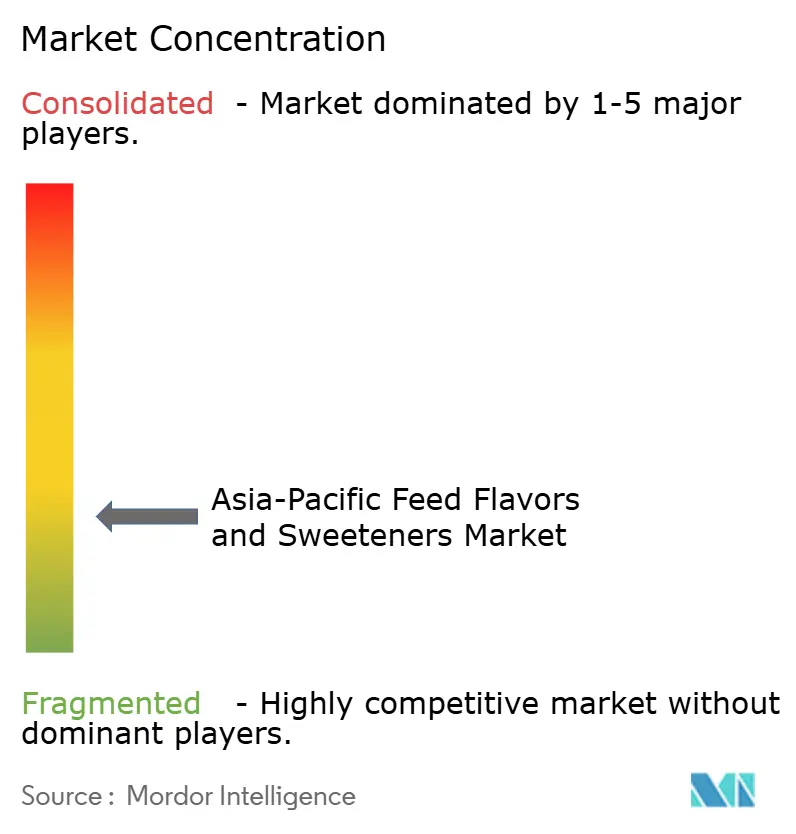
| Market Concentration | Low |
Major Players *Disclaimer: Major Players sorted in no particular order Image © Mordor Intelligence. Reuse requires attribution under CC BY 4.0. | |
Asia-Pacific Feed Flavors and Sweeteners Market Analysis by Mordor Intelligence
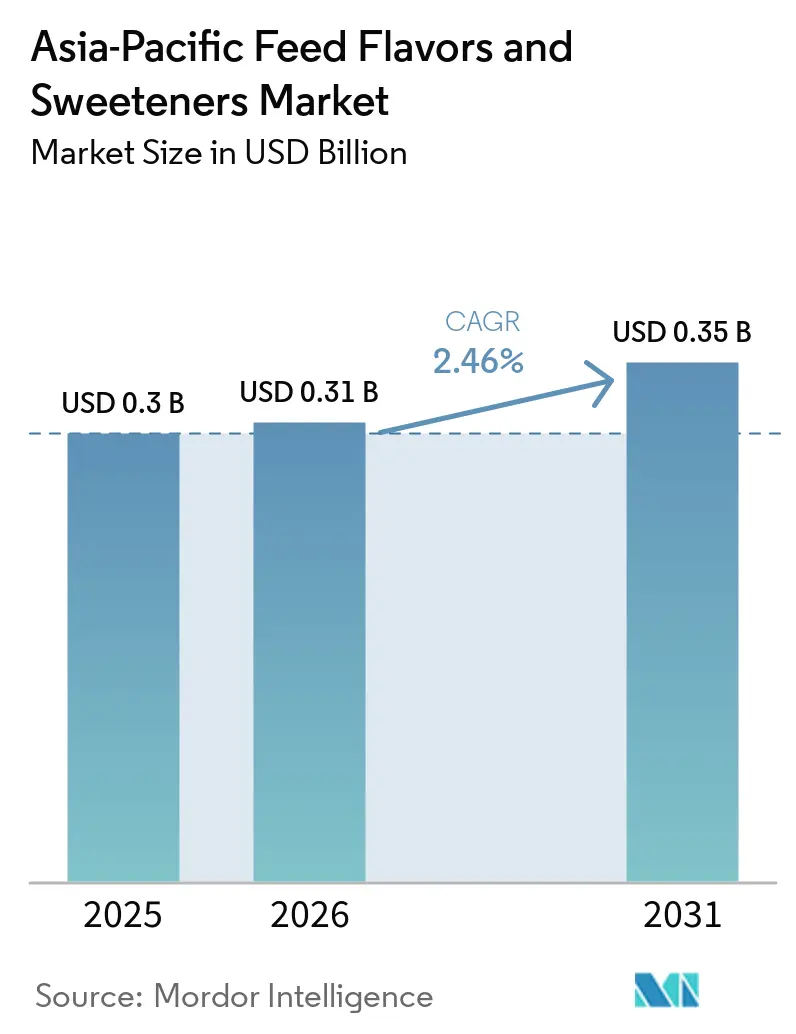
The Asia-Pacific feed flavors and sweeteners market size was valued at USD 0.30 billion in 2025 and is forecast to grow from USD 0.31 billion in 2026 to USD 0.35 billion by 2031, at a CAGR of 2.46% from 2026 to 2031. The market is supported by the region's established commercial feed industry and rising use of palatability-enhancing solutions, including feed flavors and sweeteners, across major livestock-producing markets. Demand for these products is influenced by the expansion of industrial feed production, tighter requirements for consistent feed quality, and the need to maintain feed acceptance when formulations incorporate variable local ingredients. Feed flavors and sweeteners help manufacturers manage undesirable tastes and odors, improve sensory acceptance, and support consistent feed intake across changing formulations. Suppliers are therefore increasingly competing through flavor and sweetener formulation performance, palatability efficacy, safety documentation, processing stability, and localized technical support, rather than flavor profiles alone.
Key Report Takeaways
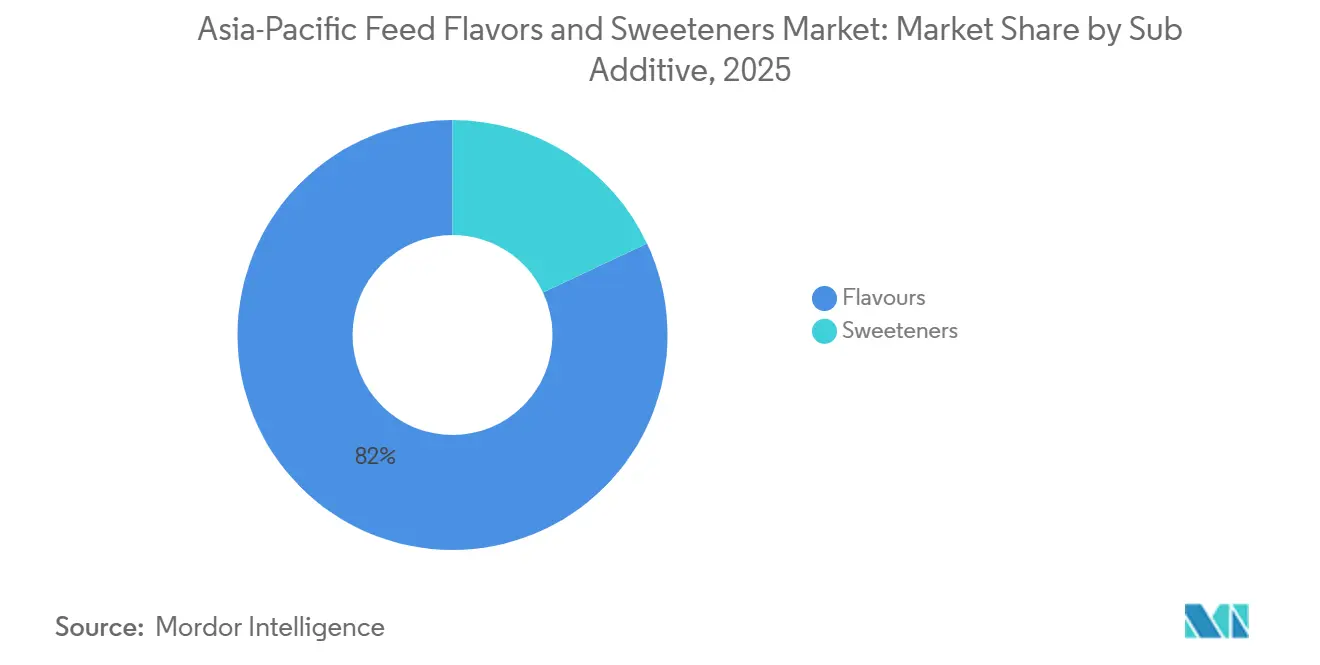
- By sub-additive, flavors accounted for 82.0% of the Asia-Pacific feed flavors and sweeteners market share in 2025, while sweeteners are forecast to be the fastest-growing segment, with a CAGR of 4.3% from 2026 to 2031.
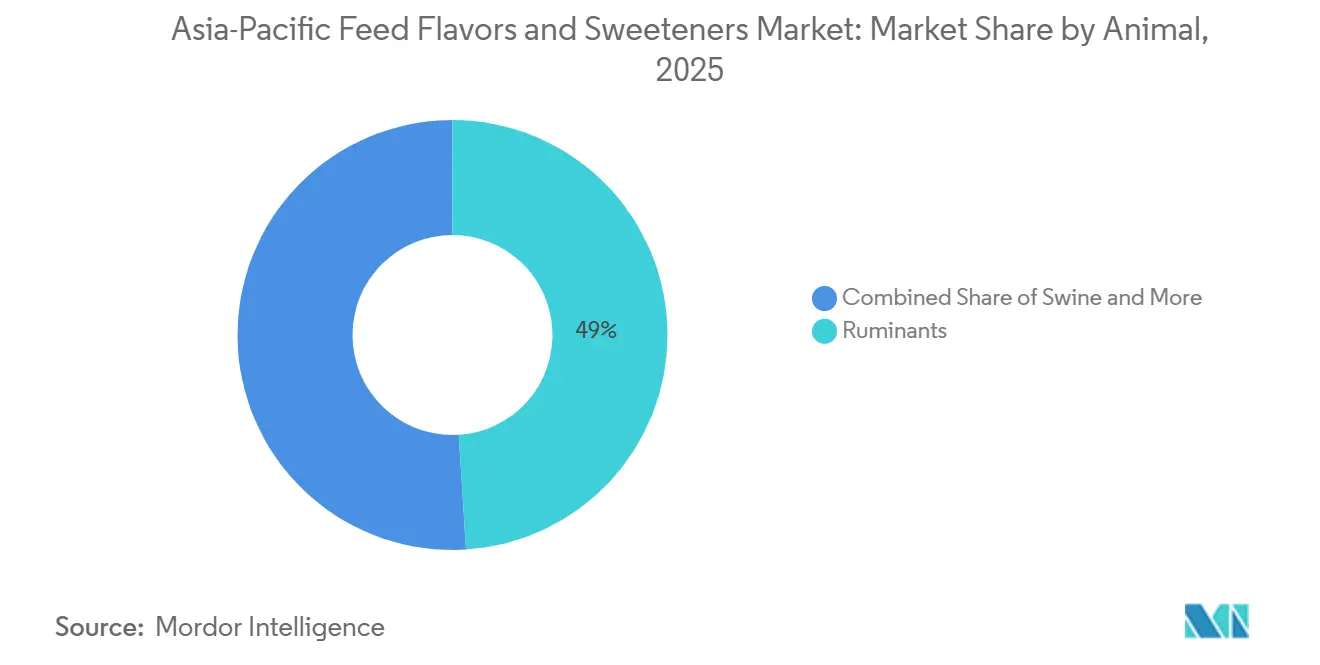
- By animal, ruminants accounted for 49.0% of the Asia-Pacific feed flavors and sweeteners market size in 2025, while swine is forecast to be the fastest-growing animal segment, with a CAGR of 4.3% from 2026 to 2031.
- By geography, China accounted for the largest country share in 2025, at 46.0%, while Vietnam is forecast to be the fastest-growing country segment, with a CAGR of 4.3% from 2026 to 2031.
Note: Market size and forecast figures in this report are generated using Mordor Intelligence’s proprietary estimation framework, updated with the latest available data and insights as of January 2026.
Asia-Pacific Feed Flavors and Sweeteners Market Trends and Insights
Drivers Impact Analysis*
| Driver | (~) % Impact on CAGR Forecast | Geographic Relevance | Impact Timeline |
|---|---|---|---|
| Expansion of compound feed production | +0.6% | China, India, Vietnam, Thailand, Indonesia | Short term (≤ 2 years) |
| Rising demand for palatability-focused feed additives | +0.5% | China, India, Japan, South Korea | Medium term (2-4 years) |
| Growing use of bitter nutrient and medication premixes | +0.3% | China, India, Japan, South Korea, Vietnam | Medium term (2-4 years) |
| Premiumization of livestock feed formulations | +0.4% | China, Japan, South Korea, Australia | Long term (≥ 4 years) |
| Species-specific palatability tuning for alternative protein diets | +0.3% | China, India, Vietnam, Thailand | Medium term (2-4 years) |
| Heat-stress and feed-transition management | +0.3% | India, Indonesia, Philippines, Thailand, Vietnam | Short term (≤ 2 years) |
| Source: Mordor Intelligence | |||
Expansion of Compound Feed Production
The expansion of commercial compound feed production is increasing the addressable customer base for feed flavors and sweeteners in the Asia-Pacific region, as industrial feed mills provide a more consistent channel for the incorporation of palatability additives than on-farm feed mixing. The Food and Agriculture Organisation (FAO) reports that commercial feed mill production accounts for around 65%–70% of domestic demand for compound or formula feeds in the Asian countries covered in its regional assessment, highlighting the established role of commercial feed manufacturing in the region[1]Source: FAO, “Part IV Country Papers,” www.fao.org. As feed production becomes increasingly standardized, additive suppliers can target feed manufacturers rather than individual farms, particularly where formulations need to accommodate changes in ingredients, animal categories, and production conditions. This creates opportunities for suppliers that can provide consistent product quality, formulation support, and reliable supply to large feed mills and integrated livestock producers.
Rising Demand for Palatability-Focused Feed Additives
The Asia-Pacific feed flavors and sweeteners market is supported by rising demand for palatability-focused feed additives that improve feed acceptance and support consistent animal intake. Within this category, flavors and sweeteners are increasingly used to improve sensory acceptance, support intake during diet changes, and offset undesirable tastes or odors associated with variable raw materials. Cassava, rice bran, oilseed meals, and processing by-products can introduce differences in bitterness, odor, and taste across commercial feed batches, increasing the need for palatability-focused additives. This requirement becomes more important as feed manufacturers use locally sourced ingredients to manage formulation costs and supply availability. In Japan and South Korea, tighter feed manufacturing margins and greater emphasis on meat quality further support the use of specialized palatability additives, including flavors and sweeteners, that help maintain feed acceptance without requiring major changes to the underlying formulation. As a result, suppliers increasingly need to demonstrate how their flavor and sweetener solutions improve feed acceptance, enable greater ingredient flexibility, and maintain consistent sensory performance across changing raw material sources. Procurement teams therefore evaluate these products not only for their ability to mask undesirable tastes and odors, but also for sweetness intensity, formulation compatibility, processing stability, and consistency across feed batches.
Premiumization of Livestock Feed Formulations
Premiumization of livestock feed formulations is increasing demand for higher-value, specialized products incorporating additives that support palatability, feed acceptance, and feeding consistency. A 2024 study published in the Journal of Animal Science evaluated sweetener and flavoring additives in newly received feedlot cattle and found that the additives influenced feeding patterns during specific periods of the 56-day trial, although they did not consistently improve overall feed intake or growth performance[2]Source: Journal of Animal Science, “Effects of flavoring additives on feed intake, growth performance, temperament, and markers of immune function for newly received feedlot cattle,” academic.oup.com. These findings indicate that the value of sensory additives extends beyond direct performance gains, particularly where feed manufacturers seek to differentiate formulations through targeted sensory characteristics and specialized nutritional solutions. As manufacturers develop more sophisticated feeds for specific animal species, production stages, and nutritional requirements, premium formulations can incorporate functional ingredients, sensory additives, and alternative feed materials while maintaining palatability and consistent quality. This trend creates opportunities for suppliers offering species-specific additive systems, technical formulation support, and consistent-quality flavor and sweetener solutions to commercial feed manufacturers across Asia-Pacific.
Species-Specific Palatability Tuning for Alternative Protein Diets
Species-specific formulation is becoming increasingly relevant as commercial diets incorporate a wider range of local materials and alternative protein sources. Ruminant, swine, poultry, and aquaculture diets differ in ingredient tolerance, feeding behavior, and sensitivity during transition stages. Flavor systems can address off-odors from rice bran, distillers' dried grains, and fishmeal alternatives when feed manufacturers change recipes. Sweetener systems are useful where weaning, medication, or diet transitions make feed intake particularly sensitive. The Asia-Pacific feed flavors and sweeteners market benefits from solutions designed for specific animal types and clearly defined feed matrices. This technical requirement creates room for regional specialists who understand local ingredients and can adapt products without compromising consistency, accounting for seasonal availability, animal preferences, and processing conditions that alter the sensory profile of a finished diet.
Restraints Impact Analysis*
| Restraint | (~) % Impact on CAGR Forecast | Geographic Relevance | Impact Timeline |
|---|---|---|---|
| Volatility in sugar, molasses, and flavor raw-material prices | -0.4% | India, Indonesia, Thailand, Vietnam | Short term (≤ 2 years) |
| Stringent approval and documentation requirements | -0.3% | China, Japan, Australia, South Korea | Long term (≥ 4 years) |
| Low willingness to pay among smallholder feed buyers | -0.3% | India, Indonesia, Philippines, Vietnam | Medium term (2-4 years) |
| Inconsistent palatability performance across local feed matrices | -0.2% | China, India, Thailand, Vietnam, Indonesia | Medium term (2-4 years) |
| Source: Mordor Intelligence | |||
Volatility in Sugar, Molasses, and Flavor Raw-Material Prices
Sugar and molasses costs are influenced by production cycles, weather events, government biofuel policies, and seasonal supply conditions. The International Sugar Organization reported a global sugar deficit of 5.5 million metric tons for the 2024/25 season[3]Source: Chinimandi, “Season 2024-25: ISO sees larger global sugar deficit of 5.5 million metric tons,” chinimandi.com. In 2025, the Organisation for Economic Co-operation and Development (OECD) and Food and Agriculture Organisation (FAO) projected that real sugar prices will decline over the medium term, although biofuel mandates may cause interim price increases. These fluctuations can raise sweetener system costs and reduce customer pricing predictability. Suppliers with direct sourcing arrangements or longer-term contracts with sugar mills can limit exposure to short-term price changes. This cost advantage tends to favor larger suppliers and may support consolidation among regional formulators that rely on purchased inputs, have limited sourcing alternatives, and cannot readily absorb temporary raw material price movements.
Low Willingness to Pay Among Smallholder Feed Buyers
Smallholder farming limits access to premium additives in parts of India, Indonesia, the Philippines, and Vietnam. Buyers in these channels often focus on direct cost per metric ton of feed and have limited capacity to absorb additional formulation expenses. Product uptake is lower when benefits are not demonstrated through locally relevant farm results. This constraint is most pronounced at smaller regional mills, which operate on tight margins and have limited technical service capacity. Suppliers must demonstrate that a feed conversion ratio (FCR) improvement can offset additive costs under local production conditions. Building this evidence requires consistent farm support across dispersed buyer networks, which can slow expansion in the Asia-Pacific feed flavors and sweeteners market, particularly when suppliers must communicate results to mill operators, distributors, and producers with varying production priorities.
*Our forecasts treat driver/restraint impacts as directional, not additive. The impact forecasts reflect baseline growth, mix effects, and variable interactions.
Segment Analysis
By Sub-Additive: Flavors Lead on Scale; Sweeteners Gain Momentum
Flavors accounted for 82.0% of the Asia-Pacific feed flavors and sweeteners market share in 2025, reflecting their use across multiple livestock species and feeding stages. Flavor systems are used to mask off-odors from local raw materials and by-products. Flavor systems are used to mask or reduce undesirable tastes and odors associated with certain feed ingredients, additives, and processing conditions, helping manufacturers maintain consistent feed acceptance when formulations change. This function becomes increasingly relevant as feed producers adjust ingredient combinations in response to raw-material availability, cost fluctuations, and nutritional requirements. Variations in ingredients such as oilseed meals, cereal by-products, and other processed feed materials can affect the sensory characteristics of finished feed, creating a role for flavor systems in maintaining palatability across batches. Their applicability across different feed formulations gives flavors a broad position in commercial feed programs and allows suppliers to address feed-intake and acceptance challenges across multiple animal categories.
Sweeteners are forecast to expand at a 4.3% CAGR between 2026 and 2031, making them the fastest-growing sub-additive category. Growth in sweeteners within the Asia-Pacific feed flavors and sweeteners market is supported by their use in weaning-stage swine diets, aquaculture formulations, and medicated feed applications where reduced voluntary intake can affect animal performance. High-intensity sweeteners, including saccharin, neotame, and trehalose-based systems, are used to improve feed acceptance at low inclusion rates while maintaining consistent sensory performance during processing and storage. Demand is also shifting toward higher-performance sweetener formulations that combine sweetness intensity with heat stability, formulation compatibility, and consistent palatability across different feed types. This creates opportunities for players to differentiate beyond basic sweetness by offering products tailored to specific animal species, production stages, and processing conditions. As feed manufacturers increasingly optimize formulations for intake, ingredient flexibility, and production efficiency, sweetener suppliers with specialized formulations and technical support can capture greater value within the growing palatability-additives segment.



By Animal: Ruminants Anchor Value While Swine Leads Growth
Ruminants accounted for 49.0% of the Asia-Pacific feed flavors and sweeteners market size in 2025, supported by China's dairy expansion, India's milk sector, and beef cattle feeding in Australia and Southeast Asia. Dairy and beef cattle form the primary ruminant demand base for palatability additives. These products are increasingly used to manage diet transitions and support dry matter intake in high-yielding dairy herds, making palatability a practical component of daily feeding management rather than a discretionary input. Ruminant demand remains linked to the intensity, quality, and scale of commercial feeding systems, as more formal operations can incorporate additives within recurring formulation and procurement cycles.
Swine is forecast to expand at a 4.3% CAGR between 2026 and 2031. African swine fever (ASF) recovery has supported modern feeding programs, stronger biosecurity, and greater attention to intake during weaning. Southeast Asia entered a rebuild-and-export cycle in 2025, with sow herd recovery supporting pork output. Sweeteners and flavors are particularly relevant during early-life feeding stages, when voluntary intake directly affects subsequent growth. Poultry and aquaculture contribute meaningful demand, but their use of specialized additives depends more strongly on demonstrated feed conversion ratio (FCR) improvement at commercial scale and a clear link between the product and farm-level economic outcomes.
Geography Analysis
China held 46.0% of the Asia-Pacific feed flavors and sweeteners market share in 2025. Its scale in commercial livestock production and feed manufacturing supports the country's dominant position. Regulatory compliance requirements also favor additives that can support feed intake without relying on growth-promoting drug feed additives. Japan has lower feed volumes but supports higher-value applications for premium beef production. Flavor systems in Japan are specified for meat-quality targets as well as feed intake, which supports a more specialized demand profile compared to large commodity-feed markets.
Vietnam is forecast to expand at a 4.3% CAGR between 2026 and 2031, making it the fastest-growing country segment. Its swine-focused production structure links local demand to the regional herd rebuilding cycle. India offers a large ruminant-driven opportunity, but its smallholder structure limits per-farm spending. Indonesia and Thailand provide a complementary path for suppliers through poultry and aquaculture production. Industrial feed capacity in these countries makes commercial mill partnerships important for market access, local trials, and routine inclusion of additives in standard feed formulations.
South Korea and Australia are moderate-volume markets with demanding approval and documentation requirements. These conditions favor suppliers with established safety records and registrations across multiple markets. The Philippines is relevant as an integrated poultry and swine production location. Myanmar, Cambodia, Sri Lanka, and other frontier markets currently have low additive use, but the ongoing formalization of compound feed production may create opportunities for the Asia-Pacific feed flavors and sweeteners market as commercial production gradually replaces less standardized on-farm feeding practices.
Competitive Landscape
The Asia-Pacific feed flavors and sweeteners market is moderately fragmented, with the top five companies holding a moderate share in 2025. Cargill, Incorporated, Archer Daniels Midland Company, DSM-Firmenich AG, Adisseo France SAS, and Kemin Industries, Inc. form this group. The remaining supplier base includes regional and local companies such as Guangzhou Tanke Bio-Tech Co., Ltd., Symrise AG, Kerry Group plc, AFB International, Inc., Alltech, Inc., CJ CheilJedang Corporation, Orffa International Holding B.V., Palital Feed Additives B.V., Phytobiotics Futterzusatzstoffe GmbH, and Dr. Eckel Animal Nutrition GmbH & Co. KG. Formulation needs vary by animal type, local raw material, and country. This variation creates space for specialists with detailed knowledge of local feed matrices, including the sensory impact of locally available ingredients and practical milling conditions. As a result, no single supplier can apply one formulation unchanged across every country and livestock production system in the Asia-Pacific feed flavors and sweeteners market.
Leading suppliers in the Asia-Pacific feed flavors and sweeteners market compete through local availability, formulation expertise, technical service, safety documentation, and demonstrated palatability performance. In March 2025, Adisseo began commercial sales from its Specialty Blending Facility in Nanjing, China, strengthening its localized specialty-feed production capabilities. Adisseo also reported strong growth in its palatability business during 2025, supported by products such as Optisweet, a high-intensity feed sweetener, and Delistart, which combines flavorings, appetizing substances, and sweeteners. ADM likewise maintains a regional portfolio of AromSense feed palatants and Sucram high-intensity sweeteners, supporting its position in APAC's feed palatability segment. These developments indicate that competition is increasingly based on the ability to provide consistent flavor and sweetener performance, formulation support, local product availability, and technical evidence, particularly where feed manufacturers require reliable palatability across different species, production stages, and changing raw-material formulations.
Smallholder and small-commercial feed mills remain underserved, as they require practical products at accessible cost. Global suppliers may find it difficult to meet this requirement through premium portfolios alone, while local firms often face constraints in technical support and documentation. Suppliers that combine heat-stable systems with locally relevant performance support may strengthen their position in the Asia-Pacific feed flavors and sweeteners market by addressing the cost, application, and evidence needs of this diverse customer group, including the need to demonstrate value under local raw-material conditions and commercially relevant feeding practices.
Asia-Pacific Feed Flavors and Sweeteners Industry Leaders
Cargill, Incorporated
Archer Daniels Midland Company
DSM-Firmenich AG
Adisseo France SAS (China National BlueStar (Group) Co., Ltd.)
Kemin Industries, Inc.
- *Disclaimer: Major Players sorted in no particular order

Recent Industry Developments
- June 2025: China's Ministry of Agriculture and Rural Affairs registered feed-additive products containing flavoring substances for poultry and swine, including GALLINAT+ and PORCINAT+ from Jefagro Technologies Inc. The registrations demonstrate continued commercialization of specialized flavoring solutions for livestock feed in China and support demand for products designed to improve palatability across species-specific feed formulations.
- March 2025: Adisseo began commercial operations at its Specialties Blending Facility in Nanjing, China, after receiving its production license earlier in the year, strengthening its local specialty feed-additive manufacturing capabilities.


Asia-Pacific Feed Flavors and Sweeteners Market Report Scope
Feed Flavors and Sweeteners are specialty feed additives used to improve the taste, aroma, and palatability of animal feed. They help encourage feed acceptance and consistent consumption across livestock, poultry, aquaculture, and other animal-feed applications.
The Asia-Pacific Feed Flavors and Sweeteners Market Report is Segmented by Sub Additive (Flavors and Sweeteners), by Animal (Ruminants, Swine, and Other Animals), and by Geography (Australia, China, and More). The Market Forecasts are Provided in Terms of Value (USD) and Volume (Metric Tons).
| Flavors |
| Sweeteners |
| Ruminants | Beef Cattle |
| Dairy Cattle | |
| Other Ruminants | |
| Swine | |
| Other Animals |
| Asia-Pacific | Australia |
| China | |
| India | |
| Indonesia | |
| Japan | |
| Philippines | |
| South Korea | |
| Thailand | |
| Vietnam | |
| Rest of Asia-Pacific |
| By Sub-Additive | Flavors | |
| Sweeteners | ||
| By Animal | Ruminants | Beef Cattle |
| Dairy Cattle | ||
| Other Ruminants | ||
| Swine | ||
| Other Animals | ||
| By Geography | Asia-Pacific | Australia |
| China | ||
| India | ||
| Indonesia | ||
| Japan | ||
| Philippines | ||
| South Korea | ||
| Thailand | ||
| Vietnam | ||
| Rest of Asia-Pacific | ||


Key Questions Answered in the Report
What is the Asia-Pacific feed flavors and sweeteners market size?
The Asia-Pacific feed flavors and sweeteners market was valued at USD 0.30 billion in 2025, reached USD 0.31 billion in 2026, and is forecast to reach USD 0.35 billion by 2031.
Which sub-additive leads feed palatability demand in Asia-Pacific?
Flavors led with an 82.0% share in 2025 because they can manage sensory variation across livestock diets and local feed materials.
Which country has the largest regional demand?
China accounted for 46.0% of the market share in 2025, supported by compound feed production and commercial feeding practices.
What is driving the shift away from antibiotic growth promoters in feed?
China’s 2020 feed rule and India’s April 2025 prohibition encourage non-antibiotic approaches that support feed intake and documented compliance.
Page last updated on:





