
Asia-Pacific Built To Rent Residential Market Size and Share
Market Overview
| Study Period | 2020 - 2031 |
|---|---|
| Forecast Data Period | 2026 - 2031 |
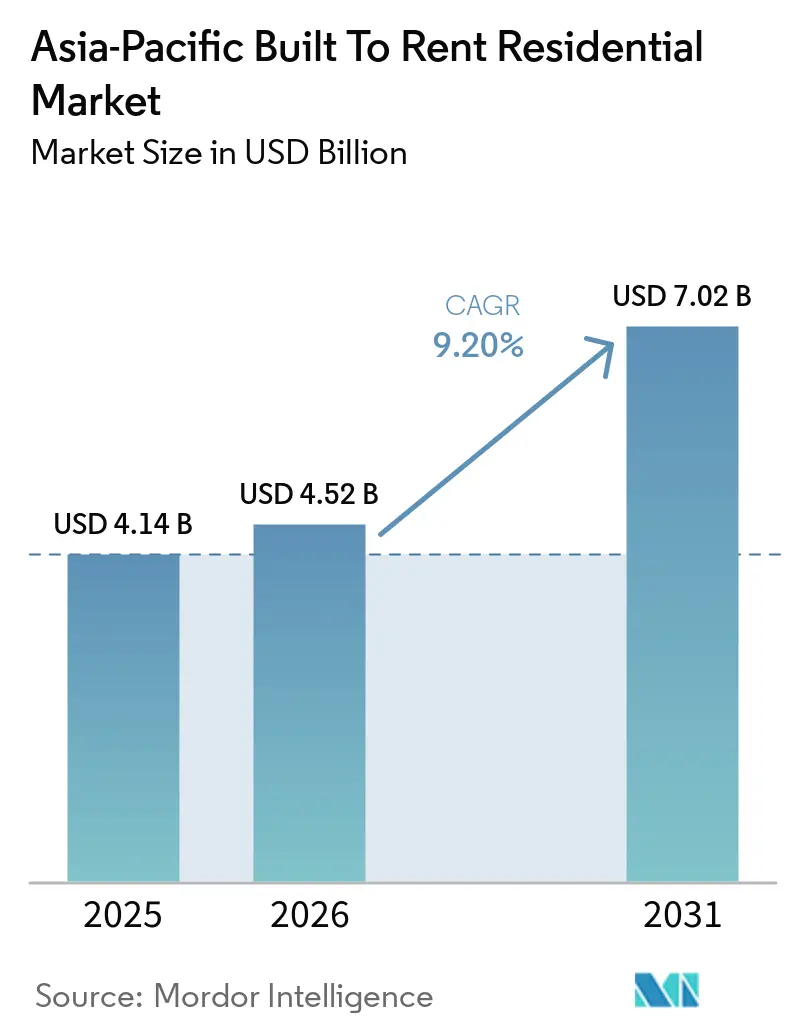
| Base Year Market Size (2025) | USD 4.14 Billion |
| Market Size (2026) | USD 4.52 Billion |
| Market Size (2031) | USD 7.02 Billion |
| Growth Rate (2026 - 2031) | 9.20 % |
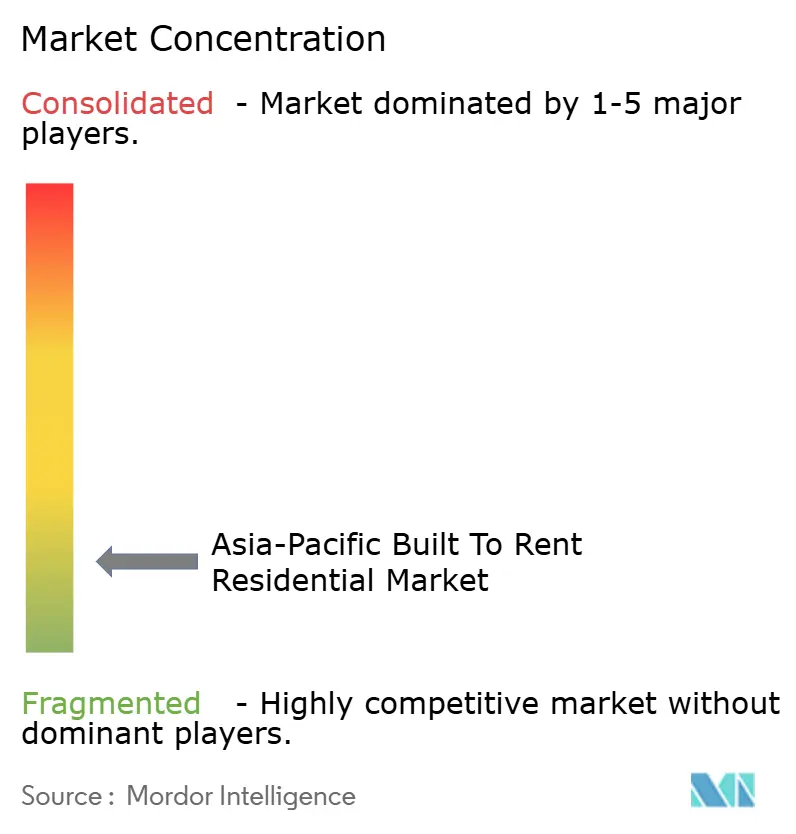
| Market Concentration | Low |
Major Players *Disclaimer: Major Players sorted in no particular order Image © Mordor Intelligence. Reuse requires attribution under CC BY 4.0. | |
Asia-Pacific Built To Rent Residential Market Analysis by Mordor Intelligence
The Asia-Pacific Built To Rent Residential Market size was valued at USD 4.14 billion in 2025 and is estimated to grow from USD 4.52 billion in 2026 to reach USD 7.02 billion by 2031, at a CAGR of 9.20% during the forecast period (2026-2031).
Demand is supported by a shortage of professionally managed rental homes in gateway cities. Housing affordability constraints are keeping more households in rental accommodation for longer periods. Institutional investors are directing more capital toward living assets, while operators are expanding management platforms across several countries. Development conditions remain difficult because construction, financing, planning, and land-tax costs can weaken project feasibility. The Asia-Pacific built to rent residential market therefore favors operators that can control development risk, maintain service quality, and secure long-term capital.
Key Report Takeaways
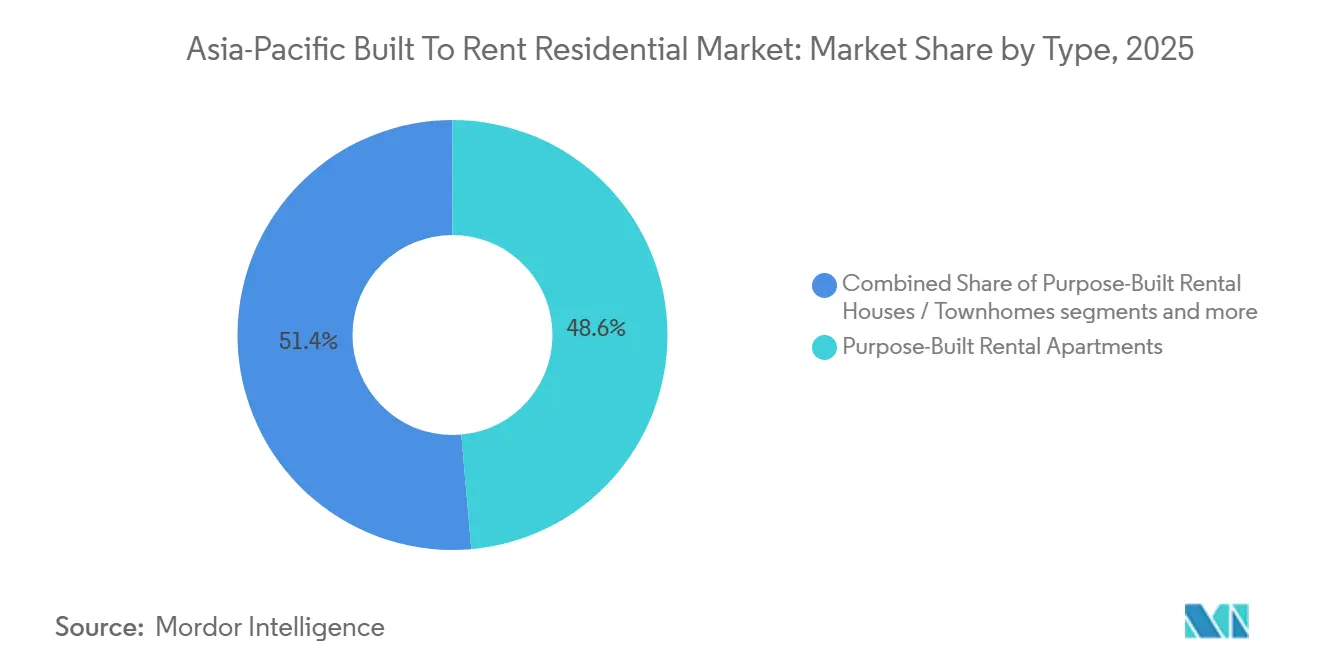
- By type, purpose-built rental apartments held 48.6% of the Asia-Pacific built to rent residential market share in 2025, while single-family built to rent / built to rent communities are forecast to grow at a 10.8% CAGR through 2031.
- By management model, third-party operators held 57.8% of the Asia-Pacific built to rent residential market share in 2025, while hybrid management is forecast to grow at a 10.4% CAGR through 2031.
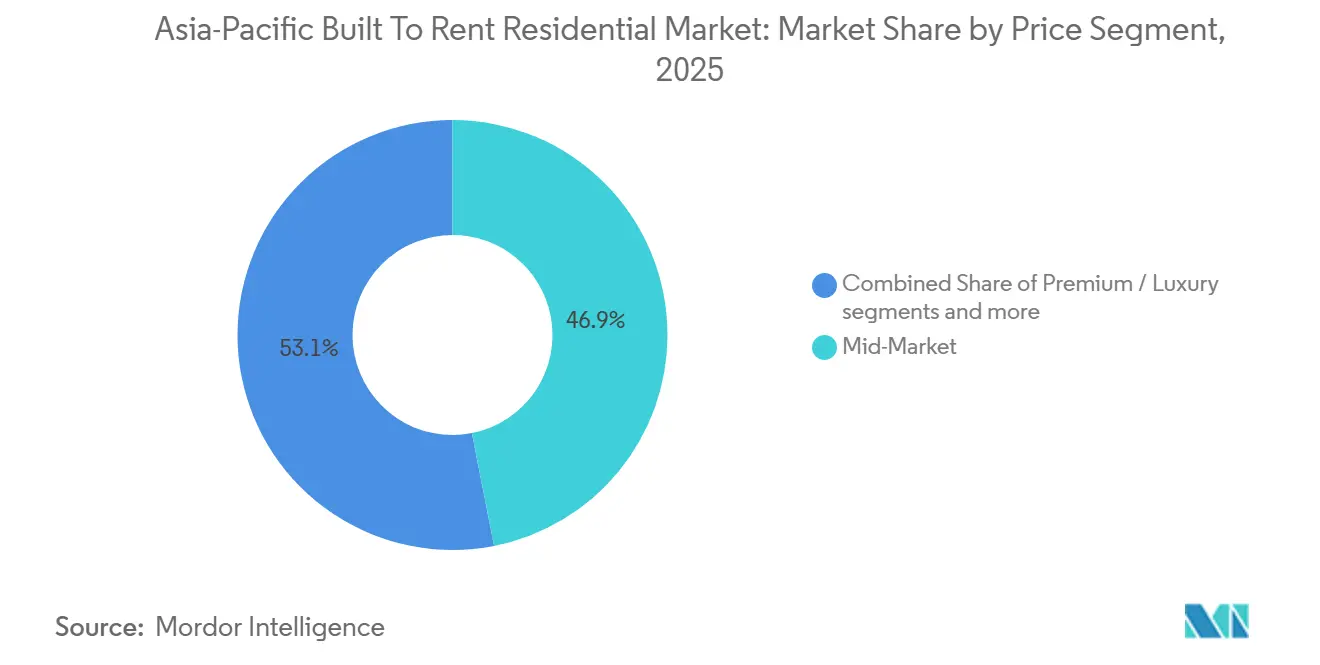
- By price segment, mid-market assets held 46.9% of the Asia-Pacific built to rent residential market size in 2025, while affordable & workforce housing are forecast to grow at an 11.2% CAGR through 2031.
- By geography, China held 34.8% of the Asia-Pacific built to rent residential market share in 2025, while India is forecast to grow at a 12.8% CAGR through 2031.
Note: Market size and forecast figures in this report are generated using Mordor Intelligence’s proprietary estimation framework, updated with the latest available data and insights as of January 2026.
Asia-Pacific Built To Rent Residential Market Trends and Insights
Drivers Impact Analysis*
| Drivers | (~) % Impact on CAGR Forecast | Geographic Relevance | Impact Timeline |
|---|---|---|---|
| Structural Housing Undersupply in Gateway Cities Drives BTR Demand | +2.4% | Asia-Pacific, especially Australia, Japan, South Korea, and Singapore | Short term (≤ 2 years) |
| Rising Homeownership Affordability Barriers Extend Rental Demand | +2.0% | Greater Tokyo, Seoul, Sydney, and Mumbai | Medium term (2-4 years) |
| Institutional Capital Allocation to Living Assets Expands BTR Investment | +1.7% | Australia, Japan, Singapore, and South Korea | Medium term (2-4 years) |
| Migration and Urban Household Formation Increase Rental Demand | +1.3% | Tier-1 and emerging Tier-2 cities across the Asia-Pacific | Long term (≥ 4 years) |
| Platform-Led Rental Management Improves BTR Operating Efficiency | +0.9% | Australia, Japan, Singapore, and South Korea | Medium term (2-4 years) |
| Repositioning Underutilized Assets Expands BTR Supply | +0.7% | Japan, Australia, Hong Kong SAR, and South Korea | Medium term (2-4 years) |
| Source: Mordor Intelligence | |||
Structural Housing Undersupply in Gateway Cities Drives BTR Demand
Gateway cities across the region continue to face a shortfall of professionally managed rental homes. Australia’s rental vacancy rate remained near 1% in 2026, while supply constraints also affected major cities in Japan and South Korea. Tokyo rents for apartments of 30 m² or less reached JPY 114,242 (USD 710) in June 2026, an increase of 12.4% from the prior year, and Fukuoka rents increased 15.9%. The shortage has pushed developers to examine conversions of hotels, offices, and underperforming retail properties. This approach can shorten delivery periods compared with new construction. It also expands the Asia-Pacific built to rent residential market where land availability and development approvals remain constrained.
Rising Homeownership Affordability Barriers Extend Rental Demand
High housing costs are extending the period during which urban households rent. The ULI Asia Pacific 2025 Home Attainability Index found that ownership remained unavailable to most residents in major regional hubs[1]Urban Land Institute, “ULI Asia Pacific Reveals 2025 Home Attainability Index,” Urban Land Magazine, urbanland.uli.org. The report also identified government policy as the main determinant of housing conditions. This makes public-private structures important for increasing formal rental supply. In Australia, amenity-rich built to rent homes achieved a 25% rental premium in 2025 and retained 70% of tenants annually[2]AEW, “Asia Pacific Research Perspective Q1 2025,” AEW, aew.com. The Asia-Pacific built to rent residential market can serve renters who need flexibility, as well as those unable to purchase a home.
Institutional Capital Allocation to Living Assets Expands BTR Investment
Institutional capital is increasing its allocation to living assets across the region. Asia-Pacific living-sector investment reached USD 21 billion in 2025, nearly 3 times the level reported a decade earlier[3]Asia Pacific Real Assets Association, “2026 APAC Living Sector Report,” APREA Knowledge Hub, aprea.asia. The region represented 60% of the global population but received 12% of global living-sector capital in 2025. This difference indicates that investor activity has room to expand where rental platforms and exit routes become more established. In China, market-oriented rental housing became eligible for C-REIT structures in July 2024, improving the potential for capital recycling. The Asia-Pacific built to rent residential market benefits when investors can enter operational assets and recycle capital into new supply.
Migration and Urban Household Formation Increase Rental Demand
Migration and household formation are increasing the demand for formal rental accommodation. Australia recorded a net overseas migration of 375,000 people in 2024 after 510,000 in 2023, while construction costs and planning backlogs limited housing starts. India has more than 450 million urban residents, and 30-35% lived in rented homes. Its cities also receive an estimated 40 million migrant workers each year. South Korea’s monthly rental transactions increased 15% in 2025 as households moved away from the jeonse lease model. The Asia-Pacific built to rent residential market can address demand from mobile workers, students, and households that prefer monthly-rent arrangements.
Restraints Impact Analysis*
| Restraints | (~) % Impact on CAGR Forecast | Geographic Relevance | Impact Timeline |
|---|---|---|---|
| High Construction and Financing Costs Reduce Project Feasibility | -1.5% | Australia, metropolitan China, metropolitan India, and South Korea | Medium term (2-4 years) |
| Planning, Land-Tax, and Residential Classification Rules Delay Development | -1.0% | Australia, Singapore, China, and India | Medium term (2-4 years) |
| Limited Institutional-Grade Stock Restricts Expansion Beyond Core Markets | -0.7% | India Tier-2 cities, and non-Tier-1 China | Long term (≥ 4 years) |
| Tenant Affordability Limits Constrain Amenity-Rich Rental Pricing | -0.5% | Asia-Pacific, especially India and China | Long term (≥ 4 years) |
| Source: Mordor Intelligence | |||
High Construction and Financing Costs Reduce Project Feasibility
Construction inflation and high financing costs continue to slow new project delivery. Housing construction prices in Australia increased 40.8% from 2020 to 2024. More than 20,000 approved built to rent units remained uncommenced in 2026 because earlier feasibility assumptions no longer held. Senior construction debt commonly represented 50-55% of loan-to-cost, which required additional capital to complete funding structures. These conditions favor operators with institutional partners or stronger balance sheets. They also constrain the Asia-Pacific built to rent residential market by reducing the number of viable projects.
Planning, Land-Tax, and Residential Classification Rules Delay Development
Planning rules and tax treatment can extend the time needed to develop rental housing. Australia has varied state-level settings for land-tax concessions and foreign-investor costs. Requirements connected with the 15% managed investment trust withholding tax rate can add further structuring work. Western Australia raised the build to rent land-tax exemption from 50% to 75% for eligible projects operating between 2025-26 and 2029-30. The state also operates a build to rent fund. Clearer rules can improve the Asia-Pacific built to rent residential market by reducing uncertainty for developers and long-term investors.
*Our forecasts treat driver/restraint impacts as directional, not additive. The impact forecasts reflect baseline growth, mix effects, and variable interactions.
Segment Analysis
By Type: Purpose-Built Rental Apartments Lead, While Single-Family Built to Rent / Built to Rent Communities Gain Momentum
Purpose-built rental apartments held 48.6% of the Asia-Pacific built to rent residential market in 2025. This format fits the density, land costs, and tenant preferences of Tokyo, Shanghai, Singapore, and Sydney. Residents in these locations often value access to employment and shared amenities. In Australia, amenity-rich built to rent homes delivered a 25% rental premium and an annual tenant retention rate of 70% in 2025. These results support the case for professionally operated apartment buildings. Multifamily built to rent also serves mid-density precincts in cities such as Seoul and Melbourne.
Single-family built to rent / built to rent communities are forecast to grow at a 10.8% CAGR from 2026 to 2031. Family-stage renters are seeking homes with more space in transit-linked suburban areas. Purpose-built rental houses and townhomes are suited to Australia, New Zealand, and expanding Tier-2 Indian cities. Lower land costs can make these formats more viable in those locations. Sumitomo Forestry and Cedar Pacific announced a joint venture valued at USD 790 million for projects in Australian cities. The Asia-Pacific built to rent residential market could gain new supply from mixed-format developments as suburban rail networks and flexible working patterns develop.



By Management Model: Third-Party Operators Lead, While Hybrid Management Models Expand Fastest
Third-party operators held 57.8% of the Asia-Pacific built to rent residential market size in 2025. Developers and investment managers use specialists for leasing, tenant services, and asset operations. Dedicated management platforms were expected to operate 80% of Australian built to rent apartments in 2026. Fund managers and pension funds often lack residential operating capabilities. They therefore rely on contracted operators to protect net operating income. This model allows a platform to apply consistent systems across several properties.
Hybrid management is forecast to grow at a 10.4% CAGR from 2026 to 2031. It combines direct tenant relationships with external technical and back-office support. Japanese landlords can retain local operating knowledge while using digital tools for maintenance, pricing, and resident communication. In-house management remains relevant where a developer has enough portfolio scale to support dedicated staff. Mirvac’s LIV platform managed 2,174 apartments in 2026. The Asia-Pacific built to rent residential market is likely to see more hybrid platforms as portfolio scale increases and operators seek better cost control.
By Price Segment: Mid-Market Forms the Core, While Affordable & Workforce Housing Leads Growth
Mid-market assets held 46.9% of the Asia-Pacific built to rent residential market size in 2025. The segment serves workers whose incomes exceed social-housing thresholds but do not support home ownership or premium rents. It is relevant in Tokyo, Sydney, Seoul, and Bengaluru. Formal mid-market rental stock can serve a broad tenant base where homes are commonly managed outside institutional systems. In India, 70% of rental housing remained informally managed in 2026. Tokyo apartment rents also set records for 25 consecutive months through June 2026.
Affordable & workforce housing is forecast to grow at an 11.2% CAGR from 2026 to 2031. Tax concessions and affordable-housing requirements support this part of the Asia-Pacific built to rent residential market. Purpose-built worker accommodation is also emerging as an institutional asset type. WeAreLiving opened a 366-apartment project in Brisbane in April 2026. Premium and luxury assets remain relevant in urban centers with strong high-income demand. Their broader expansion is limited by tenant affordability.
Geography Analysis
China held 34.8% of the Asia-Pacific built to rent residential market share in 2025. Its rental housing base has been supported by the Affordable Rental Housing program, which targeted 8.7 million units under the 14th Five-Year Plan. China also extended C-REIT eligibility to market-oriented rental housing in July 2024. This change can provide an exit route for developers and a way for institutional investors to own rental assets. Rental-only land parcels support long-hold ownership because they cannot be converted into for-sale housing. The Asia-Pacific built to rent residential market in China also benefits from policies that encourage the conversion of existing commercial housing to affordable rentals.
India is forecast to grow at a 12.8% CAGR from 2026 to 2031. The country’s institutional rental activity is forming through co-living, student housing, and worker accommodation. Residential real estate received USD 1.6 billion of institutional investment in 2025, an increase of 36% from 2024. HDFC Capital Advisors and Curated Living Solutions launched a rental homes platform with a USD 116 million initial corpus in January 2026. Japan remains the region’s most established multifamily rental location. Its share of regional living investment declined from 75% in 2019 to 50% in 2025 as capital moved into other markets.
Australia had delivered 16,072 built to rent apartments by 2026, with 12,200 under construction and 25,900 approved. New South Wales became the leading growth state in 2026, and 80% of surveyed platforms identified it as the location of their next project. South Korea is shifting from deposit-based leases to monthly-rent arrangements. Singapore, Vietnam, and Malaysia are also building formal rental frameworks and additional capacity. The Asia-Pacific built to rent residential market has earlier-stage opportunities in Taiwan, the Philippines, Thailand, and Indonesia. These countries are developing co-living and purpose-built rental supply alongside recognition of managed rental housing as a distinct asset class.
Competitive Landscape
The Asia-Pacific built to rent residential market is fragmented across the region, although platform scale is becoming more important within individual countries. Greystar is growing its regional presence through development activity in Australia and an office in South Korea. Mirvac led the Australian operating base with 2,174 built to rent apartments in 2026. Australian Retirement Trust acquired a 48.5% interest in the LIV Mirvac Fund during 2026. The transaction recapitalized the platform and supported its planned expansion beyond 5,000 apartments. Operators with reliable capital partners can grow when projects require long development periods.
Weave Living operates across Singapore, Japan, South Korea, and Australia. It manages USD 4 billion in Asia-Pacific assets under management through relationships with several capital partners. Its model combines technology, brand operations, and pooled institutional capital. Japanese domestic companies, including Mitsui Fudosan, Daiwa House Industry, and Mitsubishi Estate, also have local operating experience and strong market recognition. Their local position can make offshore expansion more dependent on partnerships. The Asia-Pacific built to rent residential market offers opportunities in Indian and Chinese Tier-2 cities, affordable housing, and asset conversions where formal managed supply remains limited.
Competition also reflects the need to protect operating performance when construction margins are under pressure. WeAreLiving opened a 366-apartment Brisbane project in 2026, with 40% of homes supported by subsidized rents. Western Australia increased its eligible build to rent land-tax exemption to 75% in June 2026. These actions show how capital partnerships and policy support can shape the competitive position of operators. The Asia-Pacific built to rent residential market remains open to local specialists because the regional scale does not remove country-specific operating requirements. No combined market share for leading companies was supplied, so a quantified market concentration score cannot be assigned.
Asia-Pacific Built To Rent Residential Industry Leaders
Mirvac Group
Lendlease Group
Greystar Real Estate Partners, LLC
Daiwa House Industry Co., Ltd.
Mitsui Fudosan Co., Ltd.
- *Disclaimer: Major Players sorted in no particular order

Recent Industry Developments
- August 2026: Novus and a Korean investment consortium announced Novus on Victoria in Chatswood, Sydney. The consortium comprises Korea Investment & Securities Co., Hyundai Engineering & Construction, and the Korea Overseas Infrastructure & Urban Development Corporation. The approved development will deliver 260 purpose-designed, built to rent apartments across 46 levels, with construction expected to commence in early 2027.
- June 2026: WeAreLiving, Aware Super, and Barings opened a 366-apartment built to rent development in Fortitude Valley, Brisbane, with 40% of the units offered at government-subsidized rents under Queensland’s pilot program.
- May 2026: IGIS X Asset Management and HOMA signed a memorandum of understanding to establish HOMA Korea. The platform targeted an initial USD 300 million in institutional commitments. Its first operations were expected in the fourth quarter of 2026. The arrangement focused on creating an institutional built to rent platform in South Korea.


Asia-Pacific Built To Rent Residential Market Report Scope
| Multifamily Built to Rent |
| Single-Family Built to Rent / Built to Rent Communities |
| Purpose-Built Rental Apartments |
| Purpose-Built Rental Houses / Townhomes |
| In-house Operator |
| Third-party Operator |
| Hybrid Management |
| Premium / Luxury |
| Mid-Market |
| Affordable & Workforce Housing |
| China |
| India |
| Japan |
| Australia |
| South Korea |
| SouthEast Asia (Singapore, Malaysia, Thailand, Indonesia, Vietnam, and Philippines) |
| Rest of Asia-Pacific |
| By Type | Multifamily Built to Rent |
| Single-Family Built to Rent / Built to Rent Communities | |
| Purpose-Built Rental Apartments | |
| Purpose-Built Rental Houses / Townhomes | |
| By Management Model | In-house Operator |
| Third-party Operator | |
| Hybrid Management | |
| By Price Segment | Premium / Luxury |
| Mid-Market | |
| Affordable & Workforce Housing | |
| By Country | China |
| India | |
| Japan | |
| Australia | |
| South Korea | |
| SouthEast Asia (Singapore, Malaysia, Thailand, Indonesia, Vietnam, and Philippines) | |
| Rest of Asia-Pacific |


Key Questions Answered in the Report
What is the forecast growth rate for Asia-Pacific built to rent residential housing?
The sector is forecast to grow at a 9.2% CAGR from 2026 to 2031, reaching USD 7.02 billion by 2031.
Which type of Asia-Pacific built to rent residential housing is the largest?
Purpose-built rental apartments led with a 48.6% share in 2025.
Which price tier is growing fastest in Asia-Pacific rental housing?
Affordable & workforce housing is forecast to grow at an 11.2% CAGR through 2031.
Which country is expected to grow fastest for built to rent homes?
India is forecast to grow at a 12.8% CAGR from 2026 to 2031.
Why are institutional investors entering managed rental housing?
Housing undersupply, persistent affordability constraints, and the potential for recurring rental income support investment interest.
What limits new built to rent supply in Asia-Pacific?
Construction and financing costs, planning requirements, tax treatment, limited institutional-grade stock, and renter affordability constrain new supply.
Page last updated on:


 Your data is secure and never sold or shared.


