
Market Overview
| Study Period | 2019 - 2031 |
|---|---|
| Forecast Data Period | 2026 - 2031 |
| Base Year Market Size (2025) | USD 3.59 Billion |
| Market Size (2026) | USD 3.95 Billion |
| Market Size (2031) | USD 6.44 Billion |
| Growth Rate (2026 - 2031) | 10.27 % |
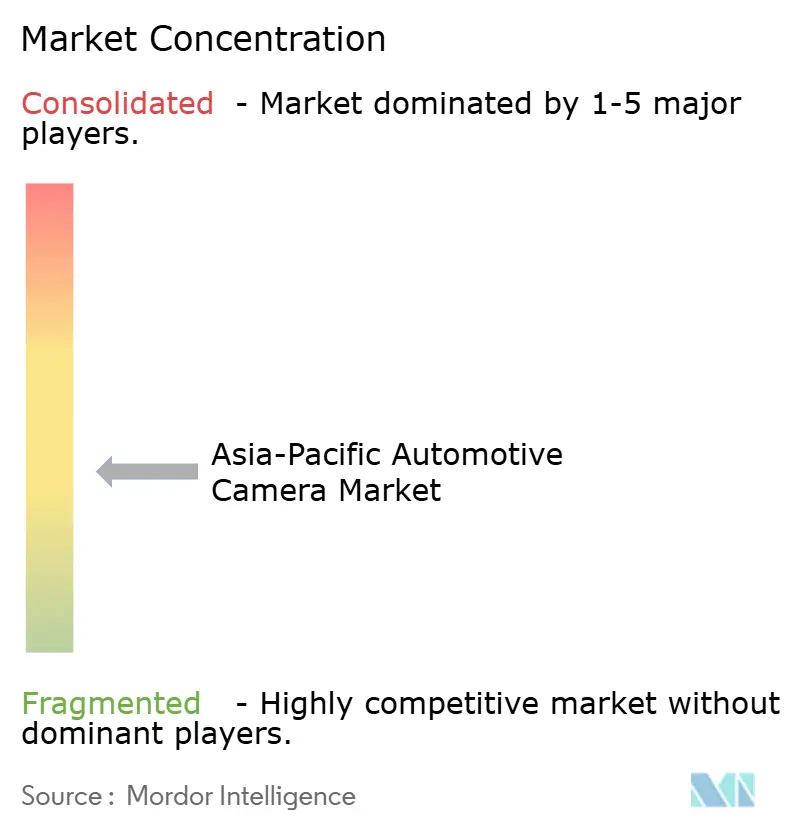
| Market Concentration | Medium |
Major Players *Disclaimer: Major Players sorted in no particular order Image © Mordor Intelligence. Reuse requires attribution under CC BY 4.0. | |
Asia-Pacific Automotive Camera Market Analysis by Mordor Intelligence
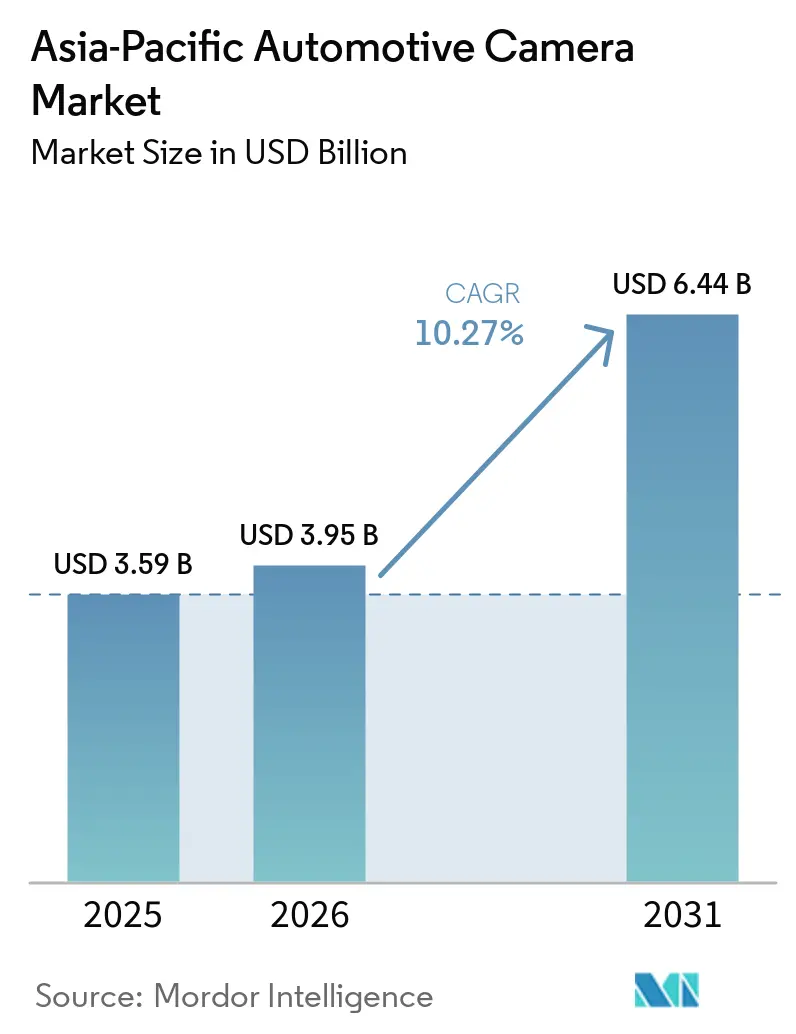
The Asia-Pacific automotive camera market size was valued at USD 3.59 billion in 2025 and is estimated to grow from USD 3.95 billion in 2026 to reach USD 6.44 billion by 2031, at a CAGR of 10.27% during the forecast period (2026-2031). The Asia-Pacific automotive camera market is moving from optional imaging features toward broader factory installation as vehicle safety rules cover more camera-supported functions. New-energy vehicle programs in China are increasing the number of cameras fitted to mainstream vehicles, which is raising camera content per vehicle. Software-defined vehicle programs are also changing purchasing decisions because automakers increasingly seek camera systems that work with centralized computing and can support later software updates. These changes favor suppliers that can combine camera hardware, perception software, cybersecurity controls, and vehicle-level validation. The Asia-Pacific automotive camera market also has uneven demand conditions, since China supplies scale, Japan and South Korea provide technology depth, and India and Southeast Asia offer a lower-base expansion opportunity.
Key Report Takeaways
- By vehicle type, passenger vehicles held 75.12% of the Asia-Pacific automotive camera market share in 2025, while light commercial vehicles are set to record the highest projected CAGR at 11.25% through 2031.
- By camera type, viewing cameras accounted for 54.25% of the Asia-Pacific automotive camera market share in 2025, while sensing/stereo cameras are projected to expand at a 14.37% CAGR through 2031.
- By technology, digital CMOS held 68.33% of revenue in 2025, while near-infrared cameras are forecast to grow at a 12.03% CAGR through 2031.
- By application, ADAS accounted for 55.16% of revenue in 2025, while driver monitoring and cabin safety are projected to grow at a 13.19% CAGR through 2031.
- By sales channel, OEM-installed systems held 86.24% of revenue in 2025, while the aftermarket is expected to grow at a 12.69% CAGR through 2031.
- By country, China dominated with 46.11% of 2025 revenue, while India is expected to grow at an 11.78% CAGR through 2031.
Note: Market size and forecast figures in this report are generated using Mordor Intelligence’s proprietary estimation framework, updated with the latest available data and insights as of January 2026.
Asia-Pacific Automotive Camera Market Trends and Insights
Drivers Impact Analysis*
| Driver | (~) % Impact on CAGR Forecast | Geographic Relevance | Impact Timeline |
|---|---|---|---|
| ADAS Mandates and NCAP Upgrades | +3.5% | China, Australia, ASEAN | Short term (≤ 2 years) |
| Multi-Camera Standardization | +2.8% | China, with spillover to ASEAN and India | Short term (≤ 2 years) |
| Electrification and Software-Defined Architectures | +2.0% | China, South Korea, Japan | Medium term (2-4 years) |
| Export-Oriented Camera Integration | +1.2% | China, Japan, South Korea | Medium term (2-4 years) |
| Commercial Fleet and Delivery Digitization | +0.9% | Asia-Pacific core markets, with spillover to ASEAN | Medium term (2-4 years) |
| Localized Camera and Software Supply | +0.8% | India, China | Long term (≥ 4 years) |
| Source: Mordor Intelligence | |||
ADAS Safety-Feature Mandates and NCAP Upgrades
China issued its mandatory national standard for combined driver assistance systems in July 2026, effective January 1, 2027, for new M- and N-category vehicles [1]. The standard covers functional safety, cybersecurity, data recording, and human-machine interaction, broadening camera-related vehicle approval decisions. Australia’s ADR 98/01 applies autonomous emergency braking requirements to passenger and light-commercial vehicles from August 2026, while ADR 99/01 will apply lane departure warning requirements to specified commercial vehicles from September 2026. ASEAN NCAP introduced its Intelligent Vehicle Advanced Safety Assessment protocol in July 2026. Mandatory compliance supports Asia-Pacific automotive camera demand, including in price-sensitive vehicle classes.
Multi-Camera Standardization in Chinese New-Energy Vehicles
Chinese new-energy vehicle programs have made multi-camera configurations more common across vehicle ranges that previously had limited camera coverage. BYD introduced its God’s Eye tri-camera suite in February 2025 and expanded the system across several vehicle lines that year. This broader adoption indicated that camera count had become a vehicle architecture decision rather than a premium-only feature. By June 2025, China’s vehicle type-approval process had required manufacturers to submit integrated driver-assistance parameters, including camera specifications. These developments affected the Asia-Pacific automotive camera market, as Chinese vehicle platforms entered export markets, influencing equipment expectations in ASEAN countries and India. Suppliers needed reliable, cost-effective cameras for high-volume models.
Vehicle Electrification and Software-Defined Architectures
The transition toward software-defined vehicles is changing how automotive camera functions are integrated, updated, and commercialized across Asia-Pacific. At CES 2026, Hyundai Mobis and Qualcomm Technologies signed an agreement to develop software-defined vehicle architectures for ADAS, including surround-view and driver-monitoring camera solutions based on Snapdragon Ride Flex [2]. The companies identified India as an expansion market. In October 2025, Sony Semiconductor Solutions introduced the IMX828, an automotive CMOS image sensor with an integrated MIPI A-PHY interface that reduces wiring complexity and latency. Consequently, the market favors suppliers that integrate hardware into computing platforms and support feature upgrades, emphasizing compatibility, software support, and system validation over camera modules alone.
Export-Oriented Camera Integration by Asia-Pacific OEMs
Automakers in China, Japan, and South Korea use shared vehicle platforms for domestic sales and exports, increasing camera specifications across production bases. The European Union’s General Safety Regulation requires advanced safety functions, including autonomous emergency braking, intelligent speed assistance, lane departure warning, and driver drowsiness alerts, influencing export-oriented programs manufactured in Asia-Pacific. Bosch and Horizon Robotics have expanded assisted-driving solutions by integrating Bosch camera systems with Horizon computing platforms. China provides the largest production scale, while India and ASEAN markets require lower-cost hardware and retrofit options. Consequently, suppliers serve demand for factory-fitted systems and adaptable fleet products. Shared platforms lower engineering costs and enable advanced camera configurations in simpler domestic models.
Restraints Impact Analysis*
| Restraint | (~) % Impact on CAGR Forecast | Geographic Relevance | Impact Timeline |
|---|---|---|---|
| System Integration and Lifecycle Cost | -0.7% | ASEAN, India, cost-sensitive segments | Short term (≤ 2 years) |
| Weather and Low-Light Performance | -0.4% | ASEAN, India, Australia and New Zealand | Medium term (2-4 years) |
| Repair, Calibration, and Cybersecurity Standards | -0.3% | Global, with Asia-Pacific-specific gaps | Medium term (2-4 years) |
| Constraints on Cabin and Driver-Monitoring | -0.2% | China, South Korea, ASEAN | Long term (≥ 4 years) |
| Source: Mordor Intelligence | |||
High System Integration and Lifecycle Cost
Advanced camera system costs remain a constraint in vehicle segments with significant sales in India, Vietnam, and Indonesia. Three-dimensional time-of-flight cameras carry higher unit costs than comparable 2D cameras, while thermal long-wave infrared cameras add several hundred dollars to bills of materials at current production volumes. These differentials hinder sensor integration in vehicles priced below USD 15,000. Functional safety and cybersecurity requirements increase engineering workloads, particularly for smaller suppliers competing on price. Aumovio India is developing a single-camera ADAS system for Level 2 assisted driving in mass-market passenger vehicles, highlighting demand for affordable solutions that balance coverage, processing, and compliance.
Adverse-Weather and Low-Light Performance Variability
Camera-based ADAS systems can lose performance in heavy rain, fog, dust, and low-light conditions across Asia-Pacific markets. A peer-reviewed 2026 study found that normalized camera image entropy declined significantly in rain and fog versus clear-condition baselines. ANCAP’s 2026 protocols assess safety-function performance at night and in rain, including detection of road workers wearing high-visibility clothing. These requirements increase demand for reliable camera systems. Although thermal long-wave infrared cameras support heat-signature detection, their cost limits mass-market adoption. India faces the region’s largest performance-cost gap because monsoons, dust, inconsistent lighting, and constrained buyer budgets require practical, affordable safety systems.
*Our forecasts treat driver/restraint impacts as directional, not additive. The impact forecasts reflect baseline growth, mix effects, and variable interactions.
Segment Analysis
By Vehicle Type: Passenger Vehicles Provide Scale While Light Commercial Vehicles Add Growth
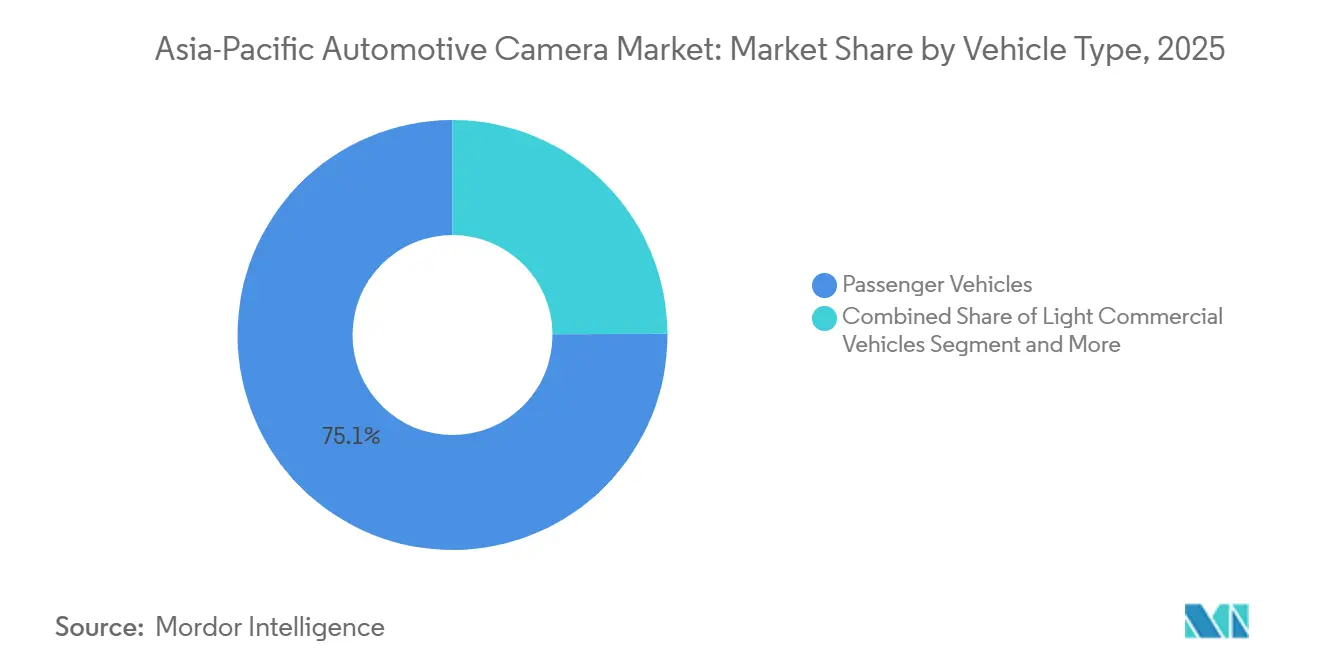
Passenger vehicles commanded 75.12% of revenue in 2025, forming the Asia-Pacific automotive camera market’s volume base. Production volumes and growing ADAS adoption in China, South Korea, and Japan support the segment. Models are shifting from rear-view cameras to three-to-five-camera systems for surround view, parking support, forward safety, and driver monitoring, increasing content per vehicle despite moderating unit growth. Scale spreads development and validation costs, supporting demand for digital CMOS cameras and processing capabilities, but intensifying price competition in entry-level and mid-range programs.
Light commercial vehicles are projected to register an 11.25% CAGR through 2031. Fleet telematics, last-mile delivery activity, and compliance requirements drive driver-facing and road-facing camera adoption. Geotab launched GO Focus Plus in Thailand in April 2026, while EROAD launched Clarity Edge Multicam in Australia[3]. Fleet retrofits complement OEM demand, while medium- and heavy-duty commercial vehicles make a smaller contribution.

By Camera Type: Sensing and Stereo Cameras Raise the Value of Vehicle Vision Systems
Viewing cameras accounted for 54.25% of 2025 revenue, reflecting widespread use in rear-view, surround-view, front-view, and interior-view applications. Their installed base sustains recurring demand for proven imaging components in the Asia-Pacific automotive camera market. Sensing and stereo cameras are projected to grow at a 14.37% CAGR through 2031, the highest among camera types, as they enable depth estimation for Level 2+ driving, urban assisted navigation, and intelligent parking.
BYD’s 2025 God’s Eye tri-camera deployment illustrated broader vision coverage across mainstream new-energy vehicles. OMNIVISION introduced the 8MP OX08D20 exterior sensor using TheiaCel technology, with mass production scheduled for Q4 2026 [4]. Higher resolution and dynamic range support challenging light conditions but do not remove validation needs in rain or fog. Market growth will depend on sensor performance and reliable local perception functions. Suppliers offering complete perception stacks are better positioned than imaging-module providers.
By Technology: Digital CMOS Holds the Installed Base While NIR Supports Cabin Monitoring
Digital (CMOS) technology led with 68.33% of 2025 revenue, reflecting established scale and ADAS control-unit compatibility. CMOS sensors support front, side, rear, surround-view, and interior applications, from parking to safety. Higher-resolution exterior cameras use the imaging approach. Supplier capacity and engineering familiarity support CMOS as the Asia-Pacific automotive camera market’s foundation. Cost reduction remains important across price points.
Near-infrared (NIR) cameras are forecast to grow at a 12.03% CAGR through 2031, driven by driver and occupant monitoring. They track gaze and eyelid movement without distracting drivers with visible light. China’s driver-assistance requirements and C-NCAP driver-monitoring criteria increase relevance. Thermal long-wave infrared cameras remain cost-limited, despite low-light and adverse-weather heat-signature detection. The market supports CMOS and NIR systems.
By Application: ADAS Provides Revenue Scale and Cabin Safety Expands Faster
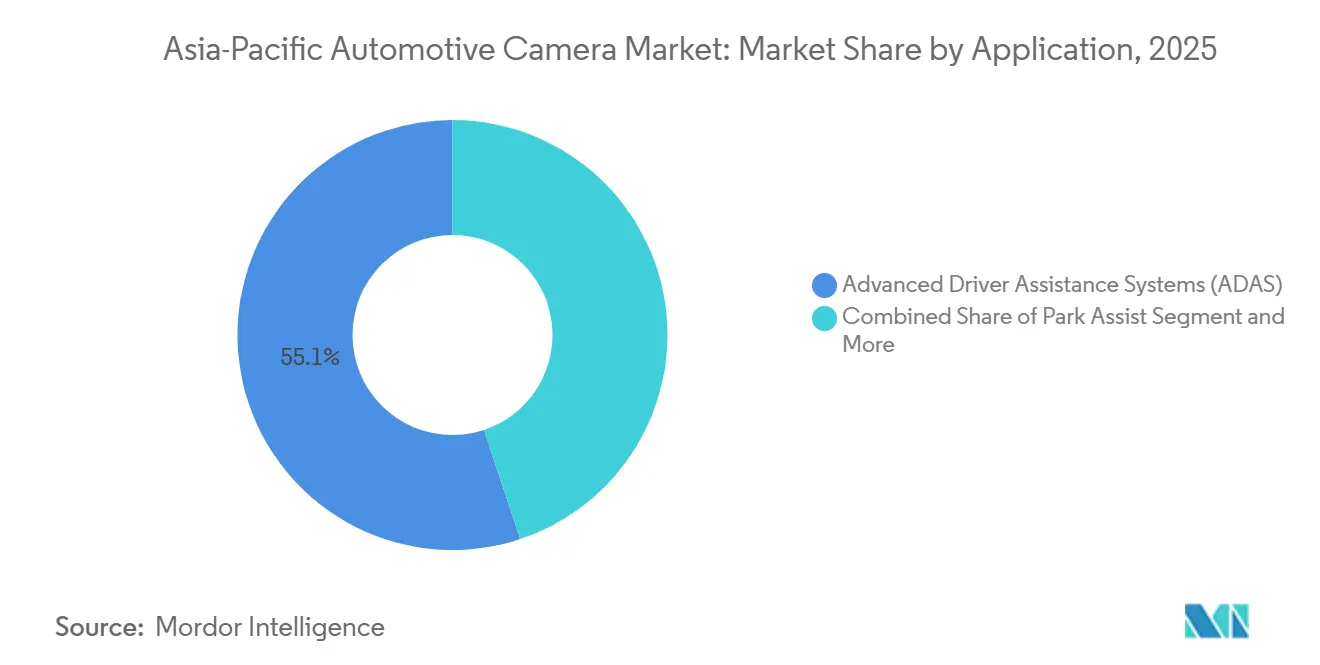
ADAS accounted for 55.16% of revenue in 2025, making it the largest application in the Asia-Pacific automotive camera market. Forward-collision warning, lane-keeping assistance, and surround-view parking systems drove adoption. Automakers adopted them to meet regulations, assessments, and consumer demand. ADAS cameras serve passenger and commercial vehicles; value depends on coverage, sensor performance, and processing. Validation is essential because unreliable detection can affect safety ratings and driver confidence. As standards tighten, systems must perform reliably in weather and lighting.
Driver monitoring and cabin safety are forecast to grow at a 13.19% CAGR through 2031, the fastest in segment data. China’s hands-off and gaze-monitoring rules support cabin-camera demand. Unlike park assist, it monitors occupants and offers higher value through integrated illumination, software, and warnings. It will develop alongside, not replace, exterior ADAS.
By Sales Channel: OEM Installation Leads While Retrofitting Broadens Access
OEM-installed systems held 86.24% of 2025 revenue, confirming factory integration as the main route to market. Automakers control architecture, software interfaces, and functional-safety validation, centralizing procurement. China’s vertically integrated new-energy vehicle producers source modules internally, embedding cameras in original designs. Multi-camera OEM ADAS suites require coordinated installation, calibration, and software integration. Factory installation creates predictable launch demand but ties suppliers to development cycles and automaker approvals.
The aftermarket is projected to grow at a 12.69% CAGR through 2031, driven by consumer retrofits and upgrades in lower-penetration ADAS markets. India and Southeast Asia have legacy commercial fleets without OEM cameras. Retrofitting adds driver- and road-facing functions without replacement cycles. Video telematics combines camera hardware with subscription fleet-management software. Reliable installation, calibration, maintenance, and data management enable access to fleets unlikely to receive near-term OEM systems.
Geography Analysis
China accounted for 46.11% of revenue in 2025 and remains the largest national market in the Asia-Pacific automotive camera market. New-energy vehicle adoption, supply networks, and multi-camera systems drive demand for exterior and in-cabin cameras. Regulations covering driver-assistance systems, safety, cybersecurity, data recording, human-machine interaction, and data transfers favor suppliers that meet development timelines and compliance requirements.
Japan and South Korea provide sensor, electronics, and vehicle-program expertise. Sony Semiconductor Solutions introduced an automotive CMOS sensor with MIPI A-PHY support, demonstrating Japanese suppliers’ role in camera-system development. Australia strengthens standards through ADR regulations and ANCAP protocols, encouraging camera performance in rain, nighttime, and challenging conditions. These markets support standards despite lower vehicle volumes than China.
India’s CAGR is projected at 11.78% through 2031. Valeo inaugurated a camera line in Sanand, Gujarat, in April 2026. Mahindra selected Mobileye’s SuperVision and Surround ADAS for at least six models, with 2027 production. Low ADAS penetration supports demand, but weather and road-lighting conditions, and price sensitivity constrain deployment. ASEAN adds telematics, retrofit, and IVASA demand.
Competitive Landscape
The Asia-Pacific automotive camera market has concentrated system integration and a diverse module-sensor base. Global suppliers remain important because they integrate cameras with ADAS software, ECUs, and validation programs. Bosch has expanded its assisted-driving collaboration with Horizon Robotics, combining vehicle-system expertise with localized computing solutions. Chinese suppliers are gaining share as automakers demand rapid development, competitive pricing, and new-energy vehicle support. China provides production scale, while India and ASEAN require lower-cost hardware and retrofit options amid rising safety requirements.
Software is important as software-defined vehicle architectures separate camera hardware from computing and perception functions. StradVision, Freetech, and Huawei’s automotive unit compete at this layer, while hardware companies seek roles. OMNIVISION launches show sensor development for exterior and in-cabin applications. Suppliers supporting over-the-air updates, cybersecurity, and reliable interfaces have an advantage; smaller modules face higher compliance costs without partnerships.
The aftermarket creates a distinct space for fleet-management and video-telematics providers. Geotab’s Thailand launch and EROAD’s multicamera offering combine hardware with software services for fleet operators, requiring repair, calibration, cybersecurity, and privacy support.
Asia-Pacific Automotive Camera Industry Leaders
-
Robert Bosch GmbH
-
DENSO Corporation
-
Continental AG
-
Valeo SE
-
ZF Friedrichshafen AG
- *Disclaimer: Major Players sorted in no particular order
Recent Industry Developments
- July 2026: Aumovio India announced about developing a single-camera advanced driver assistance system (ADAS) to make Level 2 assisted driving more viable for mass-market passenger vehicles in India. The company aims to reduce system costs by using a camera-only setup rather than the multiple radar-and-camera combinations typically used in premium ADAS packages.
- May 2026: TIER IV launched the MP camera series, an automotive-grade lineup designed for advanced autonomous driving systems and commercial-scale Level 4 deployments. TIER IV stated that the cameras incorporate proprietary image-processing technology and flexible camera controls to provide high-fidelity visual data for driverless operations.
- April 2026: Valeo marked a major milestone in India and regional manufacturing excellence through the inauguration of a new HD Surround-View Camera production line at the Sanand facility. The new line supports the high-volume production of next-generation vision camera systems for major OEMs in India.
- February 2026: MCNEX and Valens Semiconductor announced the joint development and availability of a new family of high-resolution front and rear automotive cameras. Powered by Valens' VA7000 A-PHY chipsets, these cameras delivered QHD (2560 × 1440) video over unshielded twisted-pair (UTP) or low-cost coaxial channels.
Asia-Pacific Automotive Camera Market Report Scope
The scope includes segmentation by vehicle type (passenger vehicles, light commercial vehicles, and medium and heavy commercial vehicles), camera type (viewing (surround/rear/front/interior) and sensing/stereo cameras), technology (digital (CMOS), infra-red (NIR), and thermal (LWIR)), application (park assist, advanced driver assistance systems (ADAS), and driver monitoring and cabin safety), and sales channel ((OEM-installed and aftermarket). The analysis also covers country-level segmentation, including China, Japan, India, South Korea, Australia, and the rest of Asia-Pacific. Market size and growth forecasts are presented by value in USD and volume in Units.
By Vehicle Type
| Passenger Vehicles |
| Light Commercial Vehicles |
| Medium and Heavy Commercial Vehicles |
By Camera Type
| Viewing (Surround/Rear/Front/Interior) |
| Sensing / Stereo Cameras |
By Technology
| Digital (CMOS) |
| Infra-red (NIR) |
| Thermal (LWIR) |
By Application
| Park Assist |
| Advanced Driver Assistance Systems (ADAS) |
| Driver Monitoring and Cabin Safety |
By Sales Channel
| OEM-Installed |
| Aftermarket |
By Country
| China |
| Japan |
| India |
| South Korea |
| Australia |
| Rest of Asia-Pacific |
| By Vehicle Type | Passenger Vehicles |
| Light Commercial Vehicles | |
| Medium and Heavy Commercial Vehicles | |
| By Camera Type | Viewing (Surround/Rear/Front/Interior) |
| Sensing / Stereo Cameras | |
| By Technology | Digital (CMOS) |
| Infra-red (NIR) | |
| Thermal (LWIR) | |
| By Application | Park Assist |
| Advanced Driver Assistance Systems (ADAS) | |
| Driver Monitoring and Cabin Safety | |
| By Sales Channel | OEM-Installed |
| Aftermarket | |
| By Country | China |
| Japan | |
| India | |
| South Korea | |
| Australia | |
| Rest of Asia-Pacific |
Key Questions Answered in the Report
What is the expected growth rate for automotive cameras in Asia-Pacific?
The Asia-Pacific automotive camera market is projected to grow at a 10.27% CAGR from 2026 to 2031, reaching USD 6.44 billion by 2031.
Which vehicle type generates the most camera demand in Asia-Pacific?
Passenger vehicles led with 75.12% of 2025 revenue because they combine high production volumes with rising factory installation of ADAS and surround-view cameras.
Which camera technology is growing fastest in the region?
Near-infrared cameras are expected to grow at a 12.03% CAGR through 2031 as driver-monitoring and occupant-monitoring requirements become more relevant.
What is the main opportunity for aftermarket automotive cameras?
The aftermarket is projected to grow at a 12.69% CAGR through 2031, supported by commercial-fleet retrofits and video-telematics services in India and Southeast Asia.