Market Overview
| Study Period | 2020 - 2031 |
|---|---|
| Forecast Data Period | 2026 - 2031 |
| Base Year Market Size (2025) | USD 1.09 Billion |
| Market Size (2026) | USD 1.15 Billion |
| Market Size (2031) | USD 1.53 Billion |
| Growth Rate (2026 - 2031) | 5.76 % |
| Market Concentration | Medium |
Major Players *Disclaimer: Major Players sorted in no particular order Image © Mordor Intelligence. Reuse requires attribution under CC BY 4.0. | |
Asia-Pacific Anchors And Grouts Market Analysis by Mordor Intelligence
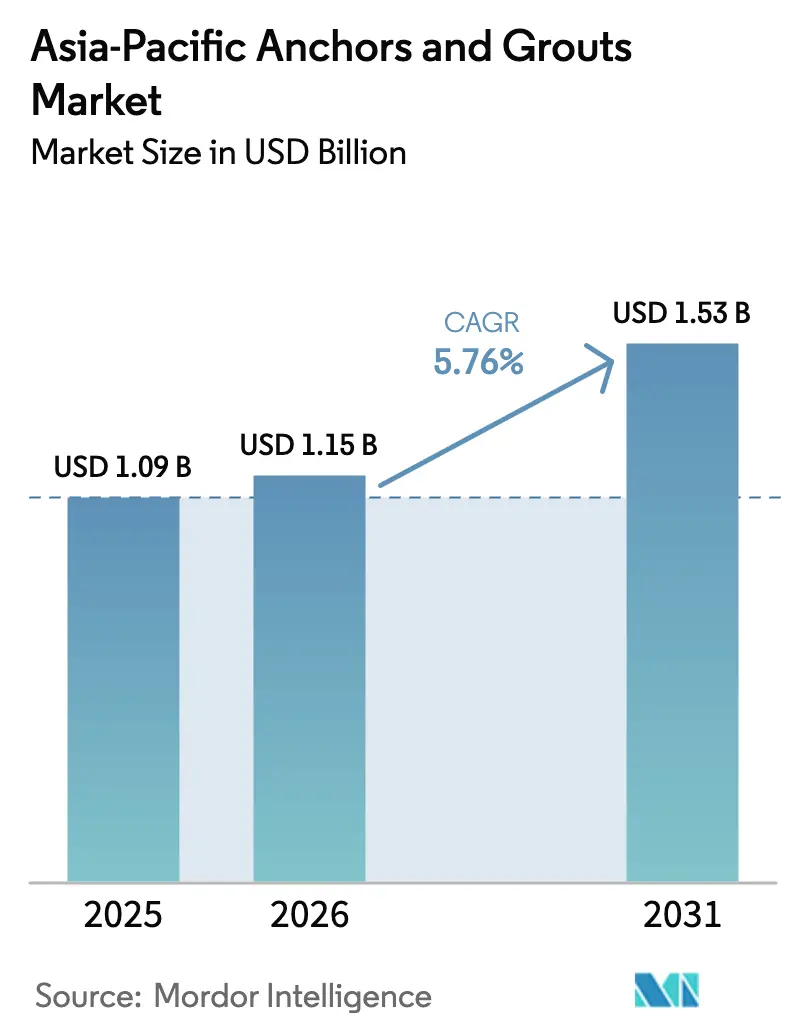
The Asia-Pacific Anchors And Grouts Market size in 2026 is estimated at USD 1.15 billion, growing from 2025 value of USD 1.09 billion with 2031 projections showing USD 1.53 billion, growing at 5.76% CAGR over 2026-2031. Robust fiscal stimulus programs, an expanding data center footprint, and a steady pipeline of megaprojects collectively underpin this trajectory for the Asia-Pacific anchors and grouts market. Four structural trends reinforce demand: 1) public-sector spending that targets rail, airports, and power assets; 2) surging upgrades of aging urban structures across Tier-1 and Tier-2 cities; 3) hyperscale data-center construction that multiplies anchoring loads; and 4) green-building mandates that favor low-VOC, high-durability resin anchors. Leading suppliers respond by localizing production, widening training support, and accelerating mergers and acquisitions to secure technology breadth—all moves that reinforce competitive advantages within the Asia-Pacific anchors and grouts market.
Key Report Takeaways
- By product type, resin fixing systems captured 57.62% of the Asia-Pacific anchors and grouts market share in 2025 and are advancing at a 6.28% CAGR through 2031.
- By end-use sector, infrastructure captured 33.74% of the Asia-Pacific anchors and grouts market share in 2025. The Industrial and Institutional segment is projected to post a 7.38% CAGR, the fastest within the outlook between 2026 and 2031.
- By geography, China retained 63.15% Asia-Pacific anchors and grouts market share in 2025, while India is projected to post the highest 6.71% CAGR through 2031.
Note: Market size and forecast figures in this report are generated using Mordor Intelligence’s proprietary estimation framework, updated with the latest available data and insights as of 2026.
Market Trends and Insights
Drivers Impact Analysis of Asia-Pacific Anchors And Grouts Market*
| Drivers | (~) % Impact on CAGR Forecast | Geographic Relevance | Impact Timeline |
|---|---|---|---|
| Accelerated public-infrastructure stimulus demand | +1.4% | China, India, Indonesia core; spillover to Southeast Asia | Medium term (2-4 years) |
| Rapid urban redevelopment of cities across major economies | +1.2% | China, India, Japan, South Korea; secondary cities in ASEAN | Long term (≥ 4 years) |
| Rapid expansion of data centers | +0.8% | Global APAC; concentrated in Singapore, Japan, Australia, India | Short term (≤ 2 years) |
| Net-zero ready commercial buildings mandate | +0.6% | Singapore, Japan, Australia; emerging in China and India | Medium term (2-4 years) |
| Offshore wind sub-structure growth requiring ultra-high-strength grouts | +0.5% | Taiwan, Australia, Japan; coastal APAC markets | Long term (≥ 4 years) |
| Source: Mordor Intelligence | |||
Accelerated Public-Infrastructure Stimulus Demand
Ongoing stimulus packages across major economies sustain multiyear procurement cycles for seismic-rated resin anchors, heavy-duty mechanical anchors, and ultra-high-strength grouts. Beijing’s 14th Five-Year Plan accelerates high-speed rail and nuclear power projects, pushing bulk orders that favor suppliers with automated production and system certifications. Indonesia’s USD 383.4 billion National Strategic Projects funnel continuous orders into bridges, ports, and metro corridors, creating repeat demand for fast-curing anchoring systems suited to tropical climates[1]. The multiplier effect extends to logistics hubs, depots, and worker housing, broadening the addressable base for the Asia-Pacific anchors and grouts market.
Rapid Urban Redevelopment Across Major Economies
Megacities such as Shanghai, Mumbai, and Jakarta are investing in seismic retrofits and vertical additions, thereby elevating demand for injectable epoxy systems that bond rebar to aged concrete without service interruptions. Japan’s “Compact City” programs necessitate precise anchoring for underground parking and podium expansions that compensate for limited footprints. Modular buildings are proliferating, driving the uptake of grouted sleeves that shorten on-site cycle times—an attribute prized by developers facing labor shortages. These cascaded needs reinforce revenue resilience inside the Asia-Pacific anchors and grouts market.
Rapid Expansion of Data Centers
Hyperscalers have earmarked USD 250 billion to boost regional capacity, prompting a surge in vibration-resistant chemical anchors for server racks, chillers, and backup generators. Singapore, Sydney, and Mumbai install low-out-gassing epoxy anchors to protect microelectronics, while tropical sites demand corrosion-inhibiting resins that endure 95% humidity. Precision anchoring aligns with Tier-4 uptime requirements, positioning specialized suppliers for premium margins within the Asia-Pacific anchors and grouts market.
Net-Zero-Ready Commercial-Building Mandate
Singapore’s Green Mark 2025 and China’s Near-Zero Energy Building code elevate specification thresholds for low-VOC, thermally efficient anchoring products[2]. Bio-based epoxy chemistries are gaining market share as developers pursue LEED and BREEAM credits. Rooftop solar and façade-integrated wind turbines introduce new anchoring loads, opening niche spaces for hybrid mortar-and-resin systems that minimize cold-bridge effects. The sustainability pivot anchors long-term product differentiation in the Asia-Pacific anchors and grouts market.
Restraints Impact Analysis of Asia-Pacific Anchors And Grouts Market*
| Restraints | (~) % Impact on CAGR Forecast | Geographic Relevance | Impact Timeline |
|---|---|---|---|
| Soaring epoxy resin prices and supply volatility | -0.9% | Global APAC; acute in import-dependent markets like Singapore, Malaysia, Thailand | Short term (≤ 2 years) |
| Skilled-labour shortages for precision anchoring | -0.7% | Japan, Singapore, Australia core; emerging in China urban areas and India metros | Medium term (2-4 years) |
| Stringent VOC regulations | -0.5% | China, Singapore, Japan leading; expanding to South Korea, Australia | Medium term (2-4 years) |
| Source: Mordor Intelligence | |||
Soaring Epoxy-Resin Prices and Supply Volatility
Anti-dumping duties up to 547.76% on Chinese resin inflows and periodic shutdowns during Lunar New Year squeeze producer margins. Spot price swings of 8-12 weeks complicate tender bids across the Asia-Pacific anchors and grouts market, prompting hedging strategies that favor backward-integrated multinationals. Bio-based epoxy alternatives emerge but remain 15-20% costlier, limiting immediate scale.
Skilled-Labor Shortages for Precision Anchoring
Construction workforces are aging; Japan’s headcount has fallen 19.9% since 2013, with over one-third of workers now above 55 years. Rising wages in India and Singapore are inflating project costs, making simplified, cartridge-based anchoring systems more attractive. Robotics pilots by Obayashi and other major companies demonstrate 20% faster installation rates and add digital QA records, a paradigm poised to permeate the Asia-Pacific anchors and grouts market.
*Our forecasts treat driver/restraint impacts as directional, not additive. The impact forecasts reflect baseline growth, mix effects, and variable interactions.
Asia-Pacific Anchors And Grouts Market Segment Analysis
By Product Types:
Resin Systems Consolidate LeadershipResin fixing systems held a 57.62% share of the Asia-Pacific anchors and grouts market in 2025 and are projected to track a 6.28% CAGR through 2031, underscoring the rising demand for seismic and corrosion performance. Within this cohort, epoxy-based sub-segments dominate, as their bond strengths exceed 25 MPa after 24 hours at 25 °C, fulfilling the criteria for skyscrapers and offshore platforms. Cementitious anchors, while cost-efficient, play a crucial role in high-temperature industrial furnaces and massive foundations. Hybrid mortars that blend polymer dispersion with micro-silica close performance gaps, illustrating the depth of product innovation in the Asia-Pacific anchors and grouts market.
Diverse climate zones catalyze formulation tailoring. Coastal ASEAN markets prefer styrene-free vinyl-ester hybrids that are resistant to chloride ingress, whereas cold-weather zones in northern Japan adopt winter-grade resins that cure at 5 °C. Regulatory pressure to curb VOCs accelerates the adoption of water-based epoxies, expanding the addressable projects that attain Green Mark or LEED status. Packaged cartridge systems with static mixers reduce human error, a key selling point amid labor constraints. This value migration sustains premium price realization and strengthens brand loyalty in the Asia-Pacific anchors and grouts market.


By End-Use Sector:
Industrial and Institutional Momentum BuildsInfrastructure projects accounted for 33.74% of 2025 revenue, reflecting the significant presence of rail, road, and energy assets. Yet, Industrial and Institutional facilities register the fastest 7.38% CAGR, driven by record capital outlays for data centers, pharmaceutical plants, and semiconductor fabs. High-tech facilities impose stringent outgassing and vibration limits, spurring demand for specialty chemical anchors with elastic moduli tuned below 3,000 N/mm². Developers allocate up to 3% of their structural budgets to anchors and grouts in such builds, which is double the allocation for conventional warehouses. This positioning makes the vertical a high-value niche for suppliers in the Asia-Pacific anchors and grouts market.
Residential uptake aligns with the rollout of affordable housing in India and smart-city retrofits in China’s Tier 2 provinces. Factory-assembled modules that integrate pre-grouted sleeves yield 20-30% site-labor savings, a feature developers leverage to offset rising material costs. Commercial offices rebalance toward flexible floor plates; detachable mechanical anchors facilitate interior churn without slab damage, a micro-trend that widens recurring revenue streams. Altogether, these shifts reaffirm a diversified growth base anchoring the Asia-Pacific anchors and grouts market.

Geography Analysis
China Anchors and Grouts Market
China accounted for 63.15% of 2025 value, a testament to its sprawling infrastructure stock and manufacturing capacity. Growth moderates as the economy pivots to services, yet retrofit programs for earthquake resilience and green upgrades continue to fuel resin-anchor substitution. Beijing’s emissions caps push contractors toward water-borne chemistries, sharpening competitive edges for early movers in the Asia-Pacific anchors and grouts market.
India Anchors and Grouts Market
India, projected at a 6.71% CAGR, benefits from USD 133 billion budgeted capex and a target of 1.18 crore affordable homes by 2028. Warehouse floor space, poised to touch 159 million ft² by 2047, reinforces industrial-grade anchor volumes. Multinationals re-entering post-regulatory clarity—Master Builders Solutions aims for INR 5 billion turnover by 2028—to validate the Asia-Pacific anchors and grouts market’s headroom.
APAC Anchors and Grouts Market
Japan, Australia, Indonesia, and Vietnam collectively form a robust secondary cluster. Japan’s JPY 38.75 trillion construction outlook through 2029 spotlights seismic-retrofit demand. Australia’s six declared offshore wind zones eliminate long-duration grout requirements that exceed 100-year service life benchmarks. Indonesia’s IDR 422.7 trillion 2024 infrastructure bill shores up bridge and mass-transit projects, while Vietnam’s high-tech manufacturing inflows trigger anchor specifications harmonized to Eurocode 2, broadening standards convergence in the Asia-Pacific anchors and grouts market.
Competitive Landscape
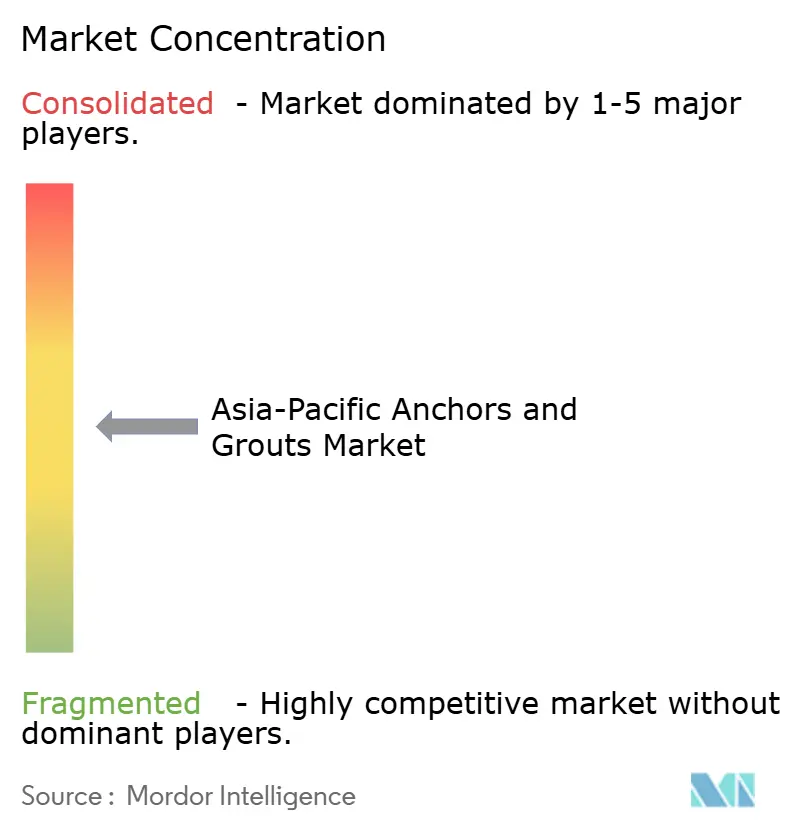
The Asia-Pacific anchors and grouts market is moderately fragmented, with European incumbents retaining technology leadership while local firms compete on price and logistics agility. Mergers and acquisitions aside, competitive vectors shift toward service intensity. Global leaders deploy field engineers and digital apps that verify hole depth, temperature, and torque, reducing callbacks. Regional challengers focus on mass-housing opportunities with low-odor epoxies, priced 15% below those of multinationals, and capture volume despite thinner margins. Supply-chain resilience strategies—such as dual-sourcing resins from Taiwan and India—become differentiators in the Asia-Pacific anchors and grouts market. Automation emerges as a key battleground. Obayashi’s robot-assisted anchor installer cuts manpower by 35%, prompting anchor makers to supply cartridges compatible with robotic dispensers. Sustainability differentiation deepens; manufacturers publish Environmental Product Declarations and integrate recycled PET into cartridge bodies, aligning with client ESG scorecards.
Asia-Pacific Anchors And Grouts Industry Leaders
-
Sika AG
-
MAPEI S.p.A.
-
Ardex Group
-
Saint-Gobain
-
Würth Group
- *Disclaimer: Major Players sorted in no particular order
Asia-Pacific Anchors And Grouts Market Companies Covered in this Report
- Ardex Group
- Arkema (Bostik)
- Cemkrete Inter Co., Ltd.
- Henkel AG & Co. KGaA
- LATICRETE International, Inc.
- MAPEI S.p.A.
- Minova
- Pidilite Industries Limited
- RPM International Inc.
- Saint-Gobain
- Shanghai Horse Construction Co., Ltd
- Sika AG
- Thermax Limited
- Würth Group
Recent Industry Developments in Asia-Pacific Anchors And Grouts Market
- March 2025: Minova announced the acquisition of Platipus Anchors, a leader in the design and manufacture of earth anchoring systems. Platipus Anchors has a significant presence in the Asia Pacific region, primarily through a network of distributors and strategic project partnerships.
- February 2025: Saint-Gobain completed its acquisition of Fosroc, elevating its anchors and grouts portfolio and reinforcing manufacturing presence in India and the Middle East.
Asia-Pacific Anchors And Grouts Market Report Scope
Commercial, Industrial and Institutional, Infrastructure, Residential are covered as segments by End Use Sector. Cementitious Fixing, Resin Fixing are covered as segments by Sub Product. Australia, China, India, Indonesia, Japan, Malaysia, South Korea, Thailand, Vietnam are covered as segments by Country.Segmentation Overview
By Product Types
| Cementitious Fixing | |
| Resin Fixing | Epoxy-based |
| Polyurethane-based | |
| Other Types |
By End-Use Sector
| Commercial |
| Industrial and Institutional |
| Infrastructure |
| Residential |
By Country
| Australia |
| China |
| India |
| Indonesia |
| Japan |
| Malaysia |
| South Korea |
| Thailand |
| Vietnam |
| Rest of Asia-Pacific |
| By Product Types | Cementitious Fixing | |
| Resin Fixing | Epoxy-based | |
| Polyurethane-based | ||
| Other Types | ||
| By End-Use Sector | Commercial | |
| Industrial and Institutional | ||
| Infrastructure | ||
| Residential | ||
| By Country | Australia | |
| China | ||
| India | ||
| Indonesia | ||
| Japan | ||
| Malaysia | ||
| South Korea | ||
| Thailand | ||
| Vietnam | ||
| Rest of Asia-Pacific | ||
Market Definition
- END-USE SECTOR - Anchors and grouts consumed in the construction sectors such as commercial, residential, industrial, institutional, and infrastructure are considered under the scope of the study.
- PRODUCT/APPLICATION - Under the scope of the study, the consumption of anchors and grouts such as cementitious fixing, resin fixing polyurethane, resin fixing epoxy, and other types are considered.
| Keyword | Definition |
|---|---|
| Accelerator | Accelerators are admixtures used to fasten the setting time of concrete by increasing the initial rate and speeding up the chemical reaction between cement and the mixing water. These are used to harden and increase the strength of concrete quickly. |
| Acrylic | This synthetic resin is a derivative of acrylic acid. It forms a smooth surface and is mainly used for various indoor applications. The material can also be used for outdoor applications with a special formulation. |
| Adhesives | Adhesives are bonding agents used to join materials by gluing. Adhesives can be used in construction for many applications, such as carpet laying, ceramic tiles, countertop lamination, etc. |
| Air Entraining Admixture | Air-entraining admixtures are used to improve the performance and durability of concrete. Once added, they create uniformly distributed small air bubbles to impart enhanced properties to the fresh and hardened concrete. |
| Alkyd | Alkyds are used in solvent-based paints such as construction and automotive paints, traffic paints, flooring resins, protective coatings for concrete, etc. Alkyd resins are formed by the reaction of an oil (fatty acid), a polyunsaturated alcohol (Polyol), and a polyunsaturated acid or anhydride. |
| Anchors and Grouts | Anchors and grouts are construction chemicals that stabilize and improve the strength and durability of foundations and structures like buildings, bridges, dams, etc. |
| Cementitious Fixing | Cementitious fixing is a process in which a cement-based grout is pumped under pressure to fill forms, voids, and cracks. It can be used in several settings, including bridges, marine applications, dams, and rock anchors. |
| Commercial Construction | Commercial construction comprises new construction of warehouses, malls, shops, offices, hotels, restaurants, cinemas, theatres, etc. |
| Concrete Admixtures | Concrete admixtures comprise water reducers, air entrainers, retarders, accelerators, superplasticizers, etc., added to concrete before or during mixing to modify its properties. |
| Concrete Protective Coatings | To provide specific protection, such as anti-carbonation or chemical resistance, a film-forming protective coat can be applied on the surface. Depending on the applications, different resins like epoxy, polyurethane, and acrylic can be used for concrete protective coatings. |
| Curing Compounds | Curing compounds are used to cure the surface of concrete structures, including columns, beams, slabs, and others. These curing compounds keep the moisture inside the concrete to give maximum strength and durability. |
| Epoxy | Epoxy is known for its strong adhesive qualities, making it a versatile product in many industries. It resists heat and chemical applications, making it an ideal product for anyone needing a stronghold under pressure. It is widely used in adhesives, electrical and electronics, paints, etc. |
| Fiber Wrapping Systems | Fiber Wrapping Systems are a part of construction repair and rehabilitation chemicals. It involves the strengthening of existing structures by wrapping structural members like beams and columns with glass or carbon fiber sheets. |
| Flooring Resins | Flooring resins are synthetic materials applied to floors to enhance their appearance, increase their resistance to wear and tear or provide protection from chemicals, moisture, and stains. Depending on the desired properties and the specific application, flooring resins are available in distinct types, such as epoxy, polyurethane, and acrylic. |
| High-Range Water Reducer (Super Plasticizer) | High-range water reducers are a type of concrete admixture that provides enhanced and improved properties when added to concrete. These are also called superplasticizers and are used to decrease the water-to-cement ratio in concrete. |
| Hot Melt Adhesives | Hot-melt adhesives are thermoplastic bonding materials applied as melts that achieve a solid state and resultant strength on cooling. They are commonly used for packaging, coatings, sanitary products, and tapes. |
| Industrial and Institutional Construction | Industrial and institutional construction includes new construction of hospitals, schools, manufacturing units, energy and power plants, etc. |
| Infrastructure Construction | Infrastructure construction includes new construction of railways, roads, seaways, airports, bridges, highways, etc. |
| Injection Grouting | The process of injecting grout into open joints, cracks, voids, or honeycombs in concrete or masonry structural members is known as injection grouting. It offers several benefits, such as strengthening a structure and preventing water infiltration. |
| Liquid-Applied Waterproofing Membranes | Liquid-Applied membrane is a monolithic, fully bonded, liquid-based coating suitable for many waterproofing applications. The coating cures to form a rubber-like elastomeric waterproof membrane and may be applied over many substrates, including asphalt, bitumen, and concrete. |
| Micro-concrete Mortars | Micro-concrete mortar is made up of cement, water-based resin, additives, mineral pigments, and polymers and can be applied on both horizontal and vertical surfaces. It can be used to refurbish residential complexes, commercial spaces, etc. |
| Modified Mortars | Modified Mortars include Portland cement and sand along with latex/polymer additives. The additives increase adhesion, strength, and shock resistance while also reducing water absorption. |
| Mold Release Agents | Mold release agents are sprayed or coated on the surface of molds to prevent a substrate from bonding to a molding surface. Several types of mold release agents, including silicone, lubricant, wax, fluorocarbons, and others, are used based on the type of substrates, including metals, steel, wood, rubber, plastic, and others. |
| Polyaspartic | Polyaspartic is a subset of polyurea. Polyaspartic floor coatings are typically two-part systems that consist of a resin and a catalyst to ease the curing process. It offers high durability and can withstand harsh environments. |
| Polyurethane | Polyurethane is a plastic material that exists in various forms. It can be tailored to be either rigid or flexible and is the material of choice for a broad range of end-user applications, such as adhesives, coatings, building insulation, etc. |
| Reactive Adhesives | A reactive adhesive is made of monomers that react in the adhesive curing process and do not evaporate from the film during use. Instead, these volatile components become chemically incorporated into the adhesive. |
| Rebar Protectors | In concrete structures, rebar is one of the important components, and its deterioration due to corrosion is a major issue that affects the safety, durability, and life span of buildings and structures. For this reason, rebar protectors are used to protect against degrading effects, especially in infrastructure and industrial construction. |
| Repair and Rehabilitation Chemicals | Repair and Rehabilitation Chemicals include repair mortars, injection grouting materials, fiber wrapping systems, micro-concrete mortars, etc., used to repair and restore existing buildings and structures. |
| Residential Construction | Residential construction involves constructing new houses or spaces like condominiums, villas, and landed homes. |
| Resin Fixing | The process of using resins like epoxy and polyurethane for grouting applications is called resin fixing. Resin fixing offers several advantages, such as high compressive and tensile strength, negligible shrinkage, and greater chemical resistance compared to cementitious fixing. |
| Retarder | Retarders are admixtures used to slow down the setting time of concrete. These are usually added with a dosage rate of around 0.2% -0.6% by weight of cement. These admixtures slow down hydration or lower the rate at which water penetrates the cement particles by making concrete workable for a long time. |
| Sealants | A sealant is a viscous material that has little or no flow qualities, which causes it to remain on surfaces where they are applied. Sealants can also be thinner, enabling penetration to a certain substance through capillary action. |
| Sheet Waterproofing Membranes | Sheet membrane systems are reliable and durable thermoplastic waterproofing solutions that are used for waterproofing applications even in the most demanding below-ground structures, including those exposed to highly aggressive ground conditions and stress. |
| Shrinkage Reducing Admixture | Shrinkage-reducing admixtures are used to reduce concrete shrinkage, whether from drying or self-desiccation. |
| Silicone | Silicone is a polymer that contains silicon combined with carbon, hydrogen, oxygen, and, in some cases, other elements. It is an inert synthetic compound that comes in various forms, such as oil, rubber, and resin. Due to its heat-resistant properties, it finds applications in sealants, adhesives, lubricants, etc. |
| Solvent-borne Adhesives | Solvent-borne adhesives are mixtures of solvents and thermoplastic or slightly cross-linked polymers such as polychloroprene, polyurethane, acrylic, silicone, and natural and synthetic rubbers. |
| Surface Treatment Chemicals | Surface treatment chemicals are chemicals used to treat concrete surfaces, including roofs, vertical surfaces, and others. They act as curing compounds, demolding agents, rust removers, and others. They are cost-effective and can be used on roadways, pavements, parking lots, and others. |
| Viscosity Modifier | Viscosity Modifiers are concrete admixtures used to change various properties of admixtures, including viscosity, workability, cohesiveness, and others. These are usually added with a dosage of around 0.01% to 0.1% by weight of cement. |
| Water Reducer | Water reducers, also called plasticizers, are a type of admixture used to decrease the water-to-cement ratio in the concrete, thereby increasing the durability and strength of concrete. Various water reducers include refined lignosulfonates, gluconates, hydroxycarboxylic acids, sugar acids, and others. |
| Water-borne Adhesives | Water-borne adhesives use water as a carrier or diluting medium to disperse resin. They are set by allowing the water to evaporate or be absorbed by the substrate. These adhesives are compounded with water as a dilutant rather than a volatile organic solvent. |
| Waterproofing Chemicals | Waterproofing chemicals are designed to protect a surface from the perils of leakage. A waterproofing chemical is a protective coating or primer applied to a structure's roof, retaining walls, or basement. |
| Waterproofing Membranes | Waterproofing membranes are liquid-applied or self-adhering layers of water-tight materials that prevent water from penetrating or damaging a structure when applied to roofs, walls, foundations, basements, bathrooms, and other areas exposed to moisture or water. |
Research Methodology
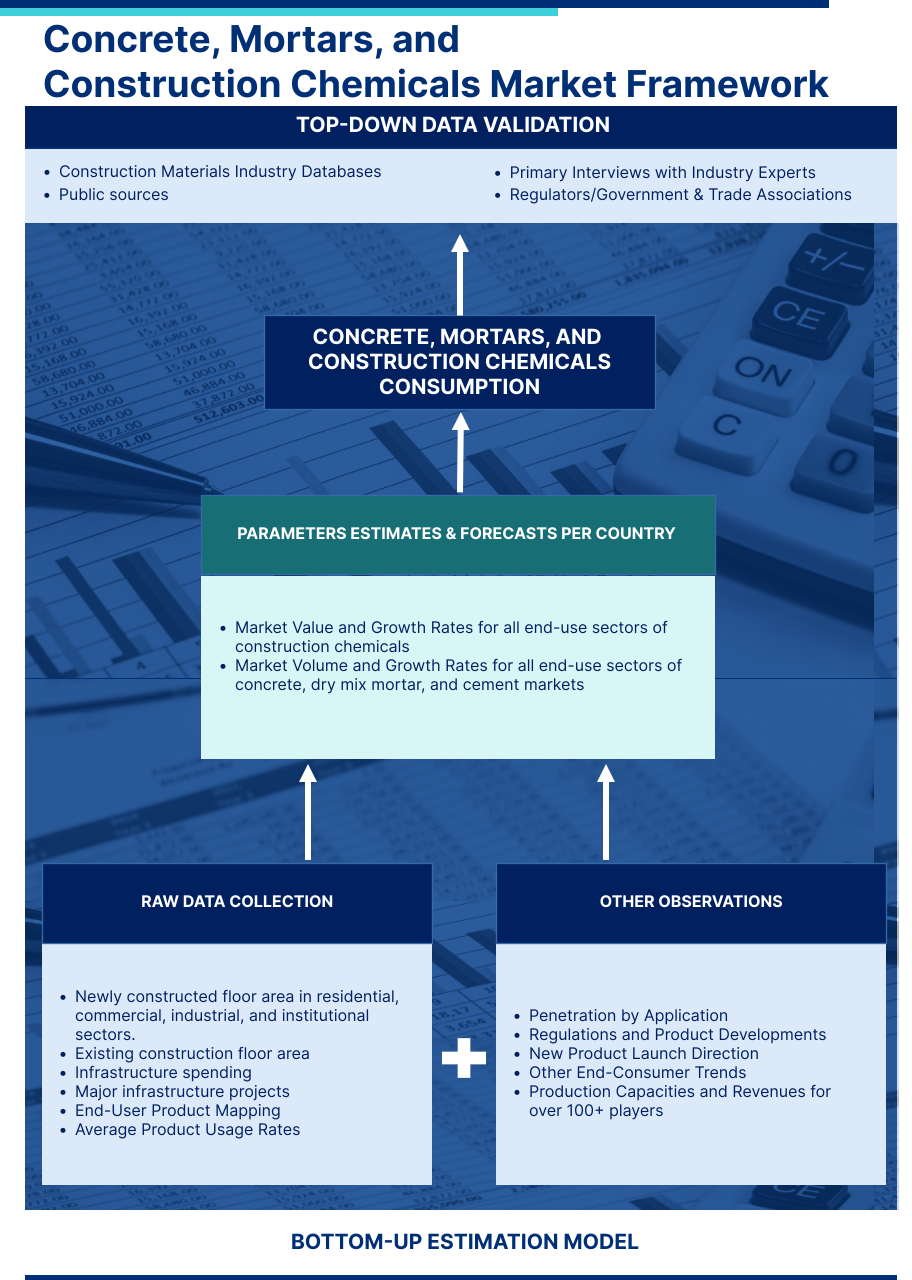
Mordor Intelligence follows a four-step methodology in all our reports.
- Step-1: Identify Key Variables: The quantifiable key variables (industry and extraneous) pertaining to the specific product segment and country are selected from a group of relevant variables & factors based on desk research & literature review; along with primary expert inputs. These variables are further confirmed through regression modeling (wherever required).
- Step-2: Build a Market Model: In order to build a robust forecasting methodology, the variables and factors identified in Step-1 are tested against available historical market numbers. Through an iterative process, the variables required for market forecast are set and the model is built on the basis of these variables.
- Step-3: Validate and Finalize: In this important step, all market numbers, variables and analyst calls are validated through an extensive network of primary research experts from the market studied. The respondents are selected across levels and functions to generate a holistic picture of the market studied.
- Step-4: Research Outputs: Syndicated Reports, Custom Consulting Assignments, Databases & Subscription Platforms