
Asia-Pacific Agricultural Drones Market Size and Share
Market Overview
| Study Period | 2021 - 2031 |
|---|---|
| Forecast Data Period | 2026 - 2031 |
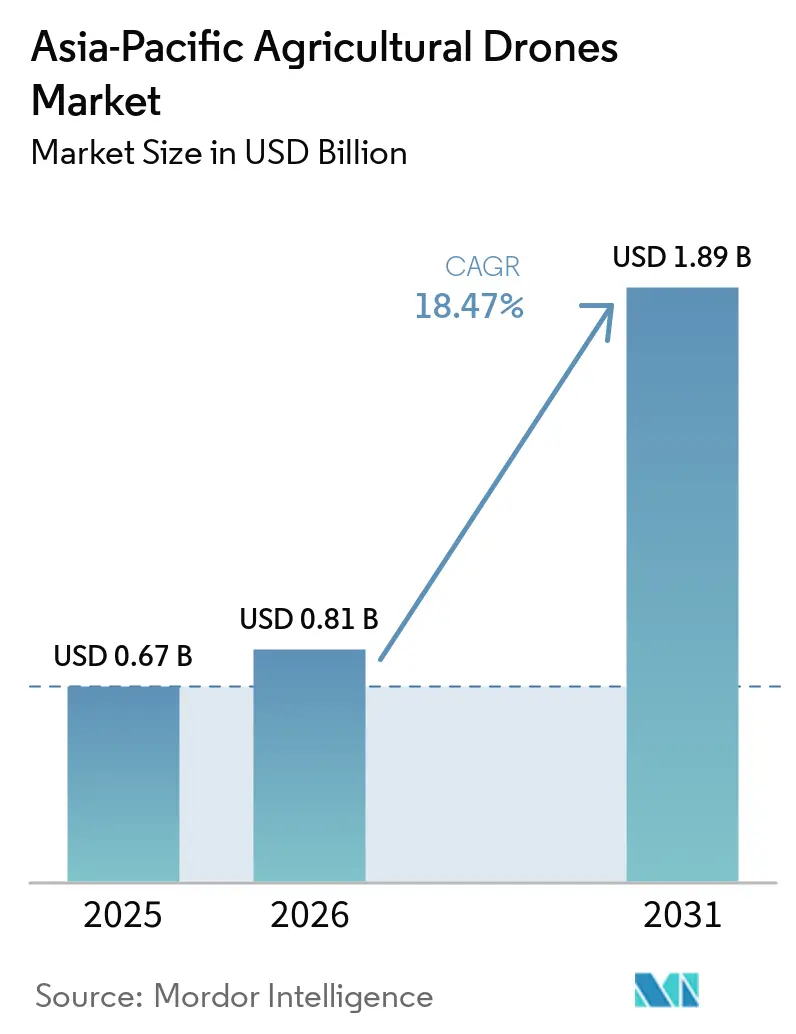
| Base Year Market Size (2025) | USD 0.67 Billion |
| Market Size (2026) | USD 0.81 Billion |
| Market Size (2031) | USD 1.89 Billion |
| Growth Rate (2026 - 2031) | 18.47 % |
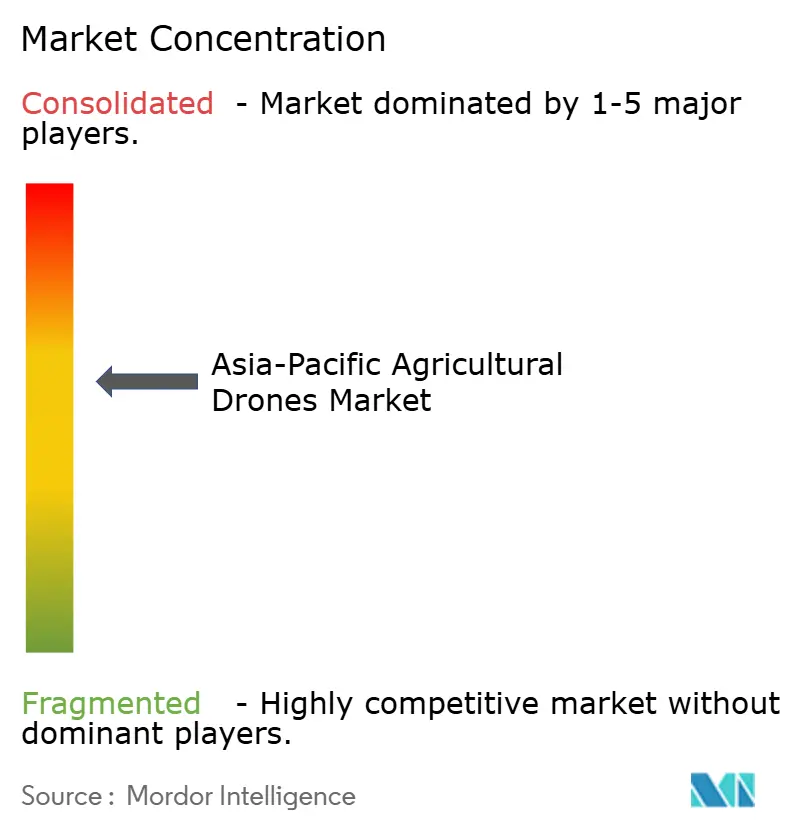
| Market Concentration | Medium |
Major Players *Disclaimer: Major Players sorted in no particular order Image © Mordor Intelligence. Reuse requires attribution under CC BY 4.0. | |
Asia-Pacific Agricultural Drones Market Analysis by Mordor Intelligence
The Asia-Pacific agricultural drones market was valued at USD 0.67 billion in 2025 and is forecast to grow from USD 0.81 billion in 2026 to reach USD 1.89 billion by 2031, at a CAGR of 18.47% during the forecast period (2026 to 2031). Three structural forces drive growth in the Asia-Pacific agricultural drone market. Government subsidy programs actively lower the cost of technology adoption, while an accelerating agricultural labor deficit across aging rural populations in Japan, South Korea, and parts of China is increasing the need for automation. The rapid proliferation of Drone-as-a-Service platforms is also supporting adoption by spreading hardware costs across thousands of small, fragmented farm plots. These forces do not operate independently. Subsidy programs across the region are frequently designed to drive service-model adoption rather than individual hardware purchases, creating a demand cycle that remains resistant to commodity price downturns.
Key Report Takeaways
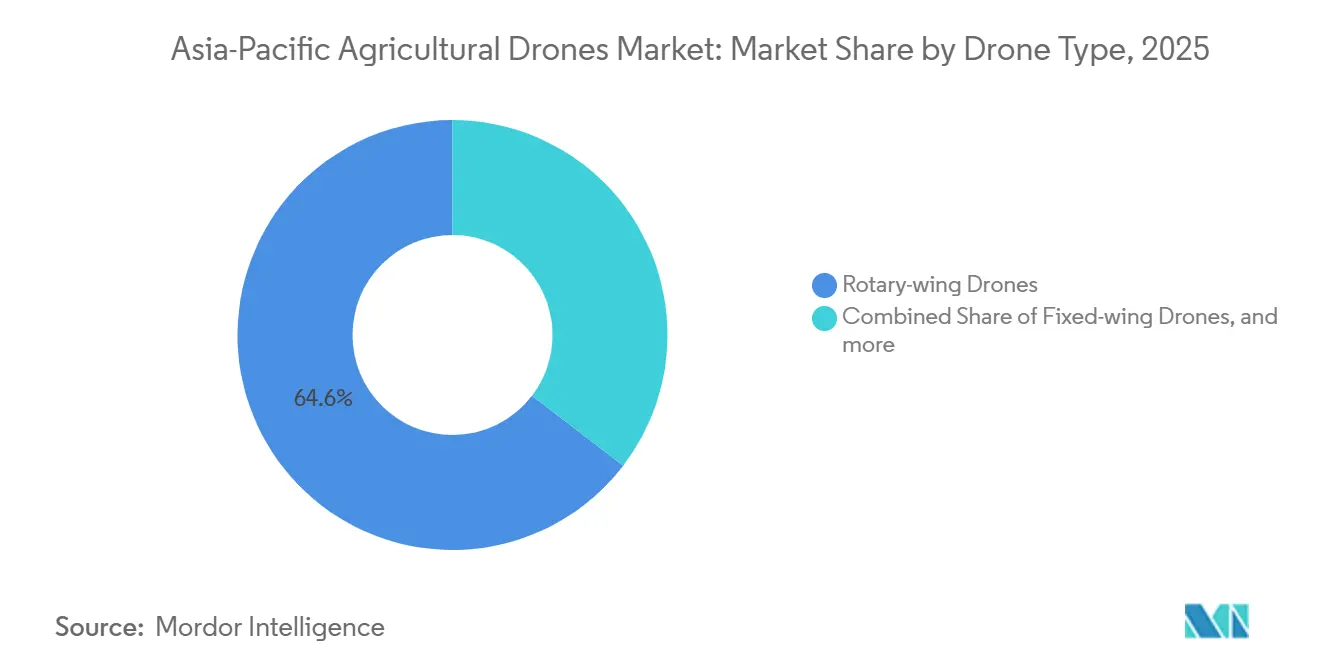
- By drone type, rotary-wing drones accounted for 64.6% of the Asia-Pacific agricultural drones market share in 2025, while hybrid drones are forecast to be the fastest-growing category, registering a CAGR of 21.0% from 2026 to 2031.
- By component, hardware accounted for 53.2% of the Asia-Pacific agricultural drones market size in 2025, while services are forecast to be the fastest-growing segment, registering a CAGR of 22.5% from 2026 to 2031.
- By application, crop spraying accounted for 46.8% of the market in 2025, while field mapping and surveying is forecast to be the fastest-growing segment, registering a CAGR of 21.5% from 2026 to 2031.
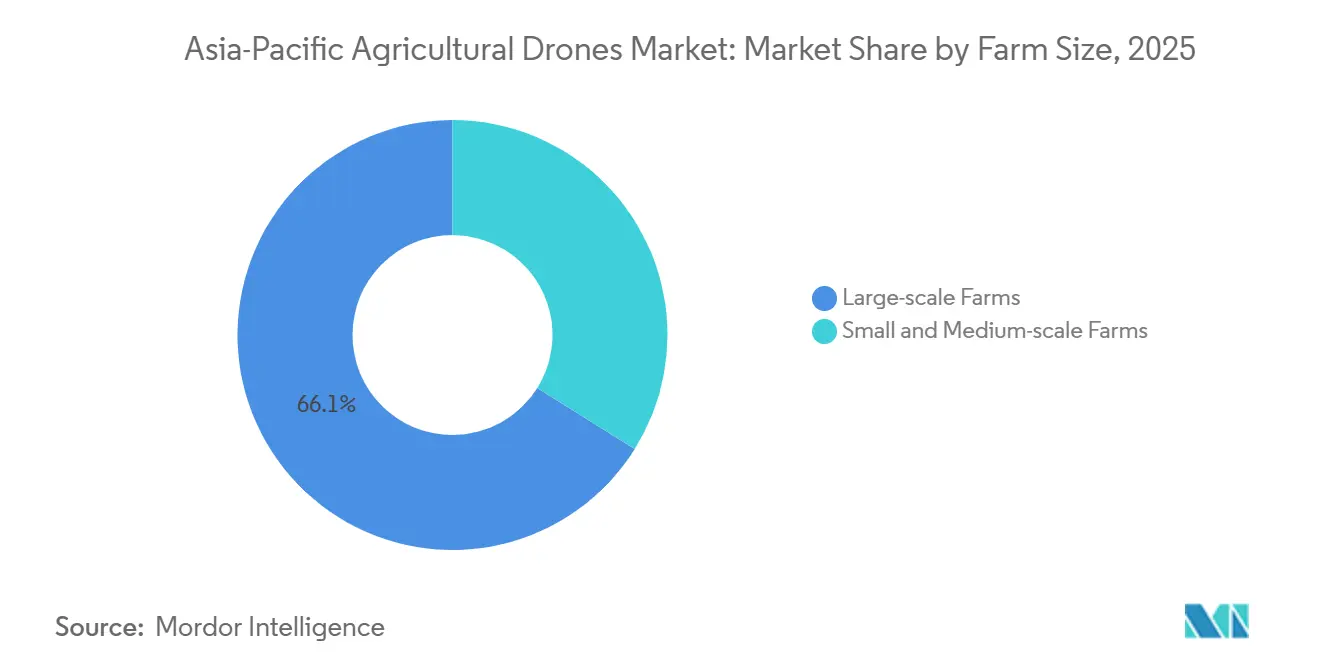
- By farm size, large-scale commercial farms accounted for 66.1% of the market in 2025, while small and medium farms scale are forecast to be the fastest-growing segment, registering a CAGR of 20.5% from 2026 to 2031.
- By geography, China accounted for 42.0% of the market in 2025, while Japan is forecast to be the fastest-growing country, registering a CAGR of 20.0% from 2026 to 2031.
Note: Market size and forecast figures in this report are generated using Mordor Intelligence’s proprietary estimation framework, updated with the latest available data and insights as of January 2026.
Asia-Pacific Agricultural Drones Market Trends and Insights
Drivers Impact Analysis*
| Driver | (~) % Impact on CAGR Forecast | Geographic Relevance | Impact Timeline |
|---|---|---|---|
| Government Subsidies and Precision-Agriculture Programs | +3.6% | China, India, Japan, South Korea, Philippines | Short term (≤ 2 years) |
| Agricultural Labor Shortages and Farm Automation | +3.3% | Japan, Australia, South Korea, China | Medium term (2-4 years) |
| Expansion of Drone Spraying and Drone-as-a-Service Models | +3.0% | India, Indonesia, Thailand, Vietnam, Philippines | Short term (≤ 2 years) |
| Rising Input Costs and Demand for Variable Rate Application | +2.8% | India, China, Australia, Southeast Asian plantation economies | Medium term (2-4 years) |
| Localized Swarm Operations for Smallholder and Fragmented Farms | +2.5% | China, India, Indonesia, Thailand, Vietnam | Long term (≥ 4 years) |
| Integration of Drone Data With Farm Credit, Insurance, and Traceability Systems | +2.0% | India, China, Australia, and export-oriented Southeast Asia | Long term (≥ 4 years) |
| Source: Mordor Intelligence | |||
Government Subsidies and Precision-Agriculture Programs
Government subsidies lower the initial cost of deploying agricultural drones and shorten the adoption cycle across the Asia-Pacific agricultural drones market. China added plant-protection drones to its 2025 scrappage-and-replacement subsidy program through a joint directive issued in February 2025. The program allowed operators to obtain enhanced purchase support when retiring older agricultural equipment[1]Xinhua News Agency, “China Expands Agricultural Equipment Subsidy Program,” Xinhua, english.news.cn.. Jiangsu, Sichuan, Anhui, Yunnan, and Inner Mongolia issued 2024 to 2026 implementation programs that extended support to smallholders and cooperatives. These programs also set annual use requirements, which linked subsidy payments to actual drone operations. Under the Sub-Mission on Agricultural Mechanization (SMAM), India provides purchase subsidies of 40% to 100% to eligible farmer-producer organizations and self-help groups for agricultural machinery and equipment, including agricultural drones. Japan provides smart agriculture grants that can cover up to 50% of eligible drone and precision-equipment costs[2]Ministry of Agriculture, Forestry and Fisheries, “Smart Agriculture,” Ministry of Agriculture, Forestry and Fisheries, maff.go.jp. Training and operating conditions can also increase the available pool of qualified operators, addressing a separate capacity constraint.
Agricultural Labor Shortages and Farm Automation
Labor shortages support the use of aerial systems where conventional farm work is becoming difficult to staff. Japan had an agricultural workforce of 1.1 million in 2024, a reduction of approximately 18% from 2020, thereby increasing the need for technologies to automate labor-intensive agricultural tasks[3]NTT Group, “Smart Agriculture Research,” NTT Group, group.ntt.. NTT and Hokkaido University began a joint project in April 2025 to develop digital-twin farms and autonomous multi-drone operations to reduce reliance on manual labor by automating field monitoring and other repetitive tasks. Their planned Smart Agriculture Operation Center model targets commercial deployment by 2030. In Japan, OPTiM Corporation covered 26,000 hectares across 110,000 fields in 133 municipalities through its Pinpoint Time Spraying service in fiscal year 2024, with more than 94% of its clients indicating an intention to renew for fiscal year 2025, indicating sustained demand for labor-saving drone services.
Expansion of Drone Spraying and Drone-as-a-Service Models
Agricultural drone adoption across the region is increasingly shifting from individual equipment purchases toward outsourced spraying and drone-service models, enabling more farmers to access the technology without the upfront cost of ownership. Aonic Sdn. Bhd secured a USD 10 million Series A round in March 2026 to expand its Malaysia-built agricultural drones, software, and agricultural services. The company reported that participating farms recorded a 50% increase in income, a 54% increase in output, and a 75% reduction in water use for spraying compared with manual methods. Terra Drone Corporation completed more than 200,000 hectares of agricultural service work, with activity reaching 4,000 flights per day at peak. The company reported pesticide application cost reductions of up to 30% for rice and palm oil farms in Indonesia. The Philippine Department of Agriculture introduced Drones4Rice in early 2025, in collaboration with PhilRice and the International Rice Research Institute, to standardize drone application protocols. Service contracts allow farmers to assess benefits over several seasons before purchasing equipment, making them a route to future equipment sales as well as service revenue.
Rising Input Costs and Demand for Variable Rate Application
Higher input costs make targeted application more relevant for farms seeking to reduce avoidable chemical use. Agricultural drones can apply products at variable rates and avoid repeated treatment of field edges. SZ DJI Technology Co., Ltd reported that precision spot spraying of weed patches can reduce herbicide use by up to 35%. This use case is relevant in India, China, Australia, and plantation economies in Southeast Asia, where operators manage varying crop conditions within the same farm. Crop maps and prescription workflows can direct spraying toward locations with identified needs, raising the value of mapping software and field data services alongside the aircraft itself. The commercial outcome depends on reliable field data and on operators who can translate that data into a usable application plan. The Asia-Pacific agricultural drones market therefore benefits when services combine crop observation with application, rather than treating them as separate tasks.
Restraints Impact Analysis*
| Restraint | (~) % Impact on CAGR Forecast | Geographic Relevance | Impact Timeline |
|---|---|---|---|
| High Acquisition and Lifecycle Costs for Advanced Systems | -3.5% | Asia-Pacific-wide, most binding for smallholder farms | Medium term (2-4 years) |
| Fragmented Aviation, Pesticide, and Data Regulations | -3.0% | Asia-Pacific multi-country deployments, Thailand, India, Malaysia | Short term (≤ 2 years) |
| Shortage of Certified Pilots and Agricultural Data Specialists | -2.5% | India, Southeast Asia, remote Australia | Medium term (2-4 years) |
| Patchy Rural Connectivity and Inconsistent Data Ownership Rules | -1.8% | India, Indonesia, Philippines, Vietnam, remote Australia | Long term (≥ 4 years) |
| Source: Mordor Intelligence | |||
High Acquisition and Lifecycle Costs for Advanced Systems
Advanced systems remain expensive for farms that cannot spread costs across large spray areas or multiple clients. The capital requirements include aircraft, batteries, payloads, and supporting equipment. Operators also require trained personnel, maintenance, software access, and reliable replacement parts over the life of a fleet. Smallholders often cannot justify these costs from a limited number of seasonal applications. The cost barrier is most restrictive where farms are fragmented, and each operation covers a small area. Subsidies and service models mitigate this challenge, but they do not eliminate lifecycle costs for the provider. Fleet owners still need sufficient recurring demand to maintain equipment utilization and recover the initial investment. This restraint helps explain why service networks are particularly important in the Asia-Pacific agricultural drone’s market.
Fragmented Aviation, Pesticide, and Data Regulations
Regulatory differences create additional costs and longer preparation times for providers operating across national borders. India requires type certification for each drone model, registration through the Digital Sky platform, and compliance with designated flight zones. Thailand introduced agricultural drone rules in August 2025 that required advance notification through the Unmanned Aircraft System Portal and limited operations to daylight hours. Malaysia introduced a Remote Certificate of Competency Agriculture Light module in 2025 for agricultural drone pilots. Aviation requirements must also align with pesticide approvals and data governance rules. A provider cannot assume that a procedure approved in one country can be applied in another. This regulatory complexity favors firms that have already established country-specific compliance teams and local partnerships. Smaller providers may face a slower and more costly path to regional expansion in the Asia-Pacific agricultural drones market.
*Our forecasts treat driver/restraint impacts as directional, not additive. The impact forecasts reflect baseline growth, mix effects, and variable interactions.
Segment Analysis
By Drone Type: Rotary-Wing Drones Dominate, While Hybrid Drones Register the Fastest Growth
Rotary-wing drones accounted for 64.6% of the drone-type share in 2025, the largest share in this category. Their hovering capability supports low-altitude spraying across paddy fields, wheat, orchards, and vegetable farms. Operators can adjust application rates and avoid excessive spraying at field edges. Fixed-wing platforms serve larger plantations, broadacre properties, and difficult terrain, with longer endurance improving coverage per charge. Hybrid vertical takeoff and landing designs combine endurance with flexible deployment, reducing the need for separate aircraft for mapping and scouting. Each platform must meet national aviation requirements.
Hybrid drones are the fastest-growing drone type, with a forecast CAGR of 21.0% from 2026 to 2031. Their vertical takeoff and landing capability, combined with longer flight endurance, supports flexible deployment for mapping, surveillance, and other agricultural applications where runway access is limited. Fixed-wing platforms continue to support mapping over larger land areas, while rotary-wing drones remain widely used for spraying and low-altitude agricultural operations. China requires licensing, while India uses phased approvals. Aeronext Inc. and MAZEX Co., Ltd formed a 2026 alliance for autonomous multi-drone operations in Japan. SZ DJI Technology Co., Ltd. tested AGRAS T50 spraying and aerial lifting in Thai durian orchards in 2026. These developments are supporting wider adoption of versatile drone platforms across diverse agricultural applications in the Asia-Pacific region.



By Component: Hardware Leads, While Services Register the Fastest Growth
Hardware accounted for 53.2% of component revenue in 2025. Aircraft systems remain capital-intensive, and many service providers own fleets. Software generates revenue through mission planning, precision analytics, and field-management tools, which are typically bundled with equipment and service contracts. Hardware suppliers benefit when systems are linked to data platforms. OPTiM covered 26,000 hectares across 110,000 fields in 133 municipalities during fiscal year 2024, with more than 94% of clients indicating intent to renew. Hardware remains important even as services account for a growing share of revenue.
Services are the fastest-growing component, with a forecast CAGR of 22.5% from 2026 to 2031. Outsourced spraying, mapping, and monitoring eliminate the need for farms to purchase aircraft, making this model suitable for farms that require occasional or seasonal services. Flight data and prescriptions can remain within the provider's software environment, making system changes costly for customers. Vendors without proprietary software may find it harder to protect margins. This shifts competition toward data interoperability and integration with farm-management or credit platforms, which can strengthen customer retention.
By Application: Crop Spraying Leads, While Field Mapping and Surveying Register the Fastest Growth
Crop spraying accounted for 46.8% of application revenue in 2025, making it the largest application segment in the Asia Pacific agricultural drones market. It provides operators with a direct means to improve the precision and efficiency of pesticide and fertilizer application while reducing labor requirements and input waste. SZ DJI Technology Co., Ltd. reported that precision spot spraying can reduce herbicide use by up to 35%. Crop monitoring/field surveillance, livestock monitoring, irrigation management, and soil and field analysis add specialized revenue streams, with livestock monitoring particularly relevant to Australia's large-station operations and precision agriculture applications gaining traction in India and China. Field mapping and surveying further expand the range of drone-based agricultural applications across the region.
Field mapping and surveying is the fastest-growing application, with a forecast CAGR of 21.5% from 2026 to 2031. Mapping is moving toward continuous crop-health monitoring and soil-variability assessment. Multispectral analysis can inform variable-rate applications and improve input use, while better mapping increases the value of spraying by enabling operators to act on observed field conditions. Drones4Rice established protocols for drone application of seed, fertilizer, and pesticides, positioning service providers as a formal input-distribution layer. Livestock monitoring supports properties where routine ground inspection is difficult, particularly in Australia, while crop monitoring/field surveillance, irrigation management, and soil and field analysis broaden drone applications across the region without displacing crop spraying's revenue leadership.
By Farm Size: Large-Scale Farms Lead, While Small and Medium Scale Farms Register the Fastest Growth
Large-scale farms held 53.6% of the farm-size share in 2025. Their capital resources and contiguous spray areas support fleet investment, and these farms often use drones as part of broader precision agriculture systems. High-payload systems are economical where they cover extensive areas, with SZ DJI Technology Co., Ltd.'s AGRAS T70P carrying 70 kilograms of chemicals and granules. Small and medium-scale farms have more customers by farm count, although their access depends on local service availability.
Small and medium-scale farms are the fastest-growing farm-size segment, with a forecast CAGR of 20.5% from 2026 to 2031. Growth is supported by the increasing availability of drone-as-a-service models, coordinated fleet operations, and subsidized agricultural drone services that reduce the need for direct equipment investment. A 2025 review published in Frontiers in Plant Science highlighted drones and remote sensing as important precision-agriculture technologies for crop monitoring, targeted interventions, and variable-rate application. The review noted that drone-based systems can help reduce input waste by enabling more precise application of pesticides and fertilizers, while also identifying high acquisition costs and limited technical skills as barriers for smallholder adoption. These findings support the role of service-based models in improving access to agricultural drones for smaller farms, although reliable local service delivery remains necessary for wider adoption.
Geography Analysis
China accounted for 42.0% of the Asia Pacific agricultural drones market in 2025, making it the largest country-level market in the region. Its position reflects manufacturing capacity, provincial subsidies, and uses from paddy farming to mountainous harvest logistics. China had approximately 3.3 million registered drones by the end of 2025, while 415,500 valid drone pilot certificates were recorded in 2025. Its 2024 to 2026 subsidy structure links support to verified outcomes, minimum use, and certified operators.
Japan is the fastest-growing country, with a CAGR of 20.0% from 2026 to 2031. Its workforce outlook makes automation important for maintaining farm productivity. Australia continues to present opportunities for agricultural drone adoption across broadacre farming, orchards, and livestock monitoring, while India remains an important market supported by the development of its agricultural drone ecosystem.
The Rest of the Asia-Pacific also presents opportunities for agricultural drone adoption through service-based models and expanding applications. Yanmar Holdings Co., Ltd.'s subsidiary Yanmar Diesel Indonesia and Terra Drone Corporation partnered in August 2025 to combine equipment distribution with spraying and mapping services. XAG Co., Ltd and Chia Tai opened a service center in Thailand in May 2025. The Philippines and Vietnam can build service demand before developing large bases of farm-owned drones, although regulations, training capacity, and connectivity are anticipated to influence adoption.
Competitive Landscape
The Asia-Pacific agricultural drones market is moderately concentrated, with SZ DJI Technology Co., Ltd., XAG Co., Ltd., Yamaha Motor Co., Ltd., Garuda Aerospace Pvt. Ltd., and Suzhou Eavision Robotic Technologies Co., Ltd. among the prominent players. SZ DJI Technology Co., Ltd reported more than 3,500 service centers, 7,000 certified instructors, and 600,000 agricultural drones deployed globally in 2026. It also reported cumulative savings of 410 million tonnes of water and 51 million tonnes of carbon emissions. XAG Co., Ltd. named Chia Tai as its Thailand distributor in January 2025. The companies opened a service center in May 2025 and planned localized production by 2028.
Yamaha Motor Co., Ltd. holds a specialized position in Japan through the FAZER R industrial unmanned helicopter. Garuda Aerospace Pvt Ltd, Marut Drones Pvt Ltd, IoTechWorld Avigation Pvt Ltd, and General Aeronautics benefit from certified domestic product lines in India. Type-certification requirements create a preference for compliant local platforms. Terra Drone Corporation competes through local operating depth and has completed more than 200,000 hectares of work in Indonesia. Daedong signed a SZ DJI Technology Co., Ltd supply agreement in July 2026 and plans to use 150 outlets to sell more than 1,000 units annually in South Korea.
Opportunities remain in livestock monitoring, variable-rate nutrition, and software connecting field data with farm management and rural credit. Service depth and local certification can help firms compete without matching leading hardware scale. Distribution partnerships can shorten training, maintenance, and parts-delivery timelines. The regional competitive balance, therefore, differs by national rules and local capabilities.
Asia-Pacific Agricultural Drones Industry Leaders
SZ DJI Technology Co., Ltd.
XAG Co., Ltd.
Yamaha Motor Co., Ltd.
Garuda Aerospace Limited
Suzhou Eavision Robotic Technologies Co., Ltd.
- *Disclaimer: Major Players sorted in no particular order

Recent Industry Developments
- July 2026: Daedong Corporation announced an official supply partnership with SZ DJI Technology Co., Ltd. to distribute DJI AGRAS T25, T50, and T70P agricultural drones across South Korea, targeting more than 1,000 units per year through 150 dealerships and service outlets.
- February 2026: Sumitomo Corporation and NTT e-Drone Technology started a marketing collaboration to expand adoption of domestically produced agricultural drones in Japan and began joint market research in Vietnam
- August 2025: Yanmar Diesel Indonesia and Terra Drone Corporation signed a sales partnership agreement for agricultural drones in Indonesia.


Asia-Pacific Agricultural Drones Market Report Scope
Agricultural drones are unmanned aerial vehicles used in farming activities such as crop spraying, field mapping, crop monitoring, and livestock monitoring to improve farm productivity and resource efficiency.
The Asia-Pacific Agricultural Drones Market Report is Segmented by Drone Type (Fixed-Wing Drones, Rotary-Wing Drones, and Hybrid Drones), by Component (Hardware, Software, and Services), by Application (Field Mapping and Surveying, Crop Spraying, Crop Monitoring/Field Surveillance, Livestock Monitoring, Irrigation Management, and Soil and Field Analysis), by Farm Size (Large-scale Farms and Small and Medium Scale Farms), and by Geography (China, India, Japan, Australia, and Rest of Asia-Pacific). The Market Forecasts are Provided in Terms of Value (USD)
| Fixed-wing Drones |
| Rotary-wing Drones |
| Hybrid Drones |
| Hardware |
| Software |
| Services |
| Field Mapping and Surveying |
| Crop Spraying |
| Crop Monitoring/Field Surveillance |
| Livestock Monitoring |
| Irrigation Management |
| Soil and Field Analysis |
| Large-scale Farms |
| Small and Medium scale Farms |
| China |
| India |
| Japan |
| Australia |
| Rest of Asia-Pacific |
| By Drone Type | Fixed-wing Drones |
| Rotary-wing Drones | |
| Hybrid Drones | |
| By Component | Hardware |
| Software | |
| Services | |
| By Application | Field Mapping and Surveying |
| Crop Spraying | |
| Crop Monitoring/Field Surveillance | |
| Livestock Monitoring | |
| Irrigation Management | |
| Soil and Field Analysis | |
| By Farm Size | Large-scale Farms |
| Small and Medium scale Farms | |
| By Geography | China |
| India | |
| Japan | |
| Australia | |
| Rest of Asia-Pacific |


Key Questions Answered in the Report
What is the size of the Asia-Pacific agricultural drones market?
The Asia-Pacific agricultural drones market is estimated at USD 0.81 billion in 2026 and is forecast to reach USD 1.89 billion by 2031, growing at a CAGR of 18.47% from 2026 to 2031.
Which drone type has the largest revenue share in Asia-Pacific agriculture?
Rotary-wing drones accounted for 64.6% of drone-type revenue in 2025, making them the largest product segment because they support low-altitude spraying and other agricultural operations.
Which agricultural drone application is growing fastest in Asia-Pacific?
Field mapping and surveying is the fastest-growing application, with a CAGR of 21.5% from 2026 to 2031, supported by increasing demand for crop monitoring, field assessment, and precision-agriculture applications.
Which country leads agricultural drone revenue in Asia-Pacific?
China accounted for 42.0% of regional revenue in 2025, making it the largest country-level market, supported by manufacturing capacity, subsidies, and a broad base of agricultural applications.
What limits wider agricultural drone use across Asia-Pacific?
High acquisition and lifecycle costs, fragmented regulations, shortages of certified operators, and inconsistent rural connectivity can delay wider adoption of agricultural drones across the region.
Page last updated on:





