
Asia-Pacific 5G Technology Market Size and Share
Market Overview
| Study Period | 2020 - 2031 |
|---|---|
| Forecast Data Period | 2026 - 2031 |
| Base Year Market Size (2025) | USD 80.22 Billion |
| Market Size (2026) | USD 94.85 Billion |
| Market Size (2031) | USD 221.18 Billion |
| Growth Rate (2026 - 2031) | 18.45 % |
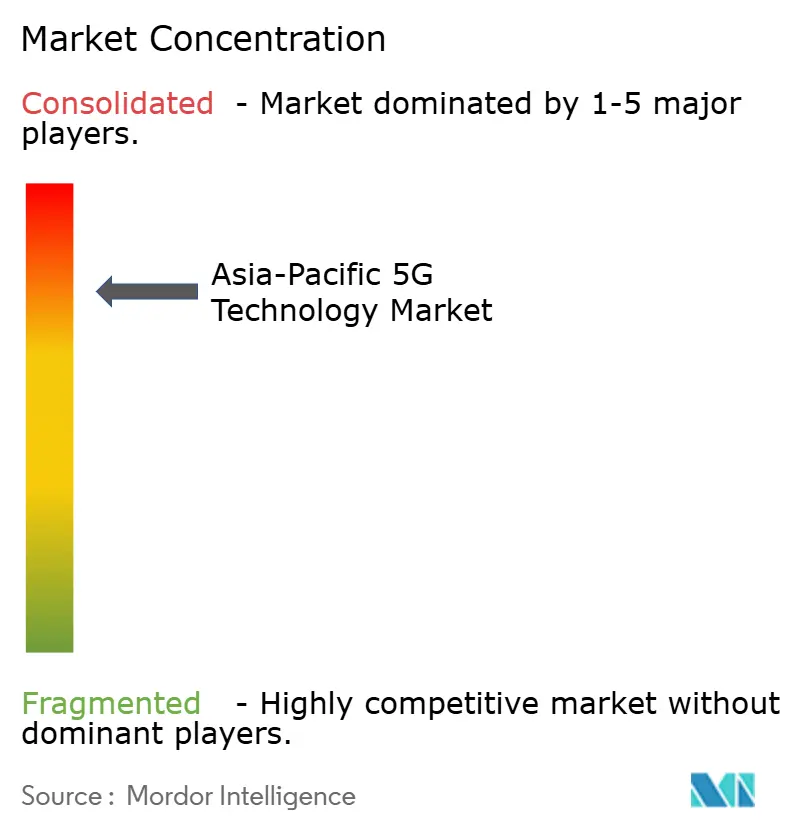
| Market Concentration | High |
Major Players *Disclaimer: Major Players sorted in no particular order Image © Mordor Intelligence. Reuse requires attribution under CC BY 4.0. | |
Asia-Pacific 5G Technology Market Analysis by Mordor Intelligence
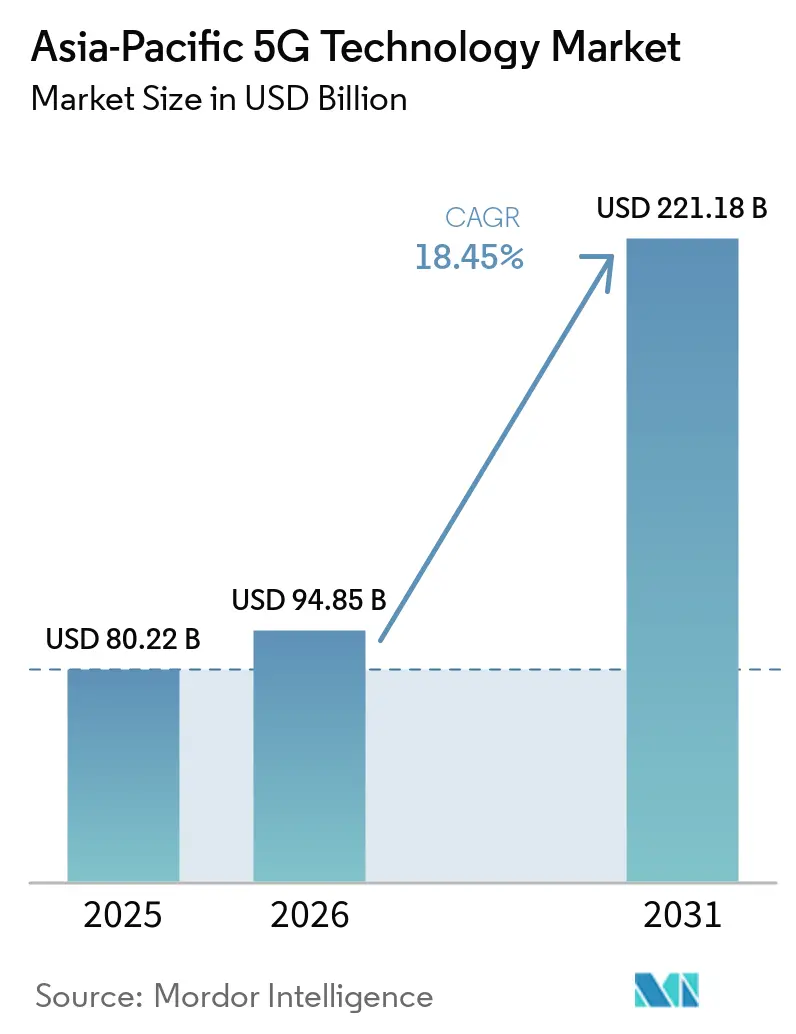
The Asia-Pacific 5G Technology Market size was valued at USD 80.22 billion in 2025 and is estimated to grow from USD 94.85 billion in 2026 to reach USD 221.18 billion by 2031, at a CAGR of 18.45% during the forecast period (2026-2031). The Asia-Pacific 5G technology market is being supported by concurrent network investment in Japan, South Korea, Singapore, Australia, China, India, and Southeast Asia. Consumer connectivity remains the largest source of revenue, while private networks, fixed wireless access, and cloud-based network functions are widening the commercial base. Operators are also shifting from early coverage deployment to capacity upgrades and services that support enterprise workloads. The pace of monetization will depend on access to harmonized mid-band spectrum, the cost of dense-network power use, and the ability to move from non-standalone to standalone networks. Vendor diversification, cloud-native cores, AI-driven radio functions, and network slicing are shaping procurement decisions across the Asia-Pacific 5G technology market.
Key Report Takeaways
- By component, hardware held 49.60% of the Asia-Pacific 5G Technology Market share in 2025, while services are projected to expand at a 19.61% CAGR through 2031.
- By spectrum band, sub-6 GHz accounted for 63.88% of the Asia-Pacific 5G technology market share in 2025, while hybrid (sub-6 GHz and mmWave) deployments are expected to advance at a 19.88% CAGR through 2031.
- By application, enhanced mobile broadband (eMBB) held 39.91% of the Asia-Pacific 5G technology market share in 2025, while FWA is projected to expand at a 20.92% CAGR through 2031.
- By end-user industry, the consumer segment held 43.12% of the Asia-Pacific 5G technology market share in 2025, while manufacturing is expected to expand at a 19.67% CAGR through 2031.
- By network architecture, non-stand-alone (NSA) held 57.59% of the Asia-Pacific 5G technology market share in 2025, while stand-alone (SA) is projected to expand at a 20.12% CAGR through 2031.
- By country, China held 50.82% of the Asia-Pacific 5G technology market share in 2025, while India is expected to expand at a 20.85% CAGR through 2031.
Note: Market size and forecast figures in this report are generated using Mordor Intelligence’s proprietary estimation framework, updated with the latest available data and insights as of January 2026.
Asia-Pacific 5G Technology Market Trends and Insights
Drivers Impact Analysis*
| Driver | (~) % Impact on CAGR Forecast | Geographic Relevance | Impact Timeline |
|---|---|---|---|
| Accelerating 5G Device Penetration Across Consumer and Enterprise Ecosystems | +3.8% | Global, with a near-term concentration in India and Southeast Asia | Short term (≤ 2 years) |
| Network Virtualization and Cloud-Native Core Migration | +3.1% | Japan, South Korea, Australia, Singapore, with spillover into Southeast Asia | Medium term (2-4 years) |
| Private 5G for Industrial Automation and Low-Latency Control | +2.6% | China, South Korea, Japan, Indonesia, and India | Medium term (2-4 years) |
| Open RAN Procurement in Cost-Sensitive Markets | +2.2% | India, Indonesia, Vietnam, and Japan, with spillover into Bangladesh and the Philippines | Medium term (2-4 years) |
| 5G-Advanced Upgrade Cycles Across Tier-1 Operators | +1.9% | Japan, South Korea, Singapore, Malaysia, Thailand, and Australia | Medium term (2-4 years) |
| Non-Standalone to Stand-Alone Transition to Unlock New Monetization Models | +1.5% | South Korea, Singapore, China, Australia, and early activity in India | Long term (≥ 4 years) |
| Source: Mordor Intelligence | |||
Accelerating 5G Device Penetration Across Consumer and Enterprise Ecosystems
5G device availability is widening the addressable subscriber base across the Asia-Pacific 5G technology market. India had more than 90% of smartphone shipments equipped for 5G in 2025, and monthly 5G traffic reached 12.9 exabytes. Qualcomm introduced Snapdragon 6 Gen 5 and Snapdragon 4 Gen 5 platforms in India in May 2026, supporting mid-range and entry-level device development.[1]Qualcomm, “Qualcomm Introduces Snapdragon 6 Gen 5 Mobile Platform,” Qualcomm, qualcomm.com India exceeded 500 million 5G subscriptions in Q1 2026, which reflects the rapid conversion of compatible devices into active connections. The same device supply chain can support industrial Internet of Things modules used in factories and logistics sites. This link between consumer-scale and enterprise equipment availability supports broader adoption of the Asia-Pacific 5G technology market.
Network Virtualization and Cloud-Native Core Migration
Cloud-native core migration is changing how operators build and manage the Asia-Pacific 5G technology market. NTT DOCOMO and NEC launched Japan’s first commercial 5G core on Amazon Web Services in March 2026.[2]NEC Corporation, “DOCOMO and NEC Launch Japan’s First Commercial 5G Core on AWS,” NEC Corporation, nec.com The hybrid environment used automated network construction methods and reduced power consumption by 70% through AWS Graviton2 processors. Ericsson signed a multiyear agreement with SoftBank in March 2026 to modernize core functions through cloud-native dual-mode 5G technology.[3]Ericsson, “Ericsson to Expand and Modernize SoftBank Corp.’s Core Network in Japan,” Ericsson, ericsson.com Tune Talk completed the first phase of a cloud-native 5G core modernization program in Malaysia during January 2026. These projects broaden the role of software, integration, and infrastructure partners in operator procurement. They also raise the importance of operational capability as the Asia-Pacific 5G technology market shifts from hardware-led deployment to software-managed networks.
Private 5G for Industrial Automation and Low-Latency Control
Private 5G deployments are becoming more relevant in manufacturing settings that require secure and predictable connectivity. Telkomsel and Pegatron implemented a standalone 5G infrastructure at an 85,000-square-meter smart factory in Batam, Indonesia. The facility connected more than 1,200 Internet of Things devices for AI-supported and automated production workflows.[4]Telkomsel, “Telkomsel Launches 5G for IoT and AI in PT Pegaunihan’s Smart Factory,” Telkomsel, telkomsel.com Industrial deployments require dependable communications for connected equipment, real-time analytics, and automation tasks. The Asia-Pacific 5G technology market, therefore, benefits when manufacturers treat connectivity as part of production infrastructure rather than as a separate technology cost. More standardized deployment models could also make private-network services accessible to smaller manufacturers. This demand supports the shift toward standalone networks, systems integration, and managed services.
Open RAN Procurement in Cost-Sensitive Markets
Open RAN is becoming a practical procurement option in select segments of the Asia-Pacific 5G technology market. 1Finity completed commercial deployment of Open RAN 5G radios in Rakuten Mobile’s nationwide Japanese network in May 2026. The deployment supports sub-6 GHz densification on the 3.7 GHz band. India, Indonesia, Vietnam, and Japan offer meaningful opportunities because policy and procurement priorities support vendor diversification. Disaggregated networks require greater integration effort than conventional single-vendor systems. That requirement creates demand for systems integration, software assurance, and managed operations. The Asia-Pacific 5G technology market can therefore gain new service revenue even when equipment procurement becomes more price-sensitive.
Restraints Impact Analysis*
| Restraint | (~) % Impact on CAGR Forecast | Geographic Relevance | Impact Timeline |
|---|---|---|---|
| Uneven Spectrum Harmonization Across APAC Economies | -2.4% | Indonesia, Thailand, the Philippines, and ASEAN core markets | Short term (≤ 2 years) |
| High Power Density and Site Energy Costs in Dense Urban Networks | -1.9% | China, India, and Southeast Asia, with early pressure in South Korea and Japan | Medium term (2-4 years) |
| Cybersecurity and Supply-Chain Trust Concerns in Critical Infrastructure Deployments | -1.5% | India, Australia, Japan, South Korea, and Southeast Asia | Long term (≥ 4 years) |
| Delayed Enterprise ROI for Private Network Rollouts | -1.2% | Asia-Pacific, with heightened sensitivity in Southeast Asia and South Asia | Long term (≥ 4 years) |
| Source: Mordor Intelligence | |||
Uneven Spectrum Harmonization Across Asia-Pacific Economies
Uneven spectrum availability can delay higher-value deployments in the Asia-Pacific 5G technology market. Indonesia and Thailand have faced constraints in the 3.5 GHz band because of existing satellite service use. The GSMA states that Asia-Pacific markets need an average of 2 GHz of mid-band spectrum to support full 5G deployment by 2030. Indonesia scheduled auctions for 700 MHz and 2.6 GHz spectrum during 2026, while future 3.5 GHz clearance remains material to capacity expansion. Limited access to harmonized bands can restrict the performance required by enterprise users. It can also postpone private-network sales and standalone core investment. National approaches to satellite use and legacy-network refarming will continue to shape deployment timing across the region.
High Power Density and Site Energy Costs in Dense Urban Networks
Power demand is a key operational constraint for dense deployments in the Asia-Pacific 5G technology market. A sub-6 GHz 5G site averaged 11.5 to 14 kilowatts, with peak usage reaching 19 kilowatts in a 2026 study. The same study compared this with a typical 4G site drawing 6 kilowatts. Dense mmWave deployments can increase the number of sites required for a given coverage area. Operators in Japan, South Korea, and Singapore are responding through more efficient radio hardware and sleep-mode software. Rapid site densification in Jakarta and Manila can create further cost pressure where grid reliability is uneven. Energy efficiency will remain central to network design, equipment selection, and operating margins.
*Our forecasts treat driver/restraint impacts as directional, not additive. The impact forecasts reflect baseline growth, mix effects, and variable interactions.
Segment Analysis
By Component: Hardware Leads as Services Redefine Revenue
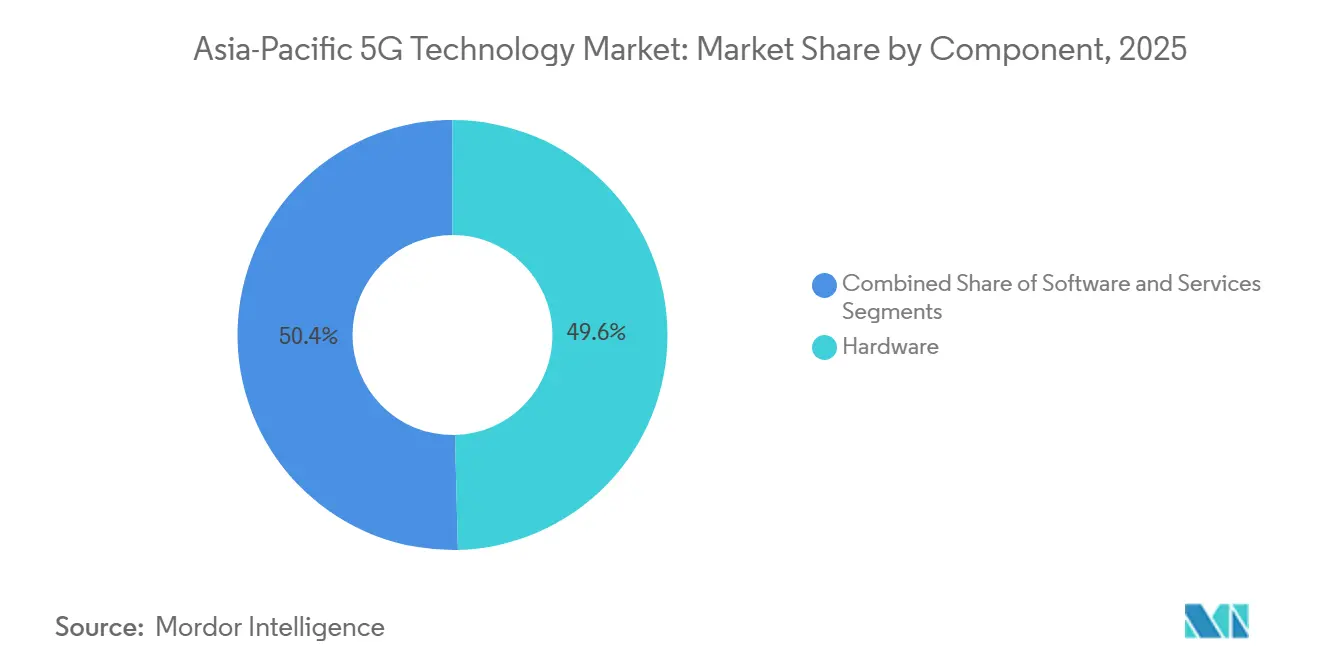
Hardware held 49.60% of the Asia-Pacific 5G technology market share in 2025. Active antenna units, base-station radios, and customer-premise equipment for fixed wireless access support this position. China had deployed 4.84 million 5G base stations by the end of 2025. This installed base shows the scale of the equipment cycle across China and other regional markets. Radio units and antennas remain necessary as operators extend coverage and add capacity. Customer equipment is also important when operators offer FWA services. Software supports network function virtualization, analytics, AI-enabled radio management, and cloud-native core orchestration. MediaTek introduced the M90 5G-Advanced modem in February 2025 with 3GPP Release 17 support, up to 12 Gbps downlink performance, and dual 5G SIM dual-active capability. These capabilities can support more advanced services around devices and edge applications.
Services are projected to expand at a 19.61% CAGR from 2026 to 2031 within the regional segment value. Managed services, private-network integration, and cloud-native core modernization will support this expansion. Open RAN can add integration requirements because network components are sourced separately. This shifts work that was previously handled within a single-vendor environment to specialized providers. Providers can also support testing, deployment, security, and ongoing network optimization. These needs are more visible as enterprise networks move from trials into operational use. The Asia-Pacific 5G technology industry is also seeing strong competition in the radio layer. Huawei, Ericsson, Nokia, ZTE, and Samsung are competing on massive MIMO, custom silicon, and AI-driven radio processing. Equipment efficiency and lifecycle cost will influence operator choices as networks become denser.



By Spectrum Band: Sub-6 GHz Anchors Coverage as Hybrid Deployments Scale
Sub-6 GHz held 63.88% of the regional 5G technology share by spectrum band in 2025. Its propagation characteristics support broad coverage and capacity in dense urban areas. The 3.5 GHz n78 band is widely used for commercial services in South Korea, Singapore, Malaysia, New Zealand, and Cambodia. It offers a practical balance of coverage, throughput, and equipment availability. mmWave is concentrated in high-density venues and enterprise campuses in Japan and South Korea. These deployments support high-capacity uses in factories and stadiums. Operators use different bands to meet local coverage, capacity, and spectrum conditions. Australia and Singapore completed 3G shutdowns in 2024, while New Zealand finalized its 2G and 3G shutdowns in early 2026. This refarming process can make lower-frequency spectrum available for 5G overlays.
Hybrid (sub-6 GHz and mmWave) deployments are projected to expand at a 19.88% CAGR from 2026 to 2031. Operators use this approach to add peak capacity without replacing their established radio networks. It allows operators to retain the broad reach of sub-6 GHz and add capacity where demand is highest. Optus and Ericsson demonstrated 180 MHz carrier aggregation across 2.3 GHz and 3.5 GHz bands on a live 5G standalone network in Australia in May 2026. The demonstration reached a peak downlink speed of 3.4 Gbps using commercial devices. This result shows that carrier aggregation can raise capacity within existing spectrum assets. Software-defined radio management is increasingly important for combining bands and managing capacity. The Asia-Pacific 5G technology market will depend on this capability as operators seek higher network utilization.
By Application: eMBB Scales While FWA Closes Broadband Gaps
Enhanced mobile broadband (eMBB) accounted for 39.91% of the regional 5G technology share in 2025. It remains the first large-scale revenue stream because operators initially focused on consumer data capacity. Advanced markets such as Japan and Australia will need enterprise-focused services as consumer adoption matures. eMBB still provides the network capacity needed for high-volume mobile data use. Massive machine-type communications support the needs of the industrial Internet of Things. Ultra-reliable low-latency communications support mission-critical uses as standalone coverage expands. These applications broaden the commercial scope beyond high-volume consumer data plans. They also give operators more service options for enterprise customers.
FWA is projected to expand at a 20.92% CAGR from 2026 to 2031 in the Asia-Pacific 5G technology market. It can extend broadband into rural and suburban areas where fiber construction is difficult to justify. Operators use FWA to combine mobile network assets with fixed broadband offerings. This model can improve the revenue case for capacity investment outside dense city centers. It also gives households and small businesses another route to high-speed connectivity. A wider FWA customer base raises the importance of dependable throughput and service quality. Those requirements can encourage further investment in standalone networks. The resulting link between access demand and network investment supports the Asia-Pacific 5G technology industry across equipment, software, and services.
By End-User Industry: Consumer Dominates as Manufacturing Absorbs Private Network Investment
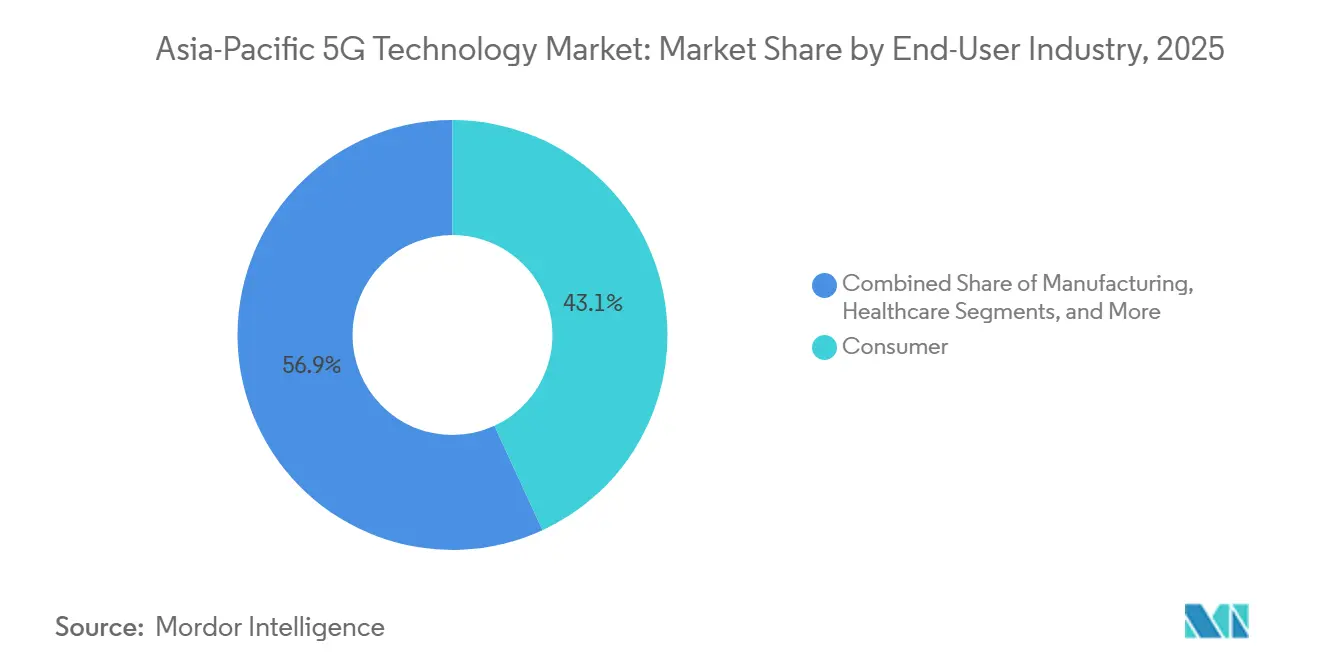
Consumer users held 43.12% of the regional 5G technology share in 2025. China, India, South Korea, and Japan provide the region’s largest subscriber bases. Consumer use supports the early scale of mobile data revenue and network utilization. Healthcare, automotive, energy and utilities, media and entertainment, and public safety and defense are developing as enterprise user groups. Media organizations use high-throughput connectivity for live streaming and augmented reality production. Public safety users can apply low-latency connectivity to mission-critical communications. Enterprise demand requires operators to deliver more tailored performance than mass-market consumer plans. The consumer share is expected to decline gradually as private-network contracts and managed connectivity add more enterprise revenue. This change can reduce reliance on consumer data plans as the only source of commercial returns.
Manufacturing is projected to expand at a 19.67% CAGR in the regional segment value from 2026 to 2031. Investment in automation, industrial policy, and practical deployment results supports demand for it. Manufacturers need communications systems that can connect machinery, sensors, workers, and operating data. Tech Mahindra, in partnership with Bharti Airtel, deployed a private 5G network at Mahindra Auto’s Chakan facility in India to support real-time analytics and connected robotics. GSMA documented private 4G and 5G deployments by Indosat Ooredoo Hutchison across Indonesian oil fields, mines, factories, and logistics sites. These projects achieved 99%-100% coverage and reduced operational downtime by nearly 30%. These operational results can strengthen the business case for future industrial deployments. Manufacturers can use them to assess connectivity alongside production efficiency and operational resilience.
By Network Architecture: NSA Anchors Scale as SA Drives Monetization Shift
NSA held 57.59% of the regional 5G technology share in 2025. Operators used established 4G cores to support early 5G radio rollouts. This approach allowed broad consumer coverage without an immediate core-network replacement. It reduced transition risk while operators were still building nationwide radio coverage. NTT DOCOMO, KDDI, SoftBank, and Rakuten Mobile first prioritized nationwide stability in Japan. NSA remains suitable for eMBB services and for markets still extending coverage. It gives operators a practical path where the immediate need is capacity rather than new network functions. Rakuten Mobile selected Cisco, Nokia, and F5 for its 5G standalone network in 2025. The multivendor configuration highlights the integration work associated with a standalone architecture.
SA is projected to expand at a 20.12% CAGR in the Asia-Pacific 5G technology market from 2026 to 2031. It supports low-latency services, private networks, network slicing, and more tailored service assurance. These functions can help operators develop enterprise offers that require specific network performance. South Korea required 5G base stations to connect to standalone core equipment by 2026. Singapore completed customer migration from NSA to SA during 2026, with M1 and StarHub completing the transition. China had an 80.9% standalone sample share in Q4 2025, more than 10 million 5G-Advanced subscribers, and more than 64,000 enterprise private networks. Standalone migration can increase integration needs in the near term. It gives operators a foundation for enterprise-grade offerings and more consistent quality control.
Geography Analysis
China held 50.82% of the Asia-Pacific 5G technology market share in 2025. The country had installed 4.84 million 5G base stations by the end of 2025. The GSMA projected USD 194.1 billion in network capital expenditure by Chinese mobile operators between 2025 and 2030. It also projected 1.8 billion 5G connections in China by 2030.
India is projected to expand at a 20.85% CAGR in the regional segment value from 2026 to 2031. The country is expected to have more than 1.1 billion 5G subscriptions by the end of 2031, representing an 81% subscription penetration rate. TRAI issued spectrum auction recommendations in February 2026 covering 11,789.15 MHz across 9 bands.
Australia and New Zealand are advanced markets with different spectra and network strategies. New Zealand completed 2G and 3G shutdowns in early 2026, freeing resources for 5G densification. Singapore completed the NSA-to-SA customer migration during 2026. Vietnam reached 10 Gbps in a 5G-Advanced live trial during 2025 and had 30,000 5G stations covering 90% of its outdoor area by the end of 2025. Indonesia and Thailand remain affected by mid-band constraints, although new auctions and modernization are supporting further deployment.
Competitive Landscape
The Asia-Pacific 5G technology market is consolidated in radio access networks and core network infrastructure. Huawei, Ericsson, Nokia, ZTE, and Samsung accounted for 95% of global RAN revenue in H1 2026. Huawei remained strongest in China and retained a substantial presence in Southeast Asia. Ericsson secured supply agreements with SoftBank, KDDI, and NTT DOCOMO during 2026.
Competition is extending into software, integration, and managed services across the Asia-Pacific 5G technology market. Open RAN providers such as Mavenir and Parallel Wireless are seeking opportunities in India and Southeast Asia. NEC and NTT DOCOMO launched Japan’s first commercial 5G core on Amazon Web Services in March 2026. Their project used infrastructure-as-code and automated network construction methods. This approach shows how cloud-based operating models are becoming part of competitive positioning.
The Asia-Pacific 5G technology market offers opportunities in Open RAN integration, private 5G managed services, and cloud-native core software. Qualcomm introduced the Dragonwing X105 modem-RF system at MWC 2026 with 3GPP Release 19 support. MediaTek and Samsung completed a 3Tx 5-layer uplink configuration test in June 2026 using the M90 modem and Samsung's virtualized RAN. Operators will weigh performance, energy use, integration capabilities, and supply chain trust when selecting partners. The largest suppliers remain strong, but software-based architectures create room for specialized providers.
Asia-Pacific 5G Technology Industry Leaders
Huawei Technologies Co., Ltd.
Telefonaktiebolaget LM Ericsson (Ericsson)
Nokia Corporation
ZTE Corporation
Samsung Electronics Co., Ltd.
- *Disclaimer: Major Players sorted in no particular order

Recent Industry Developments
- July 2026: 1Finity, a Fujitsu company, announced the commercial deployment of Open RAN 5G compact radios in Rakuten Mobile's nationwide network in Japan, which was completed in May 2026. The energy-efficient radios are delivering 5G Sub-6 GHz (3.7 GHz) network densification across Japan, based on the rollout plan announced by Rakuten Mobile and Fujitsu in March 2025.
- June 2026: Nokia and Indosat Ooredoo Hutchison signed a nationwide 5G modernization agreement in Indonesia, deploying Nokia's Habrok and Pandion radio families with AI-driven automation. The deal, backed by Nokia's NVIDIA AI-RAN partnership, targets low-band 5G deployment across the full network footprint and mid-band 5G covering approximately 80% of the network over the next 3.5 years, with live field trials on Indosat's network planned by end-2026 and commercial AI-RAN rollout expected in 2027.
- May 2026: Optus and Ericsson achieved a world-first on a live commercial 5G SA network in Australia, 180 MHz of carrier aggregation across the 2.3 GHz and 3.5 GHz spectrum bands, reaching peak downlink speeds of 3.4 Gbps using commercial off-the-shelf devices, including the Samsung Galaxy S26 Ultra.
- March 2026: Ericsson signed a multi-year framework agreement with SoftBank Corp. in Japan to deploy cloud-native dual-mode 5G core solutions, migrating nationwide access and mobility management, voice gateway, and policy control functions to a containerized architecture on Ericsson's CNIS, and strengthening SoftBank's foundation for 5G-Advanced use cases.


Asia-Pacific 5G Technology Market Report Scope
The Asia-Pacific 5G technology market revenue is generated through the sale of 5G network hardware, software licenses and subscriptions, network deployment and integration, managed and professional services, maintenance, and other 5G connectivity solutions supporting eMBB, FWA, mMTC, and URLLC applications across consumer, manufacturing, healthcare, automotive, energy and utilities, media and entertainment, and public safety and defense sectors.
The Asia-Pacific 5G technology market report is segmented by component (hardware, software, and services), spectrum band (sub-6 GHz, mmWave, and hybrid (sub-6GHz and mmWave)), application (enhanced mobile broadband (eMBB), fixed wireless access (FWA), massive machine-type communications (mMTC), and ultra-reliable low-latency communications (URLLC)), end-user industry (consumer, manufacturing, healthcare, automotive, energy and utilities, media and entertainment, and public safety and defense), network architecture (stand-alone (SA) and non-stand-alone (NSA)), and country (China, Japan, India, South Korea, Australia and New Zealand, and rest of Asia-Pacific). The market forecasts are provided in terms of value (USD).
| Hardware |
| Software |
| Services |
| Sub-6 GHz |
| mmWave |
| Hybrid (Sub-6 GHz and mmWave) |
| Enhanced Mobile Broadband (eMBB) |
| Fixed Wireless Access (FWA) |
| Massive Machine-Type Communications (mMTC) |
| Ultra-Reliable Low-Latency Communications (URLLC) |
| Consumer |
| Manufacturing |
| Healthcare |
| Automotive |
| Energy and Utilities |
| Media and Entertainment |
| Public Safety and Defense |
| Stand-Alone (SA) |
| Non-Stand-Alone (NSA) |
| China |
| Japan |
| India |
| South Korea |
| Australia and New Zealand |
| Rest of Asia-Pacific |
| By Component | Hardware |
| Software | |
| Services | |
| By Spectrum Band | Sub-6 GHz |
| mmWave | |
| Hybrid (Sub-6 GHz and mmWave) | |
| By Application | Enhanced Mobile Broadband (eMBB) |
| Fixed Wireless Access (FWA) | |
| Massive Machine-Type Communications (mMTC) | |
| Ultra-Reliable Low-Latency Communications (URLLC) | |
| By End-User Industry | Consumer |
| Manufacturing | |
| Healthcare | |
| Automotive | |
| Energy and Utilities | |
| Media and Entertainment | |
| Public Safety and Defense | |
| By Network Architecture | Stand-Alone (SA) |
| Non-Stand-Alone (NSA) | |
| By Country | China |
| Japan | |
| India | |
| South Korea | |
| Australia and New Zealand | |
| Rest of Asia-Pacific |


Key Questions Answered in the Report
What is the Asia-Pacific 5G technology market size?
The Asia-Pacific 5G technology market was valued at USD 80.22 billion in 2025, stands at USD 94.85 billion in 2026, and is projected to reach USD 221.18 billion by 2031. This reflects a forecast CAGR of 18.45% during 2026-2031, supported by continued investment in coverage, capacity, and service platforms.
What is driving 5G adoption across Asia-Pacific?
Device availability, cloud-native core migration, private 5G deployments, Open RAN procurement, and 5G-Advanced upgrades are supporting adoption. Spectrum availability, energy efficiency, and enterprise returns will shape the pace of deployment across countries with different infrastructure conditions and regulatory priorities.
Which component leads 5G technology spending in Asia-Pacific?
Hardware led with a 49.60% share in 2025, supported by radio equipment, active antennas, and fixed wireless access equipment. Services are expected to expand at a 19.61% CAGR as operators need deployment, integration, managed support, network testing, ongoing optimization, security integration, and technical support throughout the full operating life of deployed systems.
Which application is expanding fastest through 2031?
Fixed wireless access is projected to expand at a 20.92% CAGR, as operators extend broadband coverage in areas where fiber deployment is difficult. FWA also encourages investment in reliable capacity and standalone architecture, particularly where operators use mobile networks to deliver fixed broadband access.
Which country is expected to expand fastest through 2031?
India is expected to expand at a 20.85% CAGR from 2026 to 2031, supported by rapid subscriber adoption and wider FWA deployment. It crossed 500 million 5G subscriptions in Q1 2026, creating a larger base for consumer broadband and enterprise connectivity services.
Why is standalone 5G important for operators?
Standalone 5G supports low-latency services, private networks, network slicing, and tailored service assurance for enterprise users. It can help operators move beyond mass-market data plans and serve more specialized connectivity requirements for industrial, public-sector, and business users.
Page last updated on:





