
Asia-Pacific 5G Services Market Size and Share
Market Overview
| Study Period | 2020 - 2031 |
|---|---|
| Forecast Data Period | 2026 - 2031 |
| Base Year Market Size (2025) | USD 44.27 Billion |
| Market Size (2026) | USD 59.02 Billion |
| Market Size (2031) | USD 102.64 Billion |
| Growth Rate (2026 - 2031) | 11.70 % |
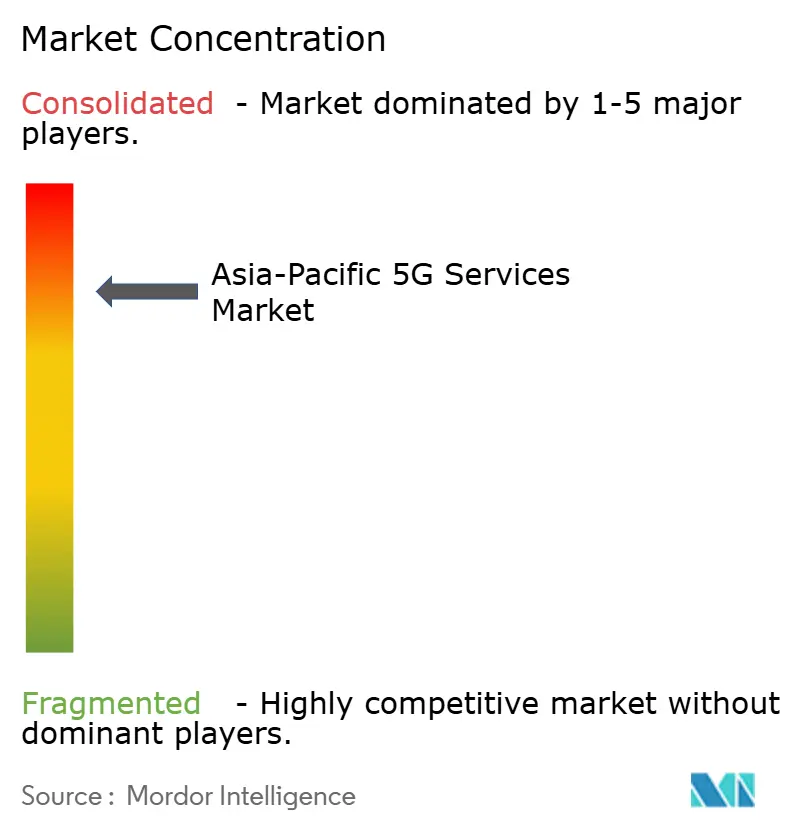
| Market Concentration | High |
Major Players *Disclaimer: Major Players sorted in no particular order Image © Mordor Intelligence. Reuse requires attribution under CC BY 4.0. | |
Asia-Pacific 5G Services Market Analysis by Mordor Intelligence
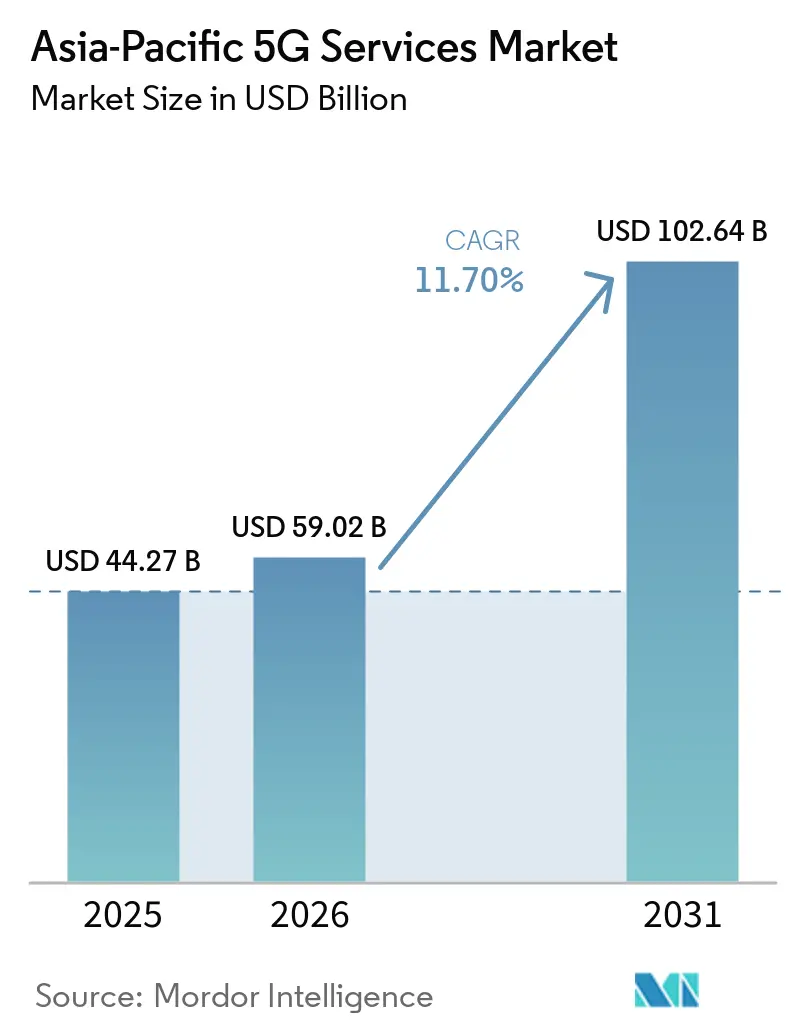
The Asia-Pacific 5G Services Market size is expected to grow from USD 44.27 billion in 2025 to USD 59.02 billion in 2026 and is forecast to reach USD 102.64 billion by 2031 at 11.70% CAGR over 2026-2031.
The Asia-Pacific 5G services market is being shaped by operators moving from Non-Standalone networks toward Standalone cores, which can support lower-latency services and more tailored enterprise connections. Rising mobile traffic is increasing the need for additional capacity, particularly in China and India, while dense urban demand is raising the value of mid-band and millimeter-wave spectrum. Operators are also shifting investment toward AI-enabled radio networks and edge computing, which can create revenue beyond consumer data plans. This change is important because unlimited consumer plans can raise traffic while limiting revenue per unit of data, increasing the need for fixed wireless access, managed enterprise services, and application bundles. The Asia-Pacific 5G services market also faces uneven spectrum availability, device affordability barriers, and higher site energy costs, which may widen the gap between more advanced networks and emerging markets.
Key Report Takeaways
- By service type, enhanced mobile broadband held 62.97% of the Asia-Pacific 5G services market share in 2025, while massive machine-type communications is projected to expand at a 12.18% CAGR through 2031.
- By network architecture, Non-Standalone 5G held 66.31% of the Asia-Pacific 5G services market share in 2025, while Standalone 5G is projected to expand at a 12.52% CAGR through 2031.
- By frequency band, mid band accounted for 69.21% of the Asia-Pacific 5G services market size in 2025, while millimeter-wave is projected to expand at a 12.36% CAGR through 2031.
- By end-user industry, IT and telecom held 29.63% of the Asia-Pacific 5G services market share in 2025, while manufacturing, energy and utilities is projected to expand at a 13.04% CAGR through 2031.
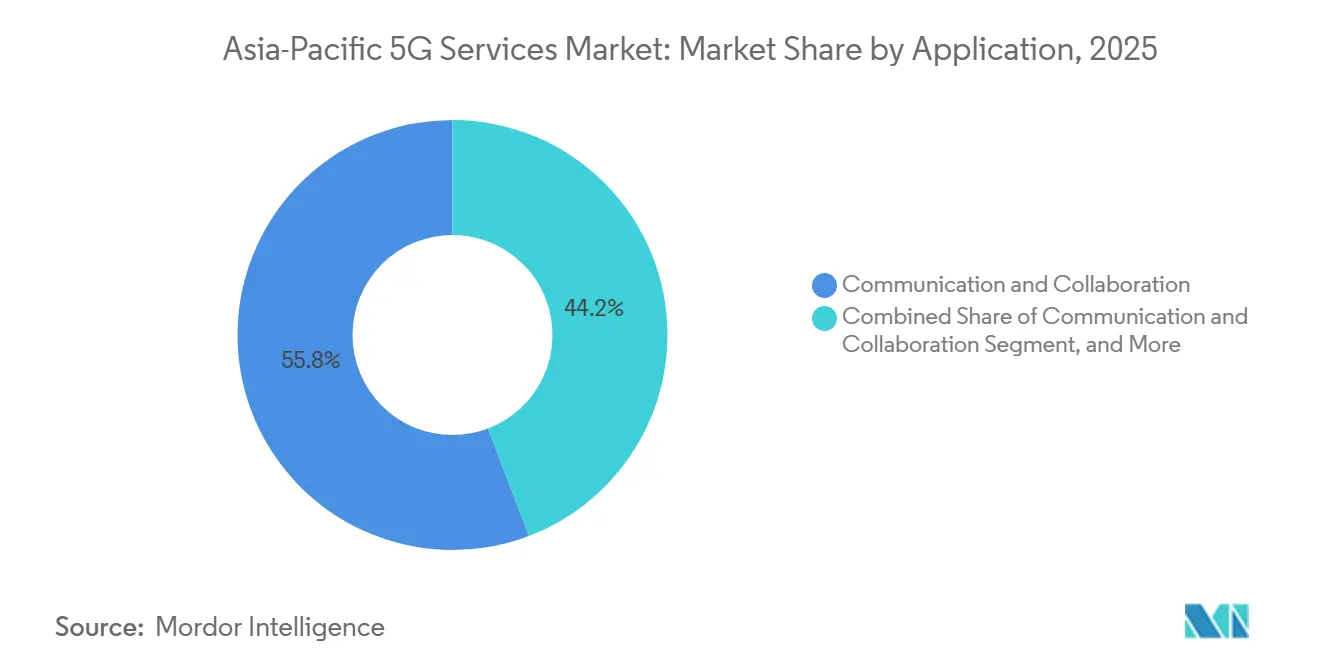
- By application, communication and collaboration held 55.78% of the Asia-Pacific 5G services market size in 2025, while Industry 4.0 is projected to expand at a 12.97% CAGR through 2031.
- By geography, China accounted for 51.12% of the regional revenue in 2025, while India is projected to expand at a 12.07% CAGR through 2031.
Note: Market size and forecast figures in this report are generated using Mordor Intelligence’s proprietary estimation framework, updated with the latest available data and insights as of January 2026.
Asia-Pacific 5G Services Market Trends and Insights
Drivers Impact Analysis*
| Driver | (~) % Impact on CAGR Forecast | Geographic Relevance | Impact Timeline |
|---|---|---|---|
| Mobile Data Traffic Growth | +2.1% | Global, concentrated in Northeast Asia and South Asia, including China and India | Short term (≤ 2 years) |
| AI-RAN and Edge-Cloud Demand | +1.9% | Japan, South Korea, and China, with spillover to Indonesia and India | Medium term (2-4 years) |
| Consumer Demand for Enhanced Mobile Broadband | +1.7% | China and India, with spillover to Malaysia, Vietnam, and Thailand | Short term (≤ 2 years) |
| Enterprise Digital Transformation Use Cases | +1.4% | China, South Korea, Singapore, and Australia, with spillover to India and Indonesia | Medium term (2-4 years) |
| Government Spectrum Release Initiatives | +1.1% | Indonesia, India, Vietnam, and the Philippines | Short term (≤ 2 years) |
| Cross-Border 3.5 GHz Harmonization and Roaming Gaps | +0.8% | Southeast Asia, Japan, and South Korea | Long term (≥ 4 years) |
| Source: Mordor Intelligence | |||
Exploding Mobile Data Traffic Reshapes Network Capacity Economics
5G carried 48% of global mobile data traffic at the end of 2025, compared with 34% at the end of 2024, and its share is forecast to reach 85% by 2031. Northeast Asia recorded average monthly traffic of 23 GB per active smartphone in 2025, and usage is forecast to reach 45 GB by 2031. Southeast Asia and Oceania recorded 21 GB per active smartphone in 2025, and usage is forecast to reach 40 GB by 2031. Network traffic, including fixed wireless access, increased 22% year over year in Q1 2026, led by India and Northeast Asia. Demand is concentrated at certain hours and locations, so operators need denser capacity and better traffic management rather than uniform network expansion. The Asia-Pacific 5G services market therefore benefits from sustained infrastructure spending, even as operators seek lower-cost ways to handle peak demand.
AI-RAN and Edge-Cloud Workloads Drive a New Revenue Layer for Operators
AI-RAN can use base-station computing resources for AI workloads and may give operators a revenue source beyond traditional data pricing. KT Corporation and Samsung Electronics validated AI-RAN optimization on KT's commercial 5G network in December 2025, using user-level AI configurations to reduce service disruption. SoftBank made its AITRAS platform commercially available in 2026, enabling third-party industrial edge workloads on GPU resources at base stations. South Korea's Ministry of Science and ICT selected SK Telecom and KT-led consortia for a KRW 16 billion, USD 11.4 million, Hyper AI Network pilot in July 2026. Nokia and Indosat Ooredoo Hutchison signed a multiyear agreement in June 2026 to modernize Indonesia's 5G radio network and develop AI-RAN services, with field trials planned by the end of 2026. These projects show that the Asia-Pacific 5G services market is increasingly linked to enterprise computing and industrial applications.
High Consumer Demand for Enhanced Mobile Broadband Strains Legacy ARPU Models
Enhanced mobile broadband remains the main consumer revenue base for the Asia-Pacific 5G services market. India shipped more than 90% 5G-enabled smartphones in 2025, while monthly 5G data traffic rose 70% year over year to 12.9 exabytes. Reliance Jio had 285 million True5G subscribers in June 2026, and its 5G users generated 1.5 times the data traffic of 4G customers. Jio AirFiber reached 13 million subscribers in FY26, demonstrating the role of fixed wireless access in extending the value of 5G capacity. Singapore completed its nationwide 5G Standalone transition in 2026, making network slicing, Voice over New Radio, and lower latency more relevant competitive features. Operators will need to connect these network features to services customers are willing to pay for, rather than relying only on larger data allowances.
Enterprise Digital Transformation Use Cases Accelerate B2B Revenue Diversification
Private 5G networks are gaining traction across manufacturing, logistics, energy, and healthcare. A GSMA Foundry survey conducted in December 2025 found that 67% of hospital leaders across 7 Asia-Pacific markets expected to increase 5G investment. Operational efficiency, virtual care, and patient monitoring were key use cases in the survey. Indosat Ooredoo Hutchison deployed private 4G and 5G networks at Indonesian oil fields, mines, factories, and logistics locations, achieving 99-100% coverage and reducing downtime by nearly 30%. Enterprise customers increasingly require service-level commitments and security compliance under standards such as IEC 62443 and ISO/IEC 27001. This shifts competition toward providers that can combine connectivity, managed services, and industry-specific operational support.
Restraints Impact Analysis*
| Restraint | (~) % Impact on CAGR Forecast | Geographic Relevance | Impact Timeline |
|---|---|---|---|
| High Deployment Costs and Long Return Horizons | -1.8% | Global, most acute in Southeast Asia and rural India | Short term (≤ 2 years) |
| Limited 5G Device Readiness | -1.5% | Indonesia, the Philippines, Vietnam, and Bangladesh | Short term (≤ 2 years) |
| Fragmented Southeast Asian Spectrum Policy | -1.3% | Indonesia and Thailand, with broader ASEAN implications | Medium term (2-4 years) |
| Power Grid Constraints and Site Energy Costs | -1.1% | South Asia and Southeast Asia, with spillover to secondary cities in China and India | Long term (≥ 4 years) |
| Source: Mordor Intelligence | |||
High Deployment Costs and Long Return Horizons Constrain Network Densification
Dense 5G deployments require antenna-integrated radios, baseband equipment, optical fronthaul, and software, which can extend ownership costs across a 7-year life cycle. Antenna-integrated radios account for 45-55% of a dense site's bill of materials. China Mobile spent RMB 150.9 billion, USD 20.8 billion, on capital expenditure in FY2025 and plans RMB 136.6 billion, USD 18.8 billion, in 2026 as it directs more spending toward computing and AI infrastructure.[1]China Mobile Limited, “2025 Annual Results,” China Mobile Investor Relations, chinamobileltd.com. The transition from Non-Standalone to Standalone cores can further delay returns because operators must invest before all enterprise features become commercially available. South Korea required 5G base stations to connect to Standalone core equipment by 2026 and offered lower LTE spectrum reallocation fees for qualifying indoor 5G deployments. The Asia-Pacific 5G services market will depend on operators matching investments with contracts that recognize the value of reliable, low-latency service.
Limited 5G Device Readiness Delays Revenue Ramp in Emerging Markets
Device affordability can limit 5G adoption even where network coverage is available. Indonesia's 5G penetration was 2% in 2025 after its 2021 launch, reflecting the cost barrier facing many consumers. 5G accounted for 35% of Indonesian smartphone shipments in Q2 2025, supported by lower-priced devices, but wider upgrade cycles remain sensitive to household budgets. Smartphone shipments across Southeast Asia fell 9% year over year in Q1 2026, delaying replacement demand in price-sensitive markets. This can weaken near-term returns from spectrum and network investment in Indonesia, the Philippines, Vietnam, and Cambodia. Operators may need handset financing and targeted device offers alongside network expansion to improve adoption and service revenue.
*Our forecasts treat driver/restraint impacts as directional, not additive. The impact forecasts reflect baseline growth, mix effects, and variable interactions.
Segment Analysis
By Service Type: Enhanced Mobile Broadband Holds the Revenue Base While mMTC Gains Industrial Use
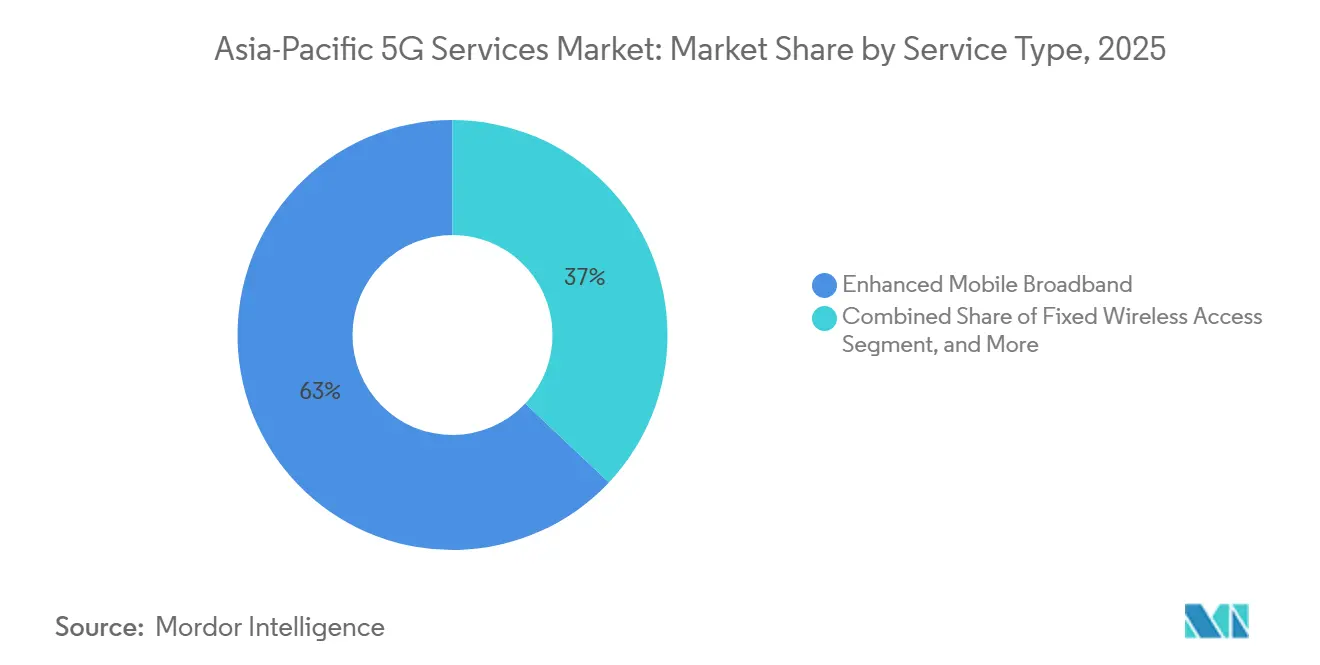
Enhanced mobile broadband held 62.97% of the Asia-Pacific 5G services market share in 2025. Its position reflects a large consumer subscriber base in China and India, where 5G is used for video, gaming, communications, and general mobile data. China Mobile reported 642 million 5G network customers in 2025. Fixed wireless access is extending this consumer-led model into homes and small businesses. More than 50% of fixed wireless access customer-premises equipment shipments in China and the rest of Asia-Pacific were 5G devices in December 2025. Jio AirFiber reached 13 million homes in FY26, adding a practical broadband use case for 5G capacity. Ultra-reliable low-latency communications remain smaller but are relevant for industrial control and safety-critical uses. Indosat's Indonesian factory deployments documented operational control loops below 30 milliseconds.
Massive machine-type communications is projected to expand at a 12.18% CAGR through 2031. The service supports large numbers of connected devices in factories, logistics sites, and agricultural operations. Reduced Capability devices can support lower-complexity IoT connections without the cost or power needs of full smartphone-class 5G devices. This makes them relevant where legacy low-power networks have served basic sensors. The Asia-Pacific 5G services market size for mMTC will depend on wider adoption of private networks and device ecosystems. Network slicing is also important because it can reserve service characteristics for a specific enterprise application. Operators using Standalone cores are better placed to offer these features than operators still dependent on legacy core systems. 3GPP Release 17 and Release 18 define key RedCap and 5G Advanced requirements that guide device and network certification. These standards can reduce interoperability barriers as industrial deployments scale.



By Network Architecture: Non-Standalone Leads Today as Standalone Migration Expands
Non-Standalone 5G held 66.31% of the Asia-Pacific 5G services market share in 2025. The architecture lets operators use existing 4G core investments while deploying 5G radio coverage. This reduced the initial cost and sped early consumer launches across the region. However, it does not provide all the capabilities needed for dedicated network slices and some low-latency enterprise services. China recorded an 80.9% 5G Standalone sample share in Q4 2025, while India recorded a 49.2% share. Reliance Jio's nationwide architecture is fully Standalone, supporting India's higher result. Singapore completed its nationwide Standalone transition in 2026. These markets show how architecture is becoming a commercial differentiator rather than only a technical choice.
Standalone 5G is projected to expand at a 12.52% CAGR from 2026 to 2031. Six of the world's top 10 countries by 5G Standalone reach were in Asia-Pacific in 2025. NTT DOCOMO and NEC launched Japan's first commercial 5G core network on AWS in March 2026.[2]NTT DOCOMO, “DOCOMO and NEC Launch Japan's First Commercial 5G Core on AWS,” NTT DOCOMO, docomo.ne.jp. The deployment used AI to automate core-network design and construction, reducing construction time by 80%. SK Telecom, KT Corporation, and LG Uplus aim to launch nationwide Standalone services by December 2026. Their migration may improve the availability of enterprise service-level agreements and differentiated network tiers. The Asia-Pacific 5G services market has a strong incentive to move toward Standalone systems because they enable more distinct service packages. The investment burden remains significant, particularly where consumer pricing has not yet reflected the added capability.
By Frequency Band: Mid Band Provides Coverage and Capacity While mmWave Serves Dense Sites
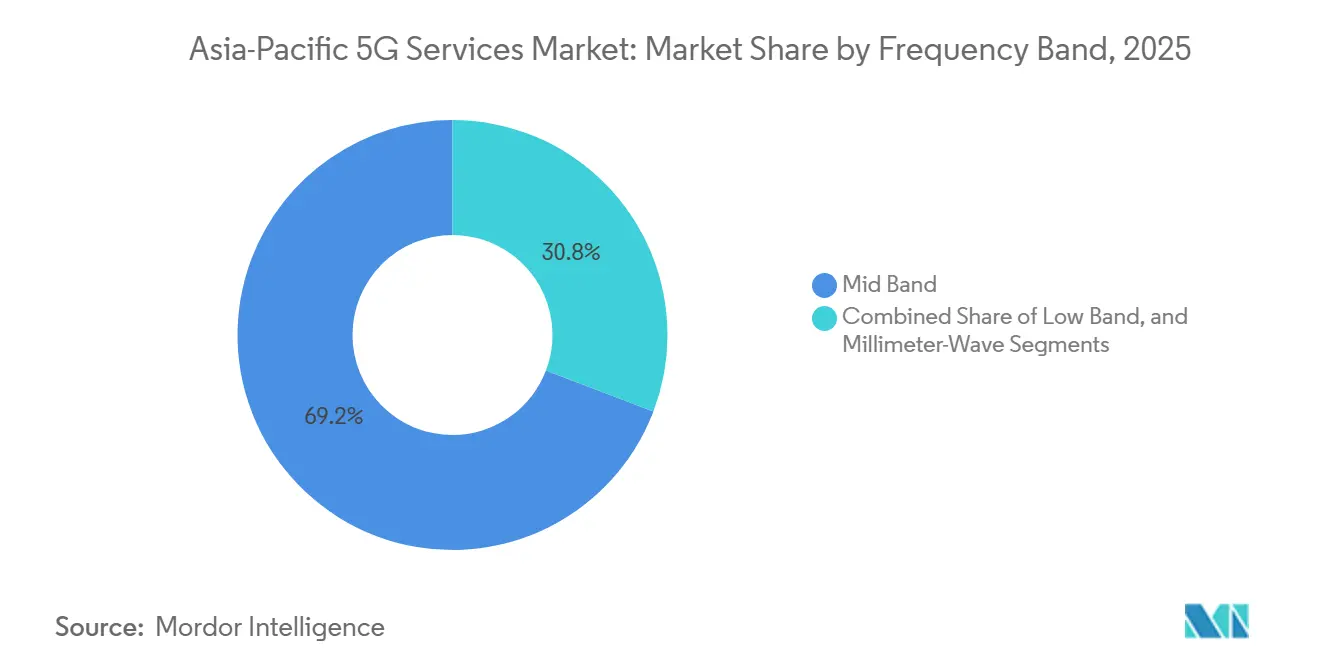
Mid band accounted for 69.21% of the Asia-Pacific 5G services market size in 2025. The 3.5 GHz range offers a balance between usable coverage and capacity, which explains its central role in China, India, Japan, South Korea, and Australia. It is especially useful for wide-area urban service where operators need more capacity than low band can provide. China's large network and India's rapid buildout have made mid band the main regional capacity layer. Mid band also supports broader population coverage than millimeter-wave deployments. The Asia-Pacific 5G services market uses this spectrum to serve both consumer traffic and many early enterprise deployments. Indonesia's limited access to cleared 3.5 GHz spectrum constrains comparable capability. This highlights how spectrum policy can shape service quality and investment returns across neighboring markets.
Millimeter-wave is projected to expand at a 12.36% CAGR through 2031. Japan's operators, including NTT DOCOMO, KDDI, SoftBank, and Rakuten Mobile, have commercial 28 GHz deployments. South Korea also licensed 28 GHz spectrum for enterprise and venue applications. NTT DOCOMO deployed Ericsson's RAN Processor 6672 commercially in July 2026. The processor delivered 4 times the prior capacity efficiency and reduced energy consumption by more than 50%. Low band remains important for rural coverage, including Reliance Jio's nationwide 700 MHz Standalone deployment. Indonesia finalized 700 MHz and 2.6 GHz spectrum allocations in July 2026, while its national plan designated 24.25-27.5 GHz for 5G and high-capacity IMT. This combination supports gradual development of capacity layers suited to different population densities.
By End-User Industry: IT and Telecom Leads While Manufacturing, Energy and Utilities Accelerate
IT and telecom held 29.63% of the Asia-Pacific 5G services market share in 2025. The segment includes managed connectivity, enterprise communications, and services supporting operators' own platforms. Its lead reflects the foundational role of telecom infrastructure in the region's wider digital economy. Many enterprise deployments begin with connectivity and network management before moving to specialized industrial applications. The segment also benefits from demand for secure mobile access and cloud-connected work tools. The Asia-Pacific 5G services market continues to rely on this broad base of business connectivity revenue. Government, defense, education, and public-sector organizations provide additional stable demand through national digital infrastructure programs. Retail, media, e-commerce, banking, financial services, insurance, and RegTech are developing use cases around transactions, customer experience, and digital operations.
Manufacturing, energy and utilities is projected to expand at a 13.04% CAGR from 2026 to 2031. Industrial networks can support automation, digital twins, predictive maintenance, and machine connectivity. Indosat's private network works in Indonesian oil fields and industrial sites, reducing downtime by nearly 30%. Bharti Airtel deployed its first private 5G smart factory in India in 2025. South Korean programs are also testing AI-supported robotics for welding, painting, and maintenance. Healthcare is another developing vertical, supported by private 5G for virtual care and remote clinical applications. Automotive and transportation uses include vehicle-to-everything trials in Japan and South Korea. These deployments require dependable coverage, security controls, and commercial terms that recognize operational value.
By Application: Communication and Collaboration Leads While Industry 4.0 Broadens Demand
Communication and collaboration held 55.78% of the Asia-Pacific 5G services market share in 2025. Enhanced voice, video conferencing, and workplace productivity tools remain central uses for 5G service. This share reflects the early consumer and business focus of regional deployments. These applications can use broad coverage and higher mobile capacity without requiring every advanced Standalone feature. Their large installed base will continue to support operator revenue during the forecast period. The Asia-Pacific 5G services market also serves smart cities and utilities through connected sensors for traffic, energy, and water management. Asset tracking is developing through RedCap devices that do not need full smartphone-level capability. Public safety and mission-critical communications are specialized opportunities in Australia, South Korea, and Japan.
Industry 4.0 is projected to expand at a 12.97% CAGR through 2031. It combines 5G with digital twins, AI-based quality inspection, and autonomous mobile robots. China has more than 64,000 enterprise private networks, supporting its large industrial base. Smart healthcare and connected vehicles also need reliable low-latency connectivity, especially for time-sensitive data and control. NTT DOCOMO and NTT demonstrated low-latency AI video analytics using in-network computing in March 2026. These services require a closer relationship between network design, cloud processing, and application performance. Standalone networks and ultra-reliable low-latency capabilities can improve their commercial feasibility. The Asia-Pacific 5G services market will increasingly be shaped by whether operators can turn these technical capabilities into repeatable sector-specific services.
Geography Analysis
China held 51.12% of the Asia-Pacific 5G services market share in 2025. The country had 2.77 million 5G base stations at the end of 2025 and 2.94 million by H1 2026. China Mobile reported 1.011 billion mobile customers and 687 million 5G network customers in H1 2026. It also reported 1.511 billion IoT card connections, which supports industrial and logistics applications. AI-network investment rose 85.2% to RMB 3.7 billion, USD 511 million, in H1 2026, while communications-network investment declined 9.8%. Japan recorded 45% 5G adoption in 2025 and is forecast to reach 92% by 2030. Its Standalone and millimeter-wave deployments make it an important setting for AI-RAN and edge-computing services.
South Korea recorded 36% 5G adoption in 2025 and is forecast to reach 86% by 2030. SK Telecom had 17.49 million 5G subscribers at the end of 2025.[3]SK Telecom, “SK Telecom 2025 Annual Results Infographic,” SK Telecom, news.sktelecom.com. The country's major operators plan nationwide Standalone service launches by December 2026. The Hyper AI Network pilot links this transition to industrial robotics and AI-enabled network operations. India is the fastest-growing geography, with the Asia-Pacific 5G services market size in India projected to expand at a 12.07% CAGR through 2031. Jio's 285 million True5G subscribers in June 2026 represented the largest base for a single-country operator outside China. Bharti Airtel's Standalone migration across 22 service circles and new lower-cost chipset platforms are improving the ecosystem for broader adoption.
Australia reached 95% 5G population coverage, with Telstra upgrading nearly 1,200 sites with 5G Advanced capability and building more than 150 sites in FY26. Telstra and Google partnered in June 2026 to expand digital infrastructure through Telstra's Aura fiber network. Singapore completed its nationwide 5G Standalone transition in 2026. Indonesia finalized 700 MHz and 2.6 GHz spectrum allocations in July 2026, but satellite use of 3.5 GHz remains a constraint on higher-capacity services. Malaysia's dual-network model gained support from Telekom Malaysia's RM 2.4 billion, USD 545 million, 3-year wholesale agreement with U Mobile. Vietnam retained Ericsson and Nokia for its 5G core and selected Huawei and ZTE for antenna contracts. Pakistan launched commercial 5G services following its March 2026 spectrum auction, adding to the region's active 5G footprint.
Competitive Landscape
The Asia-Pacific 5G services market includes mobile operators, network-equipment vendors, core-network providers, and semiconductor companies. China Mobile, Reliance Jio Infocomm, China Telecom, Bharti Airtel, and SK Telecom have substantial operator scale across the region. Huawei, Ericsson, Nokia, ZTE, and Samsung Electronics are central equipment suppliers. Huawei has a strong position in China and maintains radio and core deployments in several Southeast Asian markets. Ericsson and Nokia have stronger positions in Singapore, Australia, and other security-sensitive markets. Nokia's June 2026 agreement with Indosat expanded its role in Indonesia's network modernization. Ericsson's March 2026 agreement with Dialog Axiata supported deployment of a 5G radio network in Sri Lanka.[4]Ericsson, “Ericsson Signs Agreement with Dialog Axiata to Deploy 5G RAN,” Ericsson, telecomramblings.com. Supplier selection therefore differs by country and is influenced by local policy, existing infrastructure, and enterprise requirements.
Vendors are increasingly competing on energy efficiency and AI-enabled radio performance. Nokia's Indosat agreement combines Nokia radio products with NVIDIA GPU-accelerated computing for AI-RAN services. NTT DOCOMO's July 2026 deployment of Ericsson's RAN Processor 6672 demonstrated 4 times higher capacity efficiency and more than 50% lower energy consumption than the previous generation. These results matter where site energy use and urban capacity needs affect the economics of dense networks. Open RAN suppliers such as NEC, IPLOOK, Mavenir, and Rakuten Symphony offer alternative architectures for operators seeking more vendor flexibility. NTT DOCOMO and NEC established a government-backed venture in May 2026 to develop an Open RAN-based high-speed 5G network in Singapore. The move adds an alternative infrastructure option in a market where Huawei was excluded from 5G contracts. Standards including 3GPP Release 18 and ITU interoperability requirements also shape supplier eligibility.
The market remains concentrated among a limited group of large operators and infrastructure suppliers, though competitive conditions vary by geography and network layer. Large operators retain advantages from spectrum holdings, installed network assets, and extensive subscriber bases. Equipment vendors benefit from certification experience, product scale, and long-term customer relationships. At the same time, cloud-native cores and Open RAN create entry paths for companies with narrower technology offerings. The Asia-Pacific 5G services market is likely to reward suppliers that can meet reliability, security, energy, and enterprise integration needs at the same time. Enterprise buyers increasingly evaluate end-to-end delivery rather than radio equipment alone. This favors partnerships among operators, equipment vendors, cloud providers, and industrial technology firms. It also makes procurement cycles more complex in markets where governments seek greater control over critical communications infrastructure.
Asia-Pacific 5G Services Industry Leaders
China Mobile Limited
Reliance Jio Infocomm Limited
China Telecom Corporation Limited
Bharti Airtel Limited
SK Telecom Co., Ltd.
- *Disclaimer: Major Players sorted in no particular order

Recent Industry Developments
- August 2026: SK Telecom, KT Corporation, and LG Uplus established a public-private network investment council with South Korea's Ministry of Science and ICT (MSIT), with the operators targeting nationwide 5G Standalone commercialization by the end of 2026. The government is also preparing investment, regulatory, and support measures covering AI-RAN, 6G, submarine cables, satellites, and AI data center infrastructure.
- July 2026: NTT DOCOMO, in collaboration with Ericsson, completed Japan's first commercial deployment of Ericsson's RAN Processor 6672, delivering up to four times higher capacity efficiency and more than 50% lower energy consumption compared with the previous generation.
- July 2026: SK Telecom and KT Corporation were selected as implementing organizations for South Korea's government-led Hyper-AI Network foundational project, combining 5G Standalone and AI-RAN technologies for physical-AI applications. The two projects have a combined government budget of approximately KRW 17.2 billion through 2027, with SK Telecom focusing on AI-RAN infrastructure and KT developing an AI-based autonomous network for industrial applications.
- June 2026: Nokia and Indosat Ooredoo Hutchison signed a multiyear agreement to modernize Indonesia's nationwide 5G network and introduce AI-RAN capabilities. Nokia will supply its Habrok and Pandion radio families, while the companies will collaborate with NVIDIA on GPU-accelerated AI-RAN. Low-band 5G is planned across the full network footprint and mid-band 5G across approximately 80% of the network over 3.5 years, with field trials targeted for the end of 2026.


Asia-Pacific 5G Services Market Report Scope
The Asia-Pacific 5G Services Market Report is Segmented by Service Type (Enhanced Mobile Broadband, Ultra-Reliable Low-Latency Communications, Massive Machine-Type Communications, Fixed Wireless Access), Network Architecture (Non-Standalone 5G, Standalone 5G), Frequency Band (Low Band, Mid Band, Millimeter-Wave), End-User Industry (IT and Telecom, Automotive, Mobility and Transportation, Manufacturing, Energy and Utilities, Healthcare and Life Sciences, Banking, Financial Services, Insurance and RegTech, Retail, Media and E-Commerce, Government, Defense, Education and Public Sector, Other Industries), Application (Communication and Collaboration, Asset Tracking, Smart Cities, Smart Buildings, Autonomous Vehicles and Vehicle-to-Everything, Smart Healthcare, Industry 4.0, Smart Utilities, Immersive Media and Gaming, Public Safety and Mission-Critical Communications), and Geography (China, India, Japan, South Korea, Australia and New Zealand, Indonesia, Singapore, Rest of Asia-Pacific). The Market Forecasts are provided in Value (USD).
| Enhanced Mobile Broadband |
| Ultra-Reliable Low-Latency Communications |
| Massive Machine-Type Communications |
| Fixed Wireless Access |
| Non-Standalone 5G |
| Standalone 5G |
| Low Band |
| Mid Band |
| Millimeter-Wave |
| IT and Telecom |
| Automotive, Mobility and Transportation |
| Manufacturing, Energy and Utilities |
| Healthcare and Life Sciences |
| Banking, Financial Services, Insurance and RegTech |
| Retail, Media and E-Commerce |
| Government, Defense, Education and Public Sector |
| Other End-User Industries |
| Communication and Collaboration |
| Asset Tracking |
| Smart Cities |
| Smart Buildings |
| Autonomous Vehicles and Vehicle-to-Everything |
| Smart Healthcare |
| Industry 4.0 |
| Smart Utilities |
| Immersive Media and Gaming |
| Public Safety and Mission-Critical Communications |
| China |
| India |
| Japan |
| South Korea |
| Australia and New Zealand |
| Indonesia |
| Singapore |
| Rest of Asia-Pacific |
| By Service Type | Enhanced Mobile Broadband |
| Ultra-Reliable Low-Latency Communications | |
| Massive Machine-Type Communications | |
| Fixed Wireless Access | |
| By Network Architecture | Non-Standalone 5G |
| Standalone 5G | |
| By Frequency Band | Low Band |
| Mid Band | |
| Millimeter-Wave | |
| By End-User Industry | IT and Telecom |
| Automotive, Mobility and Transportation | |
| Manufacturing, Energy and Utilities | |
| Healthcare and Life Sciences | |
| Banking, Financial Services, Insurance and RegTech | |
| Retail, Media and E-Commerce | |
| Government, Defense, Education and Public Sector | |
| Other End-User Industries | |
| By Application | Communication and Collaboration |
| Asset Tracking | |
| Smart Cities | |
| Smart Buildings | |
| Autonomous Vehicles and Vehicle-to-Everything | |
| Smart Healthcare | |
| Industry 4.0 | |
| Smart Utilities | |
| Immersive Media and Gaming | |
| Public Safety and Mission-Critical Communications | |
| By Geography | China |
| India | |
| Japan | |
| South Korea | |
| Australia and New Zealand | |
| Indonesia | |
| Singapore | |
| Rest of Asia-Pacific |


Key Questions Answered in the Report
What is the size of the Asia-Pacific 5G services market?
The Asia-Pacific 5G services market is estimated at USD 59.02 billion in 2026 and is forecast to reach USD 102.64 billion by 2031, at a 11.70% CAGR.
What is driving 5G service adoption across Asia-Pacific?
Higher mobile traffic, Standalone network migration, enterprise private networks, AI-RAN, and edge computing are supporting demand.
Which service type holds the largest revenue share?
Enhanced mobile broadband led with 62.97% share in 2025, supported by large consumer 5G bases in China and India.
Which end-user category is projected to expand fastest?
Manufacturing, energy and utilities is projected to expand at a 13.04% CAGR through 2031, supported by automation and private-network use.
Which country leads regional 5G services revenue?
China held 51.12% of regional revenue in 2025, supported by extensive network infrastructure and industrial IoT connections.
What constraints affect regional 5G service expansion?
High deployment costs, device affordability, fragmented spectrum policy, and energy requirements can delay returns and adoption.
Page last updated on:





