
ASEAN Textile Manufacturing Market Size and Share
Market Overview
| Study Period | 2020 - 2031 |
|---|---|
| Forecast Data Period | 2026 - 2031 |
| Base Year Market Size (2025) | USD 16.78 Billion |
| Market Size (2026) | USD 17.65 Billion |
| Market Size (2031) | USD 22.90 Billion |
| Growth Rate (2026 - 2031) | 5.35 % |
| Market Concentration | Low |
Major Players *Disclaimer: Major Players sorted in no particular order Image © Mordor Intelligence. Reuse requires attribution under CC BY 4.0. | |
ASEAN Textile Manufacturing Market Analysis by Mordor Intelligence
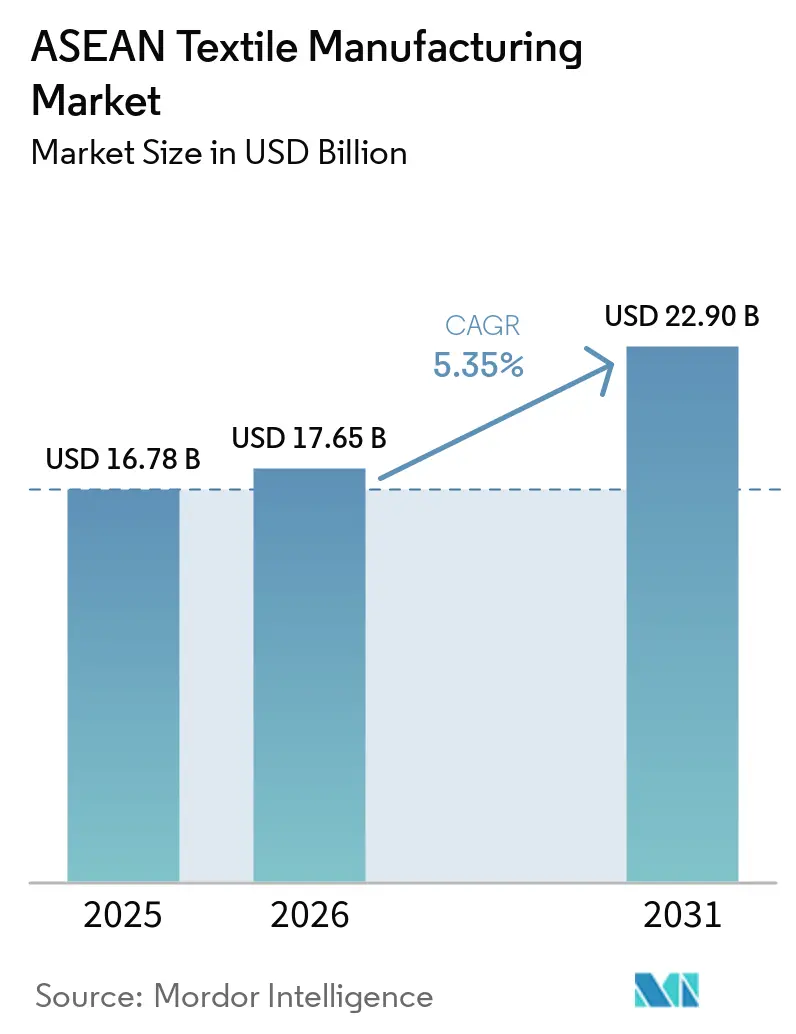
The ASEAN Textile Manufacturing Market size was valued at USD 16.78 billion in 2025 and is estimated to grow from USD 17.65 billion in 2026 to reach USD 22.90 billion by 2031, at a CAGR of 5.35% during the forecast period (2026-2031).
The region benefits as global buyers reduce dependence on a single sourcing country and place more production across Southeast Asia. Vietnam's apparel export performance and its larger share of United States imports support this shift, while Cambodia has also recorded stronger exports. Regional trade rules make local yarn, fabric, and garment supply chains more valuable because they can support preferential tariff treatment. The ASEAN textile manufacturing market is also moving toward finished and technical materials, where certification, reliable processing, and traceable inputs can matter more than labor cost alone. Larger producers are better placed to fund automation, wastewater treatment, and recycled-material systems, which may widen the gap with smaller mills.
Key Report Takeaways
- By raw material, commodity synthetics held 49.5% of the ASEAN textile manufacturing market share in 2025, while specialty and high-performance fibers are forecast to grow at an 8.2% CAGR through 2031.
- By manufacturing process, fabric manufacturing accounted for 43.5% of the ASEAN textile manufacturing market size in 2025, while textile finishing and surface treatment are forecast to grow at a 7.7% CAGR through 2031.
- By end use, apparel and fashion held 50.5% of the ASEAN textile manufacturing market share in 2025, while technical and industrial textiles are forecast to grow at a 6.7% CAGR through 2031.
- By enterprise scale, MSMEs and the unorganized sector held 57% of revenue in 2025, while large organized manufacturers are forecast to grow at a 6.6% CAGR through 2031.
- By geography, Vietnam held 29.5% of revenue in 2025 and is forecast to grow at a 6.8% CAGR through 2031.
Note: Market size and forecast figures in this report are generated using Mordor Intelligence’s proprietary estimation framework, updated with the latest available data and insights as of January 2026.
ASEAN Textile Manufacturing Market Trends and Insights
Drivers Impact Analysis*
| Driver | (~) % Impact on CAGR Forecast | Geographic Relevance | Impact Timeline |
|---|---|---|---|
| Export-Sourcing Diversification and Nearshoring | +1.5% | Global buyer focus anchored in Vietnam, Cambodia, Myanmar, and Thailand | Medium term (2-4 years) |
| FTA Rules of Origin and Regional Supply-Chain Localization | +1.2% | ASEAN-wide, with strongest relevance in Vietnam, Malaysia, and Thailand | Medium term (2-4 years) |
| Technical Textile Demand from Medical, Mobility, and Industrial Uses | +1.0% | ASEAN-wide, with strongest relevance in Thailand, Indonesia, and Malaysia | Long term (≥ 4 years) |
| Brand Demand for Traceable and Lower-Impact Materials | +0.7% | Global sourcing to Vietnam, Indonesia, and Thailand, with EU-linked supply chains | Medium term (2-4 years) |
| Digital Production and Small-Batch Customization | +0.5% | Vietnam, Thailand, Indonesia, and urban manufacturing clusters | Short term (≤ 2 years) |
| Regenerated and Recycled Fiber Capacity Expansion | +0.4% | Vietnam, Thailand, and Indonesia | Long term (≥ 4 years) |
| Source: Mordor Intelligence | |||
Export-Sourcing Diversification and Nearshoring
Global apparel and textile buyers have changed their sourcing plans since 2024, and the ASEAN textile manufacturing market has become a major destination for the resulting production. Vietnam's share of United States apparel imports rose to 21.1% in 2025 from 18.9% in 2024.[1]U.S. Department of Agriculture Foreign Agricultural Service, “Cotton and Products Annual, Vietnam,” USDA Foreign Agricultural Service, apps.fas.usda.gov Cambodia's textile, garment, footwear, and travel goods exports rose 16.6% year over year in the first 9 months of 2025. Manufacturers in Vietnam, Thailand, and Cambodia are adding spinning, weaving, and dyeing capacity to retain more production that had previously remained in China. The lasting advantage is likely to favor producers that can supply fiber, yarn, and fabric within a certified, rules-of-origin-compliant location. Myanmar retains low labor costs, but political instability limits the formal capacity expansion certification-focused buyers seek. Vietnam's industrial production index rose 9.2% in 2025, showing that order growth has supported manufacturing output as well as bookings.[2]Source: Vietnam National Statistics Office, “Index of Industrial Production in March of 2025,” General Statistics Office of Vietnam, gso.gov.vn
FTA Rules of Origin, Regional Localization, and Digital Production
Rules of origin under ATIGA, RCEP, and bilateral agreements affect investment decisions and trade documentation in the ASEAN textile manufacturing market. ATIGA textile rules require either a yarn-forward standard or 40% regional value content for preferential tariff eligibility.[3]ASEAN Secretariat, “ASEAN Trade in Goods Agreement,” ASEAN Secretariat, asean.org The 2025 ATIGA revision expanded preferential access across 458 tariff lines and introduced electronic Form D origin certification. RCEP lets manufacturers cumulate qualifying inputs across 15 participating economies, which broadens the sourcing base available to an eligible producer. This framework encourages new spinning and weaving projects in Vietnam and Malaysia because certified upstream capacity can support tariff access that a transshipment model cannot offer. Digital printing and small-batch systems add flexibility, although their benefits depend on operators, funding, and customer demand. The ASEAN textile manufacturing market therefore rewards plants that combine local input sourcing, electronic compliance systems, and responsive production scheduling.
Technical Textile Demand from Medical, Mobility, and Industrial Uses
Technical textiles are expanding faster than conventional textile categories in the ASEAN textile manufacturing market because they are used in healthcare, mobility, construction, filtration, and protective equipment. Hospital development in Indonesia, the Philippines, and Vietnam supports demand for hygiene, medical, and nonwoven materials. Automotive supply chains in Thailand and Indonesia also create demand for seat belts, airbag fabrics, tire reinforcement, and interior materials. Teijin Frontier began expanding its Pathumthani facility in 2025, adding 620 tons per year of high-tenacity recycled polyester filament yarn capacity for automotive applications. Vietnam's Ministry of Industry and Trade has identified technical textile capability as a strategic priority as commodity products face stronger import competition. Regional producers have not yet fully matched the functional specifications required by advanced industrial buyers, leaving a capability gap alongside the growth opportunity. This demand encourages investment in testing, specialized fibers, nonwovens, and finishing rather than only in conventional apparel inputs.
Brand Demand for Traceable and Lower-Impact Materials
Brand requirements for traceability, recycled content, energy performance, and wastewater control are changing investment priorities in the ASEAN textile manufacturing market. The EU Ecodesign for Sustainable Products Regulation and buyer use of facility environmental data are making sustainability performance a sourcing condition. Vietnam has significant pre-consumer textile waste, but recovery systems have historically been limited. Indorama Ventures and Jiaren Chemical Recycling formed a joint venture in 2025 targeting up to 100,000 tonnes per year of textile-recycled PET spinning capacity. PVChem and VNPOLY also signed an agreement in 2025 to produce polyester fiber from recycled PET. Producers that can document recycled inputs and controlled manufacturing conditions can compete for orders where compliance evidence is required. Smaller facilities may find the cost of certification, data collection, and equipment more difficult to absorb.
Restraints Impact Analysis*
| Restraint | (~) % Impact on CAGR Forecast | Geographic Relevance | Impact Timeline |
|---|---|---|---|
| Cotton Import Dependence and Fiber-Price Volatility | -1.1% | Vietnam, Indonesia, Myanmar, and Cambodia | Short term (≤ 2 years) |
| Energy, Water, and Compliance Cost Inflation | -0.8% | ASEAN-wide, with stronger exposure in Indonesia, Thailand, and Vietnam | Medium term (2-4 years) |
| Uneven Automation Skills and SME Financing Constraints | -0.6% | ASEAN-wide, with stronger exposure in the Philippines, Cambodia, Myanmar, and Indonesian MSMEs | Medium term (2-4 years) |
| Weak Textile-Waste Collection and Circular Feedstock Reliability | -0.4% | Vietnam, Indonesia, and Thailand | Long term (≥ 4 years) |
| Source: Mordor Intelligence | |||
Cotton Import Dependence and Fiber-Price Volatility
The ASEAN textile manufacturing market remains exposed to global cotton and fiber-price movements because domestic cotton production is limited. Vietnam imported 7.6 million 480-pound bales of cotton in marketing year 2025/26, and the United States, Brazil, and Australia supplied 86% of the volume between August 2025 and February 2026. Lower cotton prices can reduce input costs, but narrow yarn spreads can also compress spinner margins. Vinatex has identified 100% cotton import dependence and 90% to 95% fiber import dependence as key vulnerabilities. Indonesia's cotton consumption is forecast to decline 5% to 1.85 million bales in marketing year 2025/26 as weaker purchasing power constrains imports. Weak textile-waste collection also restricts reliable circular feedstock, despite new recycled-fiber projects. Indonesia's safeguards on imported cotton yarn can protect spinners while raising costs for downstream weavers and knitters.
Energy, Water, and Compliance Cost Inflation
Wet processing has high energy and water requirements, making it a cost-sensitive stage of the ASEAN textile manufacturing market. Indonesia introduced PERMEN LH 12/2025 in September 2025, setting tighter discharge limits for textile facilities that release more than 100 cubic meters of wastewater per day. Smaller manufacturers can struggle to finance treatment systems, advanced process controls, automation, and energy upgrades. Vietnam's shift from coal and biomass heating toward electrified processes also requires capital and may raise near-term operating costs. Demand-response and renewable procurement could lower heating costs by 16% to 28% in Thailand and Vietnam, but many SMEs lack the capital and technical capacity to secure these benefits. Cash-flow pressures are particularly difficult for garment-linked suppliers that pay for materials before receiving payment from customers.
*Our forecasts treat driver/restraint impacts as directional, not additive. The impact forecasts reflect baseline growth, mix effects, and variable interactions.
Segment Analysis
By Raw Material: Synthetics Retain Scale While Specialty Fibers Grow Faster
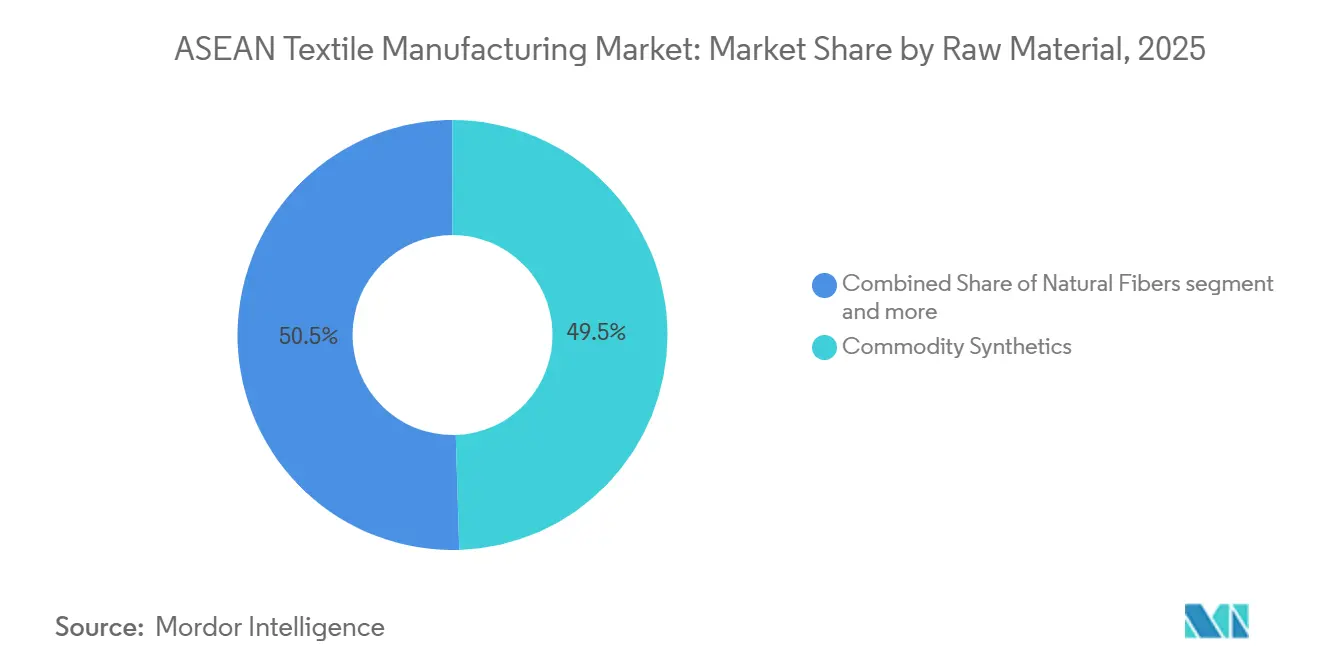
Commodity synthetics accounted for 49.5% of the ASEAN textile manufacturing market revenue in 2025. Polyester, nylon, polypropylene, acrylic, and elastane support large-volume production because they fit established regional polymer, spinning, and texturing operations. Synthetic fibers accounted for 67.4% of global fiber production, and polyester represented 57.2% of global output. Natural fibers remain important, but cotton is imported, and animal fibers such as silk and wool serve more specialized activities in Thailand and Vietnam. Artificial cellulosic fibers such as viscose, lyocell, modal, and acetate offer brands an alternative to virgin polyester and conventionally grown cotton.
Specialty and high-performance fibers are forecast to grow at an 8.2% CAGR from 2026 to 2031 within the ASEAN textile manufacturing market. Aramid, UHMWPE, technical filaments, and carbon-fiber-reinforced materials are used in transport, defense, protection, and industrial applications. The segment relies on technical specifications, consistent performance, and close engagement with industrial buyers. Indorama Ventures' 2025 recycled PET joint venture shows how a regional fiber producer is pursuing value from recovered textiles. Expected recycled-content requirements for polyester products supplied to Europe may favor certified recycled processing over virgin-resin-only production. This change can move purchasing decisions toward suppliers that can verify material origin and process quality.



By Manufacturing Process and Product Type: Finishing Gains Importance in Certified Supply Chains
Fabric manufacturing accounted for 43.5% of the ASEAN textile manufacturing market size in 2025. Weaving, knitting, and nonwoven production are established across Vietnam, Indonesia, Thailand, and Malaysia. Vietnam had an estimated 10.4 million spindle equivalents across 121 spinning mills in 2025, including 46 foreign-invested mills and 75 domestic mills. Weaving is concentrated in northern Vietnam and the Central and West Java belt, while Malaysia and Thailand have capabilities in knit performance fabrics. Nonwovens support medical textiles, geotextiles, filtration, and personal protective equipment, but they require substantial capital investment.
Textile finishing and surface treatment are forecast to grow at a 7.7% CAGR through 2031 in the ASEAN textile manufacturing market. Pretreatment, bleaching, dyeing, printing, coating, and other finishing steps increasingly determine whether fabric meets customer chemical, water, and carbon requirements. Digital printing can use 90% less water than conventional screen printing, according to the supplied Epson and IDC material. This process also supports smaller orders and faster design changes when demand is uneven. Indonesia's updated wastewater standards will require major wet-processing facilities to invest in compliance by late 2027. The segment's growth reflects higher demand for certified finished inputs, although the added environmental controls will raise capital needs.
By End Use Industry: Apparel Provides Volume While Technical Textiles Expand
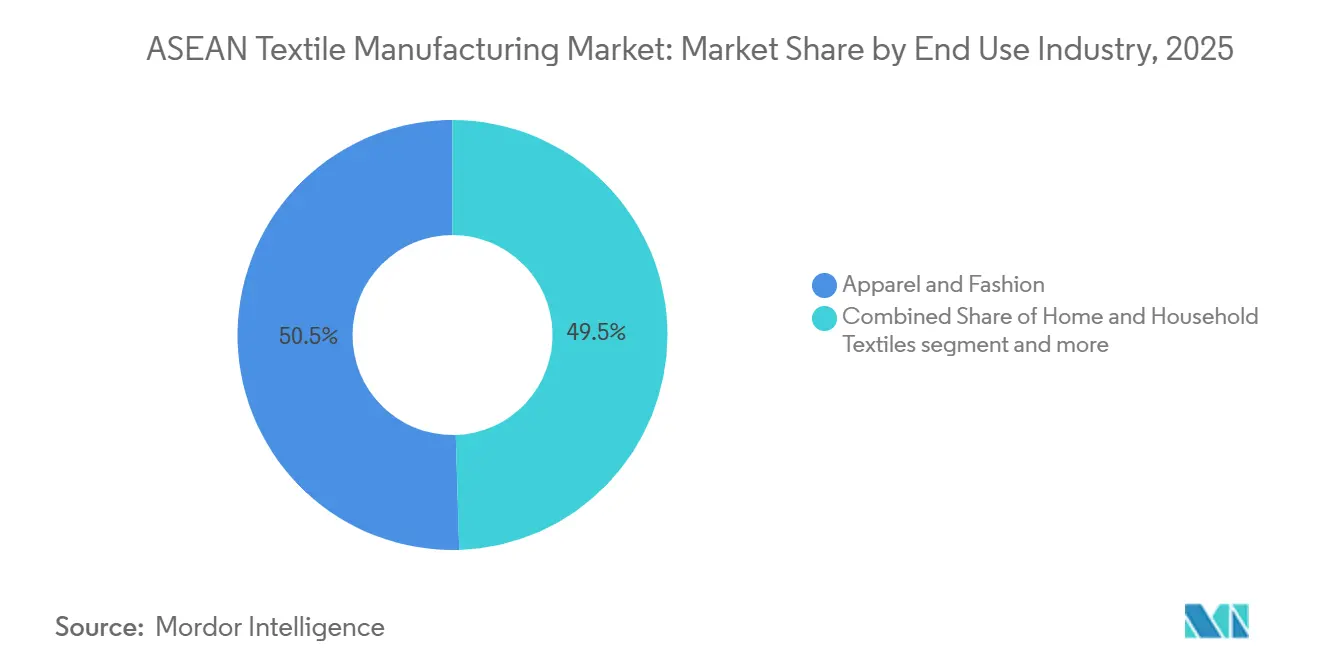
Apparel and fashion accounted for 50.5% of ASEAN textile manufacturing output by value in 2025. This activity anchors textile demand in Vietnam, Cambodia, Myanmar, and Indonesia through export-oriented garment supply chains. Home and household textiles provide a secondary outlet for bed linen, towels, and upholstery fabrics. Malaysian and Thai suppliers have stronger positions in quality-sensitive home textile categories than in basic commodity products. The segment benefits when brand sourcing shifts to Southeast Asia, but it also remains exposed to consumer spending and buyer inventory cycles.
Technical and industrial textiles are forecast to grow at a 6.7% CAGR from 2026 to 2031 in the ASEAN textile manufacturing market. Medical and hygiene materials benefit from hospital expansion in Indonesia, the Philippines, and Vietnam. Transportation textiles include seat fabrics, airbag yarn, tire cords, and seat-belt webbing, with demand strongest where automotive supply chains are deeper. Teijin Frontier's Thailand expansion adds recycled high-tenacity polyester yarn for tire cords, seat belts, and automotive reinforcement. Construction projects in Vietnam and Indonesia also support demand for geotextiles. Packaging, agricultural, and filtration materials remain smaller uses but add steady demand as industrial activity broadens.
By Enterprise Scale: Large Organized Producers Gain from Investment Capacity
MSMEs and the unorganized sector accounted for 57% of ASEAN textile manufacturing revenue in 2025. Family-owned mills, artisan weavers, contract dye houses, and informal spinners provide flexible capacity across Indonesia, Vietnam, Thailand, and the Philippines. These businesses can respond quickly to short production runs and sustain labor-intensive activity. Their operating model also leaves them more exposed to raw-material purchases, delayed customer payments, and rising compliance costs. Access to financing remains a practical constraint on automation, water treatment, and sustainability upgrades.
Large organized manufacturers held 43% of revenue in 2025 and are forecast to grow at a 6.6% CAGR through 2031. They can fund automated production, formal supplier compliance programs, FTA documentation, and foreign investment partnerships. Vinatex reported 2025 consolidated revenue above VND 18.9 trillion (USD 720 million), and pre-tax profit of VND 1.355 trillion (USD 50 million), 62% higher than in 2024. Südwolle committed an additional USD 25 million to expand its Vietnam spinning and dyeing plant from 1,450 tonnes per year to 4,000 tonnes per year. YKK approved Phase 3 of its automated Nhon Trach factory in Vietnam in June 2025. These investments give formal producers a stronger ability to meet the documentation and performance conditions set by international buyers.
Geography Analysis
Vietnam held 29.5% of the ASEAN textile manufacturing market in 2025 and is forecast to grow at a 6.8% CAGR through 2031. Its industrial production index increased 9.2% in 2025, while textile manufacturing rose 7.6% and garment manufacturing rose 13.2%. Textile and garment exports reached USD 44.2 billion in 2025, with the United States remaining the largest buyer. Vietnam's spinning base and new weaving and dyeing investments reduce reliance on imported Chinese fabric. SYRE received an investment certificate in 2025 for a USD 1 billion polyester recycling complex in Binh Dinh. Cambodia's textile, garment, footwear, and travel-goods exports totaled USD 12 billion in the first 9 months of 2025, but imported fabric still limits local value addition.
Indonesia's textile exports declined 9.5% to USD 3.28 billion in 2025, creating a difficult backdrop for the ASEAN textile manufacturing market. Sritex halted production in March 2025 after bankruptcy proceedings, and the closure affected 10,965 workers. Xinfung began a USD 30 million fiber and yarn project in Subang in 2025. Thailand's textile and wearing apparel output is expected to grow modestly in 2026 with support from government stimulus and recovering orders. Automotive supply chains and capacity additions in recycled high-tenacity yarn support its focus on technical materials.
Malaysia, the Philippines, Myanmar, and other ASEAN economies play narrower roles in the ASEAN textile manufacturing market. Malaysia is positioned in technical textiles and performance-fabric knitting, even though its upstream spinning and weaving base is limited. The Philippines mainly focuses on downstream garment assembly and medical textile processing. Myanmar's formal manufacturing activity remains restricted by political instability and limited trade-finance access. Revised ASEAN product rules, Brunei's trade-facilitation measures, and Cambodia's carbon-neutral production pathway can influence where buyers extend their supply chains.
Competitive Landscape
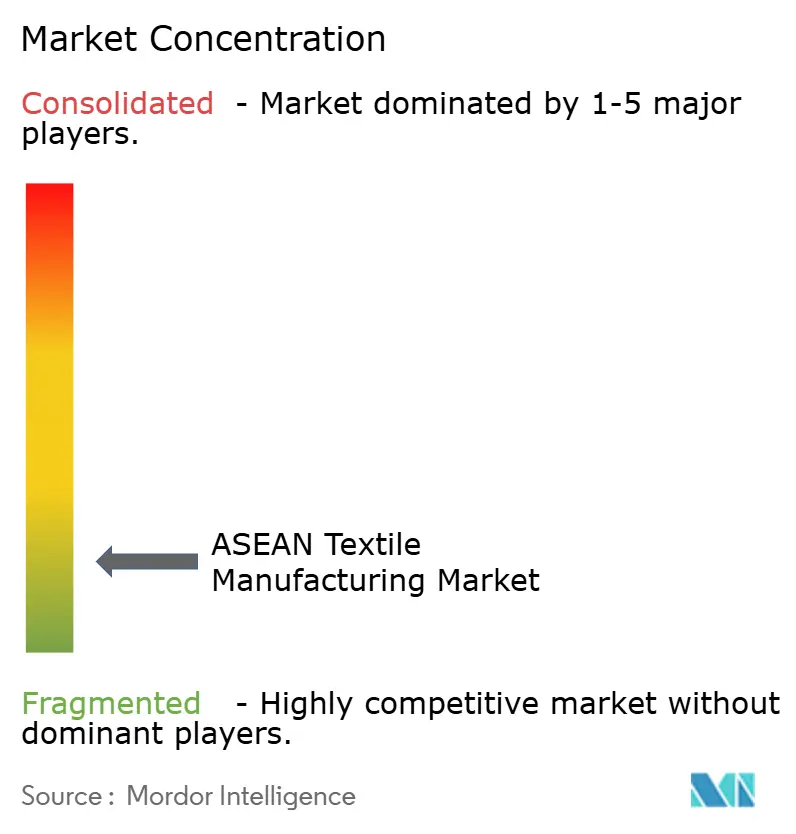
The ASEAN textile manufacturing market exhibits a low level of market concentration. Vietnam combines state-backed groups, foreign-invested integrated producers, and a large MSME base. Indonesia's 2025 Sritex closure removed a major integrated producer and created an opportunity for asset leasing or new investment. Thailand and Malaysia host clusters of foreign-affiliated producers that focus on specialty and functional materials.
Foreign-invested producers, including Toray Industries Malaysia, Teijin Polyester Thailand, Indorama Ventures, and YKK Vietnam, can draw on proprietary technology, established sustainability systems, and group-level funding. Teijin Frontier's 2025 capacity addition in Thailand is one example of a move toward recycled automotive textile inputs. Indorama Ventures' joint venture with Jiaren Chemical Recycling is another example, targeting up to 100,000 tonnes per year of textile-recycled PET spinning capacity. YKK's Phase 3 project in Vietnam adds automated manufacturing capacity and product-development capability. These projects reflect a push toward higher-value inputs and better documented production systems. They also raise the threshold for domestic competitors that rely on smaller and less formal operations.
Chinese and Taiwanese investment is also using ASEAN production locations to serve United States and European buyers through regional trade agreements. Junbang activated a self-owned Vietnam dyeing and finishing factory plan in 2025, with a groundbreaking target in the first half of 2026. Xinhai's Indonesia facility entered pre-operations in 2026 and is intended to supply H&M. The description identifies dyeing and finishing in Cambodia and Myanmar, plus artificial cellulosic fibers across ASEAN, as areas requiring further assessment of demand, infrastructure, and regulatory conditions. Environmental and product certifications are becoming more important for suppliers serving Europe. Firms without formal systems face a narrower path to buyer approval as requirements strengthen.
ASEAN Textile Manufacturing Industry Leaders
Vietnam National Textile and Garment Group
Thành Công Textile Garment Investment Trading Joint Stock Company
Phong Phu Corporation JSC
Hoa Tho Textile - Garment Joint Stock Corporation
Century Synthetic Fiber Corporation
- *Disclaimer: Major Players sorted in no particular order

Recent Industry Developments
- January 2026: Vietnam, VITAS. The Vietnam Textile and Apparel Association set a USD 50 billion total textile and garment export target for 2026, building on USD 44.2 billion in calendar 2025 revenues.
- November 2025: Thailand, Indorama Ventures, and Jiaren Chemical Recycling. Indorama Ventures' Fibers business and Jiaren Chemical Recycling formed a joint venture targeting up to 100,000 tonnes per year of textile-recycled PET spinning capacity.
- November 2025: Thailand, Teijin Frontier. Teijin Frontier commenced capacity expansion at Teijin Polyester Thailand, adding 620 tonnes per year of high-tenacity recycled polyester filament yarn for tire cords, seat belts, and automotive reinforcement applications.


ASEAN Textile Manufacturing Market Report Scope
The ASEAN Textile Manufacturing Market is Segmented by Raw Material (Natural Fibers, Commodity Synthetics, and More), by Manufacturing Process and Product Type (Fabric Manufacturing, and More), by End Use Industry (Apparel and Fashion, and More), by Enterprise Scale (Large Organized Manufacturers, and More), and by Geography (Vietnam, and More). The Report Offers Market Size and Value (USD) Forecasts for all the Above Segments.
| Natural Fibers | Plant-Based Fibers | Cotton |
| Others (Jute, Flax, Hemp, Ramie, Coir) | ||
| Animal-Based Fibers (Wool, Silk, and Other Animal Fibers) | ||
| Man-Made Cellulosic Fibers (Viscose/Rayon, Lyocell, Modal, and Acetate) | ||
| Commodity Synthetics (Polyester, Nylon/Polyamide, Polypropylene, Acrylic, and Elastane) | ||
| Specialty and High-Performance Fibers (Aramid, UHMWPE, etc.) |
| Yarn and Thread Manufacturing | |
| Fabric Manufacturing | Weaving |
| Knitting and Crocheting | |
| Nonwoven and Felt Manufacturing | |
| Other Fabric-Formation Processes | |
| Textile Finishing and Surface Treatment (Pretreatment, Bleaching, Dyeing, Printing, etc.) |
| Apparel and Fashion | |
| Home and Household Textiles | |
| Technical and Industrial Textiles | Transportation and Mobility |
| Medical and Hygiene | |
| Industrial Processing and Filtration | |
| Construction and Geotextiles | |
| Protective and Safety | |
| Packaging | |
| Other Technical Applications - Agriculture, etc. |
| Large Organized Manufacturers |
| Micro, Small, and Medium Enterprises (MSMEs) and the unorganized sector |
| Vietnam |
| Indonesia |
| Thailand |
| Malaysia |
| Cambodia |
| Myanmar |
| Philippines |
| Rest of ASEAN Countries - Singapore, Lao PDR and Brunei |
| By Raw Material | Natural Fibers | Plant-Based Fibers | Cotton |
| Others (Jute, Flax, Hemp, Ramie, Coir) | |||
| Animal-Based Fibers (Wool, Silk, and Other Animal Fibers) | |||
| Man-Made Cellulosic Fibers (Viscose/Rayon, Lyocell, Modal, and Acetate) | |||
| Commodity Synthetics (Polyester, Nylon/Polyamide, Polypropylene, Acrylic, and Elastane) | |||
| Specialty and High-Performance Fibers (Aramid, UHMWPE, etc.) | |||
| By Manufacturing Process and Product Type | Yarn and Thread Manufacturing | ||
| Fabric Manufacturing | Weaving | ||
| Knitting and Crocheting | |||
| Nonwoven and Felt Manufacturing | |||
| Other Fabric-Formation Processes | |||
| Textile Finishing and Surface Treatment (Pretreatment, Bleaching, Dyeing, Printing, etc.) | |||
| By End Use Industry | Apparel and Fashion | ||
| Home and Household Textiles | |||
| Technical and Industrial Textiles | Transportation and Mobility | ||
| Medical and Hygiene | |||
| Industrial Processing and Filtration | |||
| Construction and Geotextiles | |||
| Protective and Safety | |||
| Packaging | |||
| Other Technical Applications - Agriculture, etc. | |||
| By Enterprise Scale | Large Organized Manufacturers | ||
| Micro, Small, and Medium Enterprises (MSMEs) and the unorganized sector | |||
| By Geography | Vietnam | ||
| Indonesia | |||
| Thailand | |||
| Malaysia | |||
| Cambodia | |||
| Myanmar | |||
| Philippines | |||
| Rest of ASEAN Countries - Singapore, Lao PDR and Brunei | |||


Key Questions Answered in the Report
What is the projected value of ASEAN textile manufacturing market by 2031?
The market is forecast to reach USD 22.9 billion by 2031, growing from USD 17.7 billion in 2026 at a 5.4% CAGR.
Which ASEAN country leads textile manufacturing?
Vietnam held 29.5% of regional revenue in 2025 and is forecast to grow at a 6.8% CAGR through 2031.
Which raw materials are growing fastest in ASEAN textile manufacturing?
Specialty and high-performance fibers are forecast to grow at an 8.2% CAGR through 2031, supported by technical applications.
Why are textile finishing operations becoming more important?
Finishing is forecast to grow at a 7.7% CAGR because buyers increasingly require certified controls for chemicals, water use, and carbon performance.
What is the largest end-use category for ASEAN textile products?
Apparel and fashion accounted for 50.5% of output by value in 2025, while technical and industrial textiles are the faster-growing end use.
What constraints affect smaller textile producers in ASEAN?
SMEs face high costs for wastewater treatment, energy upgrades, automation, certification, and working capital.
Page last updated on:





