
ASEAN Disaster Restoration Services Market Size and Share
Market Overview
| Study Period | 2020 - 2031 |
|---|---|
| Forecast Data Period | 2026 - 2031 |
| Base Year Market Size (2025) | USD 0.68 Billion |
| Market Size (2026) | USD 0.72 Billion |
| Market Size (2031) | USD 0.98 Billion |
| Growth Rate (2026 - 2031) | 6.36 % |
| Market Concentration | Low |
Major Players *Disclaimer: Major Players sorted in no particular order Image © Mordor Intelligence. Reuse requires attribution under CC BY 4.0. | |
ASEAN Disaster Restoration Services Market Analysis by Mordor Intelligence
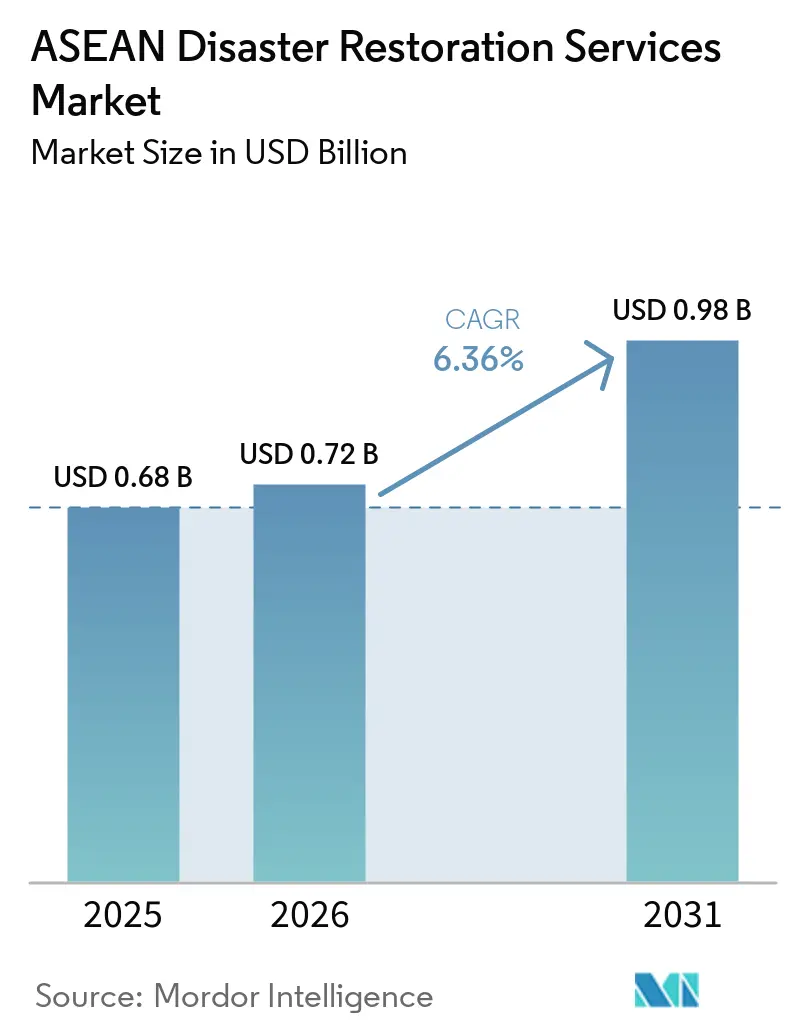
The ASEAN disaster restoration services market size was valued at USD 0.68 billion in 2025 and is estimated to grow from USD 0.72 billion in 2026 to reach USD 0.98 billion by 2031, at a CAGR of 6.36% during the forecast period (2026-2031).
Floods, typhoons, storms, and related water damage remain the central source of demand across the region because they affect both buildings and the contents needed for homes and businesses to operate. The ASEAN disaster restoration services market also benefits as urban and industrial assets become more concentrated in exposed locations, increasing the value of recovery work after a damaging event and increasing the need for specialized contractors with reliable equipment and trained crews across affected areas, property clusters, and essential operating sites. Formal insurance and public recovery programs are making contractor selection more structured in several countries, particularly where documented technical work, defined response times, and formal qualification requirements are required. International networks are better positioned for complex industrial losses, while local providers remain important for residential and smaller commercial assignments that value price, proximity, familiar local service, and direct relationships with property owners. Staffing shortages, equipment access, uneven insurance penetration, and informal repairs continue to limit the conversion of physical disaster damage into formal restoration revenue, especially in secondary cities and island locations following severe regional disaster events each year.
Key Report Takeaways
- By service type, water damage restoration held 38.5% of the ASEAN disaster restoration services market size in 2025, while the others category is forecast to expand at a 7.3% CAGR through 2031.
- By application, commercial and industrial customers accounted for 54.0% of the ASEAN disaster restoration services market share in 2025, while residential restoration is forecast to grow at a 7.1% CAGR through 2031.
- By customer and payor type, insurance-funded work represented 52.0% of the ASEAN disaster restoration services market size in 2025, while public-sector and government-funded work is forecast to grow at a 7.6% CAGR through 2031.
- By geography, Indonesia held 27% of market revenue in 2025, while the Rest of ASEAN is forecast to grow at a 6.8% CAGR through 2031.
Note: Market size and forecast figures in this report are generated using Mordor Intelligence’s proprietary estimation framework, updated with the latest available data and insights as of January 2026.
ASEAN Disaster Restoration Services Market Trends and Insights
Drivers Impact Analysis*
| Driver | (~) % Impact on CAGR Forecast | Geographic Relevance | Impact Timeline |
|---|---|---|---|
| Increasing Flood, Typhoon, and Extreme-Weather Losses | +2.1% | Indonesia, Philippines, Vietnam, Thailand, Malaysia | Short term (≤ 2 years) |
| Urbanization and Concentration of High-Value Property | +1.4% | Indonesia, Vietnam, Philippines, Thailand | Medium term (2-4 years) |
| Industrial, Logistics, and Critical-Infrastructure Expansion | +1.1% | Malaysia, Vietnam, Indonesia, Thailand | Medium term (2-4 years) |
| Rising Insurance-Linked Demand and Claims Professionalization | +0.8% | Singapore, Malaysia, Thailand, Philippines | Medium term (2-4 years) |
| Digital Damage Assessment and Moisture Monitoring Adoption | +0.5% | ASEAN, with early gains in Singapore, Malaysia, and urban Vietnam | Long term (≥ 4 years) |
| Specialist Capacity Gaps in Secondary Cities and Islands | +0.3% | Indonesia, Philippines, and Vietnam secondary cities | Long term (≥ 4 years) |
| Source: Mordor Intelligence | |||
Increasing Flood, Typhoon, and Extreme-Weather Losses
Floods, typhoons, and tropical storms create the most direct demand base for the ASEAN disaster restoration services market because water, wind, and debris can affect buildings across several countries during the same season. Consecutive events can leave soil saturated and flood defenses under pressure for extended periods, leaving properties more vulnerable to additional water intrusion. That pattern can damage more buildings, widen the affected area, and complicate access to homes, commercial sites, industrial facilities, and public infrastructure. Restoration teams must then manage drying, dehumidification, debris removal, cleaning, and follow-up mold work across many locations with limited time and available crews. The ASEAN disaster restoration services market is affected not only by the number of events but also by their timing, location, and whether they occur in quick succession. Short intervals between disasters can strain crews, extend completion times, delay access to equipment, and raise the value of work required at each damaged structure.
Urbanization and Rising Concentration of High-Value Property
Urban development is concentrating valuable residential, commercial, and industrial property in coastal and riverine locations that are exposed to recurring flood and storm conditions. This concentration raises the cost of restoring a single damaged district after a severe event because more expensive property and more occupants may be affected together. Jakarta illustrates the issue because a large share of Indonesia's economic activity is located within its metropolitan area, where flood-related disruption can affect a wide range of assets. High-value condominiums and branded residences add specialized materials, finishes, fittings, and contents that require more careful recovery than basic repair work. The ASEAN disaster restoration services market, therefore, gains demand from the increasing value of assets at risk rather than from event frequency alone. Greater housing density can also increase the number of households needing professional water removal, cleaning, drying, and mold remediation after neighborhood flooding.
Industrial, Logistics, and Critical-Infrastructure Expansion
Industrial parks, warehouses, data centers, and advanced manufacturing sites are expanding across ASEAN, adding more large facilities with complex operating requirements. These facilities contain machinery, sensitive electronics, controlled environments, and systems that cannot be restored through general repair methods alone. Business interruption can be significant when a facility remains closed after flood, fire, or storm damage because downtime can affect production, inventory, logistics, and contractual commitments. Malaysia's Johor-Singapore Special Economic Zone has attracted MYR 66.1 billion (USD 16.31 billion) in investment commitments through the end of 2025, which increases the concentration of exposed industrial assets. The ASEAN disaster restoration services market is supported when operators need climate-controlled drying, contamination control, documented assessment, and technical equipment recovery. These requirements favor providers that can meet strict site conditions, insurer requirements, and the need to restore operations with minimal additional damage.
Rising Insurance-Linked Demand and Claims Professionalization
Insurers and loss adjusters increasingly use preferred contractor networks to improve technical compliance, response speed, service documentation, and communication with policyholders. These arrangements give qualified restoration firms a more predictable route to assignments after a loss, particularly in commercial and higher-value residential claims. Singapore and Thailand provide more developed examples of formal non-life insurance practices in the region.[1]ASEAN Secretariat, “Disaster Risk Financing and Insurance in Southeast Asia: Trends, Challenges, and Strategic Approaches,” ASEAN Secretariat, asean.org The ASEAN disaster restoration services market can benefit when insurers involve restoration partners earlier in the claims process, before further moisture damage or business interruption increases costs. This approach can limit additional property damage, provide a clearer scope of work, and help insurers control the ultimate cost of a claim.
Restraints Impact Analysis*
| Restraint | (~) % Impact on CAGR Forecast | Geographic Relevance | Impact Timeline |
|---|---|---|---|
| Uneven Insurance Penetration and Out-of-Pocket Payment Burden | -1.3% | Indonesia, Vietnam, Myanmar, Cambodia, Laos | Short term (≤ 2 years) |
| Shortage of Certified Technicians and Catastrophe-Response Crews | -0.9% | ASEAN core markets, with acute shortfalls in secondary cities and islands | Medium term (2-4 years) |
| Fragmented Informal Competition and Inconsistent Service Standards | -0.6% | Indonesia, Philippines, Vietnam, Myanmar | Medium term (2-4 years) |
| Mobilization, Import Dependence, and Equipment Bottlenecks | -0.5% | Indonesia's outer islands, the Philippines, and Myanmar | Short term (≤ 2 years) |
| Source: Mordor Intelligence | |||
Uneven Insurance Penetration and High Out-of-Pocket Payment Burden
Low insurance penetration limits the portion of disaster damage that can be converted into formal restoration assignments. The ASEAN Secretariat reported 2025 penetration rates from 0.24% in Myanmar to 9.9% in Singapore. Indonesia, Vietnam, and the Philippines remained below the levels seen in more mature insurance markets. Many affected households and smaller businesses consequently rely on direct payments or informal repairs. Indonesia's average annual disaster losses reached USD 31.2 billion, while public funding capacity was USD 750 million. The ASEAN disaster restoration services market remains constrained, where recovery funding cannot support certified restoration work.
Shortage of Certified Technicians and Catastrophe-Response Crews
Qualified technicians are often unavailable when multiple disasters occur across several countries at once. RedR UK’s 2025 assessment after the Myanmar earthquake identified shortages among engineers, assessors, supervisors, masons, and carpenters. The gap is more pronounced in secondary cities, island locations, and areas with limited formal training systems. Cross-border deployment is also difficult because worker competency recognition is fragmented across ASEAN.[2]International Labour Organization, “Advancing Skills Mobility, Recognition and Development in ASEAN,” International Labour Organization, ilo.org The ASEAN disaster restoration services market can lose work when trained crews and appropriate equipment cannot arrive during the early recovery period. Labor scarcity also raises the cost of maintaining compliant teams throughout the year.
*Our forecasts treat driver/restraint impacts as directional, not additive. The impact forecasts reflect baseline growth, mix effects, and variable interactions.
Segment Analysis
By Service Type: Water Damage Leads While Contents Restoration Expands
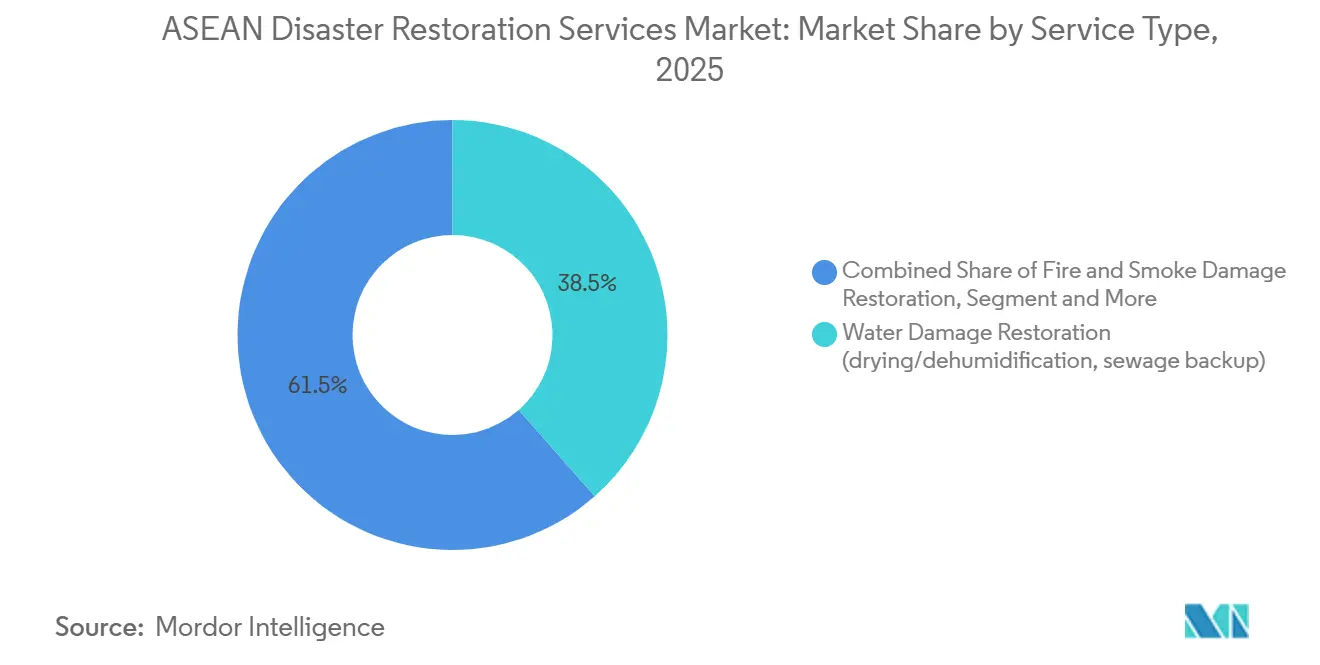
Water damage restoration held 38.5% of the ASEAN disaster restoration services market share in 2025, making it the largest service category across the region. Floods and typhoons create a steady need for drying, dehumidification, cleaning, and mold prevention after water enters homes, workplaces, and public buildings. Water intrusion can affect structures, finishes, furniture, electrical systems, stored materials, and internal spaces at the same site. These related losses increase the scope of work after a single event and require action before moisture causes further deterioration. Indonesia recorded at least 604 flood-related fatalities by December 2025, reflecting the continued severity of flood exposure across affected communities. Commercial clients often need rapid recovery because site closures can disrupt production schedules, inventory handling, logistics, and customer service. Fire and smoke services remain relevant where electrical faults or activated suppression systems create combined losses alongside water damage. Mold remediation follows water damage in humid conditions and can create repeat work after the initial emergency response is complete. The ASEAN disaster restoration services industry must therefore combine urgent work at the site with detailed follow-up recovery work.
The others category, including contents restoration, pack-out, cleaning, and storage, is forecast to grow at a 7.3% CAGR through 2031. Rising household and commercial contents values make restoration more attractive than replacement in claims where damaged items remain recoverable. Electronics, appliances, documents, stored inventory, and specialized business equipment can require separate handling, assessment, cleaning, and recovery. Pack-out services also protect movable contents while structural drying and repair are completed inside the affected property. Digital documentation can make it easier to record damaged items, maintain a clear claim file, and support insurance settlements. The ASEAN Digital Masterplan supports wider use of digital systems that can improve disaster management processes and information sharing. The ASEAN disaster restoration services market has room to develop specialist document and electronics recovery where clients have higher-value possessions or business-critical records. Such services are especially relevant to industrial facilities, logistics operations, and data-intensive businesses with sensitive equipment. Service providers can differentiate themselves when they can restore both the building and the contents inside it with coordinated handling.



By Application: Commercial and Industrial Work Generates Most Revenue
Commercial and industrial customers accounted for 54.0% of the ASEAN disaster restoration services market size in 2025, giving this application the largest revenue position. Their larger loss values reflect the cost of recovering machinery, inventory, sensitive electronics, building systems, and operating areas after a damaging event. Semiconductor plants, warehouses, food-processing facilities, and data centers can face high costs during downtime because operations, supply schedules, and customer commitments are disrupted. Restoration plans for these sites may require controlled drying, careful documentation, and specific contamination controls that general repair work may not provide. Contractual deadlines can increase pressure to return facilities to operation while protecting equipment, materials, and site safety. Singapore's Building and Construction Authority and Malaysia's Construction Industry Development Board shape quality expectations for formal contractor work.[3]Building and Construction Authority, “Registered Contractors and Licensed Builders,” Building and Construction Authority, bca.gov.sg These requirements can reinforce the role of trained providers in insured commercial work where compliance and records matter. The ASEAN disaster restoration services market is supported when industrial owners place a higher value on speed, documentation, technical competence, and minimized downtime. Large facilities can also require close coordination among insurers, loss adjusters, site management teams, equipment specialists, and restoration crews.
Residential restoration is forecast to grow at a 7.1% CAGR through 2031. Urban housing density increases the number of homes exposed when flooding affects a neighborhood, drainage system, or nearby river corridor. Gradual homeowner insurance adoption can convert more repair activity into formal contracted work with clearer scopes and documentation. Vietnam reported more than 337,000 houses collapsed, swept away, or severely damaged during the 2025 severe storms. The Philippines also reported more than 531,000 houses damaged or destroyed by Typhoons Kalmaegi and Fengshen in 2025. Many households still use local repair providers because formal coverage remains limited, and immediate repair costs can be difficult to fund. Government-supported post-disaster housing programs can add a more formal procurement route in Indonesia and Vietnam after major disasters. The ASEAN disaster restoration services market can expand when these programs require documented, qualified, and timely work across multiple damaged homes. Residential demand remains more price sensitive than commercial demand, but its broad customer base provides a significant long-term opportunity.
By Customer and Payor Type: Insurance-Funded Work Leads While Public Funding Grows
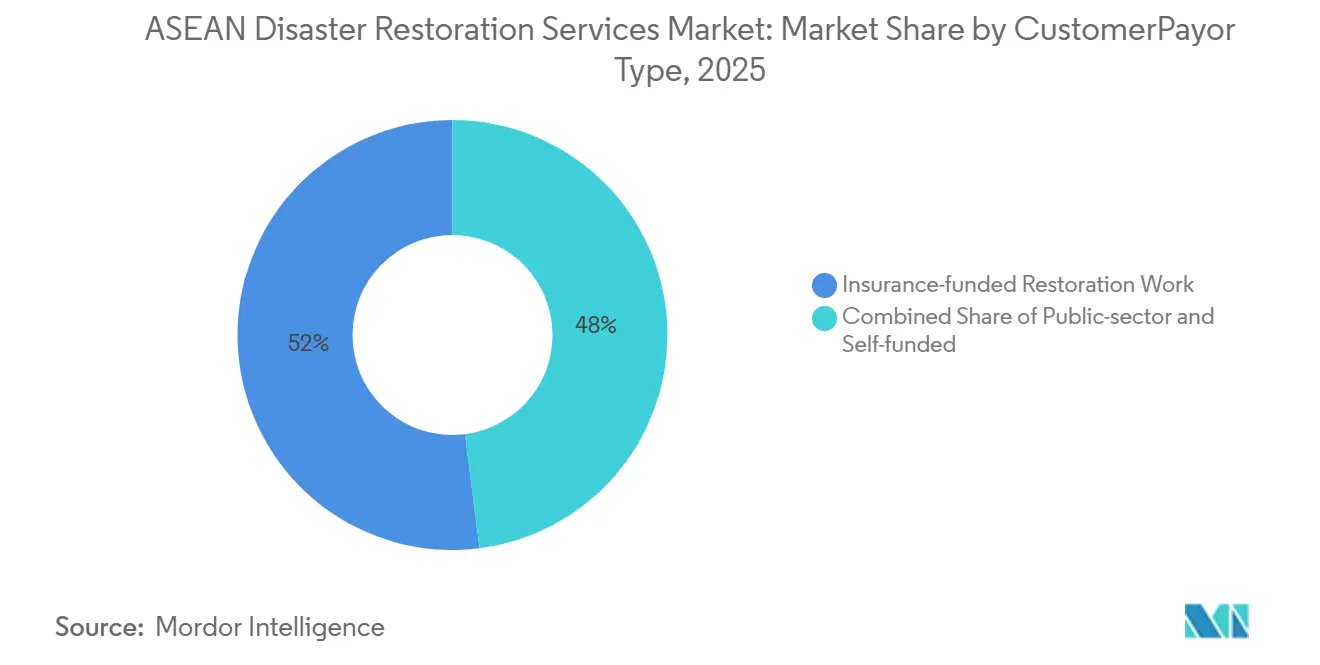
Insurance-funded assignments represented 52.0% of ASEAN disaster restoration services market share in 2025, placing insurer-directed work at the center of formal regional demand. Preferred vendor networks and loss-adjuster relationships make this work more formal, repeatable, and dependent on demonstrated service performance. Thailand reported 5.5% non-life insurance penetration, and Malaysia reported 5% in the ASEAN Secretariat's 2025 review. Singapore's 9.9% penetration made it a regional reference point for more technical insurer-supported services and contractor expectations. Insurers often need contractors that can document damage, respond quickly, and meet specified technical and reporting standards. Self-funded work serves households and small businesses outside insurance networks, particularly where coverage is unavailable or insufficient. This work can be more sensitive to price and may require less formal service specifications, even when physical damage is substantial. The ASEAN disaster restoration services industry is shaped by the difference between these 2 routes to work and their different procurement requirements. Providers that work with insurers can gain steady referrals but must maintain the required quality, response capacity, and documentation practices.
Public-sector and government-funded restoration is forecast to grow at a 7.6% CAGR through 2031. Governments are increasing the use of formal recovery frameworks after major disasters affect infrastructure, housing, water systems, and public facilities. Indonesia's PT Hutama Karya began accelerated recovery work for roads and water systems in Aceh during December 2025. Its work covered 28 project locations and had reached 58.78% physical progress by August 2026. Public procurement can cover damaged roads, water infrastructure, community facilities, and reconstruction requirements that extend across affected areas. The Philippines has disaster risk reduction arrangements that include quick-response funding tools for recovery needs. Vietnam has also indicated an intention to improve recovery coverage beyond the share historically financed by the government. The ASEAN disaster restoration services market can gain from more formal tendering, defined recovery budgets, and procurement that favors qualified contractors. Public work can involve lengthy procurement cycles, but it provides a route to larger multi-site assignments with defined public recovery objectives.
Geography Analysis
Indonesia held 27% of the ASEAN disaster restoration services market share in 2025, supported by its large population, extensive disaster exposure, and broad need for recovery services across many islands. The ASEAN Secretariat reported average annual disaster losses of USD 31.2 billion for Indonesia, against public funding capacity of USD 750 million, which leaves much recovery work outside formal funding channels. This gap sustains informal repair practices, although flood and landslide damage still creates regular demand for drying, cleaning, structural repair, and mold control. Its dispersed geography can make the deployment of crews and specialized equipment difficult, especially after widespread events affecting more than 1 location. The Philippines also faced average annual disaster losses of USD 20.8 billion, and its recurring typhoon activity continues to affect homes, businesses, and public facilities across exposed areas.
Vietnam had average annual disaster losses of USD 11.4 billion in the ASEAN Secretariat's 2025 assessment, while its expanding manufacturing, logistics, and electronics base is increasing the value of property exposed to water and storm damage. Lower insurance penetration limits the proportion of Vietnamese losses that can be directed to formal restoration providers, even when production facilities require specialist recovery. Malaysia is more organized for insurance-linked assignments, and insured industrial assets are concentrated in Selangor, Johor, and Penang, including the growing Johor-Singapore Special Economic Zone. Thailand combines USD 13 billion in average annual loss exposure with 5.5% non-life insurance penetration, which supports a greater role for formal insurer-directed work than the scale of losses alone would suggest. Myanmar presents a different but severe risk profile because the March 2025 magnitude 7.7 earthquake caused extensive damage and almost 5,500 deaths, while insurance penetration was only 0.24%.
The rest of ASEAN is forecast to grow at a 6.8% CAGR through 2031 from the region's smallest geographic base, making it the fastest-growing group in the ASEAN disaster restoration services market. Cambodia, Singapore, Laos, Brunei, and Timor-Leste have differing levels of exposure and capability, but Singapore serves as a regional base for international networks and more formal service models. Singapore's licensing and quality requirements provide a reference point for nearby countries, while less developed restoration infrastructure in Cambodia and Laos leaves space for new service capacity. In February 2026, Spectee received Japanese government support for disaster prevention and crisis management work in Vietnam and a feasibility study in Indonesia, showing continued investment in regional digital response tools.
Competitive Landscape
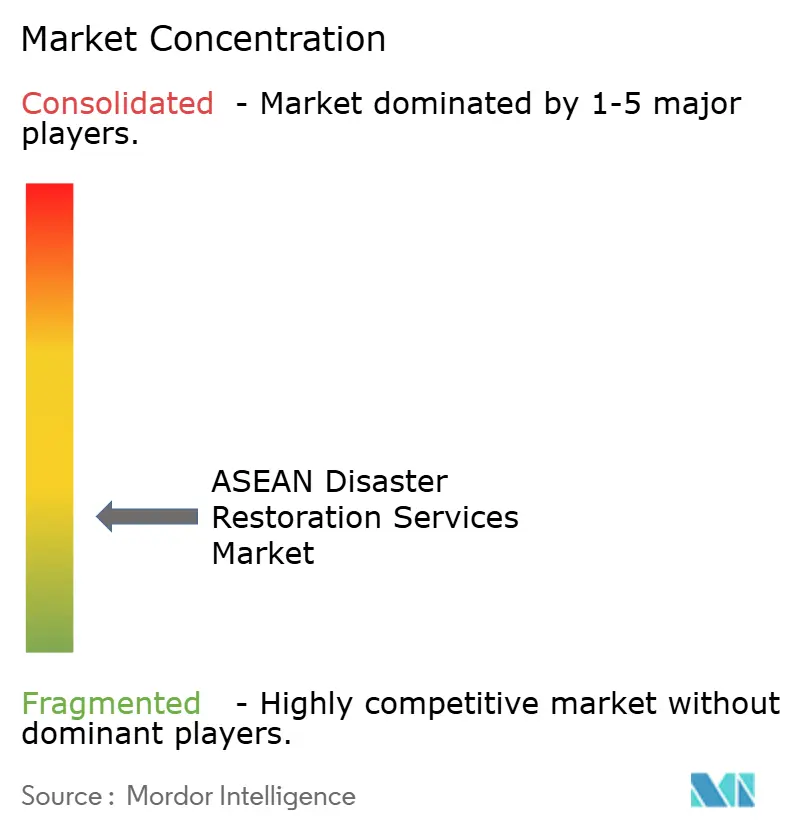
The ASEAN disaster restoration services market is fragmented because no single provider holds a dominant position across its full geography. International restoration networks compete mainly for complex industrial and large-loss commercial work, where technical certification, 24/7 mobilization, and insurer preferred-vendor relationships matter most. Local and regional contractors remain important in residential and smaller commercial work because they can compete on cost, language, and proximity to affected customers. This difference creates a continuing pricing gap between international networks and local operators, even as both groups address the same broad disaster recovery needs.
Formal credentials are an important barrier in the insured portion of the ASEAN disaster restoration services market, as Malaysia's CIDB licensing and Singapore's BCA framework shape contractor qualification expectations. Established providers can therefore gain an advantage for semiconductor, clean-room, machinery, and other complex equipment losses that require specialist treatment. Secondary cities and island locations often lack pre-positioned capacity, creating opportunities for firms able to mobilize trained crews and equipment rapidly. Digital claims integration and remote moisture monitoring can strengthen an operator's relationship with insurers by improving damage documentation and response decisions. A preferred-vendor agreement with a regional insurer can produce recurring assignment volume and is difficult to replace once performance standards have been established.
Pacific Equity Partners and CPP Investments acquired Johns Lyng Group in October 2025 for AUD 1.3 billion (USD 871.19 million), signaling the value attributed to scaled insurance-linked restoration platforms. In May 2025, YCH Group began work on an MYR 500 million (USD 123.37 million) automated logistics facility in Selangor, adding a complex asset that may need technical recovery after flood or fire damage.[4]Malaysian Investment Development Authority, “YCH Group Breaks Ground on RM500-Million Supply Chain City Malaysia,” Malaysian Investment Development Authority, mida.gov.my In December 2025, Mah Sing Group and KLK Land formed a joint venture for a 419-acre industrial park in Kulai, Johor, with MYR 2.26 billion (USD 557.64 million) in gross development value. Together, these developments reinforce the ASEAN disaster restoration services market opportunity around higher-value assets in flood-adjacent industrial corridors.
ASEAN Disaster Restoration Services Industry Leaders
BELFOR Holdings Inc.
Approved Group International
Bright Symphony Sdn Bhd
ServiceMaster Restore
First Onsite Restoration
- *Disclaimer: Major Players sorted in no particular order

Recent Industry Developments
- September 2026: Vestland Bhd's subsidiary Vestland Infra Sdn Bhd secured a MYR 264 million (USD 65.14 million) design-and-build flood mitigation contract at Sungai Golok, Kelantan, Malaysia.
- February 2026: Spectee Inc. received Japanese government backing to deploy its Spectee Pro disaster prevention and crisis management platform in Vietnam and conduct a feasibility study for Indonesia.
- October 2025: Pacific Equity Partners and CPP Investments completed the acquisition of Johns Lyng Group for AUD 1.3 billion (USD 871.19 million). The acquisition took the Australian insurance building and restoration services group private.
- September 2025: MOL Asia Oceania Pte. Ltd. held the groundbreaking for a ready-built factory at Song Khoai Industrial Park in Quang Ninh, Vietnam. The project was developed through the CapitaLand SEA Logistics Fund.


ASEAN Disaster Restoration Services Market Report Scope
The report covers the ASEAN disaster restoration services market by service type, application, customer and payor type, and geography. Service coverage includes water damage restoration, fire and smoke damage restoration, mold remediation, storm and catastrophe restoration, biohazard and trauma cleanup, specialty restoration, and other services such as contents recovery, pack-out, cleaning, and storage. The analysis assesses demand across residential, commercial, and industrial properties, along with insurance-funded, self-funded, and public-sector or government-funded work. Geographic coverage includes Indonesia, the Philippines, Thailand, Vietnam, Malaysia, Myanmar, and the rest of ASEAN, including Cambodia, Singapore, Laos, Brunei, and Timor-Leste. The report evaluates market size, forecast growth, demand drivers, constraints, segment performance, country-level conditions, competitive dynamics, and recent developments, with forecasts presented in USD for 2026-2031.
| Water Damage Restoration (drying/dehumidification, sewage backup) |
| Fire & Smoke Damage Restoration |
| Mold Remediation |
| Storm / Catastrophe Restoration (wind, hail, flood response, large-loss) |
| Biohazard & Trauma Cleanup (crime scene, unattended death, infectious cleanup) |
| Specialty Services |
| Others (contents restoration, pack-out, cleaning, storage, etc.) |
| Residential |
| Commercial & Industrial |
| Insurance-funded Restoration Work |
| Self-funded / Direct-pay Restoration Work |
| Public-sector / Government-funded Restoration Work |
| Indonesia |
| Philippines |
| Thailand |
| Vietnam |
| Malaysia |
| Myanmar |
| Rest of ASEAN (Myanmar, Cambodia, Singapore, Laos, Brunei, and Timor-Leste) |
| By Service Type | Water Damage Restoration (drying/dehumidification, sewage backup) |
| Fire & Smoke Damage Restoration | |
| Mold Remediation | |
| Storm / Catastrophe Restoration (wind, hail, flood response, large-loss) | |
| Biohazard & Trauma Cleanup (crime scene, unattended death, infectious cleanup) | |
| Specialty Services | |
| Others (contents restoration, pack-out, cleaning, storage, etc.) | |
| By Application | Residential |
| Commercial & Industrial | |
| By Customer/Payor Type | Insurance-funded Restoration Work |
| Self-funded / Direct-pay Restoration Work | |
| Public-sector / Government-funded Restoration Work | |
| By Geography | Indonesia |
| Philippines | |
| Thailand | |
| Vietnam | |
| Malaysia | |
| Myanmar | |
| Rest of ASEAN (Myanmar, Cambodia, Singapore, Laos, Brunei, and Timor-Leste) |


Key Questions Answered in the Report
What is driving demand for disaster restoration services in ASEAN?
Floods, typhoons, storm damage, denser urban development, and growing industrial assets are the central demand factors.
Which service type leads regional revenue?
Water damage restoration led with 38.5% of revenue in 2025.
Which customer group generates the most restoration revenue?
Commercial and industrial customers generated 54.0% of revenue in 2025 because their losses often involve costly assets and downtime.
Why is insurance important for restoration providers?
Insurance-funded work represented 52.0% of revenue in 2025 and provides formal contractor referral routes through insurer and loss-adjuster networks.
Which application is growing fastest through 2031?
Residential restoration is forecast to grow at a 7.1% CAGR through 2031 as urban housing density and insurance awareness increase.
Which geography is expanding fastest?
The rest of ASEAN is forecast to grow at a 6.8% CAGR through 2031 from a smaller base.
Page last updated on:





