
Aniline Derivatives Market Size and Share
Market Overview
| Study Period | 2021 - 2031 |
|---|---|
| Market Size (2026) | USD 23.65 Billion |
| Market Size (2031) | USD 27.85 Billion |
| Growth Rate (2026 - 2031) | 3.32 % |
| Fastest Growing Market | Asia-Pacific |
| Largest Market | Asia-Pacific |
| Market Concentration | Medium |
Major Players *Disclaimer: Major Players sorted in no particular order Image © Mordor Intelligence. Reuse requires attribution under CC BY 4.0. | |
Aniline Derivatives Market Analysis by Mordor Intelligence
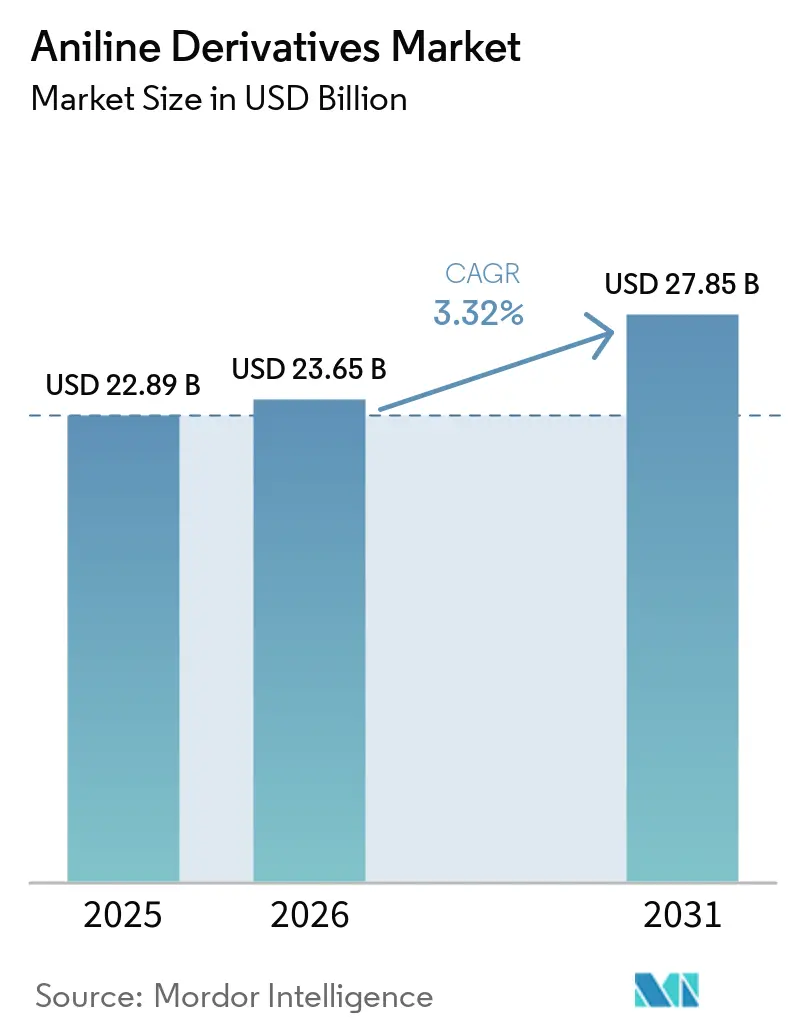
The Aniline Derivatives Market size was valued at USD 22.89 billion in 2025 and is estimated to grow from USD 23.65 billion in 2026 to reach USD 27.85 billion by 2031, at a CAGR of 3.32% during the forecast period (2026-2031). The aniline derivatives market is anchored by methylene diphenyl diisocyanate (MDI), which absorbed more than 71% of global aniline output for insulation, appliance, and automotive uses. Tighter building energy requirements and vehicle electrification support polyurethane demand, while higher-purity MDI is needed for battery-pack adhesives and other automotive uses. China’s vehicle production supports demand for polyurethane materials used in vehicle interiors, structural parts, and battery enclosures. The aniline derivatives market also faces pressure from benzene costs, toxicological controls, and supply interruptions at large MDI facilities, which can tighten regional availability even when global supply remains adequate. Capacity additions, local production plans, and bio-based aniline programs show that producers are balancing cost control with access to regulated and lower-carbon applications.
Key Report Takeaways
- By derivative type, aniline held 55.13% of the aniline derivatives market share in 2025 and is projected to advance at a 3.77% CAGR through 2031.
- By application, rubber chemicals held 30.37% of the aniline derivatives market share in 2025 and are projected to advance at a 4.14% CAGR through 2031.
- By geography, Asia-Pacific held 43.48% of the aniline derivatives market share in 2025 and is projected to advance at a 4.01% CAGR through 2031.
Note: Market size and forecast figures in this report are generated using Mordor Intelligence’s proprietary estimation framework, updated with the latest available data and insights as of January 2026.
Global Aniline Derivatives Market Trends and Insights
Drivers Impact Analysis*
| Driver | (~) % Impact on CAGR Forecast | Geographic Relevance | Impact Timeline |
|---|---|---|---|
| MDI and Polyurethane Demand in Construction, Appliances, and Automotive | +1.1% | Global, with core demand in Asia-Pacific & Europe | Medium term (2-4 years) |
| Rubber Processing Demand from Tires and Industrial Rubber | +0.8% | Global, concentrated in Asia-Pacific & North America | Short term (≤ 2 years) |
| Dyes, Pigments, and Textile Manufacturing Expansion | +0.5% | APAC core, spillover to South Asia & MEA | Medium term (2-4 years) |
| Pharmaceutical and Agrochemical Intermediate Demand | +0.4% | Global, with strong traction in Asia-Pacific & Europe | Long term (≥ 4 years) |
| Low-Emission and Bio-Based Aniline Process Commercialization | +0.2% | Europe & North America, with pilots in Asia-Pacific | Long term (≥ 4 years) |
| Source: Mordor Intelligence | |||
MDI and Polyurethane Demand in Construction, Appliances, and Automotive
MDI-grade aniline remained the most consistent demand driver for the aniline derivatives market because more than 71% of global aniline output was directed to isocyanate synthesis. Rigid polyurethane foam supports heat management in residential and commercial buildings, which makes demand responsive to building energy requirements. The European Union revised its Energy Performance of Buildings Directive, and U.S. building energy standards also reinforced the use of efficient insulation materials. Appliance demand added another source of consumption because cyclopentane-blown rigid foam is used in refrigerators and commercial cold-chain equipment. BASF advanced its feasibility study for an MDI complex in Dahej, Gujarat, after securing industrial land through BASF India Polyurethanes Private Limited, while its Geismar, Louisiana, expansion reached final commissioning[1]BASF, “BASF Evaluates MDI Investment in India,” BASF, basf.com. Covestro AG planned a 660-kiloton-per-year MDI train at its Shanghai integrated site using AdiP technology designed for net-zero Scope 1 and 2 greenhouse-gas emissions.
Rubber Processing Demand from Tires and Industrial Rubber
Rubber chemicals support growth in the aniline derivatives market through anti-degradants, accelerators, and antiozonants used in tires and industrial rubber. N-phenyl-p-phenylenediamine materials remained important, but the review of N-(1,3-dimethylbutyl)-N'-phenyl-p-phenylenediamine (6PPD) oxidation products in the United States encouraged work on alternative formulations. LANXESS introduced Vulkanox 4060 (N-Cyclohexyl-N'-phenyl-p-phenylenediamine, CCPD) and began European Registration, Evaluation, Authorisation and Restriction of Chemicals (REACH) registration for volumes above 1,000 metric tons per year. This shift supports higher-purity chloroaniline and nitroaniline intermediates used in newer anti-degradant chemistries. LANXESS expanded its Qingdao site to 30,000 metric tons per year in 2025 and began producing rubber processing promoters in Bushy Park, South Carolina, to improve supply security for tire manufacturers. Electric vehicle tires need higher load ratings, lower rolling resistance, and stronger wear resistance, which can increase chemical loading per tire.
Dyes, Pigments, and Textile Manufacturing Expansion
The aniline derivatives market benefits from dye, pigment, and textile production, especially as colorant manufacturing shifts across Asia. India is taking a larger role in dye intermediate manufacturing as Chinese suppliers face environmental compliance requirements and margin pressure. Shree Pushkar Chemicals & Fertilisers commissioned its Unit-5 dyes plant in Ratnagiri, Maharashtra, in September 2026, adding 6,000 metric tons per annum of dyes capacity. The expansion was supported by Zero Discharge of Hazardous Chemicals (ZDHC) and bluesign certifications that help suppliers reach sustainability-audited textile buyers. Sudarshan Chemical Industries agreed to acquire Clariant’s aluminum dyes and chemicals plant in Muttenz, Switzerland, which added a European manufacturing position for premium colorant applications. OEKO-TEX Standard 100 limits and REACH restrictions on certain azo dyes increase the need for compliant aniline intermediates.
Pharmaceutical and Agrochemical Intermediate Demand
Pharmaceutical and agrochemical uses provide the aniline derivatives market with demand for higher-purity intermediates. Aniline is used in the synthesis of sulfonamide antibiotics, paracetamol intermediates, herbicides, fungicides, and diuron-class crop protection products. The withdrawal of methyl parathion under the Food and Agriculture Organization and World Health Organization pesticide management frameworks redirected attention toward more complex herbicide and fungicide chemistries[2]Food and Agriculture Organization of the United Nations, “Pesticide Registration Toolkit,” Food and Agriculture Organization of the United Nations, fao.org . These chemistries can require higher aniline content and tighter purity control. India remains important for pharmaceutical-grade aniline demand because production-linked incentives for bulk drugs and active pharmaceutical ingredients encourage local processing investment. U.S. Food and Drug Administration Drug Master File expectations and Central Drugs Standard Control Organisation requirements favor suppliers with strong documentation and established quality systems.
Restraints Impact Analysis*
| Restraint | (~) % Impact on CAGR Forecast | Geographic Relevance | Impact Timeline |
|---|---|---|---|
| Toxicity, Exposure Controls, and Compliance Costs | -0.7% | Global, most stringent in Europe & North America | Medium term (2-4 years) |
| Benzene Price and Petrochemical Feedstock Volatility | -0.6% | Global, with highest exposure in Asia-Pacific & Middle East | Short term (≤ 2 years) |
| Bio-Based Substitution Risk in Sustainability-Sensitive Applications | -0.3% | Europe & North America, emerging signals in Asia-Pacific | Long term (≥ 4 years) |
| Source: Mordor Intelligence | |||
Toxicity, Exposure Controls, and Compliance Costs
Toxicity, exposure controls, and compliance costs limit smaller participants in the aniline derivatives market. The European Union classified aniline as Carc. 2, Muta. 2, and Acute Tox. 3 under the Classification, Labelling and Packaging (CLP) Regulation. Commission Delegated Regulation (EU) 2025/1222 updated CLP harmonized classification entries in June 2025, and Commission Regulation (EU) 2025/1731 added 16 new carcinogenic, mutagenic, or reprotoxic substances to REACH Annex XVII in August 2025. These changes increased the need for closed transfer systems, ventilation, exposure monitoring, and operating controls. The costs are harder to absorb for smaller derivative processors because the required infrastructure does not scale down easily. LANXESS reformulated its Rhenogran and Rhenoslab ranges to talc-free products after the International Agency for Research on Cancer classified talc as probably carcinogenic, showing how regulatory changes can add reformulation costs across rubber chemicals.
Benzene Price and Petrochemical Feedstock Volatility
Benzene price and petrochemical feedstock volatility remain a direct restraint because aniline is produced by benzene nitration to nitrobenzene, followed by catalytic hydrogenation. In the first half of 2026, disruption in the Middle East and Strait of Hormuz shipping constraints raised Cost and Freight (CFR) Japan naphtha prices by 77% in the 3 weeks ending March 20. The benzene-to-naphtha spread fell from USD 120 per metric ton in late February to negative USD 88 per metric ton on March 20. Asian benzene Free On Board (FOB) Korea prices later rebounded to USD 1,000 per metric ton in late July 2026. The movements compressed margins even while downstream MDI demand was recovering. Integrated producers with access to both coal-tar and naphtha feedstocks in China and South Korea were better protected than purchasers who rely on merchant benzene.
*Our forecasts treat driver/restraint impacts as directional, not additive. The impact forecasts reflect baseline growth, mix effects, and variable interactions.
Segment Analysis
By Derivative Type: Aniline Holds the Largest Position
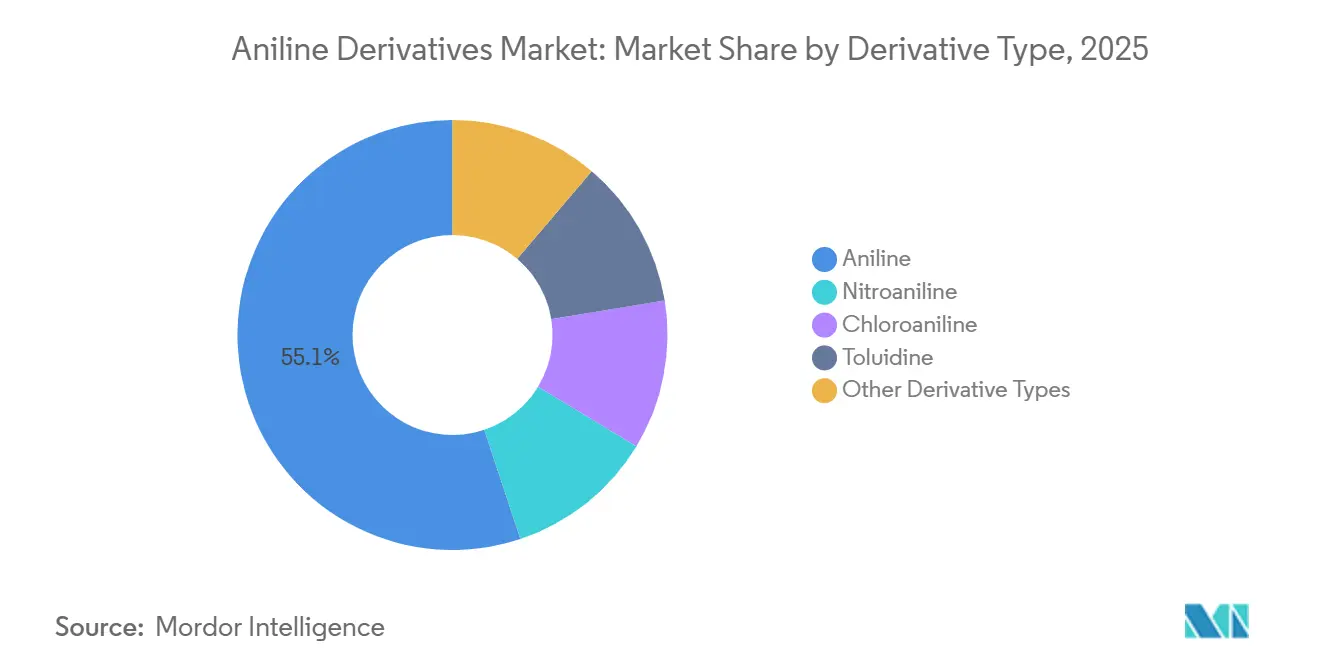
Aniline held 55.13% of the aniline derivatives market size in 2025 because it is the direct precursor for MDI and a feedstock for anti-degradants and dye intermediates. Its position is reinforced by the large volume of MDI used in insulation, appliances, automotive components, and adhesives. Integrated MDI capacity in China requires corresponding upstream aniline volumes as new plants begin operating. Wanhua completed the Fujian MDI base expansion in 2026, adding 700,000 metric tons per year and taking its global MDI capacity above 4.5 million metric tons per year. The scale of these projects keeps the parent compound central to the aniline derivatives market.
Nitroaniline and chloroaniline serve more specialized roles in pharmaceutical intermediates, optical brighteners, and next-generation rubber anti-degradants. These derivatives can command stronger pricing where purity requirements and documentation standards are high. Regulatory review of 6PPD oxidation products may support demand for alternative anti-degradants using chloroaniline and nitroaniline intermediates. Toluidine is used as a dye-intermediate precursor and rubber accelerator feedstock, with demand linked to India’s colorant exports. Specialty derivatives are less dependent on MDI volumes, although their scale is smaller. Producers with established purity controls and compliance records can preserve margins in specialty customer accounts.



By Application: Rubber Chemicals Combine Scale and Growth
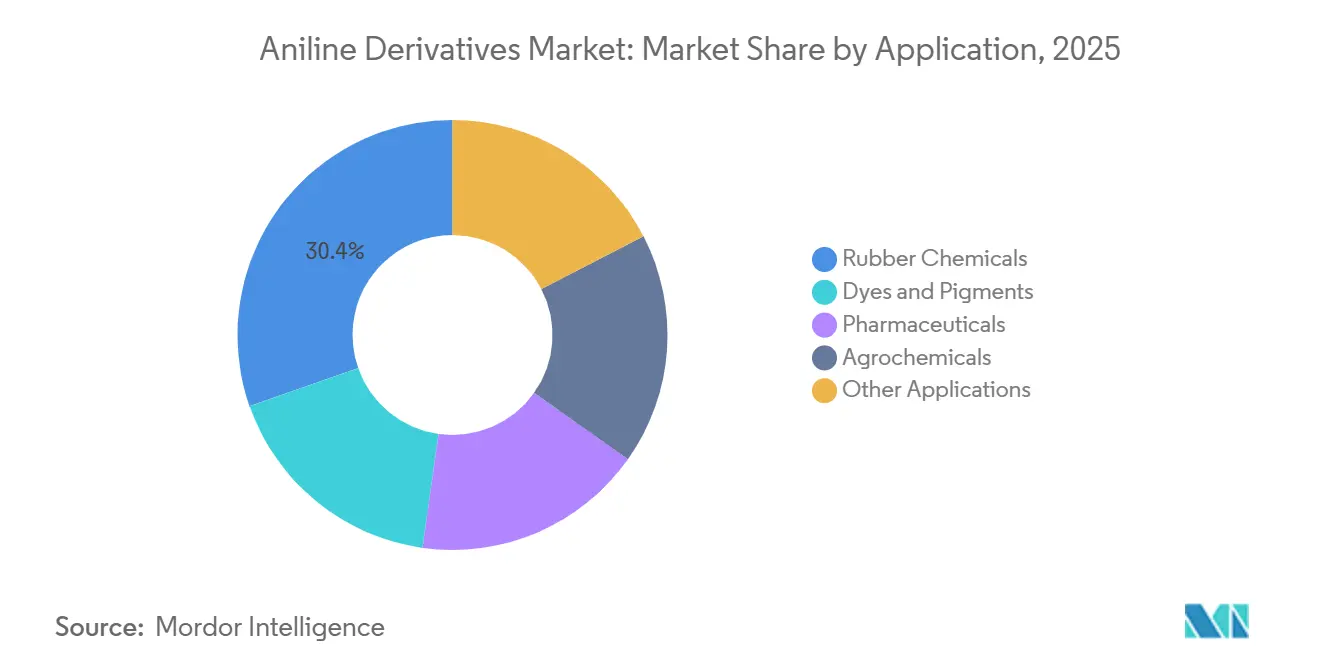
Rubber chemicals held 30.37% of the aniline derivatives market size in 2025 and are projected to advance at a 4.14% CAGR through 2031. This application combines large tire demand with increasing requirements for anti-degradant and accelerator performance. Electric vehicle tires require higher load ratings, lower rolling resistance, and longer wear life in lower-profile designs. These specifications can raise chemical loading per tire even where tire production volumes do not change. LANXESS’s capacity expansion in Qingdao and new U.S. production of rubber processing promoters showed the importance of local supply for tire manufacturers.
Dyes and pigments remain an important application because aniline derivatives are used in reactive dyes, azo dyes, and pigment intermediates. India’s export-oriented dye intermediate sector and China’s high-capacity dye operations support this demand base. Pharmaceuticals and agrochemicals provide less cyclical demand for premium-purity aniline grades. Their pricing is less directly connected to benzene commodity cycles than commodity applications. Certification and compliance requirements in textile colorant use support suppliers that can meet aromatic-amine limits and azo-dye restrictions.
Geography Analysis
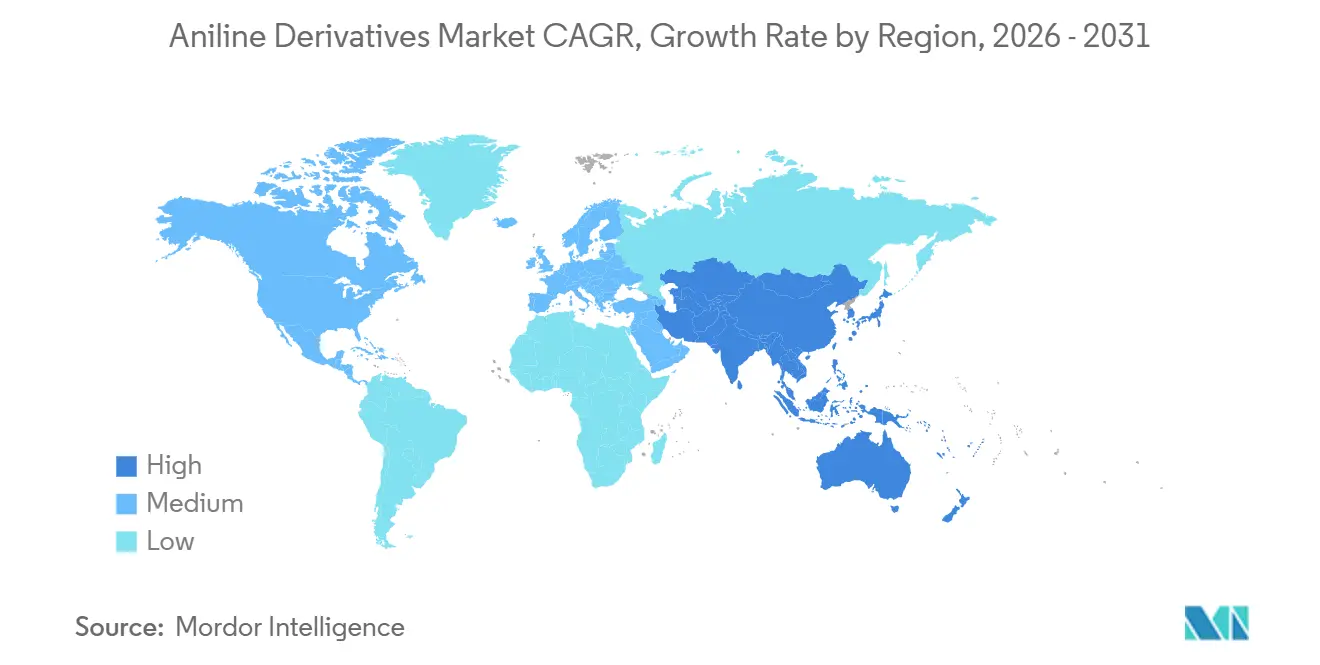
Asia-Pacific held 43.48% of the aniline derivatives market size in 2025 and is projected to advance at a 4.01% CAGR through 2031. China is the central production and consumption base, supported by large MDI, automotive, tire, and downstream chemical capacity. China Risun Group Limited brought Jilin Connell Group’s total 300,000-metric-ton-per-year aniline capacity into full operation in 2024, 1 month ahead of schedule. India is an important import-demand market because domestic aniline production covers close to half of national consumption. This gap leaves derivative processors reliant on merchant supply from China and South Korea.
India’s pharmaceutical manufacturing, infrastructure investment, and dye production can expand derivative demand where local feedstock supply is constrained. Japan and South Korea contribute to technology-intensive production for electronics, pharmaceuticals, and performance-polymer applications. Association of Southeast Asian Nations (ASEAN) countries are developing as secondary consumption centers through automotive assembly and tire manufacturing investment. North America is mature, but the environmental review of 6PPD oxidation products is changing demand toward alternative rubber chemical formulations. In Europe, sustainability specifications and occupational controls create demand for high-purity and lower-carbon inputs.
South America and the Middle East and Africa have smaller consumption bases, but their downstream needs are gradually broadening. Brazil’s agricultural activity supports demand for agrochemical intermediates. Covestro AG began a feasibility study for a 660-kiloton-per-year MDI facility in Al Ruwais Industrial City in the United Arab Emirates, supported by XRG and the TA’ZIZ chemicals hub. If sanctioned, the project would shift part of the regional derivative demand from imports toward local MDI production. Saudi Arabia is developing specialty chemical clusters through Vision 2030 capital programs, while South Africa remains a distribution hub for sub-Saharan markets.

Competitive Landscape
The aniline derivatives market is moderately concentrated, with the top five players including BASF, Covestro AG, Wanhua, Huntsman International LLC, and Sumitomo Chemical Co., Ltd. Wanhua’s Fujian expansion added 700,000 metric tons per year of MDI capacity and took global capacity above 4.5 million metric tons per year. Large integrated companies can manage volatile benzene costs more effectively than standalone derivative processors.
Covestro AG paired conventional capacity investment with lower-carbon process development through Bio4PURConti. The project involved 10 partners and aimed to demonstrate continuous-fermentation bio-based aniline using plant-based sugars from hardwood biomass. Covestro AG also planned its new Shanghai MDI train and began the UAE feasibility study, linking growth plans to major demand centers. BASF’s U.S. MDI commissioning and India feasibility assessment followed a similar approach of locating supply near construction and automotive demand. These moves increased the value of integrated regional production and long-term customer relationships.
LANXESS and Mitsubishi Chemical Corporation remain important in specialized rubber additives and dye intermediates. LANXESS’s REACH registration for Vulkanox 4060 at volumes above 1,000 metric tons per year illustrates the compliance investment needed to supply regulated tire applications. China Risun Group Limited and Shandong Jinling Chemical Co., Ltd. are expanding commodity-grade aniline capacity, but pharmaceutical and specialty uses require stronger purity and regulatory credentials. High-purity chloroaniline and nitroaniline remain areas where documentation and compliance infrastructure can limit entry. Patent activity related to energy reduction in phosgenation and MDI-splitting optimization may also constrain technology access for new entrants. The aniline derivatives market continues to favor scale in MDI while leaving focused opportunities in regulated specialty intermediates.
Aniline Derivatives Industry Leaders
BASF
Covestro AG
Wanhua
Huntsman International LLC
Sumitomo Chemical Co., Ltd.
- *Disclaimer: Major Players sorted in no particular order


Recent Industry Developments
- September 2026: BASF started the evaluation of a new MDI production complex at Dahej, Gujarat. The potential investment could strengthen regional demand for aniline-derived polyurethane intermediates used in insulation, refrigeration, automotive components, furniture, and consumer goods.
- June 2026: Covestro AG launched the EU-funded Bio4PURConti project to develop a continuous production process for bio-based aniline using plant-based biomass. The project supports the development of lower-carbon aniline derivatives for polyurethane, rubber chemicals, dyes, and other downstream applications.


Global Aniline Derivatives Market Report Scope
Aniline derivatives are aromatic amine compounds derived from aniline through chemical modification of its molecular structure. They serve as versatile chemical intermediates with properties that support the production of specialty and industrial products.
The Aniline Derivatives Market is segmented by derivative type, application, and geography. By derivative type, the market is segmented into aniline, nitroaniline, chloroaniline, toluidine, and other derivative types. By application, the market is segmented into rubber chemicals, dyes and pigments, pharmaceuticals, agrochemicals, and other applications. The report also covers the market size and forecasts for aniline derivatives in 15 countries across major regions. For each segment, the market sizing and forecasts have been done on the basis of value (USD).
| Aniline |
| Nitroaniline |
| Chloroaniline |
| Toluidine |
| Other Derivative Types |
| Rubber Chemicals |
| Dyes and Pigments |
| Pharmaceuticals |
| Agrochemicals |
| Other Applications |
| Asia-Pacific | China |
| India | |
| Japan | |
| South Korea | |
| ASEAN Countries | |
| Rest of Asia-Pacific | |
| North America | United States |
| Canada | |
| Mexico | |
| Europe | Germany |
| United Kingdom | |
| France | |
| Italy | |
| NORDIC Countries | |
| Rest of Europe | |
| South America | Brazil |
| Argentina | |
| Rest of South America | |
| Middle East and Africa | Saudi Arabia |
| South Africa | |
| Rest of Middle East and Africa |
| By Derivative Type | Aniline | |
| Nitroaniline | ||
| Chloroaniline | ||
| Toluidine | ||
| Other Derivative Types | ||
| By Application | Rubber Chemicals | |
| Dyes and Pigments | ||
| Pharmaceuticals | ||
| Agrochemicals | ||
| Other Applications | ||
| By Geography | Asia-Pacific | China |
| India | ||
| Japan | ||
| South Korea | ||
| ASEAN Countries | ||
| Rest of Asia-Pacific | ||
| North America | United States | |
| Canada | ||
| Mexico | ||
| Europe | Germany | |
| United Kingdom | ||
| France | ||
| Italy | ||
| NORDIC Countries | ||
| Rest of Europe | ||
| South America | Brazil | |
| Argentina | ||
| Rest of South America | ||
| Middle East and Africa | Saudi Arabia | |
| South Africa | ||
| Rest of Middle East and Africa | ||


Key Questions Answered in the Report
What is the size of the aniline derivatives market?
The aniline derivatives market stands at USD 23.65 billion in 2026 and is projected to reach USD 27.85 billion by 2031.
What is driving demand for aniline derivatives?
MDI demand for polyurethane insulation, appliances, and automotive components is the leading demand factor.
Which derivative type held the largest share in 2025?
Aniline held a 55.13% of the market share in 2025 because it is the direct precursor for MDI and a feedstock for rubber chemicals and dye intermediates.
Which application is projected to grow fastest through 2031?
Rubber chemicals are projected to advance at a 4.14% CAGR through 2031, supported by tire production and more demanding electric vehicle tire specifications.
Page last updated on:


 Your data is secure and never sold or shared.


