
Ambulatory Care Medical Software Market Size and Share
Market Overview
| Study Period | 2020 - 2031 |
|---|---|
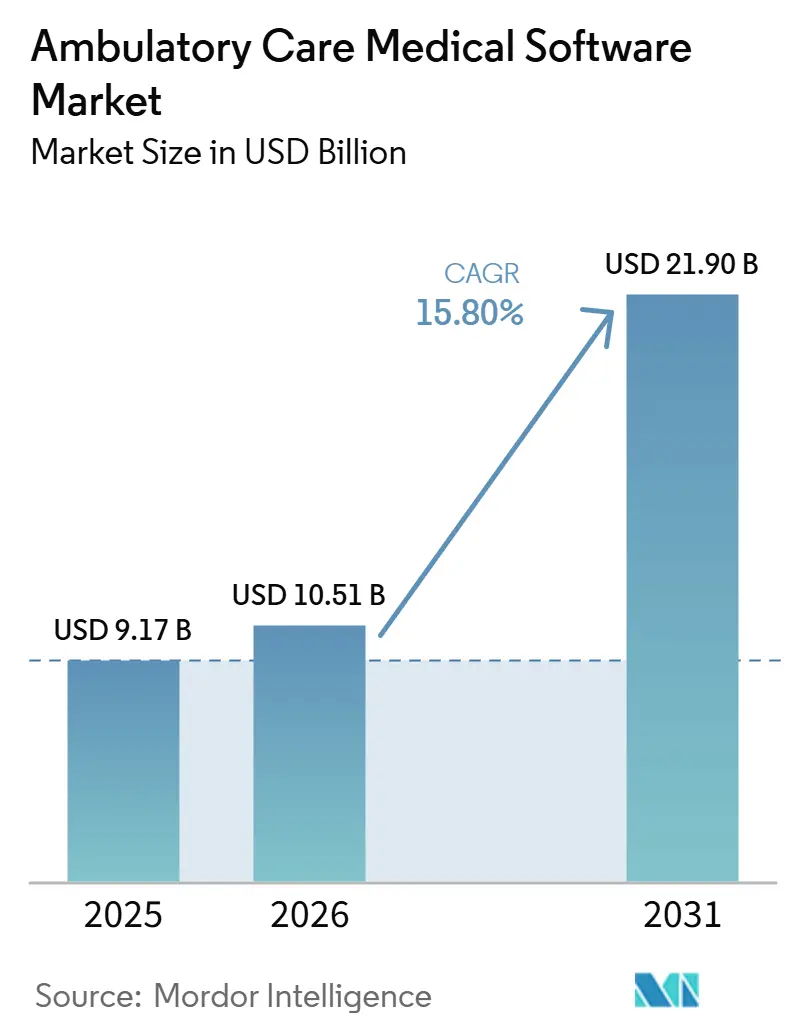
| Market Size (2026) | USD 10.51 Billion |
| Market Size (2031) | USD 21.90 Billion |
| Growth Rate (2026 - 2031) | 15.80 % |
| Fastest Growing Market | Asia-Pacific |
| Largest Market | North America |
| Market Concentration | Medium |
Major Players *Disclaimer: Major Players sorted in no particular order Image © Mordor Intelligence. Reuse requires attribution under CC BY 4.0. | |
Ambulatory Care Medical Software Market Analysis by Mordor Intelligence
The Ambulatory Care Medical Software Market size was valued at USD 9.17 billion in 2025 and is estimated to grow from USD 10.51 billion in 2026 to reach USD 21.90 billion by 2031, at a CAGR of 15.80% during the forecast period (2026-2031).
Payers, hospital systems, and federal policy continue to move eligible care from inpatient facilities to outpatient and community settings. That shift increases the need for scheduling, documentation, coding, billing, and patient engagement tools in physician offices, specialty clinics, and ambulatory surgery centers. CMS[1]Centers for Medicare & Medicaid Services, “CY 2026 OPPS and ASC Final Rule,” Centers for Medicare & Medicaid Services finalized the CY 2026 OPPS and ASC payment rule in November 2025, removing 285 procedures from the Inpatient Only list and adding 289 codes to the ASC Covered Procedures List. The rule is expected to reduce OPPS spending by USD 290 million in 2026, which changes the financial case for ambulatory care delivery and related software procurement. Revenue cycle automation, ambient documentation tools, cloud delivery, and data exchange requirements are also encouraging replacement of older systems with more integrated platforms.
Key Report Takeaways
By product type, Ambulatory EHR/EMR Software held 28.5% revenue share in 2025, while Population Health & Analytics Software is forecast to grow at a 16.4% CAGR through 2031.
By component, Software held 71.2% revenue share in 2025, while Services is forecast to grow at a 16.6% CAGR through 2031.
By deployment model, Cloud held 62.8% revenue share in 2025 and is forecast to grow at a 16.3% CAGR through 2031.
By technology, Mobile Applications held 27.6% revenue share in 2025, while AI/ML-enabled solutions are forecast to grow at a 16.5% CAGR through 2031.
By end user, Physician Offices held 46.3% revenue share in 2025, while Ambulatory Surgery Centers are forecast to grow at a 16.2% CAGR through 2031.
By geography, North America held 41.1% revenue share in 2025, while Asia-Pacific is forecast to grow at a 16.7% CAGR through 2031.
Note: Market size and forecast figures in this report are generated using Mordor Intelligence’s proprietary estimation framework, updated with the latest available data and insights as of January 2026.
Global Ambulatory Care Medical Software Market Trends and Insights
Shift Toward Lower-Cost Outpatient and Community-Based Care
CMS issued its CY 2026 OPPS and ASC final rule in November 2025. The rule removed 285 primarily musculoskeletal procedures from the Inpatient Only list and added 289 codes to the ASC Covered Procedures List. Site-neutral payment reforms for off-campus provider-based departments are expected to reduce OPPS spending by USD 290 million in 2026. Health systems therefore have a stronger financial reason to move eligible elective procedures to ambulatory surgery centers. Each newly eligible procedure creates added needs for documentation, scheduling, coding, and billing workflows. The Ambulatory Surgery Center Association[2]Ambulatory Surgery Center Association, “2025 ASC EHR Survey,” Ambulatory Surgery Center Association reported 76% EHR adoption among ASCs in July 2025, compared with 55% in 2021, and respondents identified data gathering as a leading benefit
Ambient AI Documentation and Clinical Workflow Automation
Ambient AI documentation is moving beyond initial pilots in ambulatory specialties. A 2026 outpatient study found that AI scribes reduced note-writing time by 15%, or more than 60 minutes a week per clinician, and reduced after-hours documentation time by 18% within 150 days of implementation. A real-world evaluation in Spanish outpatient care covered 2.3 million ambient AI uses over 16 months and reported strong clinician acceptance. The findings indicate that gains can support more patient interaction rather than shorter appointments. eClinicalWorks reported that its Sunoh.ai integration at Evolve Psychiatry saved providers more than 2 hours a day in documentation time. The ambulatory care medical software market is consequently favoring products that place ambient tools within the EHR workflow rather than treating them as separate applications.
Expansion of Revenue Cycle Automation and Value-Based Care Workflows
Revenue cycle automation is becoming a central operating requirement for ambulatory providers. Waystar stated that AltitudeAI prevented more than USD 15 billion in denied claims within less than 1 year of deployment. Veradigm introduced an AI-enabled Revenue Cycle Services application in January 2026. The company reported up to 25% lower preparation time for manual performance reviews, 98% first-pass clean claims, and 99% net collections for independent practices. These tools are extending from claim processing into prior authorization, denial management, coding review, and payment analysis. The ambulatory care medical software market has room for platforms that retain human review of AI-generated coding decisions, especially where smaller practices have limited audit capacity.
Cloud Migration and Subscription-Based Software Adoption
Cloud delivery remains important because it allows providers to receive updates without extensive local IT work. Cloud adoption in the U.S. ambulatory EHR segment reached 84.3% in 2025. The ONC HTI-5 proposed rule supports AI-enabled interoperability through updated standards and certification requirements. These requirements place pressure on on-premise vendors to retain compliance capabilities. Cloud systems can distribute updates for FHIR APIs, certification changes, and CMS prior authorization rules across the provider base. They also combine patient intake, eligibility, and payment processes within a shared environment. The ambulatory care medical software market benefits when cloud platforms make regulatory and workflow changes easier for independent practices to adopt.
Restraints Impact Analysis*
| Restraint | (~) % Impact on CAGR Forecast | Geographic Relevance | Impact Timeline |
|---|---|---|---|
| Implementation Complexity and Workflow Disruption | -1.2% | Global, most acute in rural North America and small practices in South Asia | Medium term (2-4 years) |
| Cybersecurity, Privacy, and Ransomware Exposure | -1.5% | Global, with highest intensity in North America and Western Europe | Short term (≤ 2 years) |
| Fragmented Data Standards Across Outpatient Ecosystems | -0.9% | Global, most severe in MEA and South America | Long term (≥ 4 years) |
| Limited Digital Maturity and Cybersecurity Staffing in Rural Practices | -0.8% | Rural North America, rural APAC, and rural MEA | Long term (≥ 4 years) |
| Source: Mordor Intelligence | |||
Cybersecurity, Privacy, and Ransomware Exposure
Healthcare was the leading sector for cyber threats in 2025, with 460 ransomware attacks and 182 data breaches reported through FBI data cited by the American Hospital Association. Ambulatory practices hold clinical and financial records in their EHR and billing systems. Their security resources are often more limited than those of academic medical centers. Indiana’s 2025 healthcare cybersecurity report identified stolen credentials, remote access, data theft, ransom, and exposure threats as a common attack sequence. Multi-factor authentication and single sign-on can help interrupt this path. For the ambulatory care medical software market, security architecture and breach-response readiness increasingly affect vendor selection and cyber-insurance expectations.
Implementation Complexity and Workflow Disruption
EHR changes can create significant disruption for ambulatory practices. The ambulatory EHR field includes more than 300 vendors serving independent practices. Ownership transitions can also alter product development and customer support arrangements. Clinical throughput may decline by 10% to 30% during a system transition, with specialty practices often facing longer recovery periods because of complex templates. A March 2026 Veradigm survey of 360 independent practice leaders found that 57% expected better automation to provide a significant or major improvement. The ambulatory care medical software market, therefore, rewards vendors that can provide stable implementation support, reliable ownership, and practical workflow migration.
*Our forecasts treat driver/restraint impacts as directional, not additive. The impact forecasts reflect baseline growth, mix effects, and variable interactions.
Segment Analysis
By Product Type: Analytics Demand Extends Beyond Core EHR Systems
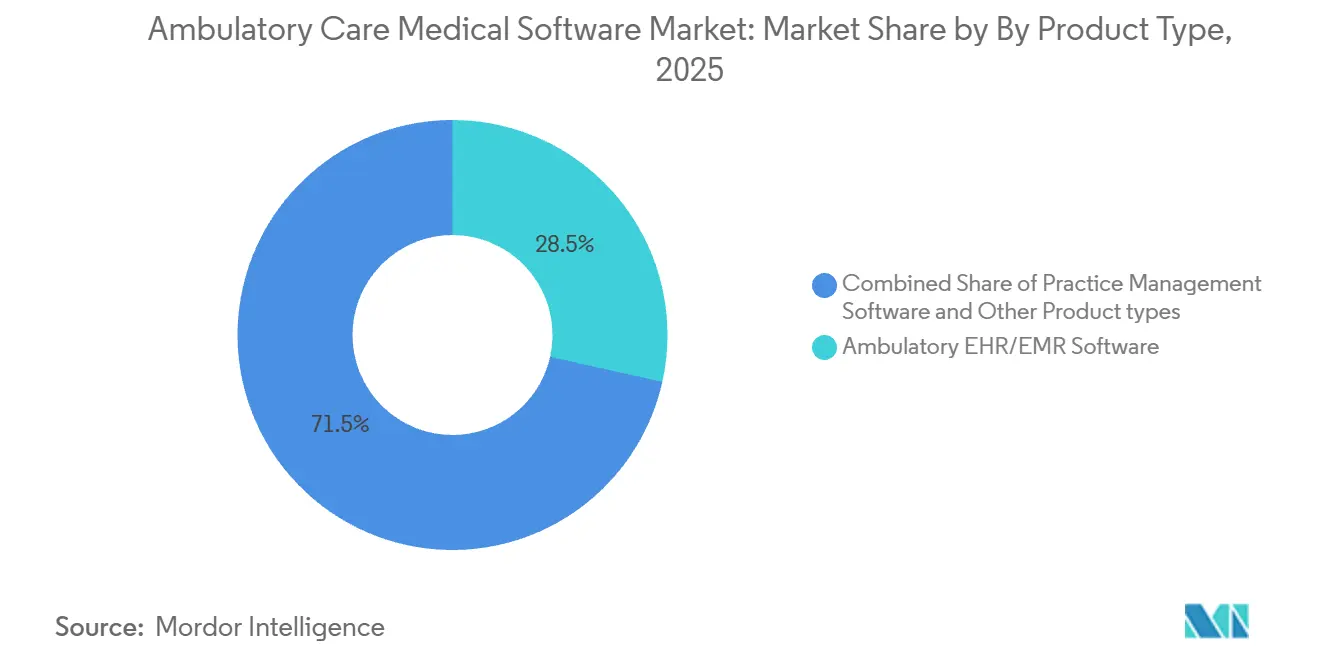
Ambulatory EHR/EMR Software held 28.5% of the ambulatory care medical software market share by product type in 2025. Its position is supported by certified EHR requirements linked to federal reimbursement eligibility and quality reporting. The North American installed base is mature, but replacement demand continues as practices move from client-server products to cloud-native architectures. Buyers increasingly look for FHIR API exchange, ambient documentation, and patient portal functions in the same system. Population Health & Analytics Software is the fastest-growing product type, with a projected CAGR of 16.4% from 2026 to 2031. Risk-bearing physician groups and accountable care organizations need risk stratification, care-gap analysis, and outreach tools to manage value-based contracts.
Revenue Cycle Management Software and Practice Management Software remain important product areas because they connect clinical activity to payment workflows. athenahealth announced more than 80 AI features for prior authorization, denials, and coding, showing the level of investment in integrated workflow tools. Patient Engagement Software has become a baseline provider requirement rather than a separate source of differentiation. E-Prescribing Software also serves a high-volume workflow, with Surescripts[3]Surescripts, “2025 Annual Impact Report,” Surescripts processing more than 30 billion health intelligence transactions in 2025. Telehealth Software has stabilized after rapid expansion, with durable demand centered on products that combine billing and clinical documentation. ASC Management Software gains support from the expansion of ASC-eligible procedures under CMS policy.



By Component: Services Support More Complex Platform Use
Software held 71.2% of component revenue in 2025. Subscription revenue, centralized updates, and data governance support the continued lead of software platforms. The model also attracts vendor investment because it can support recurring fees and remote delivery. Services is forecast to grow faster at a CAGR of 16.6% from 2026 to 2031. This demand includes implementation support, revenue cycle outsourcing, population health program management, and interoperability advisory work. The contrast indicates that customers need more help converting software capability into operating changes.
Independent practices often lack internal clinical informatics teams. That constraint increases demand for managed implementation and ongoing support. Veradigm found that 57% of independent practice leaders expected better automation to improve practice outcomes. Managed RCM offerings and ambient AI implementation support are becoming more important service categories. Some vendors are positioning these functions as recurring subscriptions rather than one-time projects. The ambulatory care medical software industry is thus relying on services to address workflow changes that software licenses alone cannot solve. This mix can also make platform switching more difficult once a provider has embedded a vendor’s operating support.
By Deployment Model: Cloud Combines Scale With Compliance Support
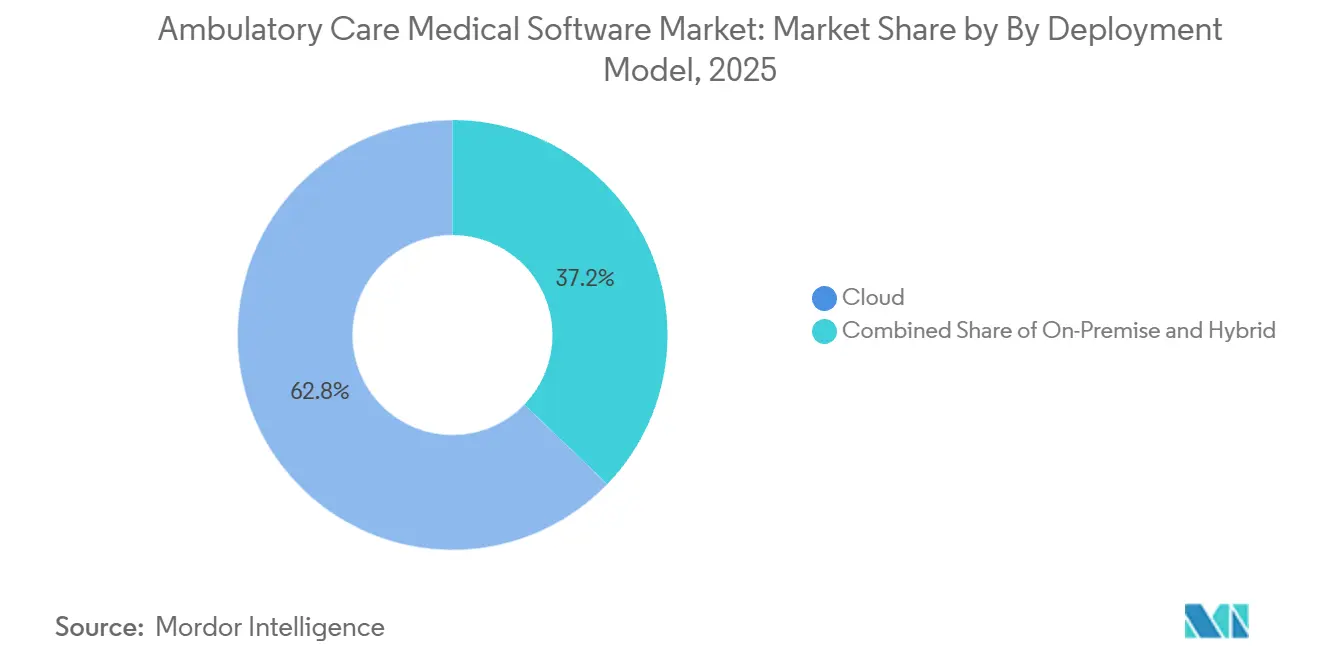
Cloud deployment represented 62.8% of the ambulatory care medical software market size by deployment model in 2025. It is also the fastest-growing deployment model, with a projected CAGR of 16.3% through 2031. In the U.S. ambulatory segment, cloud solutions held 84.3% share in 2025. The difference from the global figure reflects remaining on-premise and hybrid use in Europe and Asia, where data residency rules can affect deployment choices. The ONC HTI-5 proposed rule gives providers another reason to evaluate systems that can support updated interoperability and certification expectations.
On-premise systems remain relevant for large hospital-affiliated outpatient networks with established infrastructure and dedicated IT teams. Hybrid models serve organizations that need to meet data residency requirements while modernizing application layers. Cloud platforms can deliver regulatory changes, security updates, and API features without requiring each site to manage a separate release. They also support a more current stream of data for AI-enabled functions. This can widen the practical gap between cloud-native and older local systems. The ambulatory care medical software market is therefore moving toward cloud systems that combine scalability with regulatory support, while preserving hybrid options for complex health systems.
By Technology: AI/ML Moves Into Core Workflows
Mobile Applications held 27.6% of the technology segment in 2025. Mobile-enabled workflows initially helped cloud-based EHR products stand apart from earlier on-premise systems. AI/ML Enabled solutions are projected to grow at a 16.5% CAGR from 2026 to 2031, making them the fastest-growing technology category. The change reflects a move from experimental AI features to tools used in clinical, financial, and operational processes. Oracle launched a voice-first AI-driven ambulatory EHR for U.S. providers in August 2025. The product allows clinicians to retrieve lab results, medication history, and documentation through conversational commands.
NextGen Healthcare introduced the Nia AI orchestration agent in November 2025. The tool was designed to coordinate clinical, financial, and operational workflows through voice or text commands. Voice Recognition remains useful as both a direct input method and a foundation for ambient documentation. IoMT Enabled platforms connect wearable and remote monitoring data with ambulatory EHR records for chronic disease and population health programs. API Enabled infrastructure is becoming a procurement baseline because TEFCA and CMS prior authorization requirements favor FHIR-native connectivity. The ambulatory care medical software market is placing greater weight on the quality of integrated workflows than on stand-alone technology features.
By End User: ASCs Gain From Procedure Migration
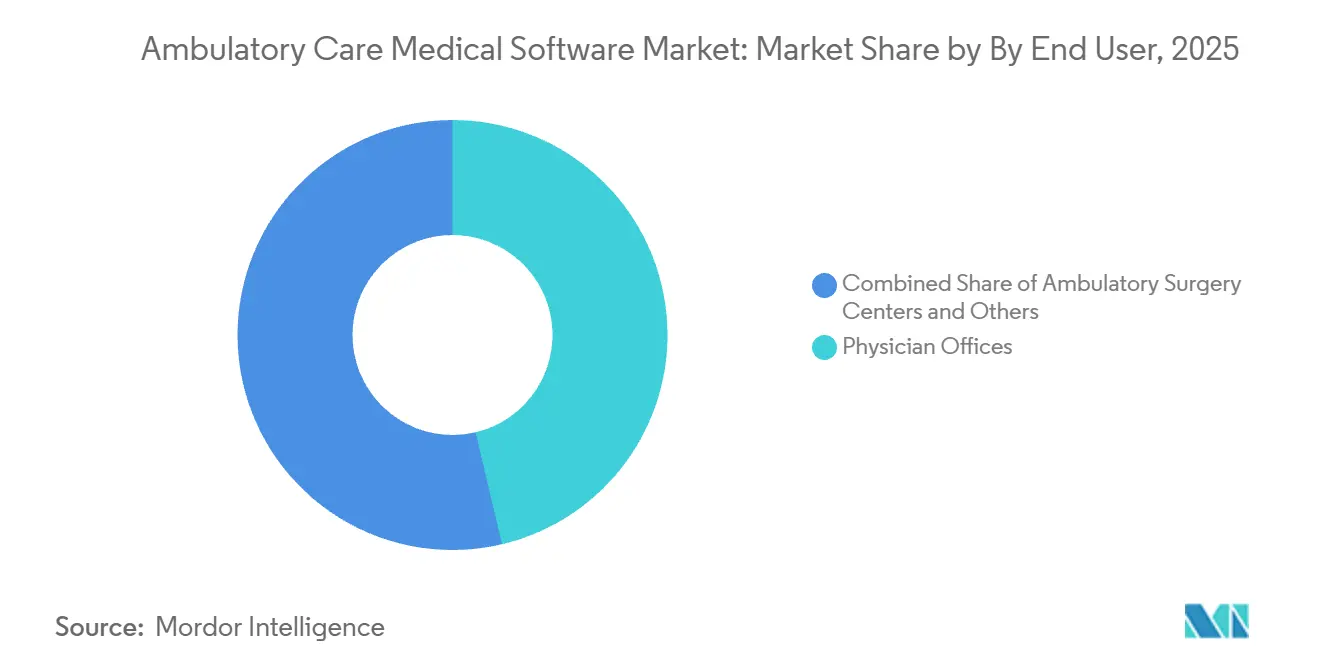
Physician Offices accounted for 46.3% of ambulatory care medical software market share by end user in 2025. They represent the largest installed base for ambulatory EHR, practice management, and patient engagement platforms. Many are independent practices, where switching costs can be lower than in hospital-affiliated settings. This supports active competition and continuing replacement demand. Ambulatory Surgery Centers are projected to record the fastest CAGR of 16.2% through 2031. Their growth aligns with CMS actions that expand the procedures eligible for ASC delivery.
The Ambulatory Surgery Center Association confirmed 76% EHR adoption in ASCs in July 2025, up from 55% in 2021. Specialty Clinics require software that supports specialized documentation, coding, and billing. Diagnostic Centers need closer integration of laboratory and imaging workflows with ambulatory EHR systems. These requirements support demand for closed-loop referral management and results routing. Physician offices remain central to vendor revenue, but growth in ASCs and specialty clinics is reducing their relative dominance. Vendors without specialty-specific functions may face weaker renewal prospects among these providers.
Geography Analysis
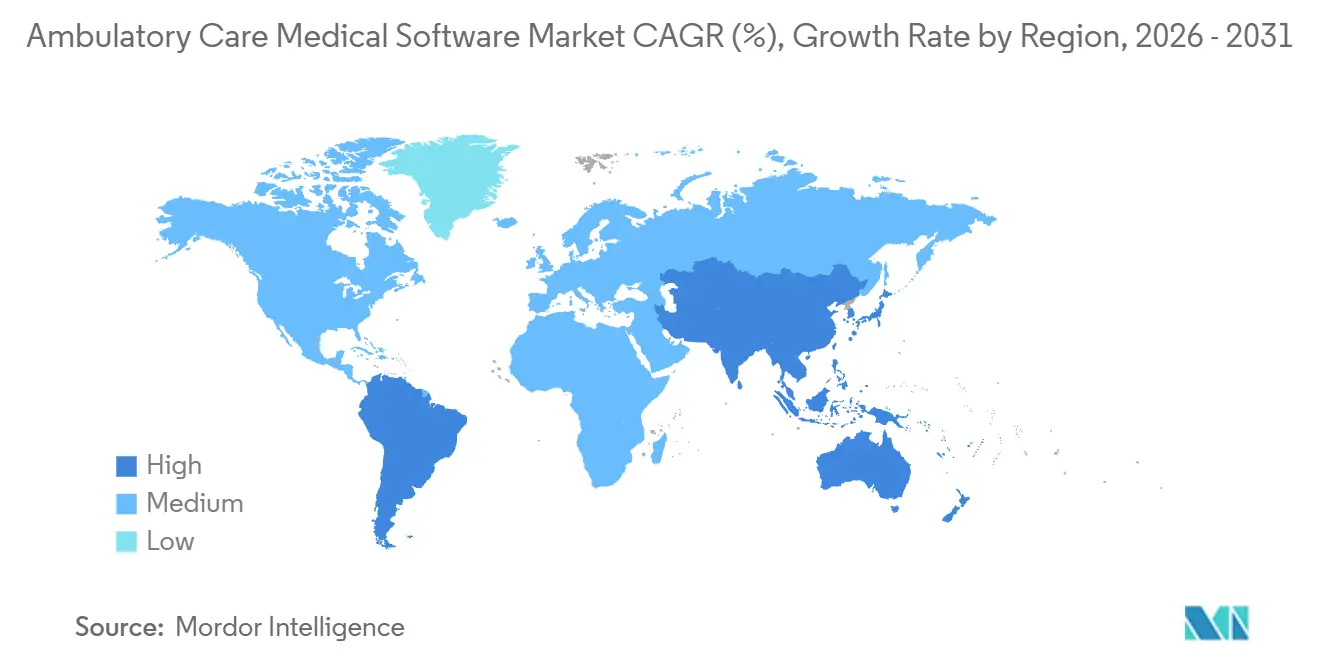
North America held 41.1% of regional revenue in 2025. The region benefits from extensive compliance requirements, established cloud EHR use, and investment in value-based care administration. U.S. ambulatory EHR cloud penetration reached 84.3% in 2025. This creates an upgrade environment shaped more by AI and interoperability gaps than by primary adoption. CMS payment reforms for 2026 expand ASC procedure eligibility and support additional demand for related operational software.
Asia-Pacific is forecast to grow at a 16.7% CAGR from 2026 to 2031, the fastest regional pace in the ambulatory care medical software market. National digital health mandates are supporting wider software adoption across outpatient networks. India’s Ayushman Bharat Digital Mission supports digital health infrastructure and interoperable records. China’s hospital grading and cybersecurity requirements encourage EMR-to-EHR upgrade cycles in large ambulatory facilities. South Korea and Australia have mature replacement cycles, while Southeast Asian markets remain at an earlier stage of adoption. These different starting points support continued regional growth through the forecast period.
Europe has a significant position because Germany, the United Kingdom, and France have established ambulatory care infrastructure. EU Health Data Space rules are expected to support data portability and favor interoperability-ready platforms. GCC countries, especially Saudi Arabia and the UAE, continue to invest in digital healthcare under national modernization programs. South Africa and other MEA markets face infrastructure and digital maturity gaps that extend implementation timelines. Brazil’s LGPD and digital health guidance[4]Government of Brazil, “Lei Geral de Proteção de Dados,” Government of Brazil are contributing to compliance-focused EHR procurement in private ambulatory networks. Argentina and other South American markets offer longer-term opportunities for cloud platforms that can localize products and meet local requirements.

Competitive Landscape
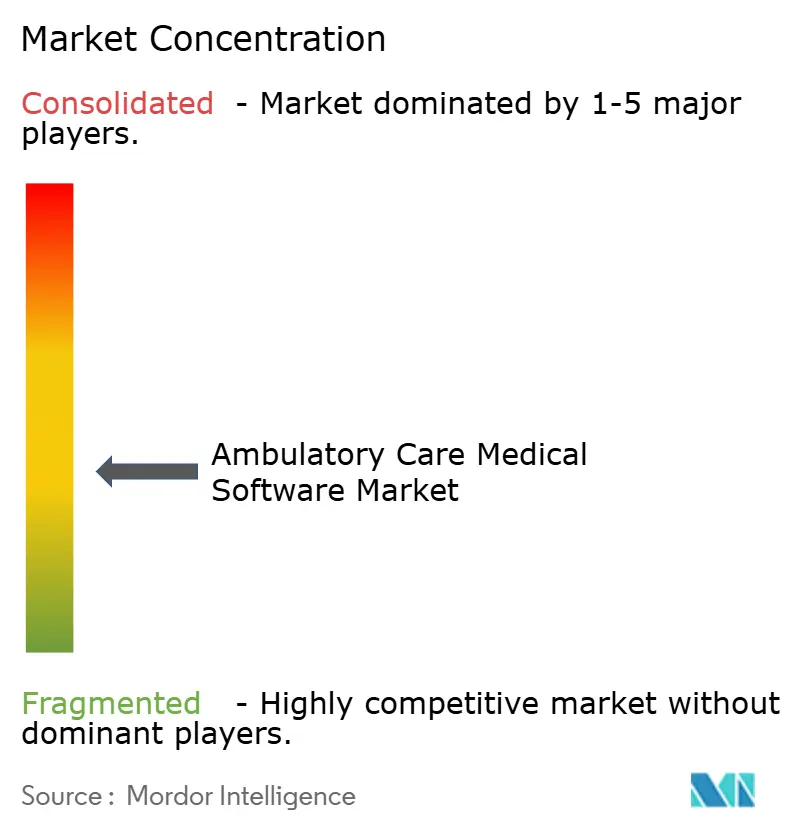
The ambulatory care medical software market has a moderately consolidated structure. athenahealth, eClinicalWorks, Epic, NextGen Healthcare, Oracle Health, and Waystar are established multi-product platform vendors. These companies compete with newer AI-focused providers for ambulatory practice renewals. Leading vendors are adding revenue cycle automation, ambient documentation, population health analytics, and interoperability tools to unified subscriptions. This approach reduces the need for customers to assemble multiple point solutions. The ambulatory care medical software market concentration score is not available because the supplied material does not provide combined market-share data for the leading companies.
Waystar expanded its collaboration with Google Cloud in March 2026 to advance agentic AI in revenue cycle management. The company then introduced an AI solution for silent denials in April 2026, targeting post-payment payer adjustments. eClinicalWorks announced production support for the CMS Kill the Clipboard initiative in April 2026. Its support allows paperless patient intake through QR codes and Smart Health Cards. These moves show that vendors are treating AI, automation, and interoperability as operating capabilities rather than optional modules. Patent activity in clinical natural language processing and workflow orchestration also reflects efforts to protect differentiation before these functions become more common.
Opportunities remain in specialty-specific ASC management products for newly eligible procedure categories. Population health platforms that combine social determinants, claims, and EHR records also serve Medicaid-managed care organizations. Cybersecurity-bundled ambulatory products can address demand for monitoring and incident response within the software offering. Smaller AI-native EHR providers are targeting independent practices with ambient documentation, integrated RCM, and FHIR-native connectivity. Those features can weaken advantages built by established vendors during earlier implementation cycles. The ambulatory care medical software market will continue to favor vendors that make these functions easier to deploy without adding workflow disruption.
Ambulatory Care Medical Software Industry Leaders
Veradigm LLC
Waystar Holding Corp.
Surescripts, LLC
Epic Systems Corporation
Oracle Corporation
- *Disclaimer: Major Players sorted in no particular order

Recent Industry Developments
- July 2026: Experity Acquires Exdion Healthcare: Experity, the on-demand care technology platform serving nearly half of US urgent care clinics, acquired Exdion Healthcare — an AI-driven SaaS company specializing in the patient chart-to-cash lifecycle including coding, billing, and RCM automation. The combined platform achieves an 86% reduction in claim denials and extends Experity's coverage across the full ambulatory revenue cycle for enterprise-level urgent care and ambulatory organizations.
- April 2026: Waystar Introduces AI Solution for Silent Denials: Waystar (Nasdaq: WAY) launched the industry's first AI-powered recoupments solution targeting an estimated USD 40 billion in provider revenue lost annually to post-payment payer adjustments. The solution was showcased at Waystar's Spring 2026 Innovation Showcase as part of the broader AltitudeAI autonomous revenue cycle platform.
- March 2026: Waystar and Google Cloud Expand AI Collaboration: Waystar and Google Cloud announced an expanded collaboration to accelerate agentic AI capabilities in healthcare revenue cycle management, building on the AltitudeAI platform that prevented more than USD 15 billion in denied claims within less than a year of deployment in 2025.
- January 2026: Veradigm Launches AI-Enabled Revenue Cycle Application: Veradigm launched a web-based AI analytics workspace for Revenue Cycle Services clients, reducing manual performance-review preparation time by up to 25%, achieving 98% first-pass clean claim rates, and automatically surfacing denial trends and payment anomalies for independent practices.


Global Ambulatory Care Medical Software Market Report Scope
| Ambulatory EHR/EMR Software |
| Practice Management Software |
| Revenue Cycle Management Software |
| Patient Engagement Software |
| Telehealth Software |
| Referral Management Software |
| Population Health & Analytics Software |
| E?Prescribing Software |
| Ambulatory Surgery Center Management Software |
| Software |
| Services |
| Cloud |
| On-Premise |
| Hybrid |
| AI/ML Enabled |
| Voice Recognition |
| Mobile Applications |
| IoMT Enabled |
| API Enabled |
| Physician Offices |
| Specialty Clinics |
| Ambulatory Surgery Centers |
| Diagnostic Centers |
| North America | United States |
| Canada | |
| Mexico | |
| Europe | Germany |
| United Kingdom | |
| France | |
| Italy | |
| Spain | |
| Rest of Europe | |
| Asia-Pacific | China |
| India | |
| Japan | |
| South Korea | |
| Australia | |
| Rest of Asia-Pacific | |
| Middle East and Africa | GCC |
| South Africa | |
| Rest of Middle East and Africa | |
| Israel | |
| South America | Brazil |
| Argentina | |
| Rest of South America |
| Product Type | Ambulatory EHR/EMR Software | |
| Practice Management Software | ||
| Revenue Cycle Management Software | ||
| Patient Engagement Software | ||
| Telehealth Software | ||
| Referral Management Software | ||
| Population Health & Analytics Software | ||
| E?Prescribing Software | ||
| Ambulatory Surgery Center Management Software | ||
| Component | Software | |
| Services | ||
| Deployment Model | Cloud | |
| On-Premise | ||
| Hybrid | ||
| Technology | AI/ML Enabled | |
| Voice Recognition | ||
| Mobile Applications | ||
| IoMT Enabled | ||
| API Enabled | ||
| End User | Physician Offices | |
| Specialty Clinics | ||
| Ambulatory Surgery Centers | ||
| Diagnostic Centers | ||
| Segmentation by Geography | North America | United States |
| Canada | ||
| Mexico | ||
| Europe | Germany | |
| United Kingdom | ||
| France | ||
| Italy | ||
| Spain | ||
| Rest of Europe | ||
| Asia-Pacific | China | |
| India | ||
| Japan | ||
| South Korea | ||
| Australia | ||
| Rest of Asia-Pacific | ||
| Middle East and Africa | GCC | |
| South Africa | ||
| Rest of Middle East and Africa | ||
| Israel | ||
| South America | Brazil | |
| Argentina | ||
| Rest of South America | ||


Key Questions Answered in the Report
What is the projected value of ambulatory care medical software by 2031?
The ambulatory care medical software market is estimated to reach USD 21.9 billion by 2031, from USD 10.5 billion in 2026, at a 15.8% CAGR.
Which product category is growing fastest?
Population Health & Analytics Software is projected to grow at a 16.4% CAGR from 2026 to 2031.
Why are ambulatory surgery centers increasing software demand?
CMS expanded the ASC Covered Procedures List by 289 codes in its CY 2026 rule, increasing the need for ASC scheduling, documentation, coding, and billing tools.
Which deployment model has the largest share?
Cloud deployment held 62.8% share in 2025 and is forecast to grow at a 16.3% CAGR through 2031.
Which end user holds the largest share?
Physician Offices held 46.3% of revenue in 2025, while Ambulatory Surgery Centers are forecast to grow fastest at a 16.2% CAGR.
What is the leading regional opportunity?
North America held 41.1% share in 2025, while Asia-Pacific is projected to grow fastest at a 16.7% CAGR through 2031.
Page last updated on:





