
Alternative Accommodation Market Size and Share
Market Overview
| Study Period | 2022 - 2031 |
|---|---|
| Market Size (2026) | USD 137.63 Billion |
| Market Size (2031) | USD 184.43 Billion |
| Growth Rate (2026 - 2031) | 6.03 % |
| Fastest Growing Market | Asia-Pacific |
| Largest Market | Europe |
| Market Concentration | Low |
Major Players *Disclaimer: Major Players sorted in no particular order Image © Mordor Intelligence. Reuse requires attribution under CC BY 4.0. | |
Alternative Accommodation Market Analysis by Mordor Intelligence
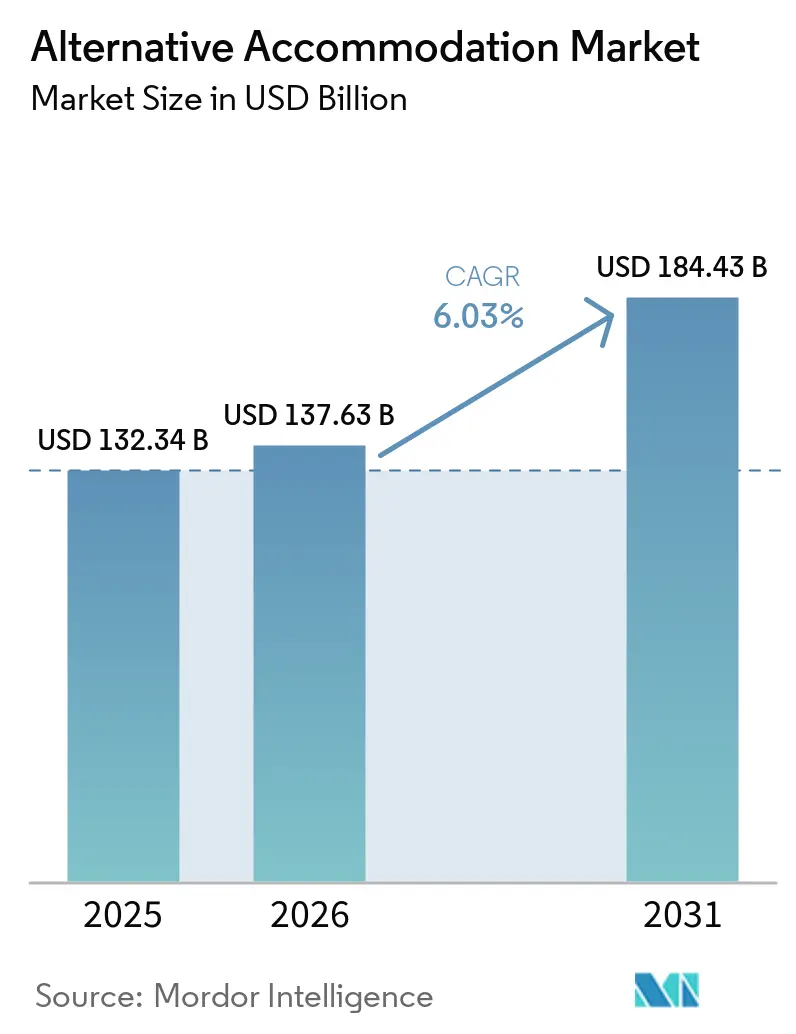
The Alternative Accommodation Market size is projected to be USD 132.34 billion in 2025, USD 137.63 billion in 2026, and reach USD 184.43 billion by 2031, growing at a CAGR of 6.03% from 2026 to 2031.
The alternative accommodation market continues to benefit from travel patterns that favor locally owned stays, cultural immersion, and flexible booking formats over standardized lodging. Europe remained the largest regional base in 2025, while Asia-Pacific is set to record the fastest expansion through 2031, underscoring that both mature tourism systems and newer demand centers are supporting growth. The alternative accommodation market also reflects a clear shift in guest behavior, where discovery increasingly starts with the stay itself, especially among younger travelers who value distinctive settings and host-led experiences. Leisure travel remains the largest demand base, but longer stays and workcation demand are improving occupancy patterns and reducing seasonal pressure for many operators. At the same time, the alternative accommodation market remains fragmented at the host level and more concentrated at the booking platform level, which is shaping margin structures, loyalty strategies, and direct booking efforts across the category.[1]
Key Report Takeaways
- By core accommodation category, Guesthouses and Pensiones led with 42.73% revenue share in 2025, while Homestays and Farm Stays are forecast to expand at a 7.12% CAGR through 2031.
- By booking channel, Online Intermediaries and Digital Marketplaces held 54.94% share in 2025, while Direct-to-Host Channels recorded the highest projected CAGR at 7.85% through 2031.
- By listing rental format, Entire Unit and Private Property accounted for 54.73% revenue share in 2025, while Private Room Inventory is advancing at a 6.98% CAGR through 2031.
- By stay purpose, Leisure Travel held 60.12% of revenue in 2025, while Long-Stay and Workcation is projected to grow at a 7.46% CAGR through 2031.
- By geography, Europe held 36.85% share in 2025, while Asia-Pacific is forecast to expand at a 7.93% CAGR through 2031.
Note: Market size and forecast figures in this report are generated using Mordor Intelligence’s proprietary estimation framework, updated with the latest available data and insights as of January 2026.
Global Alternative Accommodation Market Trends and Insights
Drivers Impact Analysis*
| Drivers | (~) % Impact on CAGR Forecast | Geographic Relevance | Impact Timeline |
|---|---|---|---|
| Rising Preference for Authentic, Localized Stays | +1.6% | Global, strongest in Europe, APAC, and North America | Short term (≤ 2 years) |
| Rapid OTA Penetration into Non-Hotel Inventory | +1.1% | Global, accelerating in APAC and Latin America | Short term (≤ 2 years) |
| Workcation Demand for Low-Density Longer-Stay Properties | +0.8% | Europe, North America, South Asia | Medium term (2-4 years) |
| Domestic Tourism Recovery in Rural and Secondary Destinations | +0.7% | APAC core, spill-over to MEA and South America | Medium term (2-4 years) |
| Community-Based Tourism and Micro-Entrepreneurship Support | +0.4% | South Asia, Southeast Asia, Sub-Saharan Africa | Long term (≥ 4 years) |
| Heritage Property Conversion and Adaptive Reuse Economics | +0.3% | Europe, East Asia, South Asia | Medium term (2-4 years) |
| Source: Mordor Intelligence | |||
Rising Preference for Authentic, Localized Stays
The alternative accommodation market is benefiting from a clear shift in demand toward stays that feel local, personal, and tied to place. American Express reported in 2026 that 83% of Millennial and Gen Z respondents prioritize unique and authentic experiences, and 91% said they were interested in converted historical spaces for future travel, which directly supports demand for heritage B&Bs, guesthouses, and boutique rural properties. Airbnb’s India travel study also showed that 63% of Gen Z travelers chose a destination because of a stay they discovered, indicating that accommodation is now influencing trip selection rather than just serving it. This shift gives the alternative accommodation market an advantage over standardized hotel supply, as independent properties often carry architectural character, host interaction, and cultural context that younger travelers now value more openly. It also supports adaptive reuse economics, since older homes, farm properties, and heritage buildings can generate hospitality value without losing their local identity.
Rapid OTA Penetration into Non-Hotel Inventory
The alternative accommodation market has been deeply shaped by online travel platforms, which remain the main route for visibility, trust building, and transaction completion. Airbnb reported 9 million active listings at the end of 2025, underscoring the scale major platforms have reached in non-hotel lodging and why online channels continue to dominate discovery behavior. This reach helps independent operators access demand that would otherwise remain inaccessible, especially across international and long-haul traffic flows. At the same time, the alternative accommodation market is seeing practical responses from hosts who want to reduce their dependence on commissions and improve repeat booking economics. Cloudbeds and Journey moved in that direction in early 2026 with a shared loyalty model that rewarded direct reservations more heavily than OTA bookings, showing that distribution in this sector is no longer only about inventory volume but also about how hosts protect margins and guest ownership. The result is a market where OTAs still lead on scale, but direct-to-host channels are gaining importance because operators now see booking control as part of long-term competitiveness.
Workcation Demand for Low-Density Longer-Stay Properties
The alternative accommodation market is also benefiting from changes in travel length and purpose, especially as remote work and leisure are blending into a single stay pattern. A 2025 study in the Journal of Destination Marketing & Management found that workcations are creating a distinct form of hospitality demand, with guests staying longer, spending differently, and using locations in ways distinct from short-break tourism. This pattern favors B&Bs, farm stays, and guesthouses in lower-density settings because those formats can offer privacy, local engagement, and a more residential feel than standard hotel rooms. In the alternative accommodation market, longer stays can also improve host economics by reducing cleaning cycles, increasing ancillary spending, and making seasonal volatility easier to manage. That matters for India and other South Asian destinations where rural or secondary locations can gain year-round demand if they combine accommodation with connectivity, local food, and activity-led experiences. As a result, workcation demand is doing more than lifting occupancy; it is changing which locations become viable and which property formats become more resilient over the forecast period.
Domestic Tourism Recovery in Rural and Secondary Destinations
The alternative accommodation market is drawing steady support from stronger domestic travel to rural and secondary destinations, where supply remains limited, and guest expectations are more experience-driven. This is especially relevant in the Asia-Pacific region, where non-urban travel patterns have widened the commercial role of homestays, small guesthouses, and community-based lodging. In India, NITI Aayog found that homestays have an employment multiplier of 4.38 and an output multiplier of 2.04, which makes them one of the strongest tourism-linked channels for local livelihood creation and a practical route for micro-entrepreneurship in smaller destinations. The International Labor Organization has also highlighted how community-based tourism can generate jobs while preserving local ecosystems and cultural participation, which supports the long-term relevance of locally owned accommodation models. In the alternative accommodation market, this means demand growth is no longer centered on major urban gateways, as rural circuits, pilgrimage-linked travel, and destination discovery through social and digital channels are pushing spending into smaller host communities. This broadens the category's base and creates a longer runway for homestay-led expansion in markets such as India, where formalization and credit access are still developing.[2]
Restraints Impact Analysis*
| Restraints | (~) % Impact on CAGR Forecast | Geographic Relevance | Impact Timeline |
|---|---|---|---|
| Fragmented Licensing and Zoning Compliance Burden | -1.0% | Global, most acute in the EU, North America, MEA | Short term (≤ 2 years) |
| Service Quality Variability and Trust Deficit Versus Hotels | -0.7% | Global | Short term (≤ 2 years) |
| Insurance, Liability, and Safety Cost Escalation | -0.5% | North America, Europe, APAC | Medium term (2-4 years) |
| Labor Shortages in Remote and Rural Operating Locations | -0.4% | Europe, North America, APAC | Long term (≥ 4 years) |
| Source: Mordor Intelligence | |||
Fragmented Licensing and Service Quality Variability
The alternative accommodation market continues to face operational friction due to varying compliance rules, property classifications, and local permissions across regions. This creates a heavier burden for small hosts, especially those trying to scale beyond one property or operate in markets where registration, zoning, and tax treatment are not aligned. The restraint is not only administrative, because uneven regulatory structures often sit alongside inconsistent service delivery, which keeps trust levels below those of branded hotels for some travelers. Bed-and-Breakfast.it’s 2025 operator survey for Italy showed that average annual revenue remained around EUR 26,500 (approximately USD 28,900), limiting the number of small operators' ability to reinvest in service upgrades, staff training, and brand presentation. In India as well, classification and standardization can improve credibility. However, adoption remains uneven across markets and property types, meaning the alternative accommodation market still has to close a trust gap to convert first-time users at scale. This restraint does not stop growth, but it does slow the pace at which informal or lower-capacity supply can compete with better-managed properties.
Service Quality Variability and Trust Deficit Versus Hotels
Service inconsistency remains a core restraint for the alternative accommodation market, as many properties still operate without the standardized processes travelers expect from branded hotels. Smaller B&Bs, guesthouses, and homestays often differ widely in cleanliness, check-in quality, food service, safety practices, and complaint handling, which can weaken repeat demand among first-time users. The Rapporto B&B Italia 2025 noted that average annual revenue in Italy’s B&B segment remained around EUR 26,500 (USD 28,900), limiting many operators' ability to invest in service upgrades, staff training, and digital guest support. This trust gap becomes more visible when misleading property descriptions, uneven amenity standards, or unmanaged guest reviews create a booking experience that feels less dependable than a hotel stay. In India, the challenge is also linked to uneven formalization, as NITI Aayog noted that 88% of homestays were unregistered, indicating that a large share of the supply still sits outside consistent quality and compliance frameworks. As a result, professionally managed operators and certified properties are likely to gain trust faster. At the same time, informal providers may find it harder to convert demand, even when traveler interest in local stays remains strong.
*Our forecasts treat driver/restraint impacts as directional, not additive. The impact forecasts reflect baseline growth, mix effects, and variable interactions.
Segment Analysis
By Core Accommodation Category: Guesthouses Lead on Scale, While Homestays Gain on Cultural Depth
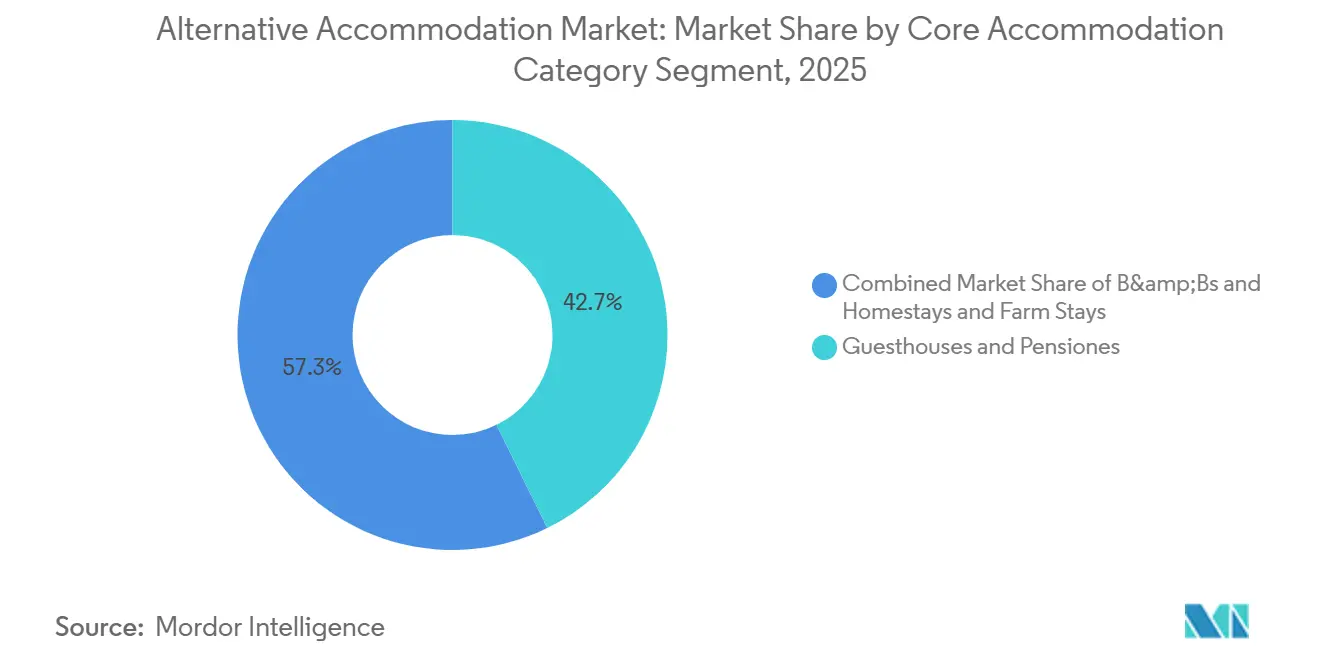
Guesthouses and Pensiones held 42.73% of the alternative accommodation market share in 2025, making them the largest core accommodation format by revenue. Their lead rests on established tourism corridors, mature operating practices, and a booking structure that travelers already understand well in Europe and other long-standing leisure markets. In the alternative accommodation market, this category benefits from being easier to standardize than small, informal homestays, while still retaining a local identity that many guests prefer to chain hotels. Guesthouses have also adapted well to digital listing requirements, mobile-first booking behavior, and review-driven discovery, helping them remain commercially visible across multiple traveler groups. Their relative scale gives them a practical edge in reputation management, multi-channel distribution, and gradual investment in quality upgrades, all of which support more stable occupancy.
Homestays and Farm Stays are the fastest-growing core format, and the alternative accommodation market size for this segment is projected to expand at 7.12% CAGR through 2031. Two parallel forces are driving growth: traveler demand for more immersive, place-specific stays, and policy interest in using tourism to expand rural income opportunities. In India, this has become especially important because homestays offer a practical bridge between tourism demand and household-level participation in the visitor economy. NITI Aayog’s 2025 homestay paper showed that the segment has the strongest employment multiplier among tourism sub-sectors, which supports its role in rural development and formalization efforts. In the alternative accommodation market, this makes homestays more than a niche lodging type, as they also serve as a delivery model for local spending, destination diversification, and community participation.

By Booking Channel: OTA Scale Remains Dominant, While Direct Booking Economics Improve
Online Intermediaries and Digital Marketplaces accounted for 54.94% of the alternative accommodation market in 2025, confirming that platforms remain the leading booking route across the category. Their scale stems from three clear advantages: broad inventory visibility, user trust, and a simple mobile booking experience that individual operators struggle to match. In the alternative accommodation market, this has made OTAs essential for demand capture, especially for cross-border travel and first-time guests who rely on familiar payment systems and review structures. Airbnb alone ended 2025 with 9 million active listings, which shows how deeply non-hotel accommodation is now embedded in mainstream travel search and conversion behavior. This channel, therefore, remains the default growth engine for many small hosts, even as they seek to reduce their dependence on third-party distribution.
Direct-to-Host Channels are the fastest-growing segment, with the alternative accommodation market size for this channel projected to expand at a 7.85% CAGR through 2031. This growth reflects a clear shift among hosts toward lower distribution costs and better control over guest relationships, especially as commission-heavy OTA models continue to pressure margins for small and independent operators. Direct bookings also give property owners more flexibility in pricing, loyalty offers, communication, and repeat-stay conversion, which is becoming more important across B&Bs, guesthouses, and homestays. The segment is also gaining support from new technology tools that make it easier for independent properties to manage websites, payments, guest engagement, and loyalty programs without relying entirely on large third-party platforms. As a result, while online intermediaries still lead on scale, Direct-to-Host Channels are emerging as a stronger strategic route for operators focused on profitability, brand identity, and long-term customer retention.
By Listing Rental Format: Entire Units Hold the Lead, While Private Rooms Regain Strategic Relevance
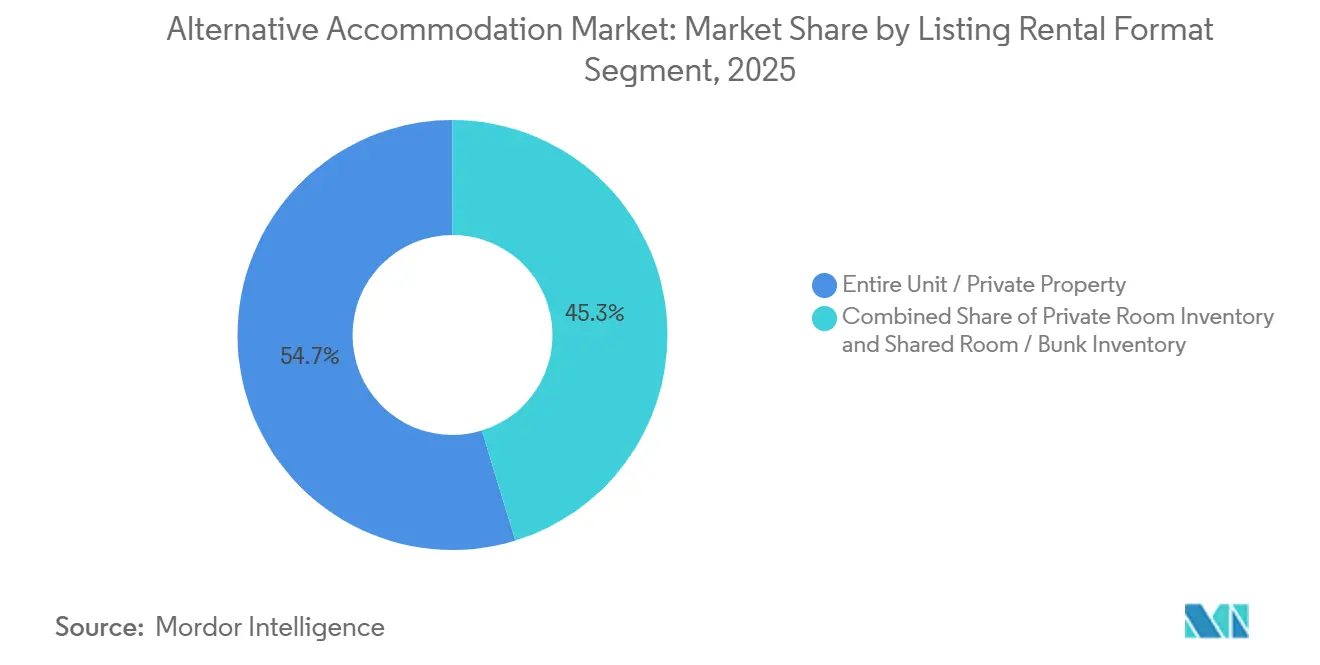
Entire Unit and Private Property listings commanded 54.73% of revenue in 2025, making them the largest rental format in the alternative accommodation market. Their strength reflects a guest preference for privacy, self-contained stays, and flexibility in check-in, cooking, and use of common space. The format also aligns well with longer bookings, as travelers who use a property for both work and leisure usually prefer full control over the environment. In the alternative accommodation market, entire units benefited further from post-pandemic habits that favored lower-contact stays and kitchen-equipped lodging. Family groups and small travel parties have added another layer of support because they often see private properties as a better value than booking multiple hotel rooms.
Private Room Inventory is projected to expand at a 6.98% CAGR through 2031, showing that shared-property lodging is not limited to budget travel. The appeal of private rooms now includes travelers who want social interaction, local guidance, and a more lived-in experience rather than a fully detached stay. This is where traditional B&Bs and host-led guesthouses keep an important edge, because their product value often comes from conversation, breakfast service, neighborhood knowledge, and emotional warmth rather than only floor area. In the alternative accommodation market, private rooms can therefore meet both affordability needs and experience needs, depending on the property and destination. This is especially relevant for India, where host interaction, household-based accommodation, and culturally rooted stays can be a positive part of the travel decision rather than a compromise.
By Stay Purpose: Leisure Dominates Demand, While Workcation Improves Revenue Quality
Leisure Travel accounted for 60.12% of market revenue in 2025, which keeps it firmly at the center of the alternative accommodation market. This broad segment includes short breaks, family trips, rural escapes, and experience-led travel, which naturally align with B&Bs, guesthouses, and homestays. The category still benefits from the emotional and cultural value that independent lodging can provide more easily than standardized hotels. In the alternative accommodation market, leisure demand also aligns well with destination-led discovery, as distinctive stays often help shape where travelers choose to go. That dynamic is especially visible among younger guests who are increasingly willing to pick a destination after finding an appealing property rather than following the older hotel-first booking sequence.
Long-Stay and Workcation is the fastest-growing stay-purpose segment at a 7.46% CAGR through 2031, and this is positively changing host economics. The 2025 journal study on workcations found that these guests often stay longer, spend more on local food and activities, and show stronger rebooking intent than short-stay leisure travelers. In the alternative accommodation market, that means revenue quality can improve even if booking frequency does not rise at the same pace. Longer stays lower turnover costs and can stabilize occupancy through shoulder seasons, which is valuable for small operators managing limited capacity. For India, this format is particularly relevant because hill, rural, and spiritual destinations can combine local immersion with slower-stay demand in a way that large urban hotels often cannot.
Geography Analysis
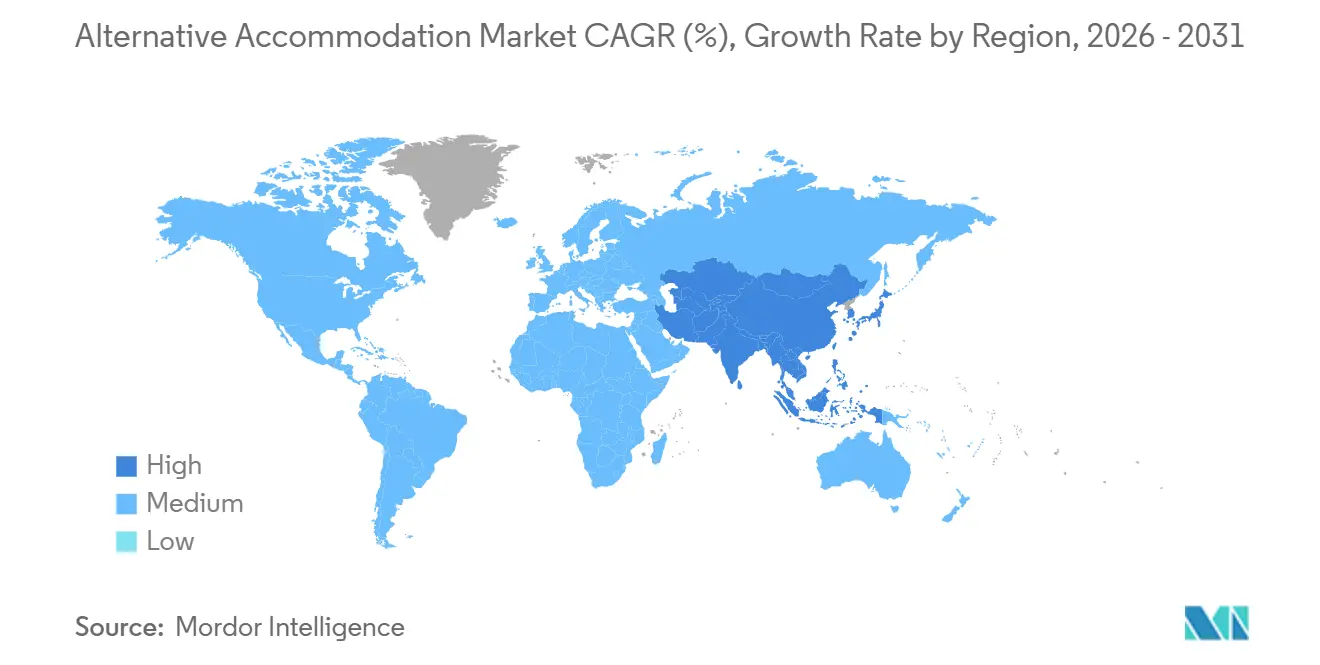
Europe held 36.85% of the alternative accommodation market share in 2025, which reflects the region’s deep base of independent lodging and its long history of rural and heritage travel. Spain’s non-hotel accommodation sector recorded 146.3 million overnight stays in 2025, setting a new record and showing that non-hotel formats are not a peripheral part of European tourism demand. Italy added another layer of support, with agriturismo arrivals reaching 5.1 million in 2025 and the market value approaching EUR 2 billion (approximately USD 2.18 billion). The region’s strength comes from established travel corridors, a dense inventory of independent properties, and a guest base already comfortable with locally owned lodging formats.
Asia-Pacific is the fastest-growing region, and the alternative accommodation market size in this region is forecast to expand at 7.93% CAGR through 2031. India is one of the clearest structural drivers in this regional picture, with homestay sales revenue of INR 4,722 crore (approximately USD 567 million) in 2024 and an expected 11.0% CAGR through 2031. This makes Asia-Pacific important not only for growth rates, but also for how the alternative accommodation market can widen participation among households and small destination operators. Rural demand, domestic travel growth, and policy support are all pushing the region toward a more formal and scalable non-hotel ecosystem. That combination is especially relevant in India, where tourism policy, local enterprise development, and accommodation diversification are increasingly moving in the same direction.
North America also held a meaningful share in 2025, supported by established B&B corridors in the United States and a guest base willing to pay for differentiated stays in scenic or wine-region locations. The alternative accommodation market in the region is moving into a more selective growth phase, where established hosts gain some pricing protection as supply growth moderates compared with faster-expanding regions. South America is seeing stronger domestic travel and rising short-term rental activity, but infrastructure gaps in secondary destinations still limit how quickly demand can be converted into bookable inventory. The Middle East and Africa remain smaller in revenue terms, but the direction of travel is positive because formalization and category recognition are improving across parts of the region. Taken together, these patterns show that the alternative accommodation market is global in structure, but the pace and quality of growth still depend heavily on how each region connects regulation, destination development, and host readiness.[3]
Competitive Landscape
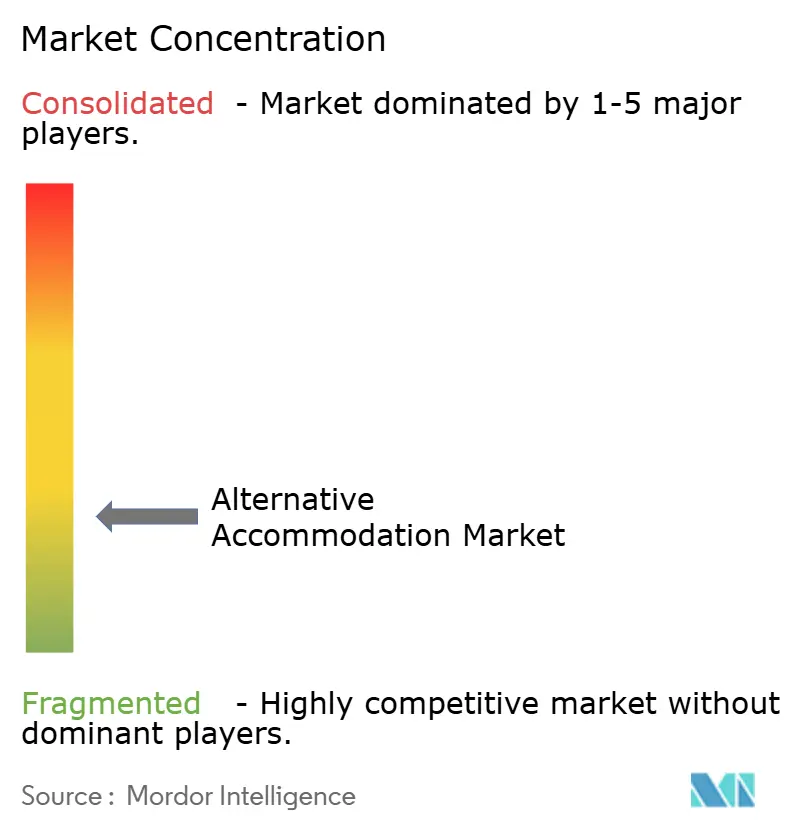
The alternative accommodation market remains fragmented at the operator level because supply is spread across a very large number of independent B&Bs, guesthouses, and homestays. That fragmentation is one of the category’s defining strengths because it gives travelers variety, local flavor, and strong destination specificity. At the same time, the market is more concentrated at the platform layer, where a small number of digital intermediaries shape discovery, bookings, and review visibility. Airbnb remains one of the clearest examples of this scale effect, with 9 million active listings at the end of 2025 and continued investment in broadening what travelers can book through the platform. This structure means that a few property owners do not dominate the alternative accommodation market. Still, it is strongly influenced by a few digital ecosystems that control search, conversion, and guest acquisition.
Competition is therefore increasingly shaped by how independent operators balance platform reach with direct relationship building. In 2026, Airbnb expanded to include boutique and independent hotels in 20 global cities and introduced price-matching and lower commissions for some participating properties, showing that the platform is working to bring a wider range of non-standard lodging into its network. This matters for the alternative accommodation market because it blurs some of the old boundaries between vacation rentals, guesthouses, and independent hotels while still preserving the appeal of unique stays. Cloudbeds and Journey made a different strategic move by building a shared loyalty system for independent hospitality businesses, which helps smaller operators compete on guest retention without surrendering brand control. These examples show that competition is no longer only about who has the most inventory, but also about who controls loyalty, guest data, and repeat booking behavior. In this environment, professionally managed independent operators are better placed than informal hosts to benefit from new tools and distribution choices.
The white space in the alternative accommodation market still sits with independent operators that have not yet invested in direct booking infrastructure, experience bundling, or certification-led trust signals. Properties that combine accommodation with food, farming, crafts, wellness, or local storytelling are increasingly well-positioned than those that sell only a room. That is especially relevant for India, where local context, host interaction, and cultural depth are often part of the accommodation value proposition rather than an add-on. Competitive differentiation is therefore moving toward product depth, digital readiness, and the ability to retain guests beyond a single OTA-led booking. The market remains open enough for small operators to participate. Still, the advantage is shifting toward those who can present themselves with more consistency, stronger trust markers, and a clearer guest experience.
Alternative Accommodation Industry Leaders
-
Airbnb, Inc.
-
B&B HOTELS Group
-
OYO Hotels and Homes Private Limited
-
Select Registry Distinguished Inns
-
The Inn Collection Group
- *Disclaimer: Major Players sorted in no particular order
Recent Industry Developments
- June 2026: Cloudbeds partnered with Journey to create a shared direct-booking loyalty network for independent properties, offering 5 times the reward points for direct bookings versus OTA channels.
- June 2026: MakeMyTrip launched a confirmed early check-in and late check-out feature across more than 11,000 properties, including a large inventory of homestays and villas in India, allowing guests to secure advance room access through structured three-, six-, or nine-hour time slots to help independent hosts monetize previously unused inventory.
- May 2026: Airbnb expanded its platform to include boutique and independent hotels in 20 global cities including New York, Paris, London, Madrid, Rome, and Singapore, introducing a price-match guarantee and lower commissions for boutique properties.
- August 2025: India’s NITI Aayog released “Rethinking Homestays: Navigating Policy Pathways,” recommending collateral-free MUDRA loans, 30-day application-disposal caps, and single-window registration for the country’s homestay sector.
Global Alternative Accommodation Market Report Scope
| Bed & Breakfasts (B&Bs) |
| Guesthouses & Pensiones |
| Homestays & Farm Stays |
| Online Intermediaries & Digital Marketplaces |
| Direct-to-Host Channels |
| Offline Intermediaries & Wholesalers |
| Entire Unit / Private Property |
| Private Room Inventory |
| Shared Room / Bunk Inventory |
| Leisure Travel |
| Business Travel |
| Visiting Friends & Relatives (VFR) |
| Long-Stay & Workcation |
| North America | United States |
| Canada | |
| Mexico | |
| South America | Brazil |
| Peru | |
| Chile | |
| Argentina | |
| Rest of South America | |
| Europe | United Kingdom |
| Germany | |
| France | |
| Spain | |
| Italy | |
| BENELUX (Belgium, Netherlands, and Luxembourg) | |
| NORDICS (Denmark, Finland, Iceland, Norway, and Sweden) | |
| Russia | |
| Rest of Europe | |
| Asia-Pacific | India |
| China | |
| Japan | |
| Australia | |
| South Korea | |
| South East Asia (Singapore, Malaysia, Thailand, Indonesia, Vietnam, and Philippines) | |
| Rest of Asia-Pacific | |
| Middle East and Africa | United Arab Emirates |
| Saudi Arabia | |
| South Africa | |
| Nigeria | |
| Rest of Middle East and Africa |
| By Core Accommodation Category | Bed & Breakfasts (B&Bs) | |
| Guesthouses & Pensiones | ||
| Homestays & Farm Stays | ||
| By Booking Channel | Online Intermediaries & Digital Marketplaces | |
| Direct-to-Host Channels | ||
| Offline Intermediaries & Wholesalers | ||
| By Listing Rental Format | Entire Unit / Private Property | |
| Private Room Inventory | ||
| Shared Room / Bunk Inventory | ||
| By Stay Purpose | Leisure Travel | |
| Business Travel | ||
| Visiting Friends & Relatives (VFR) | ||
| Long-Stay & Workcation | ||
| By Geography | North America | United States |
| Canada | ||
| Mexico | ||
| South America | Brazil | |
| Peru | ||
| Chile | ||
| Argentina | ||
| Rest of South America | ||
| Europe | United Kingdom | |
| Germany | ||
| France | ||
| Spain | ||
| Italy | ||
| BENELUX (Belgium, Netherlands, and Luxembourg) | ||
| NORDICS (Denmark, Finland, Iceland, Norway, and Sweden) | ||
| Russia | ||
| Rest of Europe | ||
| Asia-Pacific | India | |
| China | ||
| Japan | ||
| Australia | ||
| South Korea | ||
| South East Asia (Singapore, Malaysia, Thailand, Indonesia, Vietnam, and Philippines) | ||
| Rest of Asia-Pacific | ||
| Middle East and Africa | United Arab Emirates | |
| Saudi Arabia | ||
| South Africa | ||
| Nigeria | ||
| Rest of Middle East and Africa | ||
Key Questions Answered in the Report
What is the projected value of alternative accommodation by 2031?
The category is forecast to reach USD 184.43 billion by 2031, rising from USD 137.63 billion in 2026 at a 6.03% CAGR over 2026-2031.
Which accommodation category leads revenue generation?
Guesthouses and Pensiones led the category with 42.73% revenue share in 2025, showing the continued strength of professionally run independent lodging.
Which format is growing the fastest among core accommodation types?
Homestays and Farm Stays are projected to grow the fastest at a 7.12% CAGR through 2031, supported by cultural travel demand and rural livelihood policies.
Why are direct booking channels gaining importance?
Direct-to-host channels are growing because hosts want better margins, more control over repeat guests, and less dependence on OTA commissions.
Which region is expanding the fastest?
Asia-Pacific is the fastest-growing regional segment with a forecast CAGR of 7.93% through 2031, supported by India and other secondary destination markets.
What is changing host economics the most?
Long-Stay and Workcation demand is having a strong effect because longer bookings improve occupancy stability, reduce turnover costs, and increase local ancillary spending.