
Aircraft Fuel Tanks Market Size and Share
Market Overview
| Study Period | 2020 - 2031 |
|---|---|
| Market Size (2026) | USD 0.98 Billion |
| Market Size (2031) | USD 1.06 Billion |
| Growth Rate (2026 - 2031) | 1.49 % |
| Fastest Growing Market | Asia Pacific |
| Largest Market | North America |
| Market Concentration | Medium |
Major Players *Disclaimer: Major Players sorted in no particular order Image © Mordor Intelligence. Reuse requires attribution under CC BY 4.0. | |
Aircraft Fuel Tanks Market Analysis by Mordor Intelligence
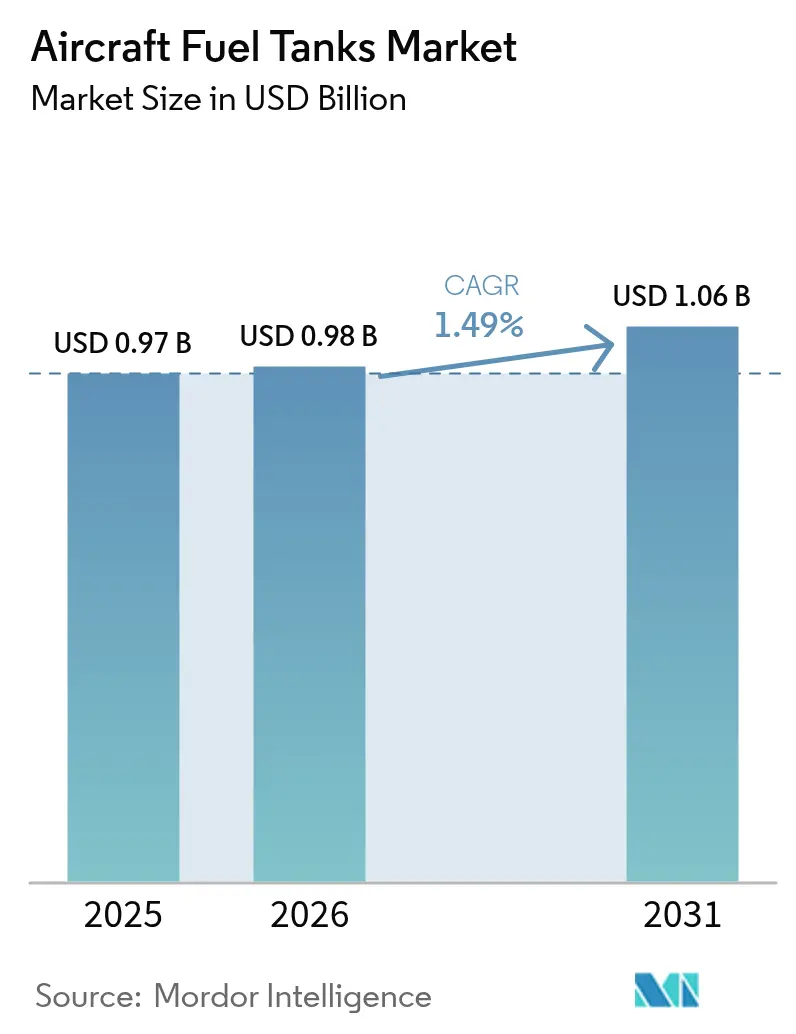
The aircraft fuel tanks market size is expected to grow from USD 0.97 billion in 2025 to USD 0.98 billion in 2026 and is forecast to reach USD 1.06 billion by 2031 at 1.49% CAGR over 2026-2031. The modest topline masks latent disruption as OEMs balance incremental upgrades to kerosene-based systems with sizeable R&D outlays for hydrogen storage. Robust replacement demand—underpinned by Boeing’s projection for nearly 44,000 new deliveries through 2043—anchors baseline production volumes, even as cryogenic concepts mature for mid-2030s entry-into-service. Parallel defense recapitalization initiatives, such as the US KC-Y bridge tanker and the Next Generation Air-refueling System, inject premium revenue streams into a market historically led by commercial programs. Composite material penetration keeps margins attractive; carbon-fiber solutions account for 41.34% of 2024 material revenues, reflecting the unrelenting OEM focus on weight reduction.
Key Report Takeaways
- By type, internal tanks controlled 59.12% of the aircraft fuel tanks market share in 2025, while external and conformal designs posted the fastest 3.9% CAGR to 2031.
- By material, carbon-fiber composites led with 40.95% revenue in 2025; hybrid cryogenic materials are set to expand at a 5.28% CAGR through 2031, outpacing legacy metallics.
- By platform, commercial aircraft programs held 48.05% of the aircraft fuel tank market size 2025, yet military aircraft recorded the strongest 3.22% CAGR to 2031.
- By end use, OEM channels captured 67.55% of 2025 revenue; the aftermarket enjoys a 4.55% CAGR on the back of auxiliary-range retrofit kits.
- By geography, North America retained leadership with a 35.05% share in 2025, whereas Asia-Pacific is the fastest-growing region, with a 5.07% CAGR through 2031.
Note: Market size and forecast figures in this report are generated using Mordor Intelligence’s proprietary estimation framework, updated with the latest available data and insights as of 2026.
Market Trends and Insights
Drivers Impact Analysis of Aircraft Fuel Tanks Market*
| Driver | % Impact on CAGR Forecast | Geographic Relevance | Impact Timeline |
|---|---|---|---|
| Commercial aircraft production up-cycle | +0.8% | Global; focus on North America and Europe | Medium term (2-4 years) |
| Defense fleet modernization programs | +0.6% | North America, Europe, Asia-Pacific | Long term (≥ 4 years) |
| Adoption of lightweight CFRP and hybrid tanks | +0.4% | Global, led by North America and Europe | Medium term (2-4 years) |
| Rising retrofit demand for auxiliary/long-range kits | +0.3% | Global; strongest in North America and Asia-Pacific | Short term (≤ 2 years) |
| Mandatory inert-gas inerting systems | +0.2% | Global | Medium term (2-4 years) |
| Emergence of cryogenic LH₂ tanks for zero-emission aircraft | +0.1% | Europe and North America first movers | Long term (≥ 4 years) |
| Source: Mordor Intelligence | |||
Commercial Aircraft Production Up-Cycle
Airlines are replacing older narrow-bodies with high-utilization single-aisle jets, sustaining baseline fuel-tank demand even during macroeconomic uncertainty. The Airbus A321XLR’s 12,900-liter rear-center tank extends range to 4,700 nm, proving that creative fuel storage unlocks new, thinner routes.[1]Airbus, “A321XLR Receives Type Certificate,” easa.europa.eu Record backlog visibility—often exceeding 10 years—allows tank suppliers to forward-plan capacity. OEMs now target 90-day cabin-to-wing modification cycles, down from 120 days on early programs, broadening line-fit throughput. Sustained single-aisle mix shifts favor technologies that ease center-of-gravity management as airlines standardize high-density seating. While supply-chain fragility tempers near-term output, the driver’s net positive effect remains sizable over the medium term.
Defense Fleet Modernization Programs
Three-phase tanker recapitalization in the United States involves completing KC-46A deliveries by 2029, procuring 140-160 KC-Y units, and fielding the stealth NGAS platform around 2040. The KC-46A alone has transferred over 200 million lb of fuel in global operations, highlighting the mission-critical role of advanced tank technology. Asia-Pacific outlays, accounting for 42% of global arms imports, widen the addressable military fleet base. Europe’s eight-unit Multinational MRTT Fleet provides a cooperative model that other regions may replicate for cost-effective aerial refueling capacity.[2]European Defence Agency, “Multinational MRTT Fleet,” eda.europa.eu Premium pricing of stealth-compatible tanks offsets the narrower unit volumes typical of defense programs, ensuring a robust revenue contribution through the long term.
Adoption of Lightweight CFRP and Hybrid Tanks
Carbon-fiber reinforced polymer has trimmed tank weight by up to 33% in NASA demonstrators, improving aircraft fuel burn by double-digit percentages. The European Space Agency validated linerless CFRP cryotanks, opening the door to 2-ton upper-stage mass savings with direct crossover potential for large transports. Automated Fiber Placement (AFP) adds real-time closed-loop control, slashing scrap rates and paving the way for certifiable Type V hydrogen vessels. Netherlands-led hydrogen-tank consortia seek 2025 flight validation, accelerating cross-industry learning curves.[3]CompositesWorld, “Type V Hydrogen Tank Manufacturing,” compositesworld.com Despite certification hurdles, composite-heavy architectures underpin most new-build civil programs, establishing a growth platform for hybrid cryogenic tanks.
Rising Retrofit Demand for Auxiliary/Long-Range Kits
Range-extension kits let airlines open marginal city pairs without ordering new airframes. ALOFT AeroArchitects’ B737NG solution adds up to 50% extra range through modular belly or lower-lobe tanks, maintaining the original cabin configuration. The modular design reduces labor hours and downtime, which is critical for carriers, averaging 12-hour daily utilization. Headwind-prone North Atlantic routes benefit from the flexibility to tanker extra fuel when seasonal winds peak. Retrofit demand surfaces strongly among regional operators that cannot justify wide-bodies but still need transcontinental reach. Consequently, despite its smaller revenue base, the aftermarket registers the steepest CAGR among all end-use channels.
Restraints Impact Analysis of Aircraft Fuel Tanks Market*
| Restraint | % Impact on CAGR Forecast | Geographic Relevance | Impact Timeline |
|---|---|---|---|
| Volatile aerospace raw-material prices and supply chain risk | -0.4% | Global; most acute in North America and Europe | Short term (≤ 2 years) |
| Stringent certification and fire-safety testing requirements | -0.3% | Global | Medium term (2-4 years) |
| High R&D and tooling CAPEX for composite tanks | -0.2% | Developed markets | Long term (≥ 4 years) |
| Sub-100-seat electric aircraft reducing future tank demand | -0.1% | Early uptake in Europe and North America | Long term (≥ 4 years) |
| Source: Mordor Intelligence | |||
Volatile Aerospace Raw-Material Prices and Supply Chain Risk
Titanium sponge sourcing remains exposed, with the United States importing over 90% from geopolitically sensitive suppliers. Russia’s conflict with Ukraine and China’s capacity build-up undermine price stability, driving a 6.8% global titanium CAGR through 2027. Counterfeit alloy incidents have prompted intensified incoming inspection protocols at Airbus and Boeing lines, heightening cost and schedule pressure. Backlogs now embed longer lead times for forgings and castings, forcing OEMs to dual-source critical tank components. Diversification campaigns and near-shoring initiatives require multi-year capital commitments, diluting margin upside for first-tier suppliers.
Stringent Certification and Fire-Safety Testing Requirements
The FAA’s Fuel Tank Flammability Reduction rule caps fleet-average exposure at 3% of operating time, obligating costly inert-gas or ignition-mitigation retrofits.[4]Federal Aviation Administration, “Fuel Tank Flammability Reduction Rule,” ecfr.gov EASA’s special-conditions process for the A321XLR entailed more than 400 joint meetings and 900 flight-test hours, demonstrating the resource intensity for novel configurations. Hydrogen aircraft add fresh hazards that require entirely new regulatory frameworks per the FAA’s December 2024 hydrogen roadmap. Qualification regimens involve pressure cycling to 3.5 psi, 25-hour vibration sweeps, and 50-ft drop tests. Over the next decade, cumulative compliance costs for mandated inerting systems could exceed USD 35.7 billion across in-service fleets.
*Our forecasts treat driver/restraint impacts as directional, not additive. The impact forecasts reflect baseline growth, mix effects, and variable interactions.
Aircraft Fuel Tanks Market Segment Analysis
By Type:
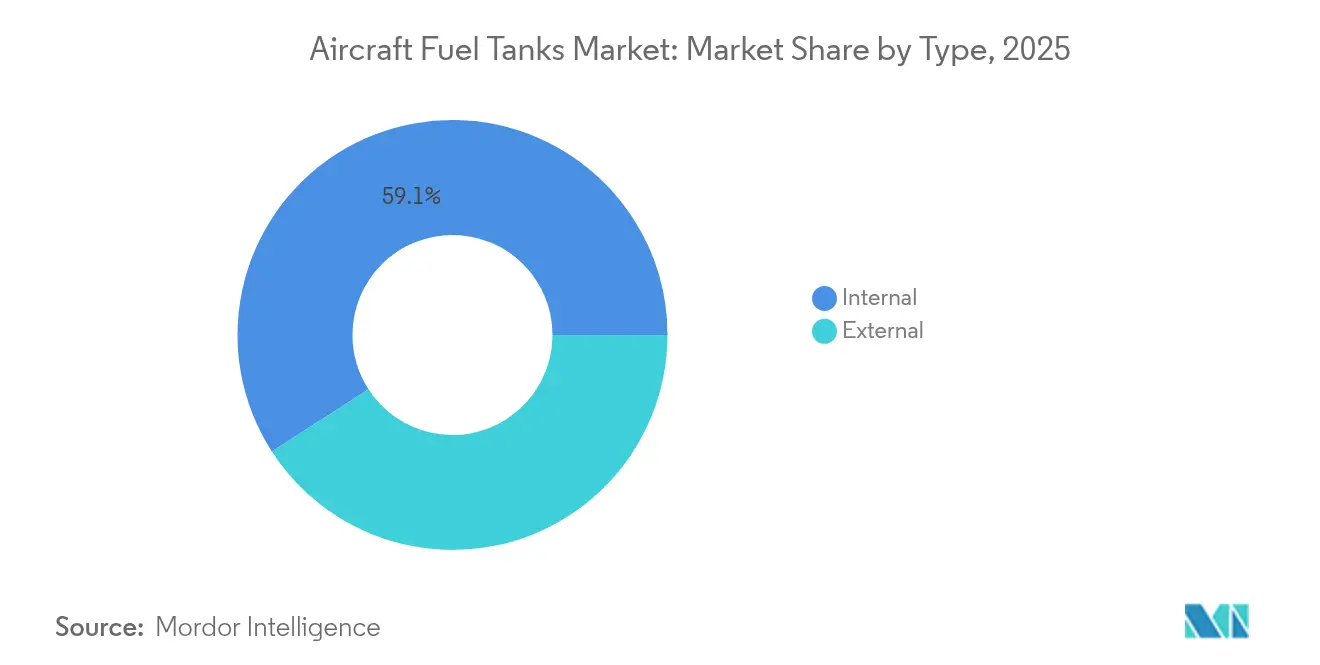
External Tanks Drive InnovationExternal tanks record the fastest 3.9% CAGR as militaries prioritize drop-tanks, conformal systems, and buddy-pod refuelers that can be jettisoned or detached when tactical needs shift. Internal systems still dominate 59.12% of 2025 revenue, underscoring their space-efficiency and center-of-gravity advantages in commercial service. Eaton’s 1,360-gal jettisonable units showcase compliance with JP-4, JP-5, and JP-8 while offering structural provisions for supersonic carriage. The emergence of conformable shapes supports blended-wing-body demonstrators that lack traditional wing boxes. Advancements in self-sealing technology protect against incendiary rounds, while integrated fuel-quantity gauging achieves sub-0.25% accuracy through digital probes.
Growth pivots to emerging hybrid fighter missions demanding stealth and ferry range, compelling designers to blend internal bays with low-observable external pods. Bladder-based auxiliary kits reinforce aftermarket momentum, letting airlines field range-extension packages without structural re-certification. Active-health-monitoring sensors feed prognostic algorithms that schedule maintenance windows before leaks propagate. Thus, even as the aircraft fuel tank market size remains, internal systems and external tank innovation deliver a disproportionate share of incremental revenue.



By Material:
Hybrid Technologies Lead InnovationCarbon-fiber composites captured 40.95% of 2025 revenue, driven by weight savings of 15-35 kg per short-haul aircraft, translating into multi-million-dollar lifetime fuel burn reductions. Hybrid cryogenic structures clock a 5.28% CAGR as hydrogen roadmaps crystallize around mid-2030s entry-into-service. Linerless Type V tanks promise 40% additional weight savings but face micro-crack propagation issues under high-cycle pressure loads. Metallic alloys such as aluminum-lithium retain relevance where proven fracture toughness is paramount, especially in wing integral tanks for wide-bodies. Polymer-based bladders continue to service retrofit demand thanks to installation speed and lower capital requirements.
Automated Fiber Placement couples ultrasonic welding to create liquid-tight seams, a prerequisite for cryogenic LH₂. Hybrid configurations mesh titanium liners with carbon overwraps, allowing linerless concepts to mature. Embedded fiber-optic sensors track strain and temperature in real time, enabling predictive maintenance business models. Consequently, while composites dominate value today, the aircraft fuel tanks market share of hybrid and smart-material solutions will continue to climb.
By Platform:
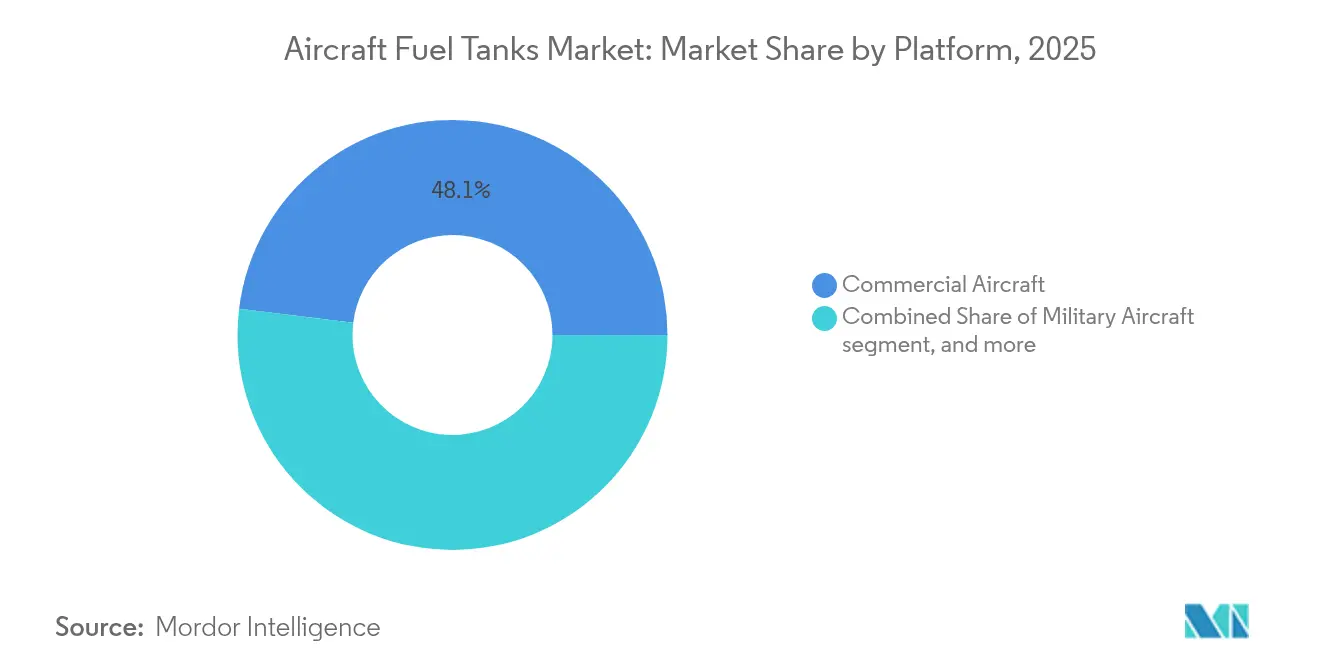
Military Modernization AcceleratesCommercial single-aisle jets commanded 48.05% of 2025 revenues, but a 3.22% CAGR on the defense side edges military programs to the growth forefront. KC-46A, KC-Y, and NGAS platforms underpin a pipeline of over 300 tanker units through 2040. Fighter upgrades involving conformal or buddy-store refuelers further inflate unit values despite lower annual volumes. The aircraft fuel tanks market size attributed to general and business aviation remains stable as long-range variants of popular models adopt tailored auxiliary solutions.
Asia-Pacific rearmament budgets pivot toward Indigenous manufacturing, generating local demand for tank subsystems in India, Japan, and South Korea. Commercial long-haul programs stay subdued, yet auxiliary packages that raise payload range on A330-200s and B767-300ERs soften the impact. JetZero’s blended-wing-body concept, backed by RTX, introduces new fuselage-integrated fuel bay architectures to reset design rules. Cumulatively, military and next-generation civil demonstrators reposition the platform mix toward higher-value configurations over the forecast window.
By End Use:
Aftermarket Retrofit MomentumOEM line-fit remained the revenue cornerstone at 67.55% in 2025, anchored by entrenched supply agreements and complex certification dossiers. Nevertheless, the aftermarket is forecast to outpace all channels with a 4.55% CAGR as operators opt for incremental range over capital-intensive fleet growth. Auxiliary kit providers benefit from modular designs that slot into lower-deck holds without disturbing passenger layouts. MRO hubs in Malaysia and Morocco gain traction as Eaton and Safran co-locate repair stations near high-growth fleets.
FAA inerting mandates spur retrofit of nitrogen-generation or ignition-mitigation systems across 3,000-plus US-registered transports. Blended-fuel compatibility checks, required as SAF ratios rise, drive further inspection and component swap-outs. Digital fuel-quantity upgrades leveraging silicon-on-sapphire sensors create a new recurring revenue layer. Hence, even though OEM channels will continue to dominate absolute dollars, aftermarket solutions remain the chief growth engine in the aircraft fuel tanks market.
Geography Analysis
North America Aircraft Fuel Tanks Market
North America led with 35.05% of 2025 revenue on the back of Boeing’s high-volume B737 and B787 lines, plus the US Air Force’s tanker recapitalization roadmap. The KC-46A program, despite schedule slips, validates advanced inert-ing and boom-refueling tanks capable of 1,200 gallons-per-minute offload rates. Washington’s policy focuses on reshoring titanium and aluminum value chains and aims to defuse geopolitical risk from Russia and China. The Biden administration’s 2025 Inflation Reduction Act credits hydrogen-aircraft demonstrators, catalyzing early LH2 tank R&D funding
APAC Aircraft Fuel Tanks Market
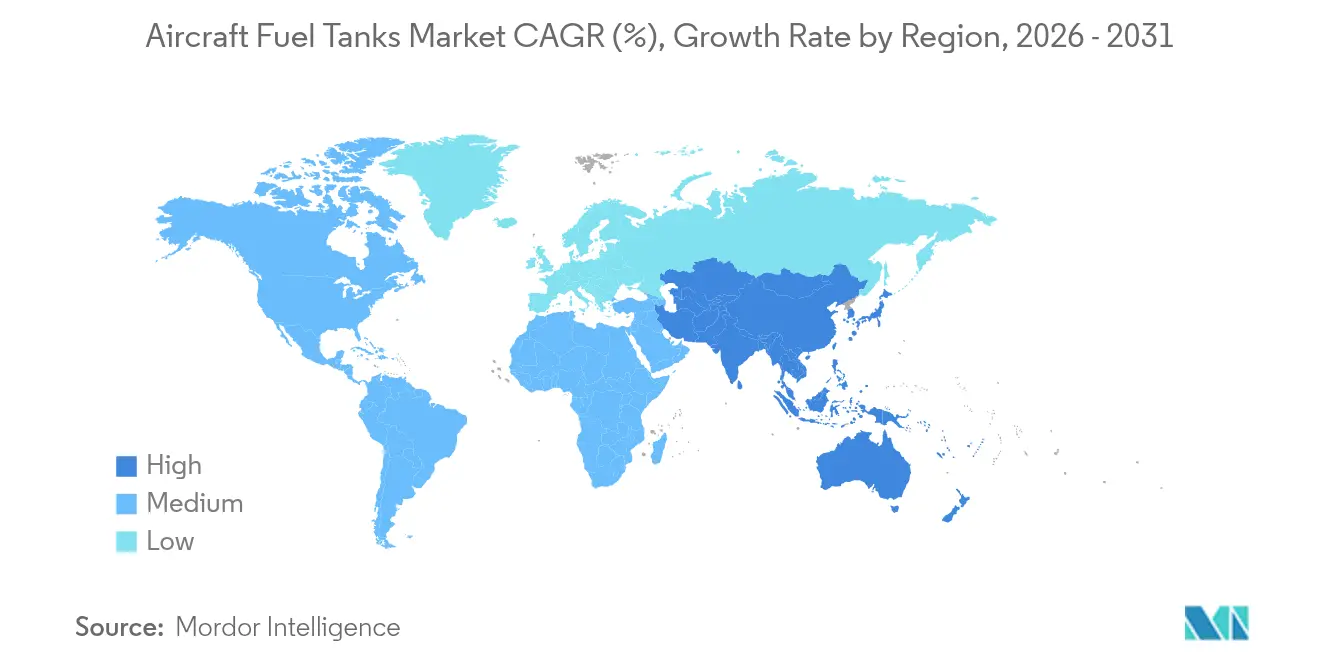
Asia-Pacific posts the highest 5.07% CAGR as China seeks to double its commercial fleet by 2043, demanding more than 8,000 single-aisle aircraft that will ship with integral carbon-fiber tanks. COMAC C919 deliveries reached 10 aircraft by end-2024, stimulating home-grown subsystem ecosystems. India’s 8.3% annual passenger growth underpins high-seat-count narrow-body orders, while its Make-in-India scheme lures fuel-system joint ventures such as Safran-HAL for LEAP engine parts. Defense spending, accounting for 42% of global imports, demands multirole tankers and conformal solutions on revamped fighter fleets.
Europe, North America and APAC Aircraft Fuel Tanks Market
Europe’s share edges forward on steady Airbus output and collaborative defense projects like the eight-unit MRTT fleet delivered out of the Netherlands. EASA’s RefuelEU mandate requires 2% SAF blending in 2025, scaling to 70% by 2050, compelling tank upgrade paths for fuel-property variability. Regional R&D clusters in Sweden and France invest heavily in cryogenic demonstrators, exemplified by GKN’s 5,000 m² expansion in Trollhättan that integrates AFP cells and digital twins. Brexit-driven customs frictions dampen UK suppliers’ competitiveness, yet targeted investments by Spirit AeroSystems shore up critical-structure capacity. Overall, geographical demand shifts make Asia-Pacific the volume growth leader while North America remains the technology bellwether.

Regulatory Landscape
Certification and continued airworthiness for aircraft fuel tanks are governed primarily by FAA and EASA rules focused on ignition prevention and explosion risk control. Key anchors include 14 CFR 25.981 (fuel tank ignition prevention for transport-category aircraft), FAA SFAR 88 (fuel tank system safety assessments and ongoing configuration controls), and EASA CS-25 (including Amendment 6 updates for large aeroplanes). These frameworks drive requirements for inerting or other flammability-reduction means, lightning and wiring protection, and design substantiation for novel tank architectures such as structural or center-tank configurations.
Post-certification oversight extends into reliability reporting and mandated configuration control. In April 2026, the FAA advanced renewal of information-collection requirements tied to fuel tank flammability reduction, reinforcing long-term data retention and reporting expectations for design approval holders and their supply chains as fleets age. Operational safety standards such as EN 12312-5:2021+A1:2025 for aircraft fueling equipment in Europe also codify ground-refueling vehicle safety features (for example, interlocks), which indirectly shapes OEM and MRO specifications for refuel interfaces and maintenance procedures.
Value Chain Analysis
The value chain starts with aerospace-grade raw materials (aluminum alloys, titanium, and composite fibers and resins) and specialty subcomponents such as bladders, seals, vents, inerting hardware, and fuel quantity gauging elements. Tier suppliers design and manufacture tanks (integral, bladder, self-sealing, drop, conformal, and buddy-store systems) and associated assemblies, then support qualification and documentation to meet airworthiness requirements such as FAA 14 CFR Part 25 Subpart E and EASA CS-25 for fuel system integrity, crash resistance, and lightning protection. Certification alignment mechanisms, including the FAA-EASA Technical Implementation Procedures, shape how suppliers structure conformity, test evidence, and design-change packages across jurisdictions.
Downstream, OEM line-fit remains the dominant channel, while the aftermarket is the second key leg where repairs, PMA replacements, and retrofit kits flow through MRO networks. Participants include specialized tank and fuel containment suppliers (for example, Robertson Fuel Systems, Floats and Fuel Cells, Inc., Safran, and Eaton) as well as broader fuel-system ecosystems that provide repair capability and spares management. The 2026 aerospace supply environment highlights constraints in materials and parts availability, pushing companies toward higher inventory buffers and broader supplier portfolios, which increases the importance of dual sourcing, qualification bandwidth, and robust traceability across multi-tier supply lines.
Competitive Landscape
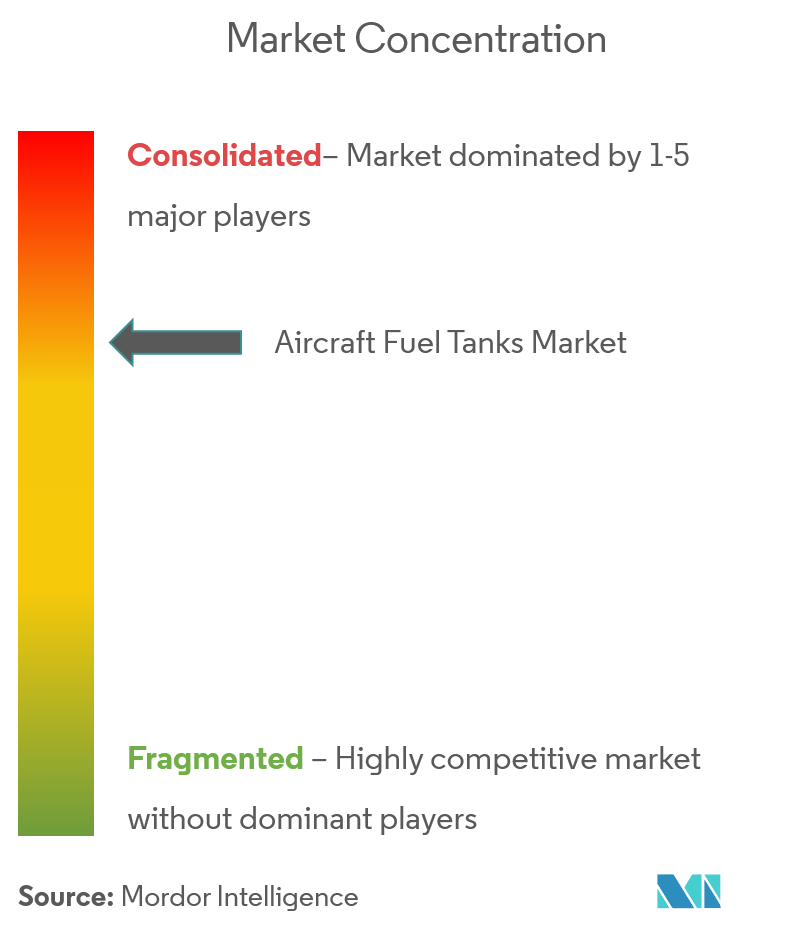
The aircraft fuel tanks market is moderately consolidated: the top five suppliers together command a major share of revenue, underpinned by multi-decade sole-source positions with Airbus and Boeing. Boeing’s USD 8.3 billion purchase of Spirit AeroSystems internalizes wing-box and center-tank know-how, protecting supply continuity after repeated quality lapses. Parker Hannifin’s sale of its composites and fuel containment arm to SK Capital narrows its aerospace span but unlocks cash for motion-control acquisitions.
Suppliers differentiate through material science and digital manufacturing. Lockheed Martin’s plant-wide digital thread slashes non-recurring expense by linking tank design, AFP lay-up, and nondestructive inspection on a single MES backbone. GKN Aerospace partners in projects such as ICEFlight, targeting 500-kW cryogenic powertrains that rely on linerless CFRP tanks capable of minus 253 °C operations.
Regulatory compliance favors incumbents with extensive design-assurance experience. FAA SFAR-88 requires continuous inspection criteria, raising barriers for new entrants lacking DER-level expertise. Yet white-space potential in LH₂ storage opens footholds for agile composites specialists willing to shoulder early-stage certification risk. Consequently, while legacy players remain dominant, the move to hydrogen is poised to reshuffle the supplier hierarchy over the next decade.
Aircraft Fuel Tanks Industry Leaders
Safran SA
Eaton Corporation plc
Robertson Fuel Systems LLC
Meggitt PLC (Parker-Hannifin Corporation)
GKN Aerospace (Melrose plc)
- *Disclaimer: Major Players sorted in no particular order
Aircraft Fuel Tanks Market Companies Covered in this Report
- Safran SA
- Meggitt PLC (Parker-Hannifin Corporation)
- Eaton Corporation plc
- Robertson Fuel Systems LLC
- Aero Tec Laboratories Ltd.
- GKN Aerospace (Melrose plc)
- Elbit Systems Ltd.
- Marshall Group
- Applied Aerospace Structures Corporation
- Collins Aerospace (RTX Corporation)

Market Opportunities and Future Outlook
Near-term opportunity is concentrated in designs that increase range or mission flexibility without major airframe redesign, and in sustainment actions that improve fuel-system availability. The A321XLR program provides a concrete reference point for structural integration of additional fuel capacity (its rear center tank architecture), which supports demand for tank-adjacent content such as access provisions, inspection features, and enhanced fire and flammability compliance documentation. In March 2026, Astronics was selected to supply fuel tank access doors for the Boeing 737 MAX program, showing that even mature platforms continue to generate content opportunities around maintainability and production-rate support.
Defense tanker modernization and readiness spending adds additional whitespace in repair-and-exchange and upgrade pathways for fuel and refueling-related hardware. In June 2026, the US Air Force awarded an IDIQ effort across 28 companies to improve KC-46 Pegasus fleet readiness, reinforcing market pull for reliable, supportable fuel and refueling component supply chains. Technology-led whitespace is also visible in survivability and next-gen storage. Programs such as CMTCs work on advanced crashworthy, self-sealing fuel bladders targeting major weight and replacement-cost reductions, while hydrogen-related tank R&D (including additively manufactured cryogenic tank concepts) expands the future design space and increases the premium on qualification, nondestructive inspection, and digital traceability capabilities.
Recent Industry Developments in Aircraft Fuel Tanks Market
- June 2026: Airbus and Safran joined Technip Energies and Tereos to form the Rebound joint venture to develop an alcohol-to-jet sustainable aviation fuel production project at the Port of Dunkirk in France, targeting 160,000 metric tons of annual output. While not a hardware program, it tightens links between airframe, engine, and fuel ecosystems and elevates compatibility, materials, and fuel-property validation demands that flow into tank and fuel-system design and sustainment.
- April 2026: Eaton expanded its aerospace authorized service center agreement with Air Support in the EMEA region, adding repair and overhaul capability for multiple engine fuel system components (including CFM56 and CF34 family fuel pumps). The added regional capacity supports faster turnaround and lower logistics friction for operators, which can increase pull-through for certified spares and repair content tied to fuel-system reliability.
- November 2024: Eaton was selected by the United States Air Force Research Laboratory to design an innovative aerial refueling system. The award supports capability development around air-to-air refueling architectures, a segment where tank and fuel handling technologies are tightly coupled with mission assurance and platform upgrade roadmaps.


Aircraft Fuel Tanks Market Report Scope and Research Methodology
Market Definition and Coverage
In this methodology, the aircraft fuel tanks market covers the revenue generated from tanks and related assemblies that store fuel on an aircraft. These are supplied to OEM production lines and to the in-service fleet for replacement and retrofit.
Scope exclusions: It does not count aircraft fueling services, airport storage infrastructure, or the broader aircraft fuel system items like pumps, valves, and fuel management electronics unless sold as part of the tank assembly.
Segments Covered in This Report
- By Type
- Internal (Integral, Bladder, Self-sealing)
- External (Drop, Conformal, Buddy-Pods)
- By Material
- Metallic Alloys (Al-Li, Ti)
- Carbon-Fiber Composites
- Polymer/Elastomer Bladders
- Hybrid and Next-Gen Cryogenic
- By Platform
- Commercial Aircraft
- Military Aircraft
- General Aviation Aircraft and Business Jets
- By End Use
- OEM
- Aftermarket/Retrofit
- By Region
- North America
- United States
- Canada
- Mexico
- Europe
- United Kingdom
- France
- Germany
- Italy
- Rest of Europe
- Asia-Pacific
- China
- Japan
- India
- South Korea
- Rest of Asia-Pacific
- South America
- Brazil
- Rest of South America
- Middle East and Africa
- Middle East
- Saudi Arabia
- UAE
- Rest of Middle East
- Africa
- South Africa
- Egypt
- Rest of Africa
- Middle East
- North America
Data Sources, Market Sizing, and Validation
Desk Research
Desk research builds the foundation for the model by setting the demand context and making sure unit and fleet assumptions are realistic. We review public aircraft delivery and backlog commentary, defense procurement releases, and air transport statistics to understand how many platforms are likely to be produced and operated in each region.
For data inputs, we refer to sources such as FAA and EASA airworthiness and safety publications, ICAO air transport datasets, the International Air Transport Association traffic indicators, US DoD budget and contract award releases, and World Bank macro indicators that affect travel and defense spend. We also use company filings and investor presentations for program exposure and material mix commentary, supported by a paid subscription focused on company financials and a paid patent database to track lightweight and composite fuel tank innovation signals. The desk research sources mentioned here are illustrative, and many other public references were also used for data collection and cross checks.
Primary Interviews and Surveys
Primary work is used to confirm what gets installed on different aircraft platforms, how often tanks are replaced, and how pricing typically moves with materials and certification needs. We speak with a mix of manufacturers, component suppliers, MRO focused participants, and aviation domain experts across APAC, EMEA, and the Americas so regional build rates and aftermarket intensity are not inferred from one geography only.
Distribution of primary research fieldwork respondents
| Company type | Respondent position | Region |
|---|---|---|
| Top tier: 32% | CXOs: 16% | APAC: 42% |
| Mid tier: 46% | Functional/Unit leaders: 30% | EMEA: 34% |
| Smaller Players: 22% | Managers: 54% | Americas: 24% |
Market-Sizing & Forecasting
Sizing starts with a top down build where aircraft production, fleet size, and utilization signals are reconstructed by region, then translated into tank demand across OEM fitment and aftermarket replacement. When the calculations are anchored to aircraft deliveries, fleet aging, and maintenance cycles, the implied annual demand pool for tanks and tank assemblies becomes clear.
Key inputs used in the model include commercial aircraft delivery outlook and backlog visibility, defense tanker and transport procurement timing, fleet age distribution and retirement pace, typical replacement intervals linked to inspection findings, and material mix shifts toward composite or hybrid designs that influence average selling prices. Forecasts are developed using scenario analysis, where traffic recovery, defense budgets, and production rate ramps are flexed and then aligned to what interviewees describe as most likely in their order books.
To keep outputs realistic, we corroborate results with selective bottom up approximations, such as sampled ASP times estimated unit volumes for a short list of platforms, plus channel checks on retrofit activity. If the two views drift too far, we adjust the totals and reconcile the drivers. Where coverage is incomplete, gaps are handled through ratio based assumptions, for example mapping tank counts per aircraft type and applying regional fleet shares, and then rechecking those assumptions in follow up calls.
Data Validation & Update Cycle
Validation is done through multiple checks so the final numbers do not rely on one data stream. We compare outputs against independent signals such as aircraft build rates, fleet in service trends, and maintenance intensity indicators, and then investigate any sharp year to year swings before sign off.
A second analyst review is completed to test whether pricing, replacement timing, and regional splits look consistent with the evidence gathered. The report is refreshed annually, and interim updates are made when material events occur, such as large order announcements, program delays, or major regulatory actions. Before delivery, a final review pass is done so clients receive the most current view available at that time.
Mordor Intelligence's Aircraft Fuel Tanks Market Size Compared Against Other Published Estimates
Published market values for aircraft fuel tanks can look far apart, even when the topic label is similar, because each publisher chooses a different scope and a different way to translate aircraft activity into revenue. The spread is usually driven by what gets counted as a tank versus a broader fuel system, how OEM and aftermarket are treated, and how price evolution is modeled across materials.
Some external estimates roll up a wider set of fuel system components and installation level services, which inflates the total. In Mordor Intelligence, the market total is limited to fuel tank hardware and tank assembly sales tied to OEM fitment and replacement or retrofit demand, with pricing anchored to platform mix and validated replacement timing rather than broad system spend assumptions.
Benchmark comparison
| Source | Market Size | Gaps in Research Methodology |
|---|---|---|
| Mordor Intelligence | USD 0.98 B (2026) | |
| Industry Publisher A | USD 9.92 B (2025) | Uses a much broader definition that appears to capture adjacent fuel system content beyond tanks, and the base year differs, which can materially change the starting point when aircraft production rates are shifting. |
| Industry Publisher B | USD 1.15 B (2025) | Starts from a different base year and applies a faster growth path, which can come from more aggressive assumptions on aftermarket penetration and ASP uplift from advanced materials without the same level of platform level replacement checks. |
The table shows that most of the variance can be explained by scope expansion into neighboring components, plus differences in base year choice and how pricing and replacement cycles are assumed. By keeping the model traceable to aircraft production and fleet signals, and by cross checking with platform level sanity tests, the resulting estimate stays easier to reproduce and to stress test for planning.


Key Questions Answered in the Report
What is the current value of the aircraft fuel tanks market?
The market is valued at USD 0.98 billion in 2026 and is forecasted to reach USD 1.06 billion by 2031.
Which segment of the aircraft fuel tanks market grows the fastest?
External and conformal tanks lead with a 3.9% CAGR through 2031 as militaries expand aerial-refueling flexibility.
Why are composites important in aircraft fuel tanks?
Carbon-fiber tanks cut structural weight by up to 33%, lowering airline fuel bills and enabling longer ranges.
How big is the aftermarket opportunity for fuel tank retrofits?
The aftermarket achieved a 4.55% CAGR, fueled by auxiliary-range kits that can extend single-aisle reach by up to 50%.
Which region leads growth in aircraft fuel tanks?
Asia-Pacific posted the highest 5.07% CAGR, driven by China’s and India’s rapidly expanding fleets and defense budgets.
Will hydrogen aircraft eliminate the need for conventional fuel tanks?
No; they will require larger cryogenic tanks, creating a new materials and certification frontier rather than shrinking demand.
Page last updated on:


 Your data is secure and never sold or shared.


