
Air Crane Helicopter Market Size and Share
Market Overview
| Study Period | 2021 - 2031 |
|---|---|
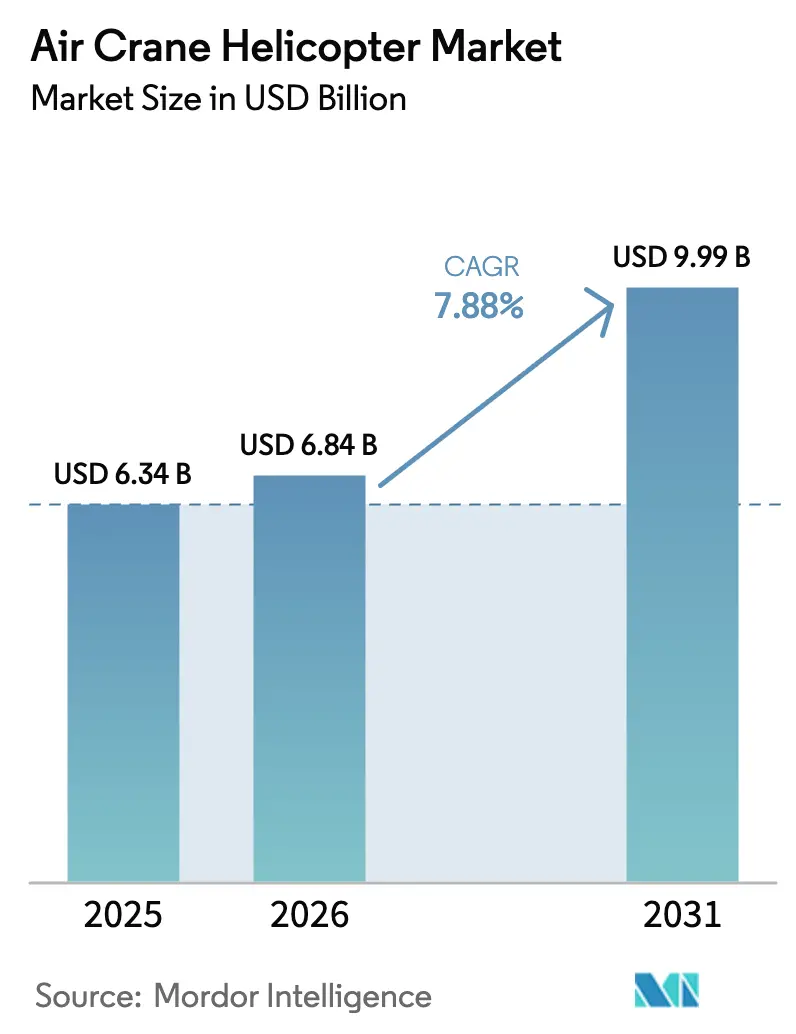
| Market Size (2026) | USD 6.84 Billion |
| Market Size (2031) | USD 9.99 Billion |
| Growth Rate (2026 - 2031) | 7.88 % |
| Fastest Growing Market | North America |
| Largest Market | Asia Pacific |
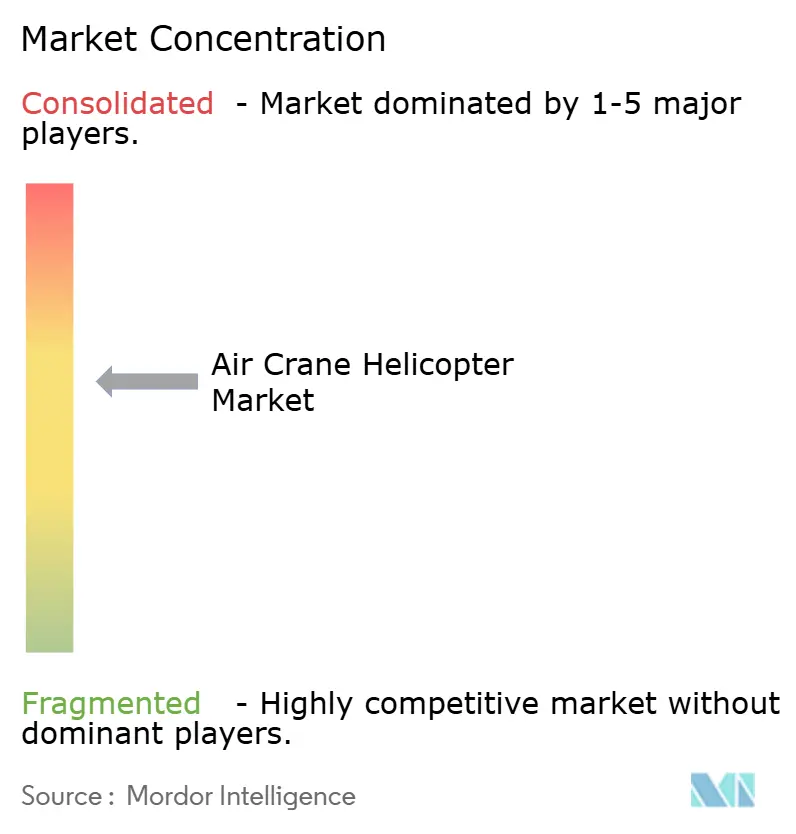
| Market Concentration | Medium |
Major Players *Disclaimer: Major Players sorted in no particular order Image © Mordor Intelligence. Reuse requires attribution under CC BY 4.0. | |
Air Crane Helicopter Market Analysis by Mordor Intelligence
Air crane helicopter market size in 2026 is estimated at USD 6.84 billion, growing from 2025 value of USD 6.34 billion with 2031 projections showing USD 9.99 billion, growing at 7.88% CAGR over 2026-2031. Rising heavy-lift requirements across wildfire suppression, offshore wind installation, remote infrastructure replacement, and military recapitalization place the air crane helicopter market at the center of global logistics strategies. Civil agencies and defense ministries increasingly view these aircraft as the only practical option for moving multi-ton payloads into austere or environmentally sensitive sites. This shift has accelerated new-build demand and long-term leasing activity. Consolidation among operators continues, with integrated service providers capturing share by coupling lift capacity, specialized crews, and fleetwide maintenance programs. At the same time, engineering advances in hybrid-electric powertrains and survivability upgrades expand the mission envelope, reinforcing confidence in fleet renewal cycles. Heightened urgency around climate-driven disasters, sustained energy transition spending, and cross-border defense cooperation ensure a resilient growth trajectory for the air crane helicopter market through 2030.
Key Report Takeaways
- By endurance, the 5,001-10,000 ft band held 45.24% of the air crane helicopter market share in 2025, while the above-10,000 ft band is projected to grow at a 9.18% CAGR through 2031.
- By load capacity, aircraft in the 3,001-6,000 lb bracket captured 39.35% of the air crane helicopter market size in 2025; the 12,001-15,000 lb bracket is advancing at a 9.78% CAGR between 2026-2031.
- By end-user, civil government operations commanded 52.02% of the air crane helicopter market share in 2025, whereas commercial operators are expanding at an 8.05% CAGR to 2031.
- By application, heavy construction and infrastructure activities accounted for 48.41% of the air crane helicopter market size in 2025; fire-fighting is rising fastest at a 9.35% CAGR through 2031.
- Geographically, Asia-Pacific led with 43.12% of the air crane helicopter market share in 2025; North America posts the quickest regional CAGR of 7.32% for 2026-2031.
Note: Market size and forecast figures in this report are generated using Mordor Intelligence’s proprietary estimation framework, updated with the latest available data and insights as of 2026.
Market Trends and Insights
Drivers Impact Analysis of Air Crane Helicopter Market*
| Driver | (~) % Impact on CAGR Forecast | Geographic Relevance | Impact Timeline |
|---|---|---|---|
| Heavy-lift demand from offshore wind turbine installation | +1.2% | North Sea, S. East Coast, East Asia | Medium term (2-4 years) |
| Emergency wildfire suppression contracts expanding in Western US and Australia | +0.9% | Western US, Australia, Mediterranean Europe | Short term (≤ 2 years) |
| Aging infrastructure replacement projects in remote areas (e.g., power-line towers) | +0.8% | North America, Europe, developed Asia-Pacific | Long term (≥ 4 years) |
| Military rotorcraft fleet recapitalization programs (CH-53K, CH-47F Block II) | +1.1% | US, India, European NATO allies | Medium term (2-4 years) |
| Exploration of hybrid-electric propulsion conversions for S-64/CH-54 platforms | +0.4% | North America, Europe | Long term (≥ 4 years) |
| Remote modular energy and mining projects (Arctic micro-grids, desert solar farms) needing heavy-lift assembly | +0.6% | Asia-Pacific, Middle East, Africa, Arctic | Medium term (2-4 years) |
| Source: Mordor Intelligence | |||
Heavy-lift Demand from Offshore Wind Turbine Installation
Offshore wind developers are moving turbines farther from shore and lifting nacelle weights past 120 tonnes, spurring specialized flight operations, reinforcing the air crane helicopter market. HTM Helicopters’ recent order for additional H145s dedicated to German and French wind farms took its fleet to eight aircraft, signaling a consistent fleet expansion by European service providers.[1]Airbus, “HTM Helicopters Orders Additional H145s for Offshore Wind,” airbus.com In North America, HeliService USA safely moved more than 2,500 technicians to Atlantic wind-farm sites between mid-2023 and early 2025, showcasing a cost-effective alternative to slow crew-transfer vessels. Medium-lift models in the 3,001-6,000 lb segment increasingly dominate crew change and light cargo missions because they balance payload with two-engine reliability in salt-spray environments. As turbine hub heights and rotor diameters grow, demand also spreads into heavier classes for pre-assembly lifts, widening revenue streams for the air crane helicopter market. Stakeholders expect sustained contract backlogs through at least 2029 as UK, Germany, Japan, and South Korean regulators approve new leases and tax incentives.
Emergency Wildfire Suppression Contracts Expanding
Climate-driven fire seasons extend beyond traditional summer windows, pushing civil agencies to fund multi-year helicopter availability programs. During Australia's season, Coulson Aviation closed a USD 400 million, 10-year contract with New South Wales Rural Fire Service to deploy CH-47 Chinooks and Type 1 tankers.[2]Coulson Aviation, “Coulson Aviation Awarded 10-Year NSW RFS Contract,” coulsonaviation.com The Forest Service's rule to overhaul aerial suppression procurement in the United States could triple annual flight hours for large helicopters by 2027. Greece followed with an order for eight H215s outfitted for night water drops exceeding 4,000 liters. Platform preferences skew toward aircraft able to ferry 10-12 crew, sling 10,000+ lb external loads, and integrate IR-stabilized mapping systems for nocturnal ops. Such capabilities allow quick redeployment across continents, sustaining utilization rates while deepening strategic relevance for the air crane helicopter market.
Aging Infrastructure Replacement Projects in Remote Areas
Electric-utility upgrades, mountain hydro renovations, and remote bridge rebuilds have converged to create a steady pipeline of multi-ton lifts. The Yoakum-Defrenn Heliport taxiway rehabilitation, valued between USD 25-100 million by the US Army Corps of Engineers, typifies projects that would otherwise need weeks of road closures. Power-line contractors leverage 6,001-12,000 lb helicopters to string new conductors across canyons, citing up to 40% savings against ground-based crane barges when terrain or environmental rules restrict land access. Renewable developers are applying the same model to solar farms on desert escarpments, where lifting prefabricated inverter stations by air prevents soil disturbance and shortens commissioning schedules. As governments earmark trillions for resilience and clean-energy infrastructure through 2030, the cumulative lift-hour demand reinforces high asset-utilization forecasts for the air crane helicopter market.
Military Rotorcraft Fleet Recapitalization Programs
Armed forces are fielding next-generation heavy-lifters with greater power margins, digital survivability suites, and wider mission sets. Boeing booked contracts topping USD 375 million for CH-47F Block II deliveries during 2024-2025 and another USD 240 million in 2025 for five MH-47Gs destined for Special Operations Aviation Command.[3]Boeing, “US Army Awards CH-47F Block II Contract,” boeing.com India’s landmark USD 7.36 billion order for 156 Prachand light combat helicopters gives Hindustan Aeronautics a production bridge until 2032 while satisfying high-altitude lift requirements above 5,000 m. International programs around the CH-53K, UH-60M, and CH-47 Block II keep assembly lines busy in the United States, Germany, and Japan, with unit prices amplified by comprehensive support packages. The cumulative procurement pipeline secures predictable deliveries throughout the decade, embedding a structural demand layer that buffers the air crane helicopter market from cyclical civil downturns.
Restraints Impact Analysis of Air Crane Helicopter Market*
| Restraint | (~) % Impact on CAGR Forecast | Geographic Relevance | Impact Timeline |
|---|---|---|---|
| Volatile aviation turbine fuel (ATF) prices squeezing operator margins | -1.4% | Global | Short term (≤ 2 years) |
| Shortage of certified Type I heavy-lift pilots and maintenance engineers | -0.8% | North America, Europe, developed Asia-Pacific | Medium term (2-4 years) |
| Scarcity of legacy spare-part inventories for retired airframes | -0.6% | Global, concentrated in CH-54 and early S-64 operators | Long term (≥ 4 years) |
| Stringent noise and emissions regulations limiting urban/EU heavy-lift flight permits | -0.5% | Europe, North American cities, developed Asia-Pacific urban corridors | Medium term (2-4 years) |
| Source: Mordor Intelligence | |||
Volatile Aviation Turbine Fuel Prices Squeezing Operator Margins
Jet-fuel costs represent almost one-third of direct operating expenses for Type I helicopter operators. The International Air Transport Association projected an average USD 2.7095 per gallon price for 2024 amid Middle-East supply risk, trimming margins for even the most efficient fleets.[4] IATA, “Jet Fuel Price Monitor,” iata.org Heavy-lift missions burn more than 500 gallons per hour when hovering with sling loads, magnifying price swings. Smaller charter firms lacking hedging tools confront cash-flow stress that limits fleet modernization, nudging them toward mergers or asset sales. Larger carriers invest in engine digital-twin monitoring, flight-profile optimization, and sustainable aviation fuel blends; however, SAF availability lingers below 1% of global supply, constraining immediate relief. Persistent volatility is therefore expected to temper rate increases and slow near-term capacity additions across the air crane helicopter market.
Shortage of Certified Type I Heavy-lift Pilots and Maintenance Engineers
Eighty percent of companies surveyed in Rotor Pro’s 2024 salary report cited pilot deficits, even with heavy-lift captains earning USD 110,000–200,000 annually. Regional airlines drawing rotorcraft talent into fixed-wing cockpits exacerbate attrition, and certification for external-load operations requires two to three years of supervised flying. Maintenance engineers certified on S-64s or CH-54s head toward retirement fast, while supply-chain bottlenecks limit retraining throughput. Vertical Aviation International formed a Workforce Development Working Group, but course approvals stretch into 2027, anchoring the staffing shortage through the medium term. Resulting downtime during peak fire and construction seasons can sideline 5-8% of global heavy-lift capacity, dampening growth potential for the air crane helicopter market.
*Our forecasts treat driver/restraint impacts as directional, not additive. The impact forecasts reflect baseline growth, mix effects, and variable interactions.
Air Crane Helicopter Market Segment Analysis
By Endurance:
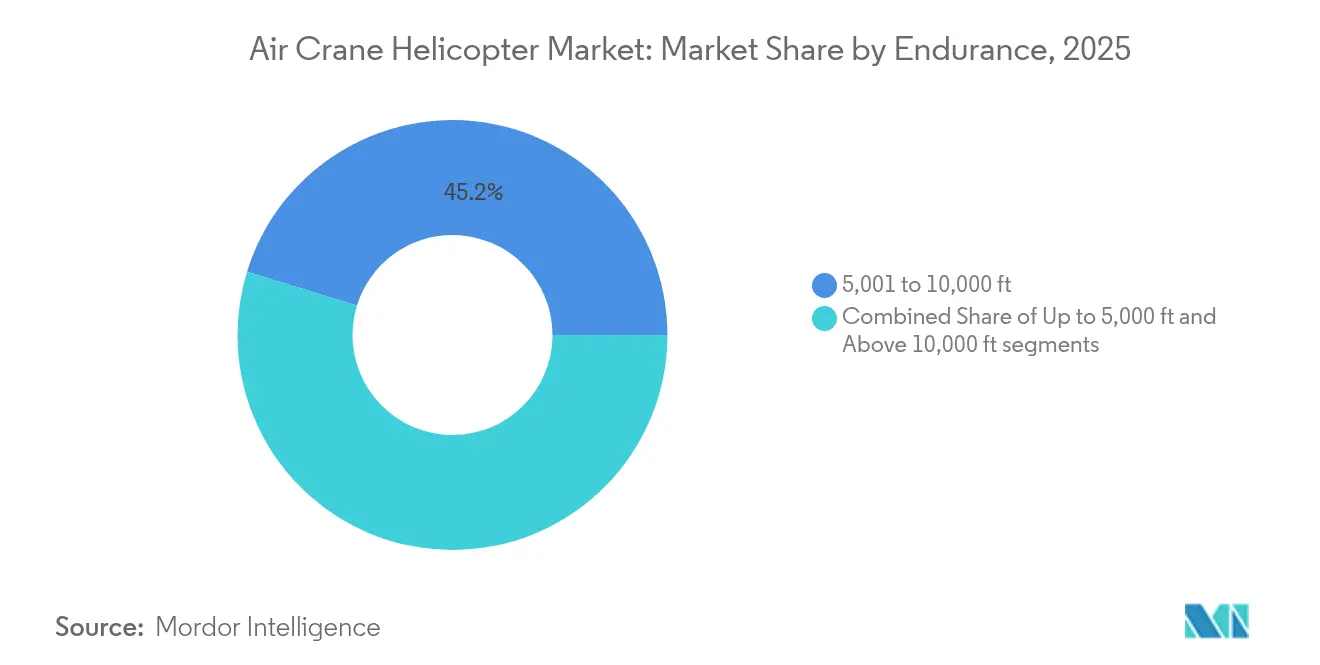
High-Altitude Operations Drive Premium DemandEndurance segmentation mirrors mission altitude more than flight duration. Aircraft certified for 5,001-10,000 ft operations commanded 45.24% of the air crane helicopter market share in 2025, anchored by mountainous power-line projects from the Rockies to the Himalayas. Operators cite these platforms’ ability to hover with payloads in thin air without sacrificing cycle economies. The air crane helicopter market size tied to this band will exceed USD 4.49 billion by 2031. Above-10,000 ft aircraft, historically niche, now expand at 9.18% CAGR as border patrols in Tibet, Andean renewable builds, and Alpine turbine swaps require even more power margin. Manufacturers respond with uprated engines, FADEC-driven torque control, and lighter composite blades that deliver 15-20% better lift-to-weight ratios. Conversely, the under-5,000 ft bracket maintains relevance for offshore wind shuttles and coastal SAR missions where density altitude is less punishing.
Mission specialists in the higher bands also invest heavily in avionics to handle variable wind shear and GNSS-degraded canyons. Enhanced‐vision systems, LPV approaches, and all-weather radars now appear as baseline configurations on new CH-47F Block II deliveries. Altitude-optimized rotorcraft enjoy premium hourly rates, offsetting ownership costs even when utilization trails utility helicopters. This economics reinforces R&D into propulsion de-rate management and de-icing automation, themes likely to dominate OEM roadmaps through 2032. The dynamic maintains a multi-tier aircraft ecosystem inside the broader air crane helicopter market, with platform choice increasingly guided by elevation-specific payload efficiency.



By Load Capacity:
Heavy-Lift Segment Accelerates with Infrastructure DemandPlatforms in the 3,001 to 6,000 lbs class formed the core of day-to-day lifting, accounting for 39.35% of the air crane helicopter market size in 2025. Nevertheless, infrastructure megaprojects and expeditionary military logistics are tilting growth toward the 12,001 to 15,000 lbs category, forecasted at 9.78% CAGR through 2031. The CH-53K King Stallion’s 36,000 lbs external-lift demonstration for the US Marine Corps set a new benchmark, raising customer expectations for single-sortie capability. Utility markets still favor mid-capacity K-Max, AW189, and S-92 variants for conductor pulls, cellular-tower placement, and offshore wind nacelle access where deck clearances are limited.
Unit economics influence procurement decisions. High-capacity helicopters cost up to three times more per flight hour but can halve total lift cycles on a bridge-girder project, compressing schedule risk penalties. As insurance underwriters reward fewer ground resets and lower worksite congestion, project bid models tilt toward the upper capacity brackets. Meanwhile, OEMs innovate quick-attach modular rigs, letting 6,001 to 12,000 lbs aircraft undertake precision lifts one day and personnel shuttles the next, sustaining year-round use rates. These developments reinforce layered demand and diversify revenue in the air crane helicopter market.
By End-user:
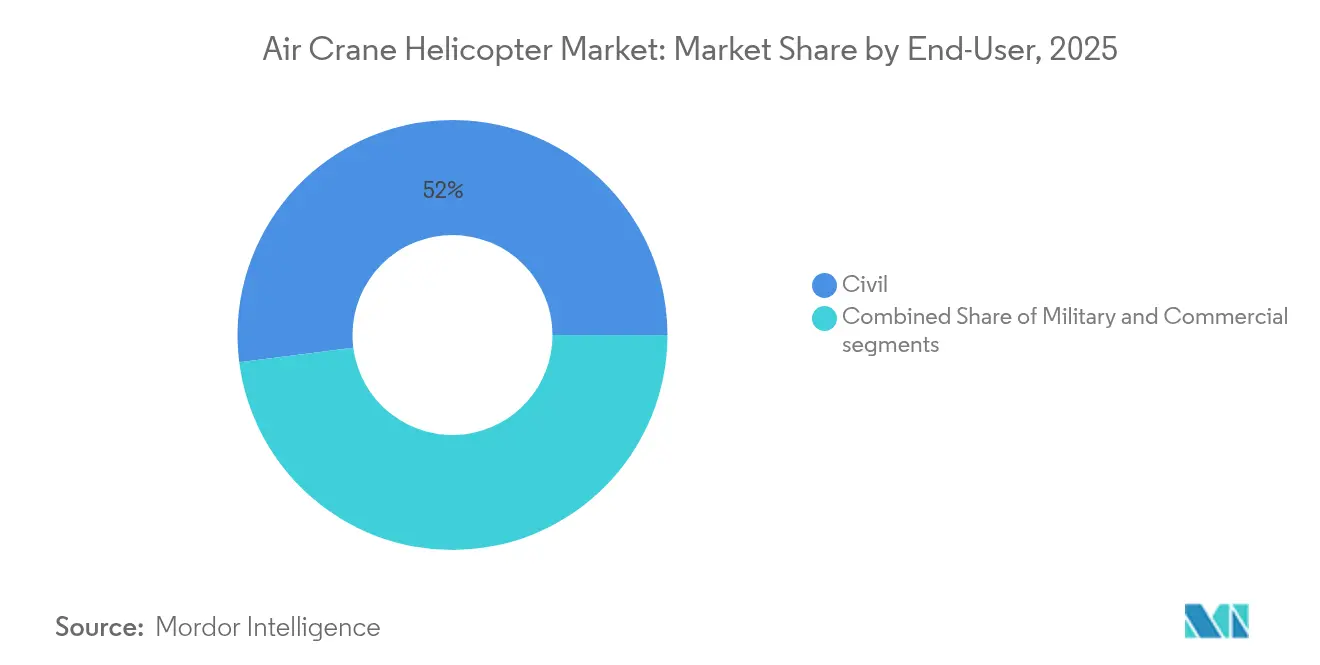
Commercial Sector Emerges as Growth LeaderCivil or government agencies such as forestry departments and emergency management offices retained 52.02% of the air crane helicopter market share in 2025, underpinned by multi-year wildfire and disaster relief budgets. Yet the commercial segment, spanning construction, mining, and energy, now posts an 8.05% CAGR through 2031, outpacing public buyers. The shift reflects public–private partnerships that outsource lift operations to specialized contractors seeking longer-term service leases instead of capital purchases. Helicopter Express’ acquisition of Erickson’s air-crane fleet exemplifies consolidation aimed at aggregating utilization across fire, wind, and infrastructure domains.
Military end-users continue to place pivotal volume orders but exhibit longer procurement cycles tied to budget appropriations. The US Army’s MH-47G Block II contract for five aircraft worth USD 240 million underscores selective modernization for special operations units. Commercial operators, by contrast, hedge cyclicality by negotiating power-by-the-hour packages with OEMs like Leonardo, ensuring predictable costs as flight hours swing with commodity prices. This service-centric purchasing behavior feeds a parallel growth track inside the air crane helicopter market, emphasizing uptime guarantees over outright fleet expansion.
By Application:
Firefighting Surges with Climate PressuresHeavy construction and infrastructure remained the largest application, contributing 48.41% of the air crane helicopter market size in 2025. Firefighting represents the fastest-growing use case at a 9.35% CAGR amid lengthening burn seasons from California to Greece. Governments channel dedicated climate-adaptation funds into rotorcraft acquisition, such as Greece’s EUR 800 million (USD 937.7 million) purchase of eight H215s for aerial suppression missions. Technical innovations like FAA-certified retractable tanks for CH-47s double sortie volumes and cut turnaround times, boosting water-delivery productivity.
Oil-and-gas support hours decline gradually as offshore wind ascends; however, helicopter providers often redeploy the same crews and airframes, smoothing fleet utilization. Timber-harvest activity faces stricter environmental rules, yet precision logging in protected zones still requires helicopters to mitigate ground disturbance. Diversification across emergency, industrial, and environmental portfolios thus creates a balanced demand mix, stabilizing growth in the broader air crane helicopter market.
Geography Analysis
APAC Air Crane Helicopter Market
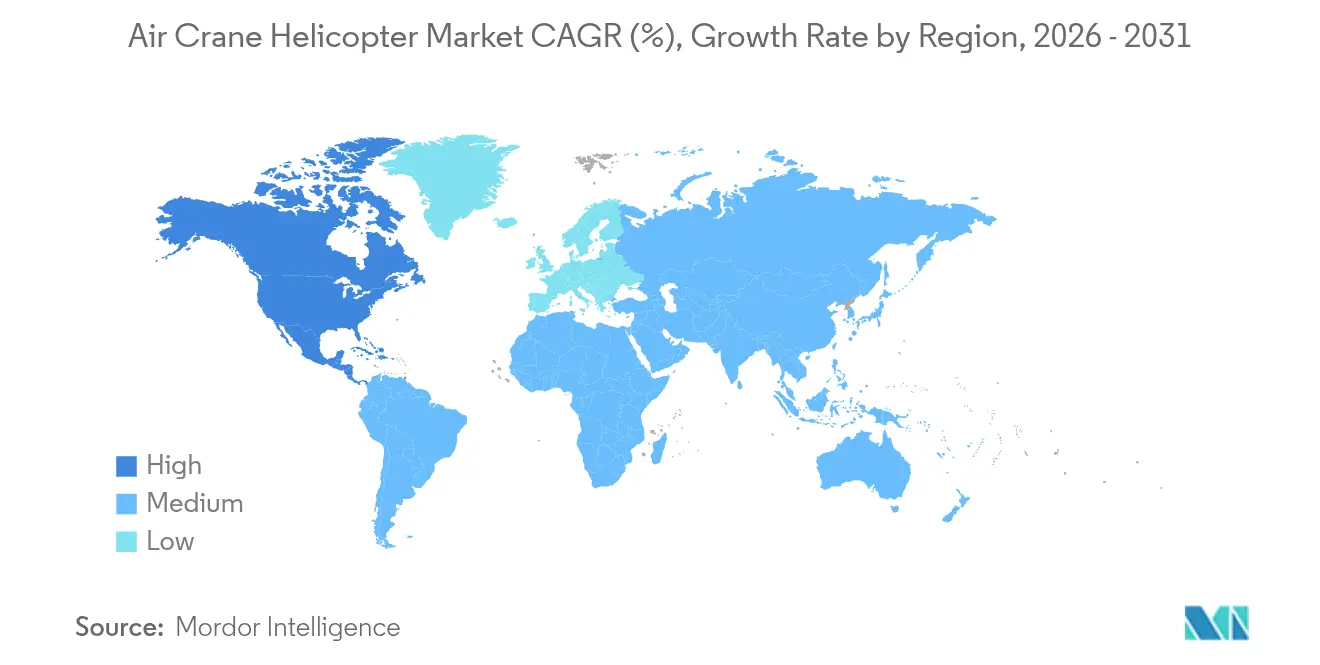
Asia-Pacific dominated the air crane helicopter market with 43.12% share in 2025, propelled by Indian and Chinese procurement drives plus remote infrastructure projects across Indonesia, the Philippines, and Australia. India’s record USD 7.36 billion Prachand order aims for more than 65% localized content, bolstering indigenous supply chains and long-term maintenance ecosystems. Japan’s acquisition of 17 CH-47 Block II Chinooks and the Philippines’ plan to operate 47 S-70i Black Hawks illustrate sustained defense outlays across the region. Parallel civil demand stems from Australian wildfire campaigns and Indonesian hydro dam construction, creating year-round lift requirements that feed the regional air crane helicopter market.
North America Air Crane Helicopter Market
North America remains the fastest-expanding region, tracking a 7.32% CAGR for 2026-2031. The US Infrastructure Investment and Jobs Act accelerates bridge and grid rebuilds, while Western wildfire budgets break spending records yearly. Bell Textron’s USD 632 million Fort Worth facility, scheduled to open in 2028 to assemble V-280 components, underscores the industrial confidence surrounding heavy-lift rotorcraft. Canada’s Griffon Limited Life Extension project keeps medium-lift fleets viable through the mid-2030s, ensuring cross-border MRO demand and technician training pipelines. These factors support the continent's dynamic and resilient air crane helicopter market.
Europe Air Crane Helicopter Market
Europe posts steady gains anchored by NATO capability targets and offshore wind expansion across the North Sea and Baltic. Greece’s EU-backed H215 firefighting contract highlights coordinated regional funding to address climate threats. The UK’s CH-47ER procurement guarantees Royal Air Force heavy-lift readiness beyond 2040, while Leonardo’s EUR 20.9 billion (USD 24.5 billion) order haul in 2024 demonstrates competitive momentum for European OEMs. Simultaneously, operators like HTM grow turbine-maintenance fleets, reinforcing pan-European network effects that amplify the air crane helicopter market’s value proposition.

Regulatory Landscape
The air crane helicopter market operates under a layered airworthiness and operations framework led by regulators such as the FAA in the United States, EASA in Europe, and the UK CAA. Certification and continued-airworthiness requirements influence retrofit content, permitting, and maintenance intervals for heavy external-load missions. In Europe, EASA updated Part-26 in March 2026, expanding requirements for cargo compartment fire protection and crash-resistant fuel system design (with phased compliance extending into the 2030s). This can pull forward modification work on CS-27/CS-29 rotorcraft used in lift, offshore, and emergency-response roles.
Wildfire aviation is also shaped by evolving US federal procurement and oversight mechanisms, including congressional activity and agency-level debates on inspection and carding standards ahead of the 2026 fire season. On the supply and platform side, type certification and supplemental type certification pathways remain central for specialized missions. The S-64 Aircrane family, operating under FAA/EASA approvals and supported by mission STCs used for firefighting configurations, affects operator eligibility for government dispatch and multi-year availability contracts.
Value Chain Analysis
The value chain covers OEM design and final assembly, tiered aerostructures and propulsion suppliers, mission-system integrators (tanks, cargo hooks, avionics), and operator-facing MRO and training networks that support high-utilization fleets for construction, offshore energy, and firefighting. In military heavy-lift, the CH-53K program shows how upstream dependencies cascade. Sikorsky coordinates a supplier base reported at 267 suppliers across 37 US states and 8 countries, while GE Aerospace supplies the T408-GE-400 engines and sustains procurement through NAVAIR-managed lots.
Downstream, operators and government customers shape configuration, spares pooling, and readiness through multi-year contracting and performance-based support, shifting more value toward sustainment and upgrades over the aircraft life. Composite manufacturing and automated production capabilities also affect lead times and repeatability for critical structures, including Aurora Flight Sciences manufacturing composite assemblies for the CH-53K. Across civil applications, certified mission kits (firefighting tanks, external-load equipment) and approved maintenance organizations remain key bottlenecks, alongside labor availability for Type I heavy-lift pilots and licensed engineers.
Competitive Landscape
Market structure leans toward moderate concentration, with a handful of OEMs and vertically integrated operators supplying most global lift hours. Helicopter Express’ April 2025 purchase of Erickson’s S-64 Skycrane fleet fundamentally rebalanced commercial capacity, creating a trans-regional giant able to bid simultaneously on US fire contracts and Asian infrastructure lifts. The move mirrors a broader pattern where scale enables investment in advanced training, parts pooling, and fleet digitalization, differentiating leaders within the air crane helicopter market.
OEM strategies target lifecycle revenue over unit sales. Bristow Group’s power-by-the-hour deals with Leonardo for AW139 and AW189 fleets exemplify contracts that guarantee spare parts, simulators, and predictive analytics in exchange for multi-year flight-hour commitments. Boeing, Sikorsky, and GE Aerospace concurrently advance hybrid-electric demonstrators, betting that emission caps and fuel-cost volatility will accelerate adoption of turbine-battery architectures. These R&D races influence future platform competitiveness, especially for civil operators sensitive to ESG reporting.
Regional specialists defend niche domains through tailored capabilities. Arctic operators emphasize airframe winterization and satellite connectivity, while Middle-Eastern contractors market high-temperature derate kits. Such specialization sustains diversity, yet cross-border mergers may rise as pilot shortages and capital-intensive fleet refresh cycles pressure sub-scale firms. Technology investment, service bundling, and geographic breadth underpin competitive positioning in the air crane helicopter market.
Air Crane Helicopter Industry Leaders
Erickson Incorporated
Airbus Helicopters
Kaman Corporation
Bell Textron Inc.
Lockheed Martin Corporation
- *Disclaimer: Major Players sorted in no particular order
Air Crane Helicopter Market Companies Covered in this Report
- Erickson Incorporated
- Airbus Helicopters (Airbus SE)
- Kaman Corporation
- Lockheed Martin Corporation
- Bell Textron Inc.
- Leonardo S.p.A
- Russian Helicopters (Rostec)
- The Boeing Company
- Hindustan Aeronautics Limited (HAL)

Market Opportunities and Future Outlook
Civil aerial firefighting offers a practical equipment-availability and modernization pathway linked to policy support and fleet-access mechanisms. The US Aerial Firefighting Enhancement Act of 2025 (Public Law 119-18) extends authority for the Department of Defense to sell surplus aircraft and parts to civilian aerial firefighting operators through October 1, 2035. It also allows use for water delivery in addition to retardant, widening the mission set for platforms adapted to tanker and sling-load roles. In parallel, ongoing debate around federal inspection and carding standards, visible in 2026 reporting and related legislative activity, creates space for operators and MROs to document compliance efficiently, field standardized configurations, and reduce downtime during peak fire seasons.
Defense modernization and long-horizon procurement are another runway for heavy-lift supply chains and upgrade content. The CH-53K King Stallion multi-year procurement framework (Lots 9-13, signed across late 2025 and January 2026) supports predictable demand for engines, composite assemblies, avionics, and sustainment capacity managed through NAVAIR, which benefits qualified suppliers expanding repair capability and supporting obsolescence and system-integration lab work. Offshore energy support continues to drive fleet refresh activity in Asia-Pacific, including Vietnam Helicopter Corporation subsidiaries ordering three Airbus H225 helicopters in April 2026 for offshore operations. This supports opportunities for operators that bundle lift capability with offshore-qualified crews, spares, and mission equipment.
Recent Industry Developments in Air Crane Helicopter Market
- July 2026: Romania Ministry of Defense finalizes contract with France for 12 Airbus H225M Caracal multi-mission helicopters, funded via the European SAFE program. The deal reinforces European heavy-lift capacity and strengthens joint procurement frameworks across the EU defense landscape. Airbus Helicopters remains central to expanding the H225M fleet in this region.
- April 2026: Vietnam Helicopter Corporation subsidiaries order three H225 helicopters to support offshore energy operations. The acquisition expands H225/M deployment in Asia Pacific and boosts regional heavy-lift demand. The arrangement extends Airbus Helicopters' footprint in offshore market segments and diversifies its customer base.
- February 2026: Erickson Incorporated acquires remaining minority stake to gain full ownership of 321 Precision Conversions (Airbus A321-200PCF freighter conversions). The consolidation strengthens heavy-lift conversion capacity and liquidity in the global market. This increases fleet modernization potential in the heavy-lift segment.


Air Crane Helicopter Market Report Scope and Research Methodology
Market Definition and Coverage
This market is sized as the revenue generated from air crane helicopter aircraft and related mission-capable configurations that are used for external lift and heavy-lift work across civil and government end users, captured in USD for the global footprint.
Scope exclusions: Excludes fixed wing cargo aircraft, ground cranes, and ordinary utility helicopters that are not configured or marketed for air crane style external lift missions.
Segments Covered in This Report
- By Endurance
- Up to 5,000 ft
- 5,001 to 10,000 ft
- Above 10,000 ft
- By Load Capacity
- Up to 3,000 lbs
- 3,001 to 6,000 lbs
- 6,001 to 12,000 lbs
- 12,001 to 15,000 lbs
- By End-user
- Civil (Forestry, Disaster Management)
- Commercial (Construction, Logging, Utility)
- Military
- By Application
- Firefighting
- Timber Harvest and Logging
- Heavy Construction and Infrastructure
- Oil and Gas/Offshore Wind Lifting
- By Geography
- North America
- United States
- Canada
- Mexico
- Europe
- Germany
- United Kingdom
- France
- Spain
- Russia
- Rest of Europe
- Asia-Pacific
- China
- Japan
- India
- South Korea
- Rest of Asia-Pacific
- South America
- Brazil
- Argentina
- Rest of South America
- Middle East and Africa
- Middle East
- United Arab Emirates
- Saudi Arabia
- Rest of Middle East
- Africa
- South Africa
- Rest of Africa
- Middle East
- North America
Data Sources, Market Sizing, and Validation
Desk Research
Desk research was used to build the core model structure and to anchor the demand signals that drive air crane helicopter flying hours and fleet needs. We relied on public sources such as civil aviation registries and airworthiness databases (for fleet counts and aircraft age), government procurement and budget documents (for firefighting and defense demand), and national wildfire incident statistics and situation reports to understand seasonal utilization patterns.
To tighten assumptions, we also reviewed sources such as ICAO and national air transport statistics where useful for aircraft activity context, trade and customs releases for aircraft and parts movement signals, and aviation safety and operations literature on heavy-lift use cases. Company filings, investor presentations, association websites, and reputable press were used for pricing cues, contract announcements, and delivery timelines, and then selective paid subscriptions were used where public disclosure was limited, especially for company financials and patent lookups. This list is indicative only, and additional sources were also used for data collection, validation, and clarification.
Primary Interviews and Surveys
Primary work was used to pressure-test the desk assumptions and to fill gaps that public data does not explain well, including typical utilization days by application and how pricing differs by lift class and endurance. We spoke with operators, MRO and conversion specialists, procurement stakeholders, and aviation consultants across key operating regions, so regional demand drivers and contract structures could be compared on a like-for-like basis.
Distribution of primary research fieldwork respondents
| Company type | Respondent position | Region |
|---|---|---|
| Top tier: 39% | CXOs: 15% | APAC: 46% |
| Mid tier: 41% | Functional/Unit leaders: 31% | EMEA: 36% |
| Smaller Players: 20% | Managers: 54% | Americas: 18% |
Market-Sizing & Forecasting
Sizing starts from a top down build where fleet in service, active firefighting seasons, and infrastructure and energy project activity are translated into likely flight hours and heavy-lift mission demand by region. To keep the model grounded, we then check results using selective bottom-up approximations, such as sampled operator fleet roll-ups, delivered unit counts tracked from public announcements, and typical price-per-hour ranges applied to utilization bands.
Key inputs used in the model include registered fleet counts and age profiles, average annual flying hours by application (for example, firefighting versus construction lift), contract mix between exclusive use and call when needed work, delivery and retirement timing, and indicative rate cards or day rates seen in public contracts. For forecasting, scenario analysis was used with a base case that is adjusted by expected wildfire severity cycles, infrastructure spending direction, and defense logistics needs that were discussed in interviews. Where a bottom-up view cannot cover smaller operators consistently, gaps are handled through penetration assumptions tied back to known fleet footprints and regional operating intensity.
Data Validation & Update Cycle
Checks are run at multiple points so totals remain consistent with real-world signals, and we do not carry forward obvious outliers. We compare model outputs with independent indicators such as fleet registry changes, large contract awards, and delivery timelines, then document and review variance drivers before sign-off.
If a major discrepancy is found, follow-up calls are triggered with relevant respondents and assumptions are reworked until the spread is explained. Reports are refreshed annually, and interim updates are made when material events occur that can shift demand, supply, or pricing. Before delivery, an analyst completes a fresh review pass so clients receive the latest updated view.
Mordor Intelligence's Air Crane Helicopter Market Size Versus Other Published Estimates
Published market values for this topic can appear far apart because the underlying scope is not always the same, and because each publisher uses different demand signals to translate activity into revenue. Differences also come from the chosen base year, how price changes are applied over time, and how fast the dataset is refreshed.
Light utility external-load helicopters are often grouped into the same bucket, and that item sits outside Mordor Intelligence's scope for this study. This keeps the numbers focused on true air-crane style heavy-lift missions rather than broad rotorcraft services. Some estimates also rely heavily on unit shipments or a single end user assumption, while others blend aggressive wildfire growth rates with rising hourly rates without cross-checking against registries and contract terms.
Benchmark comparison
| Source | Market Size | Gaps in Research Methodology |
|---|---|---|
| Mordor Intelligence | USD 6.84 B (2026) | |
| Industry Press Release A | USD 5.97 B (2024) | Uses an earlier base year and does not clearly separate heavy-lift air crane missions from adjacent helicopter services, which can shift the revenue pool and the implied price-per-hour. |
| Advisory Press Note B | USD 5.70 B (2023) | Relies on a high-level outlook with limited visibility on fleet utilization by application, and it appears to apply a smoother growth path without tying it back to contract cycles and fleet replacement timing. |
Looking across the three figures, the spread is mainly explained by scope edges and timing choices, and then by how utilization and pricing are converted into revenue. By anchoring to fleet and contract signals and then rechecking with operator-level inputs, the final market value stays traceable to a clear demand pool and repeatable calculation steps.


Key Questions Answered in the Report
What is the current value of the air crane helicopter market?
The air crane helicopter market size is USD 6.84 billion in 2026, climbing to USD 9.99 billion by 2031 at an 7.88% CAGR.
Which region leads the air crane helicopter market?
Asia-Pacific holds the largest regional share at 43.12% in 2025, driven by massive defense procurement and remote-area infrastructure projects.
What segment is growing fastest in load capacity?
Helicopters rated between 12,001 to 15,000 lbs are forecasted to expand at a 9.78% CAGR thanks to infrastructure megaprojects and military logistics needs.
Why are wildfire suppression contracts important to market growth?
Extended fire seasons have prompted multi-year, high-value contracts such as Coulson Aviation’s USD 400 million deal with New South Wales, boosting fleet utilization and new acquisitions.
How is technology shaping future competition?
Hybrid-electric propulsion demonstrations by Sikorsky and GE Aerospace indicate a shift toward lower-emission, fuel-efficient platforms that could reduce operating costs and regulatory exposure.
What challenges threaten near-term expansion?
Volatile jet-fuel prices and acute shortages of certified heavy-lift pilots and engineers can squeeze margins and delay service availability despite strong underlying demand.
Page last updated on:


 Your data is secure and never sold or shared.


