
AIOps For Telecom Networks Market Size and Share
Market Overview
| Study Period | 2020 - 2031 |
|---|---|
| Market Size (2026) | USD 5.92 Billion |
| Market Size (2031) | USD 12.07 Billion |
| Growth Rate (2026 - 2031) | 15.31 % |
| Fastest Growing Market | Asia-Pacific |
| Largest Market | North America |
| Market Concentration | Medium |
Major Players *Disclaimer: Major Players sorted in no particular order Image © Mordor Intelligence. Reuse requires attribution under CC BY 4.0. | |
AIOps For Telecom Networks Market Analysis by Mordor Intelligence
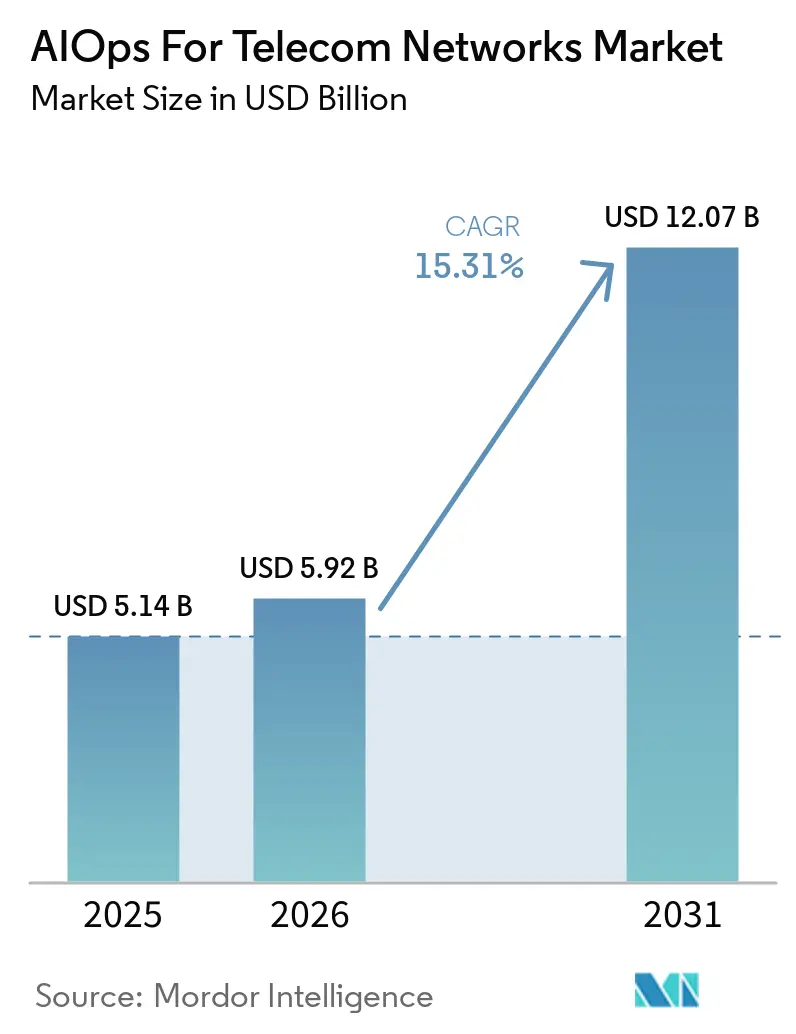
The AIOps for Telecom Networks Market size was valued at USD 5.14 billion in 2025 and is estimated to grow from USD 5.92 billion in 2026 to reach USD 12.07 billion by 2031, at a CAGR of 15.31% during the forecast period (2026-2031). Operators are moving beyond AI-assisted dashboards toward systems that can identify, decide on, and execute corrective actions across network domains. This change reflects the operational demands created by standalone 5G cores, network slicing, and cloud-native radio access networks. The AIOps for telecom networks market is also shaped by rising energy costs, service assurance challenges, and manual network operations. Vendors that combine network performance, incident response, and energy optimization within a single operating environment can address several operator budget priorities simultaneously. Partnerships between telecom software providers and cloud AI providers are becoming increasingly important as operators need both sector expertise and scalable AI infrastructure.
Key Report Takeaways
- By offering, platforms held 65.72% of the AIOps for Telecom Networks Market in 2025, while services are projected to expand at a 17.24% CAGR through 2031.
- By deployment model, on-premises deployment held 54.63% of the AIOps for telecom networks market in 2025, while cloud-based deployment is projected to expand at a 19.18% CAGR through 2031.
- By organization size, large enterprises held 78.41% of the AIOps for telecom networks market in 2025, while small and medium-sized enterprises are projected to expand at an 18.94% CAGR through 2031.
- By application, network performance management held 25.87% of the AIOps for telecom networks market in 2025, while fault and incident management is projected to expand at an 18.36% CAGR through 2031.
- By end user, mobile network operators held 53.76% of the AIOps for telecom networks market in 2025, while integrated communication service providers are projected to expand at a 17.32% CAGR through 2031.
- By geography, North America held 31.13% of the AIOps for telecom networks market in 2025, while Asia-Pacific is projected to expand at a 17.78% CAGR through 2031.
Note: Market size and forecast figures in this report are generated using Mordor Intelligence’s proprietary estimation framework, updated with the latest available data and insights as of January 2026.
Global AIOps For Telecom Networks Market Trends and Insights
Drivers Impact Analysis*
| Driver | (~) % Impact on CAGR Forecast | Geographic Relevance | Impact Timeline |
|---|---|---|---|
| 5G, Network Slicing, and Multi-Domain Complexity | +4.2% | Global, concentrated in North America, Asia-Pacific, and Europe | Short term (≤ 2 years) |
| Growth in Network Telemetry From IoT, Edge, and Cloud-Native Infrastructure | +3.5% | Global, with Asia-Pacific and North America as primary markets | Medium term (2-4 years) |
| Pressure to Reduce NOC Costs and Mean Time to Repair | +3.0% | Global | Short term (≤ 2 years) |
| Rising Demand for Predictive Service Assurance and Customer Experience Protection | +2.2% | Global | Short term (≤ 2 years) |
| Telecom-Specific Foundation Models Trained on Network Telemetry | +1.8% | North America, Europe, Asia-Pacific, China, Japan, and South Korea | Medium term (2-4 years) |
| Energy-Aware Closed-Loop Optimization for Radio and Edge Infrastructure | +1.3% | Europe, Asia-Pacific, and the Middle East | Long term (≥ 4 years) |
| Source: Mordor Intelligence | |||
5G, Network Slicing, and Multi-Domain Complexity Reshape NOC Architecture
Standalone 5G networks require operators to manage service commitments across the radio, transport, and core domains, which often use separate vendor systems. Network slicing adds another layer because each slice requires performance controls tailored to its specific service-level agreement. The 3GPP Network Data Analytics Function provides a native data collection and inference interface within the 5G core, while the O-RAN Alliance RAN Intelligent Controller extends AI-based decision support into the radio domain. Together, these standards give the AIOps for telecom networks market a clearer technical route for deployment and vendor assessment. Operator programs have shown that AI agents can manage slicing policies across many enterprise customers and adjust resources in less than 50 milliseconds during traffic surges. A single cross-domain view reduces manual transfers between specialist network operations teams, while telecom-specific foundation models can improve the interpretation of combined radio, transport, core, and service data.
IoT and Edge Telemetry Volumes Force AI-Native Data Processing
IoT endpoints, edge nodes, and cloud-native network functions are generating more operational data than traditional network teams can manually review. Ericsson reported 2.6 billion broadband and critical IoT connections at the end of 2025, which increased the volume of continuous network telemetry. The AIOps for telecom networks market, therefore, depends on systems that can correlate signals from many network layers in real time. Edge-generated information often requires local filtering and semantic compression before it reaches a central inference layer. AWS has described telecom deployments in which edge-deployed small language models condense large raw telemetry streams into smaller diagnostic signals for cloud AI agents.[1] This approach can lower backhaul requirements and shorten response times, particularly in geographically dispersed networks where centralized processing is less practical.
NOC Cost Reduction and MTTR Improvement Define AIOps ROI
Operators can most directly measure the value of AIOps through reduced network operations center workloads and faster incident resolution. A TM Forum Catalyst project reported a 57% reduction in mean time to repair through autonomous, multilayer root-cause analysis. The same program identified 30%-40% potential reductions in operating expenses through standards-based interoperability across OSS environments. These results support the AIOps market for telecom networks, as operators seek measurable operational returns from AI programs. The commercial value rises when platforms move beyond rule-based workflows and support intent-driven, closed-loop operations. Higher autonomy can reduce repetitive manual tasks, while energy-aware radio and edge optimization provide operators with an additional cost-control case on the same platform.
Predictive Service Assurance Becomes a Commercial Necessity for Operators
Operators are placing greater emphasis on preventing service disruption rather than responding after customers are affected. Deutsche Telekom reported that its RAN Guardian Agent triggered more than 100 remediation actions in its first month after going live in Germany in November 2025. The company said the system reduced the management time for major network events from hours to 1 minute during high-traffic Christmas market events.[2] Indosat Ooredoo Hutchison and Huawei reported an 80% one-hop closure rate for fault handling, a 15% reduction in mean time to repair, and an improvement in network availability from 99.3% to 99.7%.[3] These deployments show why the AIOps for telecom networks market is increasingly linked to both customer experience and internal efficiency. Predictive assurance reduces alarm overload, protects service-level agreements, and creates the basis for more reliable closed-loop remediation.
Restraints Impact Analysis*
| Restraint | (~) % Impact on CAGR Forecast | Geographic Relevance | Impact Timeline |
|---|---|---|---|
| High Integration Costs Across Legacy OSS, BSS, and Multivendor Networks | -2.1% | Global | Short term (≤ 2 years) |
| Data Privacy, Cybersecurity, and Operational Risk From Automated Remediation | -1.5% | Global, concentrated in Europe and North America | Medium term (2-4 years) |
| Poorly Labeled Alarm, Incident, and Configuration Data | -1.0% | Global | Medium term (2-4 years) |
| Operator Reluctance to Delegate Control to Agentic Systems | -0.7% | Global, primarily North America and Europe | Long term (≥ 4 years) |
| Source: Mordor Intelligence | |||
Legacy OSS and BSS Integration Costs Constrain AI Deployment Velocity
Legacy OSS and BSS systems are often customized for individual operators and can be difficult to connect with new AI tools. This challenge is more severe in multivendor networks, which require data adapters and normalization layers before telemetry can be interpreted consistently. Amdocs introduced aOS in February 2026 as an operating system designed to run on top of existing BSS and OSS stacks rather than replace them.[4] That design reflects operator concerns about disruption during system integration. The AIOps for telecom networks market may see slower adoption among mid-tier operators without large internal integration teams. Cloud-native OSS designs aligned with TM Forum Open Digital Architecture can reduce future integration burdens. However, the installed base of older systems will continue to affect deployment speed and vendor selection over the forecast period.
Automated Remediation Introduces New Cybersecurity and Operational Risk Vectors
Systems that can alter live network configurations create risks that do not arise when AI only provides recommendations. A poorly designed remediation rule could affect many network elements before a human team can intervene. The European Union AI Act requires additional controls for high-risk applications in critical infrastructure, including telecommunications. Vendors are responding with architectures that use confidence limits and send uncertain actions to human review. Nokia has described this approach within the agentic layer of its Assurance Center. A TM Forum study found that only 14% of operators could demonstrate full reliability in their AI systems, reflecting ongoing gaps in data quality and explainability. Data residency requirements in Europe and customer proprietary network information rules in North America also limit how subscriber-level telemetry can be used in shared AI environments.
*Our forecasts treat driver/restraint impacts as directional, not additive. The impact forecasts reflect baseline growth, mix effects, and variable interactions.
Segment Analysis
By Offering: Platforms Anchor Operator Adoption, Services Accelerate Faster
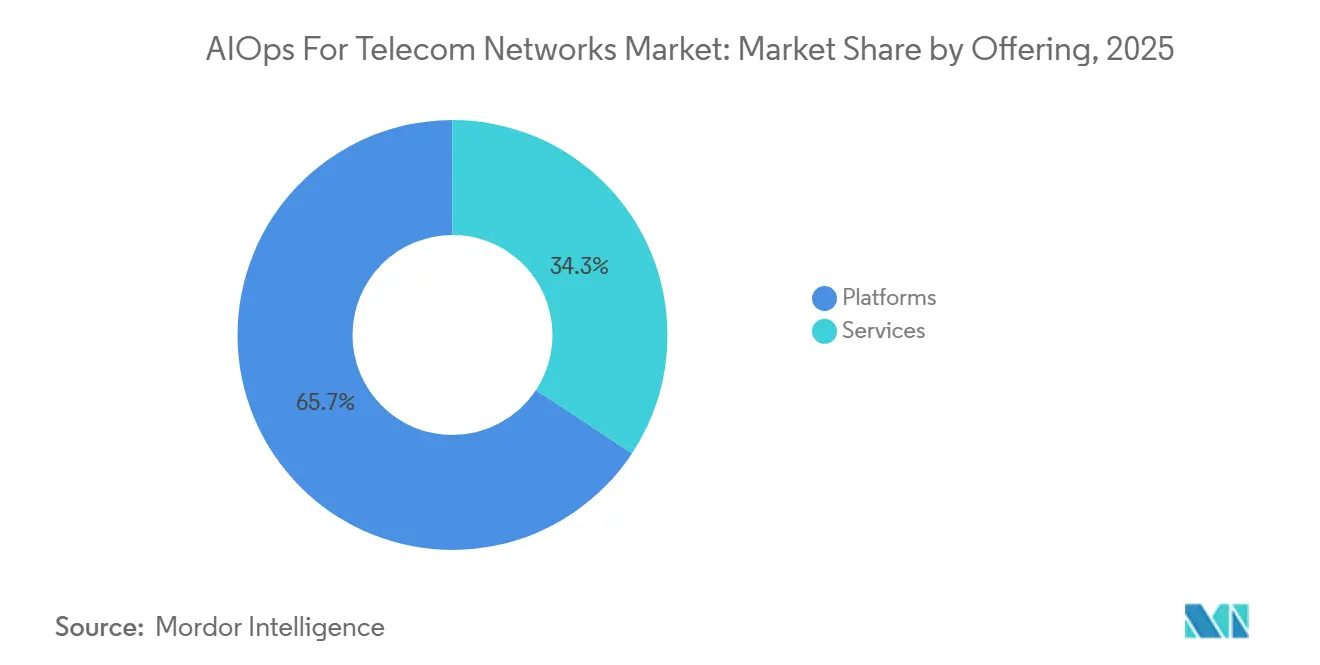
Platforms held 65.72% of the AIOps for telecom networks market share in 2025. Operators continue to favor integrated platforms that combine telemetry ingestion, model management, correlation, and closed-loop orchestration. This preference also reflects the need for carrier-grade reliability and telecom-specific operational knowledge. Platforms can include network ontologies and existing OSS connectors that general enterprise AIOps products lack. These capabilities help operators manage large volumes of alarms and performance data across several network domains. IBM Research demonstrated that telecom-focused foundation models can improve prediction accuracy for network data compared with conventional methods. This supports the position of specialized platforms within the AIOps industry for telecom networks. It also explains why operators often evaluate platforms as long-term architectural choices rather than isolated software purchases.
Services are projected to expand at a 17.24% CAGR from 2026 to 2031. This category includes implementation, platform customization, managed operations, and support for data preparation. Service demand remains closely tied to the complexity of brownfield network environments. Providers must often map legacy OSS and BSS data structures before an AI platform can operate reliably. Managed AIOps models are useful for operators that do not have dedicated AI operations teams. These models can offer more predictable outcome-based arrangements and reduce the need for internal infrastructure investment. The AIOps for telecom networks market will continue to require services, as implementation quality affects the reliability of any platform deployment. Services also help vendors build longer operator relationships after the initial platform sale.
By Deployment Model: Cloud Deployment Outpaces the On-Premises Installed Base
On-premises deployment accounted for 54.63% of the AIOps market for telecom networks in 2025. This position reflected data sovereignty requirements, latency concerns, and long-standing operator preferences for local control. On-premises systems remain important where national rules limit cloud processing of network telemetry. They are especially relevant for state-affiliated operators in parts of the Asia-Pacific and the Middle East. Local deployment can also support highly sensitive workloads that require direct access to network infrastructure. These considerations sustain a meaningful installed base even as cloud options become more capable. The AIOps for telecom networks industry, therefore, continues to support both local and hybrid operating models. Hybrid designs can give operators flexibility while retaining control over high-risk or regulated data.
Cloud-based deployment is projected to expand at a 19.18% CAGR from 2026 to 2031. Elastic cloud infrastructure can support large-scale AI inference when traffic patterns change sharply within short periods. Nokia announced in June 2026 that its Autonomous Networks Fabric would be available on AWS infrastructure with applications for orchestration, assurance, and inventory management. Cloud delivery can also reduce upfront infrastructure requirements and speed software updates. European requirements around auditability and data residency are encouraging suppliers to provide sovereign cloud options alongside public cloud services. This is likely to preserve hybrid architectures for many operators. The AIOps for telecom networks market is moving toward cloud use without eliminating the need for on-premises control.
By Organization Size: Large Enterprises Lead, but SMEs Are Closing the Gap
Large enterprises accounted for 78.41% of revenue in 2025. Large operators have historically been able to fund data engineering teams, proprietary integrations, and multiyear supplier programs. Verizon, Deutsche Telekom, and Indosat Ooredoo Hutchison have established large-scale deployment models that smaller operators have found harder to replicate. These organizations also operate broad networks that generate the data volumes needed for advanced automation. Their early investments have helped suppliers refine production use cases across assurance, fault handling, and orchestration. Large enterprises usually have the governance resources needed to supervise automated decisions. This leadership position remains central to the AIOps market for telecom networks. It also provides vendors with reference deployments that can support sales to other operator tiers.
Small and medium-sized enterprises are projected to expand at an 18.94% CAGR from 2026 to 2031. Cloud-delivered platforms are lowering entry barriers by replacing major infrastructure investments with subscription arrangements. Pre-integrated connectors can further reduce the time needed to launch an initial use case. Cisco stated that its AgenticOps platform handles more than 170,000 network alerts per hour with sub-50-millisecond AI agent response times. Modular deployment can allow smaller operators to begin with alarm reduction before progressing to predictive assurance. This approach reduces the distance between Tier-1 and Tier-2 or Tier-3 operators. The AIOps for telecom networks market can therefore become more accessible without requiring smaller providers to adopt every capability at once.
By Application: Fault Management Momentum Reshapes Platform Investment
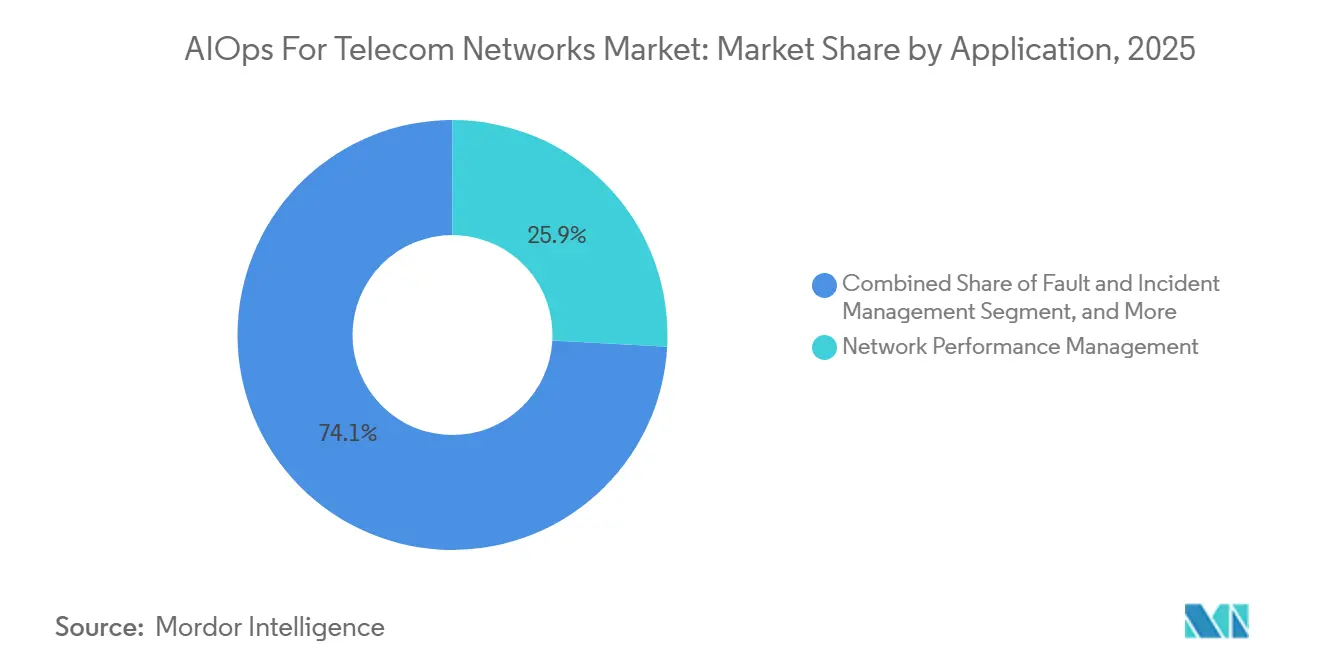
Network performance management accounted for 25.87% of revenue in 2025. It is the most established application because it was developed from earlier threshold-based monitoring practices. Operators use it to review service performance, capacity, and network quality across major domains. Network security management, customer experience management, infrastructure management, and application performance analysis serve other operational needs. Customer experience management is gaining attention because it can connect network indicators with subscriber churn risk. This creates a direct link between operations outcomes and commercial results. The AIOps for telecom networks market continues to use performance management as a foundation for wider automation. Established data pipelines and procurement patterns also make this application a practical starting point for deployment.
Fault and incident management is projected to expand at an 18.36% CAGR from 2026 to 2031. Operators are moving from pilot-stage automation to production systems that can resolve service-affecting events without routine human intervention. Nokia has described an Assurance Center capability that autonomously resolves 40% of network incidents and reduces network events by 95%-98% through proactive service-level agreement management. The 3GPP analytics function can connect network data directly with AIOps remediation workflows. This reduces the dependence on external polling of passive telemetry streams. Faster detection is important when an event can affect a 5G standalone service or an enterprise slice. The AIOps for telecom networks market is consequently directing more platform investment toward fault correlation and closed-loop resolution.

By End User: Mobile Operators Dominate, Integrated CSPs Post Fastest Growth
Mobile network operators held 53.76% revenue share in 2025. They manage dense environments that include radio, transport, core, and network slicing layers. These operators also face strong pressure to maintain service quality while controlling operating expenses. Their scale makes them early adopters of telecom-specific platforms and autonomous operations programs. Fixed and broadband operators form another important user group. They apply AIOps to fiber performance monitoring, customer-premises equipment management, and predictive field-dispatch planning. The AIOps for telecom networks market benefits from the scale and operational intensity of mobile operators. Their deployments also create use cases that can later extend to other communications providers.
Integrated communication service providers are projected to expand at a 17.32% CAGR from 2026 to 2031. Their fixed, mobile, and enterprise portfolios create correlated data across more service domains. This complexity increases the value of AI systems that can relate events across network and business operations. Amdocs stated that its aOS platform was designed to unify network operations and BSS and OSS intelligence in an agentic operating layer. The company reported that its solutions support more than 350 operators worldwide. Satellite operators and wholesale providers remain early-stage users, focusing on bandwidth optimization and anomaly detection. The AIOps for telecom networks market has room to expand as these providers move beyond focused use cases toward broader operational automation.
Geography Analysis
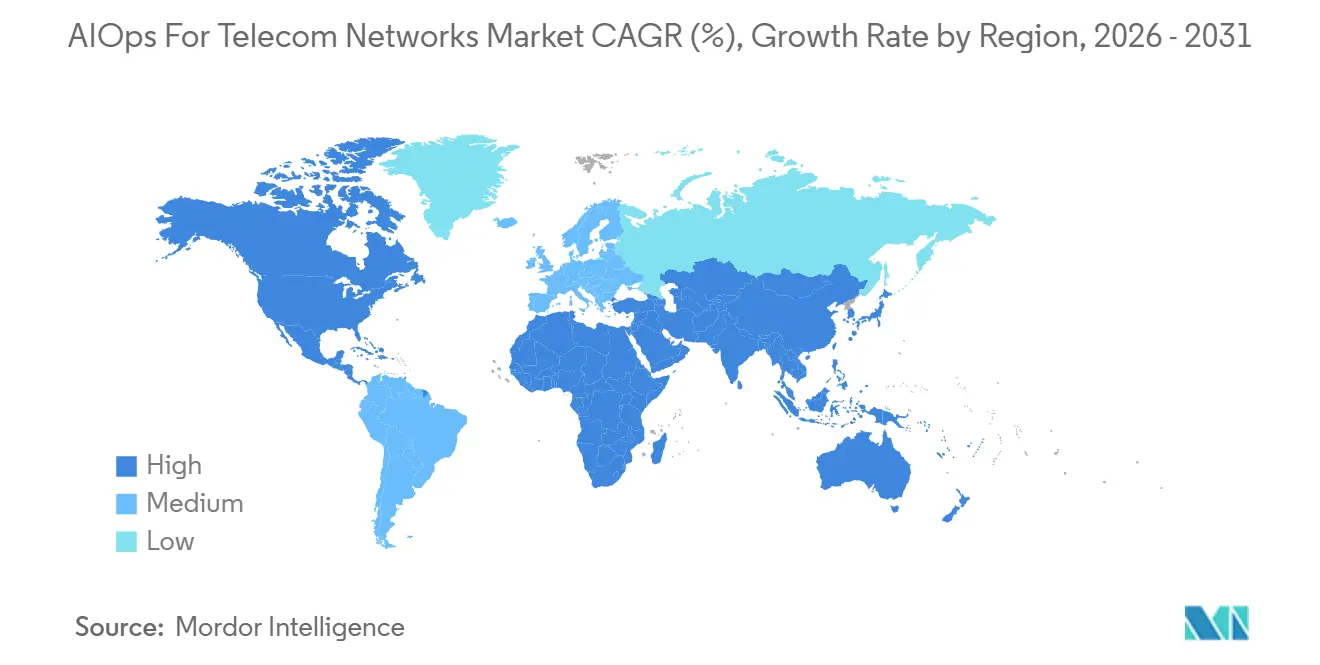
North America held 31.13% revenue share in 2025, giving it the leading position in the AIOps for telecom networks market. Major United States operators have invested in AI-led network operations alongside wider 5G commercialization programs. The region also has a strong base of cloud AI providers that work with telecom vendors on integrated offerings. These conditions support the development of production-grade automation platforms. Canada is applying AIOps to rural and remote network management. Mexico is using the technology mainly to support automation during LTE-to-5G transitions. South America is led by Brazil, where operators are investing in fault correlation and predictive maintenance for multiband 5G networks. Adoption across South America also reflects the need to manage fiber and subsea infrastructure more efficiently.
Europe remains an important operating environment for the AIOps market in telecom networks. The United Kingdom, Germany, and France are advancing autonomous network programs using TM Forum frameworks. Deutsche Telekom deployed its RAN Guardian Agent in Germany during November 2025 and is expanding related programs to the Czech Republic and Croatia. The European Union AI Act has increased the need for governance, auditability, and documented controls. These requirements may favor established vendors that can show compliance with ETSI and 3GPP standards. Saudi Arabia and the United Arab Emirates are driving adoption in the Middle East through digital transformation programs focused on smart cities and critical connectivity. Africa remains at an earlier stage, with South Africa and Nigeria concentrating on fault management and performance optimization.
Asia-Pacific is projected to expand at a 17.78% CAGR from 2026 to 2031. China, India, South Korea, Japan, Australia, and New Zealand are increasing the use of AIOps for the telecom networks market as 5G networks scale. Huawei launched AUTINOps at MWC 2026 with more than 20 AI agents and reported over 80% risk-identification accuracy and above 90% diagnosis accuracy. Nokia is working with NTT DOCOMO on SMO-driven autonomy through MantaRay SON and AutoPilot trials. India offers high-volume telemetry conditions as standalone 5G coverage expands across a large mobile subscriber base. Australia and New Zealand are smaller but technically advanced markets that favor cloud-native deployments aligned with 3GPP and TM Forum standards.
Competitive Landscape
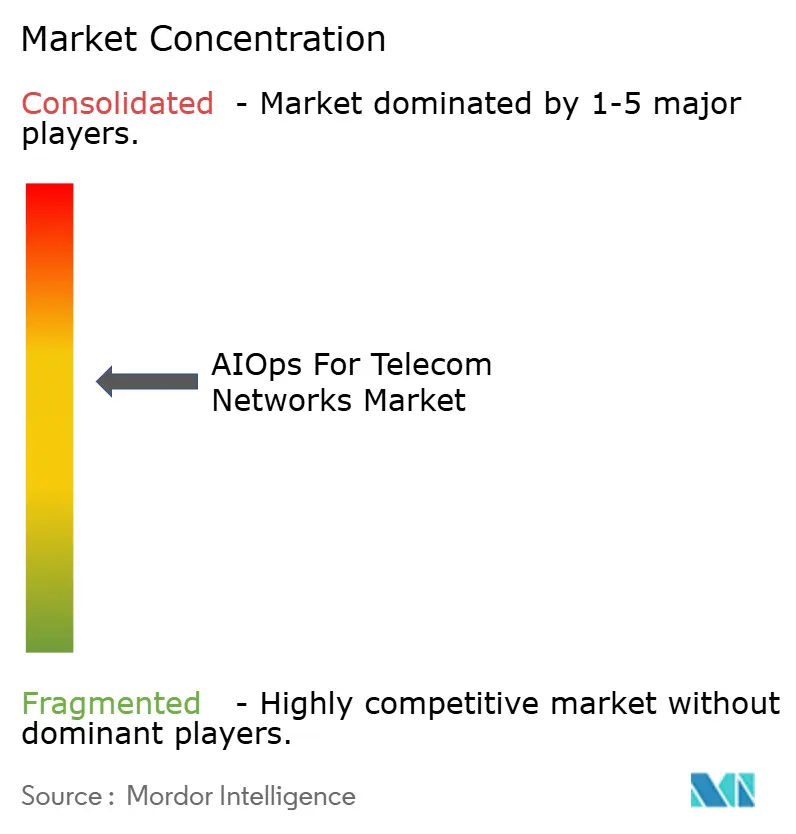
The AIOps for telecom networks market is moderately concentrated among established telecom software vendors and cloud-aligned providers. Nokia, Ericsson, Amdocs, and IBM have important positions because they combine telecom operating knowledge with large customer relationships. Cloud providers also influence competition by supplying model hosting, data platforms, and AI development tools. Suppliers are increasingly forming formal partnerships rather than competing only through standalone products. This strategy combines telecom-specific orchestration with foundation-model capabilities. It also makes supplier switching more difficult once operational data and workflows are embedded in a joint platform. The AIOps for telecom networks market, therefore, rewards vendors that can integrate across network domains and existing operator systems.
Nokia and Google Cloud announced an expanded partnership in June 2026 to develop 6 Gemini-powered agents for Nokia Assurance Center. The agents address event triage, anomaly reasoning, key performance indicator analysis, and remediation recommendations. Nokia said these capabilities could reduce network problem-solving time by 50%-80%. Ericsson introduced OSS and BSS Business Value Pathways in June 2026, using integrated operational programs that combine cross-domain AI with its OSS and BSS portfolio. Amdocs also introduced CES26 at MWC 2026 with AI-native closed loops for network assurance, inventory, and orchestration. These actions show that competition is moving from feature-level software comparisons toward outcome-led operating programs. Intellectual property is also concentrated around closed-loop remediation, digital twins, and multi-agent orchestration methods.
Specialist suppliers, including Radcom, Grokstream, and Infovista, are addressing focused needs in 5G analytics and agentic operations. Their offerings can appeal to mid-tier operators that need shorter deployment cycles and lower minimum commitments. Infovista launched VistAI in January 2026 as an agentic framework for intent-based network decision-making. The framework draws on 30 years of telecom experience and data from more than 1,000 operators. Energy-aware optimization remains a competitive opening because it connects service assurance with cost and sustainability goals. Open-source telecom reasoning models may also reduce the premium attached to proprietary models over time. The AIOps for telecom networks market will remain differentiated by integration depth, data governance, and the ability to produce reliable automated actions.
AIOps For Telecom Networks Industry Leaders
-
International Business Machines Corporation
-
Nokia Corporation
-
Telefonaktiebolaget LM Ericsson
-
Amdocs Limited
-
ServiceNow, Inc.
- *Disclaimer: Major Players sorted in no particular order
Recent Industry Developments
- June 2026: Nokia and Google Cloud announced an expanded partnership at DTW Ignite to integrate Google's Gemini models into Nokia Assurance Center. The program develops 6 specialized AI agents for event triage, anomaly reasoning, key performance indicator analysis, and remediation recommendations. The agentic platform is planned for a SaaS launch on the Google Cloud Marketplace in September 2026, with reported potential to reduce network problem-solving time by 50%- 80%.
- June 2026: Nokia announced upgrades to its autonomous networks portfolio at DTW Ignite. The company released a new Autonomous Networks Agent Library, an updated Autonomous Networks Suite, enhanced RAN automation, and AI-driven frameworks for IP, fixed, and optical networks. Nokia also confirmed collaboration with NTT DOCOMO on SMO-driven autonomy through MantaRay SON and AutoPilot trials.
- June 2026: Indosat Ooredoo Hutchison and Huawei won the TM Forum 2026 Excellence in AI and Data for Business Impact award for the AUTINOps deployment. The deployment delivered an 80% one-hop closure rate for fault handling, a 15% reduction in mean time to repair, and an improvement in network availability from 99.3% to 99.7%.
- March 2026: Amdocs unveiled CES26 at MWC 2026 in Barcelona. The agent-driven BSS, OSS, and network suite uses the aOS Cognitive Core to introduce AI-native closed loops across network assurance, inventory, and orchestration. It targets autonomous, intent-driven network operations for communications service providers.
Global AIOps For Telecom Networks Market Report Scope
The AIOps for telecom networks market revenue is generated through platform licensing and subscriptions, AI/analytics software usage, consulting and system integration, deployment, managed services, maintenance, and support provided to mobile network operators, fixed and broadband operators, integrated communication service providers, and other telecom end users across large enterprises and small and medium-sized enterprises.
The AIOps for telecom networks market report is segmented by offering (platforms and services), deployment model (on-premises and cloud-based), organization size (large enterprises, and small and medium-sized enterprises), application (network performance management, fault and incident management, network security management, customer experience management, infrastructure management, application performance analysis, and other applications), end-user (mobile network operators, fixed and broadband operators, integrated communication service providers, and other end-users), and geography (North America, South America, Europe, Asia-Pacific, Middle East, and Africa). The market forecasts are provided in terms of value (USD).
| Platforms |
| Services |
| On-Premises |
| Cloud-Based |
| Large Enterprises |
| Small and Medium-Sized Enterprises |
| Network Performance Management |
| Fault and Incident Management |
| Network Security Management |
| Customer Experience Management |
| Infrastructure Management |
| Application Performance Analysis |
| Other Applications |
| Mobile Network Operators |
| Fixed and Broadband Operators |
| Integrated Communication Service Providers |
| Other End-Users |
| North America | United States |
| Canada | |
| Mexico | |
| South America | Brazil |
| Argentina | |
| Rest of South America | |
| Europe | United Kingdom |
| Germany | |
| France | |
| Spain | |
| Italy | |
| Rest of Europe | |
| Asia-Pacific | China |
| Japan | |
| India | |
| South Korea | |
| Australia and New Zealand | |
| Rest of Asia-Pacific | |
| Middle East | Saudi Arabia |
| United Arab Emirates | |
| Rest of Middle East | |
| Africa | South Africa |
| Nigeria | |
| Rest of Africa |
| By Offering | Platforms | |
| Services | ||
| By Deployment Model | On-Premises | |
| Cloud-Based | ||
| By Organization Size | Large Enterprises | |
| Small and Medium-Sized Enterprises | ||
| By Application | Network Performance Management | |
| Fault and Incident Management | ||
| Network Security Management | ||
| Customer Experience Management | ||
| Infrastructure Management | ||
| Application Performance Analysis | ||
| Other Applications | ||
| By End-User | Mobile Network Operators | |
| Fixed and Broadband Operators | ||
| Integrated Communication Service Providers | ||
| Other End-Users | ||
| By Geography | North America | United States |
| Canada | ||
| Mexico | ||
| South America | Brazil | |
| Argentina | ||
| Rest of South America | ||
| Europe | United Kingdom | |
| Germany | ||
| France | ||
| Spain | ||
| Italy | ||
| Rest of Europe | ||
| Asia-Pacific | China | |
| Japan | ||
| India | ||
| South Korea | ||
| Australia and New Zealand | ||
| Rest of Asia-Pacific | ||
| Middle East | Saudi Arabia | |
| United Arab Emirates | ||
| Rest of Middle East | ||
| Africa | South Africa | |
| Nigeria | ||
| Rest of Africa | ||
Key Questions Answered in the Report
What is the AIOps for telecom networks market size?
The AIOps for telecom networks market size is USD 5.92 billion in 2026 and is projected to reach USD 12.07 billion by 2031, at a 15.31% CAGR.
What is driving adoption of AIOps in telecom networks?
Standalone 5G, network slicing, larger telemetry volumes, and the need to reduce incident resolution time are key drivers.
Which AIOps offering has the largest share?
Platforms led with 65.72% revenue share in 2025 because operators favor integrated tools for telemetry, AI models, and orchestration.
Which deployment model is expanding fastest?
Cloud-based deployment is projected to expand at a 19.18% CAGR through 2031 as operators need elastic infrastructure for AI inference.
Which end user is leading adoption?
Mobile network operators held 53.76% revenue share in 2025 because they operate highly complex, telemetry-dense environments.
Which region is expanding fastest?
Asia-Pacific is projected to expand at a 17.78% CAGR through 2031, supported by 5G deployment in China, India, South Korea, Japan, Australia, and New Zealand.