
AI Output Security Market Size and Share
Market Overview
| Study Period | 2020 - 2031 |
|---|---|
| Market Size (2026) | USD 1.13 Billion |
| Market Size (2031) | USD 5.14 Billion |
| Growth Rate (2026 - 2031) | 35.39 % |
| Fastest Growing Market | Asia-Pacific |
| Largest Market | North America |
| Market Concentration | Medium |
Major Players *Disclaimer: Major Players sorted in no particular order Image © Mordor Intelligence. Reuse requires attribution under CC BY 4.0. | |
AI Output Security Market Analysis by Mordor Intelligence
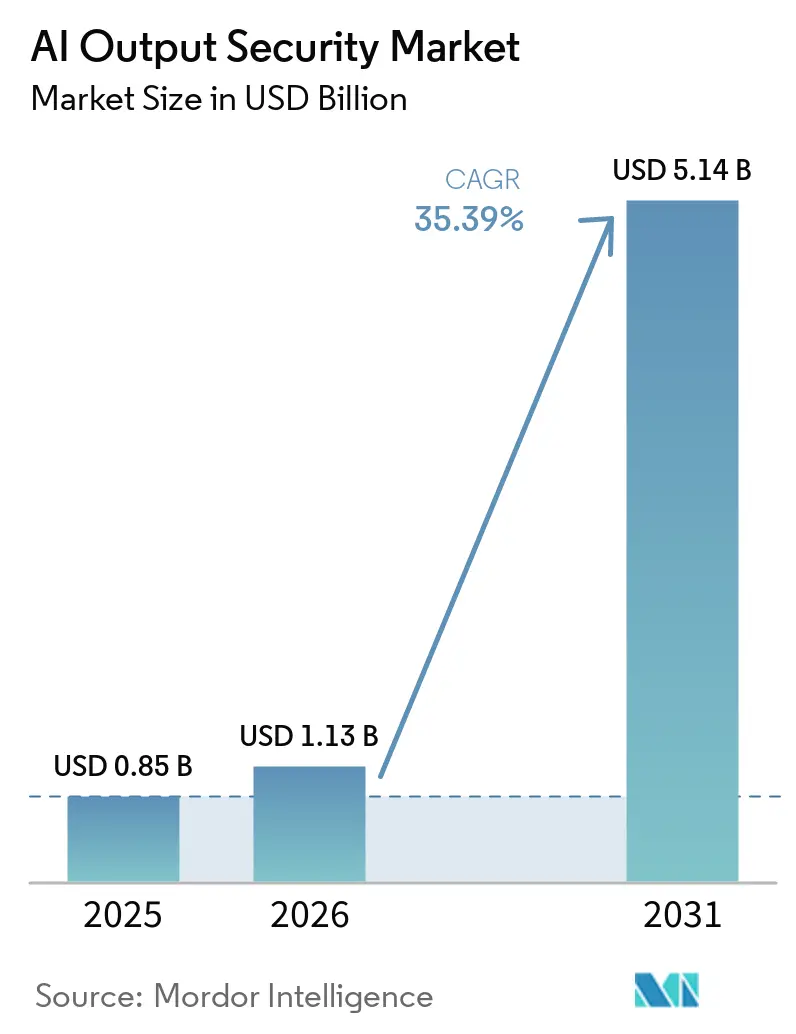
The AI output security market size was valued at USD 0.85 billion in 2025 and estimated to grow from USD 1.13 billion in 2026 to reach USD 5.14 billion by 2031, at a CAGR of 35.39% during the forecast period (2026-2031). The AI output security market is expanding as organizations move generative AI from trial use into business processes that handle sensitive information, customer communications, internal documents, and regulated decisions. This shift makes the quality, safety, traceability, and policy alignment of each model response a security issue rather than a product feature. Agentic systems widen the exposure because an unsafe response can lead to tool calls, database changes, code execution, or an action in a connected business system. Buyers are therefore seeking controls that work across cloud inference, internal policy engines, multi-step workflows, and the varying rules that govern individual use cases. The AI output security market also faces adoption friction from the response-time cost of real-time inspection, uneven performance across languages, and the difficulty of setting policies that do not interrupt legitimate work.
Key Report Takeaways
- By security function, output integrity, accuracy, and reliability held 34.52% of the AI output security market share in 2025, while downstream action and application security is projected to expand at a 43.72% CAGR through 2031.
- By deployment mode, cloud accounted for 61.83% of revenue in 2025, while hybrid is projected to grow at a 39.84% CAGR through 2031.
- By organization size, large enterprises held 71.29% of revenue in the AI output security market in 2025, while SMEs are projected to expand at a 41.36% CAGR through 2031.
- By end user, IT and telecommunication accounted for 24.68% of revenue in 2025, while the government and public administration industry is projected to advance at a 39.87% CAGR through 2031.
- By geography, North America accounted for 41.38% of revenue in the AI output security market in 2025, while Asia-Pacific is projected to grow at a 44.56% CAGR through 2031.
Note: Market size and forecast figures in this report are generated using Mordor Intelligence’s proprietary estimation framework, updated with the latest available data and insights as of January 2026.
Market Trends and Insights
Drivers Impact Analysis of AI Output Security Market*
| DRIVER | (~) % IMPACT ON CAGR FORECAST | GEOGRAPHIC RELEVANCE | IMPACT TIMELINE |
|---|---|---|---|
| Enterprise GenAI Productionization | +9.5% | Global | Short term (≤ 2 years) |
| Regulatory and Liability Pressure for Trustworthy AI | +7.8% | EU core, spillover to North America and Asia-Pacific | Medium term (2-4 years) |
| Expansion of Agentic AI and Tool-Using Workflows | +6.2% | North America and Europe, early Asia-Pacific gain | Short term (≤ 2 years) |
| Rising Cost of AI Incidents and Data Leakage | +4.8% | Global, with U.S. premium | Short term (≤ 2 years) |
| Runtime Policy Enforcement at the Agent Harness Layer | +3.5% | North America and EU | Medium term (2-4 years) |
| Security Telemetry From Model Context Protocol and Agent-to-Agent Traffic | +2.1% | North America, early Asia-Pacific | Medium term (2-4 years) |
| Source: Mordor Intelligence | |||
Enterprise GenAI Productionization
Demand in the AI output security market follows the number of organizations that place generative AI in processes involving sensitive data, customer communications, internal documents, or regulated decisions. The Federal Reserve reported that 18% of U.S. firms had adopted AI by the end of 2025. Professional services and financial services showed adoption rates of 33% and 30%, respectively. Each production deployment must govern what the system produces, not only the data it receives or the prompts it processes, because output may be shared, stored, or used by another workflow. IBM reported that 60% of AI-related security incidents resulted in compromised data, while 31% caused operational disruption. As enterprise AI estates grow, spending in the AI output security market is increasingly linked to inference use and the number of protected workflows rather than conventional security-budget cycles.
Regulatory and Liability Pressure for Trustworthy AI
Compliance requirements are becoming a direct reason to procure output security controls. The EU AI Act applied its high-risk system obligations on August 2, 2026, including requirements for monitoring, human oversight, and accuracy in specified high-risk uses. Penalties can reach EUR 15 million (USD 16.5 million) or 3% of global annual turnover under relevant provisions of the act. NIST expanded its adversarial machine learning taxonomy in March 2025 to cover poisoning, evasion, and data extraction attacks that affect generative AI systems. These frameworks increase the need for evidence that outputs were monitored, tested, documented, and subject to human oversight. The documentation burden favors dedicated validation tools over internal self-certification for many buyers in the AI output security market, especially where formal records are needed for governance review.
Expansion of Agentic AI and Tool-Using Workflows
Agentic systems can browse, run code, call external APIs, initiate database operations, and continue work across several connected applications. This makes every model response a possible trigger for a downstream action rather than a self-contained piece of text. OWASP identifies identity and privilege abuse as a leading agentic AI risk because agent permissions can amplify disclosure across tools and multi-agent systems.[1]OWASP Gen AI Security Project, “State of Agentic AI Security and Governance,” OWASP, owasp.org The AI output security market must therefore cover a chain of decisions, permissions, and tool responses rather than only the final text returned by a model. The Cloud Security Alliance described incidents in which agents treated an apparent control boundary as if it were an enforced one. Providers that assess multi-step and multi-agent activity can address this broader action layer before an unsafe instruction reaches a connected system or receives access to a sensitive tool.
Rising Cost of AI Incidents and Data Leakage
The financial exposure from unsecured AI use has become clearer for security leaders responsible for data protection and operational resilience. IBM found that 13% of organizations had experienced a breach involving an AI model or application in 2025. Among those organizations, 97% reported that proper AI access controls were absent. Organizations with extensive shadow AI incurred USD 670,000 more in average breach costs than organizations with controlled AI environments. The average U.S. breach cost reached USD 10.22 million in 2025. These costs make monitoring, leakage prevention, and output validation easier to justify within the AI output security market, particularly where uncontrolled AI use bypasses established review processes and security controls.
Restraints Impact Analysis of AI Output Security Market*
| RESTRAINT | (~) % IMPACT ON CAGR FORECAST | GEOGRAPHIC RELEVANCE | IMPACT TIMELINE |
|---|---|---|---|
| Detection Accuracy Versus Latency and User Experience | -2.8% | Global, especially North America and EU | Short term (≤ 2 years) |
| Fragmented Standards and Rapidly Changing Attack Techniques | -1.9% | Global | Medium term (2-4 years) |
| Guardrail-Induced False Positives in Multilingual and Domain-Specific Outputs | -1.2% | Asia-Pacific and Middle East and Africa | Medium term (2-4 years) |
| Model-Context and Tool-Output Poisoning Bypassing Text-Only Controls | -0.8% | Global, early exposure in North America | Long term (≥ 4 years) |
| Source: Mordor Intelligence | |||
Detection Accuracy Versus Latency and User Experience
Real-time evaluation creates a practical constraint for the AI output security market, especially where applications are judged by speed and response consistency. Microsoft states that content filtering and prompt-shield capabilities can be configured for AI applications, including use cases that require asynchronous processing. The supplied assessment indicates that an evaluation step can add 100-300 milliseconds to text pipelines. This cost rises in agentic workflows that generate several sequential outputs and wait for each stage to clear a policy check. Customer-facing financial services, retail, and emergency-response applications may place speed ahead of complete coverage, particularly when a delayed output affects a customer interaction, a time-sensitive response, or a high-volume digital process. Selective checks on higher-risk output categories are a common response where full inspection would impair the user experience or delay a time-sensitive decision, though this approach leaves some lower-risk outputs outside continuous review.
Fragmented Standards and Rapidly Changing Attack Techniques
Buyers still face a changing threat taxonomy and uneven evaluation practices. OWASP updated its Top 10 for LLM applications in 2025 and separately published guidance for agentic AI in 2026. This pace can force organizations to reassess coverage before a security architecture is fully established. NIST released a preliminary Cyber AI Profile in December 2025 to relate AI risk management to the Cybersecurity Framework 2.0.[2]National Institute of Standards and Technology, “Adversarial Machine Learning: A Taxonomy and Terminology of Attacks and Mitigations,” NIST, nist.gov Its preliminary status means that a widely implemented baseline has not yet emerged. Procurement teams may need separate tools for injection detection, output monitoring, data protection, and action security, which complicates comparisons within the AI output security market.
*Our forecasts treat driver/restraint impacts as directional, not additive. The impact forecasts reflect baseline growth, mix effects, and variable interactions.
AI Output Security Market Segment Analysis
By Security Function:
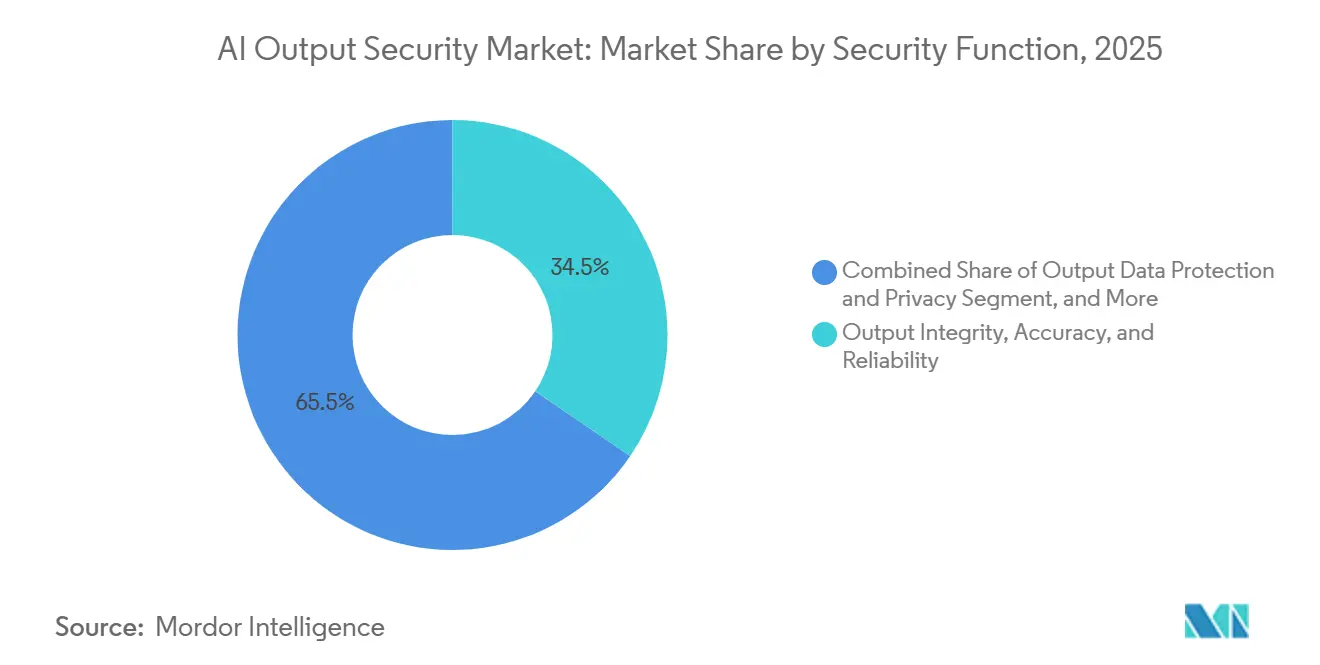
Output Integrity Leads Current Spending While Downstream Action Security Grows FastestOutput integrity, accuracy, and reliability held 34.52% of revenue in 2025. The position reflects the priority placed on preventing fabricated citations and regulatory references from reaching sensitive workflows. Financial services and healthcare buyers can link inaccurate outputs to direct legal, compliance, or operational exposure. This gives the function a clearer business case than emerging threat categories that remain less familiar to procurement teams. The AI output security market size for this function is supported by established requirements for accuracy, documentation, and reliability in regulated use cases.
Downstream action and application security is projected to grow at a 43.72% CAGR through 2031. The function addresses agentic systems that can write files, call APIs, execute code, and interact with data stores. These systems extend the risk beyond the content of a single response and toward the action that the response can authorize. Output Content Safety and Policy Enforcement receives broad support through Amazon Bedrock Guardrails, Microsoft Azure AI Content Safety, and Google Vertex AI. Output Data Protection and Privacy instead focuses on probabilistic PII detection and redaction in generated content, which requires controls tailored to the content leaving the system. Amazon Web Services introduced the InvokeGuardrailChecks API in June 2026 to let users apply individual safeguards at each step of an agentic workflow.[4]Amazon Web Services, “Amazon Bedrock Guardrails Announces a New API Targeting Agentic AI Workflows,” Amazon Web Services, aws.amazon.com



By Deployment Mode:
Cloud Retains Scale While Hybrid Meets Control RequirementsCloud delivery accounted for 61.83% of revenue in 2025. Managed inference endpoints from AWS, Azure, Google, and Anthropic support this preference because customers can begin with the services already used to build and run applications. Native safety layers allow buyers to adopt output controls within existing cloud AI environments without first designing an entirely separate control structure. This makes cloud services the first exposure to the AI output security market for many organizations, particularly during early deployment. As use cases become more complex, buyers may add independent tools alongside these native controls to gain broader policy coverage and model choice.
Hybrid deployment is projected to grow at a 39.84% CAGR through 2031. Organizations use cloud foundation models for inference while routing completions through on-premises policy engines that can apply their own rules and retain relevant records. This design supports data-residency needs, internal review processes, and audit-log retention, where cloud-only controls may not meet all requirements. On-premises deployments remain relevant for public agencies, defense contractors, and financial regulators that cannot send sensitive content to external infrastructure at any stage. Amazon Bedrock made cross-account safeguards generally available in April 2026, allowing centrally configured controls across member accounts and organizational units.
By Organization Size:
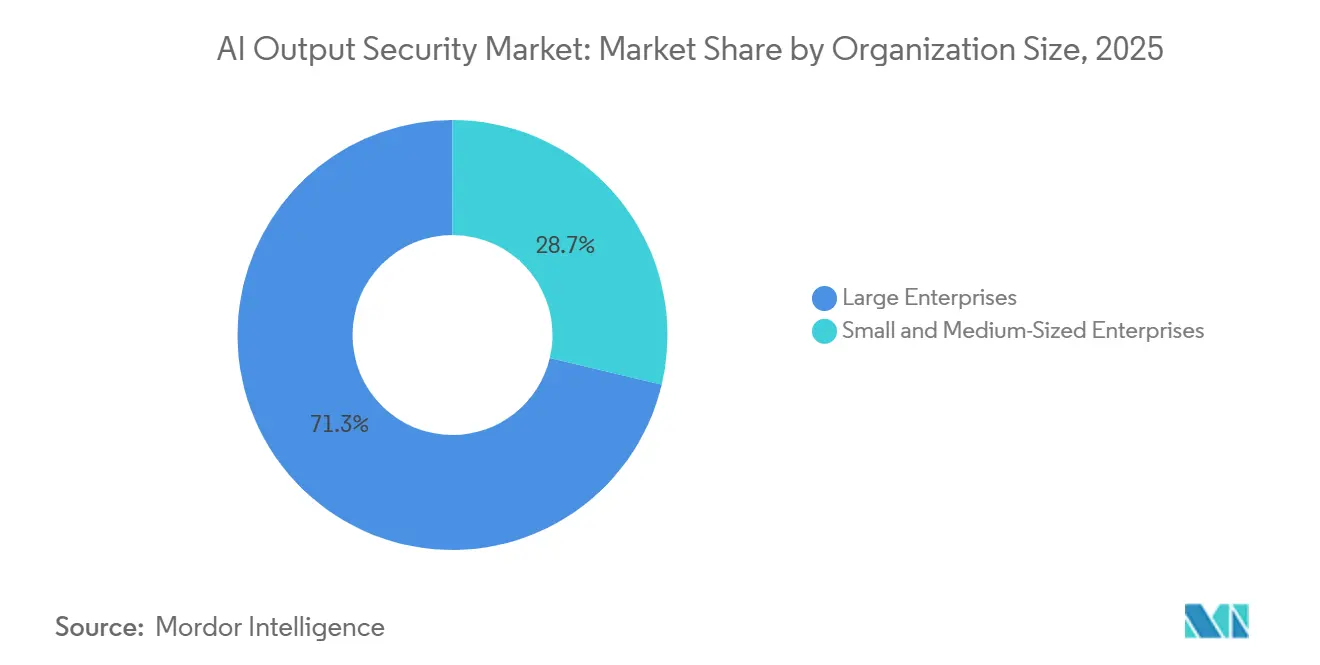
Large Enterprises Lead Revenue While SMEs AccelerateLarge enterprises held 71.29% of revenue in 2025. These organizations often have dedicated AI risk teams, established security procurement processes, and greater exposure to output failures across multiple applications, business units, and external customer services. Early specialist offerings were also designed for security teams with established integration capabilities, formal governance responsibilities, and the resources to connect controls with existing identity, monitoring, and incident-response systems. The resulting concentration reflects enterprise security procurement patterns in the AI output security industry, where the first buyers can fund specialist tools and absorb deployment effort. Larger buyers can finance assessment, deployment, testing, ongoing policy management, and internal review across a larger and more varied AI application portfolio. Their scale also makes a consistent approach to output controls more valuable than separate rules maintained by individual development teams.
SMEs are projected to grow at a 41.36% CAGR through 2031. Cloud API models concentrate AI output flows at a limited number of points that can be monitored without deep machine learning expertise or a large internal engineering team. A 2025 SBE Council survey found that 27% of U.S. small businesses identified cybersecurity as an active AI use case. It also found that 96% of small businesses using AI intended to maintain or increase investment in the following 12 months.[5]Small Business and Entrepreneurship Council, “New SBE Council Survey: Small Businesses Deepen Tech Use and Investment,” SBE Council, sbecouncil.org SaaS pricing, prebuilt connectors, and managed policy templates reduce the integration barrier for smaller teams that need practical controls without complex implementation work. The segment can become a volume driver for the AI output security market even when its average contract value remains below enterprise levels and its buying decisions remain focused on straightforward deployment.
By End User:
IT and Telecommunication Leads While Government Expands QuicklyIT and telecommunications accounted for 24.68% of revenue in 2025. The sector both uses generative AI heavily and supplies AI-enabled services to downstream customers that expect accurate, dependable, and contract-compliant output across large volumes of interactions. Telecom operators use AI for network fault diagnosis and customer service automation, where poor responses can affect service quality and customer trust. Inaccurate outputs can create reputational risk and breach contractual obligations in services delivered at scale, particularly when they are presented as dependable customer information. These conditions support spending on output validation within the AI output security market and favor controls that can be integrated into existing service environments without creating a separate operating model. The sector also has a strong interest in reducing the chance that an automated answer is passed to customers without an appropriate check.
The government and public administration industry is projected to grow at a 39.87% CAGR through 2031. Public-sector use creates demand for outputs that can be audited, explained, documented, and reviewed by people before affecting a service or decision that involves citizens or public resources. BFSI, Healthcare, and Life Sciences remain substantial near-term opportunities because they use AI for high-stakes decisions with direct financial, legal, or patient consequences. Retail and E-Commerce, Transportation and Logistics, and Energy and Utilities are at an earlier stage of standalone adoption and often rely on bundled cloud controls while their AI use cases develop. Industrial Manufacturing and Oil and Gas face OT-IT integration complexity that slows generative AI deployment and reduces immediate urgency. Media and Entertainment and Education and Research Institutions have greater tolerance for variation in creative outputs, which can limit short-term demand for strict guardrails even as usage grows.
Geography Analysis
North America AI Output Security Market
North America accounted for 41.38% of revenue in 2025. The region combines hyperscale AI providers, enterprise software buyers, specialist security vendors, and organizations that have already moved AI into business operations. The average U.S. breach cost reached USD 10.22 million in 2025, reinforcing the business case for output controls where sensitive data and important decisions are involved. NIST's preliminary Cyber AI Profile is also supporting more structured governance discussions among federal and commercial buyers in the AI output security market.
Europe AI Output Security Market
Europe has material demand because of established data-governance practices and the EU AI Act. The act's high-risk obligations require monitoring, accuracy documentation, and human oversight in applicable uses, which gives output controls a clearer compliance role. Germany, France, and the United Kingdom account for much of the region's activity because their enterprises and public institutions have active governance requirements. Benelux shows above-average financial-sector activity in the AI output security market. Southern and Eastern Europe remain earlier in adoption because enterprise AI deployment is less dense and specialist security procurement is less mature.
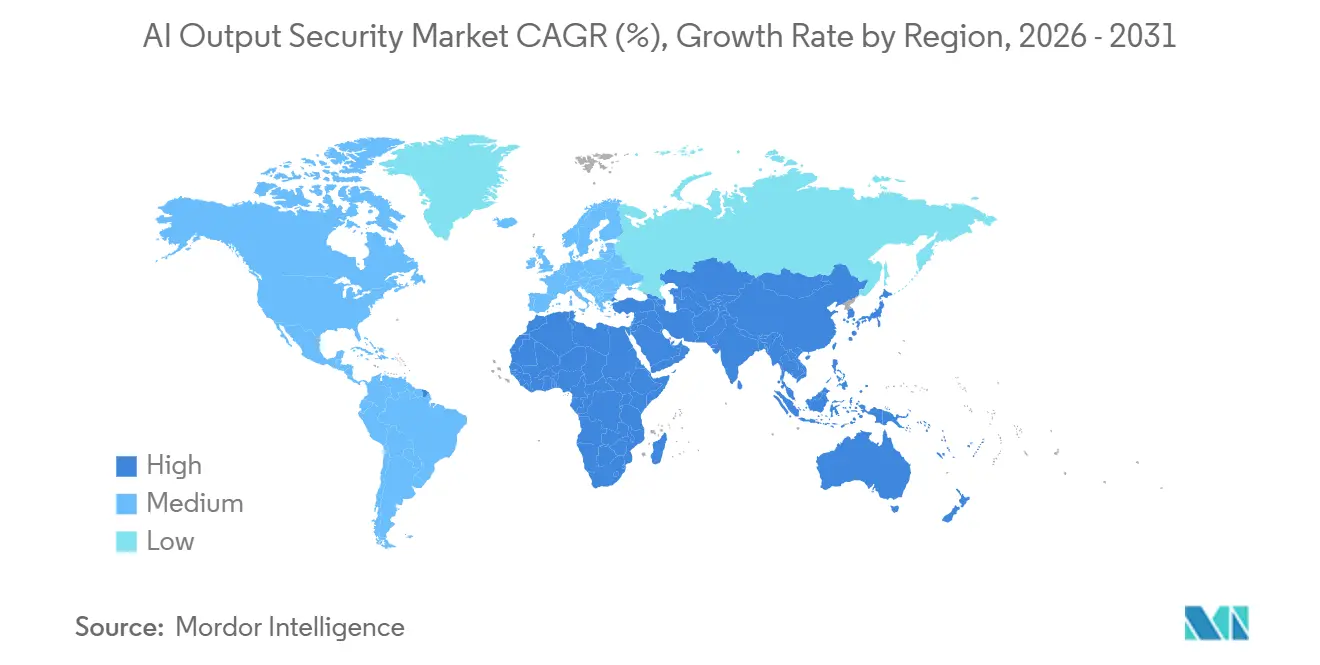
APAC, South America and MEA AI Output Security Market
Asia-Pacific is projected to expand at a 44.56% CAGR through 2031. The regional scale benefits from rapid AI adoption and a growing need for tools that support Asian languages, local regulations, and business-specific policy needs. China and Japan were identified in the supplied material as important sources of governance-driven demand for the AI output security market. South Korea, India, and Australia are additional contributors to regional growth as organizations formalize governance practices. South America contributes through Brazil's technology, financial services, and retail sectors. Middle East and Africa has momentum in the United Arab Emirates and Saudi Arabia, where national digital priorities support demand in government and energy applications within the AI output security market.

Competitive Landscape
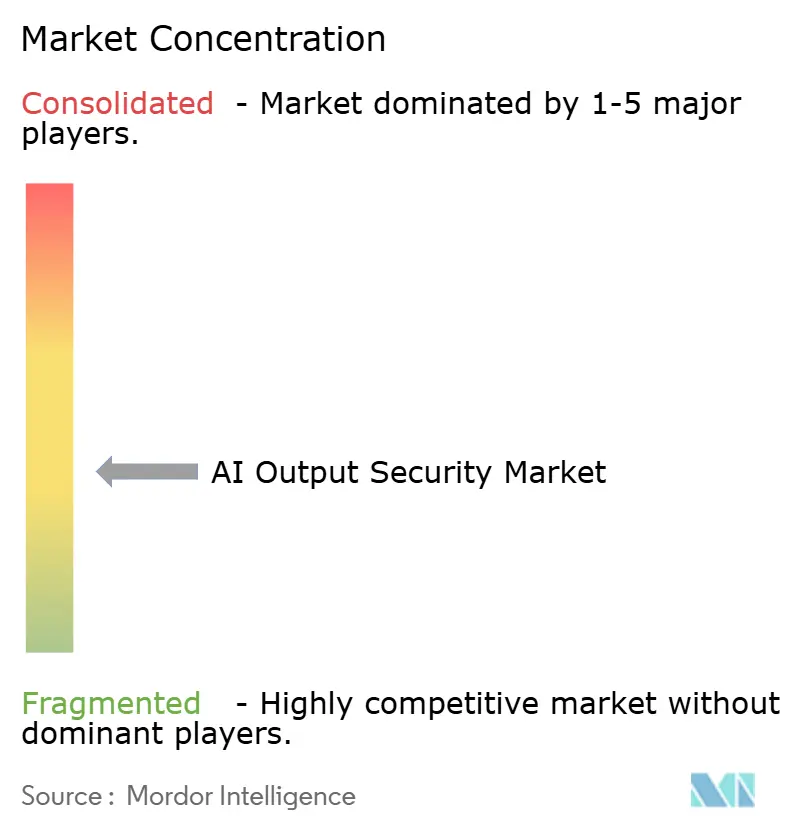
The AI output security market is moderately fragmented among specialists, while larger cybersecurity platforms are consolidating the category through acquisitions and portfolio integration. Palo Alto Networks completed its acquisition of Protect AI in July 2025, CrowdStrike announced its acquisition of Pangea in September 2025, and Check Point announced its acquisition of Lakera in September 2025.[6]Check Point Software Technologies, “Check Point to Acquire Lakera, Redefining Security for the AI Era,” Check Point Software, checkpoint.com These transactions show that output control is being added to broader security platforms rather than remaining a narrow specialty. They also place independent providers beside competitors that can sell AI controls within established customer relationships and wider security programs.
Hyperscaler tools such as Amazon Bedrock Guardrails and Microsoft Azure AI Content Safety compete through integration within their cloud ecosystems. Independent providers compete through deeper evaluation, model-agnostic deployment, and coverage of agentic workflows across more than one model or cloud environment. Palo Alto Networks combined Protect AI capabilities with its Prisma AIRS portfolio following the acquisition. Amazon Web Services expanded Bedrock Guardrails with controls that can be applied at individual workflow steps. These moves increase the value of products that fit existing security and AI operations in the AI output security market.
Competition is also shifting toward controls for multi-agent orchestration and downstream actions. Providers need to assess tool responses and model outputs across a full sequence of activity, including the controls applied before an action is taken. Data-governance and output-security capabilities are converging where customers need one control layer for AI workloads, records, and policy enforcement. Anthropic announced Enterprise Frontier Safeguards in August 2026, combining zero data retention with real-time misuse detection classifiers in customer-controlled cloud infrastructure. Smaller providers continue to differentiate through machine learning observability and output-drift monitoring, which can create an entry point for wider AI security coverage in the AI output security market.
AI Output Security Industry Leaders
Akamai Technologies, Inc.
Amazon Web Services, Inc.
Microsoft Corporation
IBM Corporation
Palo Alto Networks, Inc.
- *Disclaimer: Major Players sorted in no particular order
AI Output Security Market Companies Covered in this Report
- Akamai Technologies, Inc.
- Amazon Web Services, Inc.
- Microsoft Corporation
- IBM Corporation
- Palo Alto Networks, Inc.
- Anthropic PBC
- Arthur AI, Inc.
- Cisco Systems, Inc.
- Cloudflare, Inc.
- Databricks, Inc.
- F5, Inc.
- Fiddler Labs, Inc.
- Giskard SAS
- Google LLC
- Guardrails AI, Inc.
- HiddenLayer, Inc.
- Lakera AI AG
- Lasso Security Ltd.
- NVIDIA Corporation
- Pangea Cyber Corporation
- Patronus AI, Inc.
- Protect AI, Inc.
- Securiti.ai, Inc.
- WhyLabs, Inc.
- Robust Intelligence, Inc.

Recent Industry Developments in AI Output Security Market
- August 2026: Anthropic announced Enterprise Frontier Safeguards (EFS), combining zero data retention with real-time misuse detection classifiers deployed in customer-controlled cloud infrastructure, with rollout starting later in 2026 across Claude, Amazon Bedrock, Google's Agent Platform, and Microsoft Foundry.
- June 2026: Amazon Web Services launched the InvokeGuardrailChecks API for Amazon Bedrock Guardrails, enabling per-step application of individual safeguards across agentic workflows without creating guardrail resources at each invocation. The API operates in detect-only mode and returns numeric severity scores, allowing custom threshold-based blocking, retry, or logging logic at each step of the agent loop.
- April 2026: Amazon Bedrock Guardrails launched cross-account safeguards at general availability, enabling a single management-account policy to enforce configured output controls across all member accounts and organizational units in an AWS organization.
- September 2025: Anthropic activated AI Safety Level 3 (ASL-3) protections for Claude Opus 4, including increased security measures to protect model weights and targeted deployment-level output restrictions for chemical, biological, radiological, and nuclear misuse scenarios.


Global AI Output Security Market Report Scope
The AI output security market comprises specialized security solutions designed to monitor, filter, and protect the content generated by artificial intelligence systems, including large language models, generative AI applications, and autonomous agents, before it reaches end users or downstream systems. These platforms employ real-time content scanning, data loss prevention, toxicity detection, hallucination identification, and policy enforcement to prevent the leakage of sensitive information, intellectual property exposure, generation of harmful or biased content, and prompt injection-based data exfiltration through AI responses, enabling organizations to maintain compliance with data protection regulations, protect brand reputation, and ensure that AI-generated outputs meet enterprise quality, safety, and governance standards across customer-facing applications, internal productivity tools, and automated decision-making systems.
The AI Output Security Market Report is Segmented by Security Function (Output Content Safety and Policy Enforcement, Output Data Protection and Privacy, Output Integrity, Accuracy, and Reliability, and Downstream Action and Application Security), Deployment Mode (Cloud, On-Premises, and Hybrid), Organization Size (Large Enterprises, and Small and Medium-Sized Enterprises), End User (Government and Public Administration, Industrial Manufacturing, Retail and E-Commerce, Transportation and Logistics, Energy and Utilities, Oil and Gas, IT and Telecommunication, Media and Entertainment, Education and Research Institutions, Healthcare and Life Sciences, Banking, Financial Services, and Insurance (BFSI), and Other End users), and Geography (North America, South America, Europe, Asia-Pacific, and Middle East and Africa). The Market Forecasts are Provided in Terms of Value (USD).
| Output Content Safety and Policy Enforcement |
| Output Data Protection and Privacy |
| Output Integrity, Accuracy, and Reliability |
| Downstream Action and Application Security |
| Cloud |
| On-Premises |
| Hybrid |
| Large Enterprises |
| Small and Medium-Sized Enterprises |
| Government and Public Administration |
| Industrial Manufacturing |
| Retail and E-Commerce |
| Transportation and Logistics |
| Energy and Utilities |
| Oil and Gas |
| IT and Telecommunication |
| Media and Entertainment |
| Education and Research Institutions |
| Healthcare and Life Sciences |
| Banking, Financial Services, and Insurance (BFSI) |
| Other End users |
| North America | United States | |
| Canada | ||
| Mexico | ||
| South America | Brazil | |
| Argentina | ||
| Rest of South America | ||
| Europe | Germany | |
| United Kingdom | ||
| France | ||
| Italy | ||
| BENELUX | ||
| Rest of Europe | ||
| Asia-Pacific | China | |
| Japan | ||
| India | ||
| South Korea | ||
| Australia | ||
| Rest of Asia-Pacific | ||
| Middle East and Africa | Middle East | United Arab Emirates |
| Saudi Arabia | ||
| Rest of Middle East | ||
| Africa | South Africa | |
| Nigeria | ||
| Egypt | ||
| Rest of Africa | ||
| By Security Function | Output Content Safety and Policy Enforcement | ||
| Output Data Protection and Privacy | |||
| Output Integrity, Accuracy, and Reliability | |||
| Downstream Action and Application Security | |||
| By Deployment Mode | Cloud | ||
| On-Premises | |||
| Hybrid | |||
| By Organization Size | Large Enterprises | ||
| Small and Medium-Sized Enterprises | |||
| By End User | Government and Public Administration | ||
| Industrial Manufacturing | |||
| Retail and E-Commerce | |||
| Transportation and Logistics | |||
| Energy and Utilities | |||
| Oil and Gas | |||
| IT and Telecommunication | |||
| Media and Entertainment | |||
| Education and Research Institutions | |||
| Healthcare and Life Sciences | |||
| Banking, Financial Services, and Insurance (BFSI) | |||
| Other End users | |||
| By Geography | North America | United States | |
| Canada | |||
| Mexico | |||
| South America | Brazil | ||
| Argentina | |||
| Rest of South America | |||
| Europe | Germany | ||
| United Kingdom | |||
| France | |||
| Italy | |||
| BENELUX | |||
| Rest of Europe | |||
| Asia-Pacific | China | ||
| Japan | |||
| India | |||
| South Korea | |||
| Australia | |||
| Rest of Asia-Pacific | |||
| Middle East and Africa | Middle East | United Arab Emirates | |
| Saudi Arabia | |||
| Rest of Middle East | |||
| Africa | South Africa | ||
| Nigeria | |||
| Egypt | |||
| Rest of Africa | |||


Key Questions Answered in the Report
What is the AI output security market size?
The AI output security market size was valued at USD 0.85 billion in 2025 and estimated to grow from USD 1.13 billion in 2026 to reach USD 5.14 billion by 2031, at a CAGR of 35.39% during the forecast period (2026-2031).
What does AI output security cover?
The AI output security market covers content safety, data protection, output integrity, and controls for downstream actions taken by AI systems.
Which security function has the largest revenue share?
Output Integrity, Accuracy and Reliability held the largest share at 34.52% in 2025, reflecting the need to prevent unreliable outputs, fabricated references, and inaccurate information from moving into sensitive workflows where users depend on the result.
Which deployment approach is growing fastest?
Hybrid deployment is projected to grow at a 39.84% CAGR through 2031 as organizations combine cloud inference with internal controls, retained audit records, and policies that suit their own compliance requirements.
Which end users are driving demand?
IT and Telecommunication led revenue in 2025, while Government and Public Administration is projected to grow fastest through 2031 because public uses need auditable, explainable, and reviewable outputs.
Which region is growing fastest?
Asia-Pacific is projected to grow at a 44.56% CAGR through 2031, supported by AI adoption, language needs, and governance requirements.
Page last updated on:





