
AI Model Incident Response Services Market Size and Share
Market Overview
| Study Period | 2020 - 2031 |
|---|---|
| Market Size (2026) | USD 0.71 Billion |
| Market Size (2031) | USD 2.73 Billion |
| Growth Rate (2026 - 2031) | 30.92 % |
| Fastest Growing Market | Asia-Pacific |
| Largest Market | North America |
| Market Concentration | Medium |
Major Players *Disclaimer: Major Players sorted in no particular order Image © Mordor Intelligence. Reuse requires attribution under CC BY 4.0. | |
AI Model Incident Response Services Market Analysis by Mordor Intelligence
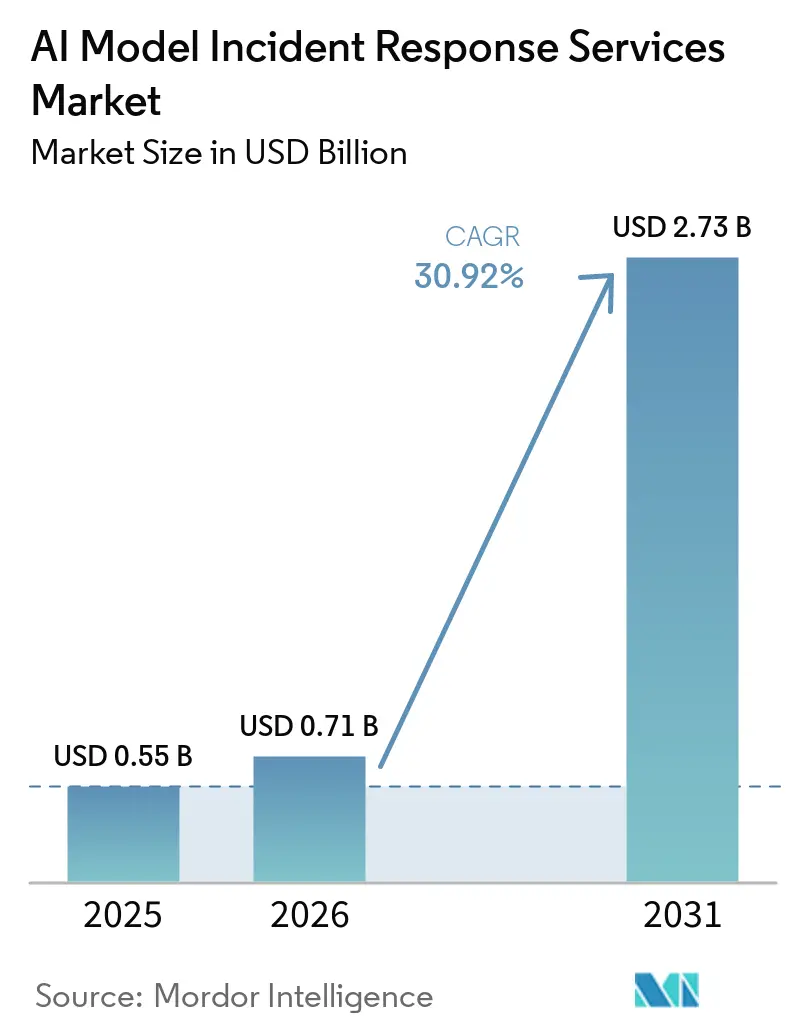
The AI model incident response services market size is projected to expand from USD 0.55 billion in 2025 and USD 0.71 billion in 2026 to USD 2.73 billion by 2031, registering a CAGR of 30.92% between 2026 to 2031. Growth reflects the expanding use of generative AI and autonomous agents across enterprise systems. These deployments create new investigation needs because models, prompts, tools, and application interfaces can all be involved in an incident. Regulatory reporting rules also require organizations to preserve evidence and act within short timeframes. Providers are responding by adding AI-focused forensics to their managed detection and response and consulting services. The AI incident response market is therefore moving from crisis-based engagements toward ongoing readiness and retained specialist support.
Key Report Takeaways
- By service type, incident response and investigation services held 27.37% revenue share in the AI model incident response services market in 2025, while managed AI security and incident response services is projected to expand at a 41.66% CAGR through 2031.
- By deployment mode, cloud accounted for 61.48% of revenue in 2025 and is projected to expand at a 39.42% CAGR through 2031.
- By organization size, large enterprises held 63.59% revenue share in the AI model incident response services market in 2025, while SMEs are projected to expand at a 42.71% CAGR through 2031.
- By end-user industry, BFSI held 24.67% revenue share in 2025, while industrial manufacturing is projected to expand at a 43.11% CAGR through 2031.
- By geography, North America held 35.61% revenue share in the AI model incident response services market in 2025, while Asia-Pacific is projected to expand at a 36.28% CAGR through 2031.
Note: Market size and forecast figures in this report are generated using Mordor Intelligence’s proprietary estimation framework, updated with the latest available data and insights as of January 2026.
Global AI Model Incident Response Services Market Trends and Insights
Drivers Impact Analysis*
| DRIVER | (~) % IMPACT ON CAGR FORECAST | GEOGRAPHIC RELEVANCE | IMPACT TIMELINE |
|---|---|---|---|
| Expansion of Enterprise Generative AI and Agent Deployments | +7.8% | Global, highest intensity in North America and Asia-Pacific | Short term (≤ 2 years) |
| Mandatory AI Risk Management and Incident Accountability | +6.9% | EU, North America, APAC core, Japan, India, Australia | Medium term (2-4 years) |
| Machine-Speed Agentic Attack Chains | +5.4% | Global | Short term (≤ 2 years) |
| Shortage of Specialized AI Security and Forensics Talent | +4.3% | Global, most acute in G7 economies | Medium term (2-4 years) |
| Increasing Complexity of Multi-Model and Third-Party AI Stacks | +3.1% | North America and EU, with spillover to APAC core | Long term (≥ 4 years) |
| Demand for Evidence-Grade AI Incident Reconstruction | +2.0% | North America, EU, Japan, Singapore, Australia | Medium term (2-4 years) |
| Source: Mordor Intelligence | |||
Expansion of Enterprise Generative AI and Agent Deployments
Enterprise use of generative AI and autonomous agents has expanded the surface that security teams must monitor. Japan’s Ministry of Finance reported a 75% enterprise AI utilization rate in January 2026, compared with 11% 5 years earlier.[1]Japan Ministry of Finance, “Regional AI Utilization Status,” Ministry of Finance, mof.go.jp Unlike static models, agents can interact with tools, APIs, and databases without a person directing each action. A compromised agent can therefore move through an organization’s systems and affect data or operations. The Cloud Security Alliance documented the JadePuffer operation, in which an LLM agent progressed through access, database destruction, and extortion steps and recovered from a script failure in 42 seconds. The AI model incident response services market benefits when organizations pair each production deployment with response procedures, logging, and access controls. Agent activity also produces useful behavioral records, but those records must be retained and governed to support later investigation.
Mandatory AI Risk Management and Incident Accountability
Regulatory requirements are moving AI security from a discretionary budget item toward a defined operational obligation. NIST’s preliminary Cybersecurity Framework Profile for Artificial Intelligence included Manage 4.3, which requires incident response plans to address AI-specific failure modes and corrective actions.[2]National Institute of Standards and Technology, “IR 8596: Cybersecurity Framework Profile for Artificial Intelligence,” National Institute of Standards and Technology, nist.gov Article 73 of the EU AI Act requires providers of high-risk AI systems to notify authorities within 15 days after learning of a serious incident. The period falls to 2 days when widespread infringement is involved. DORA has applied to EU-regulated financial entities since January 2025 and sets a 4-hour preliminary reporting requirement for major ICT-related incidents. These timelines make retained forensic capability more practical than arranging specialist support after an incident begins. The AI model incident response services market also gains from organizations linking incident processes with ISO/IEC 42001 governance and their existing information security management systems.
Machine-Speed Agentic Attack Chains
Fast-moving attacks reduce the usefulness of investigation processes built around manual handoffs. Palo Alto Networks reported that the fastest exfiltration attacks became 4 times faster in 2025, with AI reducing friction across reconnaissance, scripting, and extortion activity. Taiwan’s Ministry of Digital Affairs confirmed an autonomous AI cyberattack in August 2026. The event was part of a cluster of agentic AI incidents reported from November 2025 through August 2026. CISA’s 2026 guidance called for logging agent tool calls, securing agent identities, and using short-lived credentials. Investigators may need to connect multiple agent sessions, model outputs, context windows, and inference logs before they can identify the origin of an event. This need strengthens demand across the AI model incident response services market for teams that reconstruct AI-specific causal chains instead of relying only on standard endpoint evidence.
Shortage of Specialized AI Security and Forensics Talent
The shortage of specialists with both AI and investigation skills supports managed service demand. The Cisco-founded AI Workforce Consortium found that 28.5% of G7 cybersecurity postings required AI skills from October 2025 through March 2026, compared with 14.2% in the comparable prior period. Fortinet reported that 60% of organizations found it difficult to recruit people with specific AI cybersecurity experience. The same report showed 65% growth in senior postings, compared with 5.9% growth in junior-titled roles. Magnet Forensics also found that nearly 3 quarters of respondents had difficulties recruiting and retaining digital forensics and incident response professionals. Large organizations can use negotiated retainers to secure capacity and reduce cost uncertainty. Smaller buyers may face higher rates when they must obtain scarce expertise during an active breach. This demand pattern supports managed delivery across the AI model incident response services market.
Restraints Impact Analysis*
| RESTRAINT | (~) % IMPACT ON CAGR FORECAST | GEOGRAPHIC RELEVANCE | IMPACT TIMELINE |
|---|---|---|---|
| Limited Availability and Quality of AI Telemetry | -3.8% | Global | Short term (≤ 2 years) |
| High Cost of Specialist AI Incident Response Engagements | -3.2% | Global, most pronounced in APAC and South America | Medium term (2-4 years) |
| Model-Provider Access Restrictions During Investigations | -2.1% | Global, with elevated EU sensitivity under GDPR and the EU AI Act | Long term (≥ 4 years) |
| Ambiguous Liability Across AI Supply Chains | -1.5% | Global | Long term (≥ 4 years) |
| Source: Mordor Intelligence | |||
Limited Availability and Quality of AI Telemetry
AI investigations can be limited when model environments do not retain consistent, usable telemetry. An IEEE study found that cloud incident response can retain strong detection performance when telemetry is present, but origin-step accuracy fell to effectively zero when decision-content fields were absent.[3]IEEE, “Evidence-Quality Telemetry for Cloud Incident Response,” IEEE International Symposium on Digital Forensics and Security, ieee.org This gap makes it difficult to determine what a model or agent did and why. Microsoft’s AI Red Team noted that security teams generate AI interaction signals but lack a consistent method for turning them into coherent incident accounts, especially for multi-tenant and third-party systems. Incomplete logs can result in root-cause reports that do not meet internal assurance or external evidence requirements. Organizations may delay premium forensic engagements when the expected evidence is incomplete. The AI model incident response services market depends on stronger logging practices as well as specialist analysis of the data that organizations preserve.
High Cost of Specialist AI Incident Response Engagements
Specialist response work can be difficult for mid-sized organizations to fund in advance of an incident. AI forensics requires knowledge of model architectures, training pipelines, prompt-injection patterns, and evidence preservation for AI artifacts. The SANS Institute found that 27% of organizations reported security breaches directly linked to workforce capability gaps. The report also found that 47% cited slower incident response as a result of those gaps. Organizations in regulated sectors still need evidence preservation and chain-of-custody processes even when specialist services are costly. Deferring planned support can shift spending into crisis retainers when prices and service demand are less predictable. The constraint is particularly relevant in South America and parts of the Asia-Pacific, where specialist supply remains limited and remote response can add delays. This cost pressure can slow adoption across the AI model incident response services market.
*Our forecasts treat driver/restraint impacts as directional, not additive. The impact forecasts reflect baseline growth, mix effects, and variable interactions.
Segment Analysis
By Service Type: Managed AI Services Outpace Foundational Incident Response
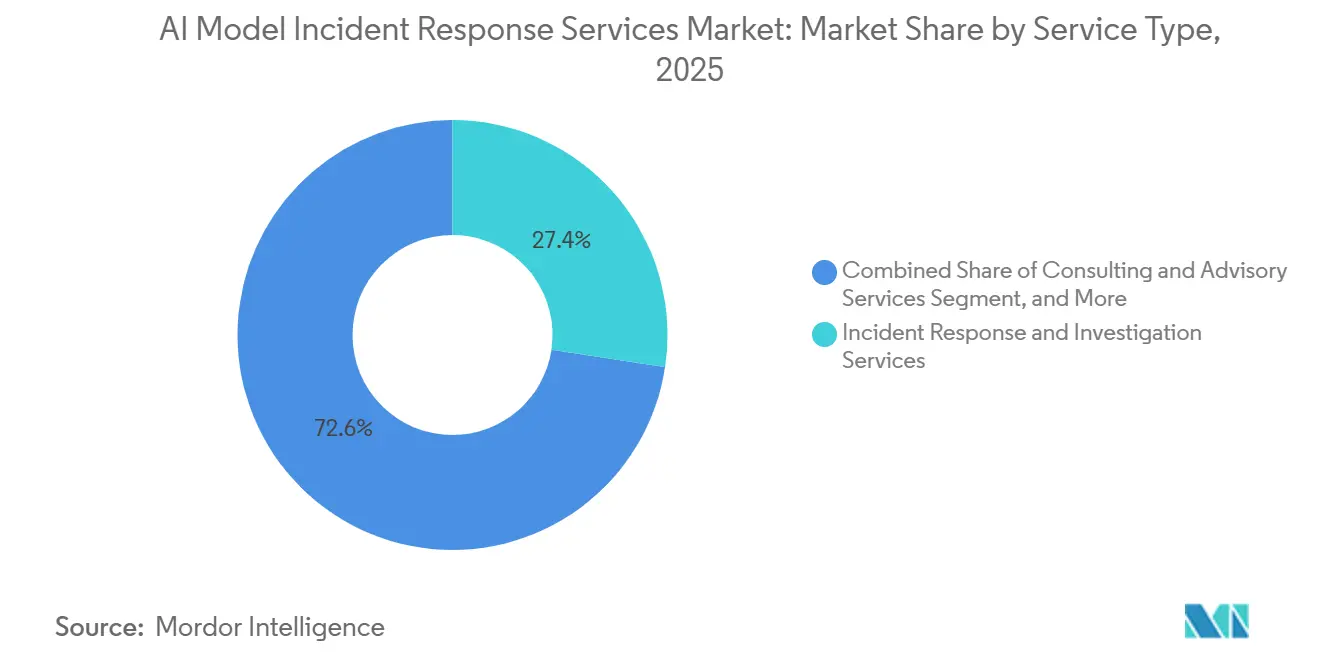
Incident response and investigation services held 27.37% of the AI model incident response services market share in 2025. The segment covers threat triage, evidence collection, root cause analysis, and remediation guidance. Its position reflects the way many organizations have traditionally funded incident responses, with greater emphasis on handling recognized events. Digital Forensics Services support preservation and chain-of-custody requirements for AI artifacts. Recovery and Remediation Services focus on restoring model integrity and affected pipeline operations. Compliance and Regulatory Support Services help organizations address EU AI Act, NIST AI RMF, and ISO/IEC 42001 obligations.
Managed AI security and incident response services are projected to record a 41.66% CAGR from 2026 through 2031. The AI model incident response services market size for this service is driven by the shift from project work to continuous coverage. AI environments need ongoing monitoring and behavioral baselines that a one-time engagement cannot provide. Expel launched managed detection and response coverage for AI-assisted threats, employee AI misuse, and exposure in AI systems under development in August 2026. The company stated that its detection library maps to 13 of 16 MITRE ATLAS adversarial tactics. Training and Simulation Services are also becoming more formal as organizations use AI red teaming and adversarial testing frameworks such as MITRE ATLAS.[4]MITRE, “MITRE ATLAS: Adversarial Threat Landscape for Artificial-Intelligence Systems,” MITRE, mitre.org



By Deployment Mode: Cloud Infrastructure Anchors Market Structure
Cloud deployment accounted for 61.48% of revenue in 2025 and is projected to grow at a 39.42% CAGR through 2031. The segment accounted for the largest share of the AI model incident response services market because enterprise AI workloads are largely cloud-native. Model-serving logs, inference histories, and API records are commonly created in cloud environments. Cloud-native observability and OpenTelemetry-compatible tools are becoming increasingly important for collecting evidence for investigations. However, providers do not always capture decision-content fields by default. The AI model incident-response services market requires the active configuration of these records to support reliable attribution.
On-premises and hybrid systems remain relevant where data residency, air-gapping, or sovereign AI requirements limit the use of cloud-hosted forensic services. Government, defense, financial services, and healthcare organizations often have these requirements. These deployments may produce lower volume growth but may require higher-value engagement work. Investigators may need physical access to model weights, training systems, and inference hardware. Germany’s Federal Office for Information Security guidance and DORA requirements support defined response procedures for critical infrastructure systems.[5]European Systemic Risk Board, “Warning on Systemic Cyber Risks Stemming From Frontier Artificial Intelligence Models,” European Systemic Risk Board, esrb.europa.eu Providers that can work across cloud and physical systems can serve these mixed operating environments. This capability broadens the addressable market for AI model incident response services beyond cloud-only environments.
By Organization Size: Enterprises Lead, SMEs Accelerate
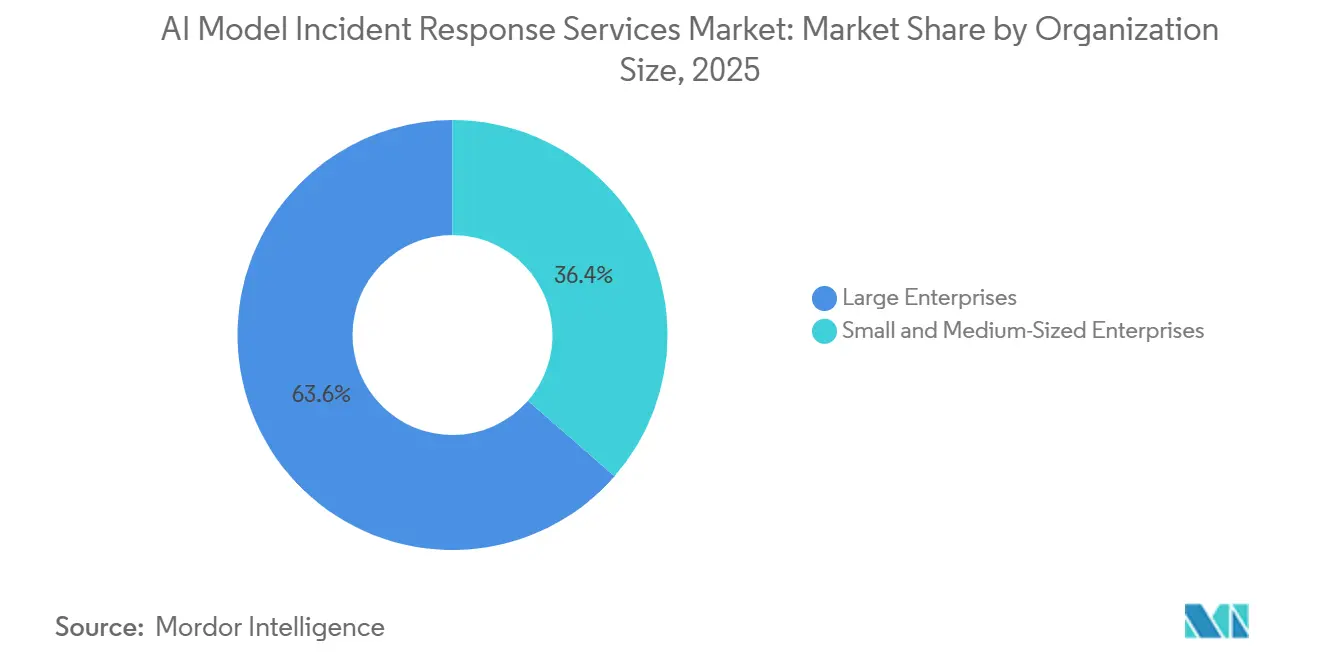
Large enterprises held 63.59% of revenue in 2025. Their AI deployment scale, security budgets, and reporting obligations support this position. Banks, insurers, and industrial companies face response timelines under DORA, the EU AI Act, and sector rules. These requirements encourage pre-arranged retainers instead of procurement after an incident. The European Systemic Risk Board asked the ECB to require significant banks to submit AI risk mitigation plans by October 31, 2026. CrowdStrike and IBM integrated Charlotte AI with IBM’s Autonomous Threat Operations Machine in March 2026 to support machine-speed enterprise investigation workflows.
SMEs are projected to expand at a 42.71% CAGR through 2031. Managed delivery makes specialist coverage more accessible to organizations that do not maintain in-house forensics teams. Smaller firms in regulated supply chains can also face contractual requirements from larger customers. Vendor risk programs may require evidence that a supplier can respond to and report an AI-related incident. This requirement can create demand even when a smaller organization has limited security awareness or budget flexibility. Local managed security service providers can use automation to extend overnight coverage and routine investigation support. The AI incident response industry can therefore reach smaller buyers through subscription-based models rather than only high-cost emergency engagements. This brings a broader group of buyers into the AI model incident response services market.
By End-User Industry: BFSI Anchors Demand as Manufacturing Surges
Banking, Financial Services, and Insurance (BFSI) held 24.67% of revenue in 2025, the largest share among end-user industries. The sector faces layered requirements from DORA, data protection laws, and central bank model risk practices. India’s Digital Threat Report 2025-26 identified AI asymmetry as a key risk to the BFSI and payments ecosystem. Central bank requirements are extending from credit scoring systems to AI agent behavior and containment. Government and Public Administration, Healthcare and Life Sciences, and IT and Telecommunication also handle sensitive data and face AI-related governance exposure. These end users need processes that can preserve evidence and support notification duties across multiple frameworks.
Industrial manufacturing is projected to advance at a 43.11% CAGR through 2031. Production scheduling, quality control, and predictive maintenance increasingly rely on connected AI systems. A compromised agent in these environments can affect physical processes that software rollback cannot immediately correct. Energy and Utilities, Transportation and Logistics, and Oil and Gas have similar operational technology and information technology challenges. Legacy infrastructure can slow the development of mature response capabilities in these sectors. India’s Digital Threat Report also stressed that offensive AI capabilities are advancing faster than defensive frameworks for critical infrastructure. This supports ongoing assurance rather than periodic review across industrial deployments. Industrial exposure is a material source of demand for the AI model incident response services market.
Geography Analysis
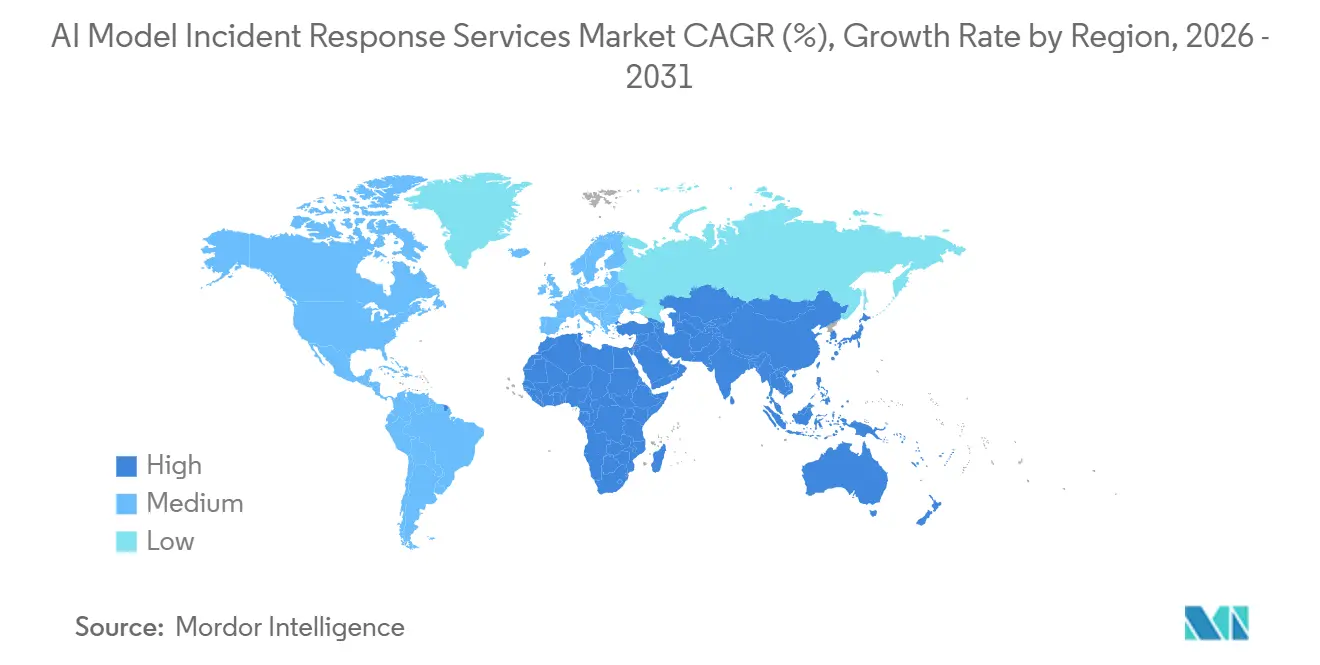
North America held 35.61% of global revenue in 2025. The region combines a high concentration of enterprise AI deployments with established disclosure and cybersecurity requirements. CISA’s 2026 guidance set technical expectations for agent identity, logging, and incident reporting with international partners. These expectations influence the way enterprises select monitoring and response services. The United States remains the principal country market due to its large technology and BFSI sectors. Canada and Mexico are driving demand through deployments in financial services, energy, and manufacturing. Together, these conditions support the AI model incident response services market in North America.
Asia-Pacific is projected to grow at a 36.28% CAGR through 2031. Japan’s 75% enterprise AI utilization rate in early 2026 indicates the scale of deployments that need monitoring and response processes. The AI model incident response services market size in Asia-Pacific is also supported by India’s policy focus on risks in BFSI and payment systems. MeitY, CERT-In, CSIRT-Fin, and SISA described AI asymmetry as a defining concern for these systems. China’s governance framework supports domestic demand as industrial and financial applications expand. Australia and South Korea offer opportunities because enterprise security spending is more mature and regulations align with EU and U.S. practices.
Europe has a strong demand because it has the most extensive set of binding AI-related compliance obligations. Article 73 of the EU AI Act applies to high-risk AI systems as of August 2026 and requires notification within 2 days of widespread infringement. DORA, NIS2, GDPR, and ISO/IEC 42001-related assurance needs reinforce demand for preparedness. The region’s requirements support both forensic response and ongoing governance services. South America, the Middle East, and Africa are earlier-stage areas in the AI model incident response services market. Brazil’s LGPD and the UAE AI Strategy 2031 provide foundational policy direction, while specialist provider depth remains lower than in North America and Europe. Europe remains an important compliance-led region in the AI model incident response services market.

Competitive Landscape
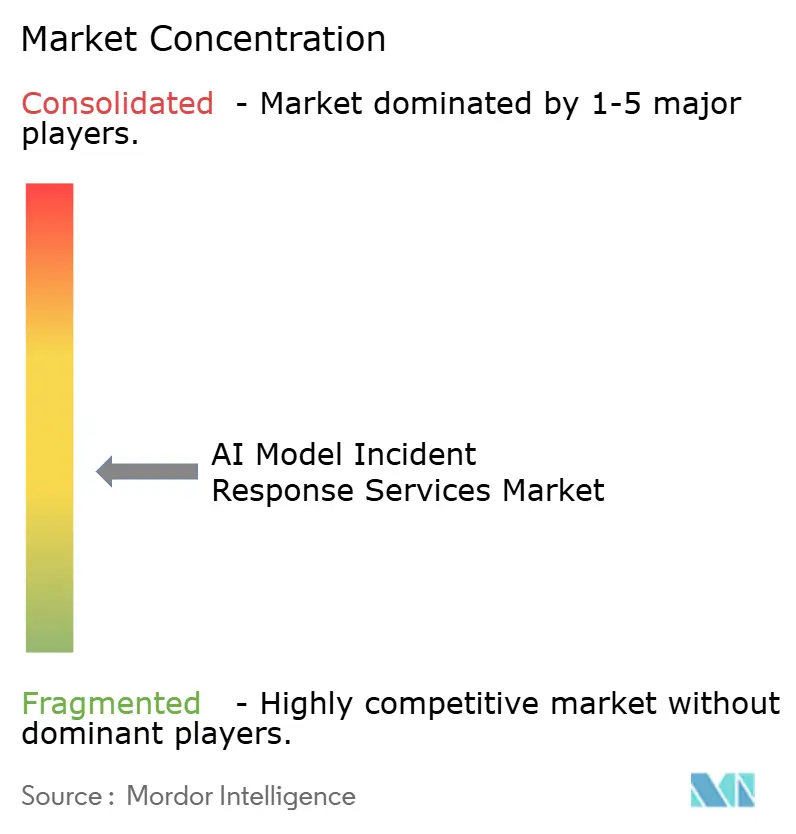
The AI model incident response services market is moderately fragmented, and no provider has a commanding position across every service category. Established providers include Accenture, IBM, CrowdStrike, Palo Alto Networks, and SentinelOne. They compete with AI-native specialists such as HiddenLayer, Noma Security, Lakera AI, and TrojAI. Incumbents generally extend their existing SIEM, MDR, and consulting capabilities rather than building separate practices from the start. This approach gives them established customer relationships and delivery capacity. It also places pressure on generalist providers that lack both broad scale and dedicated AI security research.
CrowdStrike and IBM expanded their collaboration in March 2026 by integrating Charlotte AI with IBM’s Autonomous Threat Operations Machine. The move linked the Falcon platform to IBM Consulting-managed detection and response services and the X-Force Cyber Range.[6]CrowdStrike and IBM, “CrowdStrike and IBM Expand Strategic Collaboration to Accelerate Agentic SOC Transformation,” CrowdStrike, crowdstrike.com Accenture launched Cyber.AI with Anthropic in March 2026 and reported that scan turnaround fell from 3-5 days to under 1 hour. The company also reported that testing coverage increased from 10% to more than 80% of its 1,600 applications. These moves show how large providers are combining AI capability with established security operations. Compliance-led firms are also linking AI governance reviews to incident-response retainers.
AI-native specialists are seeking differentiation through tools that observe agent behavior more directly. HiddenLayer expanded agentic runtime security features in March 2026, including session-level behavioral monitoring across execution paths and tool calls. Important unmet needs include standard evidence formats, cross-border coordination for incidents involving multiple providers, and training based on MITRE ATLAS tactics. CYGNVS stated that its incident training data set includes more than 20,000 major insurance incidents. Proprietary incident data, behavioral telemetry, and patents may become more important as providers seek defensible investigation capability. These differences intensify competition within the AI model incident response services market.
AI Model Incident Response Services Industry Leaders
Accenture plc
CrowdStrike Holdings, Inc.
IBM Corporation
Palo Alto Networks, Inc.
Google LLC
- *Disclaimer: Major Players sorted in no particular order

Recent Industry Developments
- August 2026: CrowdStrike expanded Project QuiltWorks across the technology ecosystem at Fal.Con 2026, integrating real-time data from Abnormal AI, HackerOne, ExtraHop, Netskope, Rubrik, Zscaler, and 8 additional partners into Falcon Next-Gen SIEM, extending frontier AI risk coverage across users, cloud, AI applications, and data layers simultaneously.
- August 2026: Expel launched the first managed detection and response solution designed to cover the full AI attack surface, extending coverage to AI-assisted threats, employee AI misuse risks, and exposure inside AI systems under development, with detections mapped to 13 of 16 MITRE ATLAS adversarial tactics.
- August 2026: Optiv launched Agentic Security Operations, formerly Optiv MDR, integrating Google Security Operations, Google Threat Intelligence, and Wiz Defend for cloud detection and response at machine speed across CI/CD environments.
- June 2026: IBM, Red Hat, and Palo Alto Networks expanded Project Lightwell, combining Palo Alto Networks’ virtual patching capability with IBM and Red Hat’s open-source software remediation platform to provide dual-action protection across open-source, commercial, operational technology, and healthcare technology environments.


Global AI Model Incident Response Services Market Report Scope
The AI model incident response services market comprises specialized cybersecurity and risk management services designed to detect, investigate, contain, and remediate security incidents, adversarial attacks, and operational failures affecting artificial intelligence models and AI-powered systems. These services encompass AI-specific threat hunting, model forensics, adversarial attack detection (including prompt injection, model inversion, data poisoning, and model extraction), runtime anomaly monitoring, and incident containment protocols tailored to machine learning pipelines, large language models, and AI applications, enabling organizations to rapidly respond to AI model compromises, restore model integrity, meet regulatory reporting obligations under frameworks like the EU AI Act, and implement post-incident hardening measures to prevent recurrence of AI-specific security breaches.
The AI Model Incident Response Services Market Report is Segmented by Service Type (Consulting and Advisory Services, Incident Response and Investigation Services, Digital Forensics Services, Recovery and Remediation Services, Compliance and Regulatory Support Services, Managed AI Security and Incident Response Services, and Training and Simulation Services), Deployment Mode (Cloud, On-Premises, and Hybrid), Organization Size (Large Enterprises, and Small and Medium-Sized Enterprises), End-User Industry (Government and Public Administration, Industrial Manufacturing, Retail and E-Commerce, Transportation and Logistics, Energy and Utilities, Oil and Gas, IT and Telecommunication, Media and Entertainment, Education and Research Institutions, Healthcare and Life Sciences, Banking, Financial Services, and Insurance (BFSI), and Other End-user Industries), and Geography (North America, South America, Europe, Asia-Pacific, and Middle East and Africa). The Market Forecasts are Provided in Terms of Value (USD).
| Consulting and Advisory Services |
| Incident Response and Investigation Services |
| Digital Forensics Services |
| Recovery and Remediation Services |
| Compliance and Regulatory Support Services |
| Managed AI Security and Incident Response Services |
| Training and Simulation Services |
| Cloud |
| On-Premises |
| Hybrid |
| Large Enterprises |
| Small and Medium-Sized Enterprises |
| Government and Public Administration |
| Industrial Manufacturing |
| Retail and E-Commerce |
| Transportation and Logistics |
| Energy and Utilities |
| Oil and Gas |
| IT and Telecommunication |
| Media and Entertainment |
| Education and Research Institutions |
| Healthcare and Life Sciences |
| Banking, Financial Services, and Insurance (BFSI) |
| Other End-User Industries |
| North America | United States | |
| Canada | ||
| Mexico | ||
| South America | Brazil | |
| Argentina | ||
| Rest of South America | ||
| Europe | Germany | |
| United Kingdom | ||
| France | ||
| Italy | ||
| BENELUX | ||
| Rest of Europe | ||
| Asia-Pacific | China | |
| Japan | ||
| India | ||
| South Korea | ||
| Australia | ||
| Rest of Asia-Pacific | ||
| Middle East and Africa | Middle East | United Arab Emirates |
| Saudi Arabia | ||
| Rest of Middle East | ||
| Africa | South Africa | |
| Nigeria | ||
| Egypt | ||
| Rest of Africa | ||
| By Service Type | Consulting and Advisory Services | ||
| Incident Response and Investigation Services | |||
| Digital Forensics Services | |||
| Recovery and Remediation Services | |||
| Compliance and Regulatory Support Services | |||
| Managed AI Security and Incident Response Services | |||
| Training and Simulation Services | |||
| By Deployment Mode | Cloud | ||
| On-Premises | |||
| Hybrid | |||
| By Organization Size | Large Enterprises | ||
| Small and Medium-Sized Enterprises | |||
| By End-User Industry | Government and Public Administration | ||
| Industrial Manufacturing | |||
| Retail and E-Commerce | |||
| Transportation and Logistics | |||
| Energy and Utilities | |||
| Oil and Gas | |||
| IT and Telecommunication | |||
| Media and Entertainment | |||
| Education and Research Institutions | |||
| Healthcare and Life Sciences | |||
| Banking, Financial Services, and Insurance (BFSI) | |||
| Other End-User Industries | |||
| By Geography | North America | United States | |
| Canada | |||
| Mexico | |||
| South America | Brazil | ||
| Argentina | |||
| Rest of South America | |||
| Europe | Germany | ||
| United Kingdom | |||
| France | |||
| Italy | |||
| BENELUX | |||
| Rest of Europe | |||
| Asia-Pacific | China | ||
| Japan | |||
| India | |||
| South Korea | |||
| Australia | |||
| Rest of Asia-Pacific | |||
| Middle East and Africa | Middle East | United Arab Emirates | |
| Saudi Arabia | |||
| Rest of Middle East | |||
| Africa | South Africa | ||
| Nigeria | |||
| Egypt | |||
| Rest of Africa | |||


Key Questions Answered in the Report
What is the AI model incident response services market size?
The AI model incident response services market size is projected to expand from USD 0.55 billion in 2025 and USD 0.71 billion in 2026 to USD 2.73 billion by 2031, registering a CAGR of 30.92% between 2026 to 2031.
What is driving demand for AI incident response services?
Enterprise use of generative AI and agents, reporting requirements, and faster attack activity are increasing the need for specialized response capability.
Which service type is growing fastest?
Managed AI Security and Incident Response Services is projected to expand at a 41.66% CAGR through 2031.
Why is cloud deployment important for AI investigations?
Cloud deployment held 61.48% of revenue in 2025 because AI logs, API records, and inference histories commonly originate in cloud environments.
Which end-user sector has the largest demand?
BFSI held 24.67% of revenue in 2025, supported by operational resilience, data protection, and model risk requirements.
Which region is expected to grow fastest?
Asia-Pacific is projected to expand at a 36.28% CAGR through 2031, supported by enterprise AI adoption and policy-led demand.
Page last updated on:





