
Agrochemical Tank Market Size and Share
Market Overview
| Study Period | 2022 - 2032 |
|---|---|
| Market Size (2027) | USD 1.77 Billion |
| Market Size (2032) | USD 2.22 Billion |
| Growth Rate (2027 - 2032) | 4.63 % |
| Fastest Growing Market | Asia Pacific |
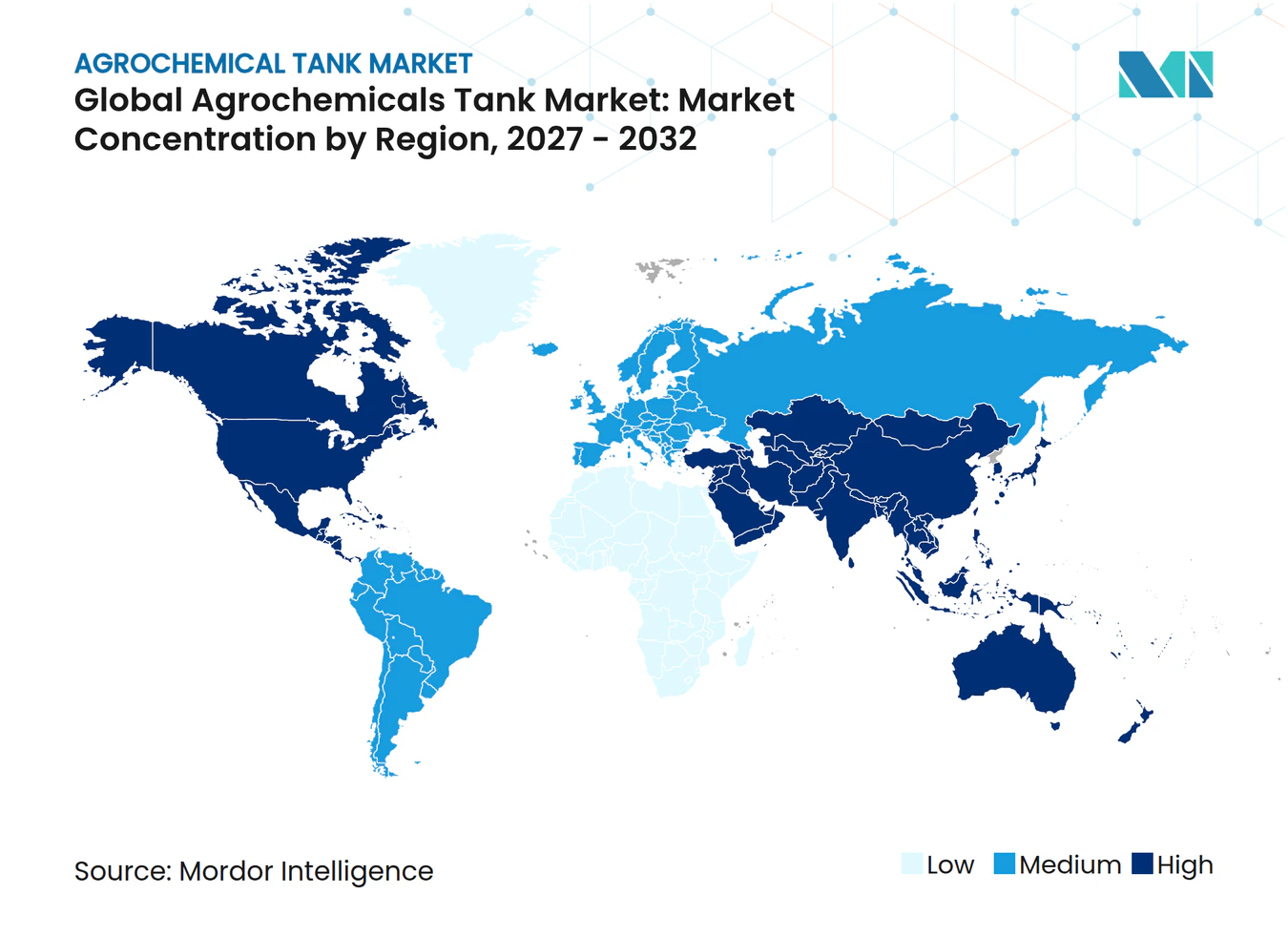
| Largest Market | North America |
| Market Concentration | Low |
Major Players *Disclaimer: Major Players sorted in no particular order Image © Mordor Intelligence. Reuse requires attribution under CC BY 4.0. | |
Agrochemical Tank Market Analysis by Mordor Intelligence
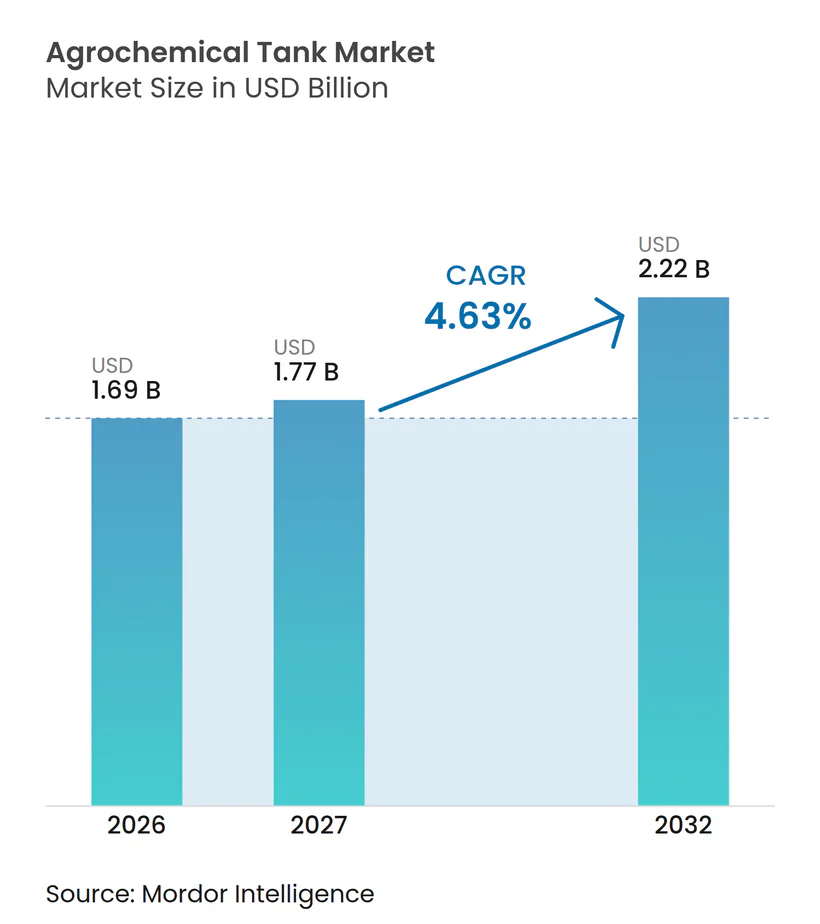
The agrochemical tank market size is projected to increase from USD 1.69 billion in 2026 to USD 1.77 billion in 2027 and reach USD 2.22 billion by 2032, growing at a CAGR of 4.63% from 2027 to 2032. The market is expanding due to increased agricultural activities and the rising demand for efficient chemical storage solutions in farming operations. These tanks are essential components in modern agriculture, specifically designed to store and handle pesticides, fertilizers, and crop protection chemicals. The market growth stems from agricultural mechanization and precision farming adoption across developed and developing regions. Manufacturers produce tanks using advanced materials that provide chemical resistance, UV protection, and durability for the safe storage of agricultural chemicals.
Polyethylene remains the primary material for agrochemical tanks, offering cost-effectiveness, chemical resistance, and easy maintenance. The market is transitioning toward specialized materials and composite solutions that deliver enhanced performance and extended service life. Technological advancements in tank design include safety features, monitoring systems, and integration with smart farming solutions. These innovations enable farmers to maintain chemical concentrations and meet environmental regulations while ensuring efficient storage and handling.
Government initiatives are driving market expansion through increased farmer adoption. In March 2023, the United States Department of Agriculture (USDA) allocated USD 29 million in grants to support independent businesses in increasing domestic fertilizer production. These grants aim to enhance competition, provide United States farmers with more options, and establish competitive pricing. This development is projected to increase the demand for fertilizer storage tanks across the country.
Note: Market numbers in this report are based on Mordor Intelligence's proprietary estimation framework, which combines nine months of actuals with Q4 projections for base year 2026.
Market Trends and Insights
Expansion of Fertilizer Storage Segment
Grains and oilseeds remain the most widely produced commodities, with fertilizers essential to their production. The demand for fertilizers primarily stems from industrial agriculture commodities, specifically in corn, wheat, and soybean cultivation. Both developed, and developing countries increasingly use fertilizer tanks to support extensive fertilizer application in key crops. According to the United States Department of Agriculture, corn production reached 389.7 million metric tons in 2023, an increase from the previous year. This growth in corn production increases the need for efficient fertilizer storage solutions.
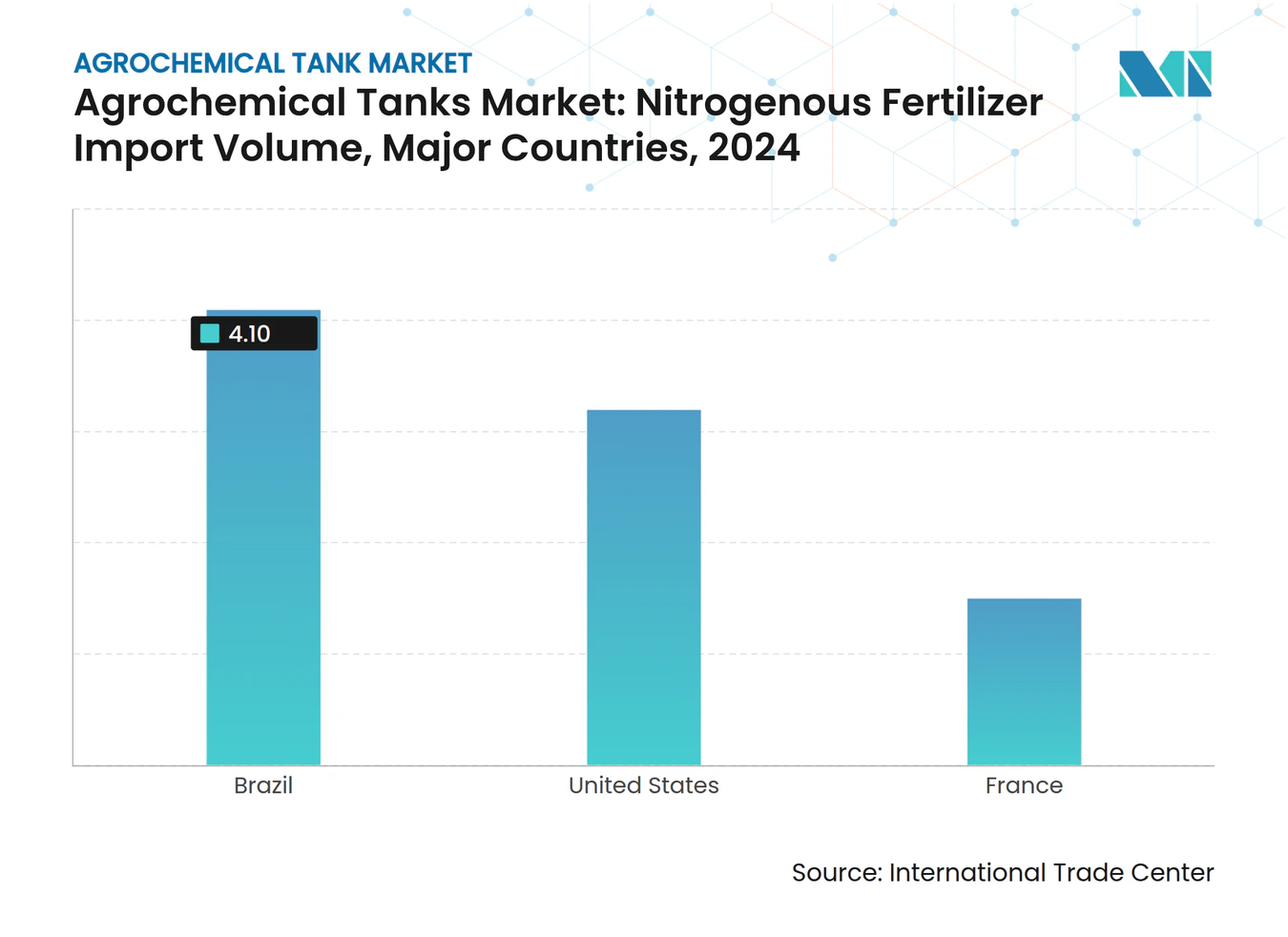
Major crop-producing nations have recorded significant increases in nitrogenous fertilizer imports, with Brazil importing 4.1 million metric tons, the United States importing 3.2 million metric tons, and France importing 1.5 million metric tons, as per statistics from the International Trade Center. This increase in fertilizer imports necessitates robust storage solutions to manage market price fluctuations and reduce supply chain risks. Fertilizer tanks are essential in addressing these challenges, allowing farmers to store large quantities of fertilizers to protect against price volatility, maintain consistent fertilizer availability, and minimize supply chain disruptions. As agricultural sectors expand in these countries, the need for efficient and reliable fertilizer storage systems continues to grow, reinforcing the importance of fertilizer tanks in maintaining agricultural productivity and stability.


Asia-Pacific Region is Fastest Growing Market
The Asia-Pacific region demonstrates a strong demand for agrochemical tanks, driven by agricultural expansion and modern farming practices. Countries like China and India, with large agricultural sectors, require storage solutions for pesticides, herbicides, and fertilizers to support crop protection and yield enhancement. The Fertilizer Association of India reports that the country's total nutrient consumption (N+P2O5+K2O) reached 30.64 million metric tons in 2023, increasing 2.7% from 2022. This growth has intensified the demand for fertilizer storage tanks across the country. China, as the world's largest pesticide producer and consumer, has recorded significant growth in agrochemical tank installations. The Ministry of Agriculture and Rural Affairs continues to implement scientific fertilization and efficiency enhancement through integrated advanced fertilization processes, combining technology, products, machinery, and tools to improve fertilizer utilization and storage.
Japan, South Korea, Thailand, and Australia have implemented agricultural modernization programs incorporating advanced farming technologies, including improved storage solutions. These initiatives emphasize standardized agrochemical storage practices, increasing the demand for safe, high-capacity tanks. The Thailand Board of Investment indicates these modernization efforts will enhance agricultural efficiency and increase the need for compliant storage infrastructure.

Competitive Landscape
Market Concentration
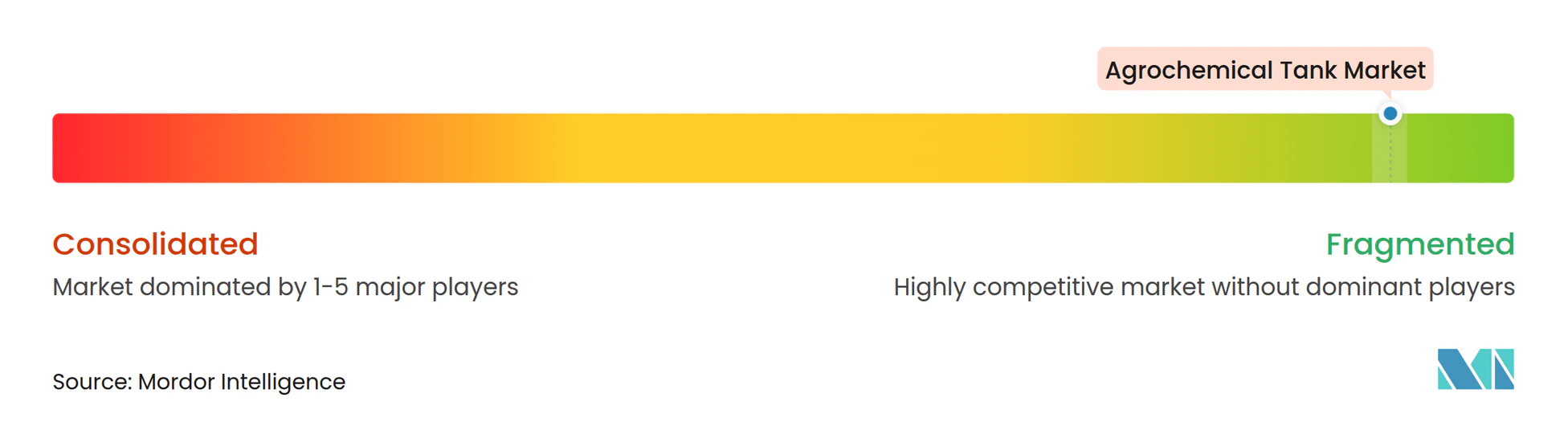
The agrochemical tank market is fragmented, with notable players including KBK Industries, LLC, Snyder Industries, LLC, L.F. Manufacturing, Inc., Chemical Containers, Inc., and ProMinent GmbH, among others. Small regional players are expanding their geographical reach to serve both industries and individual farmers in the agrochemical tank market.
Agrochemical Tank Industry Leaders
-
KBK Industries, LLC
-
Snyder Industries, LLC
-
L.F. Manufacturing, Inc.
-
Chemical Containers, Inc
-
ProMinent GmbH
- *Disclaimer: Major Players sorted in no particular order
Agrochemical Tank Market Companies Covered in this Report
- Snyder Industries, LLC
- Norwesco, Inc
- L.F. Manufacturing, Inc.
- Assmann Corporation of America
- Automat Industries Private Limited
- Chemical Containers, Inc
- Enduramaxx Limited
- KBK Industries, LLC
- ProMinent GmbH
Recent Industry Developments in Agrochemical Tank Market
- February 2025: Jamaica's Ministry of Agriculture, Fisheries, and Mining allocated USD 79 million to purchase water tanks and drip irrigation hoses for local farmers. In recent months, the ministry has already distributed 171 irrigation kits and 178 water tanks to these farmers. This initiative, which includes the procurement of water tanks and drip irrigation hoses aimed at supporting farmers during the dry season.
- December 2024: Vectus, an India-based water storage solution provider, has introduced a 10-layer water storage tank. The tank features enhanced durability, UV resistance, and antibacterial protection to ensure safe and long-term water storage.
Global Agrochemical Tank Market Report Scope
Agrochemical tanks serve as dedicated storage solutions for a variety of agricultural chemicals, such as pesticides, fertilizers, herbicides, fungicides, and insecticides. These tanks play a crucial role in safeguarding chemicals from contamination, preserving their integrity, and ensuring safe handling and application. Available in sizes ranging from small units for individual farms to expansive industrial-scale facilities, these tanks boast capacities that span from 100 liters to several thousand liters.
The agrochemical tanks market is segmented by type (conical, vertical, and horizontal), application (water storage, chemical storage, and fertilizer storage), and geography (North America, Europe, Asia-Pacific, South America, and Middle East and Africa). The report offers market sizing and forecasts in value (USD).
Segmentation Overview
| Conical |
| Horizontal |
| Vertical |
| Water Storage |
| Fertilizer Storage |
| Chemical Storage |
| North America | United States |
| Canada | |
| Mexico | |
| Rest of North America | |
| Europe | Germany |
| United Kingdom | |
| France | |
| Russia | |
| Spain | |
| Rest of Europe | |
| Asia-Pacific | India |
| China | |
| Japan | |
| Australia | |
| Rest of Asia-Pacific | |
| South America | Brazil |
| Argentina | |
| Rest of South America | |
| Middle East and Africa | Egypt |
| South Africa | |
| Rest of Middle East and Africa |
| By Type | Conical | |
| Horizontal | ||
| Vertical | ||
| By Application | Water Storage | |
| Fertilizer Storage | ||
| Chemical Storage | ||
| By Geography | North America | United States |
| Canada | ||
| Mexico | ||
| Rest of North America | ||
| Europe | Germany | |
| United Kingdom | ||
| France | ||
| Russia | ||
| Spain | ||
| Rest of Europe | ||
| Asia-Pacific | India | |
| China | ||
| Japan | ||
| Australia | ||
| Rest of Asia-Pacific | ||
| South America | Brazil | |
| Argentina | ||
| Rest of South America | ||
| Middle East and Africa | Egypt | |
| South Africa | ||
| Rest of Middle East and Africa | ||
Key Questions Answered in the Report
How big is the agrochemical tank market?
The agrochemical tank market size is projected to reach USD 1.69 billion in 2026 and grow at a CAGR of 4.63% to reach USD 2.22 billion by 2032.
What is the current agrochemical tank market size?
In 2026, the agrochemical tank market size is projected to reach USD 1.69 billion.
Who are the key players in agrochemical tank market?
KBK Industries, LLC, Snyder Industries, LLC, L.F. Manufacturing, Inc., Chemical Containers, Inc and ProMinent GmbH are the major companies operating in the Agrochemical Tank Market.
Which region has the biggest share in agrochemical tank market?
In 2026, North America accounted for the largest share of the agrochemical tank market.