
Market Overview
| Study Period | 2021 - 2031 |
|---|---|
| Forecast Data Period | 2026 - 2031 |
| Base Year Market Size (2025) | USD 97.24 Million |
| Market Size (2026) | USD 102.37 Million |
| Market Size (2031) | USD 143.24 Million |
| Growth Rate (2026 - 2031) | 6.95 % |
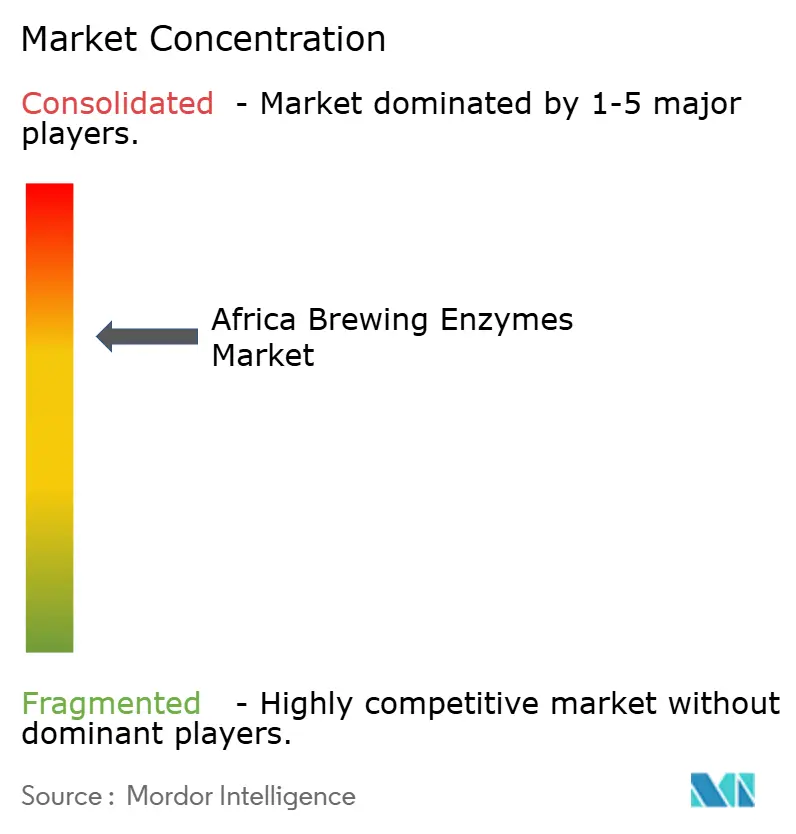
| Market Concentration | Medium |
Major Players *Disclaimer: Major Players sorted in no particular order Image © Mordor Intelligence. Reuse requires attribution under CC BY 4.0. | |
Africa Brewing Enzymes Market Analysis by Mordor Intelligence
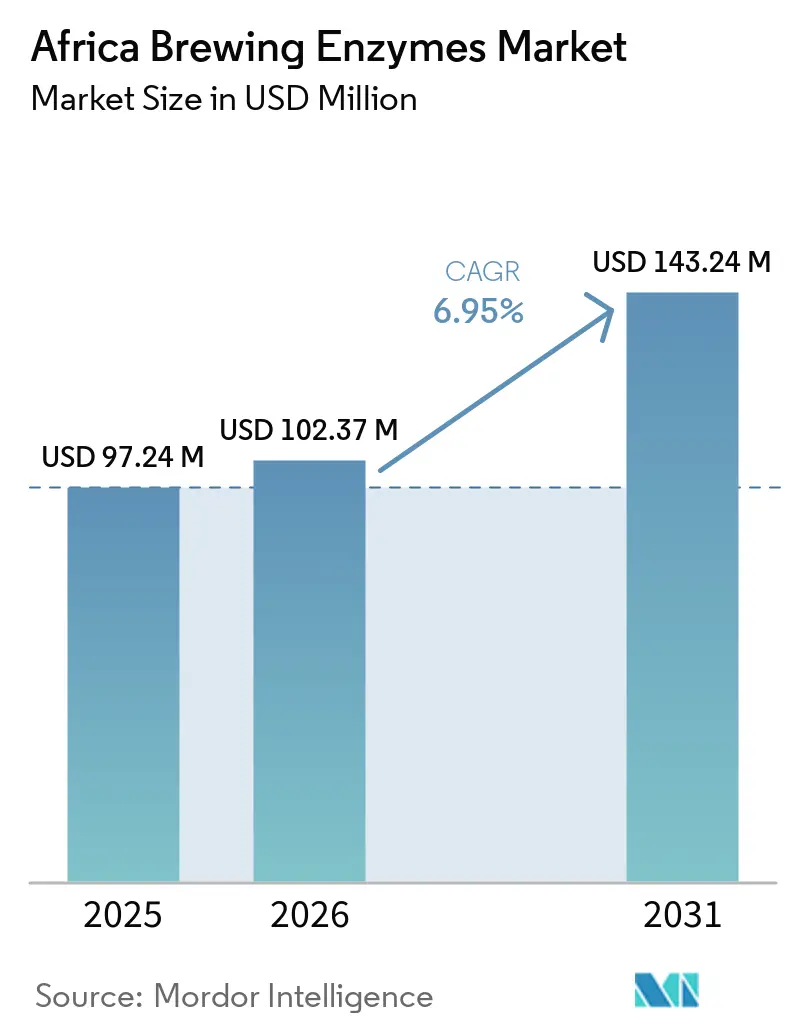
The Africa brewing enzymes market size is projected to expand from USD 97.24 million in 2025 and USD 102.37 million in 2026 to USD 143.24 million by 2031, registering a CAGR of 6.95% between 2026 to 2031. The Africa brewing enzymes market is supported by brewers using more locally available sorghum, maize, and cassava in place of imported barley malt. These grains require tailored enzyme programs because their starch conversion and filtration characteristics differ from those of conventional malt. Beer output in Africa increased by 2.60% to 166.70 million hectoliters in 2025, while output declined in other global regions, which supports a wider need for mashing, fermentation, and filtration inputs. The Africa brewing enzymes market also benefits when breweries improve yield, reduce water use, and adapt production to local grain quality. Suppliers are responding through application support, liquid products for automated dosing, and solutions for high-adjunct and no-alcohol brewing.
Key Report Takeaways
- By type, Amylase held 42.18% of the Africa brewing enzymes market share in 2025, while Beta Glucanase is projected to grow at a 9.55% CAGR through 2031.
- By source, Microbial enzymes accounted for 56.48% of the Africa brewing enzymes market share in 2025, while Plant enzymes are forecast to expand at a 9.35% CAGR through 2031.
- By form, Dry enzymes held 75.48% of the Africa brewing enzymes market share in 2025, while Liquid enzymes are projected to grow at an 8.79% CAGR through 2031.
- By application, Alcoholic Beverages accounted for 57.48% of the Africa brewing enzymes market share in 2025, while Non-Alcoholic Beverages are forecast to expand at a 9.11% CAGR through 2031.
- By geography, South Africa held 38.65% of the Africa brewing enzymes market share in 2025, while Nigeria is projected to grow at an 8.26% CAGR through 2031.
Note: Market size and forecast figures in this report are generated using Mordor Intelligence’s proprietary estimation framework, updated with the latest available data and insights as of January 2026.
Market Trends and Insights
Drivers Impact Analysis of Africa Brewing Enzymes Market*
| Driver | (~) % Impact on CAGR Forecasts | Geographic Relevance | Impact Timeline |
|---|---|---|---|
| Growing beer production across Africa | +2.0% | Pan-African, especially South Africa, Nigeria, Ethiopia | Short term (≤ 2 years) |
| Rising adoption of enzymes to improve brewing efficiency | +1.2% | South Africa, Nigeria, Egypt | Medium term (2-4 years) |
| Local substitution of imported malt with sorghum, maize and cassava | +1.3% | Nigeria, Uganda, Ghana, South Africa | Medium term (2-4 years) |
| Increasing enzyme use in high-adjunct brewing processes | +0.7% | South Africa, Nigeria | Medium term (2-4 years) |
| Rising demand for enzyme-enabled low- and no-alcohol beer formulations | +1.0% | South Africa, Nigeria, Kenya | Long term (≥ 4 years) |
| Growing focus on brewing yields, filtration efficiency and resource optimization | +0.8% | Pan-African, concentrated in South Africa and Nigeria | Medium term (2-4 years) |
| Source: Mordor Intelligence | |||
Growing Beer Production Drives Enzyme Demand Across The Continent
Africa produced 166.70 million hectoliters of beer in 2025, up 2.60% from the preceding year. South Africa increased production by 2.70% to 38.00 million hectoliters, while Nigeria remained a major regional brewing base[1]. Higher beer output increases demand for enzymes used in mashing, fermentation, clarification, and filtration. The Africa brewing enzymes market gains because each additional production run needs consistent handling of grain composition and wort quality. Mid-sized and regional breweries can require more direct formulation support than large multinational sites because they often have less process engineering capacity. This gives technical service, local trials, and repeatable dosing guidance a larger role in supplier selection across the Africa brewing enzymes market.
Local Grain Substitution Creates A Structurally Elevated Enzyme Market
Brewers are using more sorghum, maize, and cassava to reduce exposure to imported malt costs and improve local sourcing. Sorghum malt can provide 10% to 20% of the diastatic power of barley malt, which raises the value of external enzyme supplementation in brewing. Novonesis states that tailored biosolutions can help brewers use local raw materials while maintaining beer quality and process consistency. The Africa brewing enzymes market therefore serves a broader production need than simple cost control, since local grains change the chemistry of the mash. Each grain mix can need a different combination of amylase, beta-glucanase, and related processing enzymes. This raises the importance of application expertise in the Africa brewing enzymes market, especially where brewers move between seasonal grain supplies.
No- And Low-Alcohol Beer Demand Supports Specialized Enzyme Use
Producing no- and low-alcohol beer requires careful control of fermentable sugars, flavor development, and final alcohol levels. IFF presented DIAZYME® NOLO at Drinktec in 2025 as a tool that can reduce grist use by up to 37.00% in alcohol-free beer production. The product example shows why specialized enzyme use can be important when brewers develop low- and no-alcohol options. Urban consumers seeking moderation support a wider product range, while brewery teams need formulations that retain beer quality. This creates a premium application opportunity for the Africa brewing enzymes market because product development needs can be more exacting than for standard beer.
Yield, Filtration, And Resource Efficiency Create Recurring Demand
Rising grain and energy costs encourage breweries to use enzymes to improve yield and protect margins. Enzymes used during mashing can lower wort viscosity and improve separation, helping breweries use existing equipment more effectively. IFF estimates that moving 20.00% of beer production that uses traditional stabilization methods to its BCLEAR™ technology could save 300.00 million liters of water each year. Water efficiency is material for breweries operating in water-constrained areas of Africa. The Africa brewing enzymes market can therefore benefit from recurring use at established breweries, not only from new capacity additions. The 5th VLB Africa Brewing Conference in Johannesburg in June 2025 highlighted brewing grains, fermentation, sustainability, and modern processing, reflecting the practical focus on these operating issues
Restraints Impact Analysis of Africa Brewing Enzymes Market*
| Restraint | (~) % Impact on CAGR Forecasts | Geographic Relevance | Impact Timeline |
|---|---|---|---|
| High initial investment in brewing process modernization | -1.10% | Mid-tier markets, Egypt, Morocco, East Africa | Medium term (2-4 years) |
| Fluctuations in raw material prices and availability | -0.70% | Nigeria, Sub-Saharan Africa broadly | Short term (≤ 2 years) |
| Inconsistent quality of locally sourced brewing grains | -0.50% | Nigeria, Uganda, West Africa | Medium term (2-4 years) |
| Limited technical expertise in enzyme optimization | -0.40% | Rest of Africa, excluding South Africa and Nigeria | Long term (≥ 4 years) |
| Source: Mordor Intelligence | |||
Capital Intensity Slows Process Modernization In Tier-2 Markets
High-performance enzyme programs work best when breweries have reliable dosing equipment, process monitoring, and suitable controls. Smaller breweries in Egypt, Morocco, and emerging East African brewing centers can lack some of this equipment. This limits use of advanced amylases, precision no-alcohol formulations, and multi-enzyme filtration systems. The Africa brewing enzymes market can still serve these breweries, but products must fit existing operating conditions. Modernization requires capital spending that may compete with capacity, packaging, or distribution priorities. As a result, process upgrades can slow broader adoption even when the expected efficiency benefits are clear.
Raw Material Price Volatility Disrupts Enzyme Economics Downstream
Changes in sorghum, maize, and cassava prices can alter brewers’ raw-material decisions and their demand for specialized enzymes. Breweries under cost pressure may adjust adjunct ratios, delay specialty product purchases, or favor more familiar formulations. Nigerian brewers faced significant currency-related cost pressure through 2024 before conditions partly stabilized in 2025. Inconsistent grain composition also makes it harder to apply one standard enzyme protocol across production runs. The Africa brewing enzymes market is affected because suppliers must demonstrate performance across changing input conditions. Local sourcing arrangements can reduce some exposure, but their effectiveness depends on procurement capacity and dependable agricultural supply.
*Our forecasts treat driver/restraint impacts as directional, not additive. The impact forecasts reflect baseline growth, mix effects, and variable interactions.
Africa Brewing Enzymes Market Segment Analysis
By Type:
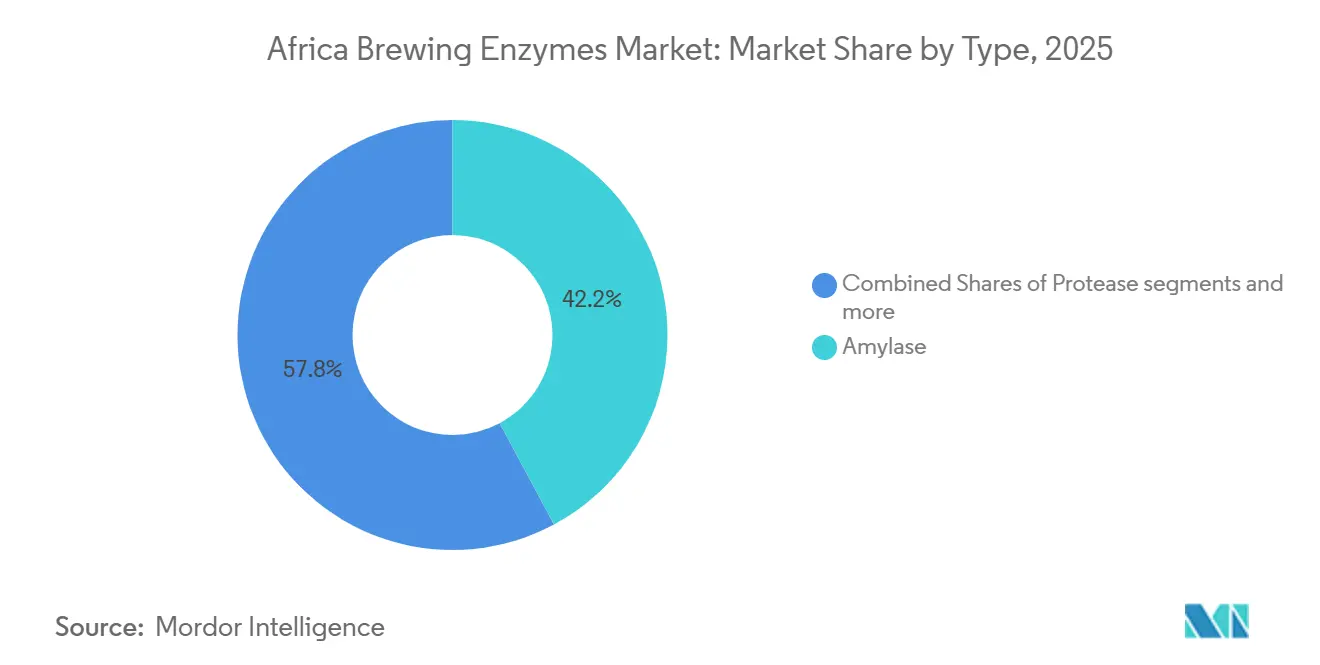
Amylase Leads While Beta Glucanase Expands With Adjunct BrewingAmylase held 42.18% of the Africa brewing enzymes market share in 2025 because starch conversion is essential across barley, sorghum, maize, and cassava formulations. The enzyme supports fermentable sugar development and remains central to everyday brewery operations. Protease supports free amino nitrogen management and can contribute to foam stability, while Alphalase and other types address separate process needs. Beta Glucanase is forecast to grow at a 9.55% CAGR through 2031, the fastest rate among type segments in the Africa brewing enzymes market. Its use rises when sorghum and other local grains create higher wort viscosity and filtration resistance.
Research published in 2025 reported that exogenous enzymes can support red sorghum wort fermentation where native enzymatic activity is limited[2]. This evidence aligns with the role of beta-glucanase in adjunct-heavy brewing systems. African brewers use these products to improve process consistency without redesigning the full brewery. Suppliers with thermostable beta-glucanase products suited to local mashing temperatures can address a practical process requirement. The Africa brewing enzymes market is therefore shaped by the quality and variability of local grain inputs as much as by overall beer volume.

By Source:
Microbial Enzymes Hold The Lead While Plant Sources Gain InterestMicrobial enzymes accounted for 56.48% of the Africa brewing enzymes market share in 2025. Fermentation-derived products are widely used because their performance is consistent across commercial brewing conditions. Variants associated with Aspergillus, Bacillus, and Trichoderma are compatible with demanding mashing and process conditions. Microbial products also have a well-established position in food and beverage manufacturing. Their established supply base helps brewers obtain products with known dosage and handling requirements.
Plant-sourced enzymes are forecast to grow at a 9.35% CAGR through 2031. Their growth reflects interest in clean-label positioning and in supply systems connected to local agricultural inputs. Brewers testing native grain varieties may also assess how plant-derived inputs fit their raw-material strategies. The Africa brewing enzymes market could become more diverse if regional manufacturers develop commercially reliable alternatives. Microbial products are expected to retain the larger base because scale, stability, and technical validation remain decisive for commercial brewers.
By Form:
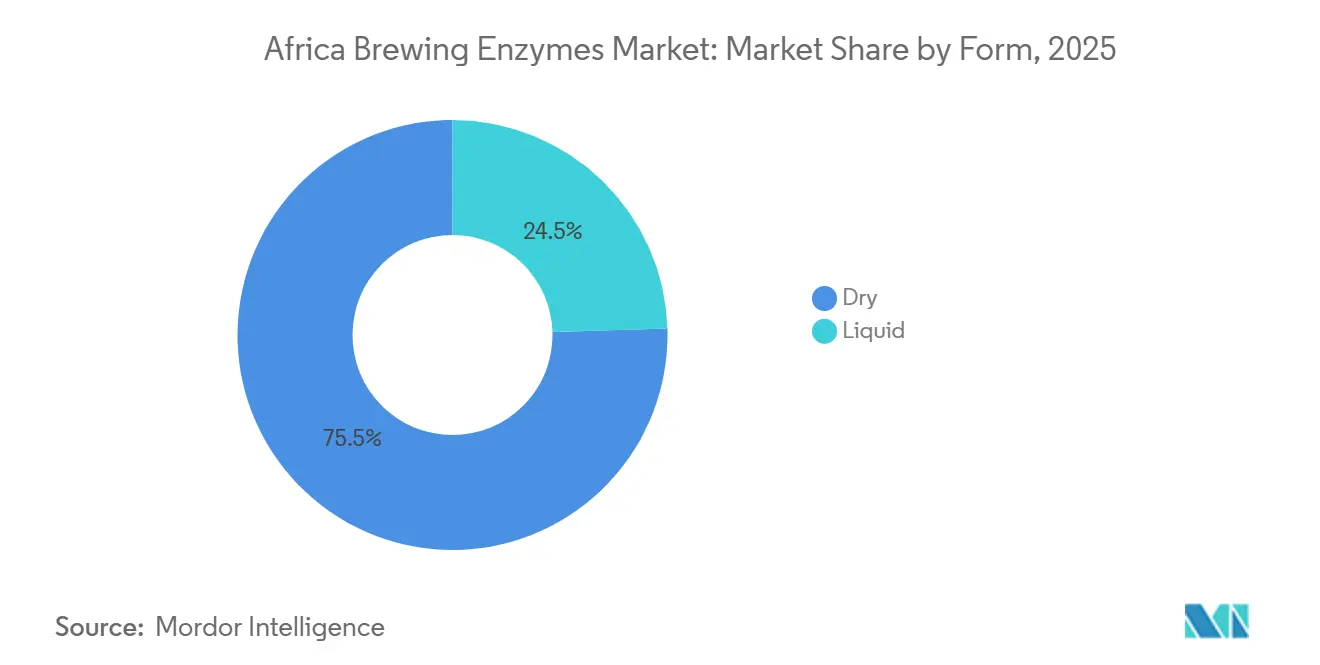
Dry Enzymes Retain Logistics Advantages While Liquid Products Gain UseDry formulations held 75.48% of the Africa brewing enzymes market share in 2025. Powders and granules have a long shelf life and can be easier to transport across markets with uneven cold-chain coverage. They also suit breweries that have limited storage infrastructure and do not use continuous dosing systems. This gives dry formulations a practical advantage among smaller and regional breweries in West, East, and Central Africa. Their handling profile supports stockholding where delivery lead times can be variable.
Liquid enzymes are forecast to grow at an 8.79% CAGR through 2031. Their use rises as larger breweries introduce automated metering, digital process monitoring, and more precise dosing practices. DSM-Firmenich introduced Maxadjunct MA in July 2025 as a concentrated liquid maltogenic amylase for brewers using local adjunct grains. The product supports the shift toward brewing with rice, maize, sorghum, and cassava. The Africa brewing enzymes market will continue to include both forms because logistics needs and brewery operating maturity differ across the region.
By Application:
Alcoholic Beverages Lead While Non-Alcoholic Beverages Add ValueAlcoholic Beverages accounted for 57.48% of the Africa brewing enzymes market share in 2025. Beer represents the main source of demand because it uses several enzyme classes through mashing, filtration, foam management, and stabilization. Wine contributes a smaller application base, especially in South Africa and Morocco. The broad process needs of beer maintain the segment’s leading position. Continued brewery capacity investment supports demand for established alcoholic beverage applications.
Non-Alcoholic Beverages are projected to expand at a 9.11% CAGR through 2031. No- and low-alcohol brewing requires precise management of starch, fermentation, flavor, and alcohol content. IFF’s DIAZYME® NOLO illustrates the technical focus of this application. The Africa brewing enzymes market gains value when brewers need targeted solutions rather than standard brewing inputs. This segment’s growth adds a specialized revenue opportunity while alcoholic beverages remain the larger demand base.
Geography Analysis
South Africa Brewing Enzymes Market
South Africa held 38.65% of the Africa brewing enzymes market share in 2026. The country produced 38.00 million hectoliters of beer in 2025, an increase of 2.70% from the prior year. Large brewery operations and a developed technical base support demand for enzyme-assisted production. The country also has the region’s strongest concentration of multinational brewing activity. Novonesis opened a Johannesburg office and customer application labs in November 2025, including microbrewery facilities for local customer collaboration. This type of local support is important for the Africa brewing enzymes market because it allows formulations to be tested with local inputs.
Nigeria Brewing Enzymes Market
Nigeria is projected to grow at an 8.26% CAGR through 2031, making it the fastest-growing geography in the Africa brewing enzymes market. The country’s brewers are increasing local use of sorghum and cassava, which creates demand for products that manage variable grain characteristics. Nigerian Breweries reported 2025 group revenue of NGN 1.50 trillion, showing the scale of commercial brewing activity in the country[3]. Local grain procurement can reduce import exposure, but it also increases the need for consistent enzymatic processing. Nigeria is therefore a key market for suppliers that pair products with application advice. New capacity and the recovery of brewer operating conditions can support continued demand through the forecast period.
Egypt and Morocco Brewing Enzymes Market
Egypt and Morocco form the next group of strategic markets with different operating conditions. Egypt has urban demand and established international brewer participation, but regulatory conditions can limit production scale. Morocco is adding premium beer activity, including Carlsberg beer produced under a licensing arrangement with Société des Boissons du Maroc in 2025. Ethiopia and Ghana are earlier-stage markets where local grains and new brewery activity can broaden enzyme use. The Africa brewing enzymes market can grow across these countries as facilities mature and operators build technical experience. Progress will depend on raw-material quality, capital availability, and the practical ability to use advanced enzyme systems.
Competitive Landscape
The Africa brewing enzymes market has a moderately consolidated structure. Novonesis A/S, IFF, and DSM-Firmenich are important suppliers, while distributors and smaller regional companies compete through product availability and application support. The leading companies differentiate through raw-material flexibility, filtration, high-adjunct brewing, and no-alcohol formulation capabilities. Novonesis launched Termamyl® Prime in December 2025 for high-gravity brewing conditions and improved production efficiency. The product is relevant to breweries managing variable barley quality and demanding process conditions. This approach shows that the Africa brewing enzymes market rewards solutions that reduce operating constraints without requiring major equipment additions.
IFF focuses on enzyme systems for alcohol-free brewing and water-efficient processing. Its DIAZYME® NOLO example addresses the growing need for precise no- and low-alcohol beer formulation. DSM-Firmenich has directed product development toward liquid adjunct solutions and brewing stabilization technologies. Its Maxadjunct MA launch in 2025 addressed high-adjunct brewing with local grains. These moves show how suppliers are linking product design to regional production conditions. Competition is therefore based on technical fit and local implementation capacity rather than price alone.
The strongest opportunity lies in serving mid-tier breweries, craft operations, and new facilities that may not have direct access to supplier technical teams. Local distributors can be important because they provide inventory, training, and faster customer contact. Application laboratories can strengthen supplier positions by allowing brewers to test local grain combinations before changing full-scale production. The Africa brewing enzymes market also has room for local biotechnology companies if they can validate product performance at commercial scale. Suppliers with dependable service models can benefit as brewery operations become more sophisticated. Leading suppliers hold a meaningful combined position, while distributors and local participants maintain active competitive pressure.
Africa Brewing Enzymes Industry Leaders
-
Kerry Group PLC
-
Novozymes A/S
-
AEB Group
-
DSM-Firmenich
-
Advanced Enzyme Technologies Limited
- *Disclaimer: Major Players sorted in no particular order
Africa Brewing Enzymes Market Companies Covered in this Report
- Novonesis A/S
- International Flavors & Fragrances, Inc.
- AB Enzymes GmbH
- Kerry Group plc
- AEB Group
- Lallemand Inc.
- DSM-Firmenich
- Amano Enzyme Inc.
- BASF SE
- Advanced Enzyme Technologies Limited
- Associated British Foods plc
- Chr. Hansen Holding A/S
- Caldic B.V.
- Brenntag SE
- Biocatalysts Ltd
- Aumgene Biosciences
- Angel Yeast Co., Ltd.
- Leveking Biotechnology Co., Ltd.
- Immobazyme
- BrewCraft Int.
Recent Industry Developments in Africa Brewing Enzymes Market
- March 2026: Amano Enzymes announced a marketing partnership with Nature’s IQ to distribute its specialty microbial enzymes across South Africa. The partnership aims to expand local access to enzyme technologies and support manufacturers in improving product quality and processing performance.
- March 2025: Soufllet Malt entered into a commercial partnership with HEINEKEN to supply malt for its South African brewing operations. Soufflet Malt committed €100 million to build a facility near HEINEKEN's Sedibeng Brewery, with planned annual capacity of approximately 100,000 tonnes and operations expected to begin in mid-2027.
Africa Brewing Enzymes Market Report Scope
The Africa brewing enzymes market is segmented by type, source, form, application, and geography. By type, the market is categorized into amylase, alphalase, beta-glucanase, protease, and other types. By source, the market is divided into microbial and plant-based enzymes. By form, the market is segmented into dry and liquid. By application, the market includes alcoholic and non-alcoholic beverages, with alcoholic beverages further categorized into beer and wine. By geography, the market covers South Africa, Nigeria, Egypt, Morocco, and the rest of Africa.
Segmentation Overview
By Type
| Amylase |
| Alphalase |
| Beta Glucanase |
| Protease |
| Other Types |
By Source
| Microbial |
| Plant |
By Form
| Dry |
| Liquid |
By Application
| Alcoholic Beverages | Beer |
| Wine | |
| Non-Alcoholic Beverages |
By Geography
| South Africa |
| Nigeria |
| Egypt |
| Morocco |
| Rest of Africa |
| By Type | Amylase | |
| Alphalase | ||
| Beta Glucanase | ||
| Protease | ||
| Other Types | ||
| By Source | Microbial | |
| Plant | ||
| By Form | Dry | |
| Liquid | ||
| By Application | Alcoholic Beverages | Beer |
| Wine | ||
| Non-Alcoholic Beverages | ||
| By Geography | South Africa | |
| Nigeria | ||
| Egypt | ||
| Morocco | ||
| Rest of Africa | ||
Key Questions Answered in the Report
What is the projected value of the Africa brewing enzymes market by 2031?
The Africa brewing enzymes market is projected to reach USD 143.24 million by 2031, growing at a 6.95% CAGR from 2026.
Which enzyme type is growing fastest in Africa?
Beta Glucanase is forecast to grow at a 9.55% CAGR through 2031, supported by high-adjunct brewing with sorghum and other local grains.
Which application has the highest growth outlook?
Non-Alcoholic Beverages are forecast to expand at a 9.11% CAGR through 2031 as breweries develop no- and low-alcohol products.
Which country leads enzyme demand in African brewing?
South Africa held 38.65% of regional demand in 2025, supported by a large beer-production base and advanced brewery operations.