
Africa 5G Technology Market Size and Share
Market Overview
| Study Period | 2020 - 2031 |
|---|---|
| Forecast Data Period | 2026 - 2031 |
| Base Year Market Size (2025) | USD 3.15 Billion |
| Market Size (2026) | USD 3.66 Billion |
| Market Size (2031) | USD 7.89 Billion |
| Growth Rate (2026 - 2031) | 16.61 % |
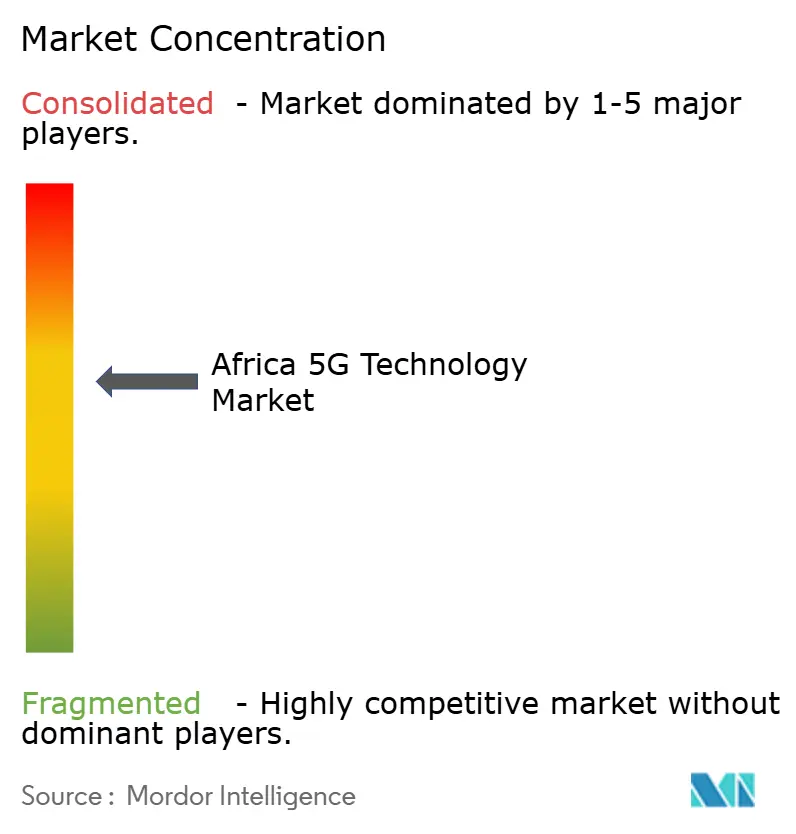
| Market Concentration | Medium |
Major Players *Disclaimer: Major Players sorted in no particular order Image © Mordor Intelligence. Reuse requires attribution under CC BY 4.0. | |
Africa 5G Technology Market Analysis by Mordor Intelligence
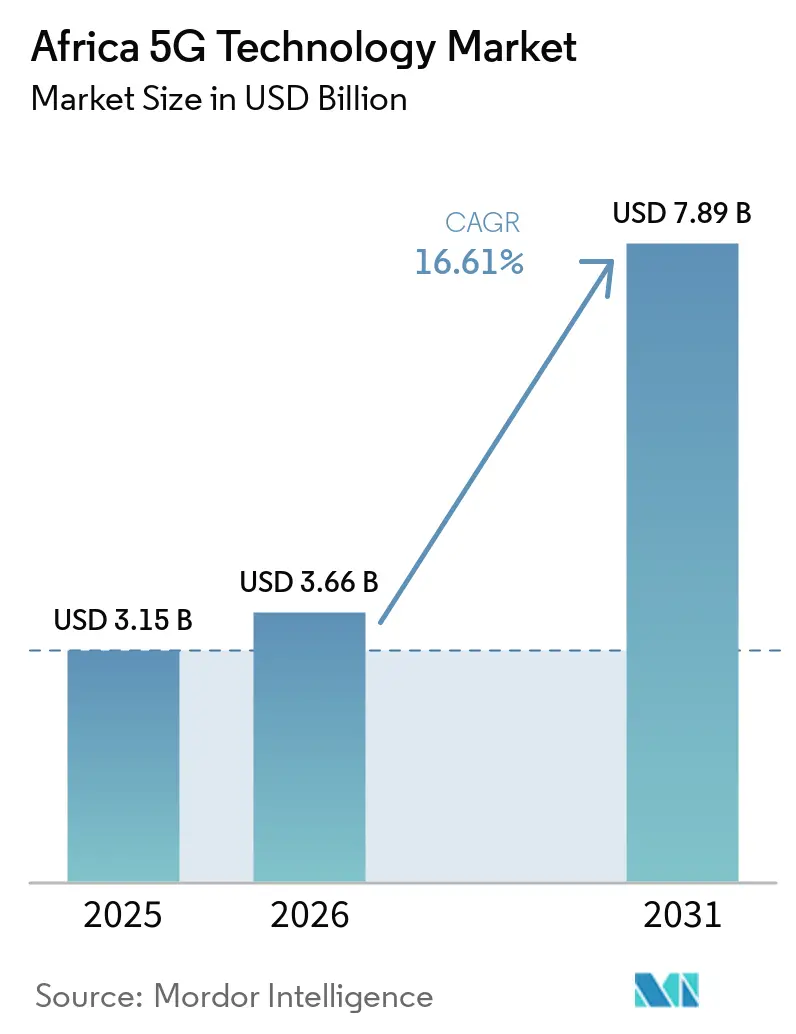
The Africa 5G Technology Market size is projected to be USD 3.15 billion in 2025, USD 3.66 billion in 2026, and reach USD 7.89 billion by 2031, growing at a CAGR of 16.61% from 2026 to 2031. Network investment is being shaped by limited fixed broadband access, which makes mobile networks the practical route to high-speed connectivity in many countries. Spectrum licensing is becoming a decisive factor because countries that release mid-band capacity earlier can support denser coverage and stronger service quality. Rising mobile data use is increasing demand for radio capacity, transport networks, and cloud-native cores across the African 5G technology market. Operators are also changing deployment economics through network sharing, wholesale platforms, and fixed wireless access. These approaches may widen access while reducing the capital required for each operator’s rollout.
Key Report Takeaways
- By component, hardware accounted for 54.51% of the Africa 5G Technology Market share in 2025, while services are projected to expand at an 18.98% CAGR through 2031.
- By spectrum band, sub-6 GHz accounted for 75.89% of the Africa 5G technology market share in 2025, while Hybrid configurations are expected to expand at a 19.12% CAGR through 2031.
- By application, eMBB commanded 43.49% of the Africa 5G technology market share in 2025, while FWA is projected to expand at a 19.78% CAGR through 2031.
- By end-user industry, the consumer segment held 49.12% of the Africa 5G technology market share in 2025, while energy and utilities are expected to expand at an 18.10% CAGR through 2031.
- By network architecture, NSA accounted for 79.11% of the Africa 5G technology market share in 2025, while SA is projected to expand at a 17.65% CAGR through 2031.
- By country, South Africa held 34.50% of the Africa 5G technology market share in 2025, while Egypt is expected to expand at a 17.88% CAGR through 2031.
Note: Market size and forecast figures in this report are generated using Mordor Intelligence’s proprietary estimation framework, updated with the latest available data and insights as of January 2026.
Africa 5G Technology Market Trends and Insights
Drivers Impact Analysis*
| Driver | (~) % Impact on CAGR Forecast | Geographic Relevance | Impact Timeline |
|---|---|---|---|
| Leapfrogging From 4G to 5G in Low-Fixed-Broadband Markets | +5.1% | Global, with primary gains across Sub-Saharan Africa and North Africa | Long term (≥ 4 years) |
| Fixed Wireless Access Closing Broadband Gaps Faster Than Fiber | +3.6% | South Africa and Nigeria core, with spillover to Kenya, Egypt, and Rest of Africa | Short term (≤ 2 years) |
| Mobile Money, Fintech, and Enterprise Digitalization Raising Traffic Intensity | +2.7% | Sub-Saharan Africa, with concentrated demand in Nigeria, Kenya, and South Africa | Medium term (2-4 years) |
| Pan-African Neutral-Host and Infrastructure-Sharing Models Improving ROI | +2.3% | Nigeria, Uganda, Tanzania, Democratic Republic of Congo, and Ghana, emerging in Kenya and Rwanda | Medium term (2-4 years) |
| Lower-Cost Sub-6 GHz Device Ecosystems Improving Consumer Adoption | +1.9% | South Africa, Nigeria, and Egypt, with spillover to West Africa | Short term (≤ 2 years) |
| Network Modernization Tied to Data Sovereignty and Edge-Ready Cloud Programs | +1.4% | South Africa and Nigeria core, Kenya, Ethiopia, and Egypt | Long term (≥ 4 years) |
| Source: Mordor Intelligence | |||
Leapfrogging From 4G to 5G in Low-Fixed-Broadband Markets
Fixed broadband penetration remained in the low single digits in several African countries. Mobile networks have therefore remained the most viable broadband channel for households and businesses. This makes 5G a broadband alternative rather than only an upgrade to existing mobile plans. Sub-Saharan Africa’s monthly mobile data traffic is projected to increase from 2.8 exabytes in 2025 to 9.7 exabytes by 2031.[1]Ericsson, “Sub-Saharan Africa to See Fastest 5G Subscription Growth,” Ericsson Mobility Report, ericsson.com Spectrum availability will determine whether operators can carry this traffic at sustainable network costs. Mobile technologies generated USD 240 billion in economic value across Africa in 2025, equal to 7.8% of regional GDP.
Fixed Wireless Access Closing Broadband Gaps Faster Than Fiber
FWA can reduce the cost and time required to connect homes by avoiding last-mile civil works. This gives the Africa 5G technology market a practical route into areas where fiber deployment is difficult to justify. By late 2025, 25 operators had activated FWA services in markets including Angola, South Africa, Nigeria, Kenya, and Zambia. MTN Group identified FWA and fiber as the main pillars of its home broadband strategy in Nigeria and Ghana. Airtel Africa had 3,609 operational 5G sites across 7 markets in the quarter ended June 2026.[2]Airtel Africa, “Q1 Results, Quarter Ended June 30, 2026,” Airtel Africa Regulatory Announcement, investegate.co.uk Its USD 1.1 billion 2026 capital expenditure program identified home broadband as a primary investment area.
Mobile Money, Fintech, and Enterprise Digitalization Raising Traffic Intensity
Financial transactions place different demands on networks than conventional voice services. They require dependable, low-latency connectivity as transaction volumes increase. More than USD 1.4 trillion moved through mobile money services in Sub-Saharan Africa during 2025.[3]GSMA, “State of the Industry Report on Mobile Money 2026,” GSMA, connectingafrica.com This accounted for 66% of the global mobile money transaction value. Safaricom’s Fintech 2.0 platform increased transaction capacity from 6,000 to 12,000 transactions per second during the first half of FY2026. Network slicing may become more valuable as fintech, IoT, connected logistics, and edge computing raise demand for dependable capacity.
Pan-African Neutral-Host and Infrastructure-Sharing Models Improving ROI
Infrastructure sharing can distribute deployment costs across operators while preserving competition in retail services. MTN Group and Airtel Africa signed a radio access network and fiber-sharing agreement for Nigeria and Uganda in March 2025. Airtel Africa and Vodacom Group also signed an infrastructure-sharing arrangement for Mozambique, Tanzania, and the Democratic Republic of Congo in August 2025. Ghana commercially activated its nationwide wholesale 4G and 5G platform on March 3, 2026, with Nokia as the core network partner. These models can create work for managed-service providers and systems integrators above the shared radio layer. They also support the faster expansion projected for Services within the Africa 5G technology market.
Restraints Impact Analysis*
| Restraint | (~) % Impact on CAGR Forecast | Geographic Relevance | Impact Timeline |
|---|---|---|---|
| Spectrum Fragmentation Across Markets Slowing Scale Economics | -3.2% | Continental, with sharpest impact in West and Central Africa | Long term (≥ 4 years) |
| High Energy and Diesel Reliance Raising Site Operating Costs | -2.6% | Sub-Saharan Africa core, Nigeria and the Democratic Republic of Congo most severely affected | Medium term (2-4 years) |
| FX Volatility and Import Dependence Inflating CAPEX | -1.9% | Nigeria, Egypt, Kenya, and all import-dependent markets | Short term (≤ 2 years) |
| Limited Fiber Backhaul and Rural Power Availability Delaying Standalone 5G Economics | -1.5% | Rural Sub-Saharan Africa, with spillover to secondary cities in West Africa | Long term (≥ 4 years) |
| Source: Mordor Intelligence | |||
Spectrum Fragmentation Across Markets Slowing Scale Economics
Different spectrum rules make regional deployments more expensive for equipment suppliers and operators. Fewer than 16 African countries had completed 5G spectrum assignments by mid-2025. In comparison, more than 90% of European countries had allocated 5G spectrum. Egypt concluded a USD 3.5 billion spectrum package with its 4 operators in early 2026.[4]National Telecom Regulatory Authority, Egypt, “Prime Minister Witnesses Telecom Sector’s Largest Frequency Deal Since Introduction of Mobile Services in Egypt,” NTRA Official Website, tra.gov.eg National licensing, pricing, and coverage obligations differ across South Africa, Nigeria, and Egypt. These differences limit equipment standardization and delay the realization of regional-scale benefits across the African 5G technology market.
High Energy and Diesel Reliance Raising Site Operating Costs
Diesel costs remain a major operating burden for towers in off-grid and semi-urban locations. Diesel represented 30% to 60% of tower operating expenditure in some such areas. Logistics added another 15% to 30% to direct fuel costs. 5G deployments require denser site networks and use 2 to 3 times more energy per site than 4G deployments. Vodacom Africa’s energy costs increased 5% to ZAR 5 billion (USD 300 million) in FY2025. Solar-powered infrastructure is expanding, but upfront capital needs can slow the transition.
*Our forecasts treat driver/restraint impacts as directional, not additive. The impact forecasts reflect baseline growth, mix effects, and variable interactions.
Segment Analysis
By Component: Services Revenue Acceleration Challenges Hardware’s Structural Lead
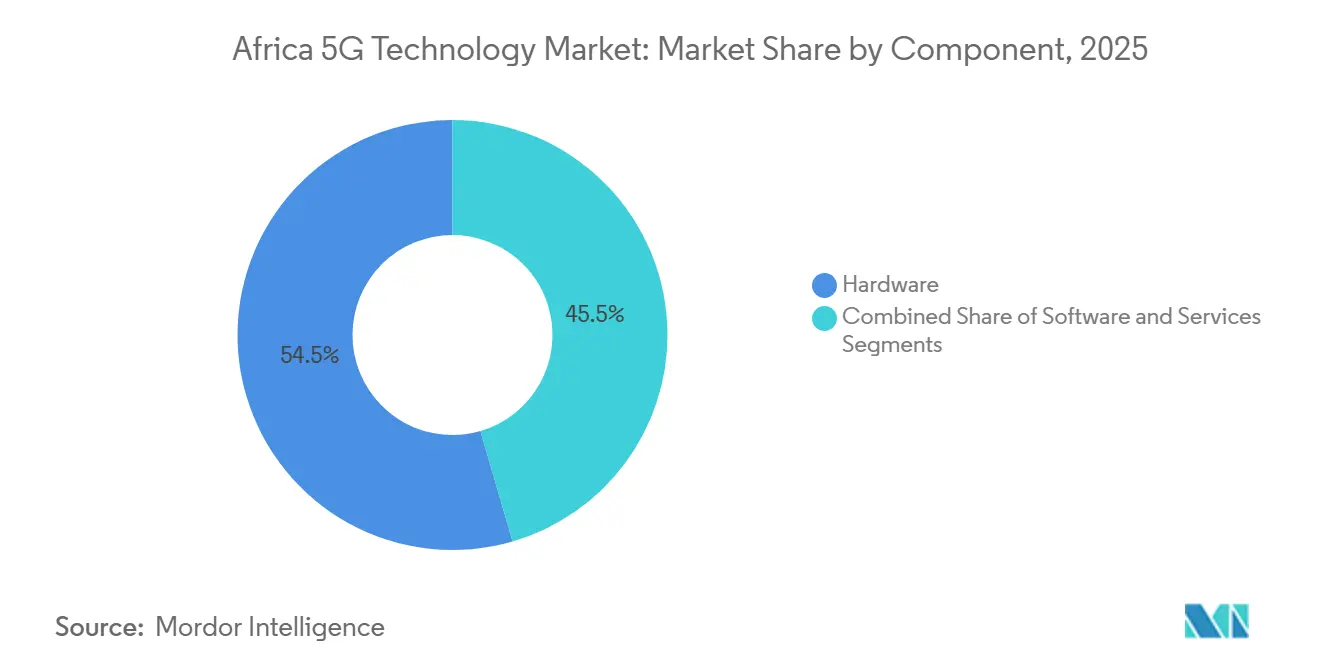
Hardware accounted for 54.51% of Africa's 5G technology market share in 2025. This reflected the buildout of macro-cell sites, radio access network equipment, and antenna systems. Ericsson, Huawei, Nokia, and ZTE secured major equipment contracts in South Africa, Egypt, Nigeria, and Kenya. Licensing requirements also pushed operators to meet defined coverage commitments. MTN South Africa completed a dual-mode 5G core upgrade during the first half of 2025. The cloud-native packet core carried 2.52 million active sessions and 40 Gbps of live traffic. Hardware demand is therefore increasingly linked to software and cloud core investment. Site construction remains necessary even when core functions move into cloud environments. Coverage obligations make timing as important as the equipment selection itself. This keeps physical network assets central during the present rollout phase.
Services are projected to expand at an 18.98% CAGR from 2026 to 2031. Managed services, network-as-a-service contracts, and systems integration are becoming more important after initial coverage is established. Operators can use these arrangements to manage network complexity and contain operating costs. Software includes core network functions, OSS/BSS platforms, and network-slicing tools. Its adoption depends on the pace of SA core deployment. Ghana’s wholesale network uses a software-driven Nokia cloud core, while MTN Group has pursued cloud-native modernization in South Africa, Zimbabwe, Angola, and Uganda. These deployments support longer-term service and software demand in the Africa 5G technology market.



By Spectrum Band: Sub-6 GHz Remains the Main Coverage Layer as Hybrid Networks Emerge
Sub-6 GHz accounted for 75.89% of the Africa 5G technology market size in 2025. Frequencies below 6 GHz give operators a practical balance between coverage and capacity. This is important where networks must serve wide areas without very dense site deployment. Morocco licensed 3.5 GHz spectrum to Maroc Telecom, Inwi, and Orange Maroc in July 2025. The licenses required 45% population coverage by the end of 2026. ICASA’s National Radio Frequency Plan 2026 also identified the upper 6 GHz and millimeter-wave capacity for mobile use. Sub-6 GHz should therefore remain the main initial rollout layer. The band supports national coverage targets with fewer base stations than higher-frequency alternatives.
Hybrid configurations are projected to expand at a 19.12% CAGR through 2031. They combine Sub-6 GHz coverage with millimeter-wave capacity in high-traffic locations. This approach may become more relevant once operators have established broader coverage footprints. Comsol is building an SA 5G core in South Africa using a single 60 MHz spectrum block. Its plan to serve millions of households by 2028 shows that the dedicated capacity can support later hybrid deployment. Private networks in ports, mines, and industrial sites can also introduce millimeter-wave systems where short-range, high-throughput links are justified.
By Application: eMBB Holds Current Revenue While FWA Extends Household Access
Enhanced Mobile Broadband (eMBB) accounted for 43.49% of Africa's 5G technology market share in 2025. It is currently the most direct way for operators to monetize mobile data faster. South Africa provided an early proof point through its established handset base. Egypt added a major eMBB opportunity with the launch of commercial 5G services in June 2025. The country’s 4 operators committed USD 675 million in licensing fees. Massive machine-type communications and ultra-reliable low-latency communications remained smaller applications in 2025. Their wider adoption requires SA cores capable of supporting network slicing. Consumer demand gives operators an immediate use case while enterprise deployments mature. It also makes handset affordability a direct consideration in service adoption. eMBB will remain a primary revenue source in the initial stages of the African 5G technology market.
FWA is projected to expand at a 19.78% CAGR from 2026 to 2031. It offers a route to monetize coverage where fiber cannot be deployed economically. Morocco and Tunisia prioritized dedicated 3.5 GHz spectrum at launch. Their reported download speeds reached 261.7 Mbps and 223.1 Mbps, respectively. Morocco’s coverage obligations and Egypt’s spectrum strategy also support residential broadband access. Private deployments in mining, ports, and manufacturing can increase demand for ultra-reliable low-latency communications. The Africa 5G technology market can therefore serve household broadband and specialized enterprise connectivity through different application paths.
By End-User Industry: Consumer Demand Provides Scale While Energy and Utilities Add Specialized Demand
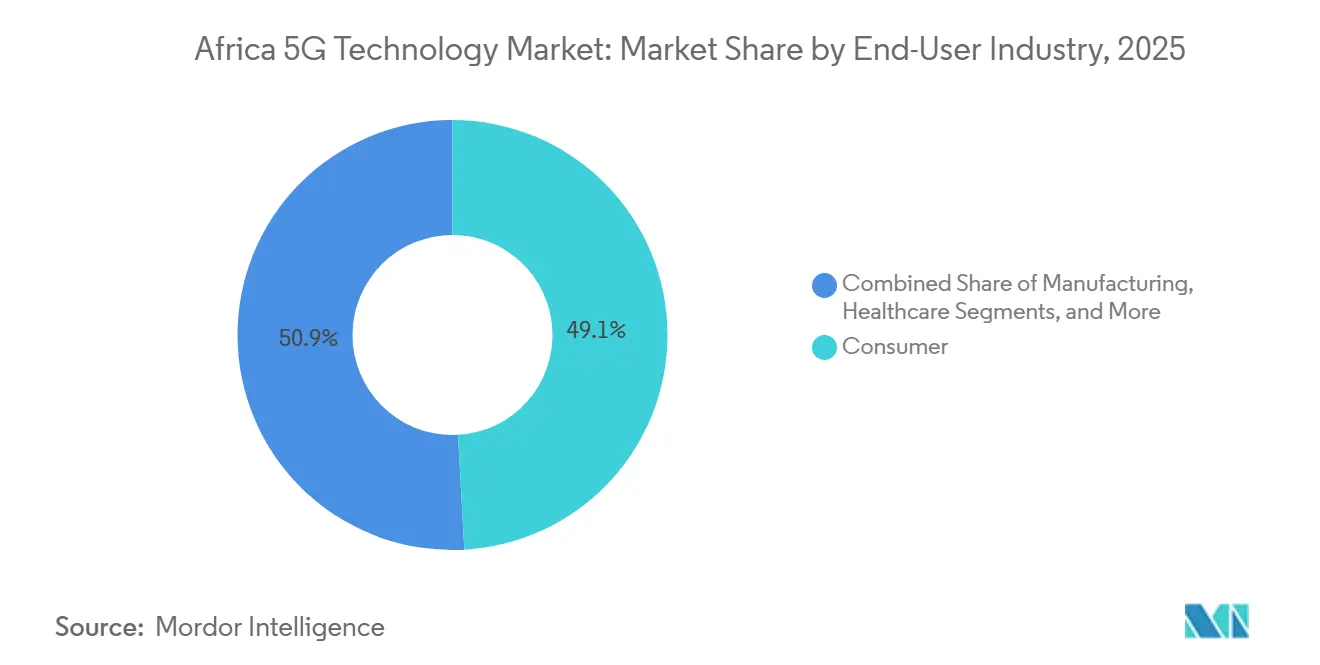
Consumer represented 49.12% of end-user revenue in 2025. eMBB and FWA services address the continuing gap in home broadband access. South Africa removed a 9% luxury tax on smartphones priced below ZAR 2,500 (USD 140). MTN South Africa also launched the Icon 5G handset at ZAR 2,499 (USD 138). ZTE manufactured the handset for prepaid users. Handsets priced below USD 200 accounted for the largest volume tier in Africa during 2025. Affordable devices can broaden the subscriber base for the Africa 5G technology market. Lower device prices can make 5G service relevant to a wider prepaid customer base. Consumer demand, therefore, remains the foundation for network utilization.
Energy and Utilities is expected to expand at an 18.10% CAGR through 2031. Private 5G networks support mining operations, oil and gas facilities, and grid monitoring systems. These applications need reliable connections and low latency for operational processes. MTN South Africa, Huawei, and China Telecom partnered in January 2025 on a private 5G network at a Northern Cape manganese mine. The deployment supported worker monitoring, vehicle tracking, and autonomous vehicle integration. Manufacturing and Healthcare are also developing use cases, including Inwi’s private 5G industrial network in Morocco’s Oriental region. These deployments show that enterprise adoption has specific operational requirements. Demand is tied to performance and reliability rather than only faster consumer downloads. This gives private networks a distinct role within the Africa 5G technology market.
By Network Architecture: NSA Supports Early Deployment While SA Enables New Capabilities
NSA represented 79.11% of network architecture revenue in 2025. It allows operators to add 5G radio access to an existing 4G core. This reduces initial cost and shortens deployment timelines. Morocco began commercial 5G services on an NSA basis in November 2025. The initial approach reflected the need to meet license commitments before full SA migration. SA's core investment has therefore been deferred in many markets rather than eliminated. NSA will remain important as the African 5G technology market expands coverage and device adoption.
SA is projected to expand at a 17.65% CAGR through 2031. Operators are adopting cloud-native cores to support lower latency and dedicated capacity management. MTN South Africa completed an automated in-service software upgrade on a live SA Packet Core Gateway in 2025. The network carried 40 Gbps of traffic during the upgrade. Comsol operates 1 of only 2 production SA cores in South Africa. SA supports network slicing, which is required for commercial-scale URLLC and mMTC services. Its uptake will influence the pace of enterprise revenue development. The architecture is particularly relevant where networks support critical operations. It allows operators to create more specialized service offerings for businesses. SA deployment will become more material as private network use cases increase.
Geography Analysis
South Africa held 34.50% of Africa's 5G technology market share in 2025. Its position reflected early spectrum assignment, a mature smartphone base, and private network activity. Vodacom’s financial services platforms processed USD 525.6 billion in transactions during FY2026. Comsol served more than 1 million Gauteng households with a 5G network in 2026. The network used a single unfragmented 60 MHz spectrum block. This showed that a wholesale-focused entrant could build an SA core without a 4G anchor. ICASA’s use-it-or-share-it rule requires high-demand spectrum to be shared within 5 years if it is not fully used.
Nigeria and Kenya formed the next tier of deployment within Sub-Saharan Africa. Nigeria’s operators spent more than USD 350 million annually on diesel for base stations as of 2025. A single urban 4G site costs USD 29,000 per year to operate, while a rural site costs USD 35,000 per year. Airtel Africa added more than 920 net new sites in 1 quarter and operated 5G in 7 of its 14 African markets during 2026. Kenya’s Safaricom had 1,700 5G sites covering 30% of the population in 2025. It also upgraded M-PESA through Fintech 2.0, enabling it to process 12,000 transactions per second. Ericsson extended its microwave partnership with Safaricom during 2026 to add E-band and multi-band backhaul.
Egypt is expected to expand at a 17.88% CAGR from 2026 to 2031. Vodafone Egypt, Orange Egypt, e& Egypt, and Telecom Egypt launched commercial 5G services in June 2025. The operators committed USD 675 million in licensing fees. Egypt then allocated an additional 410 MHz of spectrum in a USD 3.5 billion package in early 2026. The rest of Africa markets, including Morocco, Tanzania, Ethiopia, and Ghana, remained at different stages of rollout and licensing. Egypt’s additional spectrum gives operators the capacity to expand their initial launch areas.
Competitive Landscape
The Africa 5G technology market is moderately concentrated in infrastructure supply. Huawei, Ericsson, Nokia, and ZTE provide much of the radio access network hardware used by major operators. Competition is more dispersed in software, managed services, and neutral-host arrangements. Huawei expanded its relationship with MTN Group through a 2026 memorandum of understanding focused on AI-driven autonomous networks. Ericsson completed MTN South Africa’s dual-mode 5G core upgrade and extended its microwave partnership with Safaricom. Nokia supplied the core network for Ghana’s wholesale-first 5G platform. These contracts show that the vendor competition includes cloud cores, transport, and operational software.
Mavenir and Parallel Wireless are pursuing Open RAN opportunities that could change operators' sources of radio equipment. Their approach can give operators more flexibility in selecting hardware suppliers. ZTE signed an agreement with Ethio Telecom in 2026 covering 647 network sites. The work aimed to support 95.5% national 4G coverage and prepare for Ethiopia’s 5G roadmap. Samsung Electronics and MediaTek also contribute through more affordable device ecosystems. This expands competition from macro-cell hardware into handset components. The Africa 5G technology market will increasingly depend on both network availability and accessible devices.
Enterprise private networks, edge computing, and AI-based network management remain key areas of opportunity. MTN Group partnered with a data center investment platform to target 150 MW of AI data center capacity in Nigeria and South Africa. Sterlite Technologies, Aviat Networks, and Ceragon compete in fiber and wireless backhaul. Their role is important because limited terrestrial fiber increases the need for microwave and millimeter-wave transport. ICASA’s spectrum-sharing requirements, Ghana’s open-access framework, and Egypt’s coverage targets create procurement demand tied to regulatory compliance. Radisys and Mavenir are also engaging with O-RAN Alliance standards activities for disaggregated networks.
Africa 5G Technology Industry Leaders
Huawei Technologies Co., Ltd.
Telefonaktiebolaget LM Ericsson (Ericsson)
Nokia Corporation
ZTE Corporation
Mavenir plc
- *Disclaimer: Major Players sorted in no particular order

Recent Industry Developments
- September 2026: Airtel Africa announced a USD 1.1 billion CAPEX plan for its operations across 14 African markets, with the majority allocated to spectrum acquisition, fiber rollout, and home broadband expansion. The company confirmed that 5G sites had more than doubled during the period, reflecting a deliberate strategy of building network capacity ahead of demand to capture Africa’s rising data consumption.
- July 2026: Ghana’s National Communications Authority, NCA, removed Next Gen InfraCo’s, NGIC, exclusive wholesale 5G rights and opened a competitive Request for Applications for spectrum in the 700 MHz, 2.3 GHz, and 3 GHz bands. The decision restructured Ghana’s 5G sector from a single-operator model to an open competitive framework, with the government targeting 70% 5G population coverage by 2027 and additional 3.5 GHz and 26 GHz spectrum to be auctioned before the end of 2026.
- June 2026: MTN Group unveiled its Ambition 2030 strategy at Capital Markets Day 2026, announcing a target to deploy 420,000 km of fiber over the following 4 years across its 19-market footprint. The plan integrated 5G as a fronthaul layer over the fiber backbone and targeted AI-ready digital infrastructure, including distributed GPU compute at base station sites.
- November 2025: Morocco’s 3 commercial operators, Inwi, Orange Maroc, and Maroc Telecom, simultaneously launched 5G services following the ANRT’s award of 5G licenses in July 2025, including 3.5 GHz spectrum.


Africa 5G Technology Market Report Scope
The Africa 5G technology market revenue is generated through the sale of 5G network hardware, software licenses and subscriptions, network deployment and integration, managed and professional services, maintenance, and other 5G connectivity solutions supporting eMBB, FWA, mMTC, and URLLC applications across consumer, manufacturing, healthcare, automotive, energy and utilities, media and entertainment, and public safety and defense sectors.
The Africa 5G technology market report is segmented by component (hardware, software, and services), spectrum band (sub-6 GHz, mmWave, and hybrid (sub-6GHz and mmWave)), application (enhanced mobile broadband (eMBB), fixed wireless access (FWA), massive machine-type communications (mMTC), and ultra-reliable low-latency communications (URLLC)), end-user industry (consumer, manufacturing, healthcare, automotive, energy and utilities, media and entertainment, and public safety and defense), network architecture (stand-alone (SA) and non-stand-alone (NSA)), and country (South Africa, Nigeria, Egypt, Kenya, and rest of Africa). The market forecasts are provided in terms of value (USD).
| Hardware |
| Software |
| Services |
| Sub-6 GHz |
| mmWave |
| Hybrid (Sub-6 GHz and mmWave) |
| Enhanced Mobile Broadband (eMBB) |
| Fixed Wireless Access (FWA) |
| Massive Machine-Type Communications (mMTC) |
| Ultra-Reliable Low-Latency Communications (URLLC) |
| Consumer |
| Manufacturing |
| Healthcare |
| Automotive |
| Energy and Utilities |
| Media and Entertainment |
| Public Safety and Defense |
| Stand-Alone (SA) |
| Non-Stand-Alone (NSA) |
| South Africa |
| Nigeria |
| Egypt |
| Kenya |
| Rest of Africa |
| By Component | Hardware |
| Software | |
| Services | |
| By Spectrum Band | Sub-6 GHz |
| mmWave | |
| Hybrid (Sub-6 GHz and mmWave) | |
| By Application | Enhanced Mobile Broadband (eMBB) |
| Fixed Wireless Access (FWA) | |
| Massive Machine-Type Communications (mMTC) | |
| Ultra-Reliable Low-Latency Communications (URLLC) | |
| By End-User Industry | Consumer |
| Manufacturing | |
| Healthcare | |
| Automotive | |
| Energy and Utilities | |
| Media and Entertainment | |
| Public Safety and Defense | |
| By Network Architecture | Stand-Alone (SA) |
| Non-Stand-Alone (NSA) | |
| By Country | South Africa |
| Nigeria | |
| Egypt | |
| Kenya | |
| Rest of Africa |


Key Questions Answered in the Report
What is the Africa 5G technology market size?
The Africa 5G technology market was valued at USD 3.15 billion in 2025 and is estimated to reach USD 7.89 billion by 2031, at a CAGR of 16.61% during 2026-2031.
Which component leads 5G technology spending in Africa?
Hardware led component revenue with a 54.51% share in 2025, reflecting radio access network, antenna, and site deployment needs.
Which 5G application is expected to expand fastest in Africa?
FWA is projected to expand at a 19.78% CAGR through 2031 because it can deliver home broadband without last-mile fiber construction.
Why is Sub-6 GHz important for African 5G deployments?
Sub-6 GHz held 75.89% of spectrum band revenue in 2025 because it balances coverage and capacity across wide service areas.
Which country leads Africa's 5G deployments?
South Africa held 34.50% of country-level revenue in 2025, supported by spectrum access, 5G coverage, and private network activity.
What is holding back 5G deployment across Africa?
Spectrum fragmentation, energy costs, currency volatility, limited fiber backhaul, and rural power availability can delay wider network deployment.
Page last updated on:





