
Aerospace Insurance Market Size and Share
Market Overview
| Study Period | 2020 - 2031 |
|---|---|
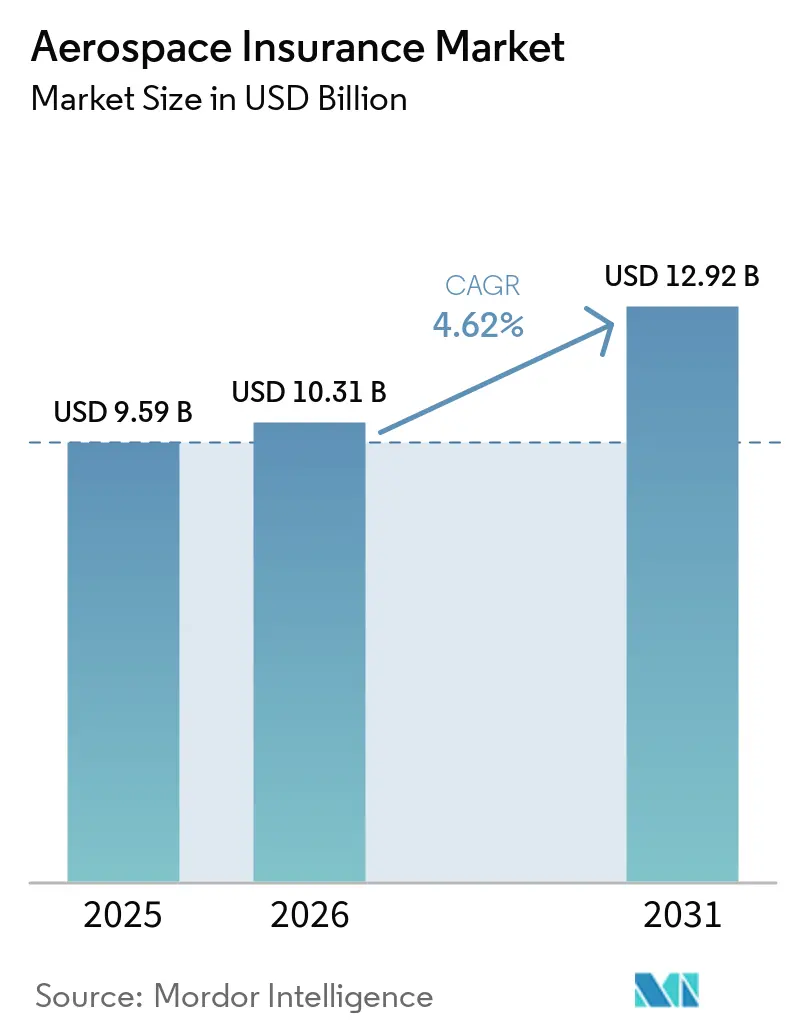
| Market Size (2026) | USD 10.31 Billion |
| Market Size (2031) | USD 12.92 Billion |
| Growth Rate (2026 - 2031) | 4.62 % |
| Fastest Growing Market | Asia-Pacific |
| Largest Market | North America |
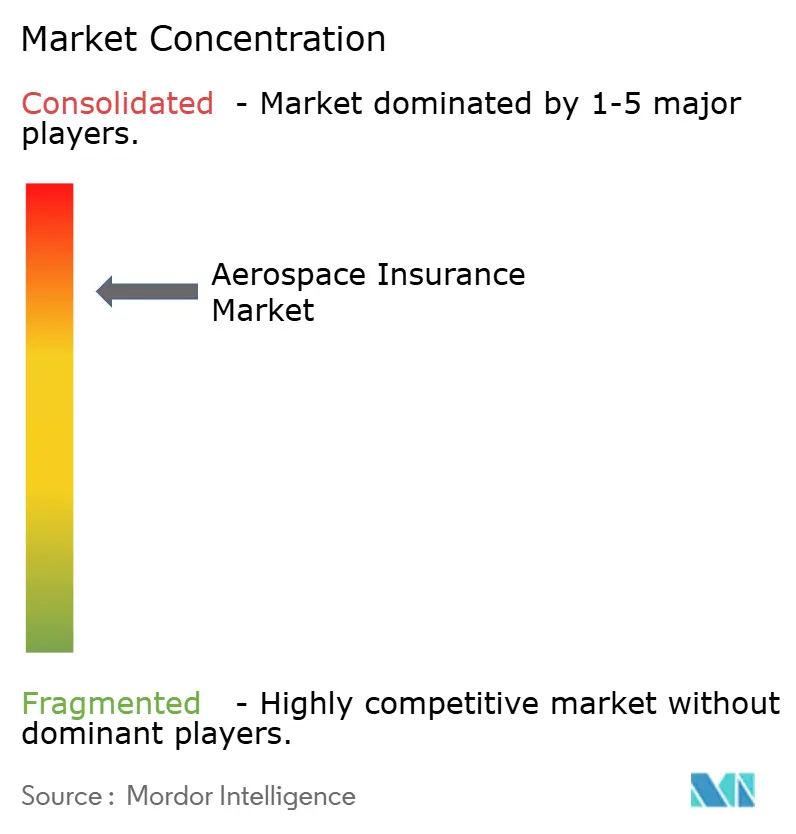
| Market Concentration | High |
Major Players *Disclaimer: Major Players sorted in no particular order Image © Mordor Intelligence. Reuse requires attribution under CC BY 4.0. | |
Aerospace Insurance Market Analysis by Mordor Intelligence
The Aerospace Insurance Market size was valued at USD 9.59 billion in 2025 and is estimated to grow from USD 10.31 billion in 2026 to reach USD 12.92 billion by 2031, at a CAGR of 4.62% during the forecast period (2026-2031).
Recovery in commercial aviation continues to expand the insured fleet base, while space programs, drone operations, and advanced air mobility create new areas of exposure. IATA reported an aircraft order backlog of 18,100 units in May 2026, which exceeded half of the active global fleet and supports a sustained increase in aviation assets requiring coverage. Claims costs remain a central underwriting issue because attritional claims accounted for 50% to 66% of annual global aviation premiums before severe losses were included. The aerospace insurance market is therefore shaped by growth in insured values and activity, but also by higher loss uncertainty and disciplined pricing. Underwriters that combine specialist risk engineering with data-led pricing can respond more effectively as exposure grows in regions and technologies with limited historical loss records.
Key Report Takeaways
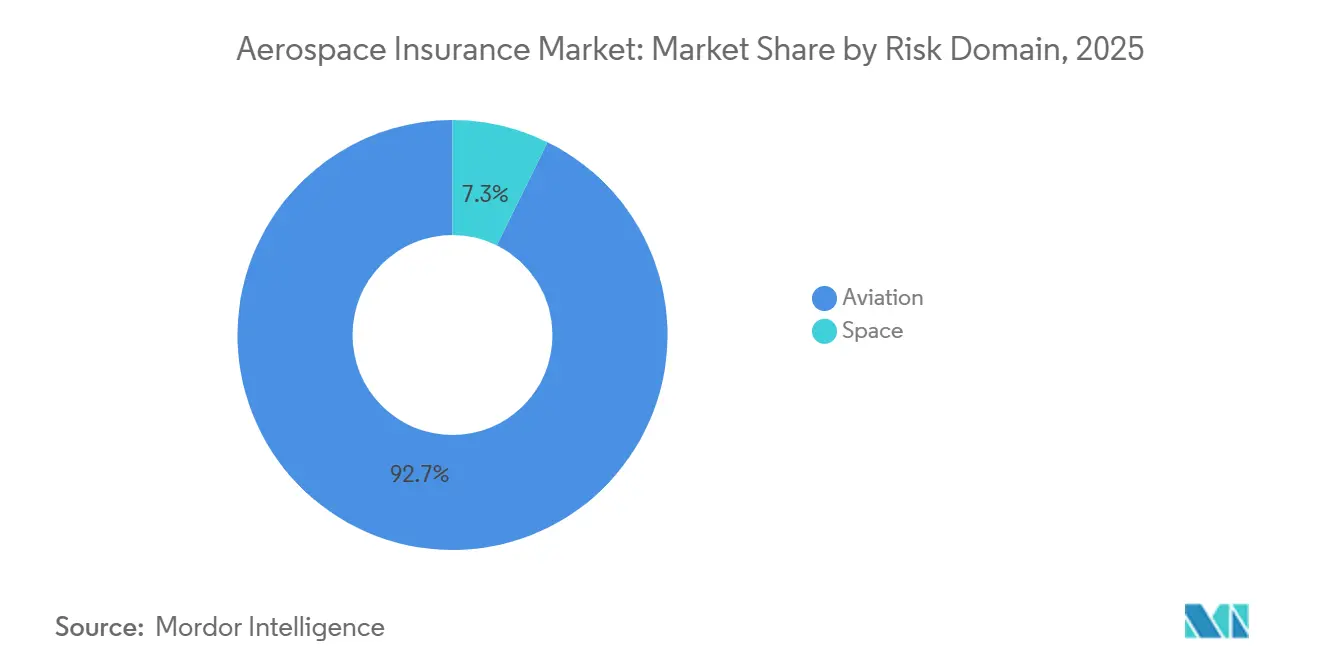
- By risk domain, aviation captured 92.71% of the aerospace insurance market share in 2025, while space is projected to grow at 6.82% CAGR through 2031.
- By insurance type, liability captured 45.68% of the aerospace insurance market share in 2025 and is projected to grow at 5.34% CAGR through 2031.
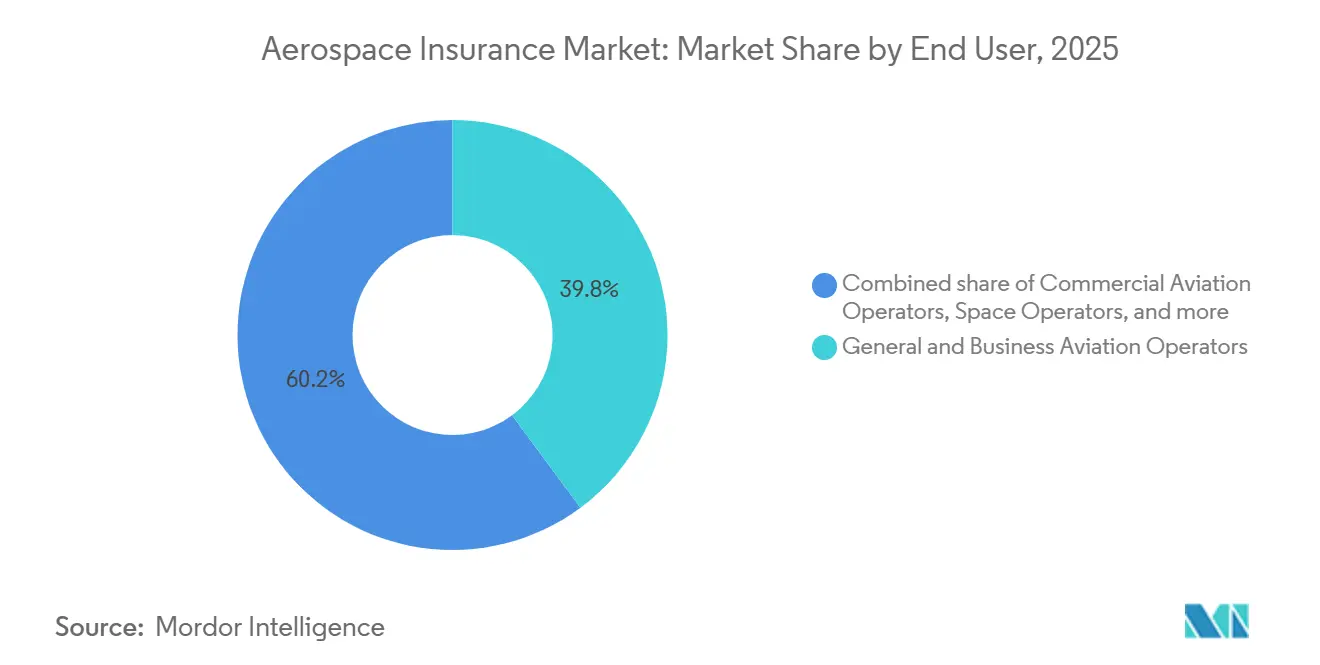
- By end user, general and business aviation operators captured 39.84% of the aerospace insurance market share in 2025, while space operators are projected to grow at 6.75% CAGR through 2031.
- By distribution channel, broker-placed open market distribution captured 74.87% of the aerospace insurance market share in 2025, while delegated authority is projected to grow at 7.22% CAGR through 2031.
- By geography, North America captured 52.69% of the aerospace insurance market share in 2025, while Asia-Pacific is projected to grow at 6.91% CAGR through 2031.
Note: Market size and forecast figures in this report are generated using Mordor Intelligence’s proprietary estimation framework, updated with the latest available data and insights as of January 2026.
Global Aerospace Insurance Market Trends and Insights
Drivers Impact Analysis*
| Driver | (~) % Impact on CAGR Forecast | Geographic Relevance | Impact Timeline |
|---|---|---|---|
| Growth in Global Aviation and Space Assets and Insurable Exposure | +1.4% | Global | Short term (≤ 2 years) |
| Expansion of Commercial Aviation, General Aviation, and Aerospace Activities | +0.9% | Asia-Pacific core, spill-over to MEA and North America | Medium term (2-4 years) |
| Growth in Satellite, Commercial Space, and Launch Activities | +0.6% | North America and Europe, with Asia-Pacific accelerating | Medium term (2-4 years) |
| Increasing Adoption of Drones, UAVs, and Advanced Air Mobility Platforms | +0.4% | North America and Europe | Long term (≥ 4 years) |
| Rising Aircraft, Spacecraft, and Other Aerospace Asset Values and Claims Costs | +0.7% | Global | Short term (≤ 2 years) |
| Increasing Liability Exposure Across Aviation and Space Operations | +0.5% | North America and Europe, extending to Asia-Pacific | Medium term (2-4 years) |
| Source: Mordor Intelligence | |||
Growth in Satellite, Commercial Space, and Launch Activities
Commercial space activity is increasing insurable exposure faster than annual premium income reflects. The Satellite Industry Association reported 259 orbital launches in 2024. Insured satellite numbers did not increase at the same pace, which concentrated premiums across a smaller share of deployed assets. Space insurance capacity entering 2026 increased by more than 15% year over year, although buyer demand for mega-constellation cover remained limited. The December 2025 total loss of SpainSat NG-2, insured for more than USD 400 million, moved the space insurance loss ratio from 15% to 75%[1]Space Insurance market update Q1 2026 - Plane Talking. These conditions make the Aerospace insurance market more exposed to substantial loss volatility even when aggregate launch activity rises.
Increasing Adoption of Drones, UAVs, and Advanced Air Mobility Platforms
Unmanned aerial systems are broadening the addressable risk pool for the aerospace insurance market, but specialized pricing systems are still developing. Swiss Re identified drone proliferation as a source of systematic liability gaps, since general liability policies can contain unpriced drone exposure[2]Swiss Re, “New Risks from Drone Technology,” Swiss Re SONAR 2025, swissre.com.. As the FAA and EASA expand beyond-visual-line-of-sight frameworks, enterprise drone fleets require coverage that reflects their operating risks. Traditional aviation carriers do not always have the distribution scale to serve these fleet programs. WTW identified new managing general agent entrants and delegated authority facilities as important channels for specialist drone capacity in 2026. eVTOL aircraft approaching type certification also require hull and liability terms before commercial operations reach scale.
Rising Aircraft, Spacecraft, and Other Aerospace Asset Values and Claims Costs
Higher replacement values are increasing loss costs across hull and liability coverage. IBA projected 1,800 aircraft deliveries in 2026, while the global average fleet age reached a record 15.2 years[3]IBA Group, “IBA Market Outlook January 2026,” IBA Group, iba.aero.. Older fleets operating in constrained maintenance, repair, and overhaul environments can increase settlement costs. WTW identified parts inflation and maintenance capacity constraints as central sources of rate pressure in airline and manufacturing lines. Large geostationary satellite insured values frequently exceed USD 400 million, while annual space class premium totals USD 500 million to USD 600 million. The aerospace insurance market must account for these large individual exposures when setting capacity and terms.
Expansion of Commercial Aviation, General Aviation, and Aerospace Activities
Global air travel growth is expanding exposure across commercial aviation, general aviation, airports, and related services. IATA expects passenger demand to more than double by 2050, with Asia-Pacific recording the fastest expansion. Avolon identified India, the UAE, and Saudi Arabia as leading aviation growth locations, with a combined aircraft order backlog above 3,000 units[4]India, UAE, and Saudi Arabia Set to Lead Global Aviation Growth – Avolon 2026 Outlook Paper. India, China, and Southeast Asia are expected to account for 8 of the 10 fastest-growing air travel markets through 2044. Rising aviation activity increases the number of assets, passengers, and contractual relationships that require insurance. It also favors insurers with regional risk engineering knowledge where exposure growth is outpacing available loss data.
Restraints Impact Analysis*
| Restraint | (~) % Impact on CAGR Forecast | Geographic Relevance | Impact Timeline |
|---|---|---|---|
| High-Severity Catastrophic and Accumulation Loss Exposure | -0.8% | Global | Short term (≤ 2 years) |
| Limited Historical Loss Data for Emerging Aviation and Space Technologies | -0.5% | Global, With the Asia-Pacific particularly exposed | Long term (≥ 4 years) |
| High Technical Complexity and Specialized Underwriting Requirements | -0.4% | Global | Long term (≥ 4 years) |
| Cyclical Underwriting Capacity and Competitive Pricing Pressure | -0.6% | Global, led by London Market | Medium term (2-4 years) |
| Source: Mordor Intelligence | |||
High-Severity Catastrophic and Accumulation Loss Exposure
The aerospace insurance market has asymmetric loss economics because attritional claims absorb 50% to 66% of annual aviation premiums before severe events are counted. The American Airlines crash in January 2025, the Air India incident in June 2025, and the UPS freighter loss in November 2025 contributed to a challenging aviation loss environment. The late-December 2024 Jeju Air disaster also added to the severity of the period. A June 2025 High Court ruling awarded AerCap approximately USD 1.035 billion under war-risk policies, and insurers were granted permission to appeal the ruling in March 2026. The broader litigation concerns nearly 150 aircraft and engines originally valued at up to USD 4.7 billion, sustaining uncertainty around significant aviation insurance exposures. Underwriters consequently need to account for accumulation scenarios that are difficult for existing models to capture.
Limited Historical Loss Data for Emerging Aviation and Space Technologies
Aerospace underwriting has traditionally relied on commercial airline and large geostationary satellite loss data. eVTOL aircraft lack commercially operating fleets of meaningful scale, requiring underwriters to draw cautiously on helicopter and fixed-wing precedents. Small low-Earth-orbit constellations operate in debris environments that geostationary satellite models were not designed to measure. A 2026 survey of 106 aerospace insurance professionals identified emerging technology risk as a systemic challenge for which existing frameworks were inadequate. Fragmented drone incident reporting can undercount frequency and contribute to early underpricing in delegated authority programs. These data limitations, technical requirements, and cyclical capacity conditions constrain the pace at which the aerospace insurance market can develop reliable coverage for new risks.
*Our forecasts treat driver/restraint impacts as directional, not additive. The impact forecasts reflect baseline growth, mix effects, and variable interactions.
Segment Analysis
By Risk Domain: Aviation Holds the Largest Premium Base While Space Grows Faster
Aviation held 92.71% of the aerospace insurance market share in 2025, reflecting its broad premium base across airline fleets, cargo carriers, general aviation, and aviation liability. IATA’s 18,100-unit order backlog in May 2026 supports continued fleet-related insurance exposure. Airline customers face projected hull and liability rate increases of 10% to 15% in 2026 following the high-severity losses recorded in 2025. General aviation accounts with profitable loss records can still receive rate reductions because capacity remains available and new MGAs are competing for business. This difference shows that underwriting conditions vary materially by operating profile and loss performance. The aerospace insurance market size remains largely driven by aviation, as the global fleet and associated liabilities expand.
Space is projected to record a 6.82% CAGR through 2031, making it the faster-growing risk domain in the aerospace insurance market. More commercial launches and lunar activity are expanding the range of assets that need specialist cover. Space capacity was more than 15% higher entering 2026, but limited demand for constellation coverage restrained the translation of exposure into premium. China’s March 2025 domestic launch consortium covered USD 1.47 billion in exposure across 25 private commercial launches. The development may reduce dependence on established international placement routes over time. Individual satellite losses remain capable of changing annual class results quickly, which requires cautious deployment of capacity.


By Insurance Type: Liability Leads in Scale and Growth
Liability captured 45.68% of the aerospace insurance market share in 2025 and is projected to grow at a 5.34% CAGR through 2031. The segment benefits from broader third-party liability requirements, greater jury award severity in North America, and new categories of insured operators. These factors increase both the number of policies requiring liability cover and the limits sought by individual insureds. Liability, therefore, combines the largest 2025 insurance-type position with the highest projected growth rate. The segment’s position also reflects the role of compulsory liability frameworks in creating baseline demand for airline coverage. For insurers, the key task is to manage limit exposure while maintaining capacity for established and emerging operators.
Hull and physical damage pricing is increasing as replacement costs for modern widebody aircraft regularly exceed USD 300 million. Aviation war and allied perils coverage has received closer scrutiny after the June 2025 ruling on aircraft withheld in Russia. The ruling identified war-risk policies as the primary recovery route for claims totaling USD 4.7 billion, although the decision is under appeal. Other specialty lines cover airport liability, maintenance and repair organizations, and aircraft product manufacturers. These lines are smaller by volume but can face correlated litigation linked to aviation events. The Montreal Convention provides a compulsory liability framework that supports baseline demand for airline liability underwriting worldwide.
By End User: General Aviation Provides Scale While Space Operators Expand Faster
General and business aviation operators held 39.84% of the aerospace insurance market share in 2025. This position was supported by the large number of private aircraft owners, business jet fleets, and flight schools in North America and Europe. WTW reported abundant general aviation capacity in 2026, with new MGAs competing for well-performing accounts. Commercial aviation operators face a different renewal environment after the severe loss cluster in 2025. WTW expects airline hull and liability increases of 10% to 15% in 2026. Aircraft lessors and financiers also remain exposed to uncertainty as withheld-aircraft litigation continues through the appeal process.
Space operators are forecast to grow at a 6.75% CAGR through 2031, the fastest rate among end users in the aerospace insurance market. The expansion is linked to reusable launch activity, Amazon’s Project Kuiper build-out, and a growing NewSpace cohort. Airports and aviation infrastructure represent a stable source of insurance demand as aircraft fleets and passenger volumes increase. Airbus expects India’s technical aviation workforce to triple to 34,000 by 2035, highlighting the downstream infrastructure required to support fleet expansion. Marsh reported growing buyer interest in long-term agreements in June 2026. These multi-year arrangements can change how loss experience develops within insurer portfolios and offer buyers more renewal certainty.
By Distribution Channel: Broker Placements Remain Central While Delegated Authority Gains Ground
Broker-placed open market distribution held 74.87% of the aerospace insurance market share in 2025. The channel remains important because large airline and spacecraft placements require specialist structuring and multicarrier co-insurance. Brokers with Lloyd’s and London Market access are well-positioned to arrange these complex programs. The scale of broker placements reflects decades of specialist intermediation in aerospace risks. It also helps buyers access capacity from several carriers for exposures that cannot be retained by one insurer. The channel will remain important for large and bespoke placements even as other distribution structures expand.
Delegated authority is forecast to grow at a 7.22% CAGR through 2031. AM Best reported that global MGA direct written premiums reached USD 108.7 billion in 2025, up 17.8% from USD 92.3 billion in 2024. Within aerospace, MGAs are serving smaller general aviation operators, drone fleets, and advanced air mobility businesses that may be difficult to price at scale through broker-led processes. WTW identified greater use of lineslips, binders, and auto-binding arrangements in aviation during 2026. Bishop Street Underwriters acquired Aerospace Insurance Managers in July 2025, providing an example of investment in specialist MGA distribution. These models can improve access and process efficiency, while technical underwriting controls remain essential.
Geography Analysis
North America held 52.69% of global aerospace insurance premiums in 2025, giving it the largest regional position in the aerospace insurance market. The region is supported by the United States’ large commercial aviation fleet and high per-insured liability exposure. WTW expects tougher renewal conditions for United States airline risks in 2026, including higher retentions for some accounts. The AerCap ruling added a claims settlement issue that reinforces the region’s influence on global loss economics. Canada’s commercial aviation recovery and Mexico’s growing general aviation activity broaden the regional insurance base. The result is a large and mature market with strong demand but meaningful exposure to liability and large-loss volatility.
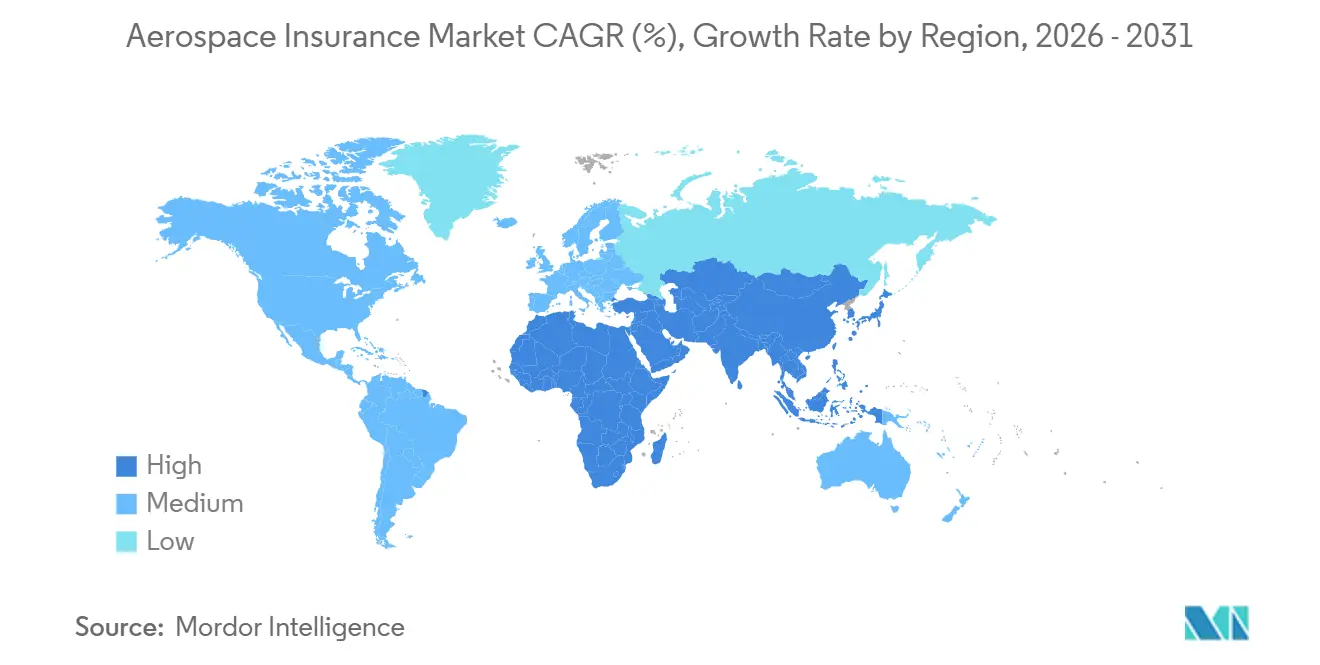
Asia-Pacific is forecast to grow at a 6.91% CAGR through 2031, the fastest regional rate in the aerospace insurance market. Airbus expects India’s commercial fleet to reach 2,250 aircraft by 2035, while IndiGo holds more than 900 aircraft on order. China is expected to require 1,000 new aircraft, and its 2025 domestic space insurance consortium indicates an effort to retain launch risk domestically. India, China, and Southeast Asia are expected to account for 8 of the 10 fastest-growing air travel markets through 2044. India’s DGCA and China’s CAAC have strengthened compulsory insurance requirements, while Singapore’s CAAS is positioning the city-state as an aviation insurance hub. These developments increase regional opportunity but also make local knowledge and disciplined data collection more important.
Europe is the second-largest regional base and remains home to the Lloyd’s and London Market ecosystem that underwrites a large share of global aerospace risks. The aerospace insurance market size in Europe benefits from this concentration of specialist underwriting expertise and international placement capacity. The 2026 IUAI survey found that 75% of aviation insurance professionals considered geopolitical instability the sector’s largest systemic threat. The Middle East and Africa also offer strategic growth potential as the UAE and Saudi Arabia hold a combined order backlog above 3,000 aircraft. Middle East carriers recorded 9.6% year-over-year demand growth in November 2025. South America is showing improving insurance penetration in Brazil and Colombia, supported by broader insurance growth in Latin America.

Competitive Landscape
The aerospace insurance market is concentrated at the primary underwriting level. Allianz Commercial, AXA XL, AIG, Chubb, and Global Aerospace hold important positions in airline and large commercial aviation programs. Specialty syndicates, regional carriers, and expanding MGAs compete for general aviation and delegated authority business. The wider supplier base limits the concentration of capacity outside the largest placements. The competitive position of an insurer depends on underwriting expertise, balance-sheet strength, distribution access, and the ability to support complex risk placements. This structure supports a market with leading global underwriters but multiple specialist participants.
The Russia-Ukraine withheld-aircraft litigation remains a major financial event for the aerospace insurance market. Lessors, including AerCap and Dubai Aerospace Enterprise, have claims against AIG, Lloyd’s, Chubb, and Swiss Re that total USD 4.7 billion. The June 2025 High Court ruling is under appeal, which continues to affect reserves and risk assessment across the involved insurers. Munich Re disclosed 2024 insurance revenue of EUR 60.8 billion and investment in cover for rocket launches, cyber risks, and other emerging technology risks. Marsh reported that buyers are increasingly considering long-term agreements that can offer renewal certainty and protection against capacity withdrawal. These approaches differentiate firms that can provide stable capacity while responding to changing loss conditions.
New activity is focused on parametric cover for small satellite constellations, cyber-physical cover for autonomous aviation, and capacity for lunar missions. These initiatives are expanding the range of specialized solutions available in the aerospace insurance market. Novacore launched a dedicated aerospace segment in April 2026 for complex aviation and space exposures. Whitecap Aerospace confirmed space underwriting capacity from January 1, 2026. Warren AI, launched in 2025 for space underwriting, combines orbital intelligence and parametric risk modeling for real-time pricing. The 2026 IUAI survey identified AI, new aircraft technologies, and growing aviation demand as leading opportunities.
Aerospace Insurance Industry Leaders
American International Group, Inc.
Chubb Limited
Sompo Holdings, Inc.
Old Republic International Corporation
Münchener Rückversicherungs-Gesellschaft Aktiengesellschaft in München
- *Disclaimer: Major Players sorted in no particular order

Recent Industry Developments
- April 2026: Novacore launched a dedicated aerospace segment for complex aviation and space exposures, building on NSM Insurance Group's 35-year specialty insurance track record. The entry adds new specialist capacity to the competitive general aviation and space mid-market.
- March 2026: United Kingdom courts granted Chubb, Fidelis, and Lloyd's syndicates permission to appeal the June 2025 High Court ruling awarding AerCap approximately USD 1 billion in war-risk recoveries for aircraft stranded in Russia, with the outcome expected to affect reserve adequacy across approximately USD 4.7 billion in total withheld aircraft claims.
- February 2026: ESA and Liberty Mutual Reinsurance signed a Memorandum of Intent for a 3-year collaboration to develop satellite-data-based parametric insurance solutions for the agriculture and forestry sectors.
- January 2026: Whitecap Aerospace confirmed space underwriting capacity from January 1, 2026, deploying up to USD 8 million for launch, commissioning, and in-orbit satellite risks through an A-rated insurer.


Global Aerospace Insurance Market Report Scope
| Aviation |
| Space |
| Hull and Physical Damage |
| Liability |
| Aviation War and Allied Perils |
| Other Specialty |
| Commercial Aviation Operators |
| General and Business Aviation Operators |
| Aviation Products Liability Insureds |
| Airports and Aviation Infrastructure |
| Aircraft Lessors and Financiers |
| Space Operators |
| Broker-placed Open Market |
| Delegated Authority |
| Direct |
| North America | United States |
| Canada | |
| Mexico | |
| South America | Brazil |
| Argentina | |
| Rest of South America | |
| Europe | United Kingdom |
| Germany | |
| France | |
| Italy | |
| Spain | |
| Rest of Europe | |
| Asia-Pacific | China |
| Japan | |
| India | |
| South Korea | |
| Australia | |
| Indonesia | |
| Thailand | |
| Malaysia | |
| Singapore | |
| Vietnam | |
| Rest of Asia-Pacific | |
| Middle East and Africa | Saudi Arabia |
| United Arab Emirates | |
| Turkey | |
| South Africa | |
| Egypt | |
| Rest of Middle East and Africa |
| By Risk Domain | Aviation | |
| Space | ||
| By Insurance Type | Hull and Physical Damage | |
| Liability | ||
| Aviation War and Allied Perils | ||
| Other Specialty | ||
| By End User | Commercial Aviation Operators | |
| General and Business Aviation Operators | ||
| Aviation Products Liability Insureds | ||
| Airports and Aviation Infrastructure | ||
| Aircraft Lessors and Financiers | ||
| Space Operators | ||
| By Distribution Channel | Broker-placed Open Market | |
| Delegated Authority | ||
| Direct | ||
| By Geography | North America | United States |
| Canada | ||
| Mexico | ||
| South America | Brazil | |
| Argentina | ||
| Rest of South America | ||
| Europe | United Kingdom | |
| Germany | ||
| France | ||
| Italy | ||
| Spain | ||
| Rest of Europe | ||
| Asia-Pacific | China | |
| Japan | ||
| India | ||
| South Korea | ||
| Australia | ||
| Indonesia | ||
| Thailand | ||
| Malaysia | ||
| Singapore | ||
| Vietnam | ||
| Rest of Asia-Pacific | ||
| Middle East and Africa | Saudi Arabia | |
| United Arab Emirates | ||
| Turkey | ||
| South Africa | ||
| Egypt | ||
| Rest of Middle East and Africa | ||


Key Questions Answered in the Report
What is the projected growth rate for aerospace insurance?
The sector is forecast to grow at 4.62% CAGR from 2026 to 2031, reaching USD 12.92 billion by 2031.
Which risk domain has the largest premium base?
Aviation held 92.71% of 2025 premiums, supported by commercial fleets, cargo carriers, general aviation, and aviation liability.
Why is space insurance expanding faster than aviation insurance?
Space is projected to grow at 6.82% CAGR through 2031 because commercial launch activity and lunar activity are expanding specialist coverage needs.
Which region is expected to grow the fastest?
Asia-Pacific is forecast to grow at 6.91% CAGR through 2031, supported by fleet expansion in India, China, and Southeast Asia.
What is driving liability insurance demand in aerospace?
Third-party liability mandates, higher jury award severity in North America, and new operator categories are increasing demand and policy limits.
How concentrated is aerospace insurance underwriting?
The sector is concentrated, with several leading global underwriters in large aviation programs and a broader group of specialists and MGAs in other lines.
Page last updated on:





