
Aerial Imaging Market Size and Share
Market Overview
| Study Period | 2020 - 2031 |
|---|---|
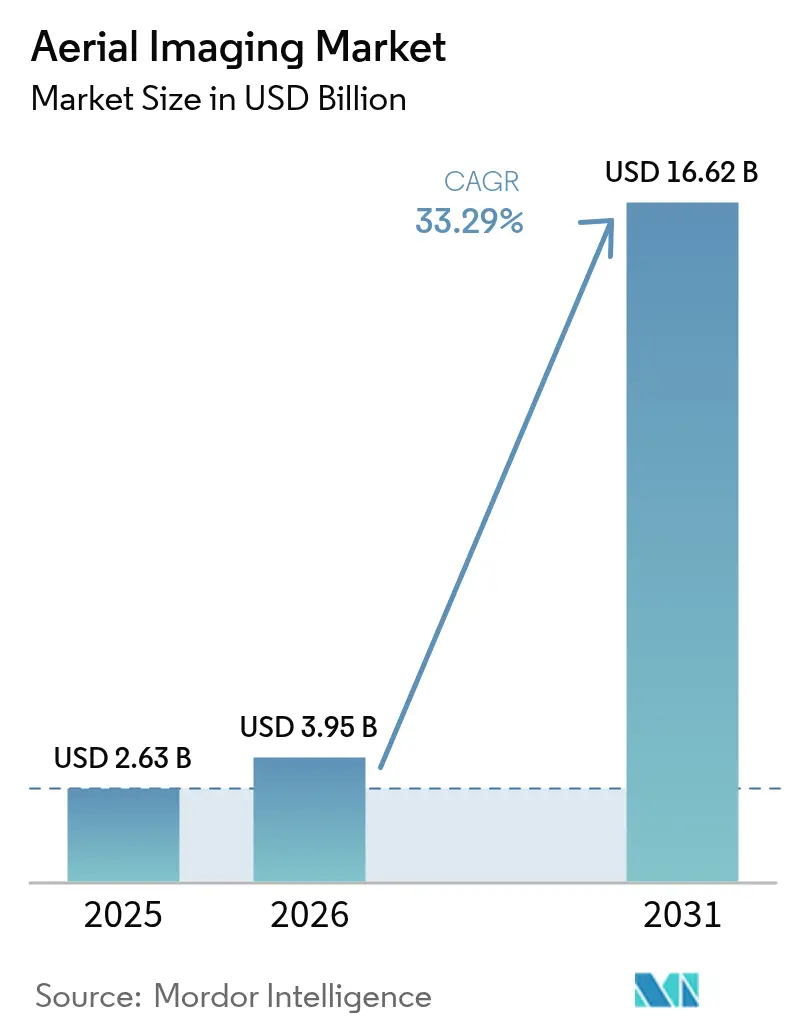
| Market Size (2026) | USD 3.95 Billion |
| Market Size (2031) | USD 16.62 Billion |
| Growth Rate (2026 - 2031) | 33.29 % |
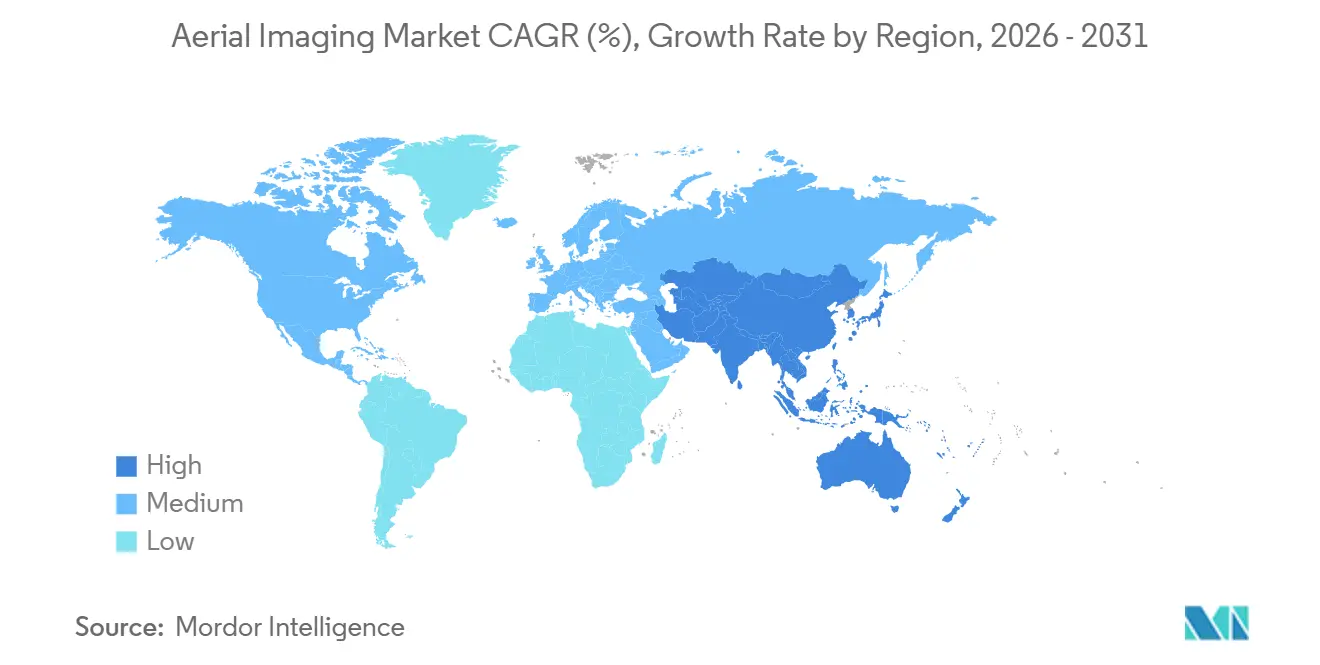
| Fastest Growing Market | Asia Pacific |
| Largest Market | North America |
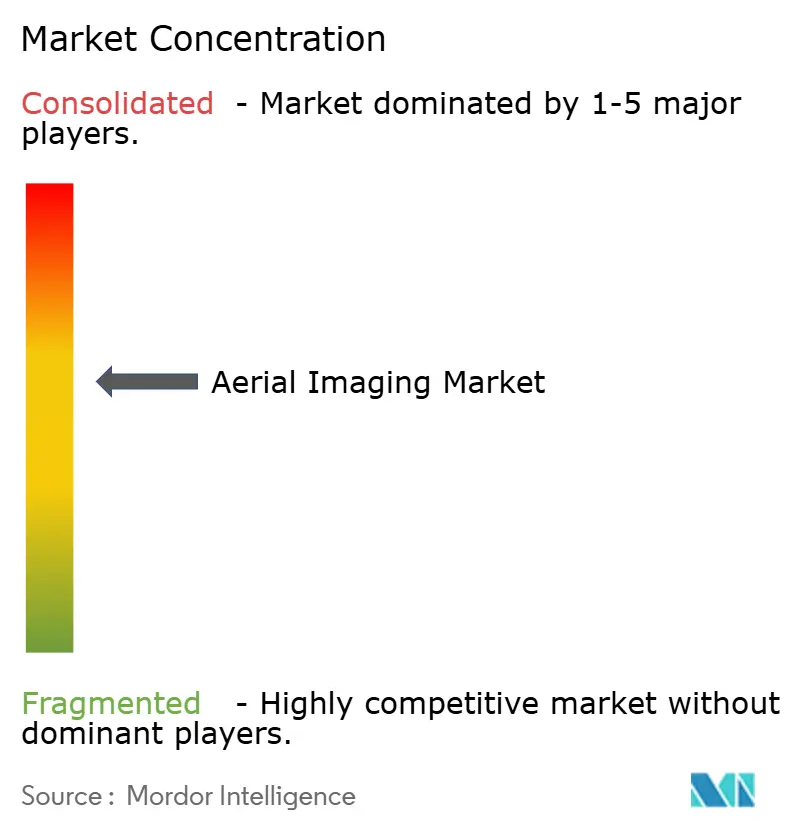
| Market Concentration | Medium |
Major Players *Disclaimer: Major Players sorted in no particular order Image © Mordor Intelligence. Reuse requires attribution under CC BY 4.0. | |
Aerial Imaging Market Analysis by Mordor Intelligence
The aerial imaging market size is projected to expand from USD 2.63 billion in 2025, USD 3.95 billion in 2026, and reach USD 16.62 billion by 2031, registering a 33.29% CAGR over 2026-2031. Early adoption obligations for sub-10-centimeter geodata, hybrid-VTOL platforms that solve the range-payload dilemma, and on-device AI chips that shrink processing cycles now frame the sector’s structural trajectory. Government digital-twin programs, energy-sector inspection demand, and subscription-library moats sustained growth in 2025, while on-demand tasking and LiDAR workflows accelerated as turnaround speed and canopy penetration became decisive purchase criteria. Competition from low-earth-orbit constellations is reshaping value propositions, yet aerial operators still own the sub-decimetre and oblique-angle niches. Hybrid-VTOL certifications, declining multirotor hardware costs, and real-time 5G streaming carved new opportunities for small providers. Meanwhile, varying privacy statutes, fragmented flight-approval regimes, and cyber-liability coverage requirements tempered margin expansion even as volume skyrocketed.
Key Report Takeaways
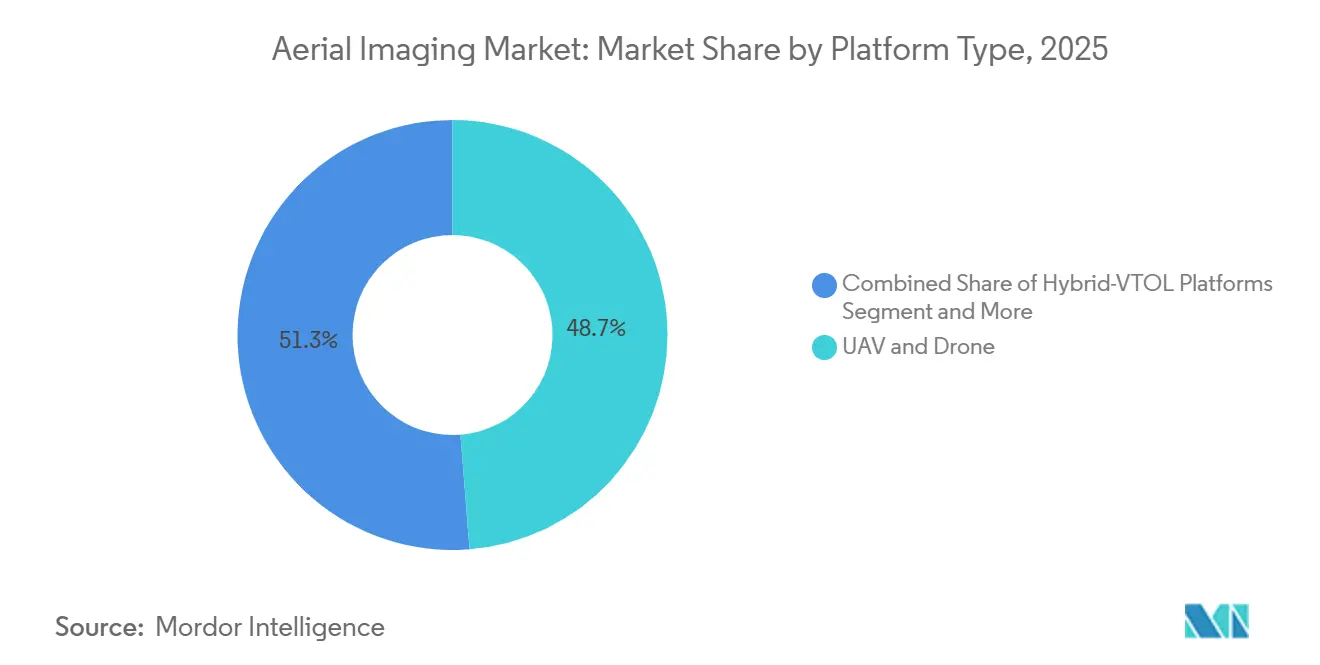
- By platform type, UAVs and drones led with 48.74% revenue share in 2025; hybrid-VTOL platforms are projected to advance at a 33.91% CAGR through 2031.
- By imaging technique, LiDAR commanded 33.78% growth through 2031, outpacing vertical imaging’s 2025 incumbent share of 42.49%
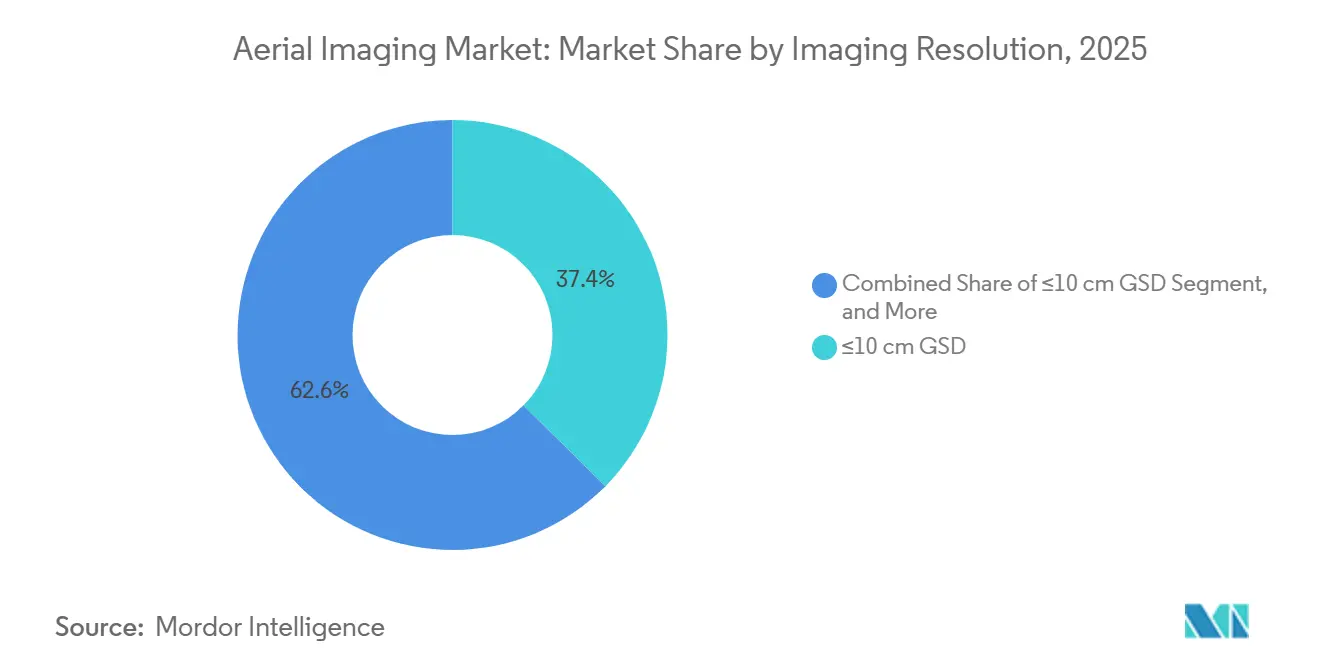
- By imaging resolution, ≤10 centimeter captures seized 37.41% of revenue in 2025 and are forecast to rise at a 34.22% CAGR to 2031.
- By delivery mode, subscription libraries accounted for 53.94% share of the aerial imaging market size in 2025, while on-demand tasking is expanding at a 34.55% CAGR over 2026-2031.
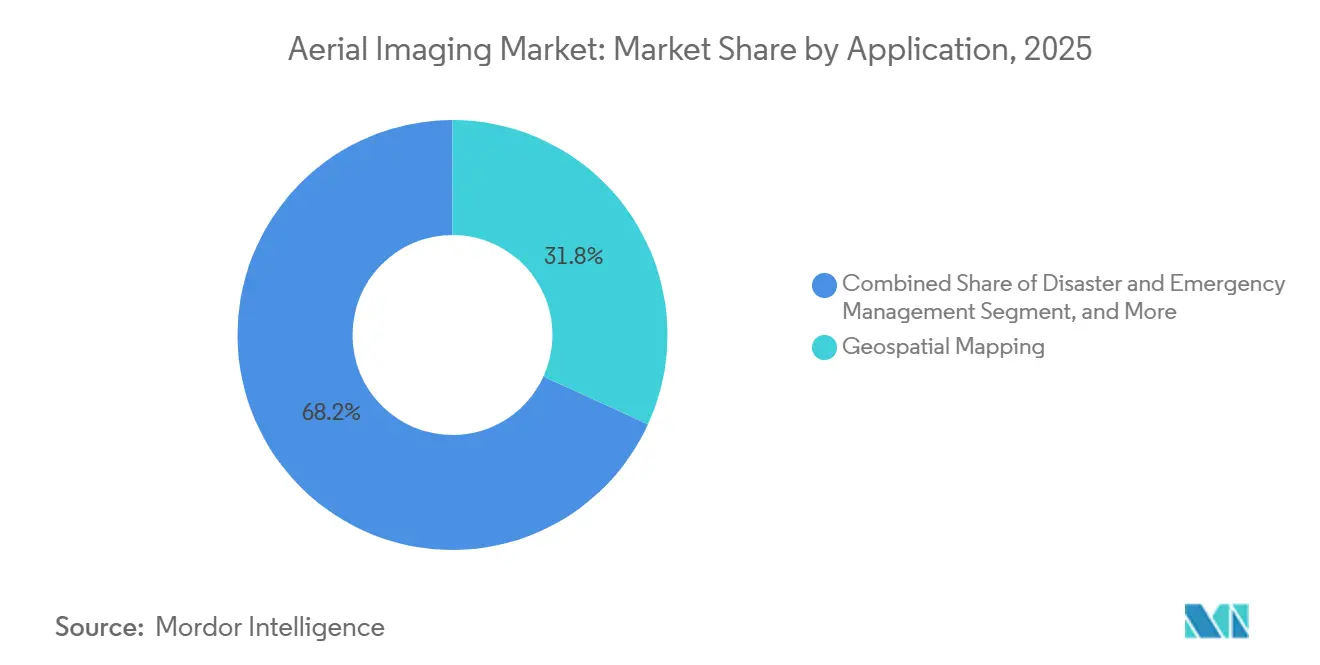
- By application, geospatial mapping held 31.82% of 2025 revenue, whereas disaster and emergency management is advancing at a 34.37% CAGR through 2031.
- By end-user, the energy, power and utilities segment is forecast to post the fastest 34.61% CAGR during 2026-2031, while government and public agencies retained 33.73% share in 2025.
Note: Market size and forecast figures in this report are generated using Mordor Intelligence’s proprietary estimation framework, updated with the latest available data and insights as of 2026.
Market Trends and Insights
Drivers Impact Analysis of Aerial Imaging Market*
| Driver | (~) % Impact on CAGR Forecast | Geographic Relevance | Impact Timeline |
|---|---|---|---|
| AI-Augmented Image Analytics Reducing Processing Time | +6.80% | Global, with early adoption in North America and Europe | Short term (≤ 2 years) |
| Proliferation of Location-Based Services, 5G and IoT Ecosystems | +6.20% | Global, accelerated in Asia-Pacific urban corridors | Medium term (2-4 years) |
| Growth in Smart-City and Infrastructure Digital-Twin Projects | +5.90% | Asia-Pacific core, spillover to Middle East | Medium term (2-4 years) |
| Rapid Adoption of UAVs and Drones for Low-Cost Data Capture | +5.40% | Global, particularly South America and Africa for agriculture | Short term (≤ 2 years) |
| Demand for High-Resolution Geodata to Train Autonomous-Vehicle Stacks | +4.70% | North America and Europe, emerging in China | Long term (≥ 4 years) |
| Agricultural Demand for Crop-Health Multispectral Imaging | +4.30% | Global, concentrated in Brazil, India, United States | Medium term (2-4 years) |
| Source: Mordor Intelligence | |||


AI-Augmented Image Analytics Reducing Processing Time
On-device neural accelerators now execute photogrammetry, segmentation, and defect-detection models during flight, collapsing delivery cycles from days to minutes. Operators embed the chips in gimbals and edge boxes weighing under 500 grams, enabling real-time orthomosaic assembly while airframes return to base. North American energy utilities began issuing service-level agreements that stipulate same-day line-fault detection, a requirement unattainable with cloud-only workflows. The processing shift slashed bandwidth costs by 55% because only finished vector layers, not raw imagery, reach the cloud. Smaller regional firms therefore compete on insight latency rather than fleet size. In Europe, GDPR-compliant edge redaction removes license plates and faces before storage, trimming post-processing expense and privacy risk.[1]Singapore Land Authority, “Virtual Singapore Platform Update,” sla.gov.sg
Proliferation of Location-Based Services, 5G and IoT Ecosystems
Standalone 5G deployments deliver sub-10 millisecond uplink latency that allows drones to stream 4K video directly into municipal traffic dashboards. Seoul and Tokyo reached 95% urban 5G coverage by late 2025, turning real-time aerial feeds into routine data layers for congestion management. IoT payloads synchronize gimbal angle, barometric pressure, and IMU data, letting automated software stitch sub-5-centimeter orthomosaics without ground-control points. Logistics firms overlay the live maps with driver GPS to fine-tune last-mile routing. Streaming workflows substitute capital-heavy local processing farms with network capacity, further democratizing entry for cash-light startups. Asia-Pacific corridors therefore exhibit the steepest ramp in tasking volume per square kilometer.
Growth in Smart-City and Infrastructure Digital-Twin Projects
Governments allocated more than USD 18 billion to digital-twin procurements in 2025, embedding quarterly UAV LiDAR refreshes into procurement guidelines. Singapore’s Virtual Singapore platform relies on 3D meshes updated every three months, enabling planners to simulate solar gain and urban heat-island effects before approving permits. The European Union earmarked EUR 1.2 billion (USD 1.28 billion) for cross-border twin interoperability, mandating sub-20-centimeter horizontal accuracy that favours aerial imaging over satellites at city scale. Infrastructure concessionaires integrate annual aerial surveys into maintenance contracts to track pavement degradation and unauthorized encroachments. Recurring datasets convert once-off survey revenue into subscription-like cash flows, raising valuation multiples across providers.
Rapid Adoption of UAVs and Drones for Low-Cost Data Capture
Enterprise quadcopters with thermal and multispectral payloads now retail below USD 15 000, 40% lower than 2024 pricing. The FAA had issued 385 000 Part 107 certificates by December 2025, reflecting surging in-house adoption by construction and agriculture clients. Lithium-polymer energy density rose to 280 Wh kg⁻¹, pushing endurance to 45 minutes and enabling 150-hectare single sorties without battery swaps. Regulatory easing, such as the FAA rule on flights over moving vehicles, unlocked roadside inspection and live-event security. Open-source flight-planning tools paired with cloud photogrammetry lowered skill barriers, letting non-specialists generate ortho-ready mosaics hours after capture.
Restraints Impact Analysis of Aerial Imaging Market*
| Restraint | (~) % Impact on CAGR Forecast | Geographic Relevance | Impact Timeline |
|---|---|---|---|
| Fragmented Global and Local Air-Regulation Regimes | -3.20% | Global, acute in Europe and Asia-Pacific | Medium term (2-4 years) |
| Rising Data-Privacy and Surveillance-Use Lawsuits | -2.80% | Europe and North America, emerging in Asia-Pacific | Short term (≤ 2 years) |
| Cyber-Attacks on Aerial Imaging Data-Streams | -1.90% | Global, concentrated in critical infrastructure sectors | Short term (≤ 2 years) |
| Competition from Low-Orbit Constellation Satellites | -1.60% | Global, particularly impacting subscription-library models | Long term (≥ 4 years) |
| Source: Mordor Intelligence | |||
Fragmented Global and Local Air-Regulation Regimes
Waiver processes differ widely: FAA approvals averaged 90 days in 2025, while European Union Aviation Safety Agency specific-category authorizations demanded 14 technical annexes and external conformity audits that extended timelines up to nine months. India bars flights within 3 kilometers of borders and military sites, excluding 18% of its landmass without case-by-case clearance. Such divergence forces operators to field jurisdiction-specific compliance teams and maintain multiple fleet configurations, eroding economies of scale. Multi-national clients now split tenders by country, raising bidding overhead and fragmenting revenue streams.
Rising Data-Privacy and Surveillance-Use Lawsuits
A 2025 California class action claimed oblique imagery captured biometric data without consent, invoking the California Consumer Privacy Act. In March 2025 the European Court of Justice ruled that aerial shots containing license plates constitute personal data under GDPR. Real-time anonymization software that blurs faces and plates in 4K at 30 fps costs USD 50 000-120 000, an outlay many small providers cannot absorb. Insurers also raised minimum cyber-liability coverage to USD 5 million for operators handling personally identifiable information, increasing premiums by up to 12% and curbing entry into urban-surveillance projects.
*Our forecasts treat driver/restraint impacts as directional, not additive. The impact forecasts reflect baseline growth, mix effects, and variable interactions.
Aerial Imaging Market Segment Analysis
By Platform Type:
Hybrid-VTOL Platforms Reshape Range EconomicsHybrid-VTOL systems are forecast to grow at a 33.91% CAGR through 2031, surpassing the aerial imaging market average as utilities embrace rotary-wing take-off paired with fixed-wing cruise for 150-kilometer corridors. UAVs and drones retained 48.74% of 2025 revenue because sub-50-hectare mapping remains their sweet spot. Fixed-wing aircraft still dominate 300-square-kilometer cadastral sorties where hour-plus endurance justifies mobilization costs. Helicopters persist for offshore rigs and alpine LiDAR, tasks that require pilot judgment under instrument flight rules. Hybrid-VTOL adoption accelerated after multiple jurisdictions granted type certifications in late 2025, reducing insurance surcharges and enabling single-operator coverage of 800-kilometer pipelines that once mandated multi-day helicopter campaigns.
Improved tiltrotor designs now deliver 120-minute endurance with 8-kilogram payloads, aligning with high-spec LiDAR weight classes and supporting automated defect detection at 2-centimeter point density. Accordingly, utilities are embedding hybrid-VTOL budgets into asset-integrity programs, a trend expected to lift the aerial imaging market share of the segment beyond 25% by 2031.


By Imaging Technique:
LiDAR Gains Traction in Canopy-Penetration WorkflowsLiDAR, projected at a 33.78% growth clip, is displacing photogrammetry where dense canopy obscures terrain or where sub-5-centimeter elevation accuracy dictates volumetric billing. The aerial imaging market size for LiDAR workflows expanded after 2024 solid-state sensors arrived at sub-USD 30 000 price points and weighed under 1.5 kilograms, enabling integration on 10-kilogram UAVs. Forestry concessions in Canada and Scandinavia rely on LiDAR to derive basal-area indices beneath conifer crowns, a task traditional orthophotos cannot meet. Vertical nadir captures still held 42.49% of 2025 revenue, favoured in agriculture and cadastral mapping.
Oblique imagery grew inside insurance underwriting and 3D city-model texturing as façades joined structural-integrity checks. Multispectral, hyperspectral, and thermal modalities found traction in crop diagnosis, environmental monitoring, and solar-panel inspection, yet adoption lags due to sensor costs and analytic complexity. Providers that bundle LiDAR scanners with AI terrain-classification pipelines now command premium day-rates, illustrating how sensor-fusion elevates deliverable value.
By Imaging Resolution:
Ultra-High Resolution Fuels Digital-Twin PrecisionSub-10-centimeter ground-sample distance images held 37.41% of 2025 revenue and will grow at 34.22% through 2031 because municipal twins and autonomous-vehicle maps need decimeter accuracy. Sensors topping 50 megapixels mounted on stabilized gimbals keep pixel blur under control at legal 120-meter altitudes, letting operators satisfy tender specifications without waiver delays. The 11–25-centimeter tier remained viable for watershed modelling and county-scale agriculture where file-size savings eclipse detail loss.
The 26–50-centimeter bracket enabled nationwide land-cover projects at costs under USD 8 000 per 500 square kilometers. Imagery coarser than 50 centimeters serves rapid reconnaissance during disaster response when speed outranks granularity. Public-works agencies now stipulate crack-width detection thresholds in tenders, effectively locking in ≤10 centimeter resolution for pavement and bridge monitoring. This mandate pulls downstream data-storage and processing demand, further reinforcing high-resolution capture economics.
By Delivery Mode:
On-Demand Tasking Gains Momentum in Time-Sensitive VerticalsOn-demand tasking is advancing at a 34.55% CAGR to 2031, chipping away at subscription-library dominance as insurers and contractors call for sub-24-hour capture windows. The aerial imaging market share of subscription libraries stood at 53.94% in 2025 because real-estate portals and cadastral agencies value predictable refresh cycles. Price gaps narrowed when operators automated flight planning and leveraged idle capacity; on-demand cost per square kilometre fell 28% in 2025. Hybrid models emerged, granting subscribers priority windows at marginal-cost rates, effectively blending recurring and transactional revenue.
API-first platforms now let clients ingest feasibility checks and finished orthomosaics into enterprise systems without human coordination, shrinking order-to-delivery cycles from weeks to hours. This self-serve convenience particularly resonates with companies that have episodic but critical imagery needs, such as legal discovery and event management.
By Application:
Disaster Management Surges on Climate-Event FrequencyDisaster and emergency management is forecast to climb 34.37% through 2031, reflecting the rising number and severity of climate-related incidents. Real-time oblique and thermal feeds integrated into incident-command dashboards proved decisive during 2025 U.S. wildfire seasons and Asia-Pacific typhoon responses. Geospatial mapping retained 31.82% share in 2025 owing to cadastral and corridor survey mandates.
Infrastructure planning and asset inspection applications linked directly to digital-twin initiatives also expanded. Environmental and forestry programs turned to aerial imaging for carbon-offset verification as ESG reporting tightened. Agriculture and precision farming remained stable, but price pressure forced service providers to bundle agronomic insights rather than sell raw geodata. Insurance adopted mandatory aerial surveys for every commercial claim above USD 500 000, making the workflow commonplace rather than exceptional.
By End-User Industry:
Energy Sector Leads Vertical GrowthEnergy, power and utilities customers will register a 34.61% CAGR through 2031. Aging grids and renewable-generation buildouts drive demand for automated thermal and visual inspection of conductors, insulators, and photovoltaic panels. Government and public agencies held 33.73% of revenue in 2025 thanks to sustained cadastral, transportation, and emergency-response budgets.
Construction and real-estate buyers expanded usage for progress verification and volumetric earthwork, while oil and gas turned to aerial LiDAR for pipeline integrity despite capital-spending caution linked to transition policies. Defense and homeland security purchases continued but faced 18-24-month procurement cycles tied to encryption mandates. Mining operations deployed LiDAR stockpile surveys to align physical and financial inventories, integrating outputs with ERP modules to cut write-off risk.
Geography Analysis
North America Aerial Imaging Market
North America generated 34.22% of 2025 revenue. FAA Remote ID enforcement accelerated fleet upgrades, while Department of Defense counter-UAS spending underpinned long-endurance platform demand. Canada’s Arctic mapping and indigenous land-claim surveys generated steady LiDAR contract flow, and Mexico earmarked USD 4.2 billion through 2027 for highway digital twins requiring annual aerial refresh. A dense cluster of autonomous-vehicle developers funded sub-10 centimeter road-network captures, awarding contracts exceeding USD 150 million in 2025 alone.
APAC Aerial Imaging Market
Asia-Pacific is forecast to grow at 34.24% over 2026-2031, the fastest regional outlook. China invests more than USD 12 billion annually in smart-city twins, India scaled digital-twin oversight for highways and metros, and Japan mandated annual LiDAR flood-risk surveys across 15 000 square kilometers of coastal plains after 2024 typhoon losses. South Korea’s average of 18 5G base stations per square kilometer in Seoul enables live 4K aerial streaming for traffic management. Australia’s mining majors integrated quarterly aerial volumetrics for International Financial Reporting Standards compliance. Regional regulatory heterogeneity favours domestic incumbents, inhibiting one-size-fits-all service models.
Europe Aerial Imaging Market
Europe maintained steady expansion through EU Digital Europe funding and biodiversity reporting tied to the EU Taxonomy. The United Kingdom cut BVLOS approval times from nine months to 12 weeks, letting utilities cover 22 000 kilometers of transmission lines with automated drones. Germany emphasized renewable-asset thermal inspections, while France budgeted EUR 40 million (USD 42.8 million) annually for sub-15 centimeter rural orthophotos. GDPR-driven anonymization raises processing costs, especially in urban surveillance, dampening margins relative to laxer jurisdictions.
MEA and South America Aerial Imaging Market
South America, the Middle East, and Africa each contribute smaller bases but show targeted acceleration: Brazilian growers saved USD 85 per hectare using multispectral imaging for nitrogen optimization, Saudi Arabia’s NEOM project demands continuous aerial feeds for its linear city blueprint, and South African miners outsourced LiDAR stockpile management to avoid CAPEX on ground scanners.[2]Directorate General of Civil Aviation India, “Drone Operator Permits Statistics,” dgca.gov.in

Regulatory Landscape
Regulation for aerial imaging is shaped by aviation safety rules for unmanned operations and by privacy and data-governance requirements for captured imagery. In the United States, the FAA has been moving toward broader operational authorizations for commercial UAS, with April 2026 implementation activity tied to Section 927 waiver authority under the FAA Reauthorization Act of 2024, supporting performance-based regulatory relief via waivers. In Europe, the European Union Aviation Safety Agency (EASA) updated its UAS rule compendium in June 2026 through a revised release of the Easy Access Rules for Unmanned Aircraft Systems, aligning with JARUS SORA 2.5 risk-assessment expectations that influence BVLOS approvals and compliance documentation.
At the international level, ICAO adopted new Standards and Recommended Practices for remotely piloted aircraft, with Annex 6 Part IV carrying an applicability date in November 2026, which is an anchor for cross-border RPAS operations and harmonized operator expectations. Alongside flight rules, public-sector procurement specifications increasingly define imagery quality and metadata requirements. For example, Toitu Te Whenua Land Information New Zealand (LINZ) issued Version 1.1 of the National Aerial Imagery Base Specification in 2026 to standardize government imagery acquisition and quality control. Separately, the European Council has advanced a Drone Security Package proposal track for 2026 that includes expanded registration and remote identification obligations, which can increase hardware and compliance burdens for smaller aerial imaging operators.
Value Chain Analysis
The aerial imaging value chain covers airframes and payload components, mission planning and flight operations, data processing and analytics, and distribution through enterprise GIS and sector-specific applications. Upstream, UAV and sensor suppliers provide platforms, cameras, LiDAR, IMUs, and communications modules, while operators and service integrators handle permitting, capture, and QA. Midstream value is shifting from commodity capture toward software-defined workflows such as on-device AI processing, cloud photogrammetry/LiDAR pipelines, and API-first delivery that integrates outputs into asset-management and insurance systems.
Downstream, imagery is packaged as on-demand tasking, recurring subscription libraries, or embedded layers inside platforms such as ArcGIS. Differentiation is increasingly tied to turnaround time, accuracy, and automated feature extraction. Substitution pressure from space-based providers is also influencing the chain, as new satellite programs emphasizing daily remapping and faster insight cycles create reference points for coverage and cadence (for example, Satellogic announced its Merlin constellation in March 2026). In parallel, edge-compute initiatives, including NASA demonstrations of geospatial AI foundation models in orbit during May 2026, point to broader industry movement toward processing closer to the sensor to reduce latency, a direction aerial providers reflect with onboard accelerators and field-deployable edge boxes.
Competitive Landscape
The aerial imaging sector is moderately fragmented. Incumbents such as Nearmap, EagleView, and Maxar defend subscription libraries with proprietary capture fleets and multi-year agency contracts. Drone-native platforms like DroneDeploy and Pix4D thrive in on-demand niches via API-first workflows that plug directly into client asset-management systems.
Hardware makers including DJI and senseFly bundle cloud subscriptions with airframe sales, whereas software-pure-plays focus on analytics and workflow automation. Planet Labs and ICEYE compress revisit intervals below 24 hours from low-earth orbit, challenging aerial incumbents on frequency but not on sub-decimeter resolution or oblique-angle flexibility. Edge-computing architectures under patent by Hexagon and Trimble process imagery aboard UAVs, slashing cloud bandwidth costs and enabling real-time quality assurance. Startups fusing aerial LiDAR with indoor mobile mapping now tackle campus-wide digital twins unreachable by single-modality providers.
Competitive intensity rose as patent filings in automated flight planning increased 35% during 2025, pushing operators toward either vertical specialization (agriculture, utilities, insurance) or deep regional regulatory mastery. Pricing pressure in commoditized agricultural scouting prompts a shift toward decision-support bundles that package analytics with risk-scoring dashboards, cementing client stickiness even as raw imagery commoditizes.[3]ASTM International, “Committee E57 3D Imaging Standards,” astm.org
Aerial Imaging Industry Leaders
Fugro Ltd
Nearmap Ltd
Eagle View Technologies Inc.
Trimble Inc.
Maxar Technologies Inc.
- *Disclaimer: Major Players sorted in no particular order
Aerial Imaging Market Companies Covered in this Report
- EagleView Technologies Inc.
- Nearmap Ltd
- Fugro N.V.
- Trimble Inc.
- Maxar Technologies Inc.
- DJI Technology Co., Ltd.
- Hexagon AB (Leica Geosystems)
- Airbus Defence and Space
- Terra Flight Aerial Imaging Inc.
- Kucera International Inc.
- Cooper Aerial Surveys Co.
- Digital Aerial Solutions LLC
- SkyIMD Inc.
- Airobotics GmbH (Ondas Holdings)
- Aerobotics (Pty) Ltd
- DroneDeploy Inc.
- Teledyne Technologies Inc.
- ESRI (Environmental Systems Research Institute)
- Landiscor Real-Estate Mapping
- GeoVantage Inc. (Aeroptic LLC)
- Parrot SA
- Pix4D SA
- senseFly SA
- Planet Labs PBC
- ICEYE Oy

Market Opportunities and Future Outlook
Opportunity is expanding where customers require sub-24-hour turnaround, high-fidelity 3D context, and automated change detection, especially for disaster response, infrastructure resilience, and insurance workflows. Platform integrations that reduce ordering and delivery friction create whitespace for aerial operators that can interoperate with dominant GIS and enterprise tools. A concrete signal is Esri's July 2026 imagery roadmap update for ArcGIS Living Atlas, which references 30 cm and 15 cm resolution upgrades for major cities through partnerships that include Nearmap, Airbus, and Vantor, reinforcing demand for frequent refresh and standardized delivery pipelines that aerial providers can plug into.
A second opportunity track comes from AI moving upstream into collection and near-real-time inference, enabling higher-value outputs than raw orthos or point clouds. The April 2026 in-orbit demonstration of a vision-language model (NAVI-Orbital) by Loft Orbital and NASA JPL underscores the momentum behind onboard semantic understanding and compressed, decision-ready deliverables, a pattern that aligns with aerial imaging's push toward edge analytics and same-day SLAs in utilities and public safety. Competitive pressure from satellites is also raising the premium on aerial niches where oblique angles, sub-decimeter detail, and targeted tasking are decisive. Providers increasingly bundle inspection-grade measurements, privacy-by-design redaction, and automated claims or maintenance workflows rather than competing on imagery alone.
Recent Industry Developments in Aerial Imaging Market
- April 2026: Loft Orbital and NASA JPL demonstrated the NAVI-Orbital vision-language model in orbit, enabling onboard semantic understanding and compressed, decision-ready outputs. This marks a significant step in onboard processing and real-time analytics for satellite and aerial data fusion ecosystems.
- February 2026: Nearmap entered an enterprise agreement with New Light Technologies to support FEMA disaster response with rapid, integrated property intelligence. The partnership streamlines post-event imagery capture and damage validation, strengthening Nearmap's position in time-sensitive, on-demand tasking where agencies prioritize speed and standardized outputs.
- February 2025: Fugro acquired EOMAP GmbH & Co. KG, adding satellite-based Earth observation capabilities for marine and freshwater environments. The move broadens Fugro's multi-sensor portfolio and reinforces a data-fusion model that combines aerial and space-derived datasets for environmental monitoring and mapping programs.


Aerial Imaging Market Report Scope and Research Methodology
Market Definition and Coverage
For this study, the aerial imaging market is counted as the revenue earned from capturing, processing, and delivering aerial imagery and related geospatial outputs from airborne platforms for commercial and government use.
Scope exclusions: Satellite-only earth observation imagery sales and purely ground-based imaging services are not counted in this market sizing.
Segments Covered in This Report
- By Platform Type
- Fixed-Wing Aircraft
- Helicopters
- UAVs / Drones
- Hybrid-VTOL Platforms
- Rest of Platform Type
- By Imaging Technique
- Vertical (Nadir) Imaging
- Oblique Imaging
- Multispectral / Hyperspectral Imaging
- LiDAR-Based Imaging
- Thermal / IR Imaging
- By Imaging Resolution
- ≤10 cm GSD
- 11-25 cm GSD
- 26-50 cm GSD
- More than 50 cm GSD
- By Delivery Mode
- On-Demand Tasking
- Subscription Libraries
- By Application
- Geospatial Mapping and Land Survey
- Infrastructure and Urban Planning
- Asset Inventory and Inspection
- Environmental and Forestry Monitoring
- Disaster and Emergency Management
- Security, Surveillance and Defense
- Agriculture and Precision Farming
- Insurance Underwriting and Claims
- Media and Entertainment
- By End-User Industry
- Government and Public Agencies
- Construction and Real-Estate
- Energy, Power and Utilities
- Oil and Gas
- Agriculture and Forestry
- Defense and Homeland Security
- Insurance
- Mining and Quarrying
- Rest of End-User Industry
- By Geography
- North America
- United States
- Canada
- Mexico
- South America
- Brazil
- Argentina
- Rest of South America
- Europe
- United Kingdom
- Germany
- France
- Italy
- Rest of Europe
- Asia-Pacific
- China
- Japan
- India
- South Korea
- Rest of Asia-Pacific
- Middle East
- Israel
- Saudi Arabia
- United Arab Emirates
- Turkey
- Rest of Middle East
- Africa
- South Africa
- Egypt
- Rest of Africa
- North America
Data Sources, Market Sizing, and Validation
Desk Research
Desk work started with building a clean fact base using aviation activity, drone adoption, and mapping demand, then mapping these signals to where paid imaging is actually purchased. Public sources such as FAA publications and UAS registrations, NASA and USGS remote sensing references, Eurostat and national statistics releases, and land administration or mapping agency portals were used to understand adoption and use cases.
To anchor assumptions, we also reviewed company annual reports, investor presentations, press releases, and public agency procurement notices where imagery contracts are discussed. In parallel, paid subscriptions for company financials and news intelligence were used alongside patent databases to track sensor and processing innovation. For equipment flow signals where relevant, an import-export shipment-level database was referenced. These examples are illustrative only, and many other public sources were reviewed for collection, cross-checking, and clarification.
Primary Interviews and Surveys
Primary discussions were used to pressure-test the desk assumptions on pricing, the split between on-demand tasking and subscription libraries, and the refresh frequency for major applications such as mapping, inspection, and insurance. We spoke with a mix of platform operators, data processors, channel partners, and buyers across key regions, and we revisited specific points when the model showed unusual growth or margin shifts.
Distribution of primary research fieldwork respondents
| Company type | Respondent position | Region |
|---|---|---|
| Top tier: 32% | CXOs: 12% | APAC: 44% |
| Mid tier: 52% | Functional/Unit leaders: 34% | EMEA: 29% |
| Smaller Players: 16% | Managers: 54% | Americas: 27% |
Market-Sizing & Forecasting
The market was first reconstructed using a top-down approach. The demand pool was built from visible activity signals such as drone and aircraft imaging utilization, mapping and surveying workloads, and the share of jobs that are outsourced to paid providers. That pool was then converted into revenue using realistic price bands. After forming the high-level totals, we checked them with selective bottom-up approximations, including sampled provider revenue ranges, channel checks, and simple ASP times volume logic for common deliverables.
Inputs used in the model included platform mix shifts (UAVs versus manned aircraft), average project frequency by application (for example, inspection cycles and post-disaster captures), the split between on-demand tasking and subscription libraries, typical ground sample distance (GSD) requirements that influence pricing, and adoption of LiDAR and thermal or IR techniques in higher-value workflows. Forecasting was run using scenario analysis, where the key drivers were stepped up or down based on what interviewees saw for regulation, buyer budgets, and fleet capability upgrades. Where bottom-up signals were missing for smaller geographies, gaps were handled through proxy indicators like construction activity and infrastructure stock, followed by a consistency check against regional demand patterns.
Data Validation & Update Cycle
Outputs were validated through multiple passes, comparing totals against independent signals such as platform deployments, announced contract activity, and observed price ranges for common imaging jobs. When large variances appeared, the assumption causing the jump was isolated, rechecked against sources, and then revalidated through follow-up outreach.
Before sign-off, the model and notes are reviewed by analysts so arithmetic issues, double counting, and unusual regional splits are caught early. The report is refreshed annually, and interim updates are triggered when material events occur, such as major regulation changes, sharp shifts in imaging hardware costs, or demand spikes after large disasters. Right before delivery, a final pass is completed so clients receive the latest updated view.
Mordor Intelligence's Aerial Imaging Market Size Versus Other Published Estimates
Published market sizes for aerial imaging can look far apart even when they appear to cover the same topic, because service scope, year definition, and how pricing is applied are not consistent across publishers. Differences also come from whether the estimate is built around imagery delivery revenue versus a broader bundle that includes adjacent hardware and software.
The main gap comes from whether subscription image libraries, on-demand tasking, and processing are counted together across platform types. Mordor Intelligence treats the market as revenue from aerial capture plus delivered imaging outputs across drones, helicopters, fixed-wing, and hybrid platforms, rather than folding in unrelated satellite-only imagery sales.
Benchmark comparison
| Source | Market Size | Gaps in Research Methodology |
|---|---|---|
| Mordor Intelligence | USD 3.95 B (2026) | |
| Global Research Publisher A | USD 3.41 B (2024) | Uses an earlier base year and a narrower value build that can undercount subscription library revenue and some higher-resolution deliverables, which lowers the starting point versus a 2026-based sizing. |
| Industry Publisher B | USD 3.47 B (2025) | Applies a slower growth path and a longer forecast window to 2034, and the definition appears to lean more toward imagery services, which can leave out portions of analytics and technique-led upsell like LiDAR in some use cases. |
The spread across the three figures is largely explained by base-year choice and what gets counted as chargeable aerial imaging output versus adjacent categories. By keeping the inputs tied to observable platform use, application refresh cycles, and realistic pricing bands, the sizing stays transparent and can be repeated when new data or interviews point to a change.


Key Questions Answered in the Report
How fast is revenue expected to grow for aerial imaging providers through 2031?
The aerial imaging market is forecast to rise from USD 3.95 billion in 2026 to USD 16.62 billion in 2031, registering a 33.29% CAGR.
Which platform type will see the highest growth by 2031?
Hybrid-VTOL platforms are projected to expand at a 33.91% CAGR through 2031 as utilities favor their combined endurance and vertical-takeoff capability.
Why are ?10 centimeter ground-sample-distance images in demand?
Smart-city twins, autonomous-vehicle map training, and infrastructure crack detection stipulate sub-decimeter resolution, driving 34.22% CAGR for this tier.
What is driving LiDAR adoption in aerial workflows?
Solid-state LiDAR sensors under USD 30 000 and under 1.5 kilograms enable canopy penetration and volumetric accuracy, fueling 33.78% growth through 2031.
Which end-user industry is growing the fastest?
Energy, power and utilities customers are forecast to lead with a 34.61% CAGR thanks to automated thermal and visual inspections of aging grids and renewable assets.
How do regulatory differences affect cross-border drone operations?
Divergent BVLOS waiver processes and privacy statutes force operators to maintain country-specific compliance teams, adding cost and slowing multinational scale-ups.
Page last updated on:


 Your data is secure and never sold or shared.


