
Adversary Emulation Platform Market Size and Share
Market Overview
| Study Period | 2021 - 2032 |
|---|---|
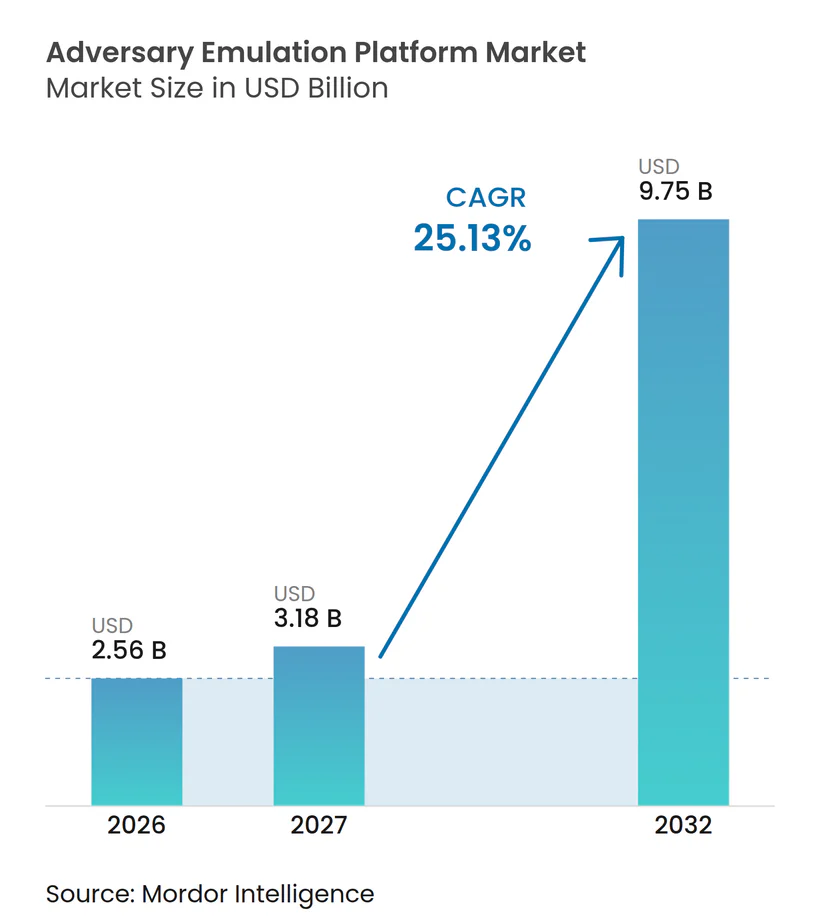
| Market Size (2027) | USD 3.18 Billion |
| Market Size (2032) | USD 9.75 Billion |
| Growth Rate (2027 - 2032) | 25.13 % |
| Fastest Growing Market | Asia-Pacific |
| Largest Market | North America |
| Market Concentration | Medium |
Major Players *Disclaimer: Major Players sorted in no particular order Image © Mordor Intelligence. Reuse requires attribution under CC BY 4.0. | |
Adversary Emulation Platform Market Analysis by Mordor Intelligence
The Adversary Emulation Platform Market size is projected at USD 2.56 billion in 2026 and is forecast to reach USD 9.75 billion by 2032, registering a CAGR of 25.13% during 2027-2032. Demand is shifting toward continuous proof that security controls perform as expected, rather than periodic compliance testing. Higher breach costs and faster attack cycles are making control validation a budget priority for large organizations. Vendors are responding by combining breach simulation, attack-path testing, and remediation workflows in broader exposure management platforms. This favors providers that can update testing content quickly and operate safely across cloud, identity, and operational technology environments. The Adversary Emulation Platform Market also has room to expand through managed services that help smaller companies use advanced testing without building large internal security teams.
Key Report Takeaways
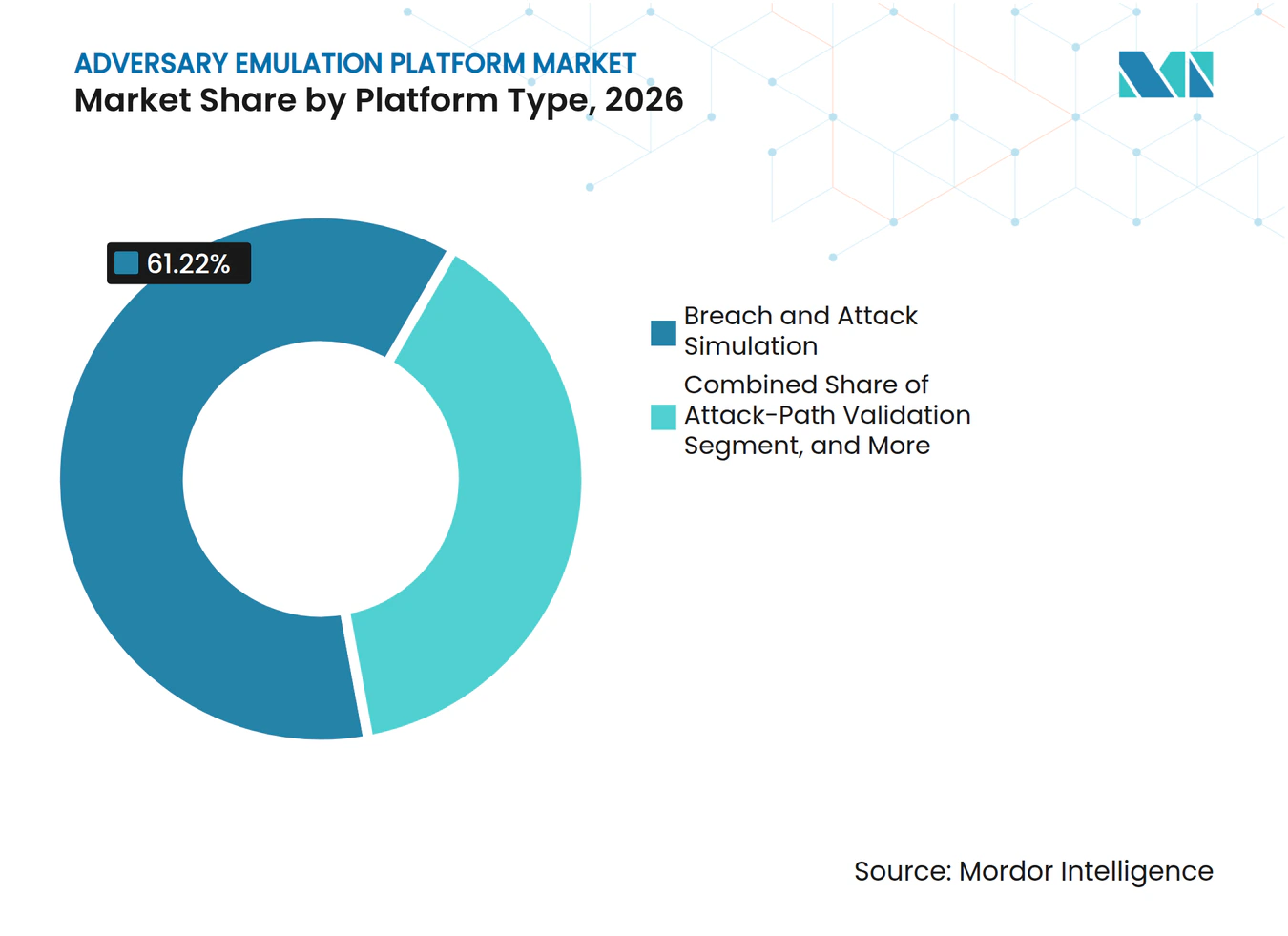
- By platform type, breach and attack simulation held 61.22% of the Adversary Emulation Platform Market share in 2026, while attack-path validation is projected to expand at a 26.30% CAGR through 2032.
- By deployment mode, on-premises held 71.12% of the Adversary Emulation Platform Market share in 2026, while cloud deployment is projected to expand at a 26.88% CAGR through 2032.
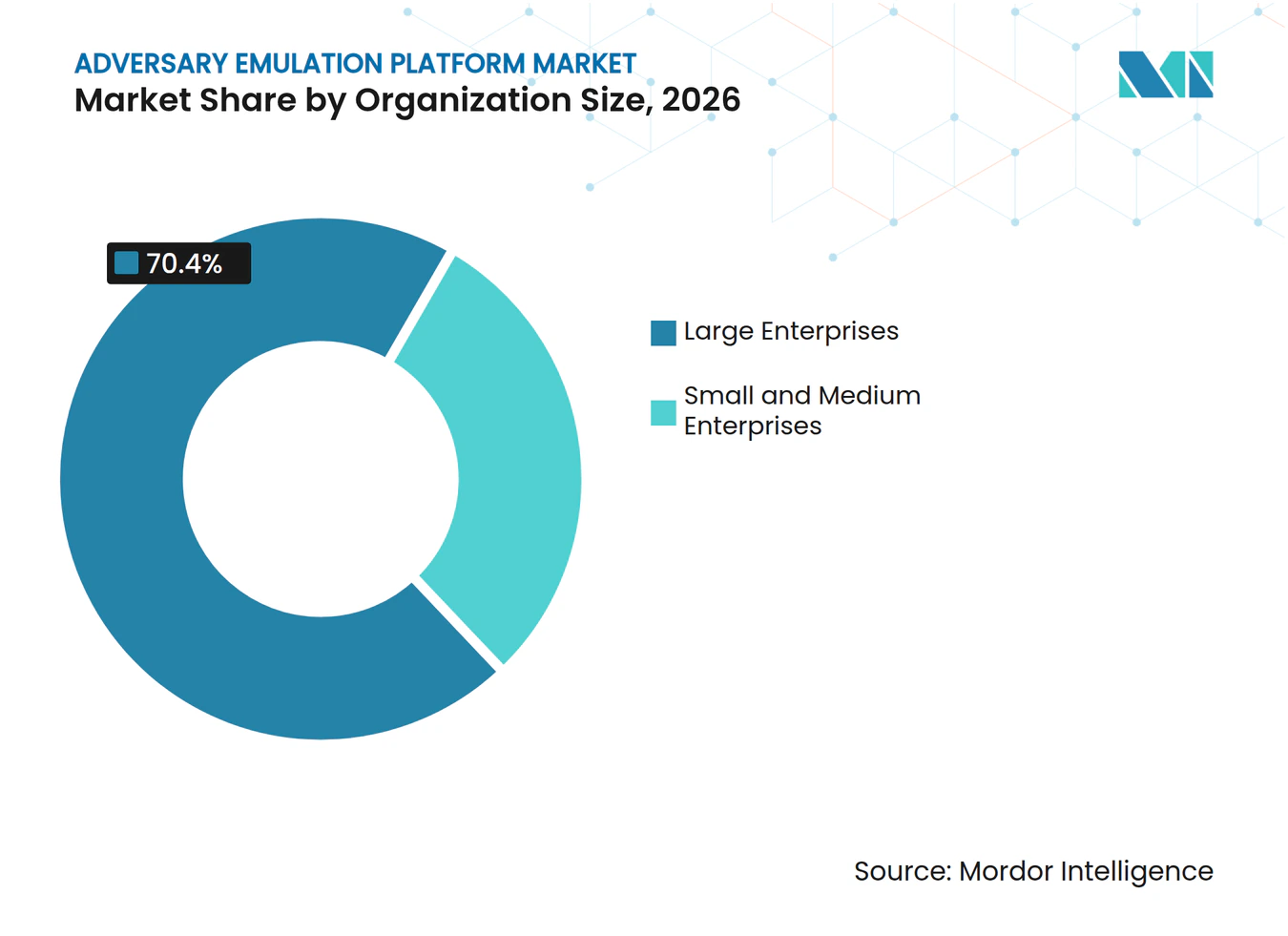
- By organization size, large enterprises held 70.40% of the Adversary Emulation Platform Market share in 2026, while small and medium enterprises are projected to expand at a 27.10% CAGR through 2032.
- By end user, banking, financial services, and insurance held 29.15% of the Adversary Emulation Platform Market share in 2026, while government and public administration are projected to expand at a 25.71% CAGR through 2032.
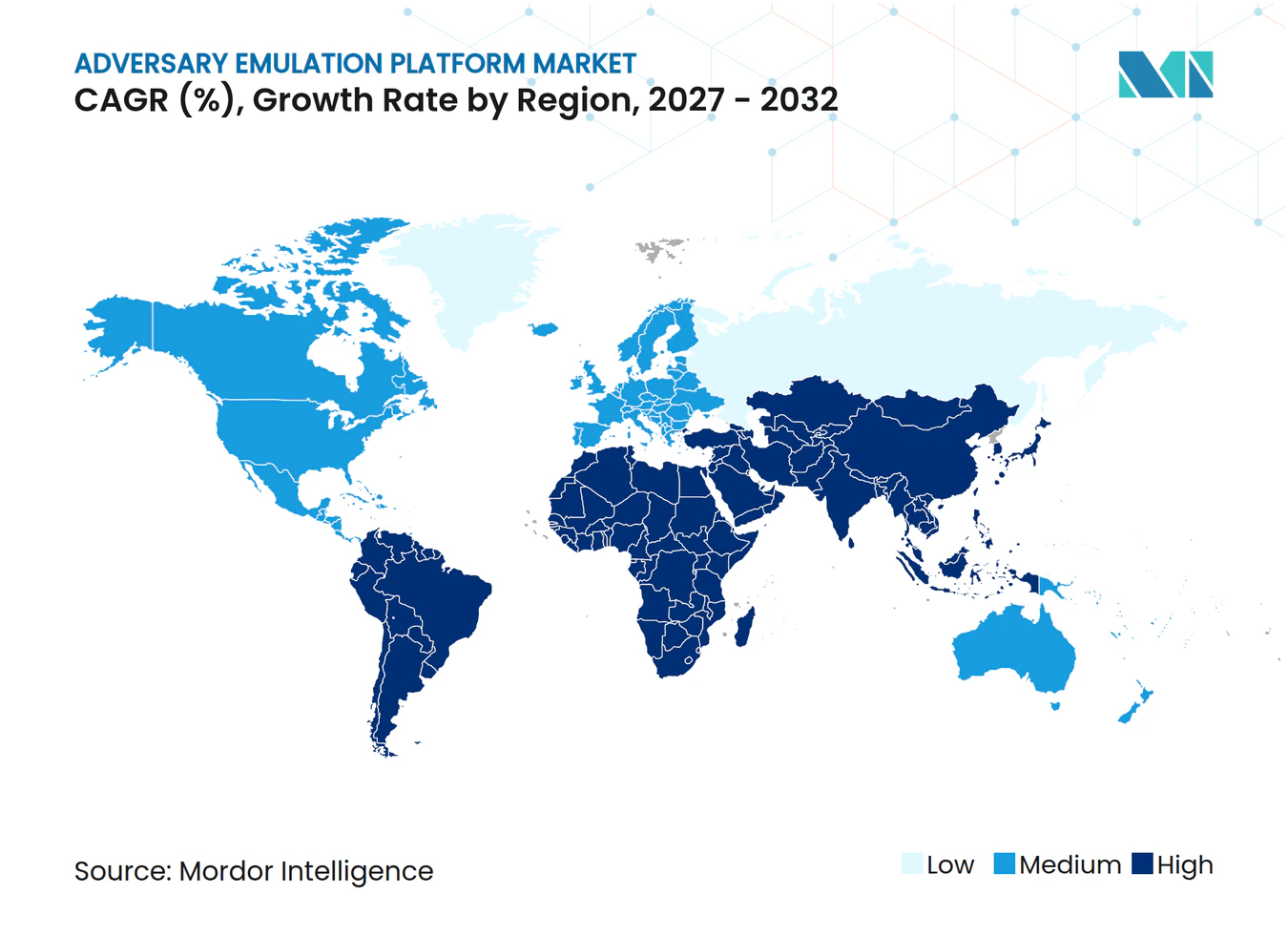
- By geography, North America held 36.18% of the Adversary Emulation Platform Market share in 2026, while Asia-Pacific is projected to expand at a 26.05% CAGR through 2032.
Note: Market numbers in this report are based on Mordor Intelligence's proprietary estimation framework, which combines nine months of actuals with Q4 projections for base year 2026.
Market Trends and Insights
Drivers Impact Analysis of Adversary Emulation Platform Market*
| Driver | (~) % Impact on CAGR Forecast | Geographic Relevance | Impact Timeline |
|---|---|---|---|
| Escalating Adversary Sophistication and Attack-Path Complexity | +4.8% | Global | Short term (≤ 2 years) |
| Shift From Periodic Testing to Continuous Security Validation | +4.2% | North America and Europe, spill-over to APAC | Short term (≤ 2 years) |
| Regulatory and Board-Level Pressure for Evidence-Based Cyber Resilience | +3.8% | EU and North America core, APAC and Middle East growing | Medium term (2-4 years) |
| Cloud, Identity, and Hybrid-Environment Expansion | +3.2% | Global, concentrated in APAC and North America | Medium term (2-4 years) |
| Shortage of Skilled Offensive Security Personnel | +2.7% | Global, pronounced in South America, Middle East, and Africa | Medium term (2-4 years) |
| Threat-Intelligence-to-Emulation Automation | +2.3% | North America and Europe core, spill-over globally | Long term (≥ 4 years) |
| Source: Mordor Intelligence | |||
Escalating Adversary Sophistication and Attack-Path Complexity
AI-enabled attacks are shortening the interval between disclosure of a weakness and its exploitation. IBM reported that AI-enabled incidents accounted for 25% of malicious breaches in 2026, averaged USD 6 million in cost, and rose 56% from the prior year. Verizon reported ransomware in 48% of breaches, which continues to pressure defenders to test controls against evolving attacker behavior. The Adversary Emulation Platform Market benefits when buyers prioritize how quickly new attacker techniques become safe test scenarios. AttackIQ released 25 ransomware-focused emulation packages in January 2026, showing the shorter content-update cycle that security teams increasingly expect. Platforms with automated content engineering can therefore compete on both response time and technique coverage.
Shift From Periodic Testing to Continuous Security Validation
Annual penetration tests provide only a limited view of whether controls continue to work as systems and attacker methods change. The Adversary Emulation Platform Market is benefiting from a shift toward repeated simulation and measurement in production security environments. CISA drew on two critical infrastructure red team assessments to recommend continuous adversary simulation rather than point-in-time exercises. This recommendation carries particular weight for public-sector buyers and regulated operators that need defensible evidence of control performance. Continuous testing also reduces the manual burden of arranging separate exercises for every major technology change. Suppliers that integrate findings into remediation and ticketing processes are better placed to retain customers as validation becomes an operating process.
Regulatory and Board-Level Pressure for Evidence-Based Cyber Resilience
DORA became applicable on January 17, 2025, and establishes digital operational resilience requirements for covered financial entities in the European Union.[1] Its testing provisions support recurring ICT testing and threat-led penetration testing for applicable significant entities. The Adversary Emulation Platform Market is supported by similar testing expectations in payments and financial services environments. These rules make documented and repeatable validation more relevant than informal testing exercises. NIS2 also extends cybersecurity obligations across 18 critical sectors, widening the group of organizations that need structured resilience programs. Vendors that map their content and reporting to established regulatory frameworks can reduce procurement friction for buyers.
Cloud, Identity, and Hybrid-Environment Expansion
Cloud workloads and identity systems have created attack paths that do not fit traditional on-premises testing programs. MITRE introduced cloud adversary emulation in its 2025 ATT&CK Evaluations, including testing against cloud-native identity techniques associated with Scattered Spider. MITRE and the Cloud Security Alliance also mapped the Cloud Controls Matrix version 4.1 to more than 900 ATT&CK technique-control relationships across 17 domains. This makes cloud and identity coverage a basic evaluation requirement for the Adversary Emulation Platform Market. Cymulate joined the Wiz Integration Network in January 2026, allowing joint customers to run simulations within existing cloud workflows. Providers without cloud-native libraries face a weaker position in hybrid enterprise evaluations.
Restraints Impact Analysis of Adversary Emulation Platform Market*
| Restraint | (~) % Impact on CAGR Forecast | Geographic Relevance | Impact Timeline |
|---|---|---|---|
| High Safety, Change-Control, and Production-Testing Requirements | -1.4% | Global, most acute in critical infrastructure and OT environments | Short term (≤ 2 years) |
| Integration Complexity Across Fragmented Security Controls | -1.0% | Global, pronounced in large enterprises with legacy SIEM/SOAR stacks | Medium term (2-4 years) |
| Limited Availability of High-Fidelity Threat-Behavior Data | -0.8% | Global, most restrictive in emerging markets | Medium term (2-4 years) |
| Open-Source Alternatives and Internal Tool-Building | -0.6% | North America and Europe, highest developer capacity | Long term (≥ 4 years) |
| Source: Mordor Intelligence | |||
High Safety, Change-Control, and Production-Testing Requirements
Production safety remains a material obstacle in critical infrastructure, manufacturing, and health care settings. A poorly controlled emulation run can interrupt operations or affect safety systems. Organizations often require strict authorization limits, reliable rollback procedures, safe-execution protocols, and isolated test networks before using the platform. CISA and the Homeland Security Systems Engineering and Development Institute developed a Caldera extension for operational technology, demonstrating the specialized work needed for this setting. These requirements can lengthen sales cycles in the Adversary Emulation Platform Market. They also make managed validation more attractive where an organization lacks dedicated offensive security staff.
Integration Complexity Across Fragmented Security Controls
Large organizations commonly operate separate SIEM, SOAR, endpoint, network, and cloud security products. These systems often use different telemetry formats and remediation processes. The value of an emulation finding declines if it cannot integrate with the case management and remediation tools teams already use. This is a concern for the Adversary Emulation Platform Market because manual translation slows validation and reduces coverage. ESET identified complexity and integration as major barriers to advanced security investment among small and medium-sized businesses in 2026. Vendors with ready-made integrations can reduce this operational burden and have an advantage over isolated testing products.
*Our forecasts treat driver/restraint impacts as directional, not additive. The impact forecasts reflect baseline growth, mix effects, and variable interactions.
Adversary Emulation Platform Market Segment Analysis
By Platform Type:
Breach Simulation Leads, While Attack-Path Validation Gains GroundBreach and attack simulation held 61.22% of the Adversary Emulation Platform Market share in 2026. Its established position reflects the need for repeatable evidence that security controls detect and prevent known attack methods. Financial services rules and payment security expectations reinforce the need for documented testing programs. Attack-path validation is projected to record a 26.30% CAGR through 2032. It shows how an attacker could exploit weaknesses and move across systems, helping enterprises prioritize connected exposures.
Automated penetration testing and automated red teaming occupy the middle of the growth range as vendors add orchestration and AI-assisted capabilities. MITRE ATT&CK version 18 expanded coverage for Kubernetes, CI/CD pipelines, and cloud identity, giving platforms more current technique content to use in automated tests. Pentera introduced Pentera 8 in March 2026 with Pentera Peer, a natural-language interface for directing adversarial testing. Other platform types, including operational technology simulation and AI-model red teaming, remain smaller in revenue but matter where generic IT testing does not address specialized risks. Snyk launched Evo Continuous Offensive Security in August 2026, showing that application security vendors are entering this part of the Adversary Emulation Platform Market.



By Deployment Mode:
On-Premises Retains Control, While Cloud Use ExpandsOn-premises deployment held 71.12% of the Adversary Emulation Platform Market share in 2026. Enterprises in defense, finance, and other regulated fields often keep validation data inside controlled infrastructure because it can reveal specific control gaps. The Defense Information Systems Agency selected AttackIQ in August 2026 for enterprise adversarial exposure validation across the Defense Information Systems Network. This decision shows why major institutional buyers can continue to favor perimeter-controlled designs. On-premises agents remain relevant where internal network and operational technology environments need direct testing access.
Cloud deployment is projected to grow at a 26.88% CAGR through 2032. SaaS delivery can lower infrastructure requirements and make ongoing breach simulation easier for mid-market security teams. Horizon3.ai received FedRAMP High authorization for NodeZero, indicating that cloud-delivered validation can meet stringent federal requirements. SafeBreach introduced an AI-powered continuous threat exposure management solution in April 2026 that combines exposure validation with cloud-delivered risk orchestration. The operating model can therefore combine local agents for internal testing with cloud orchestration for external exposure and reporting, so that the Adversary Emulation Platform Market does not move uniformly across deployment models.
By Organization Size:
Enterprise Spending Anchors Demand, While SMEs Add GrowthLarge enterprises held 70.40% of the Adversary Emulation Platform Market share in 2026. Their technology environments usually cover endpoints, cloud workloads, identity systems, business applications, and sometimes operational technology. This breadth creates a stronger need for centralized validation and remediation workflows. Pentera acquired DevOcean in October 2025 to add automated remediation orchestration, ticketing, and compliance reporting to its validation offering. IBM reported that 85% of organizations planned to increase security spending after learning about frontier AI model threats.
Small and medium enterprises are projected to grow at a 27.10% CAGR through 2032. Subscription services and managed testing reduce the up-front skills and capital requirements that once limited adoption. ESET reported that 40% of small and medium-sized businesses expected an increase in cybersecurity budgets, with cloud security the second-largest planned investment. IBM estimated the cost of a small-business breach at USD 120,000 to USD 1.24 million in its 2025 report. The financial exposure supports demand for lower-cost validation services, although skills shortages mean that this part of the Adversary Emulation Platform Market relies on ease of deployment and expert guidance.

By End User:
Financial Services Leads, While Government Demand AcceleratesBanking, financial services, and insurance held 29.15% of the Adversary Emulation Platform Market share in 2026. These organizations face detailed resilience obligations and high consequences when security controls fail. IBM found that financial services breaches cost USD 6.3 million on average in 2026, USD 1.3 million above the global mean.[2] DORA, payment security requirements, and annual penetration testing expectations have made recurring validation a more formal operational need. Complex hybrid estates also make attack-path testing relevant alongside conventional breach simulation.
Government and public administration are projected to grow at a 25.71% CAGR through 2032. Sovereign cyber programs and defense modernization are increasing the demand for realistic testing across public networks. CISA planned Cyber Storm X for fall 2026 as its tenth biennial national cyber exercise, bringing together federal, state, local, and private-sector participants. The AttackIQ selection provides a model for standardizing continuous validation across a large defense environment. Health care and life sciences, IT and telecommunications, industrial manufacturing, energy and utilities, and retail and e-commerce broaden the customer base and need evidence that controls work in changing conditions.
Geography Analysis
North America Adversary Emulation Platform Market
North America held 36.18% of the Adversary Emulation Platform Market share in 2026. It combines a dense cybersecurity supplier base with mature enterprise procurement and federal security programs. CISA, the Securities and Exchange Commission, the New York Department of Financial Services, and national defense organizations create a broad policy environment for formal security validation. The Defense Information Systems Agency's decision to select AttackIQ across the Defense Information Systems Network further supports the use of platform-based testing in the region.[3] Canada supports regional demand as financial institutions adopt cloud services and align with threat-led testing expectations.
APAC Adversary Emulation Platform Market
Asia-Pacific is projected to grow at a 26.05% CAGR through 2032. The region combines financial-sector rules, critical infrastructure protection, cloud adoption, and autonomous testing suppliers. In Japan, JSOL began commercial distribution of Horizon3.ai NodeZero in June 2026. GMO Cybersecurity by IELA launched its AI White Hacker Penetration Test service in July 2026 and later made its Net de Shindan AI White Hacker Intrusion Test generally available in September 2026. Japan's Information Technology Promotion Agency is funding research on autonomous AI penetration testing to support local product development.
Europe, the Americas and Middle East Adversary Emulation Platform Market
Europe is the second-largest regional revenue pool, with Germany, the United Kingdom, and France as leading markets. DORA has concentrated demand in the European Union's financial services sector, while NIS2 brings more sectors into structured cybersecurity programs. Brazil and Mexico are expanding digital infrastructure, while Saudi Arabia and the United Arab Emirates are building critical infrastructure cyber resilience programs. These regions have fewer established vendor deployments, which creates opportunities for managed and cloud-delivered offerings with local partners.
Competitive Landscape
Market Concentration
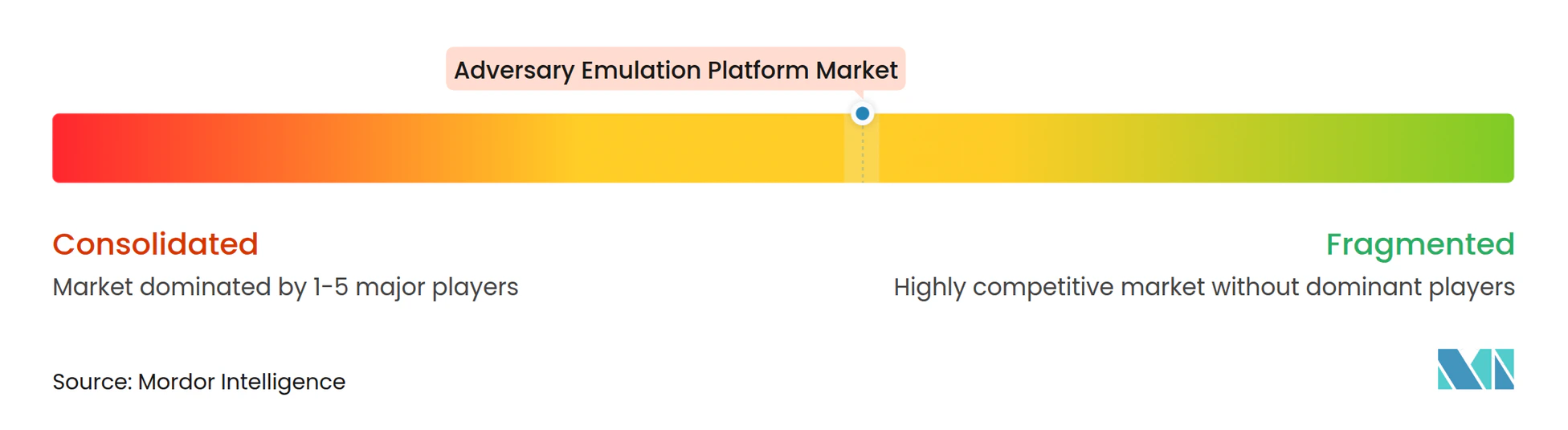
The Adversary Emulation Platform Market is moderately concentrated among large providers but remains fragmented among smaller providers in automated penetration testing, operational technology, and AI red teaming. Pentera, AttackIQ, Cymulate, Picus Security, SafeBreach, and Horizon3.ai are prominent competitors with broader platform positions. Pentera reported surpassing USD 100 million in annual recurring revenue in early 2026. Horizon3.ai raised USD 250 million in August 2026 at a valuation exceeding USD 2 billion, indicating that scale, content testing, and distribution are becoming increasingly important.
Leading suppliers are expanding from standalone validation tools into broader exposure management offerings. SafeBreach launched an AI-powered continuous threat exposure management solution in April 2026. Cymulate introduced Agentic Cyber Defense Engineering in June 2026, including Vero AI, Mitigation Hub, and Detection Studio.[4] AttackIQ unveiled AVA Agentic OS in July 2026 for continuous threat exposure management. The common objective is to connect testing, prioritization, and action, while ATT&CK-aligned content and compliance credentials support regulated procurement.
Open opportunities remain in production-safe operational technology testing, AI-system red teaming, and managed validation for smaller organizations. Pentera acquired EVA Information Security in November 2025 to extend its capabilities to AI ecosystems, agentic applications, and large language model interfaces. Cymulate introduced an MCP Server and a Claude Plugin in August 2026 to extend its Vero AI architecture into third-party AI security operations workflows. SCYTHE targets industrial and defense use cases across IT, cloud, operational technology, and AI attack surfaces, where safe execution and practical integration are decisive.
Adversary Emulation Platform Industry Leaders
-
AttackIQ, Inc.
-
BreachLock, Inc.
-
Cyberbit Ltd.
-
CyCognito Ltd.
-
Cymulate Ltd.
- *Disclaimer: Major Players sorted in no particular order
Adversary Emulation Platform Market Companies Covered in this Report
- AttackIQ, Inc.
- BreachLock, Inc.
- Cyberbit Ltd.
- CyCognito Ltd.
- Cymulate Ltd.
- Foreseeti AB
- FourCore GmbH
- Horizon3.ai, Inc.
- Mitigant, Inc.
- NopSec, Inc.
- Pentera Security Ltd.
- Picus Security, Inc.
- Prelude Security, Inc.
- Ridge Security, Inc.
- SafeBreach, Inc.
- SCYTHE, Inc.
- ThreatModeler Software, Inc.
- Valitrix, Inc.
- XM Cyber Ltd.
- Cronus Cyber Technology Ltd.
Recent Industry Developments in Adversary Emulation Platform Market
- September 2026: GMO Cybersecurity by IELA made Net de Shindan AI White Hacker Intrusion Test generally available, providing an AI-agent-driven black-box penetration testing service for publicly exposed enterprise IT assets.
- August 2026: AttackIQ unveiled AVA Agentic OS, an agentic operating system for continuous threat exposure management, coordinating specialized AI agents for cybersecurity missions.
- August 2026: DISA selected AttackIQ as the enterprise adversarial exposure validation platform for the Department of War, creating a department-wide capability to measure defensive effectiveness across the Defense Information Systems Network.
- August 2026: Horizon3.ai raised a USD 250 million Series E at a valuation exceeding USD 2 billion, with backing from Singapore's EDBI, SAIC, and Qualcomm Ventures.
Global Adversary Emulation Platform Market Report Scope
The Adversary Emulation Platform Market comprises software platforms and related services that simulate real-world cyberattacks, attacker behaviors, and adversary tactics, techniques, and procedures (TTPs) to evaluate the effectiveness of organizational security controls and cyber resilience. These platforms enable continuous security validation through breach and attack simulation, automated penetration testing, attack-path analysis, and automated red teaming. They help organizations identify control gaps, prioritize remediation, validate threat-detection capabilities, and improve incident-response readiness across on-premises, cloud, and hybrid environments. The market includes software subscriptions, platform licensing, managed services, implementation, support, and training associated with adversary emulation technologies.
The Adversary Emulation Platform Market Report is Segmented by Platform Type (Breach and Attack Simulation, Automated Penetration Testing, Attack-Path Validation, Automated Red Teaming, and Other Platform Types), Deployment Mode (On-Premises, and Cloud), Organization Size (Large Enterprises, and Small and Medium Enterprises), End User (Banking, Financial Services, and Insurance [BFSI], Government and Public Administration, Healthcare and Life Sciences, IT and Telecommunication, Industrial Manufacturing, Energy and Utilities, Retail and E-Commerce, and Other End Users), and Geography (North America, South America, Europe, Asia-Pacific, Middle East, and Africa). The Market Forecasts are Provided in Terms of Value (USD).
Segmentation Overview
| Breach and Attack Simulation |
| Automated Penetration Testing |
| Attack-Path Validation |
| Automated Red Teaming |
| Other Platform Types |
| On-Premises |
| Cloud |
| Large Enterprises |
| Small and Medium Enterprises |
| Banking, Financial Services, and Insurance (BFSI) |
| Government and Public Administration |
| Healthcare and Life Sciences |
| IT and Telecommunication |
| Industrial Manufacturing |
| Energy and Utilities |
| Retail and E-Commerce |
| Other End Users |
| North America | United States |
| Canada | |
| South America | Brazil |
| Argentina | |
| Mexico | |
| Rest of South America | |
| Europe | Germany |
| United Kingdom | |
| France | |
| Italy | |
| Russia | |
| Rest of Europe | |
| Asia-Pacific | China |
| Japan | |
| India | |
| South Korea | |
| Rest of Asia-Pacific | |
| Middle East | Saudi Arabia |
| United Arab Emirates | |
| Rest of Middle East | |
| Africa | South Africa |
| Nigeria | |
| Rest of Africa |
| By Platform Type | Breach and Attack Simulation | |
| Automated Penetration Testing | ||
| Attack-Path Validation | ||
| Automated Red Teaming | ||
| Other Platform Types | ||
| By Deployment Mode | On-Premises | |
| Cloud | ||
| By Organization Size | Large Enterprises | |
| Small and Medium Enterprises | ||
| By End User | Banking, Financial Services, and Insurance (BFSI) | |
| Government and Public Administration | ||
| Healthcare and Life Sciences | ||
| IT and Telecommunication | ||
| Industrial Manufacturing | ||
| Energy and Utilities | ||
| Retail and E-Commerce | ||
| Other End Users | ||
| By Geography | North America | United States |
| Canada | ||
| South America | Brazil | |
| Argentina | ||
| Mexico | ||
| Rest of South America | ||
| Europe | Germany | |
| United Kingdom | ||
| France | ||
| Italy | ||
| Russia | ||
| Rest of Europe | ||
| Asia-Pacific | China | |
| Japan | ||
| India | ||
| South Korea | ||
| Rest of Asia-Pacific | ||
| Middle East | Saudi Arabia | |
| United Arab Emirates | ||
| Rest of Middle East | ||
| Africa | South Africa | |
| Nigeria | ||
| Rest of Africa | ||
Key Questions Answered in the Report
What is the projected size of the adversary emulation platform market?
The market is projected at USD 2.56 billion in 2026 and is forecast to reach USD 9.75 billion by 2032, at a 25.13% CAGR during 2027-2032.
Why are organizations adopting adversary emulation platforms?
Organizations use them to test whether controls can detect and stop current attacker behavior, with ransomware present in 48% of breaches in Verizon's 2026 findings.
Which platform type has the largest share?
Breach and attack simulation leads with 61.22% share in 2026, while attack-path validation is the fastest-growing platform type at a 26.30% CAGR.
Why do regulated financial institutions use these platforms?
DORA, payment security requirements, and penetration testing obligations increase demand for documented, repeatable security validation.
Which deployment model is growing fastest?
Cloud deployment is projected to grow at a 26.88% CAGR through 2032, although on-premises deployment retains 71.12% share in 2026.
Which region is expanding most quickly?
Asia-Pacific is projected to grow at a 26.05% CAGR through 2032, supported by security requirements, cloud adoption, and autonomous testing activity.