
Industrial Cyber Range Market Size and Share
Market Overview
| Study Period | 2021 - 2032 |
|---|---|
| Market Size (2027) | USD 1.76 Billion |
| Market Size (2032) | USD 3.49 Billion |
| Growth Rate (2027 - 2032) | 14.70 % |
| Fastest Growing Market | Asia-Pacific |
| Largest Market | North America |
| Market Concentration | Low |
Major Players *Disclaimer: Major Players sorted in no particular order Image © Mordor Intelligence. Reuse requires attribution under CC BY 4.0. | |
Industrial Cyber Range Market Analysis by Mordor Intelligence
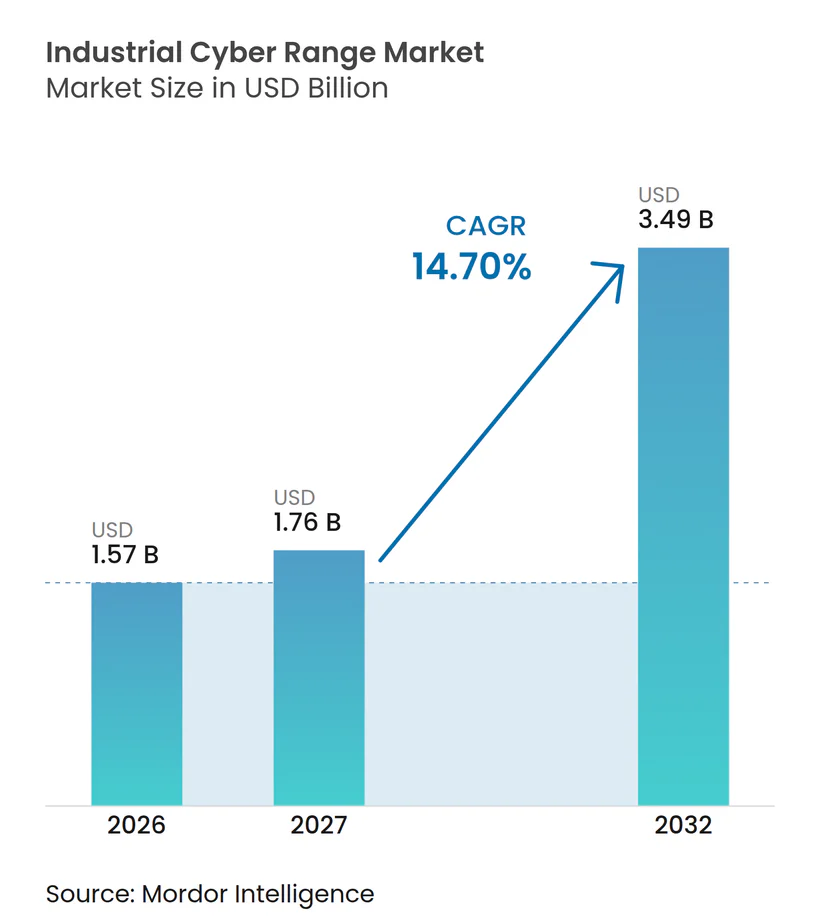
The industrial cyber range market size was valued at USD 1.57 billion in 2026 and is estimated to grow to reach USD 3.49 billion by 2032, at a CAGR of 14.70% during the forecast period 2027-2032. The industrial cyber range market supports safe exercises across supervisory control and data acquisition systems, programmable logic controllers, distributed control systems, and connected IT and OT networks. These environments allow operators to test controls and response procedures without changing live production assets. Rising industrial ransomware exposure and the broader use of connected operational technology are increasing the need for realistic training. Buyers are placing greater value on platforms that represent both network activity and physical process effects. This favors providers that can combine software simulation, digital twins, and selected physical equipment in an industrial cyber range market where fidelity affects the value of an exercise.
Key Report Takeaways
- By component, software held 65.16% of the industrial cyber range market share in 2026, while services are projected to expand at a 16.60% CAGR through 2032.
- By range type, simulation ranges accounted for 49.61% of the industrial cyber range market share in 2026, while hybrid ranges are projected to grow at a 15.91% CAGR through 2032.
- By deployment mode, cloud-based platforms held 68.19% of the industrial cyber range market share in 2026 and are projected to grow at a 16.89% CAGR through 2032.
- By organization size, large enterprises accounted for 70.23% of the industrial cyber range market share in 2026, while SMEs are expected to expand at a 16.31% CAGR through 2032.
- By end-user industry, energy and utilities held 30.14% of the industrial cyber range market share in 2026, while industrial manufacturing is projected to grow at a 15.23% CAGR through 2032.
- By geography, North America held 36.98% of the industrial cyber range market share in 2026, while Asia-Pacific is projected to expand at a 15.57% CAGR through 2032.
Note: Market numbers in this report are based on Mordor Intelligence's proprietary estimation framework, which combines nine months of actuals with Q4 projections for base year 2026.
Market Trends and Insights
Drivers Impact Analysis of Industrial Cyber Range Market*
| Driver | (~) % Impact on CAGR Forecast | Geographic Relevance | Impact Timeline |
|---|---|---|---|
| Escalating OT and ICS Attack Surface | +3.8% | Global | Short term (≤ 2 years) |
| Regulatory Pressure for Critical Infrastructure Resilience | +3.2% | North America and Europe, with emerging influence in Asia-Pacific | Medium term (2-4 years) |
| Convergence of IT, OT, IoT, and Industrial Cloud Environments | +2.5% | Global | Medium term (2-4 years) |
| Rising Need to Validate Controls Without Disrupting Production | +2.0% | Global | Short term (≤ 2 years) |
| Shortage of Industrial Cybersecurity Skills | +1.8% | Global | Long term (≥ 4 years) |
| AI-Assisted Adversary Emulation and Adaptive Scenario Generation | +1.5% | North America and Europe | Medium term (2-4 years) |
| Source: Mordor Intelligence | |||
Escalating OT and ICS Attack Surface
The industrial cyber range market is gaining support as adversary activity makes OT preparedness a direct operating requirement. Dragos identified 26 active OT threat groups in 2025, including 3 groups that reached Stage 2 of the ICS Cyber Kill Chain and mapped control loops within OT environments. Its review also reported that ransomware groups targeting industrial organizations increased 49% year over year and affected 3,300 organizations globally. Only 30% of OT networks maintained adequate operational visibility, while 88% of organizations faced OT-specific detection and response challenges. Range exercises provide teams with a controlled setting to identify and contain these attack paths. They also allow operators to test how a compromise could move from enterprise systems into plant operations.
Regulatory Pressure for Critical Infrastructure Resilience
Compliance requirements are strengthening the procurement case for the industrial cyber range market. FERC Order No. 919, published in March 2026, approved 11 modified NERC CIP reliability standards that enable virtualization in OT environments.[1] The order provides a clearer basis for utilities to use virtualized environments when meeting reliability obligations. NERC CIP-015-2 expanded internal network security monitoring to certain electronic and physical access control systems outside the Electronic Security Perimeter. NIS2 requires essential entities in 27 European Union member states to test incident-handling procedures against realistic scenarios. The expanding set of systems within regulatory scope increases demand for sector-specific exercise content.
Convergence of IT, OT, IoT, and Industrial Cloud Environments
Connected industrial environments are widening the practical use case for the industrial cyber range market. TXOne Networks reported that 96% of OT security incidents in 2025 originated from IT-level compromises. Cloud-connected historians, edge gateways, and remote-access tools extend the attack boundary beyond the plant floor. These systems operate under different availability and trust requirements from traditional industrial assets. A credible exercise must therefore represent the connections between enterprise networks, OT zones, IIoT devices, and industrial cloud services. This requirement supports platforms that can model a complete topology instead of isolated network layers.
Rising Need to Validate Controls Without Disrupting Production
Production constraints are reinforcing demand in the industrial cyber range market because live testing can interrupt critical operations. An unplanned shutdown in a process industry can cost more than USD 500,000 per hour, making a separate testing environment financially viable for plant leaders. Digital twin-based architectures can model an organization's ICS topology and allow recurring tests without affecting production. These environments can support training, validation of defensive controls, and reviews of recovery procedures. A Nature study published in 2026 found that an AI-driven multi-agent framework improved simulation realism and adaptive responsiveness compared with static rule-based models. Such designs can broaden the range of scenarios available to industrial security teams.
Restraints Impact Analysis of Industrial Cyber Range Market*
| Restraint | (~) % Impact on CAGR Forecast | Geographic Relevance | Impact Timeline |
|---|---|---|---|
| High Cost and Scarcity of High-Fidelity OT Hardware | -3.0% | Global, most acute in South America and Africa | Long term (≥ 4 years) |
| Production-Safety and Change-Control Constraints | -2.2% | Global | Medium term (2-4 years) |
| Fragmented Industrial Protocols and Incomplete Asset Data | -1.6% | Asia-Pacific core, spillover to Middle East and Africa | Long term (≥ 4 years) |
| Long Procurement Cycles and Sovereignty Requirements | -1.2% | Europe and Middle East | Medium term (2-4 years) |
| Source: Mordor Intelligence | |||
High Cost and Scarcity of High-Fidelity OT Hardware
High-fidelity OT hardware can limit the pace of adoption in the industrial cyber range market. A representative power substation or refinery environment may require programmable logic controllers, remote terminal units, human-machine interfaces, and distributed control systems. These assets can be expensive and may have long procurement lead times. Nuclear, oil, and gas operators often need custom work because proprietary control logic is difficult to reproduce using standard simulations. Limited availability of embedded controllers and older communication modules adds to this constraint. Graduated designs can lower cost by reserving physical equipment for high-consequence interfaces while simulating common protocols.
Production-Safety and Change-Control Constraints
Safety and change-control requirements can extend implementation beyond a purchasing decision. A range that mirrors production systems can trigger the same management-of-change processes as those for OT modifications. Nuclear, chemical, and oil and gas sites may subject range infrastructure to safety-case requirements similar to those for primary controls. Teams also need to demonstrate that the exercise environment cannot create unintended signal paths to operating assets. This slows deployment at organizations without dedicated OT security resources. The constraint is particularly relevant when a provider proposes a high-fidelity configuration that closely mirrors live systems.
*Our forecasts treat driver/restraint impacts as directional, not additive. The impact forecasts reflect baseline growth, mix effects, and variable interactions.
Industrial Cyber Range Market Segment Analysis
By Component:
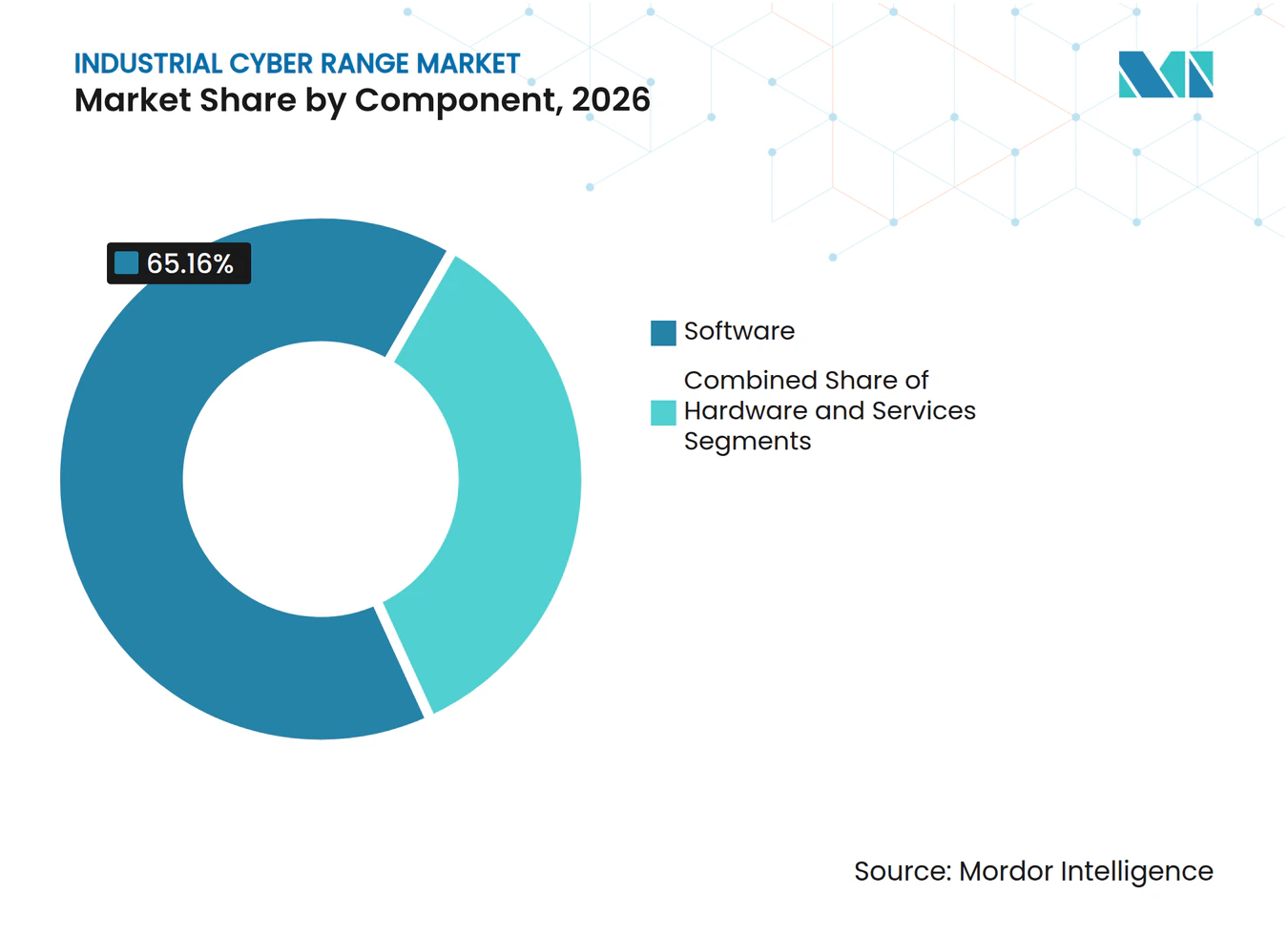
Software Provides the Deployment BackboneSoftware held 65.16% of the industrial cyber range market share in 2026. The result reflects movement away from capital-intensive physical testbeds toward license-based simulation platforms. Software-defined designs can be deployed across cloud infrastructure with limited marginal cost. They also give teams the flexibility to reset an environment and run repeated exercises. Subscription models make it easier to distribute capability across sites and users. Hardware remains relevant where operators need a close representation of critical equipment. This is particularly important for energy and nuclear applications. The balance between software scale and physical fidelity continues to shape component choices.
Services are projected to advance at a 16.60% CAGR through 2032. Organizations are increasingly using external support for scenario design, exercise facilitation, and post-exercise analysis. This demand is relevant when internal security teams lack sufficient OT expertise. Vendors with vertical content libraries can use those resources to differentiate their service offers. MITRE Caldera for OT, developed with CISA, provides an open framework for OT adversary emulation. The framework raises expectations for commercial simulation products. It also encourages vendors to compete on scenario depth, implementation support, and industrial context. Pure platform offerings can face pressure where open tools cover more basic exercise needs.



By Range Type:
Simulation Leads While Hybrid Designs ExpandSimulation ranges represented 49.61% of the industrial cyber range market share in 2026. Their position reflects lower cost and greater scalability for teams using standardized attack scenarios. A simulation environment can support repeated training for larger groups without a dedicated hardware footprint. It is useful when the training goal centers on detection, investigation, and response workflows. Emulation ranges sit between simulation and hybrid systems. They can run real OT software on virtualized infrastructure. This provides more realism than a fully simulated environment without the cost of broad physical replication. Range selection, therefore, depends on the operational purpose of the exercise.
Hybrid ranges are projected to grow at a 15.91% CAGR through 2032. Energy, chemical, and water operators use these configurations when both network-layer propagation and process-layer effects matter. This industrial cyber range market size opportunity stems from needs that simulation alone does not fully address. DIATEAM introduced a Next-Generation Hybrid Cyber Range in January 2026, using the Proxmox open-source virtualization stack. The design sought to reduce total ownership cost by removing proprietary hypervisor licensing. AI-enabled models can further enhance these environments by creating responsive attack behaviors. However, a hybrid system still needs careful isolation and valid representations of its physical interfaces.
By Deployment Mode:
Cloud-Based Platforms Reshape AccessCloud-based deployment held 68.19% of the industrial cyber range market share in 2026. It is also projected to grow at a 16.89% CAGR through 2032. Cloud delivery eliminates the need for a dedicated physical facility in many use cases. It gives distributed teams access to on-demand exercises. Providers can scale an environment for larger events without equivalent hardware expansion. These characteristics make cloud delivery suitable for recurring skills programs and broad enterprise participation. It also supports consumption-based commercial models. The dual leadership position indicates that cloud use is central to current demand.
Consumption-based pricing can help SMEs use range platforms without large infrastructure spending. Organizations can pay for an exercise rather than amortize the cost of fixed equipment over a long period. This is important for industrial companies with increasing exposure but limited security budgets. On-premises deployment remains necessary when data sovereignty or air-gapping requirements restrict third-party hosting. IEC 62443 and ISO/IEC 27001 compliance needs can therefore preserve an on-premises role. Cloud-only designs can also face latency limits for time-critical SCADA polling with response times under 100 milliseconds. A hybrid approach can place scenario management in the cloud while keeping process simulation near the operating environment. This division preserves flexibility without disregarding technical constraints.
By Organization Size:
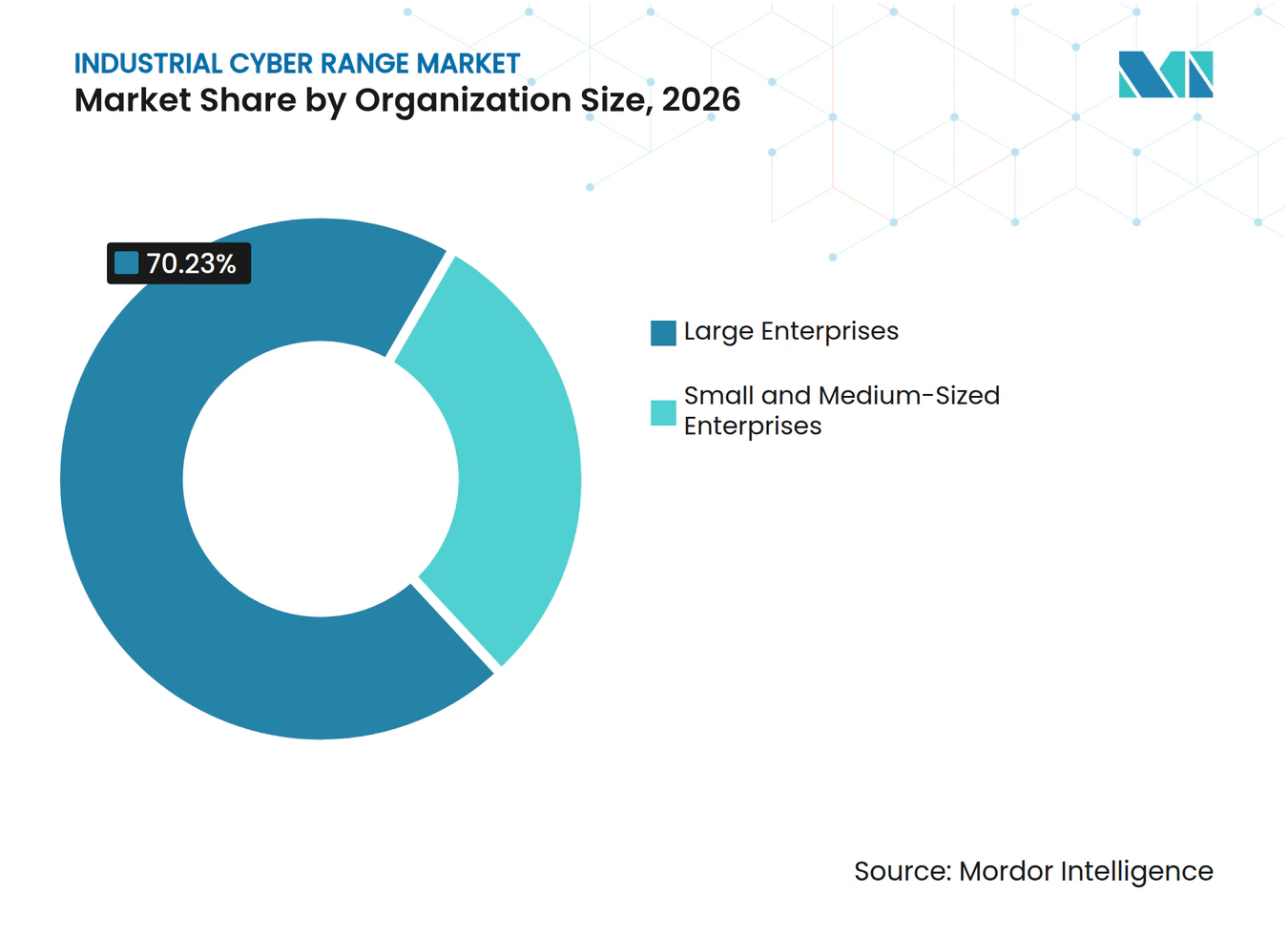
Large Enterprises Lead While SME Use GrowsLarge enterprises accounted for 70.23% of the industrial cyber range market share in 2026. Mandatory compliance requirements, cyber insurance expectations, and dedicated OT security budgets support their leading position. Utilities, petrochemical facilities, and large transport operators often fit this profile. These organizations manage critical infrastructure and require sophisticated configurations. Their scale can justify custom content and physical equipment. They also need to train technical teams, operations personnel, and senior decision-makers. This creates demand for broader exercise programs. Large enterprises remain the anchor customer group for high-fidelity platforms.
SMEs are projected to grow at a 16.31% CAGR through 2032. Cloud delivery reduces the infrastructure investment that previously limited access for smaller organizations. Industrial manufacturers with 200 to 1,000 employees can face increasing OT exposure without large, dedicated security teams. Supply-chain cybersecurity requirements from larger customers can increase their preparedness needs. The SANS findings on skills gaps indicate why structured training can matter for this group. Providers that offer targeted scenarios and simpler deployment can reach this customer base. The main limitation is that SMEs may still lack the time and specialist staff to configure complex environments. Managed services can help address this practical barrier.

By End-User Industry:
Energy and Utilities Anchor Demand While Manufacturing ScalesEnergy and utilities held 30.14% of the industrial cyber range market share in 2026. The segment has a long regulatory history in OT security and faces serious physical consequences from a successful attack. Electricity operators must demonstrate resilience across systems that support essential services. NERC's January 2026 CIP Roadmap identified coverage gaps involving low-impact systems and newly registered inverter-based resources. The expanding scope suggests more systems may need testing and workforce preparation. Energy providers also require exercises that account for specific grid and process conditions. This supports demand for range content that goes beyond generic enterprise security training.
Industrial manufacturing is projected to grow at a 15.23% CAGR through 2032. Manufacturers accounted for more than two-thirds of OT ransomware victims in 2025.[2] Smart factory programs are extending OT exposure into environments that factory security teams may not have previously defended. This creates a need for exercises that connect IT compromise pathways with production outcomes. Oil and gas, transportation and logistics, and water and wastewater require similarly specific content. Offshore platform systems, rail signaling, and water treatment SCADA cannot be adequately addressed through generic scenarios. Mining and metals also face greater exposure as remote automation and autonomous equipment become more connected. The industrial cyber range industry depends on vendors building content that fits each operational setting.
Geography Analysis
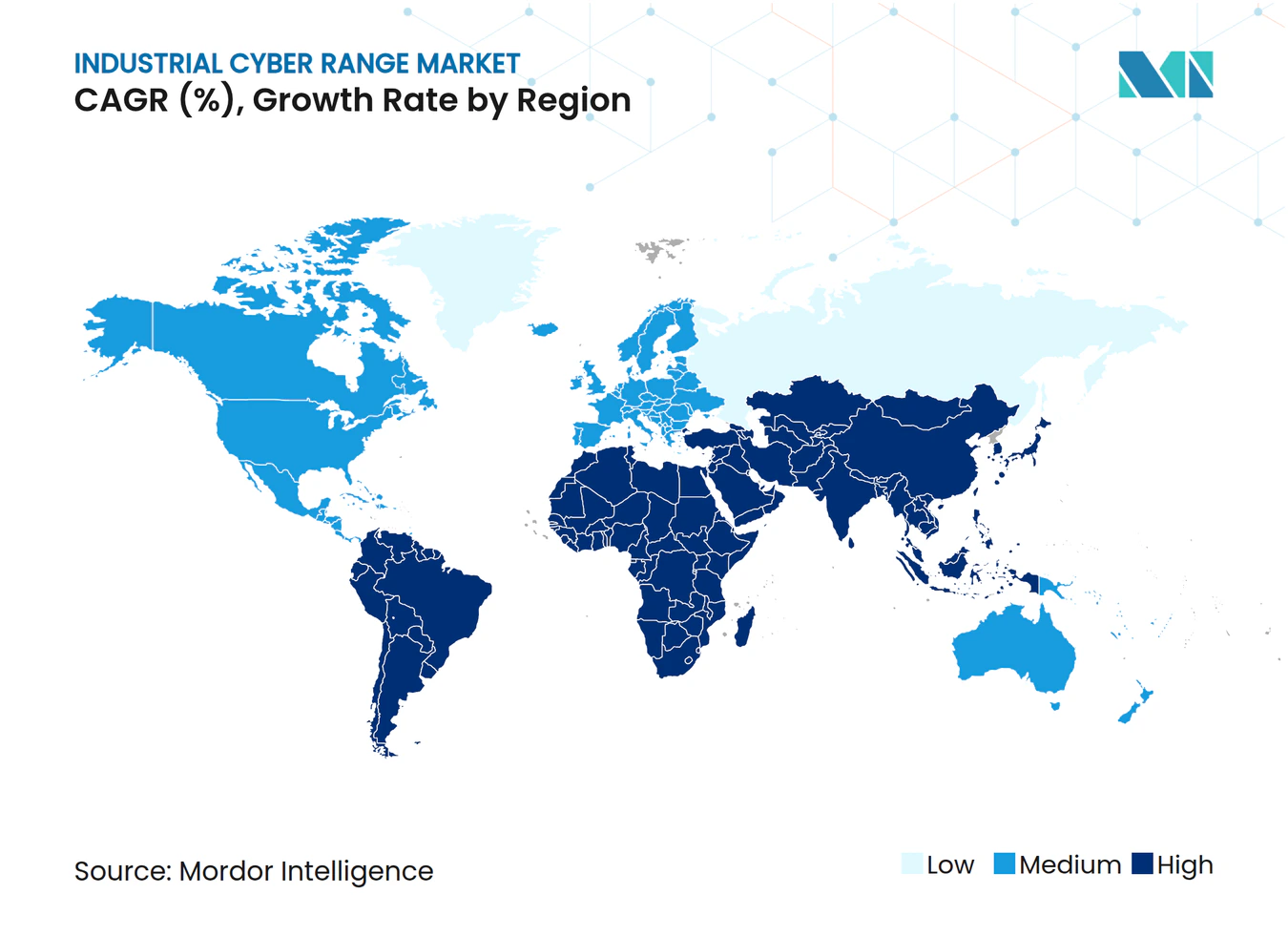
North America held 36.98% of the industrial cyber range market share in 2026. NERC CIP obligations, pipeline directives, and water utility requirements support demand for demonstrable security testing. FERC Order No. 919 supported virtualization in energy OT environments during March 2026. Cyber Shield 2026 involved more than 1,000 professionals from 23 partner nations and simulated attacks on electrical power and water OT systems, while Canada expanded cybersecurity obligations for telecommunications and pipeline operators.
Asia-Pacific is projected to grow at a 15.57% CAGR through 2032. Rapid industrial digitalization and national security programs support the regional outlook. CybExer Technologies and Cyber Defense Labs deployed an OT and IT cyber resilience test environment at Keio University in April 2026 under a NEDO program.[3] China’s MLPS 2.0 directs state-owned enterprises to allocate defined IT budget shares to OT security, while Australia’s reforms created measurable risk-management requirements across 11 sectors. India is a developing demand area, supported by industrial growth and a range of technology partnerships.
Europe has a structurally expanding opportunity because NIS2 covers essential entities across critical infrastructure. Germany and France support demand through substantial manufacturing and energy footprints. The CITADEL Range program has a value of EUR 60.4 million (USD 66.4 million) and coordinates 39 organizations from 18 European Union member states. Crisalyde and DIATEAM launched CY-R-EX in 2026 as part of the RéSISTeCC project with the University of Poitiers. South America, the Middle East, and Africa remain earlier-stage geographies, constrained by budgets and shortages of OT specialists.
Competitive Landscape
Market Concentration
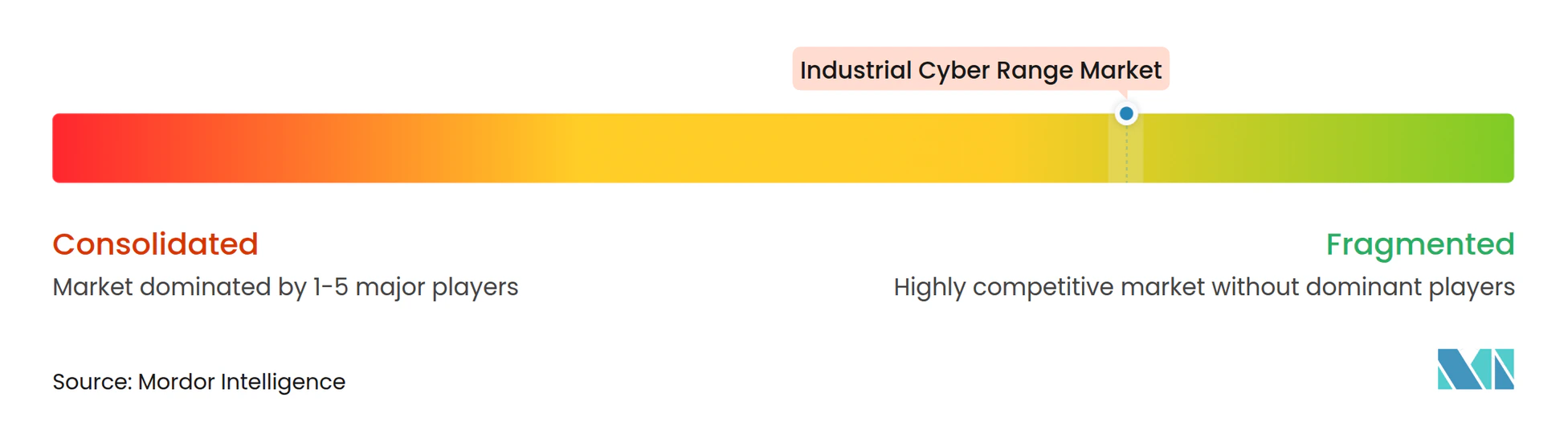
The industrial cyber range market is fragmented because buyers need different protocols, deployment models, and industry-specific scenarios. No vendor is dominant across all OT use cases, organization sizes, and verticals, and specialist providers compete with industrial cybersecurity incumbents and defense-adjacent technology companies. Cyberbit acquired RangeForce in September 2025, combining live-fire exercises with cloud-based individual upskilling.[4] SimSpace received USD 39 million in October 2025 for global expansion and AI integration.
Simulation fidelity is an important differentiator in the industrial cyber range market. A platform based only on virtual programmable logic controllers can reproduce network attack patterns but may not represent process-level consequences. Energy and chemical operators need exercises that reflect safety-critical controls. Hybrid hardware-software designs and digital-twin process simulations can address this requirement. Higher fidelity can add cost, complexity, and longer implementation time, so providers must align design with operational consequences.
The most valuable competitive space lies at the intersection of AI-driven adversary emulation and OT-specific protocol knowledge. Existing AI capabilities are stronger for IT-layer replication than for Modbus, DNP3, IEC 61850, and PROFINET. MITRE Caldera for OT provides a reference approach for OT adversary emulation. Airbus Defense and Space can benefit from sovereign-compliant deployment clearances that purely commercial vendors may not match. Niche providers can succeed where sector-specific content matters more than platform coverage.
Industrial Cyber Range Industry Leaders
-
SimSpace Corporation
-
Cloud Range, Inc.
-
CybExer Technologies OÜ
-
Cympire Ltd.
-
Circadence Corporation
- *Disclaimer: Major Players sorted in no particular order
Industrial Cyber Range Market Companies Covered in this Report
- Cyberbit, Inc.
- SimSpace Corporation
- Cloud Range, Inc.
- CybExer Technologies OÜ
- CYBER RANGES Corp.
- Circadence Corporation
- Cympire Ltd.
- RangeForce, Inc.
- Immersive Labs Limited
- ThreatGEN, LLC
- Offensive Security Services, LLC
- Cyber Skyline, Inc.
- ATCorp, Inc.
- SixGen, Inc.
- RHEA Group
- Silensec Ltd.
- Diateam SAS
- Airbus Defence and Space SAS
- Cynalytica, Inc.
- CyberGym Control Ltd.
Recent Industry Developments in Industrial Cyber Range Market
- October 2026: CYBER RANGES Corp. and OTIFYD presented their joint cyber-physical OT readiness solution at AUTOMA 2026 Oil and Gas, delivering a hybrid simulation of realistic cyber-physical incidents across digital and physical operational layers for oil and gas operators, a capability developed jointly since 2025.
- August 2026: SimSpace, Cyber Florida, and NUARI published shared lessons from the JV Tampa exercise, a nation-state cyber simulation for US utilities combining SimSpace's live-fire platform with NUARI's DECIDE executive tool, demonstrating integrated technical and management range formats for energy-sector resilience programs.
- June 2026: CybExer Technologies was named AI development lead for the European Defensethe AI development lead for the European Defense Fund's CITADEL Range program, valued at EUR 60.4 million (USD 66.4 million) Fund's CITADEL Range program, valued at EUR 60.4 million (USD 66.4 million), coordinating 39 organizations from 18 European Union member states to build AI-driven next-generation cyber ranges for European armed forces, running from November 2025 to May 2029.
- May 2026: Cympire, part of CyberproAI Group, delivered its CyWARIA platform for Cyber Yankee 2026, the National Guard's regional critical infrastructure defense exercise at Camp Net, Connecticut, providing live-fire simulation of a large-scale enterprise network attack with multiservice operators and utility-industry partners.
Global Industrial Cyber Range Market Report Scope
The Industrial Cyber Range Market comprises hardware, software, and service solutions that provide realistic simulation environments for industrial control systems (ICS), operational technology (OT), and critical infrastructure, for cybersecurity training, testing, validation, threat emulation, incident response exercises, workforce development, and cyber resilience assessment. Industrial cyber ranges enable organizations to replicate real-world industrial environments to evaluate security controls, train personnel, conduct cyberattack simulations, and strengthen preparedness against evolving cyber threats targeting critical infrastructure and industrial operations.
The Industrial Cyber Range Market Report is Segmented by Component (Hardware, Software, and Services), Range Type (Simulation Range, Emulation Range, Hybrid Range, and Overlay Range), Deployment Mode (On-Premises, and Cloud-Based), Organization Size (Small and Medium-Sized Enterprises, and Large Enterprises), End-User Industry (Energy and Utilities, Industrial Manufacturing, Oil and Gas, Transportation and Logistics, Water and Wastewater, Mining and Metals, and Other End-User Industries), and Geography (North America, South America, Europe, Asia-Pacific, Middle East, and Africa). The Market Forecasts are Provided in Terms of Value (USD).
Segmentation Overview
| Hardware |
| Software |
| Services |
| Simulation Range |
| Emulation Range |
| Hybrid Range |
| Overlay Range |
| On-Premises |
| Cloud-Based |
| Small and Medium-Sized Enterprises |
| Large Enterprises |
| Energy and Utilities |
| Industrial Manufacturing |
| Oil and Gas |
| Transportation and Logistics |
| Water and Wastewater |
| Mining and Metals |
| Other End-User Industries |
| North America | United States |
| Canada | |
| Mexico | |
| South America | Brazil |
| Argentina | |
| Rest of South America | |
| Europe | Germany |
| United Kingdom | |
| France | |
| Italy | |
| Russia | |
| Rest of Europe | |
| Asia-Pacific | China |
| Japan | |
| India | |
| South Korea | |
| Australia | |
| Rest of Asia-Pacific | |
| Middle East | Saudi Arabia |
| United Arab Emirates | |
| Rest of Middle East | |
| Africa | South Africa |
| Nigeria | |
| Rest of Africa |
| By Component | Hardware | |
| Software | ||
| Services | ||
| By Range Type | Simulation Range | |
| Emulation Range | ||
| Hybrid Range | ||
| Overlay Range | ||
| By Deployment Mode | On-Premises | |
| Cloud-Based | ||
| By Organization Size | Small and Medium-Sized Enterprises | |
| Large Enterprises | ||
| By End-User Industry | Energy and Utilities | |
| Industrial Manufacturing | ||
| Oil and Gas | ||
| Transportation and Logistics | ||
| Water and Wastewater | ||
| Mining and Metals | ||
| Other End-User Industries | ||
| By Geography | North America | United States |
| Canada | ||
| Mexico | ||
| South America | Brazil | |
| Argentina | ||
| Rest of South America | ||
| Europe | Germany | |
| United Kingdom | ||
| France | ||
| Italy | ||
| Russia | ||
| Rest of Europe | ||
| Asia-Pacific | China | |
| Japan | ||
| India | ||
| South Korea | ||
| Australia | ||
| Rest of Asia-Pacific | ||
| Middle East | Saudi Arabia | |
| United Arab Emirates | ||
| Rest of Middle East | ||
| Africa | South Africa | |
| Nigeria | ||
| Rest of Africa | ||
Key Questions Answered in the Report
What is the projected industrial cyber range market size by 2032?
The industrial cyber range market is projected to reach USD 3.49 billion by 2032 from USD 1.57 billion in 2026, at a 14.70% CAGR from 2027 to 2032.
Which component led demand in 2026?
Software led with a 65.16% share in 2026, supported by the scalability and flexibility of software-defined simulation platforms.
Why are hybrid cyber ranges growing quickly?
Hybrid ranges are projected to grow at a 15.91% CAGR because they can represent network activity and process-level effects needed by high-consequence operators.
Which deployment model is most widely used?
Cloud-based deployment led with 68.19% share in 2026 and is projected to grow at a 16.89% CAGR through 2032.
Which end-user sector has the highest demand?
Energy and utilities held 30.14% share in 2026 because of established OT security requirements and the physical consequences of disruption.
Which region is expected to grow the fastest?
Asia-Pacific is projected to grow at a 15.57% CAGR through 2032, supported by industrial digitalization and critical infrastructure resilience programs.