
Adhesion Barrier Market Size and Share
Market Overview
| Study Period | 2019 - 2030 |
|---|---|
| Market Size (2025) | USD 0.81 Billion |
| Market Size (2030) | USD 1.16 Billion |
| Growth Rate (2025 - 2030) | 7.51 % |
| Fastest Growing Market | Asia Pacific |
| Largest Market | North America |
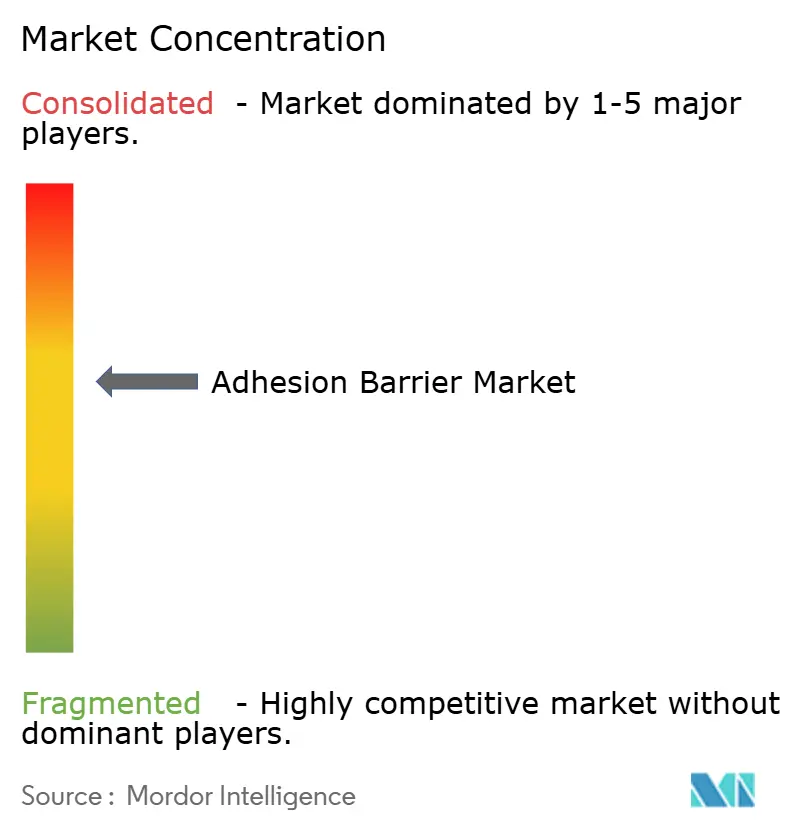
| Market Concentration | Medium |
Major Players *Disclaimer: Major Players sorted in no particular order Image © Mordor Intelligence. Reuse requires attribution under CC BY 4.0. | |
Adhesion Barrier Market Analysis by Mordor Intelligence
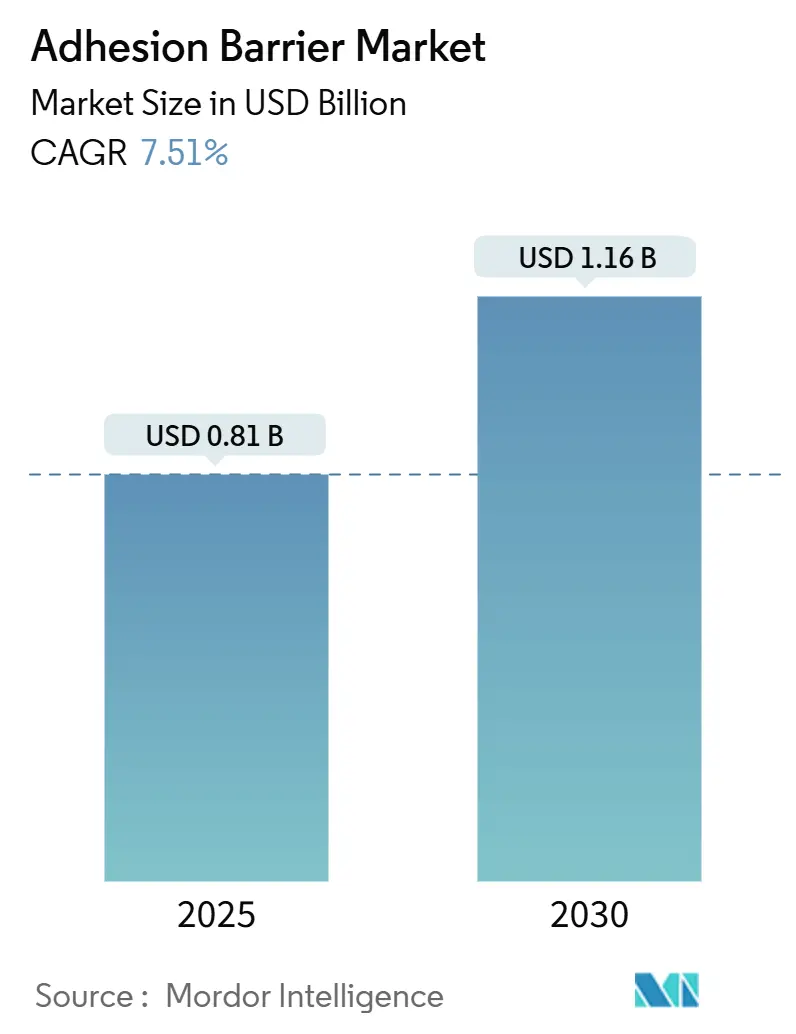
The Adhesion Barrier Market size is estimated at USD 0.81 billion in 2025, and is expected to reach USD 1.16 billion by 2030, at a CAGR of 7.51% during the forecast period (2025-2030).
Rising surgical volumes in abdominal, gynecological, orthopedic, and cardiovascular specialties underpin daily consumption, while value-based care frameworks reward hospitals that document lower adhesion-related readmissions under bundled payment contracts. In North America, widespread uptake of minimally invasive techniques and hospital protocols that classify adhesion prevention as a peri-operative quality indicator keep utilization high. Asia-Pacific is gaining momentum as public hospital modernization programs and national reimbursement schedules emphasize evidence-backed consumables that reduce downstream costs. Across regions, procurement teams prefer multi-functional barrier-sealants that combine sealing, hemostasis, and anti-adhesion properties, enabling premium pricing even as standalone film barriers face commoditization pressures.
Key Report Takeaways
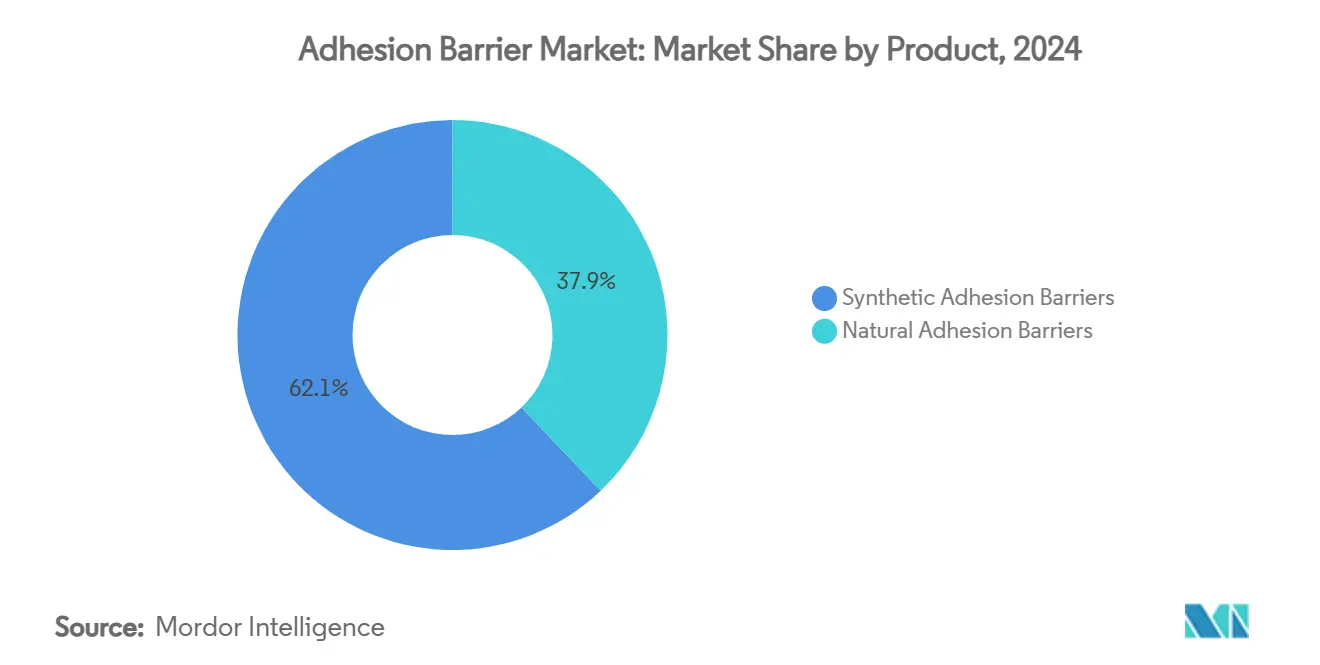
- By product, synthetic barriers held 62.11% of the adhesion barrier market share in 2024; natural barriers are advancing at an 8.21% CAGR through 2030.
- By formulation, films accounted for 47.12% of the adhesion barrier market size in 2024 and gel/spray systems are expanding at an 8.81% CAGR to 2030.
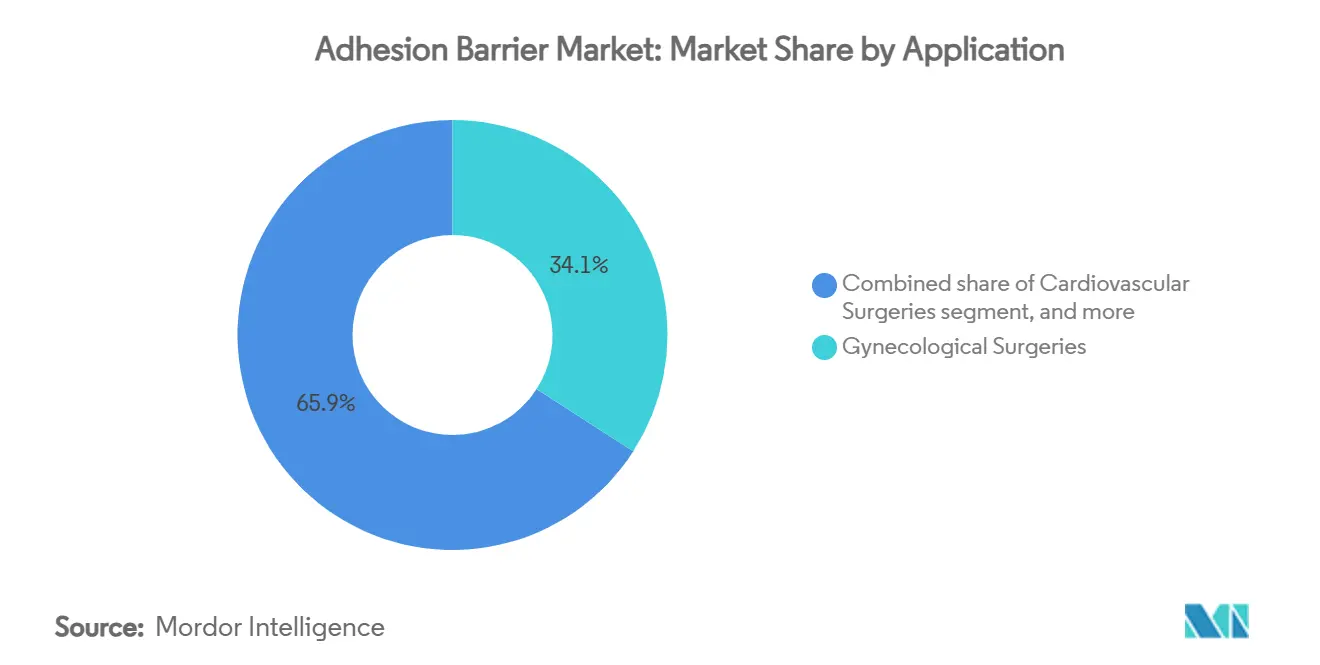
- By application, gynecological surgery commanded 34.13% of the adhesion barrier market size in 2024; cardiovascular surgery is projected to post the fastest 8.91% CAGR through 2030.
- By end-user, hospitals controlled 68.14% of global revenue in 2024, while ambulatory surgical centers are growing fastest at a 7.61% CAGR.
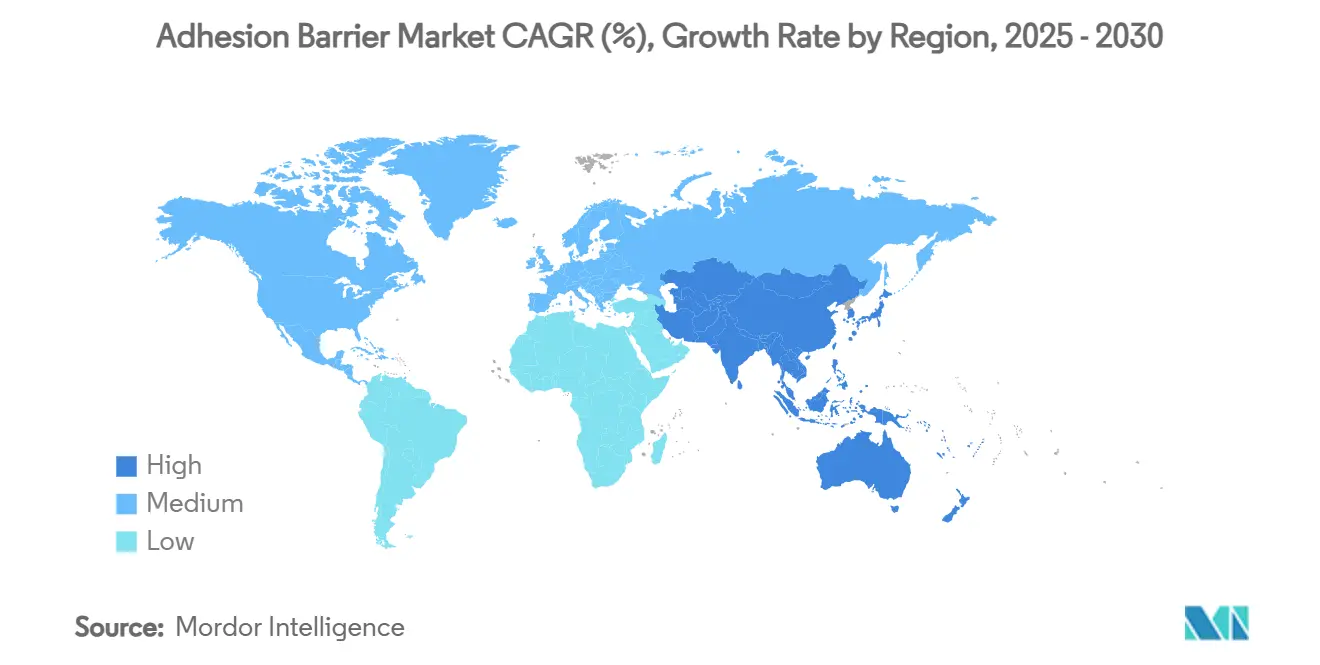
- By geography, North America captured 45.15% of revenue in 2024, whereas Asia-Pacific is advancing at an 8.51% CAGR through 2030.
Market Trends and Insights
Drivers Impact Analysis of Adhesion Barrier Market*
| Driver | % Impact on CAGR Forecast | Geographic Relevance | Impact Timeline |
|---|---|---|---|
| Rapid uptake of bio-resorbable synthetic barriers in complex cardiovascular procedures | +1.4% | North America, Europe, Japan | Long term (≥ 4 years) |
| Government-funded bundled payments driving adoption in outpatient gynecologic laparoscopy | +1.2% | North America, Europe, select Asia-Pacific | Medium term (2–4 years) |
| Hospital system “zero-adhesion” protocols triggering bulk purchasing of film barriers | +1.0% | Global | Short term (≤ 2 years) |
| Orthopedic robotics boom increasing demand for sprayable PEG barriers | +0.9% | North America, Asia-Pacific | Long term (≥ 4 years) |
| Surge in bariatric surgeries creating niche for large-format HA meshes | +0.8% | North America, Middle East, Latin America | Medium term (2–4 years) |
| Med-tech consolidation accelerating barrier/sealant combination products | +0.7% | Global | Medium term (2–4 years) |
| Source: Mordor Intelligence | |||
Shift To Value-Based Payment Incentives
Hospitals paid under bundled or capitated contracts treat adhesiolysis as an avoidable cost, so barrier use is now embedded in quality dashboards that track surgical readmissions[1]Centers for Medicare & Medicaid Services, “Hospital Readmissions Reduction Program Data,” cms.gov. Facilities that document fewer returns to theatre receive higher composite scores, unlocking bonus pools and reinforcing recurring purchases in the adhesion barrier market. Federal programs such as the Hospital Readmissions Reduction Program supply the framework for continuous reporting, essentially converting barriers from discretionary supplies to mandated inventory items. Suppliers respond by publishing health-economic dossiers showing reduced length of stay, which strengthens formulary positions and preserves premium price tiers in the adhesion barrier market.
Rise in Minimally Invasive Procedure Volumes
Outpatient laparoscopic and robotic cases outpace open surgeries in many abdominal and pelvic indications, and small trocar ports require barriers that deliver through narrow lumens without impairing visualization. Sprayable polyethylene glycol hydrogels meet this ergonomic need and minimize peritoneal drying time, reducing operating-room minutes. Value committees standardize on brands that show consistent deployment in simulation labs, creating repeat orders across integrated delivery networks. The sustained rise in minimally invasive caseloads guarantees long-run demand headroom for consumables within the adhesion barrier market.
Expansion of Robotic Surgery Platforms
Hospitals performing ≥ 300 robotic knee or hip reconstructions annually spend approximately twice the barrier budget per case compared with centres using manual instrumentation. Thin, uniform hydrogel coats avoid camera fogging and align with precision robotic workflows, explaining why spray systems command formulary preference. Broader installation of robotic platforms in thoracic and general surgery suites is set to amplify consumable pull-through, ensuring that the adhesion barrier market continues to scale alongside automation investments.
Hospital “Zero-Adhesion” Protocols
Interdisciplinary value committees now stratify procedures by adhesion risk and embed barrier orders into electronic preference cards, shifting decision power from individual surgeons to institutional buyers. Three-year, sole-source contracts provide volume visibility for suppliers and encourage iterative design improvements such as single-handed applicators. Embedding adhesion prevention into publicly reported peri-operative quality metrics signals that the adhesion barrier market has moved from optional to essential status.
Restraints Impact Analysis of Adhesion Barrier Market*
| Restraints Impact Analysis | (~) % Impact on CAGR Forecast | Geographic Relevance | Impact Timeline |
|---|---|---|---|
| Reimbursement caps on anti-adhesion consumables in DRG systems | −1.0% | North America, Europe | Short term (≤ 2 years) |
| Batch-to-batch variability in collagen barriers causing surgeon reluctance | −0.8% | Global | Medium term (2–4 years) |
| Cold-chain logistics for fibrin-based liquids limiting penetration in Sub-Saharan Africa | −0.6% | Sub-Saharan Africa | Long term (≥ 4 years) |
| Heightened FDA PMA scrutiny after recent Seprafilm recalls | −0.7% | United States | Short term (≤ 2 years) |
| Source: Mordor Intelligence | |||
DRG Reimbursement Caps
Diagnosis-Related Group ceilings do not include a dedicated code for adhesion barriers, so premium products must fit within fixed payments. Hospitals under budget pressure often substitute lower-cost synthetic sheets for high-priced biologic films, compressing margins and fuelling price competition in the adhesion barrier market. Unless separate coding emerges, suppliers of premium formats will need stronger health-economic data to sustain higher prices.
Batch-To-Batch Variability in Natural Collagen Barriers
Clinical users report variability in tensile strength and moisture content across collagen film lots, which raises return rates and erodes surgeon confidence. Revisions to purification and cross-linking protocols aim to stabilize mechanical properties, but improvements are still under regulatory review. Until consistency gaps close, preference may continue shifting toward synthetic polyethylene glycol sprays in segments where reliability is paramount, moderating the natural share within the adhesion barrier market.
*Our forecasts treat driver/restraint impacts as directional, not additive. The impact forecasts reflect baseline growth, mix effects, and variable interactions.
Adhesion Barrier Market Segment Analysis
By Product:
Synthetic Leadership with Natural AccelerationSynthetic products held 62.11% revenue share in the adhesion barrier market in 2024. Shelf-stable hyaluronate-carboxymethylcellulose films fit hospital lean-inventory goals, while predictable degradation schedules match standardized surgical checklists. Suppliers refine molecular weight to tailor absorption times, extending life cycles without triggering fresh pre-market submissions, which safeguards their dominant position across the adhesion barrier market.
Natural barriers like collagen, chitosan, human amnion are posting an 8.21% CAGR off a smaller baseline. Peer-reviewed studies funded by the National Institutes of Health show lower inflammatory markers in amniotic membrane grafts compared with synthetic films, boosting adoption in fertility-preserving myomectomies. Ethical sourcing resonates with patient-centric hospitals, although accreditation audits increase overhead. If purification upgrades for collagen pass FDA review and stabilize lot performance, natural products could expand share in the adhesion barrier industry.



By Formulation:
Established Films Versus High-Growth HydrogelsFilm barriers accounted for 47.12% of the adhesion barrier market size in 2024. Long familiarity in open abdominal and gynecological surgeries secures baseline orders, and hybrids that fuse mesh reinforcement for hernia repair illustrate how films remain adaptable to evolving clinical needs. Procurement committees, however, now screen for laparoscopic deployability, steering vendors toward foldable or fan-shaped designs that navigate port sites.
Gel and spray systems are growing at an 8.81% CAGR, reflecting the broader migration to minimally invasive techniques. Sprayable PEG hydrogels spread evenly over irregular anatomy, conserve theatre minutes, and allow exact dosing, making them popular in robotic suites. Liquid barriers remain niche but innovative prototypes with visible-light-activated stiffening, funded by the U.S. Department of Defense for field surgery kits hint at future diversification.
By Application:
Gynecological Share Versus Cardiovascular VelocityGynecological procedures generated 34.13% of 2024 revenue in the adhesion barrier market. Retrospective audits show deployment in fewer than 10% of myomectomies despite guidelines from the American College of Obstetricians and Gynecologists that recommend barrier consideration in high-risk adhesiogenic surgery. Fertility clinics now tie usage rates to quality scores, nudging surgeon adoption upward. Vendors with pre-loaded applicators suited to confined laparoscopic fields are translating this demand into market share gains.
Cardiovascular surgery is poised for the fastest 8.91% CAGR through 2030. Adhesions following sternotomy prolong re-entry times and elevate bleeding risk; Centers for Medicare & Medicaid Services, funded cost analyses confirm that avoiding one major injury offsets barrier costs during adult re-operations. Cardio-thoracic teams increasingly request transparent, imaging-compatible films that allow post-operative scanning without removal, a design driver for ongoing R&D programs disclosed in recent FDA 510(k) filings.
By End-User:
Hospital Dominance with ASC MomentumHospitals accounted for 68.14% of global revenue in 2024. Value committees rely on randomized controlled trial evidence to bundle barriers into surgical infection bundles, creating predictable annual volumes and incentivizing multi-year agreements. Teaching institutions include adhesion prevention in residency curricula, elevating usage to a marker of surgical proficiency that improves patient-safety scores on national dashboards.
Ambulatory surgical centers are expanding at a 7.61% C AGR. Bundled outpatient reimbursements make unplanned complications costly, so administrators benchmark barrier pricing against vendor calculators that model cost avoidance in same-day discharges. Spray hydrogels requiring minimal set-up time offer an operational edge. As outpatient case volumes rise, ASC product preferences will shape broader innovation priorities throughout the adhesion barrier market.
Geography Analysis
North America Adhesion Barrier Market
North America controlled 45% of global revenue in 2024. United States hospitals document USD 2.3 billion in annual adhesiolysis costs, creating strong incentives for preventive consumables[2]National Institutes of Health, “Economic Impact of Adhesiolysis,” nih.gov. Robotic platforms further raise per-procedure barrier spend, and the Medicare Hospital Outpatient Prospective Payment System counts barrier use as a quality adjustment factor in select DRG bundles. Canadian provincial formularies that are managed by governmental health ministries, rely on HTA reports from CADTH; once a barrier gains listing, national uptake accelerates, with recent interest tilting toward biologic amnion products.
APAC Adhesion Barrier Market
Asia-Pacific is advancing at an 8.5% CAGR. China’s National Medical Products Administration shortened review timelines for Class III wound-closure devices, fast-tracking synthetic spray approvals and intensifying price competition. Tropical climates in parts of India and Southeast Asia favour heat-stable synthetic powders over gelatin liquids that require cold chain, steering procurement choices. Japanese and Australian fellowship programs integrate adhesion-prevention modules, anchoring long-term demand.
EMEA and South America Adhesion Barrier Market
Europe maintains steady growth as national payers embed adhesion-avoidance metrics into Diagnosis Related Group contracts. The European Medicines Agency’s centralized registration route smooths market entry for next-generation barrier-sealants, while public tenders in Germany and France emphasise clinical dossier strength. In the Middle East and Africa, Gulf Cooperation Council oncology centres procure premium barriers for tertiary cases, creating reference installations that influence surrounding markets, although wider adoption is tempered by logistics hurdles. South American private networks rely on import licences issued by ANVISA in Brazil and INVIMA in Colombia; companies offering staggered payment terms mitigate currency risk, supporting incremental penetration of the adhesion barrier market.

Competitive Landscape
The adhesion barrier market is moderately concentrated: Johnson & Johnson, Baxter International, and Sanofi together hold roughly 60% of global revenue[3]U.S. Securities and Exchange Commission, “Form 10-K Filings 2024,” sec.gov. Their scale lets them bundle barriers with sutures, meshes, and hemostats, reducing administrative load for hospital buyers. Robust regulatory teams ensure timely responses to post-market safety updates flagged in FDA databases, reinforcing trust among risk-averse committees. Mid-tier firms such as Integra LifeSciences and Anika Therapeutics carve niches with chitosan gels for neurosurgery, leaning on National Institutes of Health-funded studies to substantiate claims. Start-ups emerging from academic labs leverage Small Business Innovation Research grants from agencies such as the National Science Foundation to develop smart polymers that couple anti-adhesion performance with antimicrobial delivery. Strategic acquisitions by larger corporations secure innovation pipelines, ensuring that the adhesion barrier market continues to evolve without fragmenting into commoditized silos.
Adhesion Barrier Industry Leaders
Johnson & Johnson
Leader Biomedical
Integra LifeSciences Holdings Corporation
Baxter International Inc.
Anika Therapeutics Inc.
- *Disclaimer: Major Players sorted in no particular order
Adhesion Barrier Market Companies Covered in this Report
- Johnson & Johnson
- Baxter
- Sanofi
- Integra LifeSciences Holdings Corp.
- Anika Therapeutics
- FzioMed Inc.
- Betatech Medical
- Leader Biomedical Group
- MAST Biosurgery AG
- GUNZE Limited
- TAICEND Technology Co., Ltd.
- Wuhan Sitaili Medical Apparatus Dev.
- Medtronic
- B. Braun
- CryoLife
- Advanced Medical Solutions Group

Recent Industry Developments in Adhesion Barrier Market
- January 2025: FDA cleared a transparent poly-L-lactic acid sheet (K233021) for sternotomy re-entries, marking the first barrier with imaging compatibility in cardiac applications.
- November 2025: The U.S. Department of Veterans Affairs added synthetic PEG spray systems to its national formulary following a multi-centre cost-effectiveness study across VA hospitals.
- August 2024: The Centers for Medicare & Medicaid Services updated the Hospital Outpatient Prospective Payment System rule to allow add-on payment petitions for multi-functional barrier-sealants, opening a pathway for future separate coding requests.
- May 2024: The National Institutes of Health awarded USD 8 million under R01 grants to explore hyaluronic-chitosan hybrid meshes for obesity-related abdominal wall reconstruction, signalling support for large-format biomaterials.
- March 2024: The National Institutes of Health awarded USD 8 million under R01 grants to explore hyaluronic-chitosan hybrid meshes for obesity-related abdominal wall reconstruction, signalling support for large-format biomaterials.


Global Adhesion Barrier Market Report Scope
An adhesion barrier refers to a medical implant that can be used to reduce abnormal internal scarring by adhesions following any surgery by separating the internal tissues and organs as long as they heal. It involves a proper surgical technique which is very much crucial to diminish adhesion formation.
The Adhesion Barrier Market is Segmented by Product (Synthetic Adhesion Barriers (Hyaluronic Acid, Regenerated Cellulose, Polyethylene Glycol, and Other Synthetic Adhesion Barriers) and Natural Adhesion Barriers (Collagen and Fibrin)), Formulation (Film, Liquid, and Gel), Application (General/Abdominal Surgeries, Gynecological Surgeries, Cardiovascular Surgeries, Orthopedic Surgeries, Neurological Surgeries, and Other Applications), and Geography (North America, Europe, Asia-Pacific, Middle East and Africa, and South America). The market report also covers the estimated market sizes and trends for 17 different countries across major regions globally. The report offers the value (in USD million) for the above segments.
Segmentation Overview
| Synthetic Adhesion Barriers | Hyaluronic Acid |
| Regenerated Cellulose | |
| Polyethylene Glycol | |
| Other Synthetic Adhesion Barriers | |
| Natural Adhesion Barriers | Collagen |
| Fibrin |
| Film / Mesh |
| Liquid |
| Gel / Spray |
| General / Abdominal Surgeries |
| Gynecological Surgeries |
| Cardiovascular Surgeries |
| Orthopedic Surgeries |
| Neurological Surgeries |
| Other Applications |
| Hospitals |
| Ambulatory Surgical Centers |
| Other End-Users |
| North America | United States |
| Canada | |
| Mexico | |
| Europe | Germany |
| United Kingdom | |
| France | |
| Italy | |
| Spain | |
| Rest of Europe | |
| Asia-Pacific | China |
| Japan | |
| India | |
| Australia | |
| South Korea | |
| Rest of Asia-Pacific | |
| Middle East & Africa | GCC |
| South Africa | |
| Rest of Middle East & Africa | |
| South America | Brazil |
| Argentina | |
| Rest of South America |
| By Product | Synthetic Adhesion Barriers | Hyaluronic Acid |
| Regenerated Cellulose | ||
| Polyethylene Glycol | ||
| Other Synthetic Adhesion Barriers | ||
| Natural Adhesion Barriers | Collagen | |
| Fibrin | ||
| By Formulation | Film / Mesh | |
| Liquid | ||
| Gel / Spray | ||
| By Application | General / Abdominal Surgeries | |
| Gynecological Surgeries | ||
| Cardiovascular Surgeries | ||
| Orthopedic Surgeries | ||
| Neurological Surgeries | ||
| Other Applications | ||
| By End-User | Hospitals | |
| Ambulatory Surgical Centers | ||
| Other End-Users | ||
| Geography | North America | United States |
| Canada | ||
| Mexico | ||
| Europe | Germany | |
| United Kingdom | ||
| France | ||
| Italy | ||
| Spain | ||
| Rest of Europe | ||
| Asia-Pacific | China | |
| Japan | ||
| India | ||
| Australia | ||
| South Korea | ||
| Rest of Asia-Pacific | ||
| Middle East & Africa | GCC | |
| South Africa | ||
| Rest of Middle East & Africa | ||
| South America | Brazil | |
| Argentina | ||
| Rest of South America | ||


Key Questions Answered in the Report
What is the current size of the adhesion barrier market?
The adhesion barrier market size is USD 0.81 billion in 2025 and is projected to reach USD 1.16 billion by 2030.
Which product segment holds the largest share?
Synthetic barriers command 62.11% of global revenue owing to their predictable degradation profiles and shelf-stable formats.
Which application is growing fastest?
Cardiovascular surgery is expanding at an 8.91% CAGR as hospitals seek to reduce re-entry complications after sternotomy.
Why are ambulatory surgical centers increasing their adoption of barriers?
Bundled payments in outpatient settings encourage use of rapid-acting spray hydrogels that minimize operating-room time and unplanned costs.
How are DRG reimbursement caps affecting premium products?
Fixed payments without dedicated barrier codes constrain pricing power, prompting hospitals to switch to lower-cost synthetic sheets in commoditized segments.
What strategic moves are market leaders making?
Large companies bundle barriers with complementary consumables, while mid-tier players focus on niche chemistries and start-ups pioneer smart polymers that combine anti-adhesion and drug-delivery functions.
Page last updated on:





