
Accounts Receivable Financing Market Size and Share
Market Overview
| Study Period | 2020 - 2031 |
|---|---|
| Market Size (2026) | USD 4.95 Trillion |
| Market Size (2031) | USD 6.29 Trillion |
| Growth Rate (2026 - 2031) | 4.90 % |
| Fastest Growing Market | Asia-Pacific |
| Largest Market | Europe |
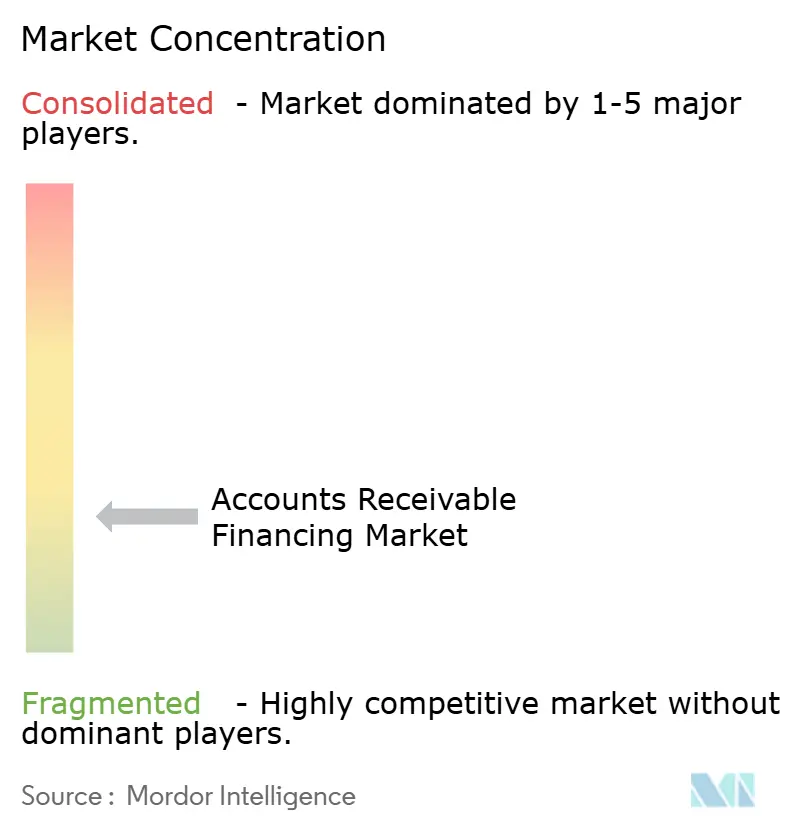
| Market Concentration | Low |
Major Players *Disclaimer: Major Players sorted in no particular order Image © Mordor Intelligence. Reuse requires attribution under CC BY 4.0. | |
Accounts Receivable Financing Market Analysis by Mordor Intelligence
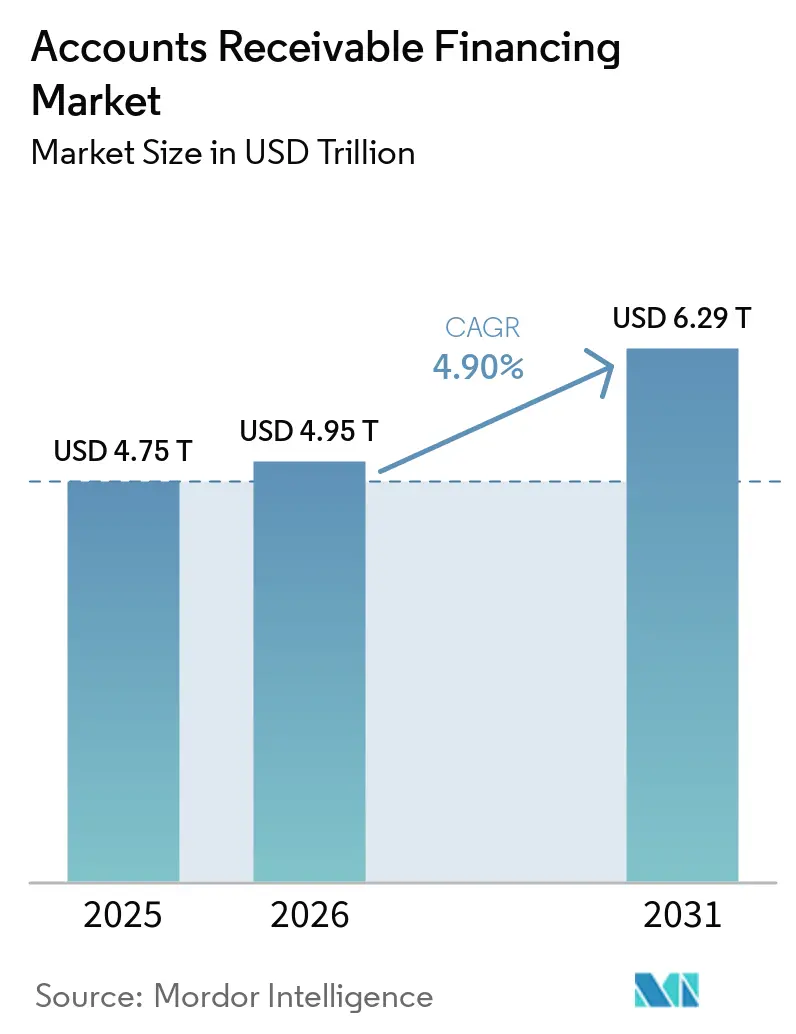
The Accounts Receivable Financing Market size was valued at USD 4.75 trillion in 2025 and is estimated to grow from USD 4.95 trillion in 2026 to reach USD 6.29 trillion by 2031, at a CAGR of 4.90% during the forecast period (2026-2031).
The accounts receivable financing market is supported by longer payment cycles, tighter access to conventional credit, and the wider use of digital invoice records. FCI reported that global factoring turnover exceeded EUR 4 trillion (USD 4.67 trillion) in 2025, which showed continued use of receivables-based funding across changing economic conditions. Supply chain finance is extending funding programs into lower supplier tiers, where formal financing had previously been limited. Providers are therefore placing greater weight on invoice data, payment records, and integration with business systems. Regulatory changes in Europe and India also support the formal use of verified invoices, which can lower verification costs and improve access to funding.
Key Report Takeaways
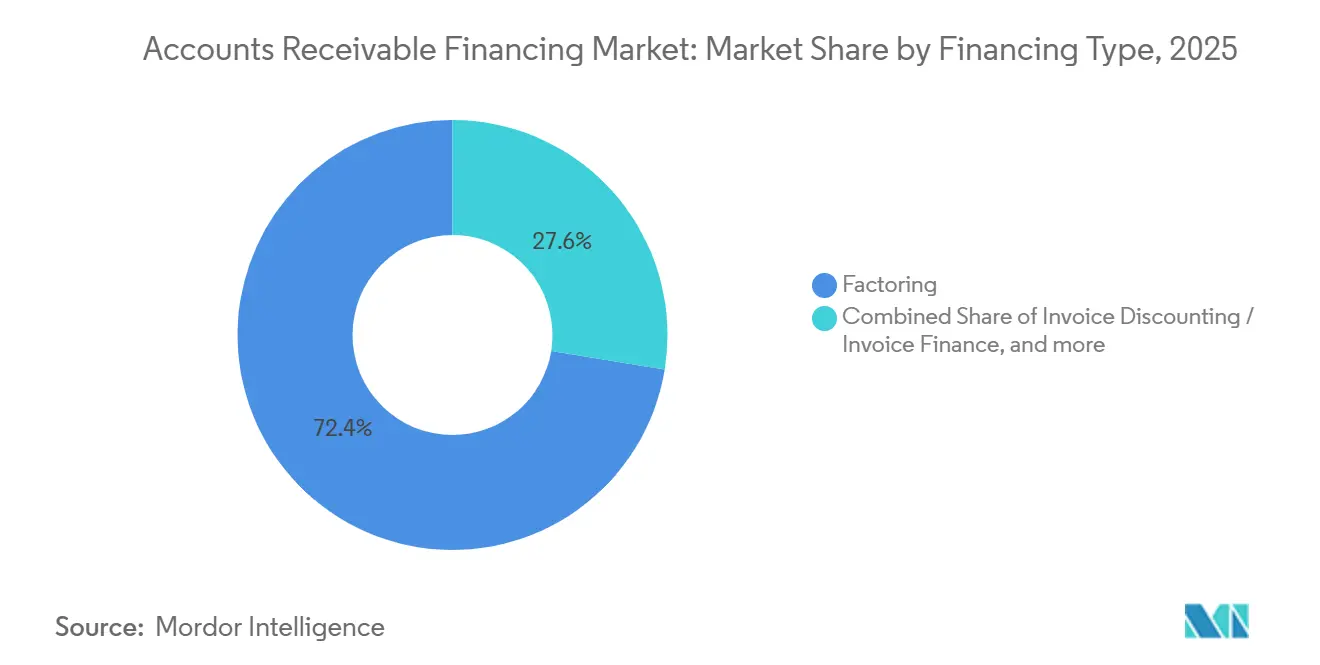
- By financing type, factoring captured 72.43% of the accounts receivable financing market share in 2025, while invoice discounting and invoice finance are projected to grow at 6.82% CAGR through 2031.
- By provider type, banks captured 87.69% of the accounts receivable financing market share in 2025, while non-bank financial institutions are projected to grow at 8.21% CAGR through 2031.
- By enterprise size, large enterprises captured 55.37% of the accounts receivable financing market share in 2025, while SMEs are projected to grow at 6.53% CAGR through 2031.
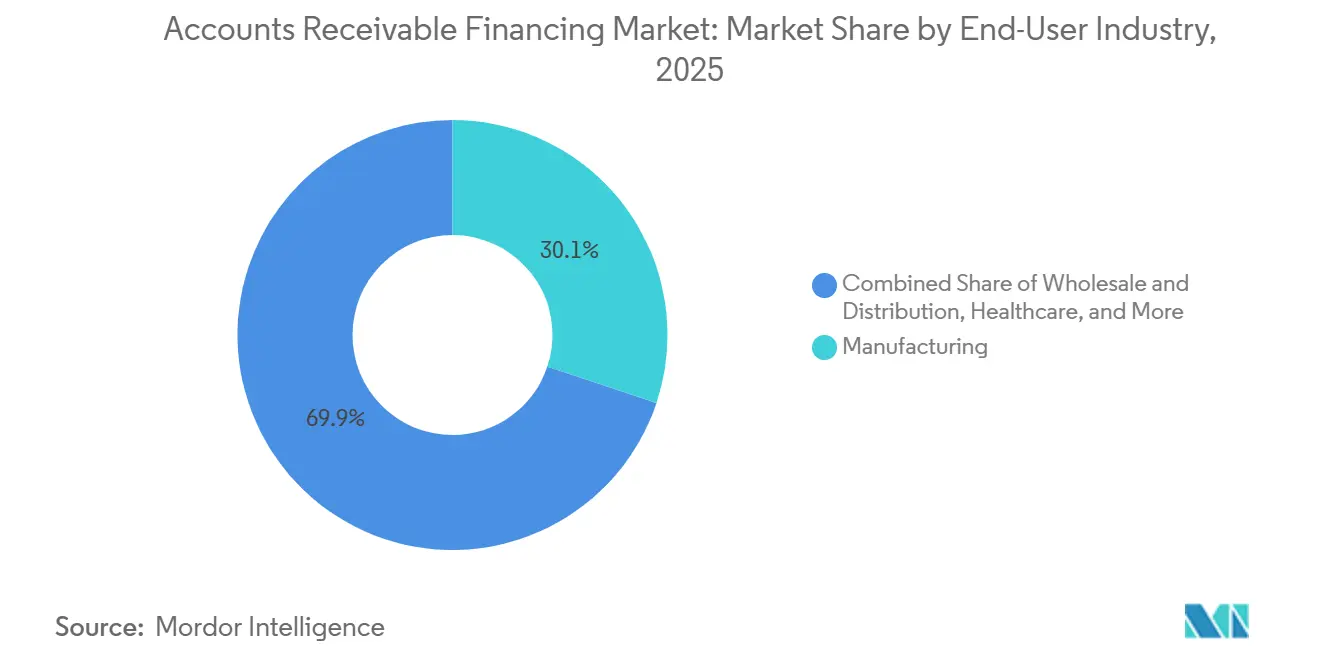
- By end-user industry, manufacturing captured 30.12% of the accounts receivable financing market share in 2025, while retail and e-commerce are projected to grow at 7.58% CAGR through 2031.
- By geographic scope of transaction, domestic transactions captured 81.87% of the accounts receivable financing market share in 2025, while international transactions are projected to grow at 7.19% CAGR through 2031.
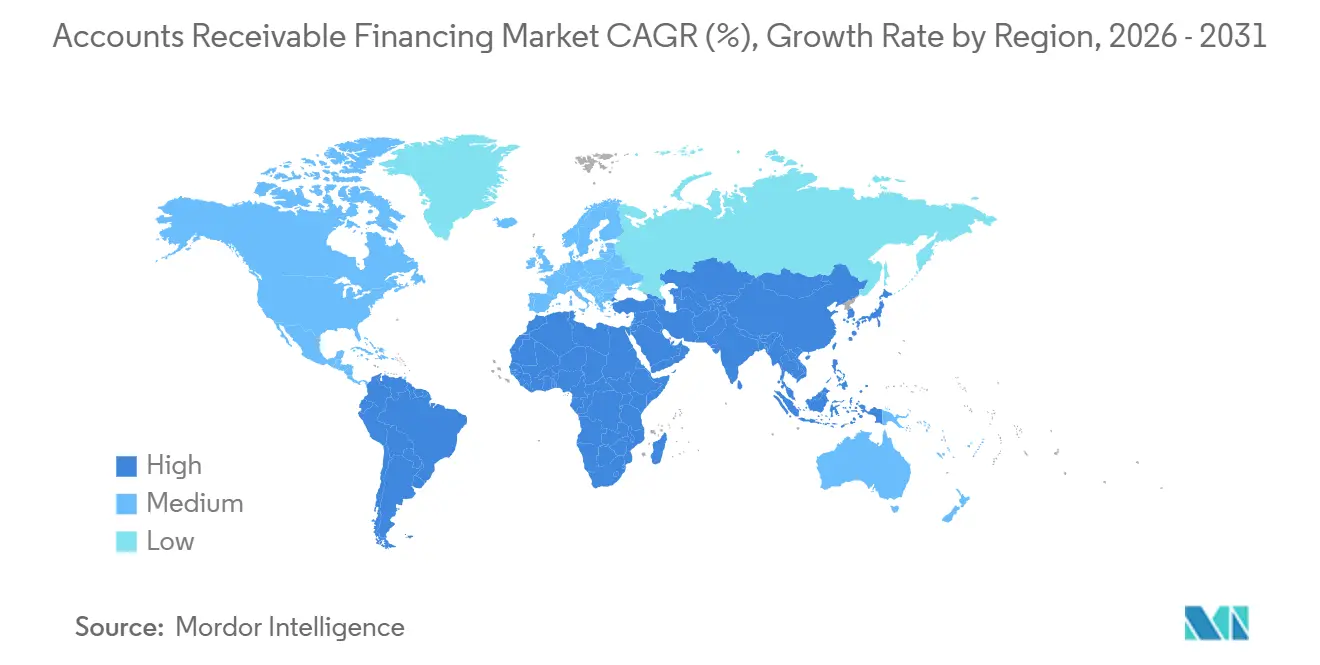
- By geography, Europe captured 66.32% of the global accounts receivable financing market share in 2025, while Asia-Pacific is projected to grow at 6.67% CAGR through 2031.
Note: Market size and forecast figures in this report are generated using Mordor Intelligence’s proprietary estimation framework, updated with the latest available data and insights as of January 2026.
Global Accounts Receivable Financing Market Trends and Insights
Drivers Impact Analysis*
| Driver | (~) % Impact on CAGR Forecast | Geographic Relevance | Impact Timeline |
|---|---|---|---|
| Longer B2B Payment Cycles Increasing Working-Capital Pressure | +1.3% | Global, with greatest relevance in Europe and North America | Short term (≤ 2 years) |
| Greater SME Reliance on Receivables Finance Amid Limited Traditional Credit | +1.1% | Asia-Pacific, South America, and MEA, with increasing relevance in North America | Medium term (2-4 years) |
| Growth in Open-Account and Cross-Border Trade | +0.8% | Asia-Pacific and Europe, with spillover to MEA and South America | Medium term (2-4 years) |
| Supply Chain Finance Adoption for Supplier Liquidity | +0.5% | North America and Europe, with early gains in Asia-Pacific | Medium term (2-4 years) |
| Digital Integration of Invoice, Payment, and Business Data | +0.7% | Global, with rapid adoption in Asia-Pacific and South America | Short term (≤ 2 years) |
| Demand for Flexible Non-Dilutive Short-Term Finance | +0.4% | North America and Europe | Short term (≤ 2 years) |
| Source: Mordor Intelligence | |||
Rising Working-Capital Pressure From Longer B2B Payment Cycles
Longer payment terms in manufacturing, retail, and logistics are increasing the need for accounts receivable financing. Suppliers that wait 60, 90, or 120 days for payment can face a funding gap that revolving credit facilities do not always address efficiently. This funding need is a key source of demand in the accounts receivable financing market. Citi stated in its 2026 supply chain financing report that AI is being used to automate SME underwriting because traditional reviews can be costly for small supplier transactions[1]Citi, “Supply Chain Financing 2026,” Citi Global Insights, citigroup.com.. Germany recorded EUR 423.5 billion (USD 494.7 billion) in factoring volume in 2025, a 6.2% increase, while the country’s GDP grew 0.2% in the same year. This contrast shows why verified receivables can become more important when businesses face tighter bank credit conditions.
Growing SME Reliance on Receivables Finance Amid Limited Access to Traditional Credit
SMEs are often underserved because supply chain finance programs tend to focus on larger suppliers. The International Chamber of Commerce noted that smaller firms can face collateral, credit-history, and relationship requirements that limit access to conventional working-capital products[2] International Chamber of Commerce, “Why SMEs Are the Missing Link in Supply Chain Finance,” ICC Academy, academy.iccwbo.org.. This gap creates a clear access issue within the accounts receivable financing market. India’s TReDS platform crossed INR 2 lakh crore (USD 23.4 billion) in bill financing by June 2025, which indicated a larger formal channel for invoice discounting. The 2026 MSME Development amendment required Central Public Sector Enterprises to route MSME invoice settlements through RBI-authorized TReDS platforms. This policy direction can reduce the funding gap for smaller suppliers and can make verified receivables more usable for lenders.
Expansion of Open-Account and Cross-Border Trade Increasing Receivables Funding Needs
Open-account trade leaves exporters with direct exposure to foreign-buyer payment risk after goods are shipped. Factoring and invoice discounting can help exporters convert these receivables into working capital while managing part of that risk. FCI reported 8.7% factoring growth in the Middle East and 8.2% growth in South America in 2025[3]FCI releases 2025 world industry statistics as global factoring market surpasses €4tn - Business Money. Trafigura completed a USD 1 billion syndicated receivables discount facility in January 2025, using credit insurance to support its capital treatment. Cross-border programs still require careful treatment of assignment priority and enforcement rules across jurisdictions.
Digital Integration of Invoice, Payment, and Business Data Accelerating Receivables Financing
Real-time invoice, logistics, and payment data can improve the speed and quality of receivables underwriting. Providers can use this data to review payment behavior and identify dilution signals before invoices become credit losses. This capability is changing how providers serve the accounts receivable financing market. SAP Taulia facilitated more than USD 50 billion in supply chain funding in 2025, a 26% year-over-year increase, and reported more than USD 1.2 trillion in annual transaction volume[4]SAP Taulia, “Over USD 50 Billion in Funding Facilitated Via the Platform in 2025,” SAP Taulia, taulia.com.. Colombia’s RADIAN registry recorded 540,692 registered invoices valued at COP 15.3 trillion (USD 4.9 billion) and 526,980 endorsed invoices valued at COP 15.0 trillion (USD 4.8 billion) in 2026. The accounts receivable financing market can benefit when invoice records become more standardized and easier to verify.
Restraints Impact Analysis*
| Restraint | (~) % Impact on CAGR Forecast | Geographic Relevance | Impact Timeline |
|---|---|---|---|
| Buyer Credit Concentration and Default Risk | -0.3% | Global, with greatest relevance in developing economies and mid-market segments | Short term (≤ 2 years) |
| Invoice Fraud, Dilution, and Dispute Risk | -0.2% | Global, concentrated in new markets and digital-onboarding segments | Short term (≤ 2 years) |
| Differences in Assignment, Priority, and Enforcement Laws | -0.1% | Cross-border transactions, particularly in Asia-Pacific, MEA, and South America | Long term (≥ 4 years) |
| Platform Integration Complexity With Legacy ERP Systems | -0.1% | Global, particularly in mid-market and SME segments | Medium term (2-4 years) |
| Source: Mordor Intelligence | |||
Buyer Credit Concentration and Default Risk Limiting Funding Capacity and Advance Rates
A receivables pool can be difficult to finance when one or a few buyers account for most of its value. Provider credit policies commonly apply concentration limits, even when the seller has a sound operating record. This issue is particularly relevant for SME suppliers that depend on one large retail or automotive customer. Moody’s stated that fraudulent counterparties can increase days sales outstanding through invoices that will not be paid, which can combine concentration and fraud risk. Banks also have incentives to apply conservative limits to concentrated portfolios under capital adequacy requirements.
Invoice Fraud, Dilution, and Dispute Risk Increasing Credit-Loss Exposure
Invoice fraud can include double financing, pre-invoicing, and fabricated receivables that do not reflect a genuine sale. These practices can create losses after funding has already been advanced and can be difficult to identify in a new counterparty relationship. The International Factoring Association reported that 99.8% of suppliers in a multi-year study experienced at least 1 dilution event, including shortfalls caused by returns, discounts, or billing disputes. Dilution can reduce collections even when the buyer does not formally default. Providers, therefore, need fraud checks, reliable invoice records, and reserve pricing that reflects disputes and other collection risks.
*Our forecasts treat driver/restraint impacts as directional, not additive. The impact forecasts reflect baseline growth, mix effects, and variable interactions.
Segment Analysis
By Financing Type: Factoring Leads Volume While Invoice Discounting Grows Faster
Factoring held 72.43% of the accounts receivable financing market in 2025. The position reflects its established operating model and its ability to combine liquidity, collections support, and credit-risk transfer for suppliers. Non-recourse factoring remains relevant where sellers want protection from buyer nonpayment. It also provides a process for managing receivables after an invoice is issued. This can be useful when smaller suppliers do not have internal collections capacity. Spain’s factoring and confirming activity reached EUR 270.0 billion (USD 292.0 billion) in 2025, while confirming reached a record EUR 142.0 billion (USD 153.0 billion). This use of buyer-confirmed payables shows how receivables and payables programs can become part of routine payment operations. The scale of confirming also shows the importance of buyer participation in funding models. It gives suppliers greater clarity on when an approved invoice can be paid. Factoring, therefore, remains central where liquidity and receivables administration are required together.
Invoice discounting and invoice finance are forecast to grow at 6.82% CAGR through 2031. Mid-sized and large businesses use the product when they want confidential financing and continued ownership of customer relationships. The arrangement can allow a company to retain its normal customer-facing collection process. Electronic invoicing requirements and application programming interface connections can reduce the document burden associated with this model. That can make the process more workable for businesses with regular invoice flows. Larger corporates are also using receivables securitization to access funding through capital-market structures. These structures can be used where a portfolio has sufficient scale and documented performance. The accounts receivable financing market is therefore serving both traditional factoring needs and data-enabled funding models. The distinction between the two approaches often depends on the seller’s desired level of control and service.


By Financing Provider Type: Banks Retain Volume While NBFIs Expand Access
Banks held 87.69% of the accounts receivable financing market in 2025. Their position is supported by lower funding costs, balance-sheet capacity, and established treasury relationships with large corporate clients. Bank-led supply chain finance programs can also use anchor-buyer credit quality to support supplier funding. This approach can give suppliers access to funding linked to a buyer they already serve. Banks can also combine receivables products with broader cash-management relationships. JPMorgan Chase launched its Working Capital Accelerator in May 2026 to combine dynamic discounting, supply chain finance, and receivables financing in one interface. The product illustrates how large banks are using digital systems to retain their place in working-capital finance. It also reflects the need for a simpler user experience across closely related funding products. Providers with established client relationships are adapting those relationships to digital workflows.
Non-bank financial institutions are forecast to grow at 8.21% CAGR through 2031. Their operating models can be suited to smaller transactions and cross-border activity, where automated underwriting lowers processing costs. They can focus on transaction types that may not fit standard bank processes. Their funding capacity can also be supplemented by institutional investors. Wayflyer and Fortress Investment Group announced a 3-year USD 1.5 billion forward-flow agreement in July 2026, raising Wayflyer’s total platform capacity to USD 4.5 billion. The agreement shows how a platform can fund originated assets through a dedicated capital arrangement. Capital rules can also encourage banks to originate assets for distribution rather than retain all receivables on their own balance sheets. This supports a larger role for NBFIs in the accounts receivable financing market. It may also widen the range of providers available to smaller businesses.
By Enterprise Size: Large Enterprises Account for More Volume While SMEs Gain Access
Large enterprises accounted for 55.37% of total transaction volume in 2025. They typically generate higher invoice volumes and maintain established treasury relationships with banks, enabling them to access supply chain finance at comparatively lower funding costs. Their established buyer relationships also allow financing programs to extend across large supplier networks. In addition, large enterprises generally have the technology infrastructure required to integrate procurement, invoicing, and payment data, supporting the efficient deployment of early-payment and dynamic discounting solutions. SAP Taulia reported USD 1.2 trillion in annual transaction volume across its platform, highlighting the scale of transaction activity supported by enterprise buyer programs and their supplier networks. As a result, large-enterprise programs remain a significant source of transaction volume in the supply chain finance market.
SMEs are forecast to grow at 6.53% CAGR through 2031. Digital platforms and policy interventions are opening channels that historically favored larger suppliers. These mechanisms can reduce the effort involved in submitting and verifying an invoice. They can also give providers a more standardized record for underwriting. India’s Economic Survey 2025-26 highlighted INR 8.1 lakh crore (USD 95.3 billion) in delayed MSME receivables. The ICC noted that SMEs represented nearly 90% of global businesses while remaining disproportionately underserved in supply chain finance. This disconnect indicates why payment delays can have an outsized effect on smaller firms. Providers that make onboarding simpler and use alternative data can address a large part of the accounts receivable financing market that remains underserved. The result can be wider access without changing the underlying need for prudent credit controls.
By End-User Industry: Manufacturing Generates Demand While Retail and E-Commerce Advance Faster
Manufacturing accounted for 30.12% of total volume in 2025. Long production cycles, inventory requirements, and multi-tier payment arrangements can create recurring working-capital gaps across the supply chain. Receivables finance enables suppliers to access liquidity between shipment and customer payment, helping reduce the impact of extended collection periods. The sector also has extensive relationships between large manufacturers and smaller component suppliers, making buyer-supported financing programs effective across multiple supplier tiers. Wholesale and distribution also remain important segments because high invoice frequency and established buyer-seller relationships are well-suited to factoring and other receivables-finance solutions. Regular sales cycles can generate predictable receivables portfolios that are easier to monitor, assess, and finance.
Retail and e-commerce are forecast to grow at 7.58% CAGR through 2031. Marketplace-based sellers often need financing that can match rapid order fulfillment and shorter operating cycles. A funding product may need to respond quickly when sales volumes change across a marketplace. This need is different from financing tied to longer production schedules. Healthcare requires more specialized underwriting because insurance reimbursement timing and disputes can affect invoice collection. Transportation and logistics can also require sector-specific assessment because operational documents determine whether an invoice is financeable. IT and telecommunications receivables can carry higher fraud and dilution exposure, which requires closer verification by lenders. These distinct operating patterns mean that a single underwriting approach may not suit every end-user category. Providers must align invoice review and risk controls with the relevant payment process.
By Geographic Scope of Transaction: Domestic Transactions Remain Larger While Cross-Border Activity Grows
Domestic transactions held 81.87% of accounts receivable financing volume in 2025. A single legal jurisdiction can simplify receivables assignment, debtor enforcement, and data standards. This can reduce the work required to establish a program and monitor collections. It can also give providers a clearer view of the rules that apply if a dispute occurs. Germany’s domestic factoring volume reached EUR 423.5 billion (USD 457.4 billion) in 2025, and its factoring-to-GDP ratio was 9.5%. The measure remained below the penetration reported for Belgium and Portugal. This suggests that mature domestic markets can still have scope for further use of factoring. Domestic programs can therefore retain room for expansion without depending on cross-border trade. Their practical advantage remains the relative simplicity of working within one system of law.
International transactions are forecast to grow at 7.19% CAGR through 2031. Open-account exports, regional trade agreements, and cross-border fintech models are increasing the need for receivables funding beyond national borders. Exporters may need funding before an overseas buyer completes payment. The provider must then consider the buyer’s credit quality and the legal terms across countries. Deutsche Bank and Korea Trade Insurance Corporation completed a USD 20 million invoice discounting facility for Posco International Singapore in March 2025. The facility demonstrated how trade-credit insurance can help support cross-border invoice funding. Insurance can reduce part of the exposure to the buyer where the structure permits it. Legal differences in assignment priority and enforcement can still lengthen the time and increase the cost needed to establish international programs. Cross-border growth will therefore depend on both trade demand and workable risk structures.
Geography Analysis
Europe held 66.32% of the regional total in 2025. FCI reported EUR 2,658.0 billion (USD 2,870.6 billion) in European factoring turnover in 2025, with France and Germany each contributing more than EUR 400.0 billion (USD 432.0 billion). Payment-delay rules and laws that restrict assignment bans have supported the use of factoring in many European markets. Germany’s 6.3% factoring growth in 2025, compared with 0.2% GDP growth, reflected continued demand for receivables funding. Romania’s factoring market exceeded EUR 10.5 billion (USD 11.3 billion) in 2025, while Spain’s confirming volume reached EUR 142.0 billion (USD 153.4 billion).
Asia-Pacific is projected to record the fastest regional CAGR of 6.67% through 2031. FCI data placed regional factoring volume at EUR 995.0 billion (USD 1,074.6 billion) in 2025, up 3.2%, and China accounted for EUR 713.0 billion (USD 770.0 billion) of the regional total. Singapore recorded 15.9% growth as a trade-finance hub. India’s TReDS Master Direction took effect on June 23, 2026, and removed mandatory due diligence friction for MSME sellers. The direction also allowed credit guarantee cover for financiers and set net-worth requirements for platform operators.
North and South America accounted for nearly 8% of global factoring volume in 2025. The United States recorded 35.5% growth in factoring volume, while South America grew 8.2% to EUR 165.0 billion (USD 178.2 billion). Brazil grew 22.2%, and Peru grew 13.1%, supported by electronic-invoice infrastructure. Kettera Financial Solutions secured a USD 50 million debt facility in April 2026 to support accounts receivable-backed SME financing in Mexico. The Middle East and Africa recorded 8.7% and 2.2% growth, respectively, in 2025, with the UAE acting as a regional hub.

Competitive Landscape
The accounts receivable financing market is fragmented, with major banks primarily serving large corporate and supply chain finance programs. Competitive dynamics vary across large corporates, SMEs, and cross-border transactions. BNP Paribas, HSBC, JPMorgan Chase, Citigroup, and Barclays compete for anchor-buyer mandates that require strong balance-sheet capacity, liquidity, and extensive cross-border networks. Deutsche Factoring Bank and Bibby Financial Services focus on selected mid-market and SME segments, offering specialized receivables financing and management capabilities. The SME and cross-border segments remain more fragmented, with no single provider maintaining a consistent structural market-share advantage. Increasingly, digital platform capabilities, transaction-processing speed, data connectivity, and automated credit assessment are becoming important differentiators alongside traditional relationship coverage.
JPMorgan Chase launched the Working Capital Accelerator in May 2026, combining dynamic discounting, supply chain finance, and receivables financing in one interface. HSBC expanded TradeCash across Singapore and the UAE in 2026 to support digital trade-finance needs. SAP Taulia launched Italy’s first supply chain finance special purpose vehicle in November 2025, operating under local securitization rules. These moves show that banks and platform firms are responding to demand for faster implementation and more direct digital workflows. They also show that compliance structures can shape the ability of non-bank platforms to expand in domestic programs.
Potential opportunities remain in SME receivables in Asia-Pacific and Latin America, and in cross-border healthcare and e-commerce transactions. These areas can require specialized documentation and underwriting methods that general platforms may not offer. Providers are investing in invoice registries, fraud checks, and analytics that identify dilution before funding is advanced. SAP Taulia’s 2025 funding and transaction data show the scale possible when receivables funding is embedded in enterprise systems. The accounts receivable financing market will remain shaped by the ability to combine reliable data, credit controls, and practical funding capacity.
Accounts Receivable Financing Industry Leaders
Bibby Financial Services Limited
eCapital Corporation
PrimeRevenue, Inc.
Taulia Inc.
Triumph Financial, Inc.
- *Disclaimer: Major Players sorted in no particular order

Recent Industry Developments
- August 2026: India's MSME Development (Amendment) Act, 2026, which received Presidential assent on August 13, 2026, mandated that all Central Public Sector Enterprises route MSME invoice settlements through RBI-authorized TReDS platforms and introduced tighter dispute-resolution timelines and enforcement powers, creating a compulsory formalization of receivables discounting for India's 63 million-plus MSME sector.
- July 2026: Wayflyer and Fortress Investment Group announced a 3-year, USD 1.5 billion forward-flow agreement under which Fortress will purchase assets originated on Wayflyer's platform, increasing total platform capacity to USD 4.5 billion over the following 24 months.
- May 2026: JPMorgan Chase launched the Working Capital Accelerator, a unified digital platform that consolidates dynamic discounting, supply chain finance, and receivables financing under a single interface, targeting treasury teams seeking an integrated working-capital solution.
- November 2025: SAP Taulia launched Italy's first Supply Chain Finance Special Purpose Vehicle, registered with the Bank of Italy under local securitization law, enabling domestic supply chain finance transactions.


Global Accounts Receivable Financing Market Report Scope
| Factoring |
| Invoice Discounting/Invoice Finance |
| Other Seller-Side Receivables Financing |
| Banks |
| Non-Bank Financial Institutions |
| Small and Medium Enterprises (SMEs) |
| Large Enterprises |
| Manufacturing |
| Wholesale and Distribution |
| Retail and E-Commerce |
| Healthcare |
| Information Technology and Telecommunications |
| Transportation and Logistics |
| Other End-User Industries (Construction and Engineering, Hospitality and Tourism, Agriculture, etc.) |
| Domestic |
| International (Cross-border) |
| North America | United States |
| Canada | |
| Mexico | |
| South America | Brazil |
| Argentina | |
| Rest of South America | |
| Europe | United Kingdom |
| Germany | |
| France | |
| Italy | |
| Spain | |
| Rest of Europe | |
| Asia-Pacific | China |
| Japan | |
| India | |
| South Korea | |
| Australia | |
| Indonesia | |
| Thailand | |
| Malaysia | |
| Singapore | |
| Vietnam | |
| Rest of Asia-Pacific | |
| Middle East and Africa | Saudi Arabia |
| United Arab Emirates | |
| Turkey | |
| South Africa | |
| Egypt | |
| Rest of Middle East and Africa |
| By Financing Type | Factoring | |
| Invoice Discounting/Invoice Finance | ||
| Other Seller-Side Receivables Financing | ||
| By Financing Provider Type | Banks | |
| Non-Bank Financial Institutions | ||
| By Enterprise Size | Small and Medium Enterprises (SMEs) | |
| Large Enterprises | ||
| By End-User Industry | Manufacturing | |
| Wholesale and Distribution | ||
| Retail and E-Commerce | ||
| Healthcare | ||
| Information Technology and Telecommunications | ||
| Transportation and Logistics | ||
| Other End-User Industries (Construction and Engineering, Hospitality and Tourism, Agriculture, etc.) | ||
| By Geographic Scope of Transaction | Domestic | |
| International (Cross-border) | ||
| By Geography | North America | United States |
| Canada | ||
| Mexico | ||
| South America | Brazil | |
| Argentina | ||
| Rest of South America | ||
| Europe | United Kingdom | |
| Germany | ||
| France | ||
| Italy | ||
| Spain | ||
| Rest of Europe | ||
| Asia-Pacific | China | |
| Japan | ||
| India | ||
| South Korea | ||
| Australia | ||
| Indonesia | ||
| Thailand | ||
| Malaysia | ||
| Singapore | ||
| Vietnam | ||
| Rest of Asia-Pacific | ||
| Middle East and Africa | Saudi Arabia | |
| United Arab Emirates | ||
| Turkey | ||
| South Africa | ||
| Egypt | ||
| Rest of Middle East and Africa | ||


Key Questions Answered in the Report
What is accounts receivable financing?
Accounts receivable financing enables a business to access cash against unpaid customer invoices. It includes factoring, invoice discounting, and related structures. The approach can help align funding with the period between a sale and customer payment.
How large is the accounts receivable financing market?
The accounts receivable financing market size is estimated at USD 4.95 trillion in 2026 and is forecast to reach USD 6.29 trillion by 2031 at a 4.9% CAGR. The forecast reflects demand for working-capital funding, verified invoice data, and broader platform access.
Which financing type has the largest share?
Factoring held 72.43% of total volume in 2025 because it can provide liquidity, collections support, and credit-risk transfer. It remains useful when a supplier needs operational support as well as funding against an invoice.
Why are SMEs adopting receivables funding?
SMEs often face limited access to conventional credit and longer customer payment terms. Digital platforms and TReDS-type programs can broaden their access to verified invoice funding. These channels can reduce barriers that have historically favored large suppliers.
Which end-user sector is growing fastest?
Retail and e-commerce is forecast to grow at 7.58% CAGR through 2031, supported by marketplace-based seller financing and rapid operating cycles. Sellers in these channels can require funding that matches changes in order and fulfillment activity.
What risks do providers need to manage?
Key risks include buyer concentration, invoice fraud, billing disputes, and dilution. Strong invoice verification and collection controls are important for limiting losses. Providers also need to account for the legal and operational features of each transaction.
Page last updated on:





