
Account-to-Account (A2A) Instant Payments Market Size and Share
Market Overview
| Study Period | 2020 - 2031 |
|---|---|
| Market Size (2026) | USD 125.30 Trillion |
| Market Size (2031) | USD 188.60 Trillion |
| Growth Rate (2026 - 2031) | 8.50 % |
| Fastest Growing Market | Middle East and Africa |
| Largest Market | Asia-Pacific |
| Market Concentration | Low |
Major Players *Disclaimer: Major Players sorted in no particular order Image © Mordor Intelligence. Reuse requires attribution under CC BY 4.0. | |
Account-to-Account (A2A) Instant Payments Market Analysis by Mordor Intelligence
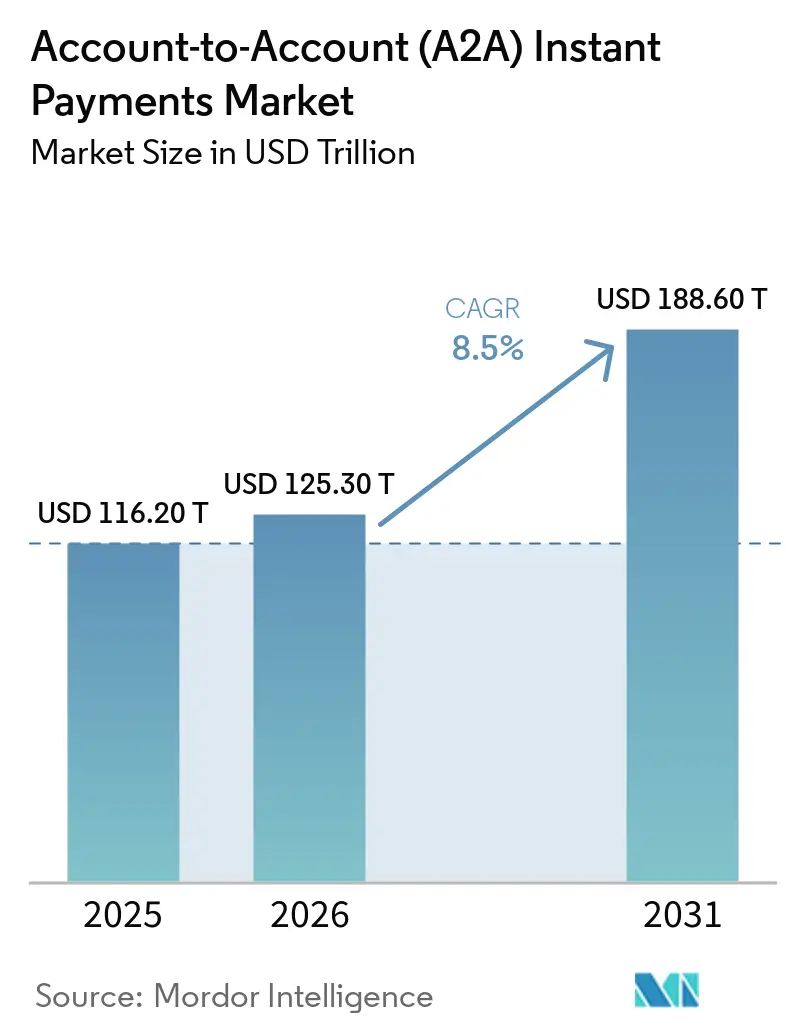
The Account-to-Account Instant Payments Market size is expected to grow from USD 116.20 trillion in 2025 to USD 125.30 trillion in 2026 and is forecast to reach USD 188.60 trillion by 2031 at 8.5% CAGR over 2026-2031.
The account-to-account instant payments market is moving away from batch settlement and payment paths that rely on several intermediaries. Domestic real-time payment systems now provide an infrastructure base that is maturing within national markets and beginning to connect across borders. Regulation is accelerating this transition by making instant transfers and verification capabilities standard service requirements in major payment jurisdictions. Lower transaction costs can create room for merchants to support consumer incentives and alter checkout choices. The account-to-account instant payments market also faces a clear need to strengthen fraud prevention, dispute handling, and consumer protection if it is to compete more directly with established card payment methods.
Key Report Takeaways
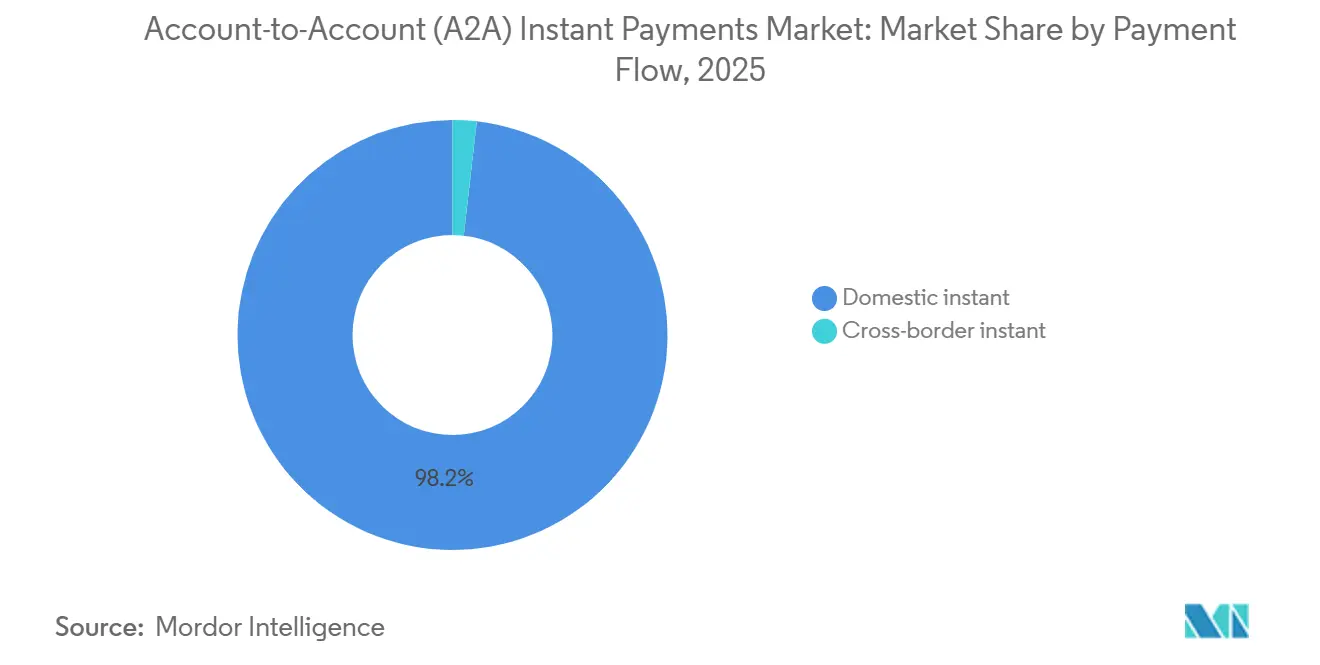
- By payment flow, domestic instant payments captured 98.2% of the account-to-account instant payments market share in 2025, while cross-border instant payments are projected to grow at 15.2% CAGR through 2031.
- By transaction type, B2B payments captured 49.7% of the account-to-account instant payments market share in 2025, while P2B payments are projected to grow at 12.3% CAGR through 2031.
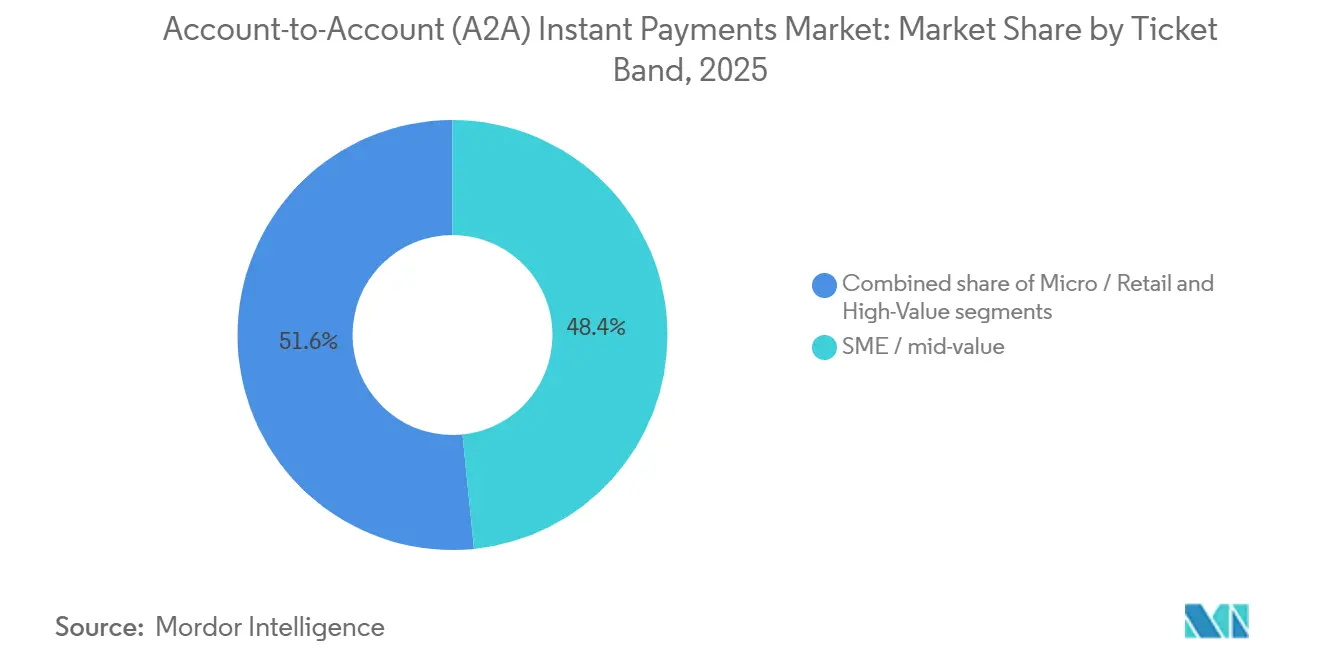
- By ticket band, SME and mid-value transactions captured 48.4% of the account-to-account instant payments market share in 2025, while micro and retail transactions are projected to grow at 13.6% CAGR through 2031.
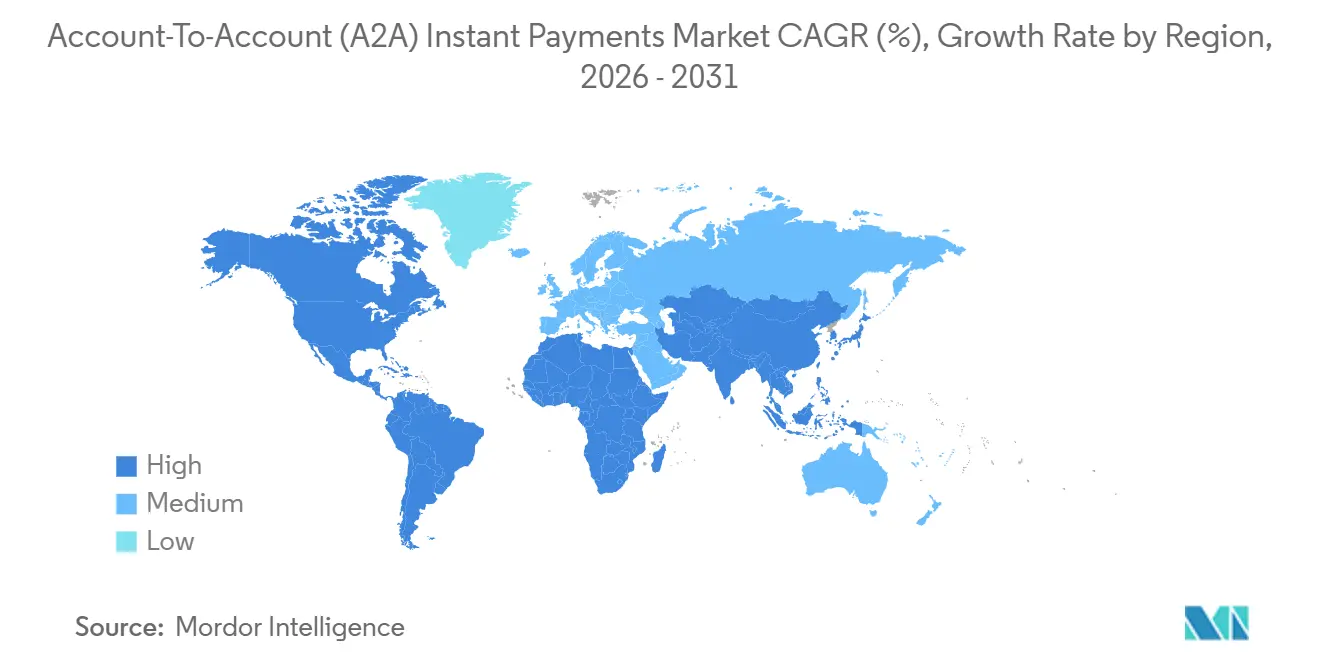
- By geography, Asia-Pacific captured 67.5% of the account-to-account instant payments market share in 2025, while the Middle East and Africa are projected to grow at 14.7% CAGR through 2031.
Note: Market size and forecast figures in this report are generated using Mordor Intelligence’s proprietary estimation framework, updated with the latest available data and insights as of January 2026.
Global Account-to-Account (A2A) Instant Payments Market Trends and Insights
Drivers Impact Analysis*
| Driver | (~) % Impact on CAGR Forecast | Geographic Relevance | Impact Timeline |
|---|---|---|---|
| Regulatory Mandates and Public-Sector Support | +2.3% | Global, European Union, India, the United Kingdom, Brazil, the Middle East, and Africa | Short term (≤ 2 years) |
| Consumer and Merchant Demand for Faster, Lower-Cost Payments | +1.7% | Global, with emphasis on Europe, Asia-Pacific, and North America | Medium term (2-4 years) |
| Open Banking and API-Based Payment Initiation | +1.5% | European Union, United Kingdom, Brazil, Australia, and emerging North American activity | Medium term (2-4 years) |
| Expansion of Consumer, Merchant, and Business Use Cases | +1.1% | Global | Medium term (2-4 years) |
| Greater Participation of Non-Bank Payment Service Providers | +0.8% | European Union, the United Kingdom, and the Asia-Pacific | Short term (≤ 2 years) |
| Cross-Border Interoperability of Instant Payment Systems | +0.7% | Association of Southeast Asian Nations, Middle East and Africa, European Union, and South America | Long term (≥ 4 years) |
| Source: Mordor Intelligence | |||
Regulatory Mandates and Public-Sector Support for Instant Payments
The European Union Instant Payments Regulation turned voluntary capability into a baseline obligation for payment service providers. The regulation applied sends and Verification of Payee deadlines from October 2025 for euro-area providers and aligns instant credit transfer pricing with conventional transfer pricing[1]https://www.ecb.europa.eu/paym/retail/instant_payments/html/instant_payments_regulation.en.html. The European Central Bank also allowed eligible non-bank payment service providers to access TARGET directly in October 2025, reducing reliance on bank balance sheets for euro instant-payment settlement and broadening participation in the account-to-account (A2A) instant payments market. Brazil and India show how operating rules and pricing policies can drive adoption. Brazil’s Pix operates as a zero-fee rail and reached 86% adult-population participation. India’s UPI operates under a zero-merchant-discount model and accounted for 84% of retail payment volume by June 2026. These models reduce cost barriers for consumers and merchants while giving providers a large installed base for additional services. The A2A instant payments market depends on policy choices governing access, pricing, and participation as much as on technology deployment.
Open Banking and API-Based A2A Payment Initiation
Open banking increasingly connects customer bank accounts directly to merchant payment flows. As of Q2 2026, 247 of the 357 EEA-regulated third-party providers held payment initiation permissions, representing more than 69% of the ecosystem. Payment initiation activity is also expanding, with payment-related open banking activity in the United Kingdom increasing by 53% year on year. On June 2, 2026, the United Kingdom Payments Initiative launched its commercial Variable Recurring Payments (cVRP) scheme, enabling recurring payments through open banking infrastructure[2]https://www.fca.org.uk/news/statements/open-banking-launch-uk-payments-initiative-scheme. eBay introduced Pay by Bank at its United Kingdom checkout through TrueLayer, while Stripe and TrueLayer launched Pay by Bank in France and Germany, extending account-to-account (A2A) payments across European commerce. Meanwhile, BIS Project Aperta, published on May 29, 2026, demonstrated cross-border open finance interoperability across the United Kingdom, the UAE, Brazil, Hong Kong SAR, and India. The project highlighted the potential of a common API-based infrastructure to connect domestic networks. These developments strengthen the outlook for A2A payments as interoperability, recurring payment capabilities, and merchant acceptance improve across markets.
Expansion of Instant A2A Use Cases Across Consumer, Merchant, and Business Payments
The Federal Reserve increased the FedNow per-transaction limit to USD 10 million in November 2025, expanding its use for treasury, large-vendor, and commercial real estate payments. FedNow settled 8,413,402 transactions worth USD 853.4 billion in 2025, with transaction volume increasing 458.9% from 2024[3]https://www.frbservices.org/resources/financial-services/fednow/volume-value-stats. In the second quarter of 2026, volume rose 83.2% to 4,997,811 transactions, while the average payment value declined to USD 54,957, indicating broader small and medium-sized enterprise and consumer use. Businesses are also evaluating instant payments for liquidity management. According to Adaptive, 7 in 10 chief financial officers use instant payment timing as a treasury decision, allowing businesses to retain liquidity until obligations are due. The account-to-account (A2A) instant payments market can therefore support working capital decisions alongside faster settlement. RTP and FedNow together settled more than USD 2 trillion in 2025, highlighting why banks and payment providers are extending instant payment services beyond person-to-person transfers.
Consumer and Merchant Demand for Faster, Lower-Cost Payments
Consumer and merchant demand is expanding as account-based methods become available within familiar checkout journeys. TrueLayer processed more than USD 1 billion in transactions over the Black Friday weekend of 2025, demonstrating that Pay by Bank can operate during periods of concentrated e-commerce demand. GoCardless served more than 350,000 businesses globally. Its July 2026 Sage Business Cloud Accounting expansion brought Pay by Bank into the workflow used by small and medium-sized enterprises in the United Kingdom and Ireland, reducing implementation work for smaller businesses. India’s payment pattern illustrates the different roles of transaction volume and value. UPI processed 85.5% of Indian payment transactions by volume but represented 9.5% of total payment value[4]https://economictimes.indiatimes.com/industry/banking/finance/upi-processes-85-of-indias-payment-volumes-but-just-9-5-of-value-rtgs-dominates-at-68-6/articleshow/131179619.cms. Consumer transactions can generate high payment volumes even when commercial transactions account for greater value. The account-to-account (A2A) instant payments market can support both types of activity. High-frequency, lower-value payments strengthen daily usage, while larger payments support commercial value creation. Merchant adoption will depend on reliable payment confirmation, simple integration, and fraud controls.
Restraints Impact Analysis*
| Restraint | (~) % Impact on CAGR Forecast | Geographic Relevance | Impact Timeline |
|---|---|---|---|
| Authorized Push-Payment Fraud and Liability Costs | -0.6% | United Kingdom, European Union, and global | Short term (≤ 2 years) |
| Card Payment Advantages in Credit, Rewards, and Consumer Protection | -0.8% | North America, the European Union, and Australia | Long term (≥ 4 years) |
| Fragmented Payment Rails, Standards, and Cross-Border Governance | -0.5% | Global cross-border corridors | Long term (≥ 4 years) |
| Real-Time Fraud, Liquidity, and Exception-Management Complexity | -0.4% | Global | Medium term (2-4 years) |
| Source: Mordor Intelligence | |||
Authorized Push-Payment Fraud and Associated Liability Costs
Authorized push payment fraud remains a material constraint because instant transfers are difficult to reverse after settlement. In the first year of the United Kingdom Payment Systems Regulator’s mandatory reimbursement regime, 269,000 authorized push payment fraud claims were filed. Of these, 188,000 were eligible, and 88% were reimbursed. Reimbursements totaled GBP 173 million (USD 220 million), with a GBP 85,000 (USD 108,000) cap per claim. Sending and receiving payment service providers shared the costs equally, encouraging investment in beneficiary account monitoring and mule account detection. Fraud risk is also increasing the need for preventive controls. Visa reported that fraudulent credit transfers cost European Union consumers and businesses EUR 2.5 billion (USD 2.7 billion) in 2024. In 2025, the European Payments Council warned that generative artificial intelligence could enable fraudsters to use deepfake audio and video at scale, reducing the time available for human intervention. The account-to-account (A2A) instant payments market requires real-time screening to identify suspicious payees before funds leave an account. Liability rules will continue to influence the cost of implementing these controls.
Competitive Advantages of Card Payments in Credit, Rewards, and Consumer Protection
Card payments retain advantages in credit, loyalty rewards, and buyer protection. The cards comprised 84% of the United Kingdom's retail spending by turnover in 2026. Account-based push payments do not provide automatic chargeback rights after a transfer clears. Recovery may require direct negotiation with the recipient. This concerns consumers buying defective or undelivered goods. It also makes customer protection central to competition between payment methods. The Federal Reserve noted in July 2025 that some account-based payment implementations lacked clear dispute-escalation routes. Responsibility may shift among the bank, the third-party provider, and the merchant. Visa launched enhanced A2A Protect on September 1, 2026, integrating Featurespace artificial intelligence for a unified real-time fraud score. The product helps banks intervene before funds leave a customer account. The account-to-account (A2A) instant payments market may therefore include card-network providers that supply risk and protection capabilities rather than relying only on interchange. This could limit the fee compression that merchants expect from direct account payments.
*Our forecasts treat driver/restraint impacts as directional, not additive. The impact forecasts reflect baseline growth, mix effects, and variable interactions.
Segment Analysis
By Payment Flow: Domestic Rails Support Current Volume, While Cross-Border Payments Lead Forecast Growth
Domestic instant payments accounted for 98.2% of the account-to-account (A2A) instant payments market size in 2025. India’s UPI processed 24,162 crore transactions in fiscal year 2025-26. These transactions were valued at USD 3.7 trillion, and UPI represented 84% of retail payment transactions by June 2026. Brazil’s Pix processed 79.8 billion transactions in 2025. This was 25.7% higher than in 2024. Pix transactions were valued at BRL 35.36 trillion (USD 6.04 trillion) and accounted for a 54.7% share of Brazilian retail transactions.
Domestic rails still need common standards before they can connect efficiently across jurisdictions. SWIFT made ISO 20022 mandatory for cross-border payment instructions in November 2025. Cross-border instant payments are projected to grow at 15.2% CAGR from 2026 to 2031, making them the fastest payment flow. The Bank for International Settlements identified fast payment system interlinking as the highest-potential mechanism for lowering cross-border retail-payment costs. Project Aperta also showed that a neutral API layer can support interoperability across 5 jurisdictions. Divergent anti-money-laundering rules, settlement-finality rules, and foreign-exchange models will continue to affect the pace of cross-border deployment.


By Transaction Type: B2B Payments Anchor Value, While P2B Payments Extend Merchant Adoption
B2B payments held 49.7% of the account-to-account (A2A) instant payments market size in 2025. FedNow’s USD 10 million limit gave larger treasury and vendor payments a practical instant-payment option. FedNow averaged USD 99,414 per transaction during 2025. This level of activity supports the role of account-based payments in corporate settlement. A survey found that 29% of United States companies with revenue above USD 25 million saw enterprise resource planning and treasury integration as the most important improvement needed for real-time payment performance. This shows that operational integration remains an important adoption condition.
P2B payments are projected to expand at 12.3% CAGR from 2026 to 2031. The United Kingdom Payments Initiative’s commercial Variable Recurring Payments scheme enables recurring Pay by Bank billing. eBay’s United Kingdom launch and Stripe’s deployment in France and Germany show growing merchant-side use. Government-to-person and person-to-government payments are also expanding through direct-benefit programs in India and Saudi Arabia. ISO 20022 structured remittance data can help business-to-business and business-to-government payments by enabling automated invoice reconciliation. The account-to-account (A2A) instant payments industry is therefore becoming relevant to recurring commerce and administrative payment processes, not only to immediate consumer transfers.
By Ticket Band: SME and Mid-Value Payments Lead Value, While Micro and Retail Payments Add Volume
SME and mid-value transactions held 48.4% of the account-to-account (A2A) instant payments market size in 2025. The FedNow limit increase targeted treasury, vendor, payroll, and real estate payments. Its USD 99,414 average transaction value in 2025 indicated institutional use before wider consumer adoption. High-value instant payments can reduce dependence on intraday credit for time-sensitive disbursements. RTP adoption was 17% among United States firms with revenue above USD 25 million. Adoption was 3% among smaller firms, linking adoption to treasury complexity.
Micro and retail transactions are projected to grow at 13.6% CAGR from 2026 to 2031. FedNow handled 4,997,811 transactions in the second quarter of 2026, while the aggregate value was USD 274.7 billion. Its average payment value fell 44.7% to USD 54,957. This pattern indicates increased participation by smaller institutions and consumer payment use cases. UPI’s high transaction-volume share and lower share of total payment value similarly demonstrate the role of micro-payments in usage growth. ISO 20022 data fields can lower reconciliation work for micro-merchants that participate in business supply chains.
Geography Analysis
Asia-Pacific held 67.5% of the global account-to-account (A2A) instant payments market in 2025. UPI processed 24,162 crore transactions in fiscal year 2025-26, and monthly volumes exceeded 2,300 crore for the first time in May 2026. UPI operates across 11 countries and represents 49% of global real-time payment volumes. Brazil’s Pix recorded 79.8 billion transactions during 2025. Pix reached more than 170 million individual users in 2026 and exceeded 7 billion monthly transactions. Singapore’s PayNow is live with UPI, while Malaysia’s DuitNow, Thailand’s PromptPay, Indonesia’s QRIS, and Vietnam’s NAPAS are progressing through bilateral payment corridors.
The Middle East and Africa region is projected to grow at 14.7% CAGR from 2026 to 2031. The Arab Monetary Fund’s Buna platform extended to Pakistan’s Raast in October 2025. This expansion reflects the region’s interest in linking domestic instant-payment systems across corridors. In North America, FedNow and RTP together settled more than USD 2 trillion in 2025. The Consumer Financial Protection Bureau Section 1033 rule remains a variable for the United States open-banking development. Payment providers in the region must also address access for smaller financial institutions as they expand account-based payment services.
Europe’s regulatory environment accelerated structural adoption in 2025. The European Union regulation required euro-area payment service providers to offer instant transfers and Verification of Payee from October 2025. The regulation applies to 3,000 payment service providers. PSD3 and the Payment Services Regulation cleared COREPER in April 2026 and are expected to support harmonized open-banking rules by 2028. In South America, Pix represented 54.7% of retail payments in the second half of 2025. Argentina and other South American countries retain emerging instant-payment systems supported by central-bank digitization mandates.

Competitive Landscape
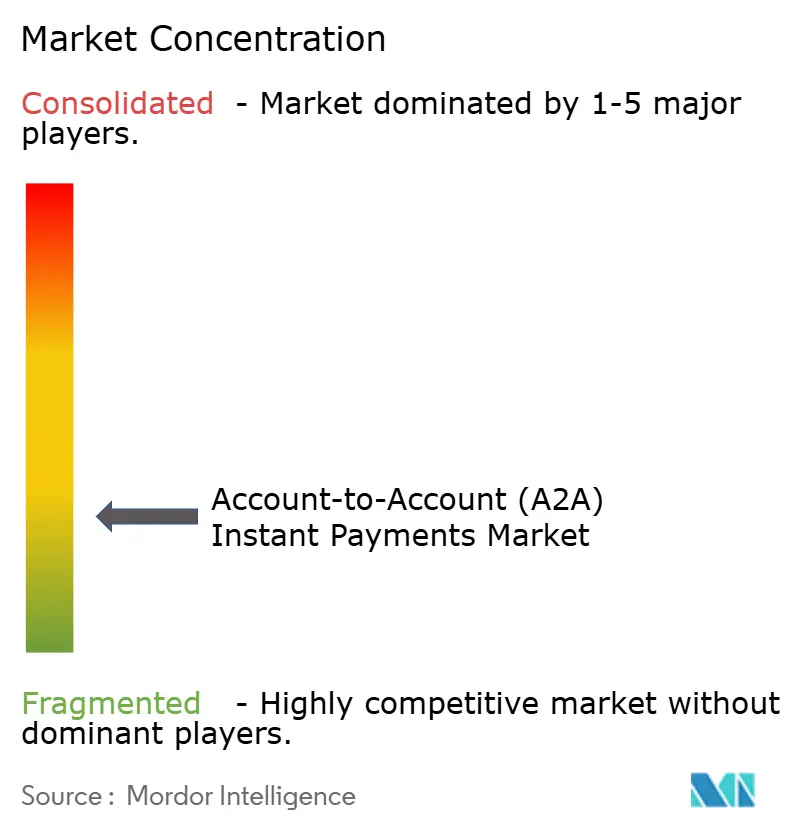
The account-to-account (A2A) instant payments market is fragmented. Trustly, TrueLayer, GoCardless, Token.io, Yapily, Volt, Brite Payments, Plaid, and Dwolla compete through API coverage, reliability, and fraud-management depth. Mollie acquired GoCardless in August 2026, forming a combined entity serving more than 350,000 businesses across more than 30 markets. TrueLayer completed the Zimpler acquisition in May 2026 after regulatory approval. It also acquired Dutch buy-now-pay-later fintech in3 during 2026. Consolidation can help providers add geographic coverage, recurring-payment capability, and complementary payment options.
Technology differentiation centers on real-time fraud intelligence and payee verification. Visa launched enhanced A2A Protect on September 1, 2026, combining Featurespace artificial intelligence with a unified fraud score. ACI Worldwide integrated Kinexys by J.P. Morgan’s Confirm application into its fraud platform in April 2026. The integration embeds payee verification across payment workflow types. Feedzai’s IQ Score provides real-time fraud-risk scoring using anonymized, aggregated intelligence derived from its USD 9 trillion global annual transaction network. The solution enables financial institutions to assess transactions against network-wide fraud signals and identify high-risk activity before funds leave the account, helping payment providers strengthen fraud prevention for real-time and account-to-account payments.
The account-to-account (A2A) instant payments market has open opportunities in cross-border interoperability for SME corridors. Providers can also offer real-time B2B reconciliation that connects payment data with enterprise resource planning systems. Digital identity and verified-payee credentials are relevant to higher-value transfers. Smaller institutions in the Middle East and Africa and Southeast Asia may need more accessible instant-payment connectivity. ISO 20022 and Verification of Payee requirements favor providers with established bank connections across several markets. Token.io’s strategic investment from HSBC in June 2025 illustrates how bank relationships can help develop this infrastructure.
Account-to-Account (A2A) Instant Payments Industry Leaders
National Payments Corporation of India
Banco Central do Brasil
Visa
The Clearing House Payments Company
- *Disclaimer: Major Players sorted in no particular order

Recent Industry Developments
- September 2026: Visa launched enhanced A2A Protect with Featurespace AI integration, providing banks with a unified real-time fraud score to stop APP fraud before money leaves accounts.
- August 2026: Mollie completed the acquisition of GoCardless, forming a combined entity serving more than 350,000 businesses across more than 30 markets.
- July 2026: GoCardless and Sage expanded their partnership to integrate Pay by Bank directly into Sage Business Cloud Accounting for SMEs in the United Kingdom and Ireland.
- June 2026: GoCardless launched the Recurring Pay by Bank capability alongside the United Kingdom Payments Initiative commercial Variable Recurring Payments scheme.


Global Account-to-Account (A2A) Instant Payments Market Report Scope
| Domestic Instant Payments |
| Cross-Border Instant Payments |
| Person-to-Person (P2P) |
| Person-to-Business (P2B) |
| Business-to-Person (B2P) |
| Business-to-Business (B2B) |
| Person-to-Government (P2G) |
| Government-to-Person (G2P) |
| Business-to-Government (B2G) |
| Others |
| Micro / Retail |
| SME / Mid-Value |
| High-Value |
| North America | United States |
| Canada | |
| Mexico | |
| South America | Brazil |
| Argentina | |
| Rest of South America | |
| Europe | United Kingdom |
| Germany | |
| France | |
| Italy | |
| Spain | |
| Rest of Europe | |
| Asia-Pacific | China |
| Japan | |
| India | |
| South Korea | |
| Australia | |
| Indonesia | |
| Thailand | |
| Malaysia | |
| Singapore | |
| Vietnam | |
| Rest of Asia-Pacific | |
| Middle East and Africa | Saudi Arabia |
| United Arab Emirates | |
| Turkey | |
| South Africa | |
| Egypt | |
| Rest of Middle East and Africa |
| By Payment Flow | Domestic Instant Payments | |
| Cross-Border Instant Payments | ||
| By Transaction Type | Person-to-Person (P2P) | |
| Person-to-Business (P2B) | ||
| Business-to-Person (B2P) | ||
| Business-to-Business (B2B) | ||
| Person-to-Government (P2G) | ||
| Government-to-Person (G2P) | ||
| Business-to-Government (B2G) | ||
| Others | ||
| By Ticket Band | Micro / Retail | |
| SME / Mid-Value | ||
| High-Value | ||
| By Geography | North America | United States |
| Canada | ||
| Mexico | ||
| South America | Brazil | |
| Argentina | ||
| Rest of South America | ||
| Europe | United Kingdom | |
| Germany | ||
| France | ||
| Italy | ||
| Spain | ||
| Rest of Europe | ||
| Asia-Pacific | China | |
| Japan | ||
| India | ||
| South Korea | ||
| Australia | ||
| Indonesia | ||
| Thailand | ||
| Malaysia | ||
| Singapore | ||
| Vietnam | ||
| Rest of Asia-Pacific | ||
| Middle East and Africa | Saudi Arabia | |
| United Arab Emirates | ||
| Turkey | ||
| South Africa | ||
| Egypt | ||
| Rest of Middle East and Africa | ||


Key Questions Answered in the Report
What is driving account-to-account instant payments adoption?
Regulation, open-banking payment initiation, merchant acceptance, and demand for immediate settlement support adoption. Direct access for eligible non-bank providers and common data standards can also broaden the range of firms that can offer account-based payment services.
How large are account-to-account instant payments in 2026?
The sector stands at USD 125.3 trillion in 2026 and is forecast to reach USD 188.6 trillion by 2031. This forecast reflects rising use of domestic real-time rails and the gradual expansion of interoperable cross-border payment arrangements.
Which payment flow is growing fastest through 2031?
Cross-border instant payments are forecast to grow at 15.2% CAGR from 2026 to 2031. Growth depends on payment-system interlinking, ISO 20022 implementation, and workable approaches to anti-money-laundering, settlement, and foreign-exchange requirements.
Which transaction type leads by value?
B2B payments held 49.7% of transaction value in 2025. Larger payment limits and payment data that supports invoice reconciliation can increase the relevance of instant payments for treasury, vendor, payroll, and other corporate payment processes.
Why do card payments remain a competing option?
Cards retain established credit, rewards, chargeback, and consumer-protection features. Account-based providers need effective fraud monitoring, clear dispute paths, and credible customer protections to address the concerns created by irrevocable payment transfers.
Which region has the fastest forecast growth?
The Middle East and Africa is projected to grow at 14.7% CAGR from 2026 to 2031. Cross-border linkage efforts and broader access to instant payment infrastructure can support growth across domestic and regional payment corridors.
Page last updated on:





