
Market Overview
| Study Period | 2020 - 2031 |
|---|---|
| Forecast Data Period | 2026 - 2031 |
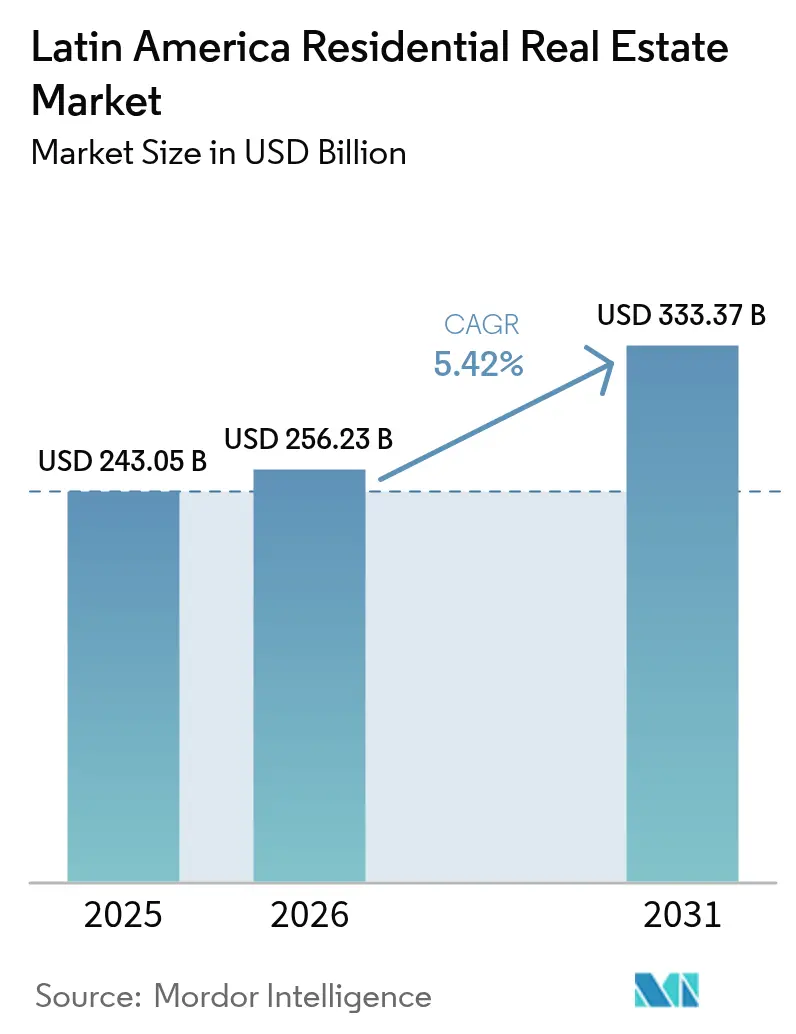
| Base Year Market Size (2025) | USD 243.05 Billion |
| Market Size (2026) | USD 256.23 Billion |
| Market Size (2031) | USD 333.37 Billion |
| Growth Rate (2026 - 2031) | 5.42% CAGR |
| Market Concentration | Medium |
Major Players *Disclaimer: Major Players sorted in no particular order Image © Mordor Intelligence. Reuse requires attribution under CC BY 4.0. | |
Latin America Residential Real Estate Market Analysis by Mordor Intelligence
The Latin America Residential Real Estate Market size was valued at USD 243.05 billion in 2025 and estimated to grow from USD 256.23 billion in 2026 to reach USD 333.37 billion by 2031, at a CAGR of 5.42% during the forecast period (2026-2031). Robust household formation outpacing population growth, a regional housing deficit above 45 million units, and declining policy rates are the structural pillars behind this uptrend. Public‐sector subsidies, rising middle‐class incomes, and the steady professionalization of property management platforms continue to draw international capital, even as construction cost inflation of 3–4% presses margins. Investors find the Latin America residential real estate market particularly attractive because rental yields averaging 9–15% exceed comparable North American returns. The adoption of PropTech has lowered acquisition costs and reduced documentation bottlenecks, encouraging faster absorption of new stock across Brazil, Mexico, and Colombia.
Key Report Takeaways
- By country, Brazil led with 40.85% revenue share in 2025, while Colombia is projected to grow at a 6.92% CAGR through 2031.
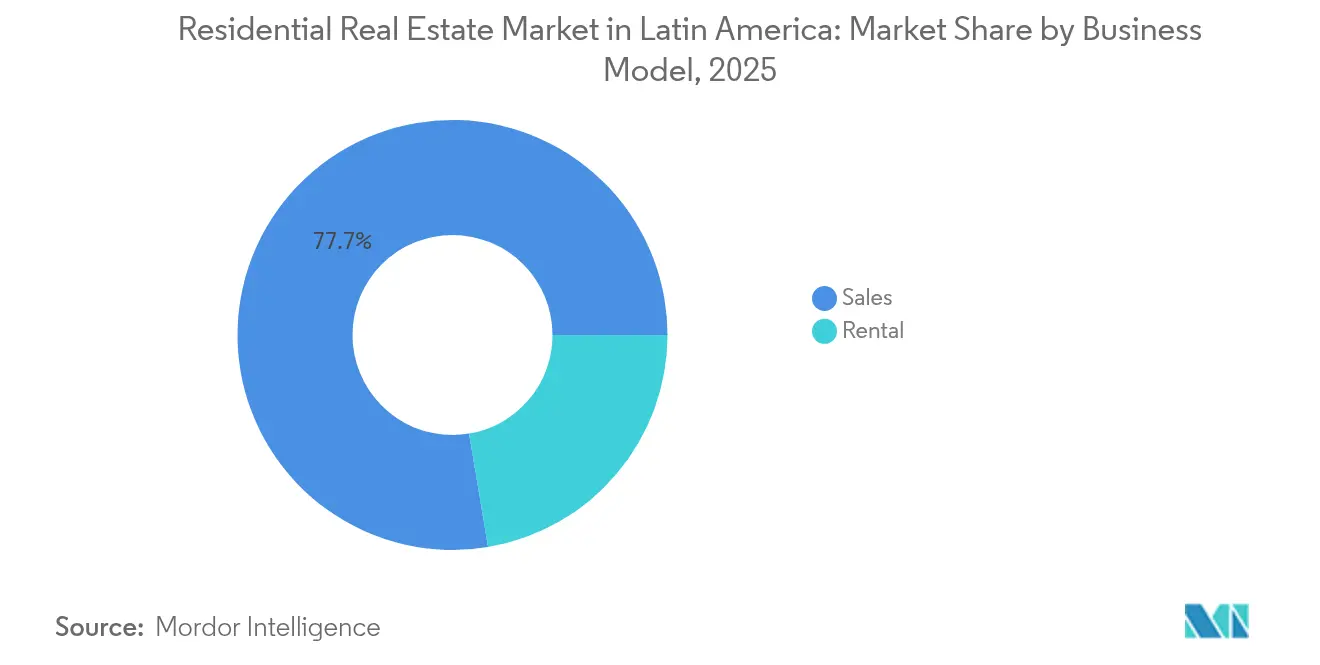
- By business model, the sales channel captured 77.65% of the Latin America residential real estate market share in 2025; the rental segment is expected to expand at a 6.02% CAGR to 2031.
- By property type, apartments and condominiums controlled 63.55% of 2025 revenue; villas and landed houses are forecast to post the fastest 6.15% CAGR over the same horizon.
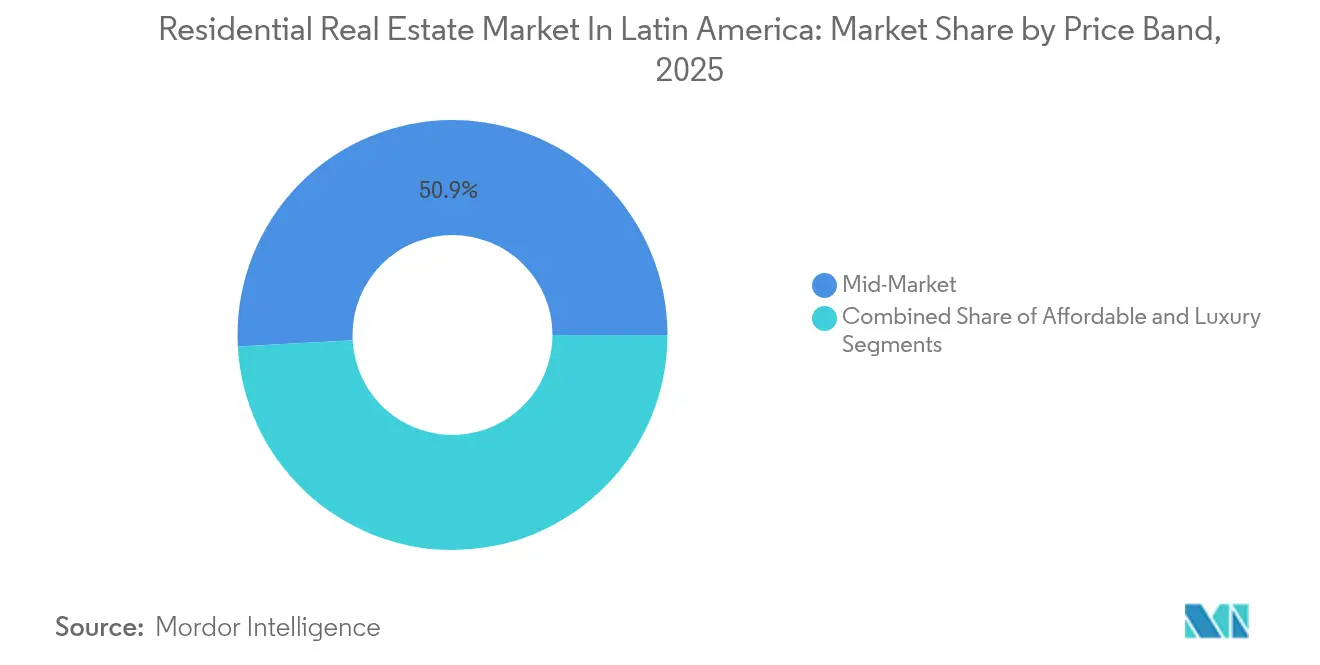
- By price band, the mid-market accounted for 50.85% of 2025 spending; the affordable tier is anticipated to climb at a 6.65% CAGR through 2031.
- By mode of sale, primary transactions represented 62.95% of revenue in 2025, whereas the secondary market shows a 6.37% CAGR outlook to 2031.
Note: Market size and forecast figures in this report are generated using Mordor Intelligence’s proprietary estimation framework, updated with the latest available data and insights as of 2026.
Latin America Residential Real Estate Market Trends and Insights
Drivers Impact Analysis*
| Drivers | (~) % Impact on CAGR Forecast | Geographic Relevance | Impact Timeline |
|---|---|---|---|
| Regional housing deficit exceeding 45 million units driving structural demand | +1.8% | Global, with highest impact in Brazil, Mexico, Colombia | Long term (≥ 4 years) |
| Government-led social housing programs expanding affordable housing supply | +1.2% | Brazil, Mexico, Colombia core, spill-over to Argentina, Chile | Medium term (2-4 years) |
| Expanding middle-class and rising incomes fueling mid- and premium housing demand | +0.9% | Brazil & Mexico primarily, emerging in Colombia, Chile | Medium term (2-4 years) |
| Improved housing finance access through mortgage and credit expansion | +0.7% | Brazil, Mexico, Colombia with regulatory influence from central banks | Short term (≤ 2 years) |
| Rising demand for gated and vertical housing driven by urban density and safety | +0.6% | Major metropolitan areas: São Paulo, Mexico City, Bogotá, Buenos Aires | Long term (≥ 4 years) |
| Source: Mordor Intelligence | |||


Regional Housing Deficit Above 45 Million Units Driving Structural Demand
In Latin America, over 59 million residents live in substandard conditions, highlighting a persistent supply gap in the region's residential real estate market. To bridge its housing deficit, Mexico needs to produce over 800,000 new homes annually, a feat that demands construction spending equivalent to 1% of the nation's GDP. Meanwhile, Colombia requires an extra 400,000 units each year just to address its qualitative housing deficits. Such disparities in supply and demand have bolstered price stability, even amidst broader economic downturns. In tier-1 cities, acute land shortages have led developers to favor vertical projects, opting for reduced footprints but commanding premium prices. Furthermore, as household formation rates surpass population growth, it's evident that demographic trends, rather than cyclical GDP fluctuations, will dictate long-term housing demand.
Government Social-Housing Programs Expanding Affordable Supply
Access to affordable housing remains a critical challenge for many families across Latin America. Governments in the region are implementing innovative programs to address this pressing issue. Brazil's revamped Minha Casa, Minha Vida (MCMV) program now extends its reach to households earning up to USD 2,400 monthly. This adjustment has funneled 83% of MRV's sales in the first quarter of 2025 into subsidized categories. In Colombia, the Mi Casa Ya initiative permits families to secure grants two years ahead of unit delivery. This not only mitigates risks associated with construction financing but also speeds up the pre-sales process. Meanwhile, Mexico's INFONAVIT reform, set to roll out in February 2025, introduces a groundbreaking rent-to-own model. This innovation separates subsidy eligibility from the immediate need for homeownership. Together, these initiatives aim to deliver 2 million affordable units by 2026, unveiling a potential construction market worth an impressive USD 100 billion. Beyond housing, these measures promise benefits like enhanced credit access, a surge in mortgage securitization, and a broader embrace of industrialized building systems[1]Ministry of Housing, “Mi Casa Ya Subsidy Program,” minvivienda.gov.co.
Expanding Middle-Class and Rising Incomes Fuel Mid- and Premium Demand
The Latin American residential real estate market is undergoing a significant transformation, driven by evolving economic and demographic trends. In 2024 and 2025, real wages in Brazil and Mexico have outpaced inflation, enhancing the discretionary budgets of both first-time buyers and those seeking upgrades. In January 2025, Cyrela, in collaboration with the Canada Pension Plan Investment Board, allocated USD 340 million to develop luxury towers in São Paulo. These towers are designed to meet the needs of professionals aged 30–45, who are forming family units later in life and now prioritize superior amenities. Colombia reflects a similar trajectory: Camacol forecasts 63,000 new mid-market closings in Bogotá and Cundinamarca for 2025, representing a 14% year-on-year increase, supported by declining mortgage rates of 11–12%. As a result, the Latin American residential real estate market is diverging into two distinct segments: a robust subsidized production sector and a resilient premium tier, both appearing well-insulated from short-term market volatility.
Improved Housing Finance Access Through Mortgage and Credit Expansion
Access to housing finance is undergoing a significant transformation in Latin America, driven by innovative policies and financial reforms aimed at empowering borrowers and expanding market opportunities. Since July 2025, Brazil's newly introduced Legal Framework for Guarantees allows a single property to secure multiple loans through specialized guarantee managers. This innovation not only reduces collateral risk but also extends loan maturities. With the Brazilian Savings and Loan System boasting USD 280 billion in deployable resources, it stands poised to finance double the origination volume of 2024. In Mexico, mortgage affordability received a boost as INFONAVIT set payroll deductions at a maximum of 20% of wages, ensuring rent payments remain capped at 30%. This adjustment enhances borrowers' residual income. A region-wide trend of rate cuts, highlighted by Colombia's reduction from double-digit policy highs, has broadened the pool of potential borrowers. Collectively, these developments are not only enlarging the funding landscape for Latin America's residential real estate market but also speeding up the closing process for both primary and secondary transactions.
Restraints Impact Analysis*
| Restraints | (~) % Impact on CAGR Forecast | Geographic Relevance | Impact Timeline |
|---|---|---|---|
| High construction costs driven by inflation and supply chain volatility | -0.8% | Global, with highest impact in Mexico, Brazil, Argentina | Short term (≤ 2 years) |
| Land scarcity and rising land prices in tier-1 metropolitan areas | -0.6% | São Paulo, Mexico City, Bogotá, Buenos Aires metropolitan areas | Long term (≥ 4 years) |
| Economic instability and currency fluctuations reducing buyer confidence | -0.4% | Argentina primarily, secondary impact in Brazil, Mexico | Medium term (2-4 years) |
| Source: Mordor Intelligence | |||
High Construction Costs Driven by Inflation and Supply Chain Volatility
The construction industry in Latin America is grappling with significant challenges as inflation and supply chain disruptions continue to impact operations. In 2024, material prices in Mexico surged by 4%, outpacing Colombia's 3% and Peru's 2% increases. This widening gap is tightening profit margins, especially on low-income projects. Backlogs from the Covid era still haunt the industry, particularly for glass, HVAC units, and finishing goods. As a result, developers face two choices: extend their build schedules or shell out extra for immediate purchases. Meanwhile, in Brazil, even as the civil-construction index sees a more moderate annual rise of 3.3%, contractors grapple with a shortage of skilled electricians and plumbers. This scarcity drives labor bids beyond budgeted amounts. The pinch is felt most acutely in affordable housing projects, where fixed sales prices clash with fluctuating material costs. In a bid to adapt, some builders are turning to off-site prefabrication of wall panels, managing to cut cycle times by 15% and providing a buffer against inflationary pressures.
Land Scarcity and Rising Land Prices in Tier-1 Metropolitan Areas
Land scarcity and rising prices in tier-1 metropolitan areas have become critical challenges for developers, reshaping strategies and decision-making processes. Strategic advantage now hinges on competition for prime plots. In Q2 2025, Cyrela invested USD 96 million in land acquisitions, a figure double its recent quarterly average, underscoring the tightening supply. While São Paulo's municipal plan encourages mixed-use transformations of vacant downtown buildings, uncertain expropriation timelines continue to delay progress and increase holding costs. To address price surges, developers like EZTEC are forming joint ventures with landowners, exchanging revenue shares for immediate cash. In Argentina, currency volatility has prompted some builders to import prefabricated homes from China, achieving a 90% reduction in construction costs, which highlights the extraordinary measures taken in response to severe scarcity. Long-term solutions, such as transit-oriented densification to maximize floor-area ratios, remain complex due to the intricate approval processes involved.
*Our forecasts treat driver/restraint impacts as directional, not additive. The impact forecasts reflect baseline growth, mix effects, and variable interactions.
Segment Analysis
By Business Model: Sales Still Commands, but Rental Accelerates
The sales channel held 77.65% of 2025 revenue, validating the homeownership culture that defines the Latin America residential real estate market. Rental, however, is predicted to log a 6.02% CAGR to 2031, propelled by delayed household formation, gig-economy mobility, and pension-fund appetite for stable cash flows. Mexico City’s August 2024 civil-code reform caps rent hikes at the inflation rate and mandates a digital registry within 30 days, heightening transparency and expanding the tenant pool. In Brazil, Cyrela and CPP Investments plan seven multifamily towers by 2027, demonstrating that institutional equity recognizes the rental gap. Savings yields near multi-year lows further redirect domestic investors into income properties, reinforcing rental’s momentum in the Latin America residential real estate market.
Better risk metrics also strengthen the rental thesis. Default data provided by Brazilian credit bureaus shows a 150 basis-point improvement in on-time payment after landlords adopted automated verification tools. Meanwhile, rent-to-own pilots under Mexico’s INFONAVIT broaden reach to lower-income households without burdening fiscal accounts. If pilot yields remain above 10%, analysts expect secondary-market securitizations to emerge by 2027, embedding liquidity into what was traditionally an opaque asset class. These trends converge to make the Latin America residential real estate market more diversified across tenure options, supporting both developers and long-term asset managers.


By Property Type: Apartments Dominate as Vertical Living Gains Popularity
Apartments and condominiums accounted for 63.55% of the 2025 value, confirming the preeminence of vertical solutions in congested metros. Villas and landed houses are projected to grow at a 6.15% CAGR, but infill condo projects still receive the lion’s share of capital allocations. EZTEC’s USD 43.6 million Moved Osasco Residence launch added 357 units across two towers in Greater São Paulo, targeting tech-sector employees and reinforcing the apartment narrative. Prefabricated façades reduce cycle time, enabling faster unit turnover and enhancing internal rates of return.
Urban land scarcity aligns with safety concerns, pushing demand toward gated high-rise communities that integrate coworking spaces, concierge services, and ESG certifications. Brazil’s Ecoparque Bairros Integrados blueprint illustrates next-generation master-planning: twin-use zoning, 50% green space, and net-zero infrastructure. In Colombia, verticalization is also driven by mortgage assessment ratios favoring smaller ticket sizes, which make apartment loans easier to originate and securitize. Consequently, the Latin America residential real estate market sees apartments remain the anchor segment, even as peripheral suburbs witness bungalow revival supported by road and rail expansions.
By Price Band: Mid-Market Retains Majority, but Affordable Leads Growth
The mid-market captured 50.85% of 2025 spend, underlining its importance as the volume backbone of the Latin America residential real estate market. Affordable housing, however, is slated for a 6.65% CAGR to 2031, outpacing all other price bands. Brazil’s revised MCMV lifted the price ceiling to USD 70,000, a move that trimmed new-launch counts by 3% yet spurred a 10% jump in sales because more families qualify. Subsidies now cover 85% of the unit price in the lowest bracket, de-risking developer pipelines.
Cury Construtora’s 2024 launch of 11,000 apartments valued at USD 620 million underscores that scale remains achievable in the affordable niche. In Colombia, pre-assignment subsidies guarantee demand before a project breaks ground, mitigating speculative oversupply. For mid-market players, competitive differentiation shifts to amenities: fiber-optic connectivity, daycare centers, and rooftop gardens. As rising incomes funnel buyers into larger footprints, the Latin America residential real estate market preserves its mid-tier volume base while using public policy to accelerate the lowest tier.
By Mode of Sale: Primary Supply Dominates but Secondary Market Fluidity Improves
Primary (new-build) deals represented 62.95% of 2025 transactions, buttressed by large-scale public programs and greenfield opportunities. The secondary channel is forecast to expand at a 6.37% CAGR, buoyed by digitized listings and improved valuation analytics. São Paulo recorded 76,000 unit sales against 73,200 launches in 2023, signaling inventory absorption and a budding resale pipeline. PropTech marketplaces fill the historical void left by the absence of MLS systems, reducing time-on-market by an average of 22 days.
Financial innovation follows. Brazil’s guarantee law permits collateral recycling, so homeowners can refinance and extract equity without extinguishing first liens, increasing mobility between primary and secondary segments. Mexico’s anti-money-laundering rules, effective August 2025, extend verification to secondary transfers, thereby lowering reputational risk for cross-border investors [lexology.com]. As trust builds, the Latin America residential real estate market becomes more liquid, encouraging portfolio rotation and professional brokerage services.
Geography Analysis
In 2025, Brazil maintained a significant 40.85% share of the Latin American residential real estate market, supported by the extensive Minha Casa, Minha Vida program and strong institutional co-investment. Last year, São Paulo alone achieved an impressive USD 8.8 billion in combined launch and sales volumes. Additionally, the newly implemented Legal Framework for Guarantees has unlocked USD 280 billion in mortgage liquidity. The growth of PropTech, increasing from 500 startups in 2018 to over 1,200 in 2024, is helping to simplify transactions. This development aligns well with construction-tech innovations, which have successfully reduced cycle times by 15%.
Mexico benefits from favorable demographic trends and industrial near-shoring, although it faces challenges with input-cost inflation exceeding 4%. In August 2024, rental reforms were introduced to stabilize tenant relationships by linking annual adjustments to headline inflation. Moreover, the February 2025 INFONAVIT reform introduced rent-to-own formats that are particularly appealing to the subprime segment. While stricter anti-money-laundering compliance has increased due diligence costs, it has also enhanced investor confidence. This improvement has allowed the Latin American residential real estate market to direct a larger portion of remittances into housing stock.
Colombia emerges as the region's growth leader, with a projected 6.92% CAGR through 2031. As mortgage rates gradually decline toward 11%, and with Mi Casa Ya subsidies covering up to USD 8,000 of the ticket price, Camacol forecasts the sale of 63,000 units in Bogotá and Cundinamarca by 2025. Despite facing temporary regulatory scrutiny-such as the investigation of Constructora Bolívar for alleged consumer-rights violations-the overall policy environment remains supportive of housing. Chile and Argentina present contrasting dynamics: Chile's Law 21,718 has reduced permit approval times to 30 days, while Argentina's volatile peso complicates cost planning, even as IRSA reports remarkable triple-digit revenue growth. Together, these factors create a diverse regional landscape where, despite increasing divergence in national cycles, the Latin American residential real estate market continues to experience overall growth.
Regulatory Landscape
Residential development and transactions across Latin America are shaped by a mix of national housing frameworks and municipal permitting, with compliance anchored in building performance standards and consumer-protection rules. In Brazil, ABNT NBR 15575 sets minimum performance requirements for residential buildings, including acoustic and thermal performance and structural safety, while municipal codes and approvals are often a key pacing item for launches in major metros. In Mexico, NOM-247-SE-2021 strengthens transparency and consumer protections for residential sales through standardized disclosures and contract practices, supporting more formalized primary-market processes.
Recent policy actions also add oversight and targeted incentives in key markets. In April 2026, a legislative initiative was submitted in Mexico to create a National Registry of Real Estate Professionals (Registro Nacional de Profesionales Inmobiliarios), indicating greater professionalization and traceability in brokerage and advisory services. In Chile, the Ministry of Housing (MINVU) has continued refining the operating framework for housing and co-ownership, with updated implementation guidance for Law 21.442 and additional urban-integration standards for public-interest housing projects. Mortgage interest-rate subsidy parameters set in 2025 support demand-side affordability in the formal financing channel.
Value Chain Analysis
The residential real estate value chain in Latin America spans land sourcing and entitlement (zoning, environmental and municipal approvals), project finance (banks, public housing programs, and capital markets), design and engineering, contracting and construction, materials and equipment supply, sales and brokerage (increasingly digitized), mortgage origination and underwriting, closing and registration, and post-handover property management and facility services. Government-backed programs play an outsized role in underwriting affordable demand and stabilizing developer cash conversion, illustrated by Brazil's Minha Casa, Minha Vida (MCMV) and similar subsidy mechanisms in Mexico and Colombia. These programs influence product mix (affordable and mid-market), pre-sales velocity, and contractor pipelines.
Key friction points sit upstream and midstream, including land scarcity and permitting in tier-1 metros, construction-cost inflation, and skilled labor shortages that extend schedules and pressure margins. These constraints push builders toward industrialized methods and tighter procurement partnerships. On the distribution and servicing side, PropTech platforms and professional property management are reducing search-to-close friction and improving ongoing asset operations, supporting liquidity in both primary and secondary transactions while widening the buyer pool for rental and for-sale formats.
Competitive Landscape
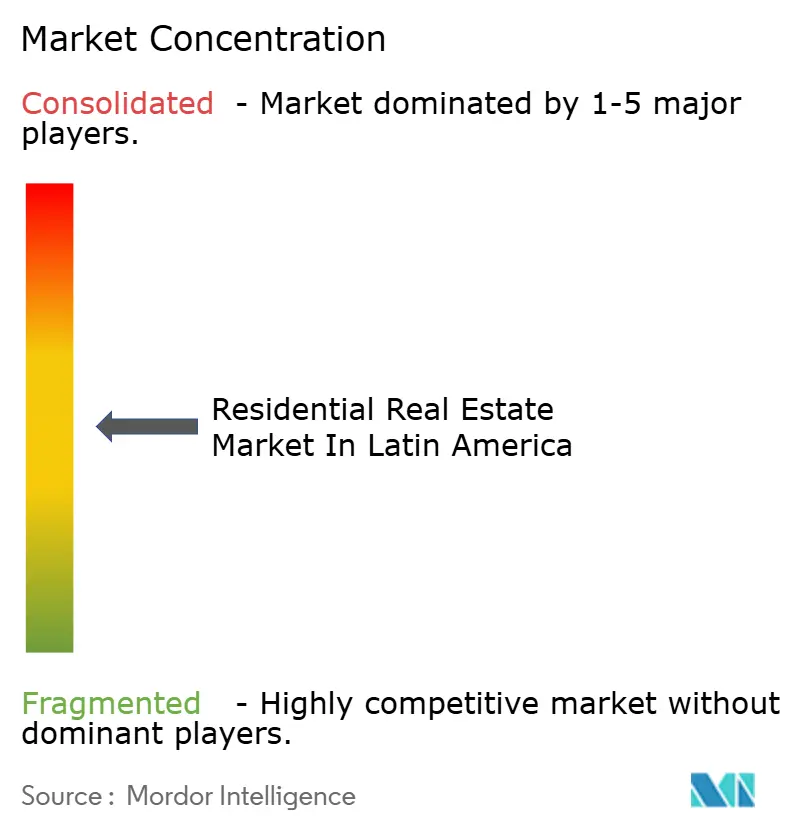
The Latin American residential real estate market features moderate concentration, while Mexico and Colombia present a more fragmented market, with no single developer holding more than a 6% share. Prominent companies such as MRV, Cyrela, and Gafisa leverage their scale by securing bulk material contracts and implementing proprietary digital sales funnels, which reduce brokerage fees by up to 70%. Their emphasis on government-backed projects ensures stable cash flows and facilitates faster turnover of their land banks. Meanwhile, mid-sized firms focus on suburban corridors that larger competitors often underserve. These firms build on local relationships and benefit from quicker municipal approvals.
Strategic partnerships are a cornerstone of the Latin American residential real estate market. For instance, Cyrela has partnered with CPP Investments in a USD 340 million venture aimed at developing luxury and multifamily rental towers, which are expected to be completed by 2027. EZTEC adopts a collaborative approach by entering revenue-sharing agreements with landholders instead of outright land purchases, thereby protecting its margins from land inflation. In Mexico, private equity firms Blackstone and Pátria demonstrated their confidence in scalable platforms by acquiring a 70% stake in Alphaville in August 2024, signaling strong global interest in the region.
The integration of technology has become indispensable. As of 2024, Brazil is home to over 1,200 PropTech firms, with regional marketplaces utilizing AI-driven credit scoring and blockchain documentation to streamline transaction times. Developers are increasingly incorporating solar micro-grids and smart-home infrastructure to enhance the appeal of their mid-market offerings. Collectively, these advancements contribute to a moderately concentrated Latin American residential real estate market while creating opportunities for specialized players in segments such as rentals, senior living, and co-living[3]Helmi Group, “PropTech Mapping in Brazil,” helmi.fi.
Latin America Residential Real Estate Industry Leaders
MRV Engenharia e Participações S.A.
Cyrela Brazil Realty S.A.
Gafisa S.A.
Tenda S.A.
Direcional Engenharia S.A.
- *Disclaimer: Major Players sorted in no particular order

Market Opportunities and Future Outlook
White space remains concentrated where structural deficits and formal financing align with scalable delivery models, particularly in affordable and rental-oriented supply. The region-wide housing deficit above 45 million units, together with active public programs aiming to fund around 2 million affordable units by 2026 (about USD 100 billion in construction value), creates room for developers and contractors to industrialize delivery through prefabrication and standardized typologies while staying within subsidy price ceilings. Evidence of institutional and corporate participation also supports platform-building opportunities in rentals and premium assets, including the Cyrela and CPP Investments joint venture in Sao Paulo, which signals continued appetite for professionally managed multifamily and amenitized product.
Technology-enabled execution is creating near-term opportunities across development, sales, and construction. BIM adoption in Brazil residential construction reached 37.2% by 2024, and the spread of digital-twin and mobile-first site tools is moving from mega-projects into medium-sized residential builds. This is improving pre-construction simulation, reducing rework, and tightening delivery control in inflation-sensitive segments. Large urban regeneration and master-planned pipelines are also feeding land development and infrastructure-linked residential supply, highlighted by IRSA's July 2026 progress on Ramblas del Plata in Buenos Aires (USD 40 million in initial networks and 18 plots sold), alongside new launches in Brazilian regional cities such as Hugo Fabbri Incorporadora's July 2026 Cambui Reserva da Mata (144 apartments, VGV of R$138 million).
Recent Industry Developments
- July 2026: Cyrela Brazil Realty reported its second-quarter 2026 operating update with 20 launches totaling R$3.8 billion in potential sales (VGV) and net sales of R$2.56 billion. The launch cadence and sales conversion underscore how large developers are maintaining primary-market absorption in core Brazilian metros through product and pricing discipline.
- June 2026: MRV Engenharia e Participacoes announced the sale of two Resia developments in the United States (Ten Oaks and Rayzor Ranch) for USD 139 million to accelerate deleveraging. The disposal reallocates capital and management attention toward core Brazil housing lines, reinforcing balance-sheet optimization as a competitive lever.
- August 2025: BRZ completed a business combination with Fica, creating a new publicly listed developer focused on Brazils multifamily segment. The transaction broadened access to public-market funding for pipeline buildout and increased consolidation momentum among scaled residential platforms.


Research Methodology Framework and Report Scope
Market Definition and Coverage
For this study, the market captures the total value of residential property activity across Latin America, including new and existing homes that are bought and sold for owner-occupation or investment, measured in USD.
Scope exclusions: We exclude purely commercial real estate assets and land-only deals that are not tied to a residential unit transaction.
Segmentation Overview
- By Business Model
- Sales
- Rental
Data Sources, Market Sizing, and Validation
Desk Research
Desk work starts by mapping the demand pool and the price signals that move housing value in the region. We referenced public statistics such as national statistics offices and central banks, housing and urban development ministries, land registry or cadaster portals where available, and multilateral sources such as the World Bank and UN-Habitat to frame housing deficit and household formation trends.
To anchor the model, we also reviewed listed developer disclosures, investor presentations, association releases, and reputed press coverage for project launches, mortgage rate direction, and sales momentum. A paid subscription for company financials and intelligence was used selectively to standardize revenue disclosures and corporate structure details, and a separate paid patent database was used only to track PropTech activity as a directional signal. These desk sources are illustrative only, and other public documents were also used for data collection, validation, and clarification.
Primary Interviews and Surveys
Primary work focused on discussions with developers, brokers, lenders, and housing market specialists across major Latin American markets. These inputs helped confirm transaction mix, typical price bands, and timing of demand shifts. The respondent feedback was also used to test desk assumptions on mortgage availability, buyer sentiment, and the share of formal versus informal transactions, before the model sign-off.
Distribution of primary research fieldwork respondents
| Company type | Respondent position | Region |
|---|---|---|
| Top tier: 35% | CXOs: 12% | |
| Mid tier: 50% | Functional/Unit leaders: 41% | |
| Smaller Players: 15% | Managers: 47% |
Market-Sizing & Forecasting
Sizing is built using a top-down approach where household formation, housing deficit signals, mortgage origination trends, and residential price indices are used to reconstruct the addressable value pool at the regional level, then allocated across key countries based on relative activity indicators. We also check totals with selective bottom-up approximations, such as sampled average selling price by typical unit type multiplied by estimated transaction volumes, then run channel checks with brokers and developers to keep the results within a realistic range.
Key model inputs include residential price movements in local currency, mortgage rate and credit growth direction, new-build launch pipelines, resale market liquidity indicators, and affordability drivers such as inflation and income growth. Forecasting uses scenario analysis supported by expert views, where base, conservative, and optimistic paths are built around rates, credit availability, and construction momentum, and then converted to USD using consistent currency timing. Where country-level gaps exist, we use proxy indicators from official statistics and interview-based ratios, and we re-check impacts during validation rounds.
Data Validation & Update Cycle
Validation is performed through step-by-step checks that compare the modeled market value against independent signals such as housing starts, mortgage origination direction, and reported sales momentum from public company disclosures. We review outliers country by country, and re-test assumptions through follow-up calls when price trends, FX shifts, or policy changes create unusual jumps.
Before publication, the model goes through multi-stage analyst review so the logic, inputs, and conversions remain consistent across markets. Reports are refreshed annually, and interim updates are triggered when there are material events such as large rate moves, major subsidy changes, or sharp currency swings. Right before delivery, analysts complete a final freshness pass to ensure the latest inputs are reflected for clients.
Mordor Intelligence's Latin America Residential Real Estate Market Size Compared With Other Published Estimates
Published market values for residential real estate in Latin America can be far apart, even when the topic sounds the same. The difference usually comes down to what is counted as market value, how informal activity is treated, and how currencies and timing are handled.
Transaction-value signals from residential price indices, mortgage origination direction, and new-launch activity are the checks that keep Mordor Intelligence's estimate tied to a repeatable demand pool for homes changing hands in the region. Some estimates also broaden the scope into overall real estate value (including non-residential assets), or they treat market value as the full stock value of homes rather than transaction activity, which can expand the number quickly.
Benchmark comparison
| Source | Market Size | Gaps in Research Methodology |
|---|---|---|
| Mordor Intelligence | USD 256.23 B (2026) | |
| Industry Publisher A | USD 869.54 B (2025) | Often reflects a broader revenue view that can resemble total real estate value or a wider definition of residential activity across the region, which inflates the base compared with a transaction-linked sizing approach. |
| Consultancy B | USD 212.00 B (2024) | Uses an earlier base year and can undercount by applying a narrower country basket or by leaning more heavily on formal tracked transactions, which can miss parts of the market where reporting is less consistent. |
Across the three figures, the spread mainly points to scope boundaries and how value is interpreted, either as transaction activity, broader sector revenue, or a narrower tracked subset. By keeping the drivers tied to observable housing activity and re-checking assumptions with local experts, the estimate stays transparent and can be reproduced when inputs change.


Key Questions Answered in the Report
How large is the Latin America residential real estate market in 2026?
It reached USD 256.23 billion in 2026 and is projected to climb to USD 333.37 billion by 2031.
Which country leads regional sales?
Brazil held 40.85% of 2025 revenue, making it the region’s largest market.
What segment is expanding fastest?
The rental channel, aided by policy reform and institutional capital, shows a 6.02% CAGR outlook to 2031.
How big is the affordable-housing opportunity?
Government programs across Brazil, Mexico, and Colombia aim to fund about 2 million units by 2026, representing roughly USD 100 billion in construction value.
What is driving foreign investor interest?
Net rental yields of 9-15% and new guarantee laws that lower financing risk are attracting cross-border capital inflows.
What are the key risks?
Construction-cost inflation, urban land scarcity, and currency volatility remain the principal headwinds affecting returns.
Page last updated on:




