

Where the Fee Stands, as of July 2026
The Massachusetts federal court vacated the H-1B fee on June 8, 2026, calling it an unlawful tax. Days later, on June 12, the same court stayed its own order, so the fee stays collectible on affected petitions while the government’s appeal runs at the First Circuit. The legal status is live and can move faster than your planning cycle. Treat it that way.
Executive Summary
In September 2025, a presidential proclamation put a USD 100,000 fee on new H-1B petitions filed for workers outside the US. In June 2026, a federal court struck it down. Read only the headline and it looks like the end of the story. It isn’t.
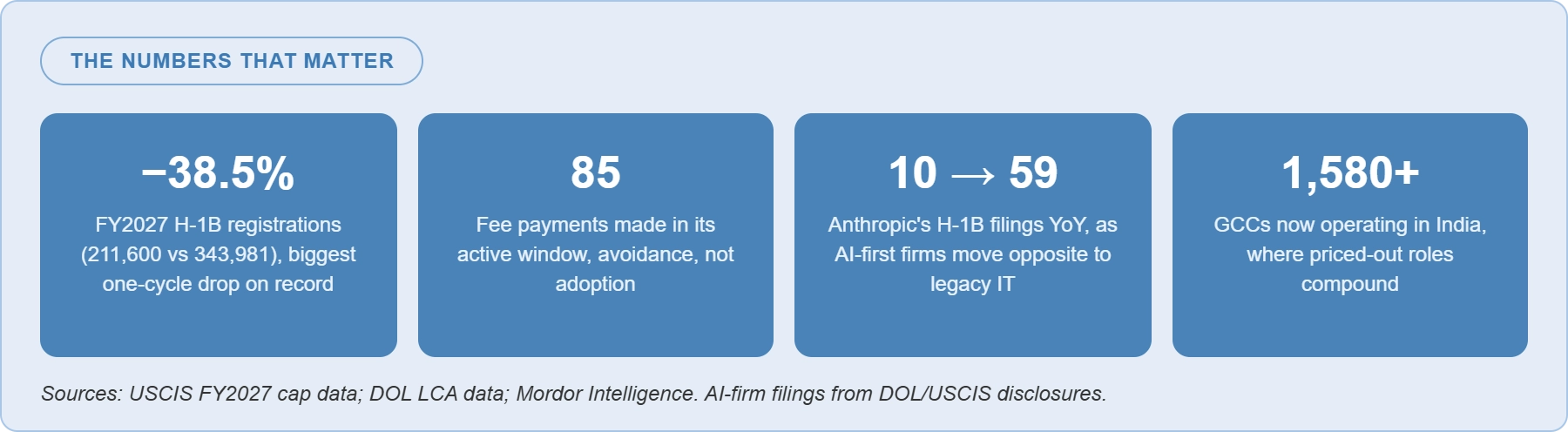
Employers spent eight months rewiring how they hire US-based foreign talent, and that rewiring did not reverse when the court ruled. FY2027 H-1B registrations fell 38.5%, the largest single-cycle drop on record. AI-first firms scaled H-1B sponsorship up while legacy IT services kept exiting. The roles that no longer move to the US are compounding in India’s global capability centers instead.
So here is the call. The fee may or may not survive appeal, but the repricing of where you hire and where work gets done has already happened. Don’t read the vacatur as permission to stop. This piece lays out what changed, what it means for your workforce strategy and delivery model, and the five moves that hold no matter how the litigation ends.
The Fee’s Real Effect Was Behavioral, Not Fiscal
When the USD 100,000 H-1B visa fee requirement took effect in September 2025, most people expected large employers to absorb it, pass it on, or fight it. Most did none of those. Government filings show just 85 payments across the fee’s active window, against a program that processed close to 400,000 petitions in FY2024. That gap is the story. The fee’s main effect was not revenue. It was deterrence.
Employers delayed filings, rerouted petitions, and rethought which roles they sponsor in the US at all. Here is the distinction that matters: a fee you pay is a cost problem; a fee you avoid is a demand-planning and location problem. The H-1B fee became the second kind within weeks, and that shift did not unwind when the court ruled.
A 38.5% Collapse, and What Actually Caused it
The FY2027 H-1B registration cycle removed any ambiguity about employer intent. Registrations fell to 211,600 from 343,981, down 38.5%, the largest single-cycle contraction in the program’s modern history.
Be precise about cause, because it changes the read. The fee is not the whole story. FY2026 H-1B registrations had already dropped 26.9% before the fee existed, driven by USCIS’s beneficiary-centric anti-fraud reform that stripped out duplicate filings. The fee added a second layer on top: employers filtering for conviction rather than volume. Separating the two matters. The reform effect is structural and will not reverse. The fee effect is behavioral, and it is sticky even if the fee dies.
Either way, the direction is the same. H-1B has moved from a volume instrument to a conviction instrument. Employers no longer register broadly and hope for H-1B lottery luck. They file when the role, the candidate, and the business case can survive a six-figure cost exposure, even a contested one.
H-1B Is Splitting Into Two Different Programs
The aggregate number hides the more important story: what is happening inside it.
Legacy IT services firms have been cutting new onsite H-1B deployment for a decade. The top seven India-based IT firms took 4,573 initial-employment approvals in FY2025, down 37% from FY2024 and roughly 70% from their FY2015 peak. The fee did not start that exit; it removed the last reason to wait. If you run a services firm still modeling H-1B as scalable onsite delivery, the offshore and outsourcing data is arguing against you.
US AI companies moved the opposite way. Anthropic went from 10 filings to 59. OpenAI from 20 to 63. Nvidia from 641 to 765. Amazon, Microsoft, Google, and Meta kept sponsoring at scale, with AI hiring concentrated on senior AI infrastructure and scarce technical roles.
So the program is bifurcating. For AI labs and chip and cloud builders, H-1B is a frontier-talent access route they will pay almost anything to keep. For legacy-services rotation, it is a shrinking channel under structural pressure. If you are in the first group, build a selective, high-conviction H-1B sponsorship model that can withstand scrutiny. If you are in the second, treat your H-1B dependency as a liability you can still control, and move before a harsher policy environment removes the option.
The Pipeline Is Already Thinning
The fee’s effects reach past what employers file, to who chooses to come at all. The existing US-educated foreign talent pool is being deployed at record rates while new students opt out. OPT participation grew 21% to 294,253 in 2024-2025 and kept rising 14% through Fall 2025. New enrollments fell 7% in 2024-2025 and hit −17% by Fall 2025.
OPT is a trailing indicator. It reflects enrollment decisions made years ago, so the short-term picture looks stable while the feed narrows underneath. If new enrollment holds at Fall 2025 rates, the STEM-OPT-to-H-1B pipeline, the one route that skips consular-processing fee exposure, thins right when AI infrastructure demand is climbing.
The US Is Building Its Own Competition
Here is the payoff, and it is the part boards most often misread. Every role that does not move to the US because of policy uncertainty stays in Bengaluru or Hyderabad, where it deepens local talent and compounds capability that eventually competes with US-based delivery. The US is not just ceding roles. It is speeding up the maturation of a rival ecosystem. India’s IT services market is already reorganizing around this, with GCC expansion and offshore-led delivery absorbing work that used to rotate onsite.
One correction to the common read, most of the displaced work is staying in India, not spreading evenly to Canada or Europe. Boards that assume uniform dispersion are misreading where capability actually compounds. India’s domestic GCC base, more than 1,580 centers, is the primary structural beneficiary, with decade-long implications for where innovation depth accumulates.
Three Scenarios, One Posture
The near-term challenge is not predicting one court outcome. It is building a model that holds across the plausible ones. “We’ll wait for the First Circuit” is not a posture when hiring and client-delivery commitments run on multi-year cycles.
H-1B Fee Scenarios and the Workforce Strategy Posture Each Demands
| Scenario 1: Base | Scenario 2: Downside | Scenario 3: Stress | |
| Outcome | Fee vacated, legislation stalls | ~50%Fee reinstated or codified | Fee codified plus placement ban |
| Our read | ~50% | ~35% | ~15% |
| What changes | Selective sponsorship returns; wage scrutiny persists | Only frontier-tech roles viable at $100K | Staffing model disrupted; OPT restricted; $200K wage floor |
| Your posture | Prioritize higher-wage roles; hold offshore scale | Accelerate GCC build; model visa ROI at $100K or more | Stress-test now; GCC is the non-negotiable hedge |
Source: Mordor Intelligence. Probabilities are Mordor Intelligence’s read of the current litigation-and-legislative posture, a judgment call, not a model output. Weigh them to your own risk tolerance.
The right move is not betting on Scenario 1. It is a posture that holds in Scenario 1 and does not break in 2 or 3: strengthen offshore capability now regardless of the ruling, build GCC optionality as insurance, and reserve US sponsorship for roles whose business case survives a six-figure cost.
Five Moves That Hold Across All Three Scenarios
- Classify roles by visa sensitivity before each cap season. Senior AI architects with narrow global supply warrant selective sponsorship. Mid-tier development, QA, and analytics increasingly have viable offshore hiring alternatives. Know which is which before you file.
- Treat sponsorship as capital allocation, not compliance. Every petition should carry an ROI case tied to revenue and replacement cost. If it does not survive at USD 100,000, it will not survive the next policy shock either.
-
Accelerate GCC investment. It is the hedge, not the contingency. The window to build capability before a harsher environment is open now. Firms still treating GCC as a backup plan are running a risk they could be removing.
- Build the OPT pipeline deliberately. The 294,000-plus professionals on OPT are underused. Structured OPT-to-sponsorship pipelines for high-value STEM talent cut consular-processing exposure, the highest-risk route under any fee reinstatement.
- Plan for scenarios, not outcomes. The first question on every new petition should be: what is our Plan B if this is delayed six months or blocked permanently? No answer means the plan is not finished.
The Call
The USD 100,000 H-1B fee may never be collected at scale. A future administration could revive it. Congress could codify it. It could vanish. None of those outcomes changes your response. H-1B is becoming more selective, more wage-sensitive, and more tied to workforce strategy across every litigation path. The fee accelerated trends already in motion; it did not create them. What it added, permanently, is a planning discipline: employers now model immigration risk alongside headcount, pay, and delivery location. That will not stop when a court rules.
What Could Flip This Call
If the broader legislative track stalls, no wage-floor hikes, no OPT limits, no third-party-placement rules, and H-1B drifts back to a low-scrutiny H-1B visa lottery, some of the 2025-2026 caution fades. The GCC trend and the AI split would continue regardless, but the urgency of scenario planning would ease. Watch the First Circuit ruling and the next congressional session as the leading indicators.
The Next Layer of Intelligence
The workforce question underneath all this is where technology work gets done, and how fast the offshore and GCC base is absorbing it. That is a market you can size, not just a policy you can track. Mordor Intelligence’s IT outsourcing coverage maps the offshore-delivery shift by service line, geography, and delivery model, across India and Asia-Pacific, so you can put a number on the hedge you are building rather than treating GCC expansion as a gut call.
Go Deeper
Want the market data behind the offshore shift this piece describes? Explore our IT Outsourcing market report for the size, growth, and delivery-model trends reshaping where technology work gets done.
