
Gaming Market Size and Share
Market Overview
| Study Period | 2020 - 2032 |
|---|---|
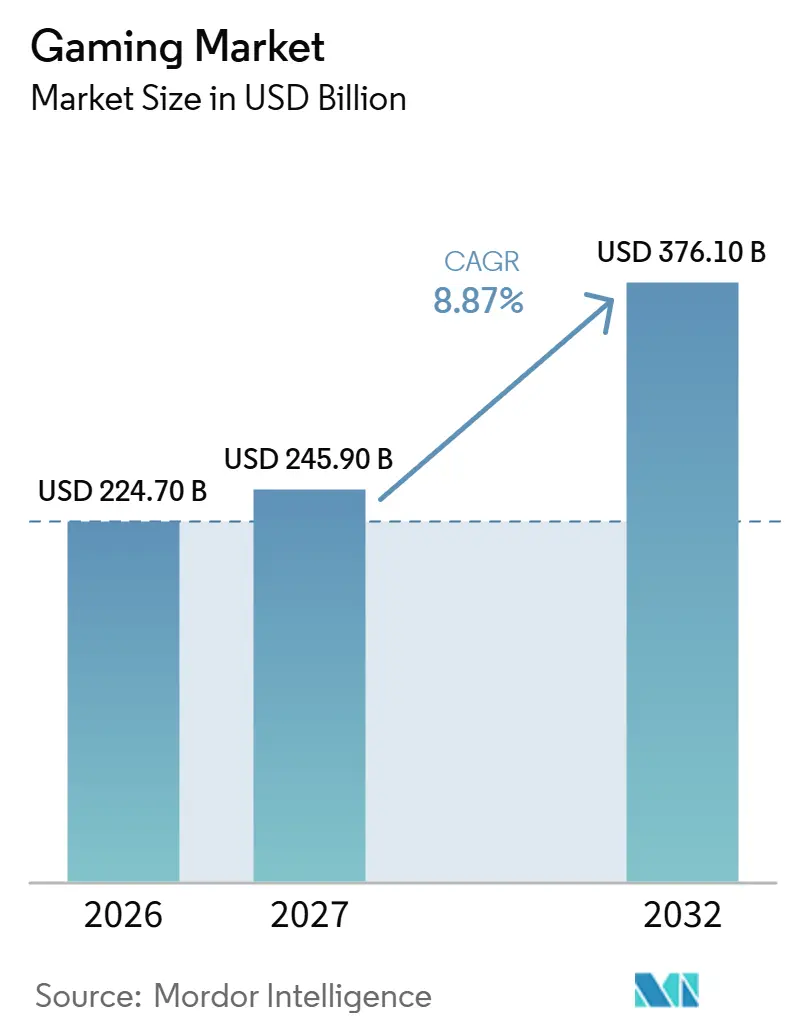
| Market Size (2027) | USD 245.9 Billion |
| Market Size (2032) | USD 376.1 Billion |
| Growth Rate (2027 - 2032) | 8.87 % CAGR |
| Fastest Growing Market | Middle East |
| Largest Market | Asia Pacific |
| Market Concentration | Medium |
Major Players*
*Disclaimer: Major Players sorted in no particular order. |

Gaming Market Analysis by Mordor Intelligence
Growth depends on converting established gaming audiences into repeated paid-content relationships, with mobile franchise renewal and live services providing complementary routes. In China, the commercial task combines a large player base with constraints on minors' service access and game approvals. Publishers and platforms can respond through bundled game access and streaming services that make network quality part of the content offer. A publisher's expansion case therefore rests on matching each paid-content offer to both its delivery route and local operating rules.
Key Report Takeaways
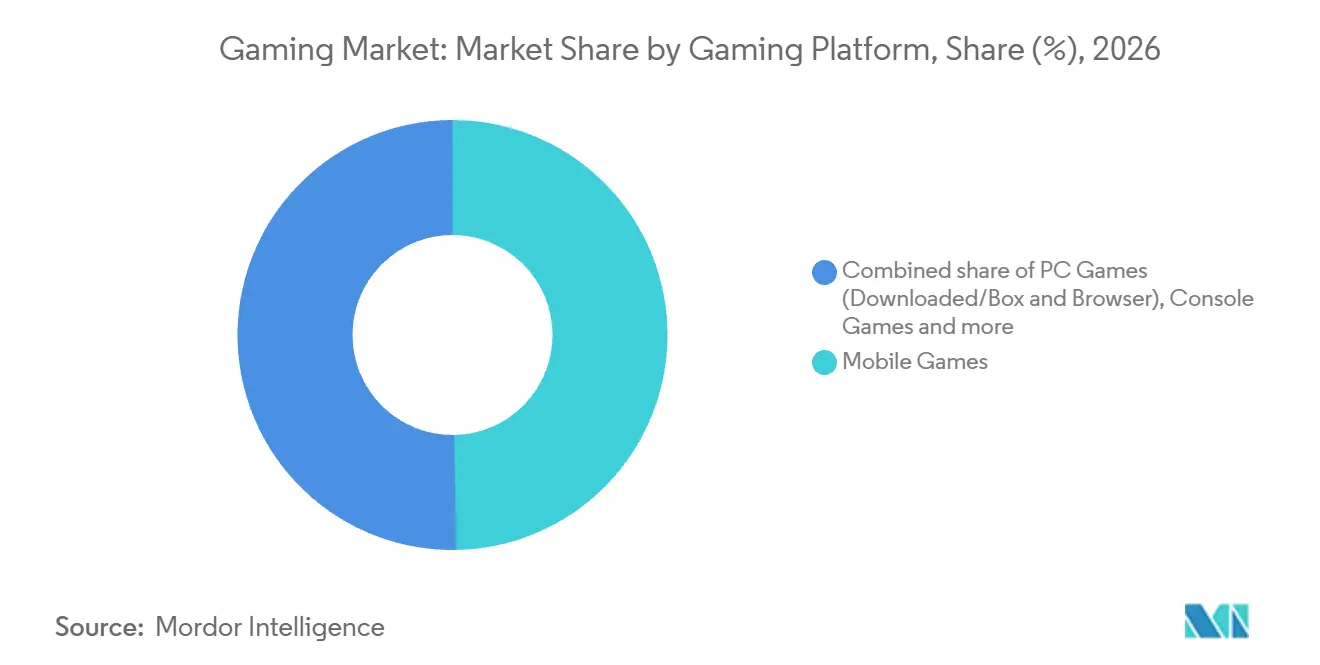
- By gaming platform, mobile games led with a 49.72% gaming market share in 2026, while cloud gaming is forecast to be the fastest-growing segment at a CAGR of 25.6% over 2027-2032.
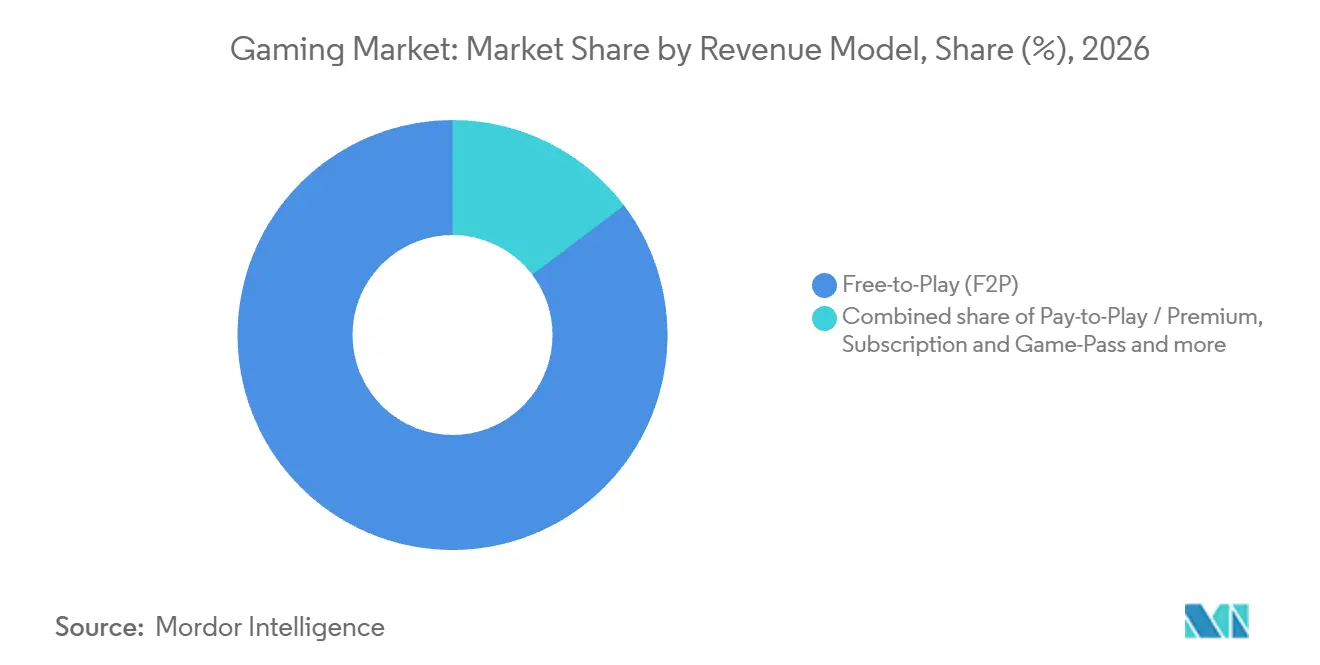
- Across revenue models, free-to-play accounted for an 85.3% share of the gaming market size in 2026, and subscription and game-pass offerings lead forecast growth with a CAGR of 13.3% over 2027-2032.
- Among genres, action/adventure led with 27.38% of market revenue in 2026, while shooter and battle royale games are forecast to grow fastest at a CAGR of 10.4% over 2027-2032.
- Within player age groups, ages 18-35 accounted for the leading 50.58% share of market revenue in 2026, whereas ages 36-50 are forecast to grow fastest at a CAGR of 10.5% over 2027-2032.
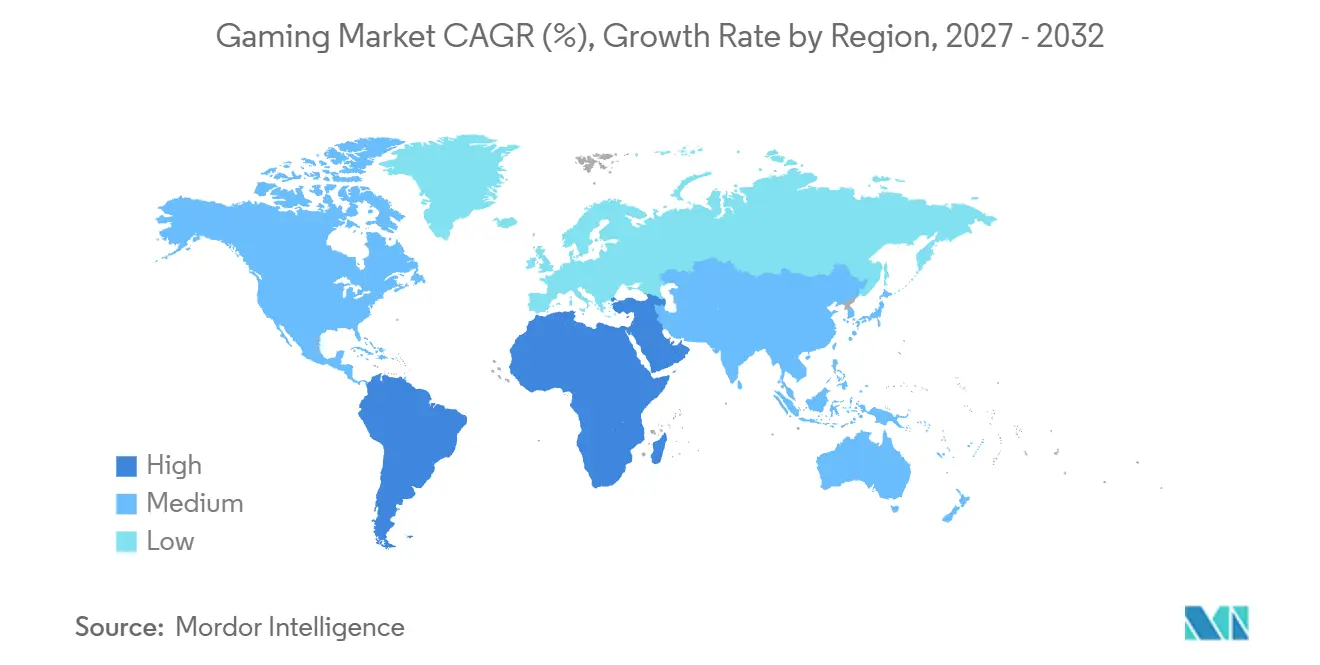
- Geographically, Asia Pacific led with 49.51% of market revenue in 2026, and the Middle East is forecast to be the fastest-growing region with a CAGR of 9.9% over 2027-2032.
Note: Market numbers in this report are based on Mordor Intelligence's proprietary estimation framework, which combines nine months of actuals with Q4 projections for base year 2026.
Global Gaming Market Trends and Insights
Drivers Impact Analysis
| Driver | (~) % Impact on CAGR Forecast | Geographic Relevance | Impact Timeline |
|---|---|---|---|
Mobile-first Monetization Surge | +3.8% | Southeast Asia, North America, South America and Oceania | Short term (≤ 2 years) |
5G-enabled Cloud Gaming Uptake | +1.1% | Germany | Medium term (2-4 years) |
AAA IP Trans-media Expansion Boosting Console and PC Revenues | +1.9% | United Kingdom, Germany and Brazil | Medium term (2-4 years) |
Increase in Live-service and In-game Advertising Revenues | +3.4% | United States, Europe, Asia, Australia, Canada and Latin America | Short term (≤ 2 years) |
Generative AI-driven User-Generated Content Workflows | +0.6% | New Zealand | Long term (≥ 4 years) |
Telco Bundling of Game Pass-style Subscriptions in Emerging Markets | +0.4% | Indonesia and Philippines | Short term (≤ 2 years) |
| Source: Mordor Intelligence | |||
Mobile-first Monetization Surge
Mobile publishers can expand receipts by renewing established franchises across distinct regional release windows. Gravity reported 12.2% growth in consolidated mobile-game revenue in 2025 from 2024. It attributed the increase mainly to initial revenue from Ragnarok M: Classic and Ragnarok X: Next Generation. Ragnarok M: Classic launched in Southeast Asia in February 2025 and in Taiwan, Hong Kong, and Macau in April 2025. Ragnarok Origin revenues partially offset the increase, showing that the portfolio's contribution varied across titles. That mix exposes Gravity's growth to the launch calendar, because the newer releases had to outweigh weaker Ragnarok Origin receipts.
5G-enabled Cloud Gaming Uptake
Responsive mobile play makes network treatment commercially relevant to cloud-gaming access. In December 2025, Deutsche Telekom made its integration with NVIDIA's GeForce NOW available to eligible customers on its 5G+ network in Germany. Across sessions from October 7, 2025, to February 1, 2026, Telekom reported 20% lower latency in GeForce NOW sessions receiving gaming-slice treatment on its network. The comparison used other GeForce NOW sessions on that same network without the treatment. The same analysis reported 73% fewer frames with packet loss in treated sessions. Telekom ties the packet-loss reduction to smoother play without image loss, so eligible GeForce NOW users receive a measured delivery difference on the treated connection.
AAA IP Trans-media Expansion Boosting Console and PC Revenues
A game franchise's adaptation offers an additional discovery channel without requiring another game release. Fallout Season 2 ranked No. 1 in more than 80 countries during its first 3 months after its December 2025 premiere, according to Amazon MGM Studios data reported by TheWrap. The adaptation drew outsized viewing in the United Kingdom, Germany, and Brazil. After A Minecraft Movie's April 2025 release, Minecraft console unit sales rose 36%, according to Sensor Tower. Franchise owners can renew console-game demand through adaptations, as Minecraft's 36% rise in console unit sales shows, while Fallout's No. 1 ranking in more than 80 countries illustrates television's discovery reach.
Increase in Live-service and In-game Advertising Revenues
A publisher's live-service opportunity rests on keeping released games commercially active between major full-game launches. Take-Two Interactive Software Inc. reported 3% year-over-year growth in recurrent consumer spending net revenue in its fiscal first quarter ended June 30, 2026. These receipts accounted for 84% of its GAAP net revenue, combining virtual currency, add-on content, in-game purchases, and in-game advertising. For the fiscal year ended March 31, 2026, recurrent consumer spending revenue grew 16% and made up 78% of GAAP net revenue. The later quarter's 3% revenue gain and 1% decline in recurrent consumer spending net bookings followed that faster annual revenue growth. The annual and quarterly revenue gains support continued investment in postlaunch monetization, while the bookings decline argues against assuming that recognized revenue growth guarantees expanding sales commitments.
Restraints Impact Analysis
| Restraint | (~) % Impact on CAGR Forecast | Geographic Relevance | Impact Timeline |
|---|---|---|---|
China's Tight Game Approval and Play-time Quota Regime | -1% | China | Long term (≥ 4 years) |
iOS ATT and Privacy Rules Inflating User-Acquisition Costs | -0.7% | Italy | Medium term (2-4 years) |
Global AAA Talent Shortage Driving Development Delays | -0.4% | European Union | Medium term (2-4 years) |
Rising Cloud-compute Costs Squeezing Margins of F2P Publishers | -0.2% | North America, South America, Asia Pacific and Europe | Short term (≤ 2 years) |
| Source: Mordor Intelligence | |||
China's Tight Game Approval and Play-time Quota Regime
China's play-time controls restrict the hours during which publishers can serve younger online players. Effective September 1, 2021, the National Press and Publication Administration permits service to minors under 18 only from 8 to 9 p.m. on Fridays, Saturdays, Sundays, and statutory holidays.[1] The restriction covers online game companies and platforms, concentrating permitted access within those windows. Separately, NetEase Inc. said in April 2026 that approval failures or delays, among other factors, could delay launches or cancel pipeline development. Publishers therefore face constraints on both access to younger customers and the timing of new releases. Designing around permitted play sessions cannot remove the separate approval risk attached to commercialization.
iOS ATT and Privacy Rules Inflating User-Acquisition Costs
For game advertisers exposed to consent restrictions, access to advertising data becomes part of acquisition economics. In December 2025, Italy's competition regulator, the Autorità Garante della Concorrenza e del Mercato (AGCM), found that Apple's App Tracking Transparency implementation imposed double consent on third-party iOS apps. The ATT prompt was insufficient to satisfy privacy-law consent requirements, so developers needed an additional prompt. AGCM found that the implementation restricted advertising data use and increased advertisers' costs in Italy.[2] For publishers using this advertising channel, the combination can weaken the commercial case for expanding player acquisition. Advertising-led expansion must absorb the consent-related cost burden before additional recruitment can translate into earnings.
Segment Analysis
By Gaming Platform: Mobile Reach and Cloud Delivery Shape Access
Mobile games accounted for a 49.72% share of the gaming market size in 2026, making them the largest segment. Sensor Tower reported worldwide mobile-game in-app purchase revenue of USD 39.8 billion in the first half of 2026, down 2% from USD 40.6 billion a year earlier. Tencent reported operating 7 of China's 10 leading domestic mobile games by average quarterly daily active users in Q2 2025, citing QuestMobile rankings. A challenger launching in China therefore competes with an operator that already holds most of the country's highest-use mobile titles. An entrant's growth case needs gains for its own games rather than an assumption that worldwide in-app purchase spending will expand.
Cloud gaming is the fastest-growing segment, with a forecast CAGR of 25.6% over 2027-2032. In November 2025, Microsoft reported that Xbox Cloud Gaming hours streamed by Game Pass subscribers were 45% higher than at the same time in 2024.[3] For VR/AR gaming, Valve's September 2026 Steam survey reported VR headsets among 1.35% of Steam users. Game Pass can capture additional streamed play within an existing subscription relationship, whereas VR distribution on Steam depends on reaching the small headset-owning audience.
Note: Segment shares of all individual segments available upon report purchase
By Revenue Model: Free Access and Subscription Bundles Divide Monetization
Free-to-play (F2P) was the largest segment, accounting for 85.3% of total industry revenue in 2026. In the 3 months ended June 30, 2026, Roblox averaged 123 million daily active registered accounts, including approximately 1.6 million average daily unique paying users, across its platform of gaming, education, and entertainment experiences. In 2025, Roblox said most experiences were free, creators determined each experience's business model, and most free experiences allowed purchases of experience-specific enhancements. That structure separates audience reach from the purchase decision, giving creators a monetization opportunity within experiences users can access without payment. Because creators set each experience's business model, monetization on Roblox follows separate creator decisions rather than one platform-wide price.
Subscription and game-pass offerings are the fastest-growing segment, with a forecast CAGR of 13.3% over 2027-2032. Microsoft reported nearly USD 5 billion in annual Game Pass revenue for fiscal 2025, which ended June 30, 2025, reaching that level for the first time. Discord announced Nitro Rewards on May 11, 2026, including a Game Pass Starter Edition benefit at no extra cost for Nitro members where available. Bundling places game access inside another membership, creating a route to players through a partner's customer relationship. The Starter Edition benefit makes the Nitro partnership an entry-level route into Game Pass alongside the service's established annual revenue base.
Note: Segment shares of all individual segments available upon report purchase
By Genre: Franchise Scale Meets Cross-Device Revenue Growth
Action/adventure represented a 27.38% gaming market share in 2026, making it the largest segment. Take-Two's fiscal 2026 annual report recorded cumulative worldwide sell-in of more than 465 million units for Grand Theft Auto, a series from its Rockstar Games label. Its subsequent quarterly report for the period ended June 30, 2026, put that cumulative worldwide sell-in total above 470 million units. Take-Two said it expects its wholly owned Rockstar Games label to continue to be a leader in the action/adventure product category. At more than 470 million units sold in, Grand Theft Auto sets the franchise scale that an action/adventure challenger has to compete with.
Shooter and battle royale games are the fastest-growing segment, with a forecast CAGR of 10.4% over 2027-2032. Krafton Inc. reported that revenue from its PUBG IP Franchise, spanning PC and mobile activity, rose 25% in the first half of 2026 from a year earlier. A shooter publisher pursuing PUBG's model has to keep the same franchise relevant on 2 device types at once.
By Player Age Group: Young Adult Scale and Adult Growth Shape Content Choices
Players ages 18-35 formed the largest segment, accounting for 50.58% of total industry revenue in 2026. In the Entertainment Software Association (ESA) survey across 21 countries in 2025, players ages 25-34 represented 26% of active weekly video game players aged 16 or older. Roblox estimated that engagement hours among its U.S. users ages 18-34 grew 37% year over year in Q2 2026. Those cohort estimates extrapolate from Roblox users who completed age checks to users without age checks. Roblox's estimated 37% rise in hours for ages 18-34 compares with 27% for all its U.S. users over 18, so on that platform young adults added play faster than adult users as a whole.
Players ages 36-50 are forecast to be the fastest-growing segment, with a CAGR of 10.5% over 2027-2032. In a September 2026 disclosure, RuStore described users ages 35-45 as its most active group, making purchases more frequently and spending more per transaction. For mobile-game publishers selling through RuStore, this overlapping cohort offers a spending-growth mechanism through purchase frequency and transaction value, alongside attracting additional players. Paid-content offers that encourage repeat purchases can address these adult buyers' demonstrated activity more directly than an acquisition-only strategy.

Recognized by Experts. Trusted by Leaders.
A trusted intelligence partner to global decision-makers across 90+ countries.







Geography Analysis
Asia Pacific Gaming Market
Asia Pacific accounted for 49.51% of the gaming market size in 2026, making it the largest regional market. China had 684 million game users in the first half of 2026, up 0.82% from a year earlier. Indonesia's Ministry of Trade cited more than 192 million game players in 2025 data from the Agate Whitepaper. China's modest user-base change puts greater commercial weight on engagement and monetization within an already extensive audience. For a publisher seeking additional users, Indonesia offers a separate large audience rather than a dependence on faster expansion in China's near-flat user base.
Middle East Gaming Market
The Middle East is forecast to grow at a CAGR of 9.9% over 2027-2032, making it the fastest-growing region. The Saudi Center for Opinion Polling's 2025 study of Saudi mobile-phone users aged 18 or older found that approximately 7 out of 10 surveyed players made monthly game payments. In May 2026, Savvy Games Group and Roblox signed a memorandum of understanding to support Saudi developers through training, community building, and technical support. The commercial opening combines recurring game-content demand with a planned route for Saudi creators to develop content for an audience with demonstrated payment activity.
North America's content-spending base includes the United States, where consumers spent USD 52.4 billion on video game content in 2025. In South America, Brazil's surveyed active gamers aged 16 or older most regularly played action, puzzle, and shooter games in 2025, and 82% played with others in person at least monthly. Across 16 European markets, 82% of players had played on mobile in 2025, making it the most-used device in that sample. In Africa, South African surveyed active gamers aged 16 or older most regularly played puzzle, action, and sports games in 2025, and 76% played with others in person at least monthly. These patterns favor mobile access in the European sample and social formats in Brazil and South Africa, where action and puzzle preferences overlap.
Regulatory Framework and Outlook
The regulatory comparison covers selected jurisdictions and the conditions attached to game-content publishing and distribution. Ratings assess local publishers and distributors serving each country's players, with duties applied to the particular service, feature, or distribution activity covered. Classification, child-data practices, and licensing create different commercial steps, so an available entry route can coexist with continuing operating obligations.
Regulatory Table
| Decision factor | United States | Brazil | Germany | China | United Arab Emirates | South Africa |
|---|---|---|---|---|---|---|
Primary authority | Federal Trade Commission | Ministry of Justice and Public Security; Agência Nacional de Proteção de Dados (ANPD) | State youth-protection authorities | National Press and Publication Administration | National Media Authority | Film and Publications Board |
Key instruments or direction | Children's Online Privacy Protection Rule for child-directed services or operators with actual knowledge of children's data collection | Game classification; loot-box age checks to exclude children and adolescents unless boxes are removed or access is disabled by default | Age classification for computer and console games accessible to minors; online development-harm controls | Domestic online-game publication approval | Game age-rating certificate service terms | Distributor registration and public-exhibition classification |
Commercial effect | Covered operators notify parents and obtain verifiable consent before collecting, using, or disclosing personal data from children under 13 | Digital-only games may self-rate under Brazilian criteria and display rules; physical games need prior rating and package labels | Classify covered computer/console games before minors' access; prevent development-harmful online content from being generally perceived by minors | Domestic applicants need eligible publishers, rights documentation, an operator's telecommunications and information-services license, compliant content, and minors-protection controls | Distribution/import applicants need a valid media license for the rating-application route | Register for distribution; classify games before public exhibition and observe assigned age restrictions |
Current policy attractiveness | Medium | Medium | Medium | Low | Medium | Medium |
Future direction of policy attractiveness | No change | No change | No change | Hardening | No change | No change |
| Source: Mordor Intelligence | ||||||
The amended COPPA Rule has applied to most covered operators since the April 22, 2026, compliance date, and the February 25, 2026, FTC policy gives conditional enforcement relief only to general- and mixed-audience services that use safeguarded personal information solely for age checks, supporting Medium and No change in the United States. Germany's classification duties support Medium and No change because the September 2026 media-reform draft retains the link between age ratings and presumed developmental harm, while South Africa's registration and exhibition controls support continuity pending approval of its revised online policy. The UAE's licensed rating route is administered by the National Media Authority created under Federal Decree-Law No. 11 of 2025, and its service terms still require distribution/import applicants to hold a valid media license, supporting Medium and No change, whereas China's domestic-title approval conditions and September 2026 minor-mode proposal for network games offered to users under 16 support Low and Hardening. Brazil's Medium assessment balances digital self-rating with March 18, 2026, loot-box safeguards, while ANPD's ECA Digital consultation through October 26, 2026, concerns general enforcement and sanctions procedures rather than changed game-feature duties.
Value Chain Stages
The value chain comparison follows development platforms, digital release and commerce, and multiplayer operation, focusing on where suppliers earn revenue. Unity supplies development-platform access through Pro and Enterprise subscriptions, establishing a recurring supplier relationship around the tools used to create games. Distribution and hosting add separate commercial relationships, so a game's route to players can involve payments at several operational stages.
Value Chain Analysis Table
| Primary activity | Key participants | Value capture | Bottleneck | Resilience response |
|---|---|---|---|---|
Development-platform provision | Development-tool suppliers such as Unity | Pro and Enterprise subscription fees | Recurring paid-tool commitments | Match subscription tier to development requirements |
Digital release and commerce | Storefront operators such as Apple and Valve | Valve's USD 100 app fee, recoupable in a later payment after USD 1,000 in Steam Store or in-app purchase adjusted gross revenue | Steam onboarding fee is paid before conditional recoupment | Phase app onboarding across releases |
Multiplayer game operation | Game-server hosting suppliers such as Amazon Web Services | Multiplayer server-hosting service charges | Resources must match fluctuating player demand | Scale hosting resources with player demand |
| Source: Mordor Intelligence | ||||
Studios using paid Unity tools during development and paying Steam's app fee commit funds before launch receipts, while multiplayer hosting follows variable player demand. The Steam fee's conditional recoupment makes release-stage cash exposure different from a permanent transaction margin. For hosted multiplayer games, demand-responsive scaling can align the operating resource commitment more closely with actual play.

Reports are available across multiple geographies.
Gain in-depth market insights across regions to support informed decisions.
Competitive Landscape
Market Concentration
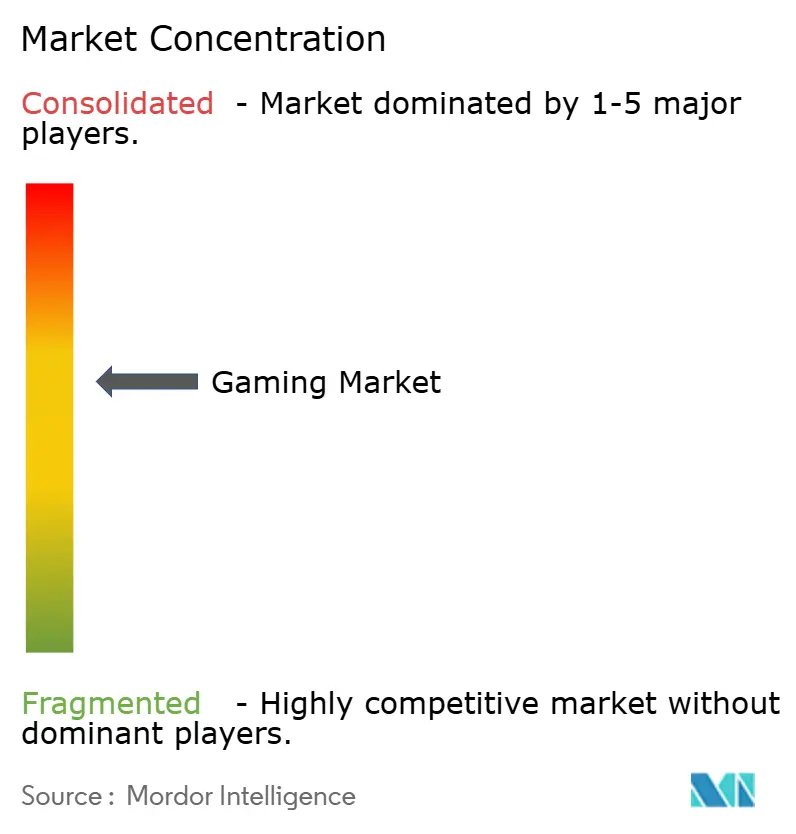
Competition is moderately concentrated around major game publishers and platform operators, combining content development with several routes to reach players. Tencent Holdings Ltd. develops and operates games, and its domestic games revenue grew 17% year over year in Q2 2026, with contributions from Delta Force and VALORANT. Sony Group Corp. operates the PlayStation platform and publishes games through its wholly owned subsidiary Sony Interactive Entertainment, and it owns developer Bungie, which it acquired in 2022. Microsoft Corp. operates Xbox content and subscription services, Apple Inc. operates the App Store, and NetEase Inc. develops online games and related services. This structure makes competitive strength depend on both game-level demand and access to the platforms through which content and subscriptions reach buyers.
Platform competition also centers on how existing content is organized for players across a company's game services. Apple launched its Apple Games app for iOS, iPadOS, and macOS in the European Union on September 15, 2025, as a central hub for games from the App Store and Apple Arcade. That approach places aggregation of existing libraries alongside additional content development as a way to differentiate the platform experience. A challenger distributed through the App Store or Apple Arcade faces a combined library view controlled by Apple, so its route to players includes the platform's presentation of existing content.
The European Union's Digital Markets Act requires designated app-store gatekeepers, including Apple, to allow effective distribution through third-party stores or the web. Apple's EU terms effective October 1, 2026, set a 5% Core Technology Commission on digital transactions in apps distributed outside the App Store. The terms replaced the Core Technology Fee, a per-install fee for developers that achieve extraordinary scale, and eliminated the initial acquisition and store-services fees. The commission's transaction basis makes channel economics depend on paid activity, giving the largest-scale publishers a transaction-based alternative to an installation-based charge. Regulatory access and commercial distribution terms consequently shape a challenger's choice of route for paid game content to EU players.
Gaming Industry Leaders

*Disclaimer: Major Players sorted in no particular order
Key Opportunities for Market Participants
The opportunities comparison contrasts creator-led item sales, occasional cloud access, and games delivered through an entertainment membership. Fortnite lets enrolled developers aged 18 or older sell items and offers in published islands, subject to publishing, content, and regional rules. Its developer payout is 100% of V-Bucks value after platform and store fees from January 9, 2026, through January 31, 2027, compared with an ordinary rate of 50%.
Market Opportunities Table
| Opportunity | Why now | Buyer / lead segment | Recommended play | Main barrier | Likely beneficiaries |
|---|---|---|---|---|---|
Paid content within published islands | Fortnite's in-island item and offer sales are operating | Enrolled Fortnite developers and their island players | Build a clear paid-content proposition within a published island | Converting play into purchases of a sufficiently useful offer | Epic Games Inc. and enrolled Fortnite developers |
Occasional cloud access to owned games | Xbox announced purchased cloud hours without Game Pass for November 2026 | Players with eligible owned games on supported devices, subject to market availability | Prepare eligible owned-game catalogs for the announced hourly access route | Converting occasional interest into paid cloud hours | Microsoft Corp. and publishers of eligible games |
Shared-screen subscription games | Netflix membership includes games at no additional fee, without ads or in-app purchases, in a limited 20-country beta on supported TVs and computers | Netflix members using supported TVs with the Netflix app and stable internet | Develop content suited to TV play using a phone or tablet for each player | Designing play around the phone-controller requirement | Netflix and participating game developers |
| Source: Mordor Intelligence | |||||
The strongest immediate opening is paid content within published Fortnite islands, where the sales mechanism operates and temporary payout terms improve the creator's share of V-Bucks value. The ordinary rate matters because a published island can outlast the higher-payout period. Pricing and ongoing content costs need to work at the ordinary 50% payout rate if an island is to remain commercially viable after January 31, 2027.
Recent Industry Developments
- Oct 2026: Apple's EU terms took effect on October 1 with a 5% Core Technology Commission on digital transactions in apps distributed outside the App Store. It replaced the per-install Core Technology Fee for developers achieving extraordinary scale.
- Sep 2026: Sony Interactive Entertainment released Marvel's Wolverine worldwide exclusively for PlayStation 5. Insomniac Games developed the action-adventure game in collaboration with Marvel Games.
- Aug 2026: Electronic Arts Inc. completed its acquisition by PIF, Silver Lake, and Affinity Partners, transferring ownership of the game publisher to the consortium.
Table of Contents for Gaming Industry Report
1. INTRODUCTION
- 1.1 Study Assumptions and Market Definition
- 1.2 Scope of the Study
2. RESEARCH METHODOLOGY
3. EXECUTIVE SUMMARY
4. MARKET LANDSCAPE
- 4.1 Market Overview
- 4.2 Market Drivers
- 4.2.1 Mobile-first Monetization Surge
- 4.2.2 5G-enabled Cloud Gaming Uptake
- 4.2.3 AAA IP Trans-media Expansion Boosting Console and PC Revenues
- 4.2.4 Increase in Live-service and In-game Advertising Revenues
- 4.2.5 Generative AI-driven User-Generated Content Workflows
- 4.2.6 Telco Bundling of Game Pass-style Subscriptions in Emerging Markets
- 4.3 Market Restraints
- 4.3.1 China's Tight Game Approval and Play-time Quota Regime
- 4.3.2 iOS ATT and Privacy Rules Inflating User-Acquisition Costs
- 4.3.3 Global AAA Talent Shortage Driving Development Delays
- 4.3.4 Rising Cloud-compute Costs Squeezing Margins of F2P Publishers
- 4.4 Industry Value Chain Analysis
- 4.5 Regulatory Landscape
- 4.6 Technological Outlook
- 4.7 Porter's Five Forces Analysis
- 4.7.1 Threat of New Entrants
- 4.7.2 Bargaining Power of Suppliers
- 4.7.3 Bargaining Power of Buyers
- 4.7.4 Threat of Substitutes
- 4.7.5 Competitive Rivalry
- 4.8 Impact of Macroeconomic Factors on the Market
5. MARKET SIZE AND GROWTH FORECASTS (VALUE)
- 5.1 By Gaming Platform
- 5.1.1 Mobile Games
- 5.1.2 PC Games (Downloaded/Box and Browser)
- 5.1.3 Console Games
- 5.1.4 Cloud Gaming
- 5.1.5 VR/AR Gaming
- 5.2 By Revenue Model
- 5.2.1 Free-to-Play (F2P)
- 5.2.2 Pay-to-Play / Premium
- 5.2.3 Subscription and Game-Pass
- 5.3 By Genre
- 5.3.1 Action/Adventure
- 5.3.2 Shooter and Battle Royale
- 5.3.3 Role-Playing (RPG/MMORPG)
- 5.3.4 Sports and Racing
- 5.3.5 Other Genres
- 5.4 By Player Age Group
- 5.4.1 Under 18 Years
- 5.4.2 18-35 Years
- 5.4.3 36-50 Years
- 5.4.4 Above 50 Years
- 5.5 By Geography
- 5.5.1 North America
- 5.5.1.1 United States
- 5.5.1.2 Canada
- 5.5.1.3 Mexico
- 5.5.2 South America
- 5.5.2.1 Brazil
- 5.5.2.2 Argentina
- 5.5.2.3 Rest of South America
- 5.5.3 Europe
- 5.5.3.1 Germany
- 5.5.3.2 United Kingdom
- 5.5.3.3 France
- 5.5.3.4 Italy
- 5.5.3.5 Spain
- 5.5.3.6 Russia
- 5.5.3.7 Rest of Europe
- 5.5.4 Asia Pacific
- 5.5.4.1 China
- 5.5.4.2 Japan
- 5.5.4.3 South Korea
- 5.5.4.4 India
- 5.5.4.5 Australia
- 5.5.4.6 New Zealand
- 5.5.4.7 Rest of Asia Pacific
- 5.5.5 Middle East
- 5.5.5.1 United Arab Emirates
- 5.5.5.2 Saudi Arabia
- 5.5.5.3 Turkey
- 5.5.5.4 Rest of Middle East
- 5.5.6 Africa
- 5.5.6.1 South Africa
- 5.5.6.2 Nigeria
- 5.5.6.3 Kenya
- 5.5.6.4 Rest of Africa
6. COMPETITIVE LANDSCAPE
- 6.1 Market Concentration
- 6.2 Strategic Moves
- 6.3 Market Share Analysis
- 6.4 Company Profiles (includes Global level Overview, Market level overview, Core Segments, Financials as available, Strategic Information, Market Rank/Share for key companies, Products and Services, and Recent Developments)
- 6.4.1 Tencent Holdings Ltd.
- 6.4.2 Sony Group Corp.
- 6.4.3 Microsoft Corp.
- 6.4.4 Apple Inc.
- 6.4.5 NetEase Inc.
- 6.4.6 Nintendo Co. Ltd.
- 6.4.7 Activision Blizzard Inc.
- 6.4.8 Electronic Arts Inc.
- 6.4.9 Epic Games Inc.
- 6.4.10 Sea Ltd. (Garena)
- 6.4.11 Roblox Corp.
- 6.4.12 Krafton Inc.
- 6.4.13 Bandai Namco Holdings Inc.
- 6.4.14 Take-Two Interactive Software Inc.
- 6.4.15 Ubisoft Entertainment SA
- 6.4.16 Square Enix Holdings Co. Ltd.
- 6.4.17 Valve Corp.
- 6.4.18 Zynga Inc.
- 6.4.19 Embracer Group AB
- 6.4.20 Jam City Inc.
- 6.4.21 miHoYo Co. Ltd. (HoYoverse)
- 6.4.22 Com2uS Corp.
- 6.4.23 ZeptoLab UK Ltd.
7. MARKET OPPORTUNITIES AND FUTURE OUTLOOK
- 7.1 White-Space and Unmet-Need Assessment
Scope and Methodology
| By Gaming Platform | Mobile Games | |
| PC Games (Downloaded/Box and Browser) | ||
| Console Games | ||
| Cloud Gaming | ||
| VR/AR Gaming | ||
| By Revenue Model | Free-to-Play (F2P) | |
| Pay-to-Play / Premium | ||
| Subscription and Game-Pass | ||
| By Genre | Action/Adventure | |
| Shooter and Battle Royale | ||
| Role-Playing (RPG/MMORPG) | ||
| Sports and Racing | ||
| Other Genres | ||
| By Player Age Group | Under 18 Years | |
| 18-35 Years | ||
| 36-50 Years | ||
| Above 50 Years | ||
| By Geography | North America | United States |
| Canada | ||
| Mexico | ||
| South America | Brazil | |
| Argentina | ||
| Rest of South America | ||
| Europe | Germany | |
| United Kingdom | ||
| France | ||
| Italy | ||
| Spain | ||
| Russia | ||
| Rest of Europe | ||
| Asia Pacific | China | |
| Japan | ||
| South Korea | ||
| India | ||
| Australia | ||
| New Zealand | ||
| Rest of Asia Pacific | ||
| Middle East | United Arab Emirates | |
| Saudi Arabia | ||
| Turkey | ||
| Rest of Middle East | ||
| Africa | South Africa | |
| Nigeria | ||
| Kenya | ||
| Rest of Africa | ||
