

Market Overview
| Study Period | 2017 - 2030 |
|---|---|
| Base Year For Estimation | 2024 |
| Forecast Data Period | 2025 - 2030 |
| Market Size (2025) | USD 3.12 Billion |
| Market Size (2030) | USD 4.17 Billion |
| Growth Rate (2025 - 2030) | 4.92% CAGR |
| Market Concentration | Low |
Major Players
*Disclaimer: Major Players sorted in no particular order Image © Mordor Intelligence. Reuse requires attribution under CC BY 4.0. |
|

Africa Seed Market Analysis by Mordor Intelligence
The Africa seed market size is valued at USD 3.12 billion in 2025 and is forecast to climb to USD 4.17 billion by 2030, advancing at a 4.92% CAGR over the period. The projected expansion rests on four structural pillars: growing preference for hybrid and stress-tolerant genetics, the steady roll-out of government-funded seed-replacement schemes, ongoing expansion of irrigated acreage, and the landmark regional seed-law harmonization that came into force under the African Continental Free Trade Area in 2024. Digitally enabled micro-pack distribution has further lowered entry barriers for smallholder farmers, who account for roughly 80% of regional production, while early field trials of gene-edited crops promise an additional pipeline of climate-resilient varieties. Together, these forces are tilting the balance away from informal exchange networks toward structured commercial channels that emphasize quality assurance, traceability, and faster varietal turnover.
Key Report Takeaways
- By breeding technology, hybrids captured 60.2% of Africa seed market size in 2024, while open-pollinated varieties and hybrid derivatives are projected to grow at a 4.95% CAGR through 2030.
- By cultivation mechanism, open field systems accounted for 99.9% of Africa seed market size in 2024; protected cultivation is projected to expand at a 7.84% CAGR through 2030.
- By crop type, row crops held 77.5% of Africa seed market share in 2024, yet vegetables remain the fastest-growing segment at 5.57% CAGR to 2030.
- By geography, Nigeria led with 40.6% of Africa seed market share in 2024, whereas Kenya posted the fastest trajectory at a 5.92% CAGR to 2030.
Africa Seed Market Trends and Insights
Drivers Impact Analysis
| Driver | (~) % Impact on CAGR Forecast | Geographic Relevance | Impact Timeline |
|---|---|---|---|
| Rising adoption of hybrid and stress-tolerant seed varieties | +1.2% | Nigeria, Kenya, South Africa, and Ghana | Medium term (2-4 years) |
| Government-funded input and seed-replacement programs | +0.8% | Nigeria, Ethiopia, Tanzania, and Kenya | Short term (≤ 2 years) |
| Expansion of irrigated land and protected cultivation | +0.6% | Egypt, South Africa, Kenya, Ghana | Long term (≥ 4 years) |
| Regional seed-law harmonization under AfCFTA (The African Continental Free Trade Area) | +0.7% | Tanzania and Kenya | Medium term (2-4 years) |
| Digital micro-pack seed sales via last-mile agro-dealers | +0.5% | Nigeria, Kenya, Ghana, Tanzania | Short term (≤ 2 years) |
| Gene-edited indigenous crops entering national trials | +0.4% | South Africa, Kenya, Nigeria | Long term (≥ 4 years) |
| Source: Mordor Intelligence | |||
Rising Adoption of Hybrid and Stress-Tolerant Seed Varieties
Climate volatility is nudging farmers toward hybrids that deliver higher yield stability, drought tolerance, and pest resilience compared with traditional open-pollinated options. Nigeria documented a 35% jump in hybrid maize uptake during 2024, with stress-tolerant entries constituting 60% of new registrations[1]Source: Nigeria Agricultural Seed Council, "Annual Seed Registration Report 2024," seedcouncil.gov.ng. Multinationals and local breeders alike are now tailoring heat-tolerant wheat for Egypt’s desert expansion and drought-resistant sorghum for the Sahel, deepening the hybrid pipeline across diverse agro-ecologies.
Government-Funded Input and Seed-Replacement Programs
Public programs remain a reliable pull factor. Nigeria’s Anchor Borrowers Programme alone supplied 2.3 million metric tons of certified seed in 2024[2]Source: Central Bank of Nigeria, "Anchor Borrowers Programme Report 2024," cbn.gov.ng. Ethiopia funnels in annual seed vouchers to its Productive Safety Net Programme, directly linking social protection with varietal renewal. Tanzania aims for a significant replacement rate of traditional seed stocks by 2027, leveraging cooperatives to distribute subsidized packets. These schemes strengthen demand certainty for suppliers while enhancing genetic gains in the field.
Expansion of Irrigated Land and Protected Cultivation
Access to water and micro-climate control are altering seed preferences. Egypt already manages 45,000 hectares of greenhouse area, underpinning a specialized vegetable seed segment valued at USD 85 million per year[3]Source: Egyptian Ministry of Agriculture, "Protected Cultivation Statistics 2024," agriculture.gov.eg. South Africa’s Western Cape reports modest yearly growth in high-tech houses, while Kenya’s flower complex added to greenhouse area in 2024. As protected cultivation spreads, demand is shifting toward determinate growth habits, uniform maturity, and multi-disease resistance traits embedded in next-generation hybrids aimed at high-value horticulture.
Regional Seed-Law Harmonization under AfCFTA
The 2024 African Continental Free Trade Area (AfCFTA) protocols permit a variety of registered products in one signatory nation to circulate in 21 markets without re-testing, slashing entry costs. This regulatory convergence reduces market entry costs for seed companies by 40-60% while accelerating variety deployment across borders. West African Economic and Monetary Union's unified seed certification system, launched in 2024, creates a market for farmers accessible through a single regulatory approval process.
Restraints Impact Analysis
| Restraint | (~) % Impact on CAGR Forecast | Geographic Relevance | Impact Timeline |
|---|---|---|---|
| Dominance of informal seed systems supplying seed | -1.1% | Sub-Saharan Africa, rural areas | Long term (≥ 4 years) |
| Fragmented GMO regulations are delaying transgenic approvals | -0.7% | Nigeria, Ghana, Kenya, and Tanzania | Medium term (2-4 years) |
| Counterfeit seed eroding farmer trust | -0.6% | Nigeria, Kenya, Ghana, and Tanzania | Short term (≤ 2 years) |
| Rising hybrid-production costs | -0.4% | Global, affecting smallholder farmers | Medium term (2-4 years) |
| Source: Mordor Intelligence | |||
Dominance of Informal Seed Systems Supplying Seed
Traditional seed systems continue supplying farmers with seed requirements across sub-Saharan Africa, limiting commercial seed market penetration despite the quality and yield advantages of certified varieties. Ethiopia's Central Statistical Agency reported that most smallholder farmers rely on farm-saved seeds and informal exchanges, constraining hybrid adoption rates. This preference stems from cultural practices, economic constraints, and risk-averse farming strategies that prioritize seed security over yield maximization. Tanzania's informal seed networks supply traditional crop varieties, creating parallel distribution systems that compete directly with commercial channels while maintaining genetic diversity but limiting productivity gains.
Fragmented GMO Regulations Delaying Transgenic Approvals
Inconsistent biotechnology policies across African countries create regulatory uncertainty that delays transgenic crop commercialization and increases development costs for seed companies. Nigeria's National Biotechnology Development Agency approved Bt cotton and cowpea varieties in 2024, while neighboring Ghana maintains restrictive Genetically Modified Organism (GMO) policies that prevent similar technology deployment. Kenya's decade-long GMO moratorium, partially lifted in 2024, illustrates regulatory volatility that discourages long-term biotechnology investments. These policy inconsistencies fragment the continental market into biotechnology-friendly and restrictive zones, limiting economies of scale for transgenic seed development.
Segment Analysis
By Breeding Technology: Hybrids Sustain Leadership amid Affordability Tension
Hybrids dominate with 60.2% market share in 2024, driven by superior yield performance and increasing farmer awareness of productivity benefits. Open-pollinated varieties demonstrate faster growth at 4.95% CAGR through 2030, reflecting cost-conscious farmer preferences and breeding companies' focus on affordable variety development. Within hybrid categories, non-transgenic varieties maintain market leadership while transgenic hybrids gain traction in biotechnology-friendly countries like South Africa and Nigeria. Herbicide-tolerant hybrids show particular promise in mechanized farming systems, while insect-resistant varieties address pest pressure in cotton and maize production.
The breeding technology landscape reflects broader agricultural modernization trends, with farmers gradually transitioning from traditional varieties toward improved genetics. Kenya's experience demonstrates this evolution, where hybrid maize adoption increased, supported by government extension services and seed company demonstration plots, Kenya Agricultural and Livestock Research Organization.

Note: Segment shares of all individual segments available upon report purchase
Get Detailed Market Forecasts at the Most Granular Levels
Download PDF
By Cultivation Mechanism: Protected Systems Accelerate from a Tiny Base
Open field cultivation commands 99.9% market share in 2024, reflecting Africa's predominantly smallholder farming structure and limited infrastructure for controlled environment agriculture. Protected cultivation demonstrates exceptional growth potential with a 7.84% CAGR through 2030, driven by high-value crop production and climate adaptation strategies. Egypt leads protected cultivation adoption with greenhouse vegetable production, while South Africa's Western Cape province experiences rapid expansion in flower and vegetable greenhouse systems.
Protected cultivation growth correlates with urbanization trends and increasing demand for year-round fresh produce supply. Kenya's greenhouse flower industry, generating good export revenues during 2024, demonstrates the economic viability of controlled environment agriculture in African contexts. Morocco's greenhouse cluster in Agadir province supplies European markets with off-season vegetables, illustrating the export potential of protected cultivation systems. These developments create specialized seed demand for greenhouse-adapted varieties requiring specific characteristics like determinate growth habits, disease resistance, and uniform maturity patterns.
By Crop Type: Vegetables Surface as the Growth Engine
Row crops maintain a 77.5% market share in 2024, dominated by staple grains and cereals that form the foundation of African food security systems. Vegetables exhibit superior growth dynamics with a 5.57% CAGR through 2030, driven by urbanization, dietary diversification, and export market development. Within row crops, grains and cereals lead demand, followed by oilseeds benefiting from cooking oil processing expansion. Fiber crops, particularly cotton, face challenges from synthetic material competition but maintain importance in West African economies.
Vegetable seed demand reflects changing consumption patterns as urban populations seek diverse, nutritious foods beyond traditional staples. Nigeria's tomato processing industry drives hybrid tomato seed demand while creating backward linkages with smallholder farmers, Nigerian Tomato Growers Association. Within vegetables, Solanaceae varieties (tomato, pepper, eggplant) show the strongest growth, followed by Brassicas and Cucurbits. Root and bulb vegetables, including onions and potatoes, benefit from storage and processing industry development. Unclassified vegetables like lettuce and spinach gain traction in urban agriculture systems and export-oriented production.

Note: Segment shares of all individual segments available upon report purchase
Get Detailed Market Forecasts at the Most Granular Levels
Download PDF
Geography Analysis
Nigeria maintains pole position through a 40.6% share underpinned by a significant amount of seed budget in 2024 and many new variety registrations that same year. Government programs funnel public money toward certified maize, rice, and cowpea, and mobile channels are tightening quality control. Yet informal trade and counterfeits continue to dilute formal penetration, leaving room for further professionalization over the forecast window. Egypt and South Africa represent mature nodes where sophisticated biotech and protected cultivation drive seed specialization.
South Africa’s commercial farms operate at scale, with Bt maize area and gene editing moving forward under a clear biosafety code. Kenya, on track for a 5.92% CAGR, marries rigorous regulation with vibrant private breeding. Its Big Four Agenda channeled subsidies to farmers, while greenhouse acreage supports the flower industry’s export earnings. Rapid digitization via iCow and parallel fintech solutions positions Kenya as the laboratory for data-driven last-mile models that could later migrate westward.
Ethiopia and Tanzania are next-wave markets with sizable rural populations and fresh policy attention. Irrigation corridors along Ethiopia’s Blue Nile tributaries and Tanzania’s southern highlands are earmarked for crop diversification; seed companies that align early with public extension services stand to gain first-mover advantage. Ghana, diversifying beyond cocoa, is rolling out irrigation schemes to bolster grain and vegetable output, further widening the opportunity set despite GMO hesitancy.
Competitive Landscape
Multinationals and indigenous players compete across a fragmented landscape where regulatory navigation is as critical as product performance. Bayer deploys global R&D pipelines but increasingly localizes production to meet AfCFTA rules of origin and minimize forex exposure. All three invest in digital platforms, with Bayer recording high growth in African user engagement during 2024. East-West Seed and FICA Seeds counterbalance with deep farmer relationships and agile adaptation to local conditions, often outperforming larger rivals in specific regional niches.
Distribution innovation has become the central competitive battleground. Companies are racing to perfect micro-pack formats, mobile payment integration, and last-mile logistics that can penetrate villages beyond the reach of traditional agro-dealers. Syngenta's Seeds2Dreams platform onboarded 450,000 smallholders in 2024, combining seed sales with advisory content that builds trust and loyalty. Corteva's university partnerships, 15 new agreements in 2024, aim to deepen local talent pools and breeding capacity, positioning the company for long-term market development.
The AfCFTA seed protocols are reshaping competitive dynamics by enabling cross-border production optimization. Companies can now concentrate breeding in centers of excellence while serving multiple markets from a single registration. This favors players with regional scale and sophisticated regulatory affairs teams, potentially accelerating consolidation. Local champions like Zambia Seed Company are responding by upgrading quality systems as evidenced by FICA Seeds' ISO 9001:2015 certification and forming strategic alliances that preserve market access.
Africa Seed Industry Leaders
-
BASF SE
-
Bayer AG
-
Corteva Agriscience
-
Groupe Limagrain
-
Syngenta Group
- *Disclaimer: Major Players sorted in no particular order

Need More Details on Market Players and Competitors?
Download PDF
Recent Industry Developments
- May 2025: East-West Seed established a vegetable seed production facility in Tanzania, targeting regional markets with locally-adapted hybrid varieties.
- March 2025: Bayer established a maize seed processing facility in Kabwe, Zambia. The new facility, named "Baya Itaba," aims to triple the company's seed production capacity in Zambia to provide smallholder farmers with increased access to high-quality maize seeds.
Africa Seed Market Report Scope
Hybrids, Open Pollinated Varieties & Hybrid Derivatives are covered as segments by Breeding Technology. Open Field, Protected Cultivation are covered as segments by Cultivation Mechanism. Row Crops, Vegetables are covered as segments by Crop Type. Egypt, Ethiopia, Ghana, Kenya, Nigeria, South Africa, Tanzania are covered as segments by Country.
Breeding Technology
| Hybrids | Non-Transgenic Hybrids | |
| Transgenic Hybrids | Herbicide Tolerant Hybrids | |
| Insect Resistant Hybrids | ||
| Open Pollinated Varieties and Hybrid Derivatives | ||
Cultivation Mechanism
| Open Field |
| Protected Cultivation |
Crop Type
| Row Crops | Fiber Crops | Cotton |
| Other Fiber Crops | ||
| Forage Crops | Alfalfa | |
| Forage Corn | ||
| Forage Sorghum | ||
| Other Forage Crops | ||
| Grains and Cereals | Corn | |
| Rice | ||
| Sorghum | ||
| Wheat | ||
| Other Grains and Cereals | ||
| Oilseeds | Canola, Rapeseed and Mustard | |
| Soybean | ||
| Sunflower | ||
| Other Oilseeds | ||
| Pulses | ||
| Vegetables | Brassicas | Cabbage |
| Carrot | ||
| Cauliflower and Broccoli | ||
| Other Brassicas | ||
| Cucurbits | Cucumber and Gherkin | |
| Pumpkin and Squash | ||
| Other Cucurbits | ||
| Roots and Bulbs | Garlic | |
| Onion | ||
| Potato | ||
| Other Roots and Bulbs | ||
| Solanaceae | Chilli | |
| Eggplant | ||
| Tomato | ||
| Other Solanaceae | ||
| Unclassified Vegetables | Asparagus | |
| Lettuce | ||
| Okra | ||
| Peas | ||
| Spinach | ||
| Other Unclassified Vegetables | ||
Country
| Egypt |
| Ethiopia |
| Ghana |
| Kenya |
| Nigeria |
| South Africa |
| Tanzania |
| Rest of Africa |
| Breeding Technology | Hybrids | Non-Transgenic Hybrids | |
| Transgenic Hybrids | Herbicide Tolerant Hybrids | ||
| Insect Resistant Hybrids | |||
| Open Pollinated Varieties and Hybrid Derivatives | |||
| Cultivation Mechanism | Open Field | ||
| Protected Cultivation | |||
| Crop Type | Row Crops | Fiber Crops | Cotton |
| Other Fiber Crops | |||
| Forage Crops | Alfalfa | ||
| Forage Corn | |||
| Forage Sorghum | |||
| Other Forage Crops | |||
| Grains and Cereals | Corn | ||
| Rice | |||
| Sorghum | |||
| Wheat | |||
| Other Grains and Cereals | |||
| Oilseeds | Canola, Rapeseed and Mustard | ||
| Soybean | |||
| Sunflower | |||
| Other Oilseeds | |||
| Pulses | |||
| Vegetables | Brassicas | Cabbage | |
| Carrot | |||
| Cauliflower and Broccoli | |||
| Other Brassicas | |||
| Cucurbits | Cucumber and Gherkin | ||
| Pumpkin and Squash | |||
| Other Cucurbits | |||
| Roots and Bulbs | Garlic | ||
| Onion | |||
| Potato | |||
| Other Roots and Bulbs | |||
| Solanaceae | Chilli | ||
| Eggplant | |||
| Tomato | |||
| Other Solanaceae | |||
| Unclassified Vegetables | Asparagus | ||
| Lettuce | |||
| Okra | |||
| Peas | |||
| Spinach | |||
| Other Unclassified Vegetables | |||
| Country | Egypt | ||
| Ethiopia | |||
| Ghana | |||
| Kenya | |||
| Nigeria | |||
| South Africa | |||
| Tanzania | |||
| Rest of Africa | |||
Need A Different Region or Segment?
Customize Now
Market Definition
- Commercial Seed - For the purpose of this study, only commercial seeds have been included as part of the scope. Farm-saved Seeds, which are not commercially labeled are excluded from scope, even though a minor percentage of farm-saved seeds are exchanged commercially among farmers. The scope also excludes vegetatively reproduced crops and plant parts, which may be commercially sold in the market.
- Crop Acreage - While calculating the acreage under different crops, the Gross Cropped Area has been considered. Also known as Area Harvested, according to the Food & Agricultural Organization (FAO), this includes the total area cultivated under a particular crop across seasons.
- Seed Replacement Rate - Seed Replacement Rate is the percentage of area sown out of the total area of crop planted in the season by using certified/quality seeds other than the farm-saved seed.
- Protected Cultivation - The report defines protected cultivation as the process of growing crops in a controlled environment. This includes greenhouses, glasshouses, hydroponics, aeroponics, or any other cultivation system that protects the crop against any abiotic stress. However, cultivation in an open field using plastic mulch is excluded from this definition and is included under open field.
| Keyword | Definition |
|---|---|
| Row Crops | These are usually the field crops which include the different crop categories like grains & cereals, oilseeds, fiber crops like cotton, pulses, and forage crops. |
| Solanaceae | These are the family of flowering plants which includes tomato, chili, eggplants, and other crops. |
| Cucurbits | It represents a gourd family consisting of about 965 species in around 95 genera. The major crops considered for this study include Cucumber & Gherkin, Pumpkin and squash, and other crops. |
| Brassicas | It is a genus of plants in the cabbage and mustard family. It includes crops such as carrots, cabbage, cauliflower & broccoli. |
| Roots & Bulbs | The roots and bulbs segment includes onion, garlic, potato, and other crops. |
| Unclassified Vegetables | This segment in the report includes the crops which don’t belong to any of the above-mentioned categories. These include crops such as okra, asparagus, lettuce, peas, spinach, and others. |
| Hybrid Seed | It is the first generation of the seed produced by controlling cross-pollination and by combining two or more varieties, or species. |
| Transgenic Seed | It is a seed that is genetically modified to contain certain desirable input and/or output traits. |
| Non-Transgenic Seed | The seed produced through cross-pollination without any genetic modification. |
| Open-Pollinated Varieties & Hybrid Derivatives | Open-pollinated varieties produce seeds true to type as they cross-pollinate only with other plants of the same variety. |
| Other Solanaceae | The crops considered under other Solanaceae include bell peppers and other different peppers based on the locality of the respective countries. |
| Other Brassicaceae | The crops considered under other brassicas include radishes, turnips, Brussels sprouts, and kale. |
| Other Roots & Bulbs | The crops considered under other roots & bulbs include Sweet Potatoes and cassava. |
| Other Cucurbits | The crops considered under other cucurbits include gourds (bottle gourd, bitter gourd, ridge gourd, Snake gourd, and others). |
| Other Grains & Cereals | The crops considered under other grains & cereals include Barley, Buck Wheat, Canary Seed, Triticale, Oats, Millets, and Rye. |
| Other Fibre Crops | The crops considered under other fibers include Hemp, Jute, Agave fibers, Flax, Kenaf, Ramie, Abaca, Sisal, and Kapok. |
| Other Oilseeds | The crops considered under other oilseeds include Ground nut, Hempseed, Mustard seed, Castor seeds, safflower seeds, Sesame seeds, and Linseeds. |
| Other Forage Crops | The crops considered under other forages include Napier grass, Oat grass, White clover, Ryegrass, and Timothy. Other forage crops were considered based on the locality of the respective countries. |
| Pulses | Pigeon peas, Lentils, Broad and horse beans, Vetches, Chickpeas, Cowpeas, Lupins, and Bambara beans are the crops considered under pulses. |
| Other Unclassified Vegetables | The crops considered under other unclassified vegetables include Artichokes, Cassava Leaves, Leeks, Chicory, and String beans. |
Need More Details on Market Definition?
Ask a Question
Research Methodology
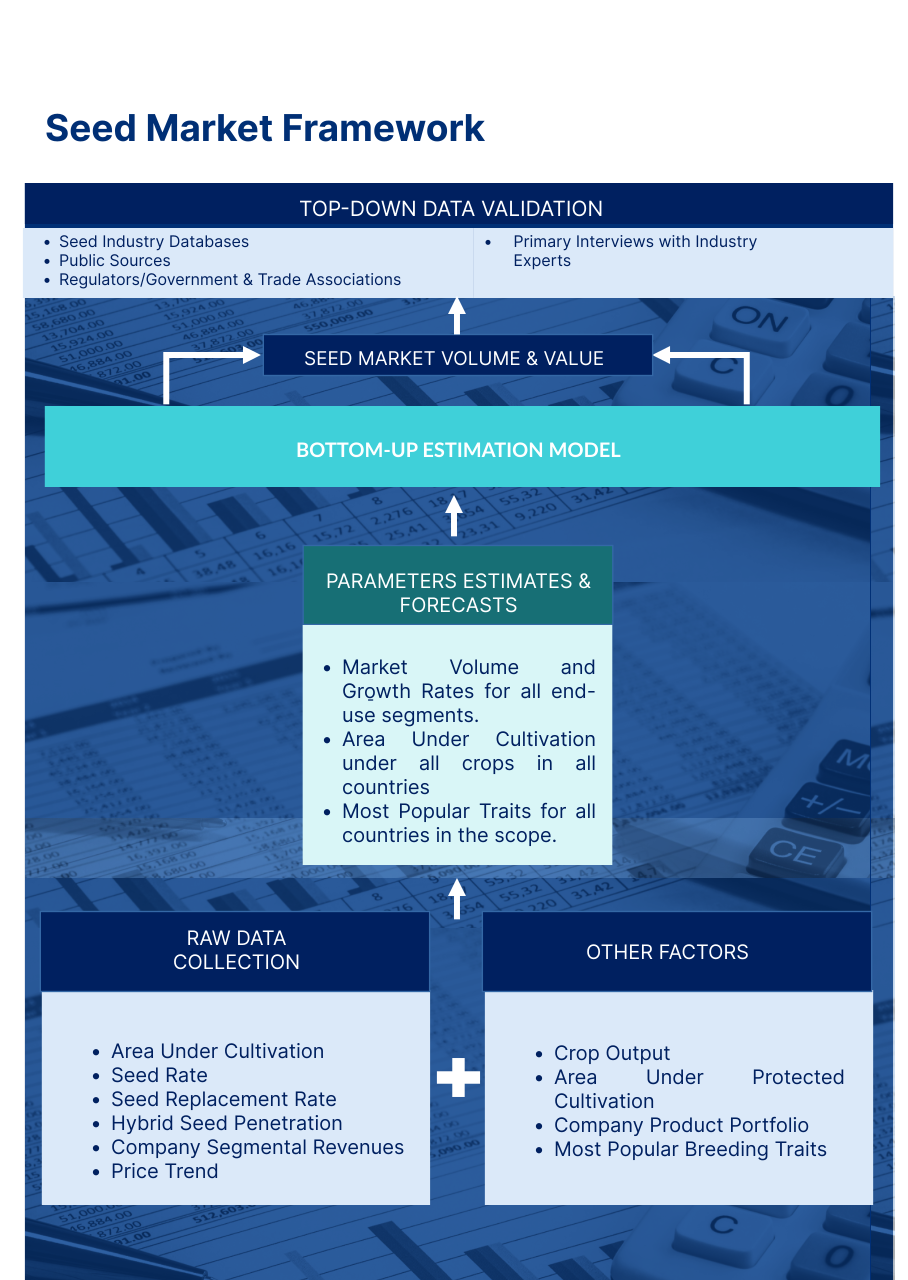
Mordor Intelligence follows a four-step methodology in all our reports.
- Step-1: IDENTIFY KEY VARIABLES: In order to build a robust forecasting methodology, the variables and factors identified in Step-1 are tested against available historical market numbers. Through an iterative process, the variables required for market forecast are set and the model is built on the basis of these variables.
- Step-2: Build a Market Model: Market-size estimations for the forecast years are in nominal terms. Inflation is not a part of the pricing, and the average selling price (ASP) is kept constant throughout the forecast period.
- Step-3: Validate and Finalize: In this important step, all market numbers, variables and analyst calls are validated through an extensive network of primary research experts from the market studied. The respondents are selected across levels and functions to generate a holistic picture of the market studied.
- Step-4: Research Outputs: Syndicated Reports, Custom Consulting Assignments, Databases, and Subscription Platforms
Get More Details On Research Methodology
Download PDF




