
Peas Market Analysis by Mordor Intelligence
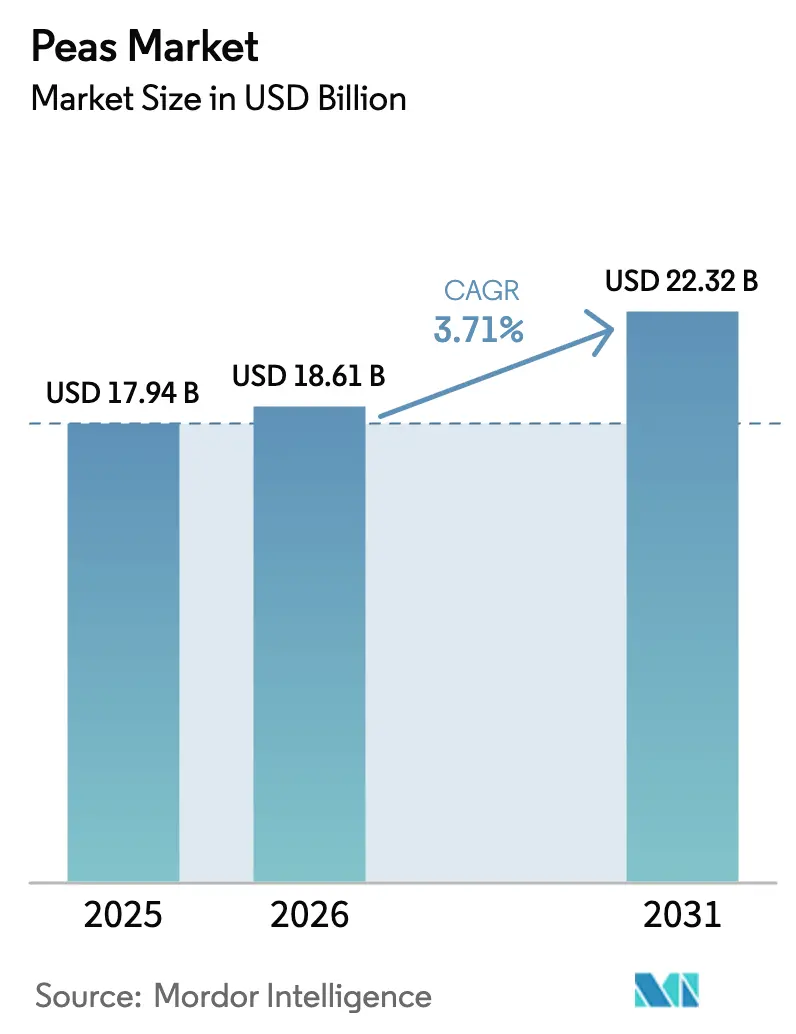
The peas market size is projected to expand from USD 17.94 billion in 2025 and USD 18.61 billion in 2026 to USD 22.32 billion by 2031, registering a CAGR of 3.71% between 2026 to 2031. Field-pea volumes previously routed through commodity feed channels are increasingly being redirected to plant-protein processors, which offer higher margins. In North America and Europe, direct hectare subsidies are supporting the recovery of domestic protein-crop acreage, reversing a two-decade decline. Trade dynamics are also undergoing significant changes. Russia has captured a substantial share of China’s 2024 pea imports, displacing Canada as the dominant supplier. This shift has led exporters to prioritize identity-preserved, non-GMO supply contracts. Additionally, on-farm artificial intelligence (AI) systems aimed at reducing harvest losses are contributing to measurable yield improvements, tightening supply-demand balances in deficit regions, thereby reducing the market's vulnerability to weather-related disruptions.
Key Report Takeaways
- By geography, North America held 31.7% of the peas market share in 2025, and Asia-Pacific is forecast to expand at a 7.4% CAGR through 2031.
Note: Market size and forecast figures in this report are generated using Mordor Intelligence’s proprietary estimation framework, updated with the latest available data and insights as of January 2026.
Global Peas Market Trends and Insights
Drivers Impact Analysis
| Driver | (~) % Impact on CAGR Forecast | Geographic Relevance | Impact Timeline |
|---|---|---|---|
| Rising demand from plant-based protein processors | +1.2% | North America and Europe | Medium term (2-4 years) |
| Feed industry reformulations favoring field peas | +0.8% | Asia-Pacific spillover to North America | Long term (≥ 4 years) |
| Government support programs for pulse crops | +1.0% | North America, Europe, and India | Short term (≤ 2 years) |
| Soil-health benefits driving crop-rotation adoption | +0.9% | Europe, North America, and Australia | Long term (≥ 4 years) |
| Emergence of certified traceable pea supply chains | +0.7% | Global, led by North America and Europe | Medium term (2-4 years) |
| On-farm AI vision systems reducing harvest losses | +0.9% | North America, Asia-Pacific, and Africa | Medium term (2-4 years) |
| Source: Mordor Intelligence | |||
Rising Demand from Plant-Based Protein Processors
Pea-protein isolate capacity is expanding faster than field-pea output, underpinning sustained premiums in the peas market. In November 2021, Roquette invested over CAD 600 million (approximately USD 450–600 million) to establish the world's largest pea protein plant in Portage la Prairie, Manitoba, Canada. The facility has the capacity to process 125,000 metric tons of yellow peas annually[1]Source: Roquette, “Investor Relations - Capacity Expansion,” roquette.com. The United States International Trade Commission's ruling insulating domestic processors from offshore isolates has funneled Canadian yellow peas into value-added channels, lifting spot prices in 2025. Collectively, these moves keep farm-gate prices upward and reinforce the growth trajectory of the peas market.
Feed Industry Reformulations Favoring Field Peas
Aquaculture and pet-food companies are displacing soybean meal with field peas to align with non-genetically modified labeling mandates. Salmon diets now include pea concentrate without compromising growth, cutting phosphorus discharge in Norway and Chile, where effluent caps tightened in 2024[2]Source: Wiley, “Alternative Protein Sources in Aquafeed,” wiley.com. Grain-free pet food formulas continue to drive steady demand for pea starch, even following regulatory clarifications by the Food and Drug Administration. These formulas are particularly popular among pet owners seeking alternatives to traditional grain-based diets, further bolstering the market for pea starch. In the European Union, livestock integrators incorporate peas to meet protein-autonomy targets, supporting stable returns for Canadian and French growers, despite a reduction in acreage between 2021 and 2023. This reformulation trend redirects pea production into premium feed, strengthening the demand base for the peas market. Additionally, the use of peas in premium feed aligns with the growing focus on sustainable, high-quality livestock nutrition, thereby contributing to the long-term stability of the market.
Government Support Programs for Pulse Crops
Direct hectare payments and margin-insurance schemes are reversing two decades of pulse-acreage decline in North America and Europe, injecting predictability into a crop historically plagued by volatile returns. Canada's AgriStability program compensates producers for 70% of margin shortfalls when reference prices fall below five-year averages, a safety net that insulated growers when yellow-pea prices dropped in 2024-25. India's National Food Security Mission for Pulses extends subsidies for certified seed, bio-fertilizers, and micro-irrigation systems, targeting a 15% increase in domestic pea production by 2027 to reduce import dependency. Together, these incentives underpin the peas market’s projected growth.
Soil-Health Benefits Driving Crop-Rotation Adoption
Biological nitrogen fixation and carbon sequestration delivered by field peas are quantifiable enough to influence rotation economics even in the absence of direct subsidies, particularly where fertilizer costs remain elevated. Peas fix 40 to 80 kilograms of nitrogen per hectare annually through symbiotic rhizobia, reducing synthetic-nitrogen applications by 30% to 50% in subsequent cereal crops and lowering input costs by USD 60 to USD 100 per hectare. Carbon sequestration of 0.5 to 1.5 metric tons of CO₂ equivalent per hectare per season positions peas as a compliance tool for growers participating in voluntary carbon markets, where credits trade at USD 15 to USD 30 per metric ton.
Restraints Impact Analysis
| Restraint | (~) % Impact on CAGR Forecast | Geographic Relevance | Impact Timeline |
|---|---|---|---|
| Pest and disease pressure | −0.8 % | North America and Europe | Short term (≤ 2 years) |
| High farm-gate price volatility | −0.6 % | Canada and Australia | Medium term (2–4 years) |
| Tightening herbicide residue limits in key import markets | −0.4 % | Europe and China, spillover to exporters | Medium term (2–4 years) |
| Limited cold-chain capacity for value-added pea products in emerging economies | −0.3 % | Sub-Saharan Africa and South Asia | Long term (≥ 4 years) |
| Source: Mordor Intelligence | |||
Pest and Disease Pressure
Ascochyta blight slashed Saskatchewan yields by 18% in 2024 despite two fungicide passes, while aphanomyces root rot can persist for 10–15 years in infested soils[3]Source: Canadian Phytopathological Society, “Ascochyta Blight Management,” phytopath.ca. Pea weevil infestations can reduce germination rates by up to 40% and may void export contracts requiring zero-tolerance thresholds. These infestations pose significant challenges for pea producers, impacting both domestic and international trade. Implementing eight-year rotation intervals and using resistant cultivars help mitigate these risks but increase opportunity costs, limiting short-term acreage expansion in the pea market. Additionally, adopting these measures requires careful planning and resource allocation, further influencing market dynamics.
High Farm-Gate Price Volatility
Canadian yellow pea prices declined by 12% between the 2023-24 and 2024-25 marketing years to an average of USD 405 per metric ton, primarily due to Russia's record harvest and its expanded market share in China. This decline reflects the competitive pressures from Russia's production and its ability to capture a larger share of the Chinese market. In 2024, Australian field pea prices fluctuated between AUD 450 (USD 292.5) and AUD 500 (USD 325) per metric ton, influenced by domestic supply conditions and global demand trends. Additionally, North American acreage is forward-contracted, leaving the majority of growers vulnerable to spot-market volatility. This exposure to price swings has hindered the growth of the peas market, as growers face challenges in managing financial risks and ensuring profitability.
Geography Analysis
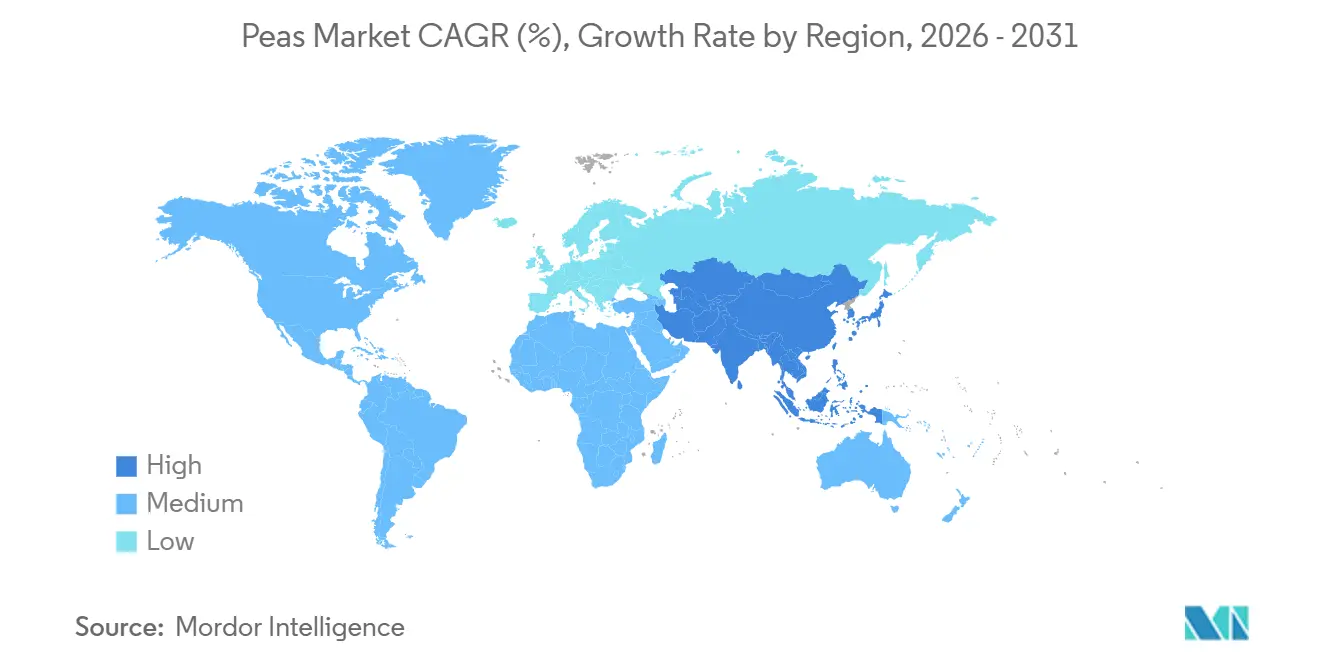
In 2025, North America accounted for 31.7% of the pea market share, driven by Canada's position as the world's second-largest exporter and the United States' increasing focus on domestic pea-protein processing. The construction of pea-protein facilities by Louis Dreyfus Company in Yorkton, Saskatchewan, and Portage la Prairie, Manitoba, during 2024-2025 highlights a strategic move toward value-added processing within production regions rather than exporting raw commodities. This development challenges Canada's traditional dominance and shifts trade flows toward Black Sea ports. Exporters face higher compliance costs due to maximum residue limits, which require discontinuing glyphosate pre-harvest desiccation. However, this also strengthens the premium positioning of traceable supply chains. The region's growth has been constrained by crop diseases such as ascochyta blight and aphanomyces root rot, which negatively impacted yields in Saskatchewan in 2024.
Asia-Pacific is the fastest-growing geography, with a 7.4% CAGR through 2031, propelled by aquaculture feed reformulation in China and India's drive to rebuild domestic pulse production. South America plays a modest role in global trade flows. In Brazil, farmers in Rio Grande do Sul are incorporating peas into wheat rotations but face challenges due to limited access to certified seeds. The integration of peas into crop rotations aims to improve soil health and diversify agricultural production. Argentina exports small volumes to the Middle East but experiences production losses due to inefficiencies in post-harvest handling, including inadequate storage facilities and outdated processing techniques.
Europe held a moderate share in the pea market. The Middle East and Africa remain net importers. United Arab Emirates and Saudi Arabia trans-ship Canadian and Australian peas to South Asia and East Africa. South Africa’s stable production feeds domestic processors, while Ethiopia and Kenya suffer post-harvest losses due to cold-chain deficits. Accelerated investment in logistics is critical for unlocking the potential of the peas market across these deficit regions. Additionally, the lack of refrigerated transport reduces processing incentives, hindering the growth of the regional peas market and limiting its competitiveness in international markets.
Get Analysis on Important Geographic Markets
Download PDF
Competitive Landscape
The peas market comprises companies such as AGT Food and Ingredients, Roquette, and Ingredion. These firms operate integrated fractionation facilities and maintain contracts with growers across various regions, ensuring a consistent supply of peas for diverse applications. Roquette's invested to establish the pea protein plant in Portage la Prairie, Manitoba, Canada. The facility has the capacity to process 125,000 metric tons of yellow peas annually. PURIS and Ingredion pursue backward integration through contracted acreage, securing non-genetically modified supply while absorbing agronomic risk previously borne by commodity traders.
Technological advancements are leading to a divided supply base. For instance, John Deere’s AI-enabled systems and Trimble’s precision-harvesting technologies enhance operational efficiency for large-scale farms in regions such as Saskatchewan, North Dakota, and Western Australia. However, these technologies remain financially inaccessible for farmers managing sub-five-hectare plots in India and Africa. Additionally, the United States' anti-dumping ruling has redirected Chinese isolate exports toward Southeast Asia and the Middle East, increasing competition in these emerging markets. Processors capable of adhering to varying residue standards, ranging from the European Union's 10 milligrams per kilogram glyphosate limit to unregulated thresholds in North America, are positioned to gain a competitive advantage.
Opportunities exist in Africa and South Asia, where significant gaps in cold-chain infrastructure result in high post-harvest losses, thereby impacting the overall efficiency and profitability of agricultural supply chains. Addressing these gaps by developing robust cold-chain systems and adopting value-added processing technologies could significantly reduce losses, improve product quality, and enable producers to capture higher margins. Furthermore, Bioceres' rhizobia inoculants offer sustainable solutions to enhance soil fertility and crop yields, while Farmers Edge's blockchain traceability platforms provide transparency and traceability across the supply chain. These innovations position emerging players to compete effectively with established incumbents by leveraging sustainability credentials, improving operational efficiency, and meeting the growing demand for traceable and sustainably produced goods.
Recent Industry Developments
- February 2026: Food Sense Wales organized a Veg Summit at Yr Egin in Carmarthen to highlight the accomplishments of the Peas Please initiative in Wales. The Peas Please initiative aims to facilitate increased vegetable consumption across the UK.
- April 2025: AAC Beyond is a notable yellow pea variety recently introduced to the commercial market by Agriculture and Agri-Food Canada (AAFC). It is designed to meet the specific requirements of growers in Western Canada. This variety is recognized for its consistently high yield and protein content, early maturity, and moderate resistance to Fusarium root rot, making it appealing to commercial growers focused on productivity and disease management.
- February 2024: The ICAR–Indian Institute of Vegetable Research, Varanasi, has developed and commercialized Kashi Tripti, a high-yielding, mid-maturity edible-podded pea variety. This development is noteworthy as Kashi Tripti is the first edible-podded pea variety introduced from Uttar Pradesh, representing a significant advancement in vegetable crop improvement within the region.
Global Peas Market Report Scope
The Peas Market Report is Segmented by Geography (North America, South America, Asia-Pacific, Europe, and More). The Report Includes Production Analysis (Volume), Consumption Analysis (Value and Volume), Import Analysis (Value and Volume), Export Analysis (Value and Volume), Wholesale Price Trend Analysis, List of Key Players, and More. The Market Forecasts are Provided in Terms of Value (USD) and Volume (Metric Tons).
By Geography
| North America | United States | Production Analysis (Area Harvested, Yield, and Production Volume) |
| Consumption Analysis (Consumption Value and Volume) | ||
| Import Market Analysis (Import Value, Volume, and Key Supplying Markets) | ||
| Export Market Analysis (Export Value, Volume, and Key Destination Markets) | ||
| Wholesale Price Trend Analysis and Forecast | ||
| Regulatory Framework | ||
| List of Key Players | ||
| Logistics and Infrastructure | ||
| Seasonality Analysis | ||
| Canada | Production Analysis (Area Harvested, Yield, and Production Volume) | |
| Consumption Analysis (Consumption Value and Volume) | ||
| Import Market Analysis (Import Value, Volume, and Key Supplying Markets) | ||
| Export Market Analysis (Export Value, Volume, and Key Destination Markets) | ||
| Wholesale Price Trend Analysis and Forecast | ||
| Regulatory Framework | ||
| List of Key Players | ||
| Logistics and Infrastructure | ||
| Seasonality Analysis | ||
| Mexico | Production Analysis (Area Harvested, Yield, and Production Volume) | |
| Consumption Analysis (Consumption Value and Volume) | ||
| Import Market Analysis (Import Value, Volume, and Key Supplying Markets) | ||
| Export Market Analysis (Export Value, Volume, and Key Destination Markets) | ||
| Wholesale Price Trend Analysis and Forecast | ||
| Regulatory Framework | ||
| List of Key Players | ||
| Logistics and Infrastructure | ||
| Seasonality Analysis | ||
| Europe | United Kingdom | Production Analysis (Area Harvested, Yield, and Production Volume) |
| Consumption Analysis (Consumption Value and Volume) | ||
| Import Market Analysis (Import Value, Volume, and Key Supplying Markets) | ||
| Export Market Analysis (Export Value, Volume, and Key Destination Markets) | ||
| Wholesale Price Trend Analysis and Forecast | ||
| Regulatory Framework | ||
| List of Key Players | ||
| Logistics and Infrastructure | ||
| Seasonality Analysis | ||
| France | Production Analysis (Area Harvested, Yield, and Production Volume) | |
| Consumption Analysis (Consumption Value and Volume) | ||
| Import Market Analysis (Import Value, Volume, and Key Supplying Markets) | ||
| Export Market Analysis (Export Value, Volume, and Key Destination Markets) | ||
| Wholesale Price Trend Analysis and Forecast | ||
| Regulatory Framework | ||
| List of Key Players | ||
| Logistics and Infrastructure | ||
| Seasonality Analysis | ||
| Germany | Production Analysis (Area Harvested, Yield, and Production Volume) | |
| Consumption Analysis (Consumption Value and Volume) | ||
| Import Market Analysis (Import Value, Volume, and Key Supplying Markets) | ||
| Export Market Analysis (Export Value, Volume, and Key Destination Markets) | ||
| Wholesale Price Trend Analysis and Forecast | ||
| Regulatory Framework | ||
| List of Key Players | ||
| Logistics and Infrastructure | ||
| Seasonality Analysis | ||
| Russia | Production Analysis (Area Harvested, Yield, and Production Volume) | |
| Consumption Analysis (Consumption Value and Volume) | ||
| Import Market Analysis (Import Value, Volume, and Key Supplying Markets) | ||
| Export Market Analysis (Export Value, Volume, and Key Destination Markets) | ||
| Wholesale Price Trend Analysis and Forecast | ||
| Regulatory Framework | ||
| List of Key Players | ||
| Logistics and Infrastructure | ||
| Seasonality Analysis | ||
| Ukraine | Production Analysis (Area Harvested, Yield, and Production Volume) | |
| Consumption Analysis (Consumption Value and Volume) | ||
| Import Market Analysis (Import Value, Volume, and Key Supplying Markets) | ||
| Export Market Analysis (Export Value, Volume, and Key Destination Markets) | ||
| Wholesale Price Trend Analysis and Forecast | ||
| Regulatory Framework | ||
| List of Key Players | ||
| Logistics and Infrastructure | ||
| Seasonality Analysis | ||
| Asia-Pacific | China | Production Analysis (Area Harvested, Yield, and Production Volume) |
| Consumption Analysis (Consumption Value and Volume) | ||
| Import Market Analysis (Import Value, Volume, and Key Supplying Markets) | ||
| Export Market Analysis (Export Value, Volume, and Key Destination Markets) | ||
| Wholesale Price Trend Analysis and Forecast | ||
| Regulatory Framework | ||
| List of Key Players | ||
| Logistics and Infrastructure | ||
| Seasonality Analysis | ||
| India | Production Analysis (Area Harvested, Yield, and Production Volume) | |
| Consumption Analysis (Consumption Value and Volume) | ||
| Import Market Analysis (Import Value, Volume, and Key Supplying Markets) | ||
| Export Market Analysis (Export Value, Volume, and Key Destination Markets) | ||
| Wholesale Price Trend Analysis and Forecast | ||
| Regulatory Framework | ||
| List of Key Players | ||
| Logistics and Infrastructure | ||
| Seasonality Analysis | ||
| Australia | Production Analysis (Area Harvested, Yield, and Production Volume) | |
| Consumption Analysis (Consumption Value and Volume) | ||
| Import Market Analysis (Import Value, Volume, and Key Supplying Markets) | ||
| Export Market Analysis (Export Value, Volume, and Key Destination Markets) | ||
| Wholesale Price Trend Analysis and Forecast | ||
| Regulatory Framework | ||
| List of Key Players | ||
| Logistics and Infrastructure | ||
| Seasonality Analysis | ||
| South America | Brazil | Production Analysis (Area Harvested, Yield, and Production Volume) |
| Consumption Analysis (Consumption Value and Volume) | ||
| Import Market Analysis (Import Value, Volume, and Key Supplying Markets) | ||
| Export Market Analysis (Export Value, Volume, and Key Destination Markets) | ||
| Wholesale Price Trend Analysis and Forecast | ||
| Regulatory Framework | ||
| List of Key Players | ||
| Logistics and Infrastructure | ||
| Seasonality Analysis | ||
| Argentina | Production Analysis (Area Harvested, Yield, and Production Volume) | |
| Consumption Analysis (Consumption Value and Volume) | ||
| Import Market Analysis (Import Value, Volume, and Key Supplying Markets) | ||
| Export Market Analysis (Export Value, Volume, and Key Destination Markets) | ||
| Wholesale Price Trend Analysis and Forecast | ||
| Regulatory Framework | ||
| List of Key Players | ||
| Logistics and Infrastructure | ||
| Seasonality Analysis | ||
| Middle East | United Arab Emirates | Production Analysis (Area Harvested, Yield, and Production Volume) |
| Consumption Analysis (Consumption Value and Volume) | ||
| Import Market Analysis (Import Value, Volume, and Key Supplying Markets) | ||
| Export Market Analysis (Export Value, Volume, and Key Destination Markets) | ||
| Wholesale Price Trend Analysis and Forecast | ||
| Regulatory Framework | ||
| List of Key Players | ||
| Logistics and Infrastructure | ||
| Seasonality Analysis | ||
| Saudi Arabia | Production Analysis (Area Harvested, Yield, and Production Volume) | |
| Consumption Analysis (Consumption Value and Volume) | ||
| Import Market Analysis (Import Value, Volume, and Key Supplying Markets) | ||
| Export Market Analysis (Export Value, Volume, and Key Destination Markets) | ||
| Wholesale Price Trend Analysis and Forecast | ||
| Regulatory Framework | ||
| List of Key Players | ||
| Logistics and Infrastructure | ||
| Seasonality Analysis | ||
| Africa | South Africa | Production Analysis (Area Harvested, Yield, and Production Volume) |
| Consumption Analysis (Consumption Value and Volume) | ||
| Import Market Analysis (Import Value, Volume, and Key Supplying Markets) | ||
| Export Market Analysis (Export Value, Volume, and Key Destination Markets) | ||
| Wholesale Price Trend Analysis and Forecast | ||
| Regulatory Framework | ||
| List of Key Players | ||
| Logistics and Infrastructure | ||
| Seasonality Analysis | ||
| Tanzania | Production Analysis (Area Harvested, Yield, and Production Volume) | |
| Consumption Analysis (Consumption Value and Volume) | ||
| Import Market Analysis (Import Value, Volume, and Key Supplying Markets) | ||
| Export Market Analysis (Export Value, Volume, and Key Destination Markets) | ||
| Wholesale Price Trend Analysis and Forecast | ||
| Regulatory Framework | ||
| List of Key Players | ||
| Logistics and Infrastructure | ||
| Seasonality Analysis | ||
| Ethiopia | Production Analysis (Area Harvested, Yield, and Production Volume) | |
| Consumption Analysis (Consumption Value and Volume) | ||
| Import Market Analysis (Import Value, Volume, and Key Supplying Markets) | ||
| Export Market Analysis (Export Value, Volume, and Key Destination Markets) | ||
| Wholesale Price Trend Analysis and Forecast | ||
| Regulatory Framework | ||
| List of Key Players | ||
| Logistics and Infrastructure | ||
| Seasonality Analysis | ||
| Kenya | Production Analysis (Area Harvested, Yield, and Production Volume) | |
| Consumption Analysis (Consumption Value and Volume) | ||
| Import Market Analysis (Import Value, Volume, and Key Supplying Markets) | ||
| Export Market Analysis (Export Value, Volume, and Key Destination Markets) | ||
| Wholesale Price Trend Analysis and Forecast | ||
| Regulatory Framework | ||
| List of Key Players | ||
| Logistics and Infrastructure | ||
| Seasonality Analysis | ||
| By Geography | North America | United States | Production Analysis (Area Harvested, Yield, and Production Volume) |
| Consumption Analysis (Consumption Value and Volume) | |||
| Import Market Analysis (Import Value, Volume, and Key Supplying Markets) | |||
| Export Market Analysis (Export Value, Volume, and Key Destination Markets) | |||
| Wholesale Price Trend Analysis and Forecast | |||
| Regulatory Framework | |||
| List of Key Players | |||
| Logistics and Infrastructure | |||
| Seasonality Analysis | |||
| Canada | Production Analysis (Area Harvested, Yield, and Production Volume) | ||
| Consumption Analysis (Consumption Value and Volume) | |||
| Import Market Analysis (Import Value, Volume, and Key Supplying Markets) | |||
| Export Market Analysis (Export Value, Volume, and Key Destination Markets) | |||
| Wholesale Price Trend Analysis and Forecast | |||
| Regulatory Framework | |||
| List of Key Players | |||
| Logistics and Infrastructure | |||
| Seasonality Analysis | |||
| Mexico | Production Analysis (Area Harvested, Yield, and Production Volume) | ||
| Consumption Analysis (Consumption Value and Volume) | |||
| Import Market Analysis (Import Value, Volume, and Key Supplying Markets) | |||
| Export Market Analysis (Export Value, Volume, and Key Destination Markets) | |||
| Wholesale Price Trend Analysis and Forecast | |||
| Regulatory Framework | |||
| List of Key Players | |||
| Logistics and Infrastructure | |||
| Seasonality Analysis | |||
| Europe | United Kingdom | Production Analysis (Area Harvested, Yield, and Production Volume) | |
| Consumption Analysis (Consumption Value and Volume) | |||
| Import Market Analysis (Import Value, Volume, and Key Supplying Markets) | |||
| Export Market Analysis (Export Value, Volume, and Key Destination Markets) | |||
| Wholesale Price Trend Analysis and Forecast | |||
| Regulatory Framework | |||
| List of Key Players | |||
| Logistics and Infrastructure | |||
| Seasonality Analysis | |||
| France | Production Analysis (Area Harvested, Yield, and Production Volume) | ||
| Consumption Analysis (Consumption Value and Volume) | |||
| Import Market Analysis (Import Value, Volume, and Key Supplying Markets) | |||
| Export Market Analysis (Export Value, Volume, and Key Destination Markets) | |||
| Wholesale Price Trend Analysis and Forecast | |||
| Regulatory Framework | |||
| List of Key Players | |||
| Logistics and Infrastructure | |||
| Seasonality Analysis | |||
| Germany | Production Analysis (Area Harvested, Yield, and Production Volume) | ||
| Consumption Analysis (Consumption Value and Volume) | |||
| Import Market Analysis (Import Value, Volume, and Key Supplying Markets) | |||
| Export Market Analysis (Export Value, Volume, and Key Destination Markets) | |||
| Wholesale Price Trend Analysis and Forecast | |||
| Regulatory Framework | |||
| List of Key Players | |||
| Logistics and Infrastructure | |||
| Seasonality Analysis | |||
| Russia | Production Analysis (Area Harvested, Yield, and Production Volume) | ||
| Consumption Analysis (Consumption Value and Volume) | |||
| Import Market Analysis (Import Value, Volume, and Key Supplying Markets) | |||
| Export Market Analysis (Export Value, Volume, and Key Destination Markets) | |||
| Wholesale Price Trend Analysis and Forecast | |||
| Regulatory Framework | |||
| List of Key Players | |||
| Logistics and Infrastructure | |||
| Seasonality Analysis | |||
| Ukraine | Production Analysis (Area Harvested, Yield, and Production Volume) | ||
| Consumption Analysis (Consumption Value and Volume) | |||
| Import Market Analysis (Import Value, Volume, and Key Supplying Markets) | |||
| Export Market Analysis (Export Value, Volume, and Key Destination Markets) | |||
| Wholesale Price Trend Analysis and Forecast | |||
| Regulatory Framework | |||
| List of Key Players | |||
| Logistics and Infrastructure | |||
| Seasonality Analysis | |||
| Asia-Pacific | China | Production Analysis (Area Harvested, Yield, and Production Volume) | |
| Consumption Analysis (Consumption Value and Volume) | |||
| Import Market Analysis (Import Value, Volume, and Key Supplying Markets) | |||
| Export Market Analysis (Export Value, Volume, and Key Destination Markets) | |||
| Wholesale Price Trend Analysis and Forecast | |||
| Regulatory Framework | |||
| List of Key Players | |||
| Logistics and Infrastructure | |||
| Seasonality Analysis | |||
| India | Production Analysis (Area Harvested, Yield, and Production Volume) | ||
| Consumption Analysis (Consumption Value and Volume) | |||
| Import Market Analysis (Import Value, Volume, and Key Supplying Markets) | |||
| Export Market Analysis (Export Value, Volume, and Key Destination Markets) | |||
| Wholesale Price Trend Analysis and Forecast | |||
| Regulatory Framework | |||
| List of Key Players | |||
| Logistics and Infrastructure | |||
| Seasonality Analysis | |||
| Australia | Production Analysis (Area Harvested, Yield, and Production Volume) | ||
| Consumption Analysis (Consumption Value and Volume) | |||
| Import Market Analysis (Import Value, Volume, and Key Supplying Markets) | |||
| Export Market Analysis (Export Value, Volume, and Key Destination Markets) | |||
| Wholesale Price Trend Analysis and Forecast | |||
| Regulatory Framework | |||
| List of Key Players | |||
| Logistics and Infrastructure | |||
| Seasonality Analysis | |||
| South America | Brazil | Production Analysis (Area Harvested, Yield, and Production Volume) | |
| Consumption Analysis (Consumption Value and Volume) | |||
| Import Market Analysis (Import Value, Volume, and Key Supplying Markets) | |||
| Export Market Analysis (Export Value, Volume, and Key Destination Markets) | |||
| Wholesale Price Trend Analysis and Forecast | |||
| Regulatory Framework | |||
| List of Key Players | |||
| Logistics and Infrastructure | |||
| Seasonality Analysis | |||
| Argentina | Production Analysis (Area Harvested, Yield, and Production Volume) | ||
| Consumption Analysis (Consumption Value and Volume) | |||
| Import Market Analysis (Import Value, Volume, and Key Supplying Markets) | |||
| Export Market Analysis (Export Value, Volume, and Key Destination Markets) | |||
| Wholesale Price Trend Analysis and Forecast | |||
| Regulatory Framework | |||
| List of Key Players | |||
| Logistics and Infrastructure | |||
| Seasonality Analysis | |||
| Middle East | United Arab Emirates | Production Analysis (Area Harvested, Yield, and Production Volume) | |
| Consumption Analysis (Consumption Value and Volume) | |||
| Import Market Analysis (Import Value, Volume, and Key Supplying Markets) | |||
| Export Market Analysis (Export Value, Volume, and Key Destination Markets) | |||
| Wholesale Price Trend Analysis and Forecast | |||
| Regulatory Framework | |||
| List of Key Players | |||
| Logistics and Infrastructure | |||
| Seasonality Analysis | |||
| Saudi Arabia | Production Analysis (Area Harvested, Yield, and Production Volume) | ||
| Consumption Analysis (Consumption Value and Volume) | |||
| Import Market Analysis (Import Value, Volume, and Key Supplying Markets) | |||
| Export Market Analysis (Export Value, Volume, and Key Destination Markets) | |||
| Wholesale Price Trend Analysis and Forecast | |||
| Regulatory Framework | |||
| List of Key Players | |||
| Logistics and Infrastructure | |||
| Seasonality Analysis | |||
| Africa | South Africa | Production Analysis (Area Harvested, Yield, and Production Volume) | |
| Consumption Analysis (Consumption Value and Volume) | |||
| Import Market Analysis (Import Value, Volume, and Key Supplying Markets) | |||
| Export Market Analysis (Export Value, Volume, and Key Destination Markets) | |||
| Wholesale Price Trend Analysis and Forecast | |||
| Regulatory Framework | |||
| List of Key Players | |||
| Logistics and Infrastructure | |||
| Seasonality Analysis | |||
| Tanzania | Production Analysis (Area Harvested, Yield, and Production Volume) | ||
| Consumption Analysis (Consumption Value and Volume) | |||
| Import Market Analysis (Import Value, Volume, and Key Supplying Markets) | |||
| Export Market Analysis (Export Value, Volume, and Key Destination Markets) | |||
| Wholesale Price Trend Analysis and Forecast | |||
| Regulatory Framework | |||
| List of Key Players | |||
| Logistics and Infrastructure | |||
| Seasonality Analysis | |||
| Ethiopia | Production Analysis (Area Harvested, Yield, and Production Volume) | ||
| Consumption Analysis (Consumption Value and Volume) | |||
| Import Market Analysis (Import Value, Volume, and Key Supplying Markets) | |||
| Export Market Analysis (Export Value, Volume, and Key Destination Markets) | |||
| Wholesale Price Trend Analysis and Forecast | |||
| Regulatory Framework | |||
| List of Key Players | |||
| Logistics and Infrastructure | |||
| Seasonality Analysis | |||
| Kenya | Production Analysis (Area Harvested, Yield, and Production Volume) | ||
| Consumption Analysis (Consumption Value and Volume) | |||
| Import Market Analysis (Import Value, Volume, and Key Supplying Markets) | |||
| Export Market Analysis (Export Value, Volume, and Key Destination Markets) | |||
| Wholesale Price Trend Analysis and Forecast | |||
| Regulatory Framework | |||
| List of Key Players | |||
| Logistics and Infrastructure | |||
| Seasonality Analysis | |||
Need A Different Region or Segment?
Customize Now
Key Questions Answered in the Report
How large is the peas market in monetary terms?
The peas market size is estimated at USD 18.61 billion in 2026 and projected to reach USD 22.32 billion by 2031.
What is the projected growth rate for peas demand?
Global demand is forecast to rise at a 3.71% CAGR from 2026 to 2031, buoyed by plant-based protein and feed reformulation trends.
Which region currently leads in peas revenue?
North America held 31.7% of peas market share in 2025, driven by Canada's export scale and United States processing investments.
Which geography is expanding fastest?
Asia-Pacific is forecast to grow at 7.4% CAGR through 2031, supported by Chinese aquaculture feed demand and India's production incentives.
How are residue regulations affecting exporters?
The European Union's 10 milligrams per kilogram glyphosate ceiling is pushing exporters to adopt non-chemical desiccation, adding USD 15-25 per metric ton in compliance costs.
Who are the top pea-protein processors?
Roquette, Yantai Shuangta, PURIS, Ingredion, and AGT Food and Ingredients collectively control the global ingredient-grade capacity.

