

Market Overview
| Study Period | 2020 - 2031 |
|---|---|
| Base Year For Estimation | 2025 |
| Forecast Data Period | 2026 - 2031 |
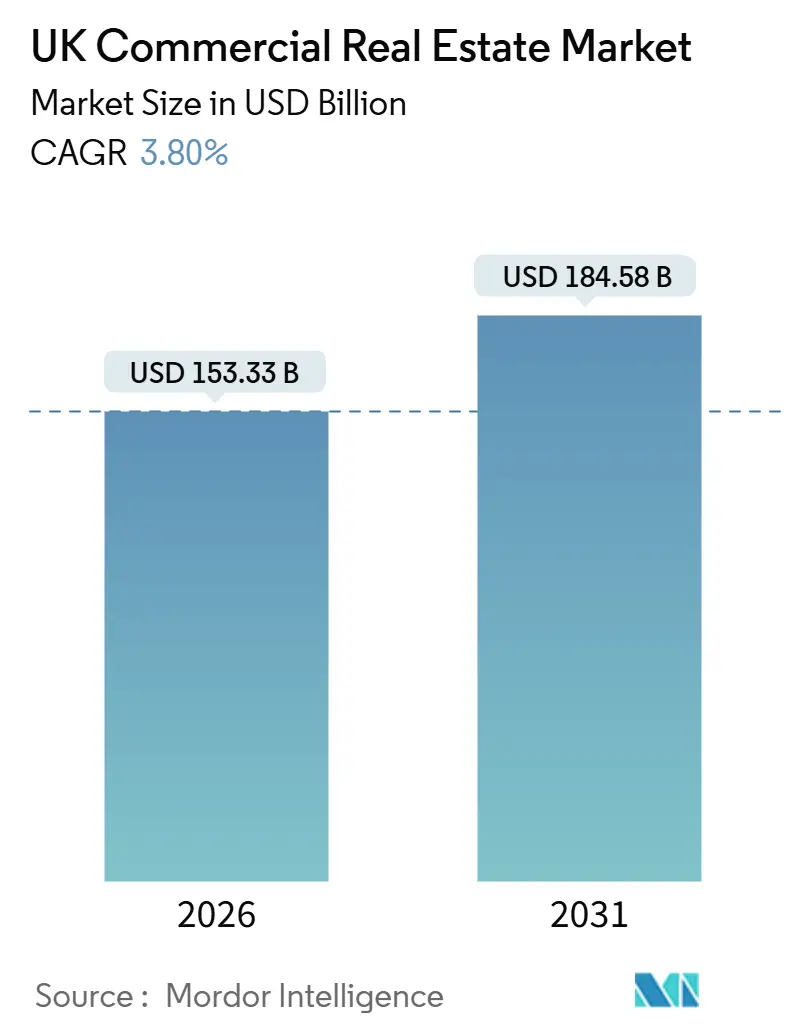
| Market Size (2026) | USD 153.33 Billion |
| Market Size (2031) | USD 184.58 Billion |
| Growth Rate (2026 - 2031) | 3.80% CAGR |
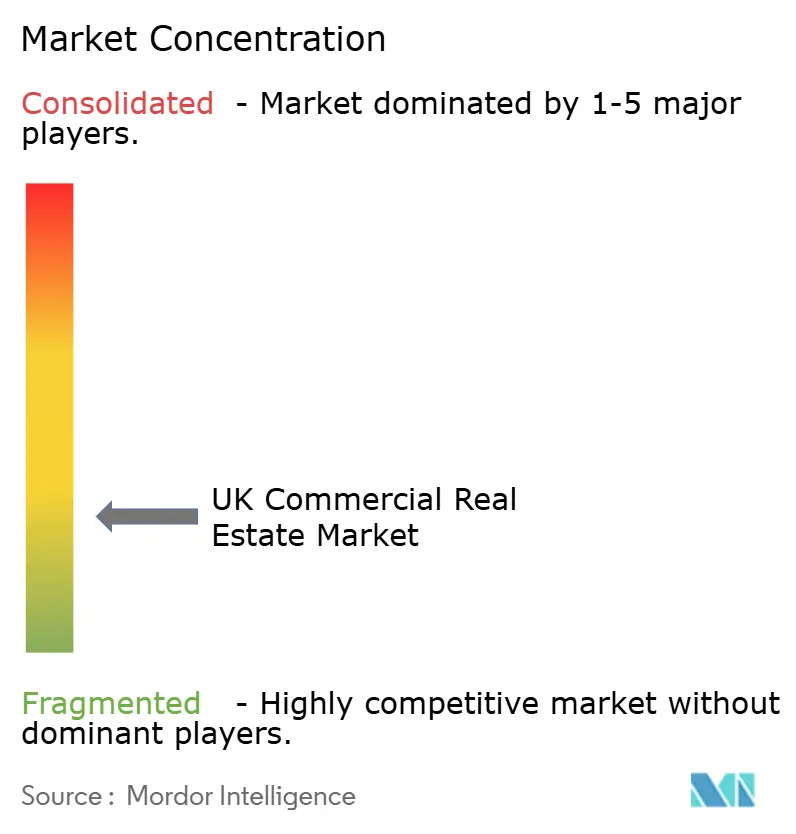
| Market Concentration | Low |
Major Players *Disclaimer: Major Players sorted in no particular order Image © Mordor Intelligence. Reuse requires attribution under CC BY 4.0. | |
UK Commercial Real Estate Market Analysis by Mordor Intelligence
The UK commercial real estate market size stands at USD 153.33 billion in 2026 and is projected to reach USD 184.58 billion by 2031, reflecting a 3.8% CAGR. Investors are pivoting toward data centers, life-sciences campuses, and last‑mile logistics, aiming for more resilient cash flows under supportive policy frameworks. The Office for Budget Responsibility projects commercial property prices to rise 11.1% in 2025, decline 1.9% in 2026, and recover 1.8% in 2027, which signals that the valuation trough after 2022’s rate shock has likely passed. The designation of data centers as Critical National Infrastructure and the creation of AI Growth Zones are reshaping capital deployment and land strategy for large platforms. Freeports and aligned investment zones are channeling fresh foreign direct investment into industrial corridors while accelerating pre‑let activity on strategic sites.[1]https://www.gov.uk/government/organisations/department-for-science-innovation-and-technology
Key Report Takeaways
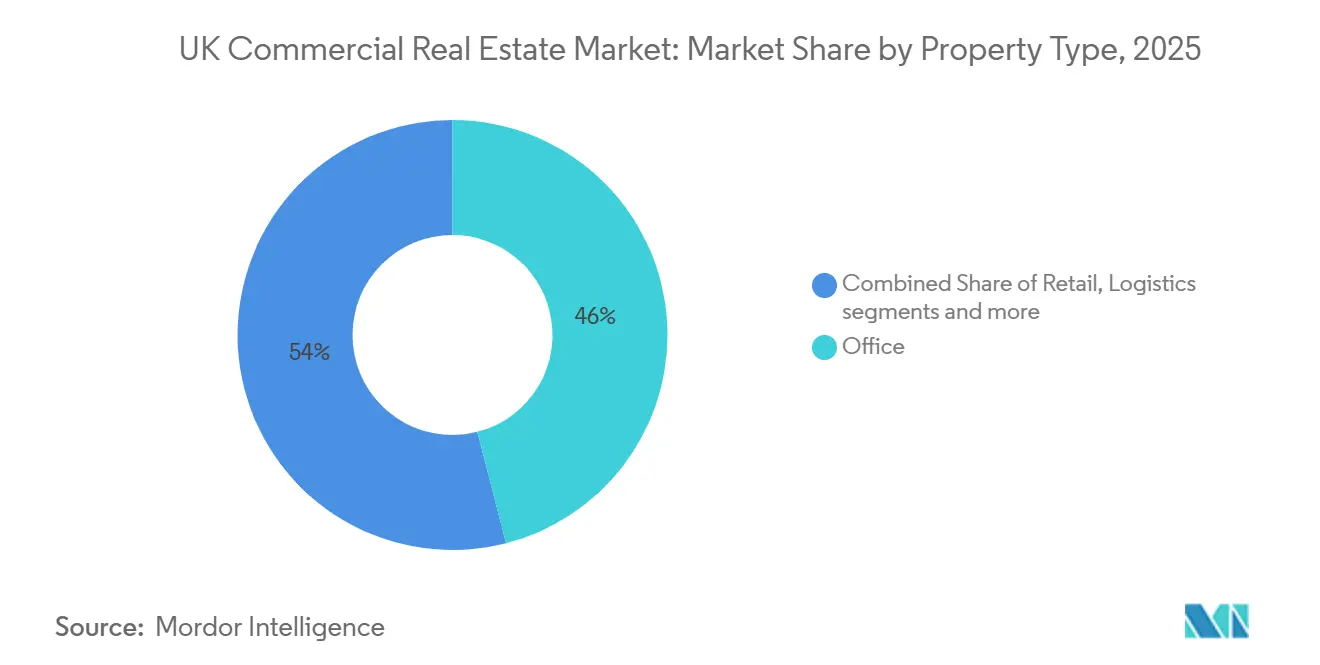
- By property type, offices led with 46% revenue share in 2025, while logistics is forecast to expand at a 4.55% CAGR through 2031.
- By business model, sales accounted for 66% in 2025, while the rental segment is projected to grow at a 4.66% CAGR to 2031.
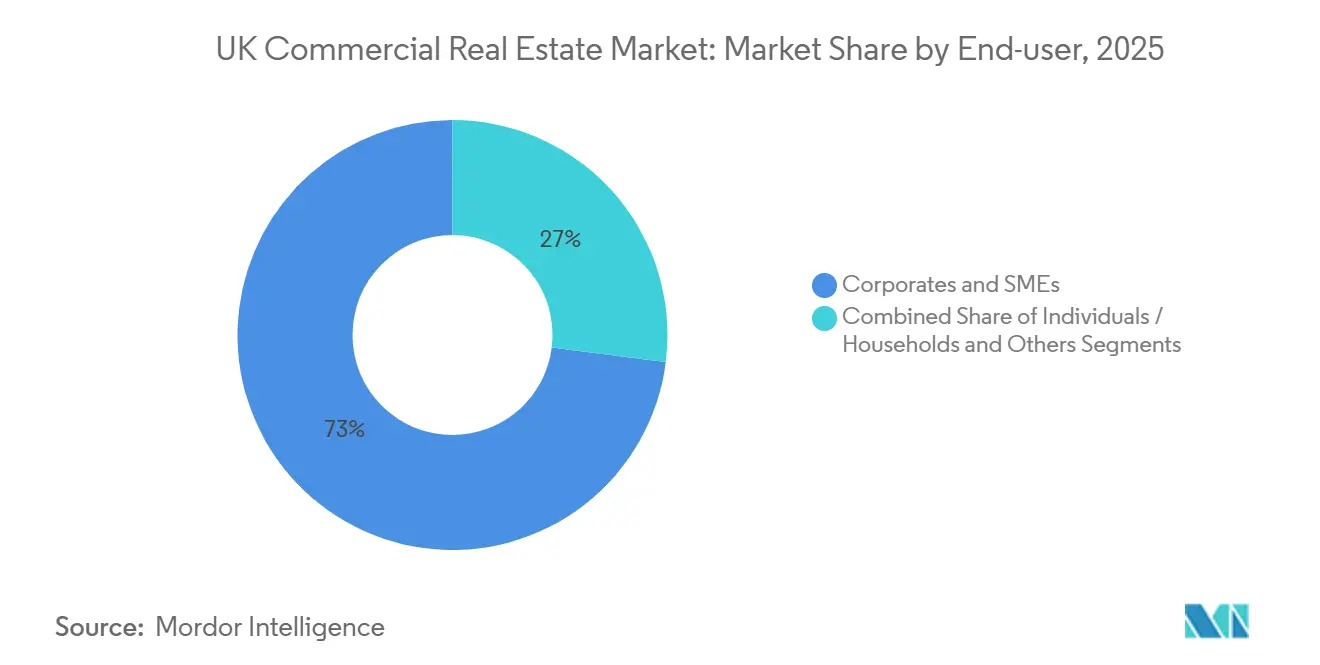
- By end‑user, corporates and SMEs represented 73% in 2025, while the individuals‑and‑households segment is expected to grow at a 4.22% CAGR to 2031.
- By region, England held a 77.33% share in 2025, while Scotland is set to post a 4.66% CAGR to 2031.
Note: Market size and forecast figures in this report are generated using Mordor Intelligence’s proprietary estimation framework, updated with the latest available data and insights as of January 2026.
UK Commercial Real Estate Market Trends and Insights
Drivers Impact Analysis
| Drivers | (~) % Impact on CAGR Forecast | Geographic Relevance | Impact Timeline |
|---|---|---|---|
| Rapid Growth of Life‑Sciences & Data‑Centre Real Estate Enabled by Government Grants | +1.2% | England (Oxford–Cambridge Arc, Culham AIGZ), South/North Wales, North East England | Long term (≥ 4 years) |
| Accelerating E‑commerce Warehousing Demand Across the UK | +0.9% | England (Southeast, Midlands), Scotland (Central Belt), Wales (M4 Corridor) | Medium term (2–4 years) |
| Freeports & Broad Tax‑Incentive Zones Catalysing Industrial Real Estate Investment | +0.8% | Humber, Thames, Solent, Liverpool City Region, East Midlands Airport, Teesside, Freeport East, Plymouth, Celtic Freeport, Inverness & Cromarty Firth | Medium term (2–4 years) |
| Rising Institutional Investor Appetite for Build-to-Rent Portfolios amid Severe Housing Shortage | +0.7% | London, Manchester, Birmingham, Edinburgh | Medium term (2–4 years) |
| Flight‑to‑Quality Toward Grade‑A, ESG‑Certified Offices Nationwide | +0.6% | London (City, West End), Manchester, Edinburgh, Glasgow | Long term (≥ 4 years) |
| Source: Mordor Intelligence | |||
Understand The Key Trends Shaping This Market
Download PDF
Rapid Growth of Life‑Sciences & Data‑Centre Real Estate Enabled by Government Grants
The government’s designation of data centers as Critical National Infrastructure and AI Growth Zones targets a tripling of AI‑capable capacity from 2 GW to 6 GW by 2030. Vantage Data Centers committed GBP 12 billion in 2025, equal to USD 15.2 billion in 2025 terms, with job creation planned at scale. SEGRO and Pure Data Centres formed a 50:50 joint venture to deliver a 56 MW West London facility with a gross capital investment of near GBP 1 billion, or USD 1.27 billion in 2025 terms, targeting a 9% to 10% unlevered net yield. The National Energy System Operator signaled 381.5 GW of ready‑to‑build grid capacity, and Ofgem set out a connections reform package to shorten timelines for projects that include data centers. These measures draw capital toward power‑rich brownfield land, where life sciences and data‑center developments now compete for the same sites in the UK commercial real estate market.[2]https://www.savills.co.uk/
Accelerating E‑commerce Warehousing Demand Across the UK
Logistics vacancy rose from 3.3% at the end of 2022 to 7.2% in Q3 2024, while rental growth forecasts moderated to 5.5% in 2024 and 3.7% in 2025. Construction starts have fallen 69% from recent peaks, which is tightening future supply and supporting prime yield resilience. Institutional capital is prioritizing pre‑let and built‑to‑suit schemes for major e‑commerce platforms, which compresses yields on Grade‑A assets. Landlords are retrofitting with on‑site solar and EV charging to meet occupier standards and secure longer terms. These conditions support a durable rental growth path in prime locations as older stock faces faster obsolescence in the UK commercial real estate market.
Freeports & Broad Tax‑Incentive Zones Catalysing Industrial Real Estate Investment
The UK’s ten Freeports have attracted GBP 6.4 billion in private investment, equal to USD 8.13 billion in 2025 terms, with 89% classified as foreign direct investment. Parliament extended the main tax‑relief window from five to ten years, which improves underwriting for new platforms and large pre‑lets. As of June 2025, 72% of Freeport tax‑site projects had secured planning permission, with clean energy leading capital deployment. The GBP 600 million Strategic Sites Accelerator, or USD 762 million in 2025 terms, is unlocking brownfield through remediation grants that de‑risk private co‑investment. These incentives are creating a visible pre‑let pipeline around ports, energy, and advanced manufacturing within the UK commercial real estate market.[3]https://www.local.gov.uk/
Flight‑to‑Quality Toward Grade‑A, ESG‑Certified Offices Nationwide
Minimum Energy Efficiency Standards require all commercial properties to achieve EPC C by April 1, 2027, and EPC B by April 1, 2030, with non‑compliance penalties proposed to increase and grace periods reduced. Many assets sit below Band C, and estimated upgrade costs often range from GBP 15,000 to GBP 80,000 per property, or USD 19,050 to USD 101,600 in 2025 terms, creating a clear advantage for newer or comprehensively refurbished buildings (GBP values shown first, USD values in brackets). Prime London office yields stabilized at 4.00% by the end of June 2025, while weaker secondary assets continued to lag. The share of companies requiring full on‑site presence increased to 48% in 2025, which adds pressure to secure Grade‑A space in core districts. Together, compliance deadlines and workplace policies are concentrating demand in best‑in‑class assets within the UK commercial real estate market.
Restraints Impact Analysis
| Restraints | (~) % Impact on CAGR Forecast | Geographic Relevance | Impact Timeline |
|---|---|---|---|
| Construction‑Material Inflation & Labour Shortage Post‑Brexit | -0.5% | National, particularly acute in London, Southeast England | Short term (≤ 2 years) |
| Tightening LTV Ratios amid Volatile Gilt Yields | -0.4% | National, with London and the Southeast most sensitive to financing conditions | Short term (≤ 2 years) |
| Persistent Retail Space Rationalisation in Secondary Cities | -0.3% | Secondary cities and towns across England, Wales, and Scotland | Medium term (2–4 years) |
| Source: Mordor Intelligence | |||
Construction‑Material Inflation & Labour Shortage Post‑Brexit
Ready‑mixed concrete sales in Great Britain fell 4.3% from Q1 2025 to Q2 2025, and were down 7.1% year‑on‑year in Q1 2025. The construction‑materials trade deficit widened 1.8% in 2024 to GBP 14,410 million, which equals USD 17,100 million in 2024 terms. The sector is set to require 251,500 additional workers by 2028, or more than 50,000 per year, which underscores the depth of the skills gap. Tender‑price inflation forecasts from Mace point to 3.5% escalation for national real estate in 2025 and 3.0% in 2026, with national infrastructure at 4.0% in both years. Developers are responding with modular methods and design‑for‑manufacture approaches to control on‑site labor exposure in the UK commercial real estate market.
Tightening LTV Ratios amid Volatile Gilt Yields
Thirty‑year gilt yields spiked to 5.75% in early September 2025, which tightened underwriting and widened debt spreads across acquisitions. Commercial real estate transactions totaled GBP 7 billion in Q3 2025, or USD 8.89 billion in 2025 terms, nearly 50% below the ten‑year quarterly average. The OBR expects a 5.2% decline in commercial property transactions in 2025, with a 1.5% improvement in 2026. Bank of England survey indicators show the share of firms citing the cost of finance as a major constraint fell from 46% in January 2024 to 38% in January 2025. As gilt curves flatten toward 2026, the UK commercial real estate market should see narrower bid‑ask spreads and more portfolio rotation.
Segment Analysis
By Property Type: Logistics Propels Growth While Offices Hold Largest Share
Offices held 46% of the UK commercial real estate market share in 2025, reflecting the depth of London’s core districts and long‑standing institutional ownership. Logistics is set to grow at a 4.55% CAGR during 2026 to 2031 as e‑commerce demand meets a constrained pipeline after a 69% drop in starts from recent highs. Prime yields for top London industrial assets have held below 5% as competition for Grade‑A space persists. Retail remains under pressure in secondary towns while prime city‑center locations in Scotland show near‑zero vacancy, illustrating a split between destination streets and struggling high streets. The UK commercial real estate market is therefore re‑weighting toward high‑quality logistics and mission‑critical alternatives.
Comparing logistics to the overall growth rate shows that this segment contributes a meaningful share of incremental value despite a smaller base, which supports a targeted allocation strategy. The UK commercial real estate market size for logistics is projected to expand in line with the 4.55% CAGR outlook through 2031 as developers commit capital to pre‑let schemes. Office outcomes are bifurcating, with Grade‑A space seeing firmer rents while older stock faces upgrade costs to meet EPC thresholds. UK hotel and hospitality assets recorded steady 2025 progress with value and revenue growth across select portfolios. Data‑center and life‑sciences assets are competing for power‑adjacent sites, reinforcing alternatives as a major leg of growth in the UK commercial real estate market.
Note: Segment shares of all individual segments available upon report purchase
Get Detailed Market Forecasts at the Most Granular Levels
Download PDF
By Business Model: Rental Segment Outpaces Sales Amid Institutional Capital Inflows
Sales represented 66% of activity in 2025, consistent with long‑term balance‑sheet ownership preferences in the UK. The rental segment is projected to grow at a 4.66% CAGR from 2026 to 2031, driven by build‑to‑rent adoption and portfolio platforms that monetize inflation‑indexed leases. Logistics landlords reported strong like‑for‑like rental income growth and sizeable uplifts on rent reviews and renewals in the first half of 2025, underscoring pricing power in core locations. The UK commercial real estate market is favoring rental‑backed cash flows in logistics and residential as funding costs normalize.
Sales activity has been constrained by volatile gilt yields, which widened debt costs and reduced transaction volumes in 2025. The OBR expects a modest recovery in transactions during 2026, which should support a gradual pick‑up in sales executions. Impact‑oriented vehicles have committed new funds for UK housing delivery, which may add pipeline for rental platforms over time. The UK commercial real estate market size tied to rental income is set to grow as portfolios scale and securitization options broaden. Portfolio owners continue to favor shorter breaks with higher base rents to balance flexibility and income durability.
By End‑user: Corporates Dominate but Households Segment Gains Momentum
Corporates and SMEs accounted for 73% of end‑user demand in 2025, reflecting their share of office, logistics, and prime retail occupancy. The individuals‑and‑households segment is forecast to grow at a 4.22% CAGR, supported by persistent rental inflation and build‑to‑rent activity in regional cities with yields above 5%. Public‑sector owners are accelerating refurbishment or disposal decisions ahead of EPC deadlines to avoid penalties and upgrade costs. Healthcare‑linked real estate has attracted inbound capital with multi‑decade lease terms and inflation‑linked rents.
Corporate leasing behavior is normalizing with more firms requiring full on‑site presence in 2025, which tightens Grade‑A availability in core submarkets. Households’ rising contribution is a function of supply shortfalls and policy targets that outstrip completion rates, which should sustain demand for institutional rental platforms. Healthcare transactions in 2025 signaled durable income streams backed by long leases and public referrals. The UK commercial real estate industry is tracking toward a mix that blends corporate demand with scaled residential rental exposure across city regions.
Note: Segment shares of all individual segments available upon report purchase
Get Detailed Market Forecasts at the Most Granular Levels
Download PDF
Geography Analysis
England is the largest geography with a 77.33% share in 2025, anchored by London’s deep office market and the South East’s logistics corridor. Prime office yields in London stabilized around 4.00% by mid‑2025, aided by tenant flight‑to‑quality and a clearer view on upgrade obligations. Logistics demand remains steady despite a slowdown in speculative starts, and developers are focusing on pre‑lets and power‑capable sites. The UK commercial real estate market continues to prioritize power, transport, and planning certainty around Greater London and the South East.
Scotland is the fastest‑growing region, projected at a 4.66% CAGR for 2026 to 2031, supported by energy transition and Freeport projects that anchor long‑term occupier demand. High‑street prime in Edinburgh shows very low vacancy and stable to firming yields, which supports refurbishment activity and cash‑flow predictability. The Inverness and Cromarty Firth Freeport has secured major manufacturing commitments that will spur adjacent logistics and supplier activity. The UK commercial real estate market in Scotland benefits from more affordable development inputs and targeted policy signals compared with saturated southern corridors.
Wales and Northern Ireland represent smaller shares but are positioned to capture spillover as AI zones and supply chains scale. Wales is preparing to leverage AI Growth Zone benefits, while Northern Ireland features in cross‑border healthcare portfolios bought by inbound investors. Freeports and investment zones across the UK have secured planning for most tax‑site projects, which supports forward funding in industrial corridors. These dynamics point to broader geographic participation in the UK commercial real estate market as policy anchors bed in and power access tightens site selection.
Competitive Landscape
The UK commercial real estate market remains fragmented, with no single owner exceeding a low single-digit share, yet consolidation is progressing among listed vehicles and private platforms. The 2025 merger between Picton Property Income and Tritax Big Box reflected a push for scale and diversified balance sheets. Platforms with lower funding costs are competitively positioned to manage MEES upgrades, finance development near power nodes, and secure large pre‑lets.
Strategic moves in 2025 concentrated on data‑center adjacency, logistics rental growth, and select office refurbishments that can hit EPC B ahead of 2030. SEGRO’s 50:50 joint venture with Pure Data Centres to build a 56 MW West London facility with around GBP 1 billion of gross capital, or USD 1.27 billion in 2025 terms, targeted a 9% to 10% unlevered net yield and a hyperscaler pre‑let. Derwent London rebalanced its capital stack with asset disposals and new unsecured debt while sequencing major refurbishments across prime West End addresses. Specialist credit investors increased exposure through floating‑rate senior loans secured by hotel portfolios with double‑digit running yields.
Inbound investors also expanded in 2025. CareTrust REIT acquired Care REIT plc for USD 840.5 million, adding 132 care homes with a 20.2‑year weighted average remaining lease term and USD 68.6 million of annualized rent. Vantage Data Centers announced GBP 12 billion of UK commitments, equal to USD 15.2 billion in 2025 terms, aligned with AI capacity targets. Large advisors and owners are piloting AI tools to streamline planning tasks such as Biodiversity Net Gain assessments, which can reduce cost and compress critical paths.
UK Commercial Real Estate Industry Leaders
Land Securities Group PLC
Segro PLC
British Land Company PLC
Tritax Big Box REIT plc
LondonMetric Property plc
- *Disclaimer: Major Players sorted in no particular order
Need More Details on Market Players and Competitors?
Download PDF
Recent Industry Developments
- July 2025: Covivio’s UK hotel portfolio grew revenue 9.6% like‑for‑like and saw yields move from 5.3% in 2024 to 5.5% in H1 2025, with RevPAR up 2.5% year‑on‑year at end‑May.
- June 2025: Real Estate Credit Investments reported FY 2025 net profit of GBP 22.8 million, equal to USD 29.0 million, and total assets of GBP 391.7 million, equal to USD 497.5 million, reinvesting into floating‑rate senior loans with running yields above 12%.
- April 2025: SEGRO signed a new EUR 1.6 billion revolving credit facility with an initial five‑year tenor, equal to USD 1.73 billion in 2025 terms, to back expansion and data‑center investments.
- February 2025: Derwent London signed a GBP 115 million unsecured loan facility, equal to USD 146.1 million in 2025 terms, and managed approaching maturities while planning USD‑scaled capex for 2025 onwards.
Research Methodology Framework and Report Scope
Market Definitions and Key Coverage
Our study defines the United Kingdom commercial real estate (CRE) market as the gross value generated each year from the sale or rental of income-producing built assets, offices, retail facilities, logistics and industrial sheds, hospitality venues, and other specialized properties, situated within UK territory and expressed in constant 2024 US dollars. We treat capital improvements to existing stock as part of the asset value once delivered.
Scope Exclusion: Pure-play residential dwellings, raw land trades, and fee-based brokerage or facilities-management services lie outside this estimate.
Segmentation Overview
- By Property Type
- Offices
- Retail
- Logistics
- Others (industrial real estate, hospitality real estate, etc.)
- By End-user
- Individuals / Households
- Corporates & SMEs
- Others
- By Region
- England
- Wales
- Scotland
- Northern Ireland
Detailed Research Methodology and Data Validation
Primary Research
We validate desk findings through structured conversations with asset managers, REIT finance heads, regional developers, valuers, and prop-tech operators across England, Scotland, Wales, and Northern Ireland. These interactions clarify gray areas such as typical lease lengths, grade-A yield premiums, refurbishment cost inflation, and emerging demand pockets, letting us fine-tune model drivers.
Desk Research
Mordor analysts first map the national asset base through tier-1 public sources such as the Office for National Statistics construction output tables, HM Land Registry price paid data, HMRC stamp-duty receipts, and Bank of England commercial property lending series. Trend indicators are supplemented by trade bodies, British Property Federation reports on investment flows, UK Warehousing Association vacancy audits, Royal Institution of Chartered Surveyors sentiment surveys, and Planning Portal pipeline filings. Company filings drawn from D&B Hoovers, news streams from Dow Jones Factiva, and Questel patent insights on smart-building tech provide firm-level color that sharpens sector splits. The sources cited are illustrative, not exhaustive; numerous additional data sets underpin our desk work.
Market-Sizing and Forecasting
The market baseline is anchored through a top-down flow. We rebuild gross asset value by layering annual investment volumes onto MSCI/ONS capital-value indices, adjusting for stock turnover and obsolescence. Select bottom-up checks, portfolio roll-ups of listed landlords multiplied by fair-value factors, test the totals before adjustments. Key variables include net initial yields, prime vacancy rates, construction-cost inflation, e-commerce penetration, and real GDP. A multivariate regression with ARIMA error-correction projects each driver, while scenario analysis gauges upside from accelerated EPC retrofits. Gaps in granular stock data are bridged with region-specific vacancy and yield matrices derived from survey responses.
Data Validation and Update Cycle
Outputs pass a two-step analyst peer review, then a senior sign-off that flags anomalies against independent indices and lender benchmarks. Models refresh annually; interim updates trigger when material events shift any core driver. Before delivery, an analyst reruns the numbers so clients always receive the latest calibrated view.
Why Mordor's UK Commercial Real Estate Baseline Delivers Decision-Ready Clarity
Published estimates differ because firms mix property classes, apply dissimilar yield assumptions, or freeze models for years while exchange rates and inflation march on. By ring-fencing strictly income-earning assets, indexing values to constant-currency 2024 dollars, and refreshing each year, Mordor Intelligence minimizes those distortions.
Key gap drivers include: some publishers fold large residential conversion pipelines into CRE, others gross up raw transaction volumes without adjusting for unsold inventory, and several rely on partial REIT samples rather than economy-wide metrics. Our discipline around scope, annual refresh cadence, and dual-path (top-down corroborated by selective bottom-up) testing keeps our figures balanced and reproducible.
Benchmark comparison
| Market Size | Anonymized source | Primary gap driver |
|---|---|---|
| USD 148.80 B (2025) | Mordor Intelligence | - |
| USD 255.00 B (2024) | Global Consultancy A | Includes residential conversions; uses nominal GBP with no constant-currency deflator |
| USD 295.00 B (2023) | Industry Association B | Grosses transaction volumes into value; counts owner-occupied corporate premises |
| USD 219.80 B (2023) | Trade Journal C | Extrapolates nationwide from limited REIT filings; broad vacancy discount |
These comparisons show that while others swing wider, Mordor's disciplined selection of scope and annually refreshed variables yields a transparent, traceable baseline managers can rely on for strategic decisions.
Need A Different Region or Segment?
Customize Now
Key Questions Answered in the Report
What is the current size and 2031 outlook for the UK commercial real estate market?
The UK commercial real estate market size is USD 153.33 billion in 2026 and is projected to reach USD 184.58 billion by 2031 at a 3.8% CAGR.
Which property type is growing fastest in the UK commercial real estate market?
Logistics is forecast to expand at a 4.55% CAGR from 2026 to 2031 as e-commerce demand meets a constrained pipeline and pre-let development models strengthen.
How do policy initiatives affect the UK commercial real estate market in 2026?
Data centre designations, AI Growth Zones, and Freeports are unlocking investment, speeding grid connections, and supporting pre-lets across industrial and alternative segments.
Which region leads and which is growing fastest in the UK commercial real estate market?
England leads with a 77.33% share, while Scotland is projected to grow fastest at a 4.66% CAGR through 2031 based on energy transition and Freeport activity.
How are financing conditions influencing transactions in the UK commercial real estate market?
Thirty year gilt volatility pushed up debt costs, which reduced 2025 volumes, but forecasts indicate a modest recovery in 2026 as yield curves stabilize.
What types of assets are attracting the most capital in the UK commercial real estate market?
Data centers, life sciences campuses, last mile logistics, and high quality Grade A offices are drawing the most capital due to policy support and resilient occupier demand.


