

Market Overview
| Study Period | 2017 - 2028 |
|---|---|
| Base Year For Estimation | 2023 |
| Forecast Data Period | 2024 - 2028 |
| Market Size (2024) | USD 442.17 Million |
| Market Size (2028) | USD 552.91 Million |
| Growth Rate (2024 - 2028) | 5.75% CAGR |
| Market Concentration | Low |
Major Players
*Disclaimer: Major Players sorted in no particular order Image © Mordor Intelligence. Reuse requires attribution under CC BY 4.0. |
|

South Africa Adhesives Market Analysis by Mordor Intelligence
The South Africa Adhesives Market size is estimated at 442.17 million USD in 2024, and is expected to reach 552.91 million USD by 2028, growing at a CAGR of 5.75% during the forecast period (2024-2028).
The South African adhesive industry is experiencing a significant transformation driven by increasing environmental consciousness and regulatory pressures. Manufacturers are progressively shifting towards sustainable adhesives, with water-borne adhesives gaining prominence due to their lower volatile organic compound (VOC) emissions and reduced environmental impact. This transition is particularly evident in the industrial sector, where companies are investing in research and development to create sustainable alternatives. The government's commitment to environmental protection has further accelerated this trend, leading to increased adoption of green technologies and sustainable manufacturing practices across the adhesives sector.
The market is witnessing substantial infrastructure development initiatives, supported by the government's announcement of a USD 45.3 billion investment plan for infrastructure development. This comprehensive development strategy encompasses various construction projects, including the development of smart cities and urban renewal programs. The construction sector's revival is further evidenced by the 24.8% year-over-year increase in registered building plans to ZAR 8.3 million, demonstrating strong growth potential for adhesive applications in construction-related activities.
The rapid digitalization of South Africa's retail landscape has created new opportunities in the adhesive market, particularly in the packaging sector. With e-commerce sales surpassing USD 1.8 billion, there is an increasing demand for innovative packaging solutions that require advanced adhesive technologies. This growth is complemented by the expansion of the consumer electronics segment, which is projected to reach USD 1,467 million, driving demand for specialized electronic adhesives and bonding agents. The market is also seeing significant technological advancements in adhesive formulations to meet the evolving needs of electronic device manufacturers.
Industry consolidation through strategic acquisitions and partnerships is reshaping the competitive landscape. Major manufacturers are expanding their presence through local partnerships and acquisitions, as exemplified by recent strategic moves in the market. The industry's manufacturing base, concentrated in key industrial hubs like Durban and KwaZulu-Natal, is undergoing modernization with investments in advanced manufacturing capabilities. Companies are increasingly focusing on research and development to create innovative solutions that address specific market needs while maintaining competitive advantages in terms of performance and cost-effectiveness.
South Africa Adhesives Market Trends and Insights
Plastic packaging with nearly 79% of the overall production will dominate the packaging industry
- The demand for quick and on-the-go packaged items is increasing due to consumers' busier lifestyles, greater spending power, and related factors. In today's competitive FMCG market, it has become inevitable for companies to use attractive packaging and offer innovation in their packaging to stand out from their competitors and maintain their brand in the market. Consumers and manufacturers prefer paper and paperboard packaging instead of plastic packaging. This factor is likely to result in increased use of paper-based packaging and its adhesive usage. In 2021, paper and paperboard packaging accounted for 21% of total packaging, amounting to 9.7 million tonnes of packaging, and it is expected to register a growth of 3.83% during the forecast period.
- Due to the COVID-19 pandemic, the country-wide lockdowns and temporary shutdown of manufacturing facilities caused several issues, including disruptions in supply chains and import and export trade. As a result, the country's packaging production registered a stagnant growth of 0.91% in 2020 compared to the previous year, significantly affecting the market. Packaging production is majorly driven by plastic in the country, which accounted for 36.2 million ton or around 79% of the packaging produced in 2021. With the advancement of plastic recyclability, the plastic segment is likely to maintain its growth and register a 3.17% CAGR during the forecast period.
- The growing interest in public health issues during the post-pandemic period, along with the emerging e-commerce activities across the nation, is likely to boost the growth of the food processing industry, which will further drive packaging demand over the coming years.

Understand The Key Trends Shaping This Market
Download PDF
Growing popularity of electric vehicles will proliferate automotive production
- The South African automotive sector comprises 22 businesses that manufacture cars and commercial vehicles. Among these are seven major vehicle manufacturers/assemblers [car and LCV] and several medium and heavy commercial vehicle assemblers [MCV, HCV, and buses]. In addition, 21 enterprises are involved in importing and distributing new automobiles in the country. There are over 500 automotive component suppliers, with 180 being first-tier suppliers. BMW, Ford, Isuzu, Mercedes-Benz, Nissan, Toyota, and Volkswagen are the primary drivers of the value chain. These firms significantly impact the economy of Gauteng, the Eastern Cape, and KwaZulu-Natal. These OEMs, together with their suppliers, are at the heart of the three regional clusters, and their socioeconomic contribution is critical to the social upliftment of these areas.
- In 2019, the country recorded about 6,31,921 units of vehicles produced, which drastically reduced to 4,47,213 units in 2020, accounting for a decline of about 29% owing to the COVID-19 pandemic. Due to this, the variation in automotive production between 2019 and 2021 was about -21%, whereas the variation between 2020 and 2021 was recorded at about 12%.
- Over the years, the use of internal combustion engine (ICE) vehicles has contributed significantly to problems such as climate change, environmental pollution, and increased cost of gas. The automotive industry in South Africa is among the highest CO2 emitters, responsible for approximately 20% of total emissions and the third highest contributor to air pollution. Owing to this, the industry has adopted alternatives such as EVs due to their simplicity and technological advancements, which ensure low emissions.

Understand The Key Trends Shaping This Market
Download PDF
OTHER KEY INDUSTRY TRENDS COVERED IN THE REPORT
- Rapid growth of civil aviation to boost the aircraft component production
- Import dependency will likely flatten the growth of footwear production
- Government initiatives for residential projects to escalate construction works
- Import dependency and lower consumption rate to flatten the growth of furniture production
Segment Analysis: End User Industry
Packaging Segment in South Africa Adhesives Market
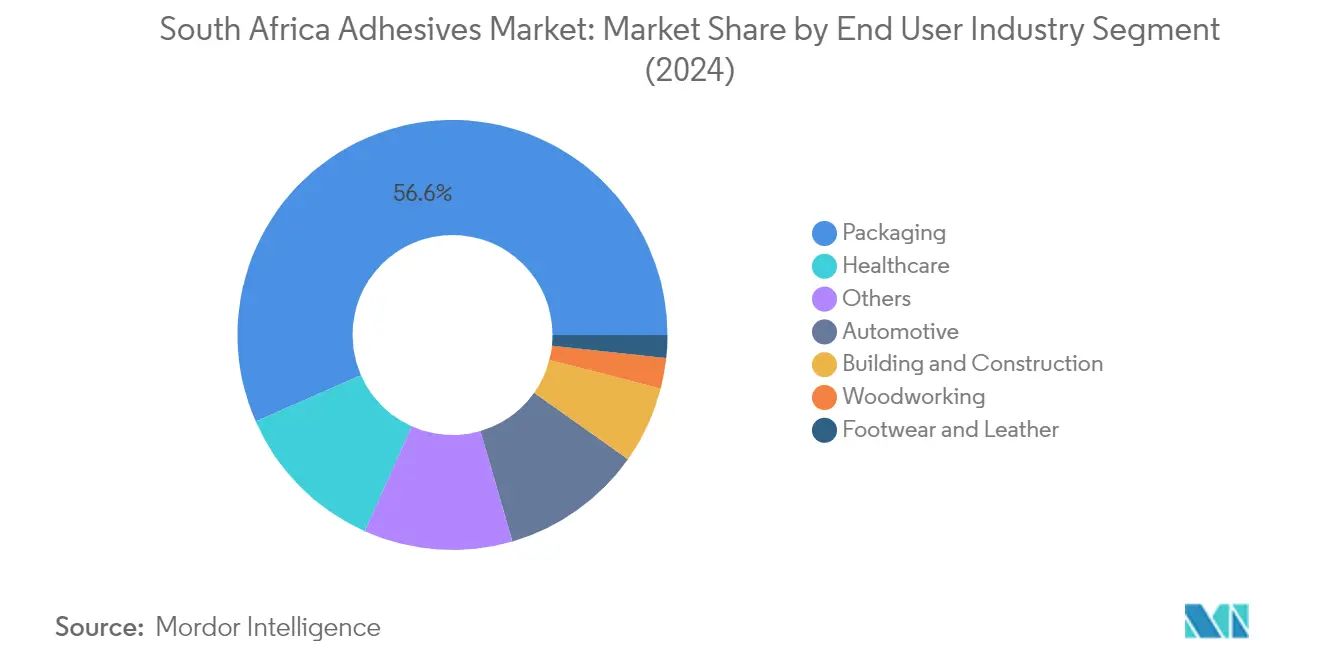
The packaging adhesives segment dominates the South African adhesives market, commanding approximately 57% of the total market share in 2024. This significant market position is primarily driven by the extensive use of adhesives in various packaging applications, including labels, tapes, carton sealing and joining, and labeling. The segment's dominance is further strengthened by the growing e-commerce sector in South Africa, which has led to increased demand for packaging solutions. The packaging industry's preference for water-borne adhesives, particularly in food packaging applications through emulsion and dispersion systems, has contributed to its market leadership. Additionally, the segment benefits from the rising adoption of flexible packaging solutions and the increasing focus on sustainable packaging materials.
Aerospace Segment in South Africa Adhesives Market
The aerospace adhesives segment is emerging as the fastest-growing sector in the South African adhesives market, projected to grow at approximately 8% CAGR during 2024-2029. This remarkable growth is attributed to South Africa's position as the most influential nation in the African aerospace sector, with over 120 state-owned and privately held domestic aerospace enterprises. The segment's growth is fueled by increasing demand for aerospace adhesives in manufacturing satellite systems, UAVs, airplanes, and complete aircraft. The country's unique position as a supplier of parts and components to major aerospace firms like Boeing and Airbus further drives the demand for specialized adhesives. The growth is also supported by government-private partnerships and research universities active in the aerospace sector, particularly through initiatives like the National Aerospace Centre at the University of Witwatersrand in Johannesburg.
Remaining Segments in End User Industry
The other segments in the South African adhesives market include automotive, healthcare, building and construction, woodworking and joinery, and footwear and leather industries. The automotive adhesives sector maintains a significant presence due to the country's position as a major automotive manufacturing hub in Africa. The healthcare segment is driven by increasing demand for medical adhesives in medical device assembly and packaging applications. The building and construction sector's demand is influenced by infrastructure development projects and green building initiatives. The woodworking and joinery segment caters to the furniture manufacturing industry, while the footwear and leather segment serves the country's growing footwear manufacturing sector. Each of these segments contributes uniquely to the market's diversity and overall growth.
Segment Analysis: Technology
Water-borne Segment in South African Adhesives Market
Water-borne adhesives have emerged as the dominant technology segment in the South African adhesives market, commanding approximately 35% of the total market value in 2024. This significant market position is attributed to their environmentally friendly nature and lower volatile organic compound (VOC) emissions compared to traditional alternatives. The segment's leadership is further strengthened by its widespread adoption in the packaging adhesives industry, particularly in food packaging applications through emulsion and dispersion systems. Water-borne adhesives are increasingly preferred by manufacturers as they help keep operational costs low and maintain higher production capacities, primarily due to their exemption from specialized permits and handling charges that are typically required for other adhesive technologies.
Hot Melt Segment in South African Adhesives Market
The hot melt adhesives segment is demonstrating remarkable growth potential in the South African market, particularly in packaging, disposable hygiene products, automotive, and bookbinding applications. This growth trajectory is driven by the segment's fast processing capabilities and environmentally friendly properties. Available in both low and high-temperature versions, these adhesives offer versatile applications - from bonding heat-sensitive materials at 121°C to creating stronger bonds at 193°C for automotive and construction applications. The segment's expansion is further supported by its increasing adoption in energy-efficient applications and the rising demand from end-use industries seeking sustainable adhesive solutions.
Remaining Segments in Technology
The South African adhesives market encompasses several other important technology segments including reactive, solvent-borne, and UV cured adhesives. Reactive adhesives play a crucial role in applications requiring substantial permanency and high-strength adherence, particularly in high-tech devices and automotive applications. Solvent-borne adhesives maintain their significance in specific industrial applications despite environmental concerns, while UV cured adhesives are gaining traction in specialized applications due to their rapid curing properties and efficiency. Each of these segments serves distinct market needs and continues to evolve with technological advancements and changing industry requirements.
Segment Analysis: Resin
Polyurethane Segment in South African Adhesives Market
The polyurethane segment has emerged as the dominant force in South Africa's adhesives market, commanding approximately 22% of the total market value in 2024. This significant market position can be attributed to polyurethane adhesives' superior adhesion properties at low temperatures, particularly in the -40°C range, making them ideal for various industrial applications. The segment's leadership is further strengthened by its extensive use in the automotive industry for manufacturing vehicle doors and instrument panels, as well as in construction applications where high bond strength and flexibility are crucial. Polyurethane adhesives have gained particular traction in South Africa due to their versatility in bonding different materials, including foils, films, and elastomers, while offering excellent resistance to environmental factors.
VAE/EVA Segment in South African Adhesives Market
The VAE/EVA segment is demonstrating remarkable growth potential in the South African adhesives market, with projections indicating an upward trajectory of approximately 7% through 2024-2029. This growth is primarily driven by the segment's increasing adoption in packaging applications, where these adhesives are widely used in paper bags, pouches, sacks, envelopes, and corrugated boards. The segment's expansion is further supported by its ability to function across a wide temperature range, from -40°F to 160°F, making it highly versatile for various applications. The growth is also attributed to the increasing demand in construction applications, particularly in bonding edges to panels on edge banding machines, profile laminating, and cabinet assembly.
Remaining Segments in Resin
The South African adhesives market encompasses several other significant resin segments, including acrylic, cyanoacrylate, epoxy, and silicone adhesives, each serving specific industrial needs. Acrylic adhesives have established a strong presence in building construction and automotive applications, particularly for exterior use. Cyanoacrylate adhesives have found their niche in the healthcare and electronics industries, offering rapid bonding capabilities. Epoxy adhesives continue to be crucial in structural applications, providing high bond strength properties. Silicone adhesives have carved out their space in applications requiring high temperature resistance and flexibility, particularly in automotive and construction sectors. These segments collectively contribute to the market's diversity and cater to specific application requirements across various industries.
Competitive Landscape
Top Companies in South Africa Adhesives Market
The South African adhesives market features prominent players like Henkel AG & Co. KGaA, Avery Dennison Corporation, Arkema Group, H.B. Fuller Company, and Permoseal (Pty) Ltd leading the industry. Companies are increasingly focusing on developing sustainable and eco-friendly adhesive technologies, particularly targeting low VOC emissions and improved performance characteristics. Product innovation efforts are centered around specialized adhesives for emerging applications in the automotive, electronics, and packaging sectors. Operational agility is demonstrated through investments in local manufacturing facilities and distribution networks to ensure reliable supply chains. Strategic partnerships and licensing agreements with global technology providers are becoming common to enhance product portfolios and market reach. Companies are also expanding their presence through acquisitions of local players to strengthen their distribution channels and customer base in the region.
Mix of Global and Local Players
The South African adhesive industry exhibits a fragmented structure with a balanced mix of multinational corporations and local manufacturers. Global conglomerates like Henkel and Dow leverage their extensive R&D capabilities and international experience to maintain market positions, while local players such as Permoseal and UNIKEM Group capitalize on their understanding of regional requirements and established distribution networks. The market demonstrates moderate consolidation, with the top five companies collectively holding a significant market share, though numerous smaller players serve specific niches or regional markets.
The industry has witnessed increased merger and acquisition activity, particularly with global players acquiring local companies to strengthen their market presence. These strategic moves are driven by the desire to gain immediate access to established distribution channels, local manufacturing facilities, and customer relationships. Companies are also forming strategic alliances and joint ventures to combine technological expertise with local market knowledge, creating more competitive offerings for the South African market.
Innovation and Sustainability Drive Future Success
Success in the South African adhesives market increasingly depends on companies' ability to develop innovative, sustainable solutions while maintaining cost competitiveness. Market leaders are investing in research and development to create adhesives that meet evolving industry requirements, particularly in high-growth sectors like packaging and automotive. Companies are also focusing on strengthening their distribution networks and technical support services to enhance customer relationships and market penetration. The ability to offer customized solutions for specific applications while maintaining operational efficiency will be crucial for maintaining competitive advantage.
For new entrants and smaller players, success lies in identifying and serving underserved market segments or specialized applications. Companies need to focus on developing eco-friendly products to align with growing environmental consciousness and potential future regulations. Building strong relationships with key end-user industries and offering comprehensive technical support services will be essential for market growth. The increasing focus on local manufacturing and supply chain resilience presents opportunities for companies to establish or expand their production facilities in South Africa, while also considering potential regulatory changes regarding VOC emissions and environmental standards. Additionally, the presence of epoxy manufacturers in South Africa offers further opportunities for innovation and market expansion.
South Africa Adhesives Industry Leaders
-
Arkema Group
-
AVERY DENNISON CORPORATION
-
H.B. Fuller Company
-
Henkel AG & Co. KGaA
-
Permoseal (Pty) Ltd
- *Disclaimer: Major Players sorted in no particular order

Need More Details on Market Players and Competitors?
Download PDF
Recent Industry Developments
- July 2022: Arkema closed the acquisition of Permoseal, a pioneer in adhesive solutions for DIY, packaging, and construction, and enhanced its presence in South Africa.
- March 2022: Bostik signed an agreement with DGE for distribution throughout Europe, Middle East & Africa. The agreement includes Born2BondTM engineering adhesives developed for 'by-the-dot' bonding applications in specific industries, such as automotive, electronics, luxury packaging, medical devices, and MRO.
- December 2021: Under the Nuplaviva brand, Arkema introduced a new range of disposable hygiene adhesive solutions formulated with bio-based renewable content.
South Africa Adhesives Market Report Scope
Aerospace, Automotive, Building and Construction, Footwear and Leather, Healthcare, Packaging, Woodworking and Joinery are covered as segments by End User Industry. Hot Melt, Reactive, Solvent-borne, UV Cured Adhesives, Water-borne are covered as segments by Technology. Acrylic, Cyanoacrylate, Epoxy, Polyurethane, Silicone, VAE/EVA are covered as segments by Resin.
End User Industry
| Aerospace |
| Automotive |
| Building and Construction |
| Footwear and Leather |
| Healthcare |
| Packaging |
| Woodworking and Joinery |
| Other End-user Industries |
Technology
| Hot Melt |
| Reactive |
| Solvent-borne |
| UV Cured Adhesives |
| Water-borne |
Resin
| Acrylic |
| Cyanoacrylate |
| Epoxy |
| Polyurethane |
| Silicone |
| VAE/EVA |
| Other Resins |
| End User Industry | Aerospace |
| Automotive | |
| Building and Construction | |
| Footwear and Leather | |
| Healthcare | |
| Packaging | |
| Woodworking and Joinery | |
| Other End-user Industries | |
| Technology | Hot Melt |
| Reactive | |
| Solvent-borne | |
| UV Cured Adhesives | |
| Water-borne | |
| Resin | Acrylic |
| Cyanoacrylate | |
| Epoxy | |
| Polyurethane | |
| Silicone | |
| VAE/EVA | |
| Other Resins |
Need A Different Region or Segment?
Customize Now
Market Definition
- End-user Industry - Building & Construction, Packaging, Automotive, Aerospace, Woodworking & Joinery, Footwear & Leather, Healthcare, and Others are the end-user industries considered under the adhesives market.
- Product - All adhesive products are considered in the market studied
- Resin - Under the scope of the study, resins like Polyurethane, Epoxy, Acrylic, Cyanoacrylate, VAE/EVA, and Silicone are considered
- Technology - For the purpose of this study, Water-borne, Solvent-borne, Reactive, Hot Melt, and UV Cured adhesive technologies are taken into consideration.
| Keyword | Definition |
|---|---|
| Hot-melt Adhesive | Hot melt adhesives are generally 100% solid formulations, based on thermoplastic polymers. They are solid at room temperature and are activated upon heating above their softening point, at which stage they are liquid, and hence, can be processed. |
| Reactive Adhesive | A reactive adhesive is made up of monomers that react in the adhesive curing process and do not evaporate from the film during use. Instead, these volatile components become chemically incorporated into the adhesive. |
| Solvent-borne Adhesive | Solvent-borne adhesives are mixtures of solvents and thermoplastic, or slightly cross-linked polymers, such as polychloroprene, polyurethane, acrylic, silicone, and natural and synthetic rubbers (elastomers). |
| Water-borne Adhesive | Water-borne adhesives use water as a carrier or diluting medium to disperse a resin. They are set by allowing the water to evaporate or be absorbed by the substrate. These adhesives are compounded with water as a diluent, rather than a volatile organic solvent. |
| UV Cured Adhesive | UV curing adhesives induce curing and create a permanent bond without heating by using ultraviolet (UV) light or other radiation sources. An aggregation of monomers and oligomers is cured or polymerized by ultraviolet (UV) or visible light in a UV adhesive. Because UV is a radiating energy source, UV adhesives are often referred to as radiation curing or rad-cure adhesives. |
| Heat-resistant Adhesive | Heat-resistant Adhesives refer to those that do not break down under high temperatures. One aspect of a complicated system of circumstances is the adhesive's capacity to withstand disintegration brought on by high temperatures. As the temperature rises, adhesives may liquefy. They can withstand stresses resulting from differing coefficients of expansion and contraction, which might be an additional advantage. |
| Reshoring | Reshoring is the practice of moving commodity production and manufacturing back to the nation where the business was founded. Onshoring, inshoring, and back shoring are further terms used. Offshoring, the practice of producing items abroad to lower labor and manufacturing costs, is the opposite of this. |
| Oleochemicals | Oleochemicals are compounds produced from biological oils or fats. They resemble petrochemicals, which are substances made from petroleum. The oleochemical business is built on the hydrolysis of oils or fats. |
| Nonporous Materials | Nonporous materials are substances that do not permit the passage of liquid or air. Nonporous materials are those that are not porous, such as glass, plastic, metal, and varnished wood. Since no air can get through, less airflow is required to raise these materials, negating the requirement for high airflow. |
| EU-Vietnam Free Trade Agreement | A trade agreement and an investment protection agreement were concluded between the European Union and Vietnam on June 30, 2019. |
| VOC content | Compounds with limited solubility in water and high vapor pressure are known as Volatile Organic Compounds (VOCs). Many VOCs are human-made chemicals that are used and produced in the manufacture of paints, pharmaceuticals, and refrigerants. |
| Emulsion Polymerization | Emulsion polymerization is a method of producing polymers or connected groups of smaller chemical chains known as monomers, in a water solution. The method is often used to make water-based paints, adhesives, and varnishes, in which the water stays with the polymer and is marketed as a liquid product. |
| 2025 National Packaging Targets | In 2018, the Australian Environment Ministry set the following 2025 National Packaging Targets: 100% of the packaging must be reusable, recyclable, or compostable by 2025, 70% of plastic packaging must be recycled or composted by 2025, 50% of average recycled content must be included in packaging by 2025, and problematic and unnecessary single-use plastic packaging must be phased out by 2025. |
| Russian Government’s Import Substitution Policy | The Western sanctions suspended the distribution of several high-tech items to Russia, including those required by the raw material export sectors and the military-industrial complex. In response, the government launched an "import substitution" scheme, appointing a special commission to oversee its implementation in early 2015. |
| Paper Substrate | Paper substrates are paper sheets, reels, or boards with a base weight of up to 400 g/m2 that has not been converted, printed or otherwise altered. |
| Insulation Material | A material that inhibits or blocks heat, sound, or electrical transmission is known as Insulation Material. The variety of insulation materials includes thick fibers like fiberglass, rock and slag wool, cellulose, and natural fibers as well as stiff foam boards and sleek foils. |
| Thermal Shock | A temperature change known as thermal shock generates stress in a material. It commonly results in material breakdown and is especially prevalent in brittle materials like ceramics. When there is a quick temperature change, either from hot to cold or vice versa, this process occurs abruptly. It occurs more frequently in materials with poor heat conductivity and insufficient structural integrity. |
Need More Details on Market Definition?
Ask a Question
Research Methodology
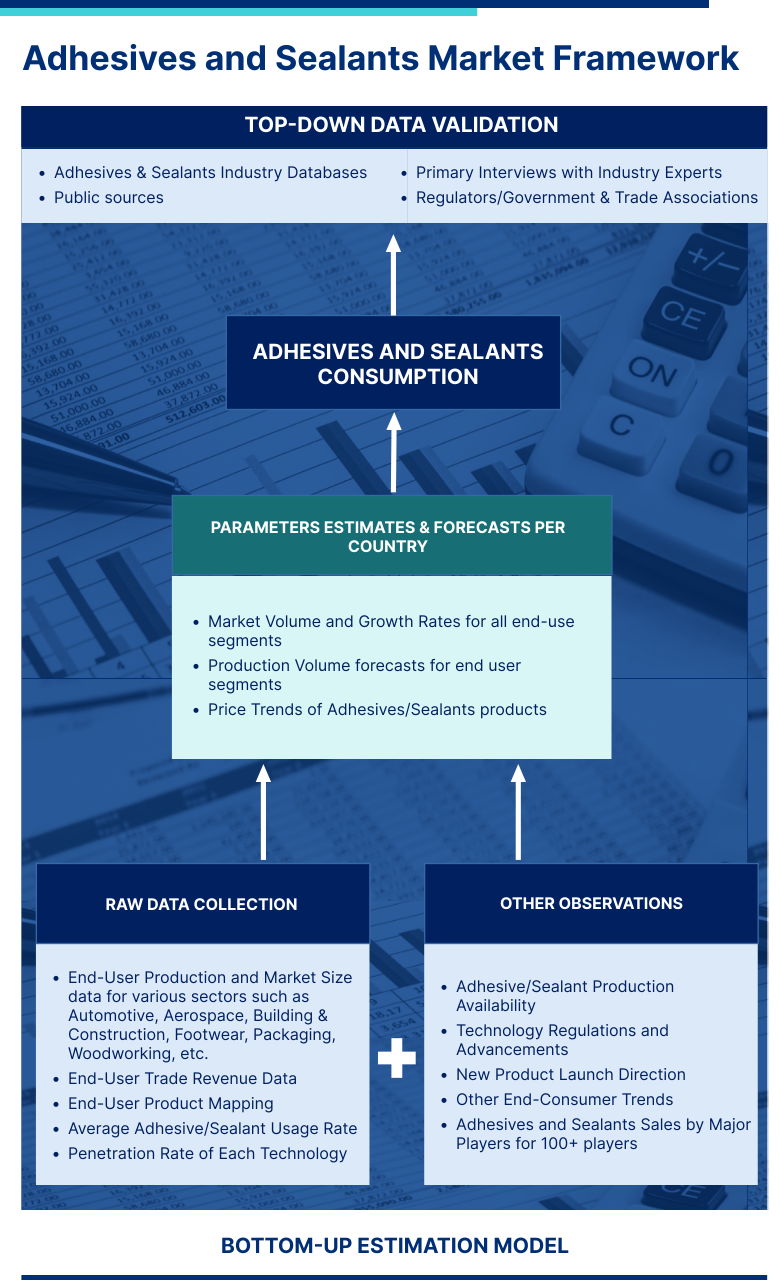
Mordor Intelligence follows a four-step methodology in all our reports.
- Step-1: Identify Key Variables: The quantifiable key variables (industry and extraneous) pertaining to the specific product segment and country are selected from a group of relevant variables & factors based on desk research & literature review; along with primary expert inputs. These variables are further confirmed through regression modeling (wherever required).
- Step-2: Build a Market Model: In order to build a robust forecasting methodology, the variables and factors identified in Step-1 are tested against available historical market numbers. Through an iterative process, the variables required for market forecast are set and the model is built on the basis of these variables.
- Step-3: Validate and Finalize: In this important step, all market numbers, variables and analyst calls are validated through an extensive network of primary research experts from the market studied. The respondents are selected across levels and functions to generate a holistic picture of the market studied.
- Step-4: Research Outputs: Syndicated Reports, Custom Consulting Assignments, Databases & Subscription Platforms
Get More Details On Research Methodology
Download PDF




