
Market Overview
| Study Period | 2020 - 2031 |
|---|---|
| Forecast Data Period | 2026 - 2031 |
| Historical Data Period | 2020 - 2024 |
| Growth Rate | 6.04% CAGR |
Major Players *Disclaimer: Major Players sorted in no particular order Image © Mordor Intelligence. Reuse requires attribution under CC BY 4.0. | |
Middle-East And Africa Reactive Adhesives Market Analysis by Mordor Intelligence
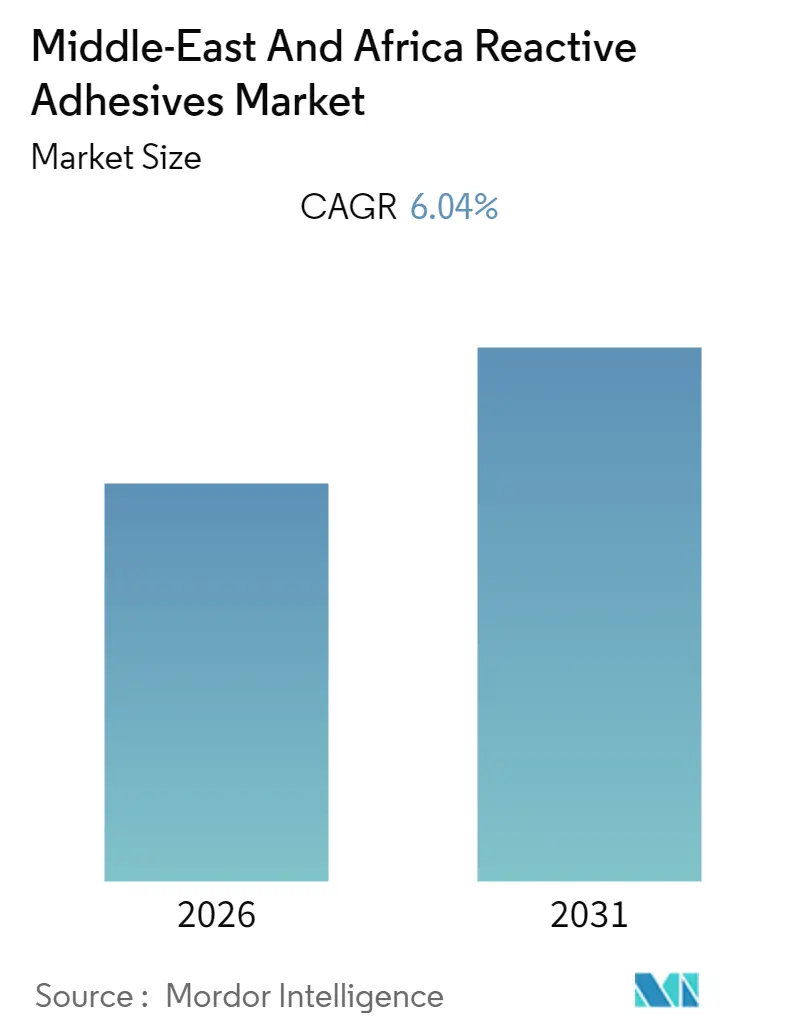
The Middle-East and Africa Reactive Adhesives Market size is expected to register a CAGR of greater than 6.04% during the forecast period.
- Growing popularity of heat-resistant products is expected to provide a major growth opportunity for the Middle-East and Africa reactive adhesives market studied.
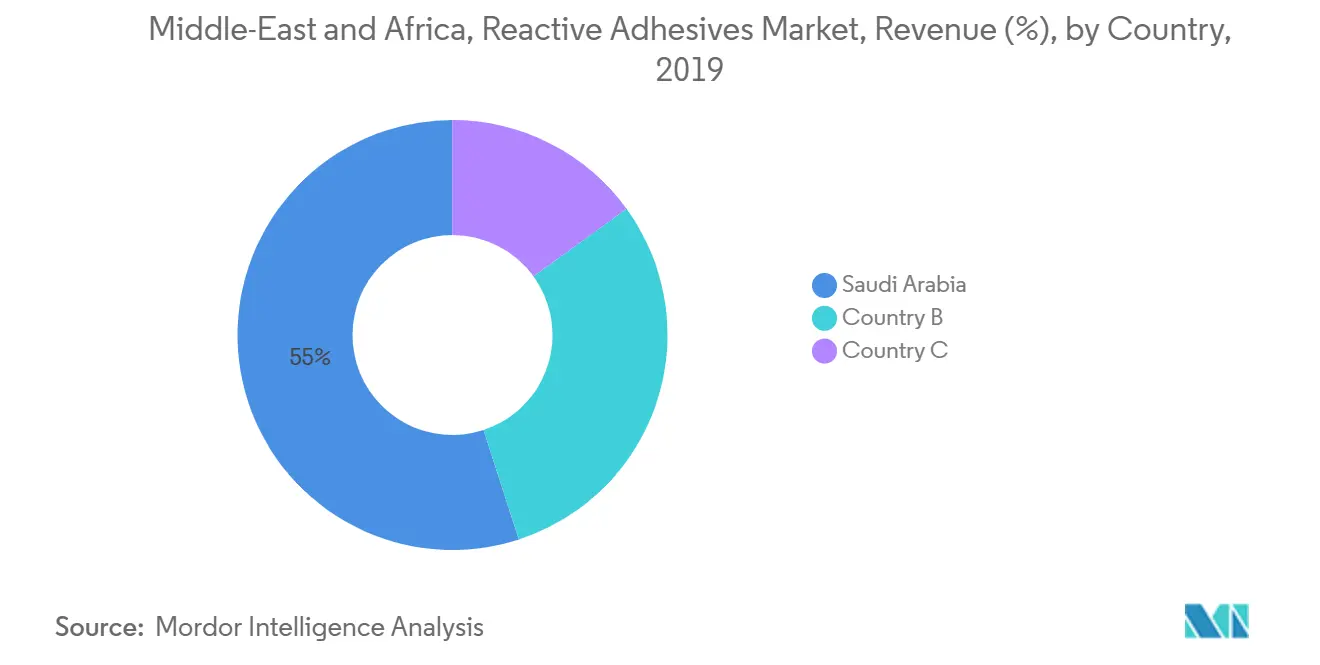
- Saudi Arabia accounted for the highest share of the Middle-East and Africa reactive adhesives market and is likely to continue dominating the market during the forecast period.
- Among the end-user industries, renewable energy industry dominated the Middle-East and Africa reactive adhesives market studied owing to the high demand from decking application.
Note: Market size and forecast figures in this report are generated using Mordor Intelligence’s proprietary estimation framework, updated with the latest available data and insights as of 2026.
Middle-East And Africa Reactive Adhesives Market Trends and Insights
Renewable Energy Industry to Witness the Highest Growth Rate
- The consumption of wind energy has been significantly increasing in the Middle-East & Africa region in the past few years.
- Wind energy offers many advantages over traditional energy sources which include unlimited & free energy, clean and non-polluting way to generate electricity. Unlike other types of power plants, it emits no air pollutants or greenhouse gases.
- Reactive adhesives are used to bond blades together. They offer a solution of reduced weight, as well as providing benefits in reduced assembly time and corrosion protection.
- Hence, owing to the above-mentioned factors, renewable energy industry is likely to witness the highest growth rate during the forecast period.


Saudi Arabia to Dominate the Market
- Saudi Arabia accounts for the major share of the Middle-East & Africa Reactive Adhesives Market currently owing to the high demand from construction, aerospace, and electronics industry.
- The aircraft fleet in the Middle Eastern region is expected to be doubled in the next 10 years, owing to the increased air traffic, majorly from the Middle East to Africa. Infrastructure development and technological advances are primarily being focused by the Saudi Arabian aerospace industry to smoothen the market entry for multinational players into the country.
- Government and private investments in different sectors in the country have increased the industrial and commercial building and construction activity in the country which has boosted the demand for reactive adhesives in the country.
- Hence, owing to the above-mentioned reasons, Saudi Arabia is likely to dominate the Middle-East and Africa reactive adhesives market studied.
- studied during the forecast period.
Competitive Landscape
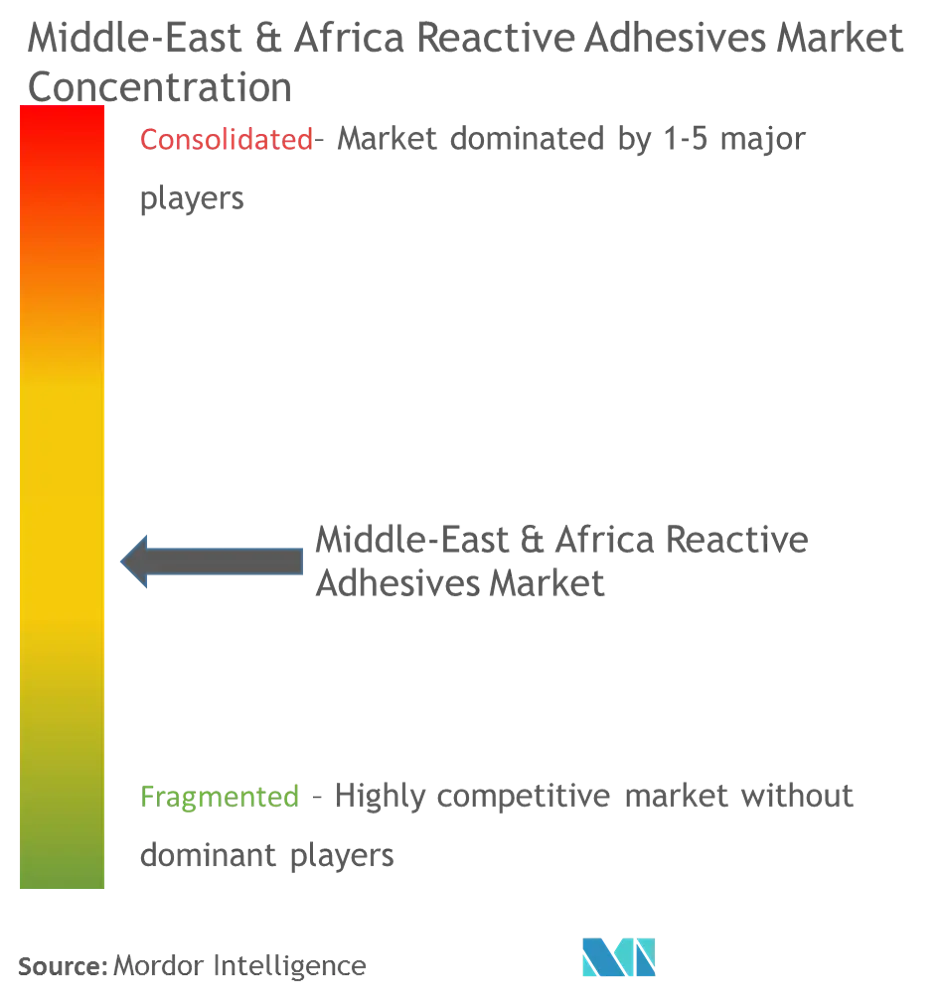
The Middle-East & Africa reactive adhesives market is moderately fragmented as the market of the market share is divided among a large number of players. Some of the key players in the market include 3M, Collano AG, Arkema Group, Jowat SE, and Henkel AG & Co. KGaA, among others.
Middle-East And Africa Reactive Adhesives Industry Leaders
3M
Collano AG
Arkema Group
HENKEL AG & Co. KGaA
Jowat SE
- *Disclaimer: Major Players sorted in no particular order

Market Opportunities and Future Outlook
Heat-resistant reactive systems, including epoxy and polyurethane chemistries, are creating whitespace in high-temperature and harsh-service applications across MEA. In segments where project owners and OEMs move from mechanical fastening to structural bonding, reactive adhesives support weight reduction, corrosion protection, and faster assembly. On the demand side, construction activity in Saudi Arabia is sustaining pull for structural bonding in precast concrete, facade installation, and building-envelope applications. In renewable energy value chains, wind-energy blade manufacturing and repair use reactive adhesives for blade bonding and composite assembly.
Regional chemicals infrastructure investment also helps the supply side, since expanding upstream feedstock availability can broaden local manufacturing for materials used across adhesive value chains. In May 2026, TA'ZIZ signed agreements valued at USD 28.5 billion tied to the build-out of a UAE chemicals infrastructure complex, while in July 2026 Tasnee completed a USD 500 million ethylene expansion at SEPC in Al Jubail Industrial City, strengthening regional availability of petrochemical building blocks. Adhesive suppliers expanding within MEA can also improve practical support for reactive adhesive users, including faster technical service and shorter lead times. This aligns with H.B. Fuller's May 2025 manufacturing investments in Cairo, Egypt and an expanded UAE site, which supports consistent supply, application support, and process validation for reactive adhesive users across construction, transportation, electronics, and renewables.
Recent Industry Developments
- June 2026: Henkel announced that Adhesive Technologies flagship sites in Gebkim, Turkiye, and Kurkumbh, India, achieved zero fossil fuel operations through electrification and 100% renewable energy. The electrification and renewables approach is aimed at lower-carbon manufacturing for adhesive supply into MEA-linked value chains. Henkel said the move supports customers prioritizing decarbonization and audited sustainability credentials.
- December 2025: 3M introduced the 3M Adhesive Mix Monitor, a solution that provides real-time feedback and traceability for two-part structural adhesive dispensing. The solution targets process control and quality assurance needs in high-value bonding applications. 3M positioned the monitor as a way to reduce scrap and rework while improving consistency in reactive adhesive assembly.
- December 2024: Arkema finalized the acquisition of Dow's flexible packaging laminating adhesives business. The transaction expanded Arkema's adhesive portfolio and scale in packaging. Arkema said it strengthens competitive intensity in reactive and specialty adhesive solutions supplied to converters and brand owners serving MEA markets.


Research Methodology Framework and Report Scope
Market Definition and Coverage
For this study, the Middle East and Africa reactive adhesives market is defined as the value of reactive adhesive materials sold in the region, where bonding happens through a chemical reaction after application (for example, moisture cure, heat cure, or mix-activated systems), across industrial and construction uses.
Scope exclusions: Non-reactive adhesive technologies and non-adhesive products (such as sealants and surface treatments) are excluded unless they are explicitly sold and used as reactive adhesives in end-application settings.
Segmentation Overview
- Resin Type
- Polyurethane
- Epoxy
- Cyanoacrylate
- Modified Acrylic
- Anaerobic
- Silicone
- Other Resin Types
- End-user Industry
- Building & Construction
- Renewable Energy
- Transportation
- Healthcare
- Electronics
- Aerospace
- Sports & Leisure
- Other End-user Industries
- Geography
- Saudi Arabia
- South Africa
- Rest of Middle-East and Africa
Data Sources, Market Sizing, and Validation
Desk Research
Desk research was used to build the fact base around MEA demand drivers, trade flows, and end-use activity that typically pulls reactive adhesive consumption. We referred to public sources such as UN Comtrade for import-export patterns, national statistics offices for construction and industrial output series, World Bank and IMF macro indicators, and trade-association publications covering chemicals and downstream manufacturing, along with peer-reviewed journals for curing chemistry and safety considerations.
To convert these signals into sizing inputs, we also reviewed company annual reports, investor presentations, and press releases to understand capacity moves, route-to-market changes, and price direction commentary. Patent databases were checked for activity around reactive chemistries used in structural bonding, which helped with resin mix assumptions. Where needed, paid subscriptions for company financials and shipment-level trade checks were used to sanity-check ranges. The desk sources listed above are illustrative, and we also reviewed other public documents and datasets during data collection and validation.
Primary Interviews and Surveys
Primary interviews and surveys were conducted with a mix of raw material distributors, formulators, converters, and end-user procurement and engineering teams across construction, transportation, electronics, and renewables in MEA. The discussions focused on what is actually purchased and applied in the region, how specifications are shifting (for example, faster cure or higher temperature resistance), and how pricing is negotiated and revised. We compared inputs across multiple countries to close gaps left by public data, then refined assumptions before finalizing the model.
Distribution of primary research fieldwork respondents
| Company type | Respondent position | Region |
|---|---|---|
| Top tier: 32% | CXOs: 14% | |
| Mid tier: 52% | Functional/Unit leaders: 36% | |
| Smaller Players: 16% | Managers: 50% |
Market-Sizing & Forecasting
Sizing was developed using a top-down approach where regional demand is reconstructed from end-use activity pools and material intensity, then converted into value using observable pricing logic. For reactive adhesives, the main inputs included construction starts and infrastructure spend proxies, vehicle and transport equipment output indicators, electronics and appliance assembly direction, renewable energy project additions, and import-export movement for relevant chemical inputs and finished formulations.
After the first build, selective bottom-up approximations were used to corroborate totals, including sampled supplier revenue splits, distributor channel checks, and an average selling price (ASP) times volume cross-check for major resin families. When a bottom-up data point was missing for a country, gaps were handled by mapping to a comparable market using industrial mix, trade openness, and typical formulation penetration, then reviewing the mapping with local experts.
For forecasting, scenario analysis was applied, followed by a multivariate regression check on the most stable drivers. The results were stress-tested with expert expectations on pricing and mix shift. ASP progression assumptions were kept traceable, so annual price changes could be linked to feedstock direction, currency translation timing, and contract reset cycles.
Data Validation & Update Cycle
Model outputs were validated through multiple checks, starting with consistency tests between value growth, volume direction, and end-use indicators that should move together across MEA. Variances were flagged when a country-level result looked out of line with trade movement, construction momentum, or interview feedback, and then the inputs were revisited until the drivers and the outcome matched logically.
Before sign-off, results go through step-by-step analyst reviews where assumptions are rechecked, calculations are replicated, and edge cases are explained in plain terms. Reports are refreshed annually, and interim updates are triggered when material events occur, such as sharp currency moves, major project delays, or notable price swings. Right before delivery, a final pass is completed so the client receives the most current view.
Mordor Intelligence's Middle East and Africa Reactive Adhesives Market Size Measured Against Other Published Estimates
Published market sizes for MEA reactive adhesives can vary, even when the same label is used, because the assumed boundary and the pricing timeline are not always aligned. Differences also come from how researchers treat currency conversion, whether prices are modeled as contract-based or spot-like, and how often the underlying inputs are refreshed.
In practice, the gap usually shows up when ASP updates are applied too smoothly across years, or when exchange rates are taken from a single month that does not match real procurement cycles in the region, which can shift the reported value meaningfully. A refresh-led build can also change the outcome, since updated trade signals and fresh validation checks may correct older penetration assumptions. By rechecking ASP steps and currency timing during annual refresh cycles and re-contacting sources when anomalies appear, Mordor Intelligence keeps the estimate closer to what buyers actually pay and use in MEA.
Benchmark comparison
| Source | Market Size | Gaps in Research Methodology |
|---|---|---|
| Mordor Intelligence | USD 0.00 B (2025) | |
| Trade Data Publisher A | USD 0.01 B (2024) | Estimate appears to be derived from a narrower trade-linked proxy and may miss locally produced material and distributor re-exports, which can understate value in markets with internal blending and repackaging. |
| Industry Portal B | USD 0.00 B (2025) | Figure likely uses a broad adhesives proxy with simplified price escalation and a single exchange-rate assumption, which can blur reactive-only scope and distort year-on-year value in volatile currency periods. |
Overall, the spread is mainly explained by how tightly the scope stays on reactive chemistries and whether pricing is updated in step with contracts and currency translation. Our approach stays repeatable because each country total is tied back to a small set of observable demand drivers and then validated with on-ground pricing and mix checks, which reduces the chance of overstating the market through overly smooth assumptions.


Key Questions Answered in the Report
What is the current Middle-East and Africa Reactive Adhesives Market size?
The Middle-East and Africa Reactive Adhesives Market is projected to register a CAGR of 6.04% during the forecast period (2026-2031)
Who are the key players in Middle-East and Africa Reactive Adhesives Market?
3M, Collano AG, Arkema Group, HENKEL AG & Co. KGaA and Jowat SE are the major companies operating in the Middle-East and Africa Reactive Adhesives Market.
What years does this Middle-East and Africa Reactive Adhesives Market cover?
The report covers the Middle-East and Africa Reactive Adhesives Market historical market size for years: 2019, 2020, 2021, 2022, 2023, 2024 and 2025. The report also forecasts the Middle-East and Africa Reactive Adhesives Market size for years: 2026, 2027, 2028, 2029, 2030 and 2031.
Page last updated on:






