
Wax Emulsion Market Size and Share
Market Overview
| Study Period | 2022 - 2032 |
|---|---|
| Market Size (2027) | USD 3.08 Billion |
| Market Size (2032) | USD 3.94 Billion |
| Growth Rate (2027 - 2032) | 5.04 % |
| Fastest Growing Market | Asia-Pacific |
| Largest Market | Asia-Pacific |
| Market Concentration | Medium |
Major Players *Disclaimer: Major Players sorted in no particular order Image © Mordor Intelligence. Reuse requires attribution under CC BY 4.0. | |
Wax Emulsion Market Analysis by Mordor Intelligence
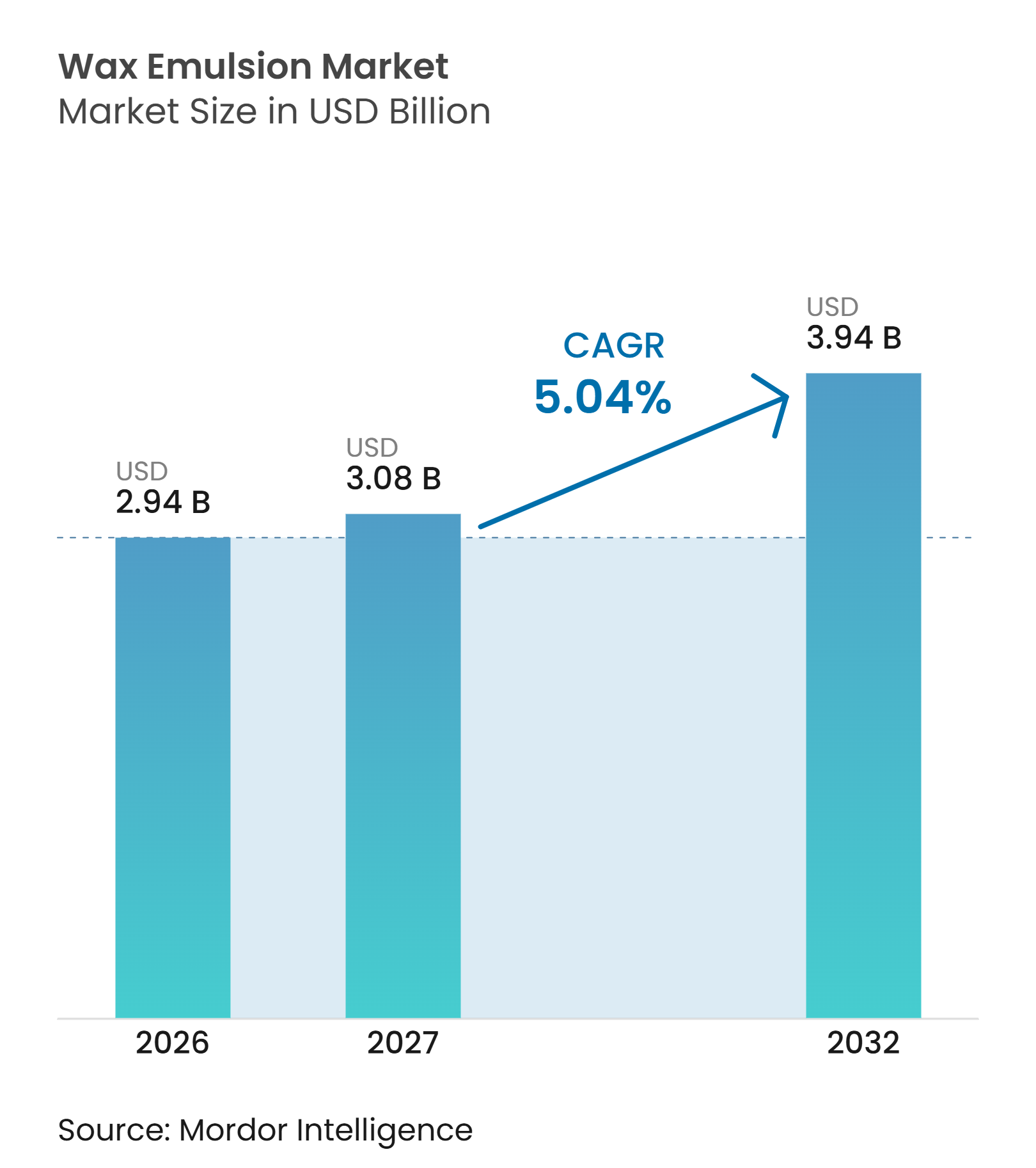
The Wax Emulsion Market size was valued at USD 2.94 billion in 2026 and is estimated to grow from USD 3.08 billion in 2027 to USD 3.94 billion by 2032, at a CAGR of 5.04% during the forecast period (2027-2032). The wax emulsion market is moving beyond its traditional role as a commodity additive, as coating and packaging formulators require water-based systems that retain slip, film integrity, and abrasion resistance. Tightening restrictions on Volatile Organic Compounds (VOCs) and Per- and Polyfluoroalkyl Substances (PFASs) are increasing demand for alternatives suitable for regulated coatings and food-contact packaging. The U.S. Environmental Protection Agency finalized amendments to aerosol-coating VOC standards in January 2025, creating a defined compliance pathway for affected manufacturers. The European Commission updated the EU Ecolabel criteria for paints and varnishes in February 2026, introducing requirements addressing VOC and Semi-Volatile Organic Compounds (SVOC) content. These compliance requirements favor suppliers that can combine reliable formulation support with products suited to water-based systems.
Key Report Takeaways
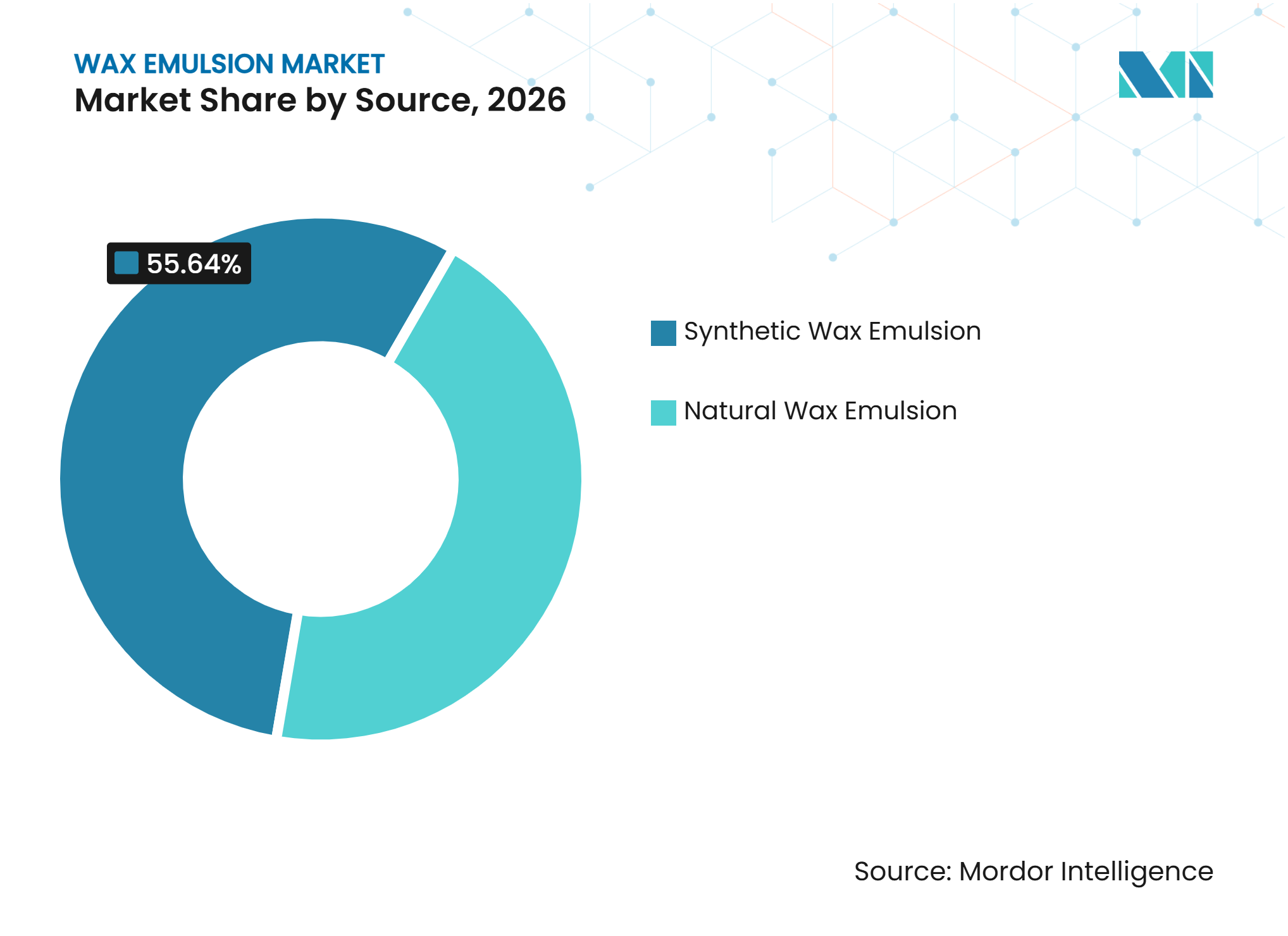
- By source, synthetic wax emulsions held 55.64% of the Wax Emulsion Market share in 2026, while natural wax emulsions are forecast to grow at a 5.78% CAGR through 2032.
- By type, paraffin wax emulsions held a 31.37% share in 2026, while polyethylene wax emulsions are forecast to grow at a 6.11% CAGR through 2032.
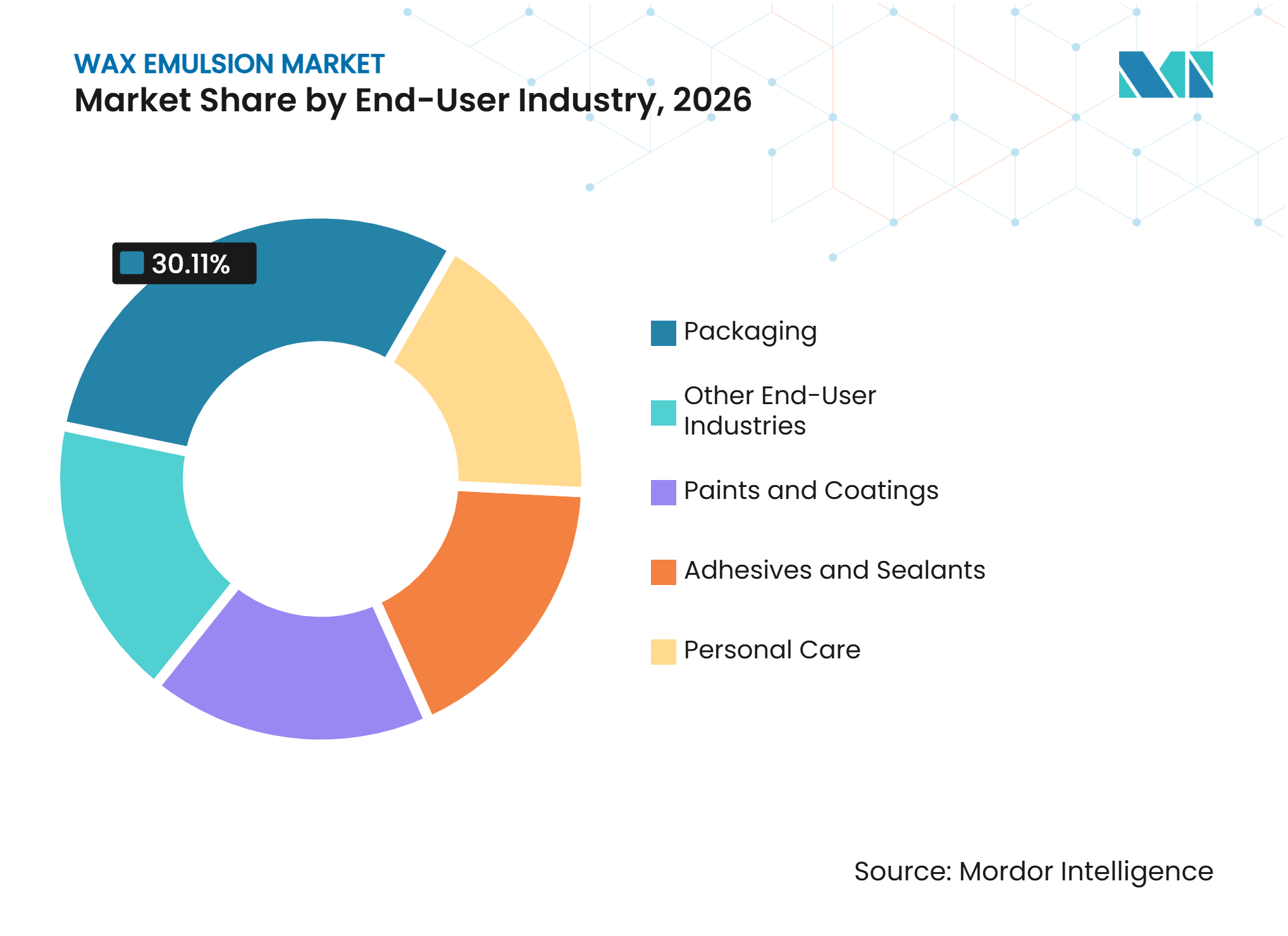
- By end-user industry, packaging held a 30.11% share in 2026, while personal care is forecast to grow at a 6.45% CAGR through 2032.
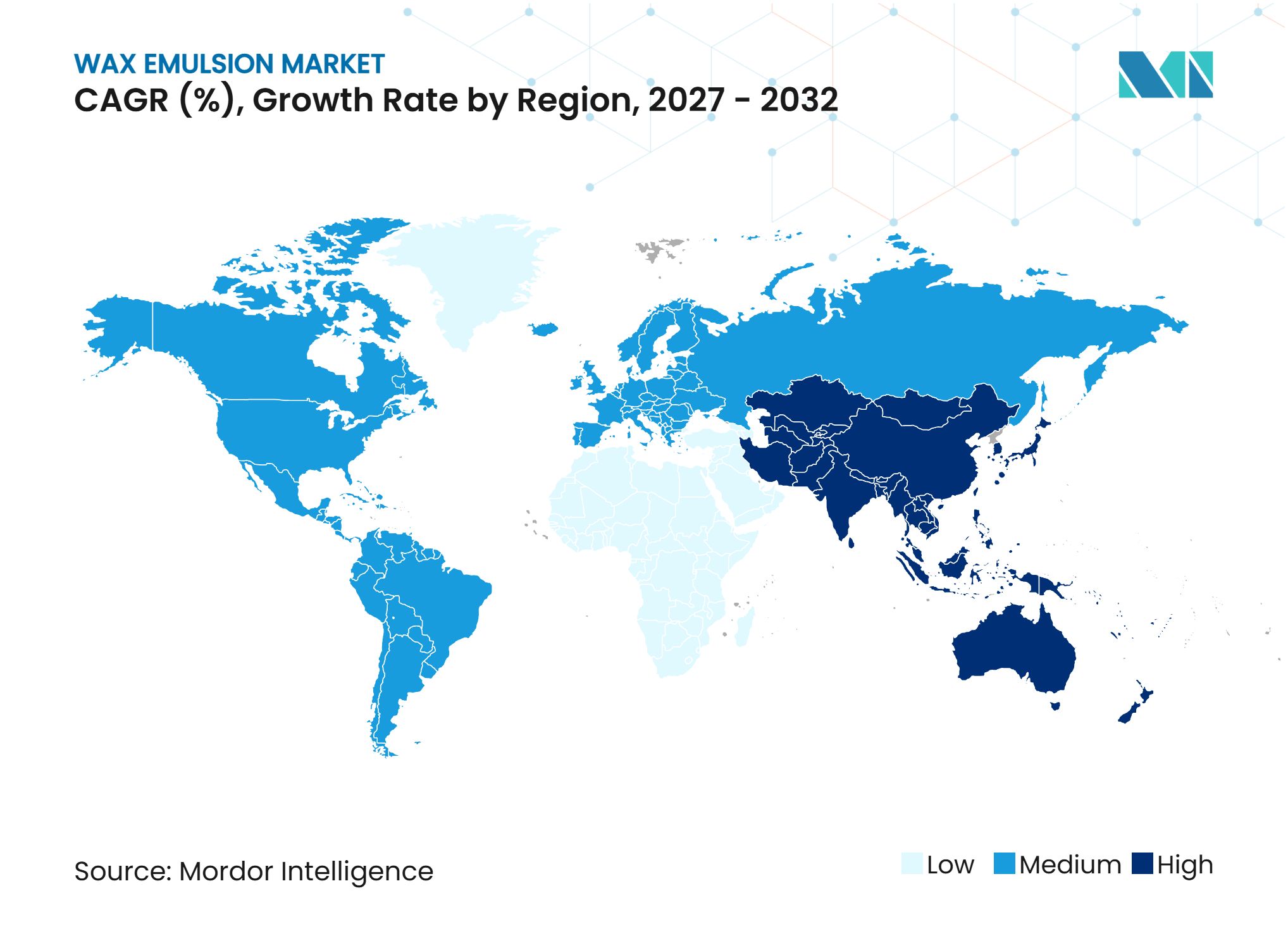
- By geography, Asia-Pacific held a 38.45% share in 2026 and is forecast to grow at a 6.23% CAGR through 2032.
Note: Market numbers in this report are based on Mordor Intelligence's proprietary estimation framework, which combines nine months of actuals with Q4 projections for base year 2026.
Market Trends and Insights
Drivers Impact Analysis of Wax Emulsion Market*
| Drivers | (~) % Impact on CAGR Forecast | Geographic Relevance | Impact Timeline |
|---|---|---|---|
| Growth of Water-Based, Low-VOC Coatings and Adhesives | +1.8% | Global, with concentrated near-term impact in North America and Europe | Short term (≤ 2 years) |
| Expanding Paper, Flexible Packaging, and Food-Contact Barrier Applications | +1.5% | Global, with strong relevance in China, India, and North America | Medium term (2-4 years) |
| Bio-Based and Renewable Wax Adoption in Personal Care and Textiles | +1.2% | Europe and North America, with expansion in Asia-Pacific and South America | Medium term (2-4 years) |
| Rising Demand for High-Performance Surface Modification | +0.8% | Global, with strong demand in Asia-Pacific, Europe, and North America | Long term (≥ 4 years) |
| Source: Mordor Intelligence | |||
Growth of Water-Based, Low-VOC Coatings and Adhesives
VOC regulations increased the importance of water-based coating development in the wax emulsion market. These systems require additives that restore slip, anti-blocking performance, and surface durability without increasing solvent loading. The EPA finalized aerosol-coating amendments in January 2025 and issued an interim final rule in July 2025. This regulatory timeline prompted formulators to complete qualification work before compliance deadlines took effect. Lubrizol expanded its polytetrafluoroethylene (PTFE)-free Lanco Surface Modifier portfolio in Asia-Pacific during November 2025, including dispersed and emulsion products for coatings formulators. The wax emulsion market benefits when water-based coatings and adhesives become the preferred approach for new products in regulated applications.
Expanding Paper, Flexible Packaging, and Food-Contact Barrier Applications
The removal of per- and polyfluoroalkyl substances (PFAS)-based grease barriers created new demand for suppliers serving the paper and flexible packaging industries. In January 2025, the FDA determined that authorizations for 35 food-contact notifications involving PFAS were no longer effective[1]. Wax emulsions can support barrier, release, and surface performance functions where formulators require food-contact-compliant alternatives. BASF introduced Joncryl Wax 30 in March 2025 for food-packaging inks and overprint varnishes. The shift is also tied to the EU Packaging and Packaging Waste Regulation, which places recyclability at the center of packaging development. Food-contact and recyclability requirements are becoming part of product design, giving the wax emulsion market a more durable opportunity than a short-term replacement cycle.
Bio-Based and Renewable Wax Adoption in Personal Care and Textiles
Natural wax emulsions gained attention as brands sought renewable content and ingredients that support natural-origin product positioning. Carnauba, beeswax, and rice bran derivatives can offer a distinct value proposition compared with petroleum-based waxes in personal care formulations. BASF introduced Lamesoft OP Plus in April 2025 as a readily biodegradable opacifier dispersion with natural-origin content of 92% to 98%. This type of launch indicates that wax-based dispersions are being positioned as purpose-built formulation ingredients rather than simple substitutes. The wax emulsion market also benefits from demand for texture, opacity, and sensory properties in creams, hair care, and color cosmetics. A higher formulation value in these applications can make personal care an attractive segment, even when its quantity is lower than that of packaging.
Rising Demand for High-Performance Surface Modification
Demand for scratch resistance, controlled gloss, rub resistance, and surface feel broadened the role of wax emulsions in coatings. Waterborne wood coatings, industrial floor coatings, and automotive finishes require additives that maintain surface performance under more stringent chemical requirements. Lubrizol's 2025 rollout of PTFE-free modifiers demonstrated how suppliers adapted their product lines to meet this need. Polyethylene wax emulsions are well-suited to these applications because their hardness and melting profile support demanding surfaces. The wax emulsion market may also benefit from new uses in agricultural coatings, as suppliers explore bio-based approaches to improve the handling of coated seeds. The opportunity depends on application testing, as performance expectations vary considerably across substrates and binder systems.
Restraints Impact Analysis of Wax Emulsion Market*
| Restraints | (~) % Impact on CAGR Forecast | Geographic Relevance |
|---|---|---|
| Crude-Oil and Agricultural Feedstock Price Volatility | -0.5% | Global, with strong exposure in Asia-Pacific, North America, and Brazil |
| Formulation Complexity Across Diverse Binder Systems | -0.3% | Global, with heightened relevance in Europe and North America |
| Performance Gaps in Bio-Based Emulsions Under Severe Service Conditions | -0.4% | Europe and North America, with similar constraints in Asia-Pacific industrial coatings |
| Source: Mordor Intelligence | ||
Crude-Oil and Agricultural Feedstock Price Volatility
Paraffin and polyethylene wax emulsions rely on petroleum-derived feedstocks, making their cost base sensitive to crude oil and polyolefin prices. This exposure is significant because synthetic materials remain the largest source category in the wax emulsion market. Natural waxes face distinct supply risks: carnauba production is concentrated in Brazil, and beeswax availability can be affected by regional apicultural conditions. Agricultural wax feedstocks are also influenced by harvest conditions, land-use choices, and biofuel demand. These factors can make prices less predictable for both suppliers and downstream formulators. This restraint is most immediate when changes in raw material costs cannot be passed through quickly in customer contracts.
Formulation Complexity Across Diverse Binder Systems
Wax emulsions must be compatible with acrylic, polyurethane, styrene-acrylic, vinyl acetate-ethylene, and alkyd binder systems. Each chemistry has its own pH range, ionic requirements, film-formation behavior, and processing conditions. A product that performs well in wood coatings may not deliver the same outcome in a packaging ink vehicle. Suppliers therefore require application laboratories and technical support to validate particle distribution, freeze-thaw stability, and surface behavior. This increases the time and cost required for product qualification in the wax emulsion market. It also gives an advantage to companies that can provide formulation-ready support for complex end uses.
*Our forecasts treat driver/restraint impacts as directional, not additive. The impact forecasts reflect baseline growth, mix effects, and variable interactions.
Wax Emulsion Market Segment Analysis
By Source:
Synthetic Materials Retain Scale While Natural Grades Gain ValueSynthetic wax emulsions held 55.64% of the wax emulsion market share in 2026. Their position reflects batch consistency, scalability, and broad use in demanding industrial binder systems. Synthetic grades include low-melting paraffin emulsions for paper applications and higher-performance polyethylene grades for inks and flexible packaging. Sasol describes its SASOLWAX range as supporting lower-carbon coatings, inks, and adhesives applications. Such products are useful where food-contact performance and reliable technical behavior are both required. The wax emulsion market continues to rely on synthetic products, as customers require repeatable results across production runs.
Natural wax emulsions are forecast to grow at a 5.78% CAGR through 2032. Carnauba and beeswax grades support formulations that require renewable-origin positioning or a natural-ingredient profile. Their small particles can help preserve appearance in high-gloss surface systems. BASF's 2025 personal care launch illustrates a commercial focus on biodegradable, natural-origin, wax-based dispersions. Natural materials are likely to capture value in premium personal care and specialty formulations even as synthetic grades retain higher output share. This distinction between output leadership and value creation is central to the wax emulsion market.



By Type:
Paraffin Leads Current Demand While Polyethylene Gains GroundParaffin wax emulsions accounted for 31.37% of the market in 2026. They remain widely used because they are cost-effective, widely available, and well-established in coating and packaging applications. Paraffin-polyethylene blends can balance cost with improved melting behavior and rub resistance. BASF's Joncryl WAX 30 was introduced for food-packaging inks and varnishes, demonstrating the continuing relevance of engineered wax systems in this segment. Paraffin also remains relevant in wood-panel production, where water repellency is important during processing. These uses give the wax emulsion market a broad base of recurring industrial demand.
Polyethylene wax emulsions are forecast to grow at a 6.11% CAGR through 2032. Their higher hardness, higher melting profile, and abrasion resistance make them suitable for demanding waterborne wood coatings and printing inks. This growth indicates that formulators are willing to pay for performance in applications with more demanding surface requirements. Polypropylene wax emulsions serve narrower uses in textiles and polymer processing. Carnauba, beeswax, and rice bran materials remain important where natural-origin claims and biodegradable product positioning are priorities. The market size for polyethylene wax emulsions is expanding as polytetrafluoroethylene (PTFE)-free surface modification becomes more important in coatings.
By End-User Industry:
Packaging Maintains Share While Personal Care AdvancesPackaging held 30.11% of the wax emulsion market share in 2026. The segment uses wax emulsions for moisture resistance, grease resistance, release properties, and anti-blocking performance in paper and flexible packaging. FDA action on PFAS food-contact notifications is increasing the need for alternative barrier approaches in paper and paperboard applications. Michelman launched Michem Coat 9250 in November 2025 for recyclable paper hot cups, supporting the transition toward fiber-based foodservice packaging. Paints and coatings, adhesives and sealants, and textiles provide further industrial demand for the wax emulsion market.
Personal care is forecast to grow at a 6.45% CAGR through 2032. Wax emulsions contribute structure, texture, opacity, and sensory properties to products such as lipsticks, creams, mascaras, and hair care items. CHT introduced a rice-bran-wax-derived opacifier in 2026 for personal care applications, reflecting demand for natural-origin and microplastic-free formulations. Personal care provides suppliers with a route to specialty products differentiated by application knowledge rather than by commodity scale, supporting a more favorable value mix for the wax emulsion market.

Geography Analysis
Asia-Pacific
Asia-Pacific held 38.45% of the wax emulsion market share in 2026 and is forecast to grow at a CAGR of 6.23% through 2032. Regional consumption is supported by China's packaging production base, India's food processing and consumer goods demand, and specialty applications in Japan. ExxonMobil began operating its Huizhou chemical complex in July 2025, adding ethylene and LLDPE production capacity in China, which strengthened the regional feedstock base for downstream polyolefin applications. Japan and South Korea remain important markets for high-performance printing inks, automotive coatings, and premium personal care products. The combination of large-scale manufacturing and specialty demand makes the Asia-Pacific region a significant market for wax emulsions.
North America
The North American market is shaped by food-contact and VOC regulations. The FDA's January 2025 PFAS notification action removed a class of grease-proofing chemistry from food-contact packaging applications, creating demand for alternative barrier materials. Wax emulsion coatings can serve in foodservice packaging and paper applications that require such alternatives. The EPA aerosol-coating amendments provide a compliance framework for the development of waterborne coatings. Michelman's launch of a recyclable hot-cup coating further highlights the importance of fiber-based packaging innovation in the region. These regulatory factors support the wax emulsion market where customers require surface performance without PFAS-based chemistries.
Europe and Emerging Markets
Europe maintains a detailed regulatory environment for paints, packaging, and food-contact materials. The updated EU Ecolabel rules for paints and varnishes apply VOC and SVOC requirements through December 2032, and the EU Packaging and Packaging Waste Regulation reinforces requirements for recyclability and material design. ALTANA secured a EUR 300 million credit line from the European Investment Bank in December 2025 to support sustainable innovation projects. Repsol invested EUR 2.5 million in its Palencia plant in April 2025 to expand specialty production capacity[2]. In emerging markets, Brazil provides a natural link between carnauba supply and cosmetics manufacturing, while the Middle East and Africa offer longer-term demand driven by petrochemical feedstocks, packaging growth, and food retail development.
Competitive Landscape
Market Concentration
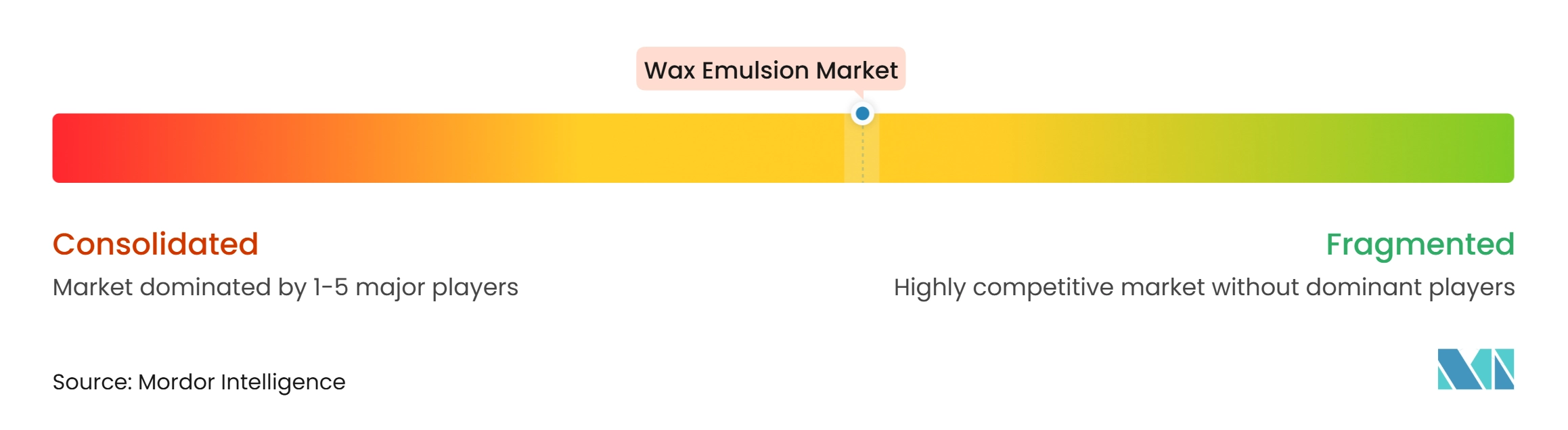
The wax emulsion market is moderately fragmented. BASF, ALTANA, Lubrizol, and Sasol have broad portfolios, global reach, and resources to develop products that address evolving regulatory requirements. Michelman, Paramelt, DEUREX, Münzing, and NIPPON SEIRO bring specialized formulation knowledge to specific end-use applications. Large producers can support high-capacity supply commitments, while specialists can respond quickly to demanding formulation needs. Neither group fully replaces the other, as scale and application responsiveness address different customer requirements. This creates space for collaboration, technical service, and differentiated product development.
Compliance-focused development is a central competitive strategy in the wax emulsion market. ALTANA's European Investment Bank (EIB)-backed financing supports work on sustainable innovation and avoiding critical substances. Lubrizol expanded its PTFE-free modifier range for Asia-Pacific coating formulators in November 2025. BASF introduced Joncryl Wax 30 for packaging inks and varnishes in March 2025. These developments reflect how suppliers use regulatory readiness and application-specific products to maintain their market positions.
Opportunities remain in food-contact products that can meet requirements across multiple regions. PTFE-free surface modifiers that retain slip and abrasion performance are another important development area. Bio-based emulsions for agriculture and personal care also offer scope for specialized products. CHT's 2026 rice-bran-wax opacifier demonstrates product development focused on natural-origin and microplastic-free personal care needs. The wax emulsion market rewards suppliers that can document compliance while delivering stable results across diverse binder systems. Competition is therefore based on technical support, formulation reliability, and product differentiation as much as on production capacity.
Wax Emulsion Industry Leaders
-
BASF
-
Michelman, Inc.
-
ALTANA AG
-
Sasol
-
NIPPON SEIRO CO., LTD.
- *Disclaimer: Major Players sorted in no particular order
Wax Emulsion Market Companies Covered in this Report
- ALTANA AG
- BASF
- CHT Germany GmbH
- DEUREX AG
- Exxon Mobil Corporation
- Hexion Inc.
- Lubrizol
- Michelman, Inc.
- Micro Powders
- Münzing Corporation
- NIPPON SEIRO CO., LTD.
- Paramelt
- Repsol
- Sasol
- Wacker Chemie AG
Recent Industry Developments in Wax Emulsion Market
- November 2025: Lubrizol signed a Memorandum of Understanding with Fulai New Material to advance sustainable coating solutions in Asia-Pacific. The company also expanded its range of PTFE-free Lanco Surface Modifier wax additives for wax emulsion applications, available in dispersed and emulsion formats for coating formulators across the region.
- November 2025: Michelman launched Michem Coat 9250, a water-based wax emulsion coating designed to enable the recyclability of paper hot cups for hot beverages. The product passed recyclability protocols in Europe, the United States, China, and Australia, addressing global brand owner requirements for a single compliant solution.
Global Wax Emulsion Market Report Scope
A wax emulsion is a stable mixture in which fine particles of solid wax are dispersed in water and held together by surfactants or emulsifiers. The wax particles remain uniformly distributed throughout the water phase, preventing separation over time. Surfactants or emulsifiers coat the wax particles, allowing them to remain suspended in water despite the natural incompatibility between wax and water.
The wax emulsion market is segmented by source, type, end-user industry, and geography. By source, the market is segmented into natural wax emulsion and synthetic wax emulsion. By type, the market is segmented into beeswax, carnauba wax, paraffin wax, polyethylene wax, polypropylene wax, and other wax types. By end-user industry, the market is segmented into packaging, paints and coatings, adhesives and sealants, personal care, and other end-user industries. The report also covers market sizes and forecasts for wax emulsion across 15 countries in major regions. The market sizes and forecasts are provided in terms of value (USD).
Segmentation Overview
| Natural Wax Emulsion |
| Synthetic Wax Emulsion |
| Beeswax |
| Carnauba Wax |
| Paraffin Wax |
| Polyethylene Wax |
| Polypropylene Wax |
| Other Wax Types |
| Packaging |
| Paints and Coatings |
| Adhesives and Sealants |
| Personal Care |
| Other End-User Industries |
| Asia-Pacific | China |
| India | |
| Japan | |
| South Korea | |
| ASEAN Countries | |
| Rest of Asia-Pacific | |
| North America | United States |
| Canada | |
| Mexico | |
| Europe | Germany |
| United Kingdom | |
| France | |
| Italy | |
| NORDIC Countries | |
| Rest of Europe | |
| South America | Brazil |
| Argentina | |
| Rest of South America | |
| Middle East and Africa | Saudi Arabia |
| South Africa | |
| Rest of Middle East and Africa |
| By Source | Natural Wax Emulsion | |
| Synthetic Wax Emulsion | ||
| By Type | Beeswax | |
| Carnauba Wax | ||
| Paraffin Wax | ||
| Polyethylene Wax | ||
| Polypropylene Wax | ||
| Other Wax Types | ||
| By End-User Industry | Packaging | |
| Paints and Coatings | ||
| Adhesives and Sealants | ||
| Personal Care | ||
| Other End-User Industries | ||
| By Geography | Asia-Pacific | China |
| India | ||
| Japan | ||
| South Korea | ||
| ASEAN Countries | ||
| Rest of Asia-Pacific | ||
| North America | United States | |
| Canada | ||
| Mexico | ||
| Europe | Germany | |
| United Kingdom | ||
| France | ||
| Italy | ||
| NORDIC Countries | ||
| Rest of Europe | ||
| South America | Brazil | |
| Argentina | ||
| Rest of South America | ||
| Middle East and Africa | Saudi Arabia | |
| South Africa | ||
| Rest of Middle East and Africa | ||
Key Questions Answered in the Report
What is current market size of Wax Emulsion Market?
The Wax Emulsion Market size was valued at USD 2.94 billion in 2026 and is estimated to grow from USD 3.08 billion in 2027 to USD 3.94 billion by 2032, at a CAGR of 5.04% during the forecast period (2027-2032).
Which wax emulsion type is growing fastest?
Polyethylene wax emulsions are forecast to grow at a 6.11% CAGR through 2032.
Which end-user application is growing fastest?
Personal care is forecast to grow at a 6.45% CAGR through 2032.
Which region leads global demand for wax emulsions?
Asia-Pacific leads with a 38.45% share in 2026 and is forecast to grow at a 6.23% CAGR through 2032.