
Virtual Private Server Market Size and Share
Market Overview
| Study Period | 2020 - 2031 |
|---|---|
| Market Size (2026) | USD 5.99 Billion |
| Market Size (2031) | USD 12.17 Billion |
| Growth Rate (2026 - 2031) | 15.22 % |
| Fastest Growing Market | Asia Pacific |
| Largest Market | North America |
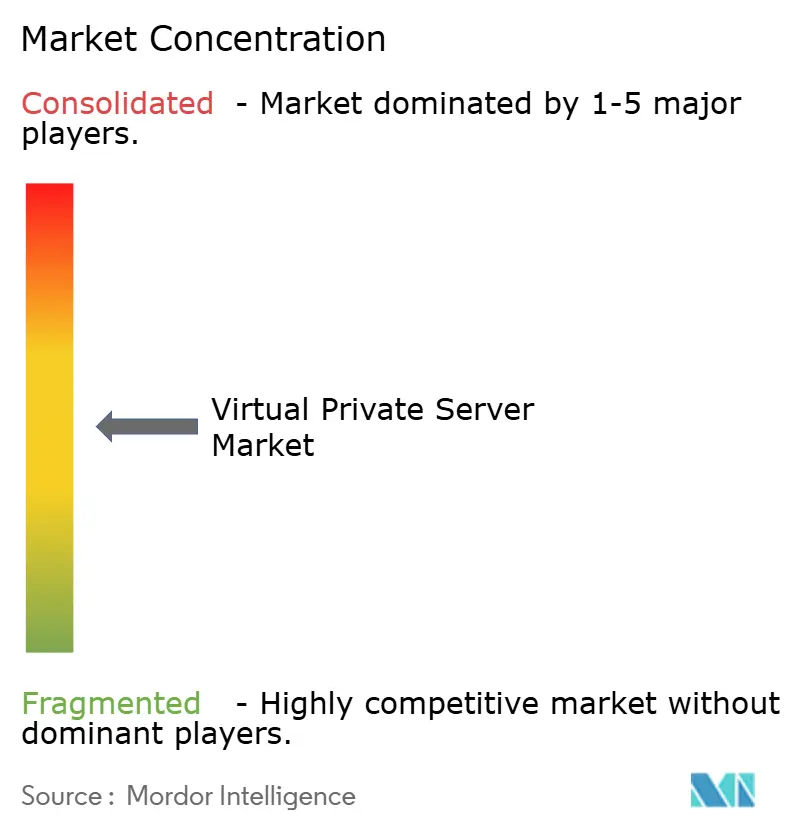
| Market Concentration | Medium |
Major Players *Disclaimer: Major Players sorted in no particular order Image © Mordor Intelligence. Reuse requires attribution under CC BY 4.0. | |
Virtual Private Server Market Analysis by Mordor Intelligence
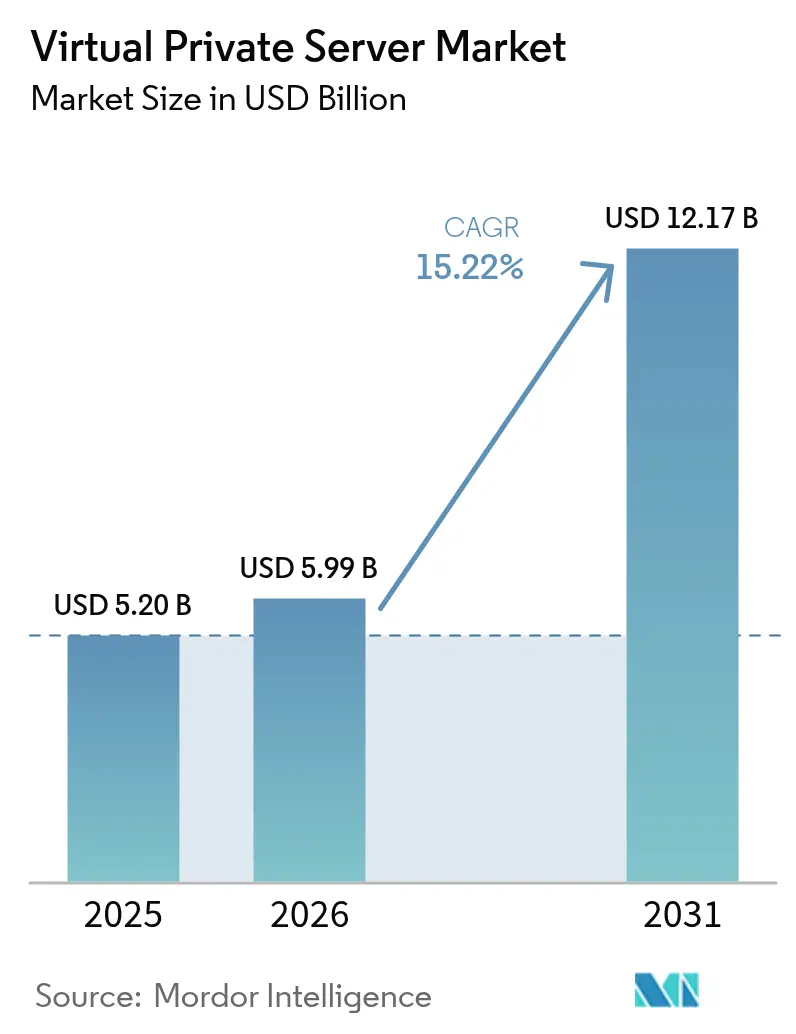
The virtual private server market size is expected to grow from USD 5.20 billion in 2025 to USD 5.99 billion in 2026 and is forecast to reach USD 12.17 billion by 2031 at 15.22% CAGR over 2026-2031. This sustained expansion illustrates how the virtual private server market acts as a midpoint between low-cost shared hosting and high-capex dedicated servers for organizations modernizing their digital estates[1]IBM Security, “Cost of a Data Breach Report 2024,” ibm.com. Demand accelerates because VPS instances provide the isolation, customizable security, and predictable performance now required for AI inference, edge-computing, and sovereign-cloud deployments that must meet local data-residency rules. The average data-breach cost climbed to USD 4.45 million in 2024, prompting security-conscious buyers to abandon shared hosting in favor of VPS environments with configurable firewalls and zero-trust architectures. At the same time, containerization and GPU-enabled instances are redefining price-performance expectations, forcing providers to innovate on billing transparency, network-egress waivers, and automated uptime guarantees.
Key Report Takeaways
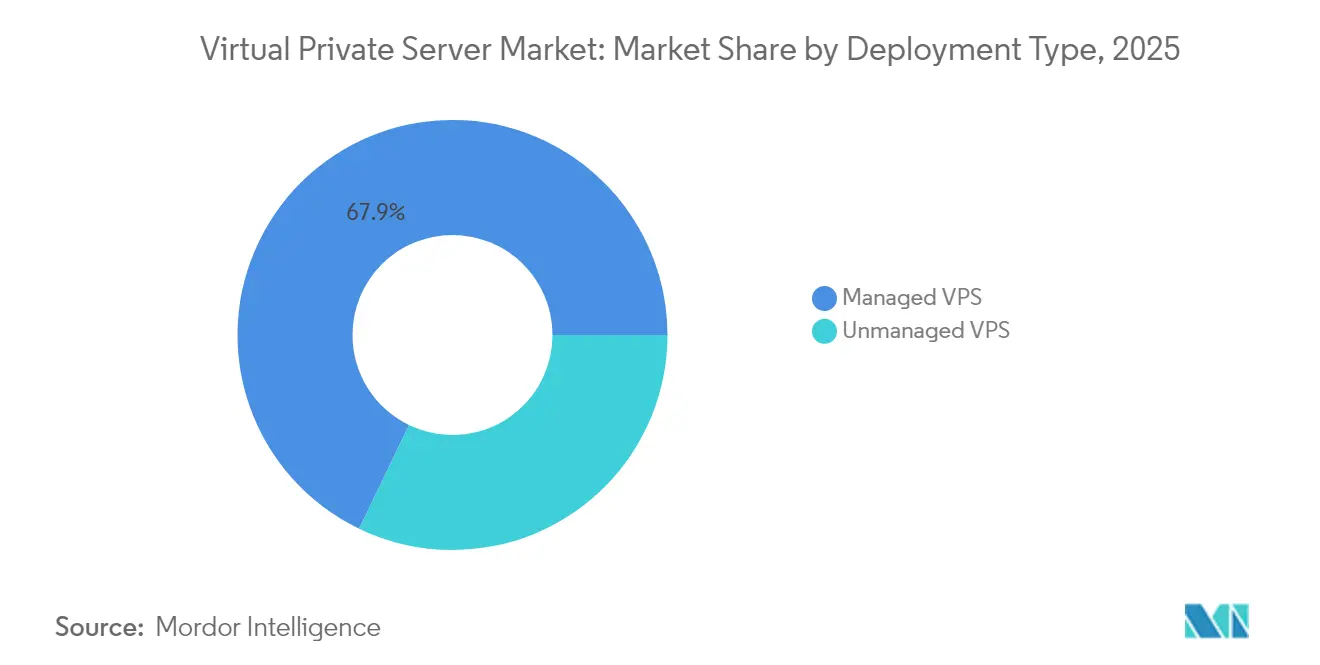
- By deployment type, managed services captured 67.85% of virtual private server market share in 2025, whereas unmanaged services are poised to register a 16.62% CAGR through 2031.
- By operating system, Linux held 55.60% of virtual private server market share in 2025, while Windows VPS is projected to expand at 14.07% CAGR by 2031.
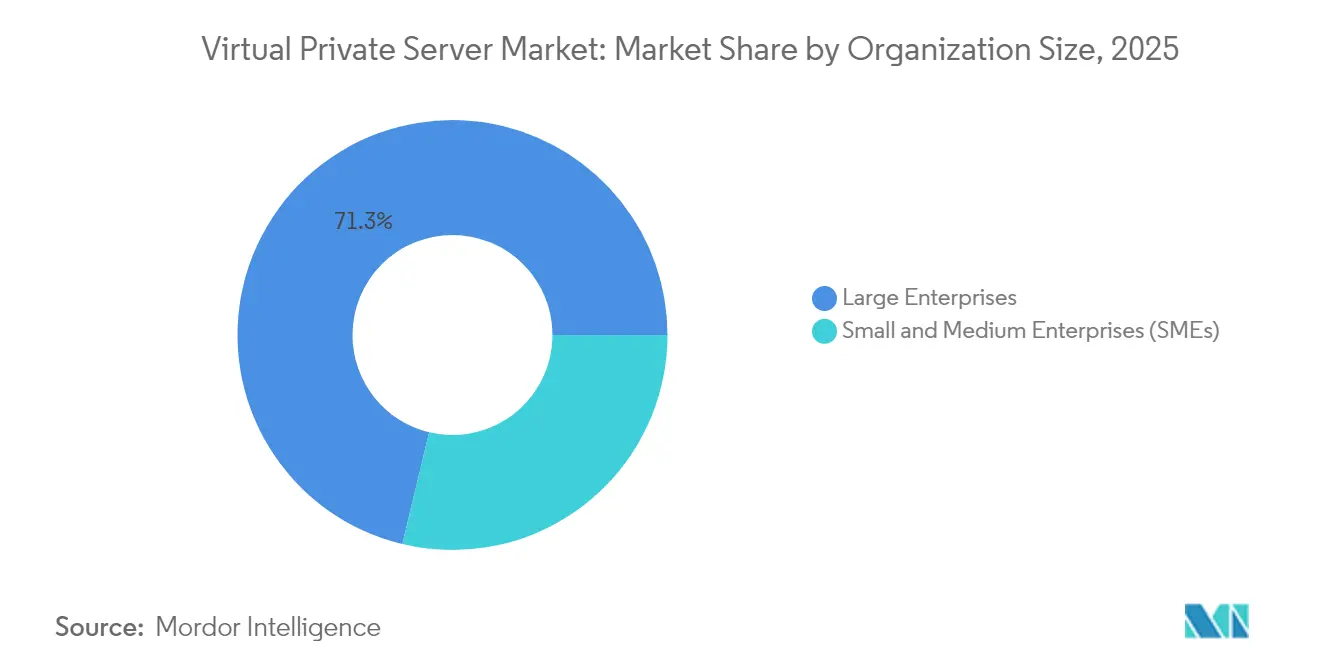
- By organization size, large enterprises controlled 71.25% of virtual private server market size in 2025; small and medium enterprises are advancing at a 16.74% CAGR through 2031.
- By end-user vertical, the IT and telecommunication segment led with 34.85% revenue share in 2025, while BFSI is growing fastest at 15.36% CAGR to 2031.
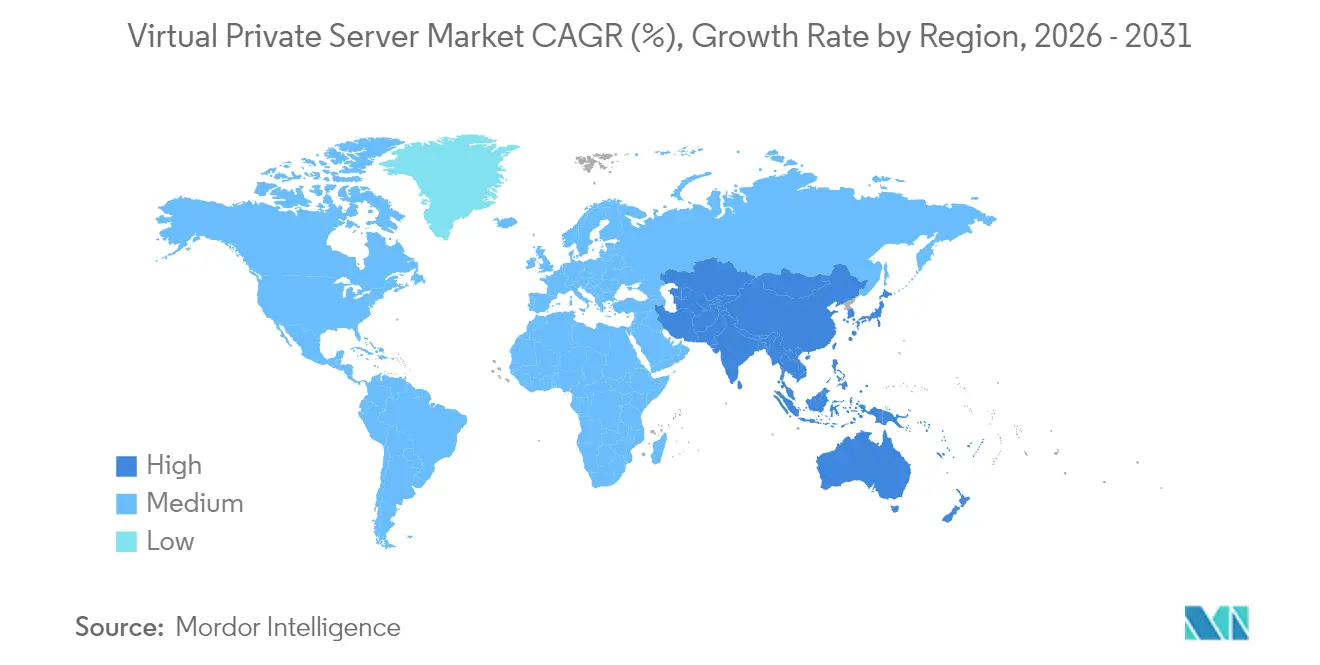
- By geography, North America commanded 37.10% of virtual private server market share in 2025; Asia-Pacific is on track for a 15.82% CAGR through 2031.
Note: Market size and forecast figures in this report are generated using Mordor Intelligence’s proprietary estimation framework, updated with the latest available data and insights as of 2026.
Global Virtual Private Server Market Trends and Insights
Drivers Impact Analysis*
| Driver | (~) % Impact on CAGR Forecast | Geographic Relevance | Impact Timeline |
|---|---|---|---|
| Rising enterprise security concerns | +3.2% | North America and EU | Medium term (2-4 years) |
| Demand for cost-effective scalability and uptime | +2.8% | APAC and Latin America | Short term (≤ 2 years) |
| SMEs’ digital-commerce expansion | +2.1% | APAC, MEA spill-over | Medium term (2-4 years) |
| VPS as bridge in multi-cloud migration | +1.9% | North America, EU | Long term (≥ 4 years) |
| GPU-ready VPS for AI/ML workloads | +2.3% | North America and China | Medium term (2-4 years) |
| Sovereign-cloud and data-residency mandates | +1.8% | EU, APAC | Long term (≥ 4 years) |
| Source: Mordor Intelligence | |||
Rising Enterprise Security Concerns
Security remains the most influential adoption trigger because organizations need granular network controls unavailable in shared hosting. More than 56% of companies reported VPN-related cyberattacks during 2024, a statistic pushing buyers toward isolated virtual servers with programmable access rules. European businesses intensify this move to satisfy GDPR while maintaining full audit trails for regulators. Providers showcasing ISO 27001 certifications, hardware-root-of-trust, and real-time threat monitoring are translating these assurances into premium subscription tiers.
Demand for Cost-Effective Scalability and Uptime
Budget discipline fuels interest in VPS plans that mimic dedicated-server performance but at fractional cost. SMEs adopting cloud services report 2.1 times aggregate cost savings when VPS underpins their digital-commerce stack. Containerization strengthens this trend, with 92% of surveyed organizations running containers in production and 91% relying on Kubernetes orchestration. Vendors therefore emphasize auto-healing clusters and hourly billing models that scale linearly with actual resource draw.
SME Digital-Commerce Boom Driving VPS Uptake
Half of global SMEs increased digital-transformation budgets in 2025, cementing VPS as a foundational layer for customer-facing web applications. German SMEs showed an average ROI of 13.44 on new technology investments, where VPS enabled deeper analytics and improved customer experience. Managed VPS providers seize this momentum by bundling codeless deployment wizards that offset chronic DevOps skill shortages.
VPS as Bridge Solution in Multi-Cloud Migration
Roughly two-thirds of enterprises now operate across multiple public clouds, and many regard neutral VPS nodes as staging grounds before locking workloads into hyperscalers. The European Data Act entering force in September 2025 further boosts portability requirements, positioning VPS suppliers with robust API interoperability as preferred partners[2]European Union, “Regulation (EU) 2023/2854 – European Data Act,” europa.eu .
Restraints Impact Analysis*
| Restraint | (~) % Impact on CAGR Forecast | Geographic Relevance | Impact Timeline |
|---|---|---|---|
| Intense price competition | −2.1% | North America and EU | Short term (≤ 2 years) |
| Limited DevOps skills within SMEs | −1.3% | Global, heavier in emerging markets | Medium term (2-4 years) |
| Server-hardware supply-chain volatility | −1.8% | Global | Medium term (2-4 years) |
| Sustainability regulations lifting OPEX | −1.1% | EU, North America, APAC | Long term (≥ 4 years) |
| Source: Mordor Intelligence | |||
Intense Price Competition
Hyperscalers like AWS, Azure, and Google exploit economies of scale to launch micro-instances that undercut specialist hosts, while shared-hosting providers blur the line with VPS-grade resource guarantees. Spot and pre-emptible VMs can be 75% cheaper for interruptible workloads, challenging mid-tier vendors to differentiate beyond raw price.
Limited DevOps Skills in SME Customer Base
A projected shortfall of 67,000 U.S. semiconductor-related engineers by 2030 signals broader talent constraints in cloud operations and automation. VPS vendors offering UI-driven configuration, auto-patching, and 24×7 chat support help mitigate this barrier, yet uptake in underserved regions still lags overall demand.
*Our forecasts treat driver/restraint impacts as directional, not additive. The impact forecasts reflect baseline growth, mix effects, and variable interactions.
Segment Analysis
By Deployment Type: Managed Services Sustain Leadership
Managed services dominated with 67.85% revenue share in 2025 because enterprises offload patching, monitoring, and compliance to specialists. Tier-one providers now embed Kubernetes operators, real-time DDoS scrubbing, and Infrastructure-as-Code templates to sustain this lead. Unmanaged VPS still posts a compelling 16.62% CAGR through 2031, with hobbyists, game-server admins, and blockchain validators drawn to root-level freedom. The virtual private server market size for unmanaged plans is projected to reach USD 4.16 billion by 2031, demonstrating the dual-track nature of demand.
Managed portfolios increasingly include AI-ready clusters with pooled GPUs and shared model libraries that shorten development sprints. Zero-cost egress offers—first rolled out by UpCloud in April 2025—are spreading through the provider landscape as a differentiator against hyperscalers that still charge for outbound bandwidth. Over time, transparency on data-transfer pricing could become a decisive conversion lever, especially for SMEs hosting high-traffic e-commerce stores.



By Operating System: Linux Dominance Reinforced by Container Adoption
Linux retained 55.60% share in 2025 and is expected to advance at 16.21% CAGR through 2031. Cloud-native tooling such as Docker and Kubernetes natively targets Linux namespaces, elevating the platform as default for microservices deployment. Windows VPS fills a critical niche for .NET and Active Directory workloads in sectors like legal, finance, and manufacturing, but rising license costs keep its share below the Linux trajectory. Lightweight Linux distributions—some less than 200 MB—boot in seconds on edge devices, satisfying emerging low-latency use cases in smart retail and industrial IoT.
The AI surge prompts vendors to ship pre-configured Ubuntu or Rocky Linux images containing CUDA, cuDNN, and PyTorch, cutting model-deployment times from days to hours for data-science teams. Security advantages also matter: live-kernel patching reduces downtime, and SELinux or AppArmor provide mandatory-access controls without third-party agents.
By Organization Size: Enterprise Dominance with SME Acceleration
Large enterprises commanded 71.25% of virtual private server market size in 2025 because they require large-node fleets for ERP, disaster-recovery, and hybrid-cloud links. However, SMEs are growing fastest at 16.74% CAGR, propelled by rising digital-commerce adoption and easy-to-use managed stacks. One provider reported that average onboarding time for SMEs dropped below 48 hours after launching guided DNS and SSL setup wizards—a clear productivity gain that accelerates market penetration.
Higher adoption among SMEs also stems from per-second billing, prepaid credit options, and localized language support portals that lower psychological switching costs. While SME workloads remain smaller, volume gains can materially lift provider utilization, especially across under-tapped emerging markets in Southeast Asia and Latin America.
By End-User Vertical: IT and Telecom Lead, BFSI Gains Momentum
IT and telecommunication firms absorbed 34.85% of virtual private server market share in 2025 due to their role in delivering SaaS, managed network services, and white-label cloud offerings. Banking, financial services, and insurance is the fastest mover at 15.36% CAGR because regulators now permit safe-cloud models for sensitive data once real-time encryption, geofencing, and audit logging are in place.
Healthcare uses VPS to host electronic health records, telemedicine portals, and diagnostic-image archives, meeting HIPAA or local equivalents. Manufacturers deploy edge-positioned VPS instances to process factory-floor sensor data in near real time, reducing latency and bandwidth overhead compared with centralized cloud pushes. Public-sector agencies adopt sovereign VPS nodes so citizen data stays inside national borders, addressing transparency mandates under freedom-of-information laws.
Geography Analysis
North America controlled 37.10% of virtual private server market share in 2025, powered by dense carrier-neutral data-center ecosystems and well-funded enterprise IT budgets. Secondary markets like Phoenix and Montréal post double-digit capacity growth because land availability and renewable-energy mix outperform saturated coastal hubs. Providers here leverage mature power-purchase agreements to secure carbon-neutral energy, anticipating stricter state-level climate statutes.
Asia-Pacific is projected to record the fastest CAGR at 15.82% through 2031, supported by government digital-economy blueprints and rapid fiber backhaul deployment. Colocation power is expected to rise from 10,233 MW in 2023 to 19,069 MW by 2028, reflecting a 13.3% compound rate that underpins VPS node expansion. Major players such as Alibaba Cloud and AWS open new availability zones in Jakarta, Hyderabad, and Osaka, scaling regional supply and spurring competitive price benchmarking among local hosts.
Europe’s focus on data-sovereignty and sustainability shapes a distinct adoption profile. The impending European Data Act forces providers to guarantee portability and fair exit clauses, encouraging buyers to consider open-API VPS suppliers. Power-grid constraints in Amsterdam and Frankfurt push operators toward emerging hubs in Madrid, Warsaw, and Milan where municipalities offer favorable tax incentives for green facilities. Strict energy-reporting obligations foster adoption of immersion cooling and waste-heat reuse, translating sustainability goals into concrete capital-expenditure lines.

Regulatory Landscape
The regulatory environment for VPS increasingly mirrors broader cloud and digital-infrastructure rules, pushing providers toward stronger security controls, auditability, and customer identity verification. In the European Union, the NIS2 framework and related implementation measures treat cloud computing service providers as digital infrastructure and raise requirements around incident handling, logging, and security governance. The European Data Act entered into force in September 2025 and increases expectations for data portability and switching for customers using cloud and VPS-like infrastructure.
Outside the EU, national cybersecurity and anti-fraud initiatives can also affect VPS provisioning. In India, CERT-In directions require extended retention of customer and system data by service providers, increasing compliance costs and shaping how VPS platforms design onboarding, recordkeeping, and support processes. In Russia, April 2026 reporting around amendments to an Anti-Fraud 2.0 bill highlighted added obligations for hosting providers to restrict resources used to enable access to blocked information, reinforcing the operational need for stricter acceptable-use enforcement and faster suspension workflows. In parallel, vendors use standards alignment as a cross-border compliance lever, with ISO/IEC 27018:2025 and ISO/IEC 27017:2026 used to support commonly referenced baselines for cloud security and PII protection.
Value Chain Analysis
Upstream inputs for VPS include server CPUs and memory, SSD/NVMe storage, networking equipment and transit/peering, virtualization and automation software, and data center capacity (floor space, power, and cooling). Scarce enablers such as IPv4 address blocks and access to reliable, cost-effective power in high-demand hubs act as recurring constraints, while specialized compute tiers increase dependency on timely access to newer CPU and GPU platforms.
Midstream, hosting operators and cloud providers assemble these inputs into standardized VPS offerings through hardware qualification (burn-in and benchmarking), hypervisor and template hardening, network-resilience configuration, and operational layers such as monitoring, patching, backup, and DDoS protection. Distribution is largely digital, via direct self-service consoles, reseller and affiliate channels, and developer marketplaces, with billing, identity checks, and support operations acting as key service-delivery components. Competitive positioning across the chain is shaped by hyperscaler influence on the broader IaaS ecosystem; for example, the UK Competition and Markets Authority (2024) highlighted concentration in cloud infrastructure that can raise switching barriers, increasing the value of portability tooling and vendor-neutral automation platforms (such as RackN-style infrastructure abstraction) for providers seeking differentiation.
Competitive Landscape
The virtual private server market remains moderately fragmented. Hyperscalers—AWS, Microsoft Azure, and Google Cloud—dominate high-value enterprise contracts, but specialized providers like DigitalOcean, Vultr, and Linode carve developer and SME niches via simplified UX and transparent pricing. Regional hosts such as OVHcloud, Hetzner, and Leaseweb focus on local compliance, customizable hardware, and multilingual support.
Strategic moves illustrate divergent paths. Vultr raised USD 333 million in fresh equity, led by AMD Ventures, to finance GPU-dense zones and edge locations across five continents. DigitalOcean posted Q1 2025 revenue of USD 211 million, a 14% year-on-year uptick, attributing triple-digit AI revenue growth to its new GenAI platform. UpCloud’s zero-cost egress policy places pressure on competitors still charging per-GB transfer fees. Meanwhile, consolidation continues as World Host Group acquires stalwarts like A2 Hosting to scale east-west traffic coverage.
Technology roadmaps converge around automation, security, and carbon transparency. Providers integrate Terraform modules, Kubernetes CRDs, and SAML-based single sign-on into base plans. Hardware refreshes feature AMD EPYC 9004 “Genoa” CPUs or Intel Sapphire Rapids chips to achieve higher performance per watt. Confidential-computing enclaves powered by AMD SEV-SNP or Intel TDX enter general availability in mid-tier SKUs, attracting regulated industries seeking extra data-in-use protection.
Virtual Private Server Industry Leaders
Amazon Web Services, Inc.
GoDaddy Inc.
Rackspace Inc.
DigitalOcean, Inc.
Liquid Web, LLC
- *Disclaimer: Major Players sorted in no particular order

Market Opportunities and Future Outlook
VPS demand is increasingly tied to measurable security and governance requirements, creating whitespace for providers that package compliance-ready controls as default features rather than add-ons. The European Data Act's September 2025 entry into force increases the practical value of workload portability, transparent exit terms, and interoperable management APIs, which benefits VPS platforms that can document switching processes and support multi-cloud staging patterns.
A second opportunity area is performance-optimized, workload-specific virtual infrastructure that narrows the gap between VPS and specialized cloud instances. In 2026, hyperscaler releases highlighted how compute is fragmenting into network-optimized and GPU-accelerated tiers, including AWS making EC2 G7 instances generally available in June 2026 for AI inference and graphics workloads, and Google Cloud reaching general availability for C4N in July 2026 for network and block-storage optimized compute. That cadence raises customer expectations for VPS providers on storage IOPS consistency, egress transparency, and instance templates for modern stacks. The market also shows commercial pull for simplified provisioning and cost clarity, evidenced by Amazon Lightsail expanding blueprint-based VPS setups in early 2026 with enforced IMDSv2 defaults. Providers that combine these product patterns with localized footprints (for latency and data residency), automated operations (AIOps-assisted monitoring and remediation), and security baselines aligned to recognized standards have clearer paths to compete for regulated and AI-adjacent workloads that are still being split between shared hosting and full hyperscale IaaS.
Recent Industry Developments
- February 2026: Amazon Web Services added a new WordPress blueprint to Amazon Lightsail, including a guided setup workflow and default enforcement of Instance Metadata Service Version 2 (IMDSv2). The update further standardizes VPS-style deployments with stronger baseline security controls and faster time-to-launch for small teams running content and commerce sites.
- January 2025: World Host Group acquired A2 Hosting, extending consolidation among hosting providers serving shared, VPS, and adjacent infrastructure customers. The deal supports broader geographic and product bundling strategies that can pressure smaller independent VPS hosts on pricing and service breadth.
- November 2024: Rackspace Technology launched on-demand GPU-as-a-Service powered by NVIDIA H100 and A30 GPUs and expanded its Rackspace Spot footprint to San Jose. This move broadened access to GPU-backed virtual infrastructure for AI and accelerated-compute use cases, reinforcing competitive differentiation around performance tiers beyond general-purpose VPS.


Research Methodology Framework and Report Scope
Market Definition and Coverage
This market covers revenue earned from offering virtual private server hosting, where customers rent an isolated virtual server instance with dedicated resources, delivered through a hosting provider and paid for as a service.
Scope exclusions: We exclude bare metal dedicated servers, shared hosting only plans, colocation services, and pure virtualization software sold as licenses.
Segmentation Overview
- By Deployment Type
- Managed VPS
- Unmanaged VPS
- By Operating System
- Linux
- Windows
- Other Operating System
- By Organization Size
- Large Enterprises
- Small and Medium Enterprises (SMEs)
- By End-user Vertical
- IT and Telecommunication
- BFSI
- Retail and E-commerce
- Healthcare and Life Sciences
- Manufacturing
- Government and Public Sector
- Others
- By Geography
- North America
- United States
- Canada
- Mexico
- Europe
- Germany
- United Kingdom
- France
- Italy
- Spain
- Rest of Europe
- Asia-Pacific
- China
- Japan
- India
- South Korea
- Australia
- Rest of Asia-Pacific
- South America
- Brazil
- Argentina
- Rest of South America
- Middle East and Africa
- Middle East
- Saudi Arabia
- United Arab Emirates
- Turkey
- Rest of Middle East
- Africa
- South Africa
- Egypt
- Nigeria
- Rest of Africa
- Middle East
- North America
Data Sources, Market Sizing, and Validation
Desk Research
Desk work started with building the demand context for VPS, then mapping it to hosting and cloud infrastructure activity that can be checked in public sources. We used sources such as ITU and World Bank digital indicators, OECD datasets for broadband and enterprise ICT adoption, and US FCC releases for connectivity patterns that influence hosting demand.
On the supply and pricing side, we reviewed provider disclosures such as annual reports, investor presentations, and product pages to understand plan structures, billing cycles, and typical price bands for Windows and Linux VPS. We also reviewed reputable press coverage and technical publications for signals like virtualization shifts, security expectations, and general cloud migration timing. A paid subscription for company financials and news helped fill gaps when reporting was limited. These desk sources are not exhaustive, and we also pulled from additional public references to collect inputs, validate assumptions, and clarify open questions.
Primary Interviews and Surveys
Primary work focused on validating what customers actually buy and how providers package VPS in real contracts, before the model was finalized. Interviews covered hosting providers, cloud and infrastructure resellers, managed service partners, and IT buyers across key regions. The goal was to confirm adoption drivers, typical migration paths from shared hosting, and the split between managed and unmanaged VPS offerings.
Distribution of primary research fieldwork respondents
| Company type | Respondent position | Region |
|---|---|---|
| Top tier: 38% | CXOs: 16% | APAC: 45% |
| Mid tier: 46% | Functional/Unit leaders: 26% | EMEA: 36% |
| Smaller Players: 16% | Managers: 58% | Americas: 19% |
Market-Sizing & Forecasting
Sizing starts from a top-down build where hosting and cloud infrastructure spending signals are converted into a VPS revenue pool using penetration-style assumptions. These assumptions were tested by region and customer type to keep the totals realistic. We corroborate the result with selective bottom-up checks such as sampled plan pricing multiplied by expected active instance volumes, channel checks on reseller activity, and supplier roll-ups where public revenue splits are available.
Key inputs used in the model include active website and online business formation trends, broadband quality and reliability signals, SMB digitalization pace, typical VPS plan price bands and renewal behavior, and the share of workloads moving from shared hosting to VPS for performance and security reasons. Where bottom-up evidence is thin, we use conservative adoption ranges from interviews and then apply sensitivity checks, so the final number does not depend on a single assumption.
Forecasting uses scenario analysis supported by simple regression-style relationships between demand indicators (such as connectivity and digital business growth) and observed hosting spend direction. The forecast path is then adjusted using primary feedback on expected price changes, packaging shifts between managed and unmanaged VPS, and regional demand momentum so the outlook remains practical.
Data Validation & Update Cycle
Model outputs are checked against independent signals that should move with VPS demand, including reported hosting revenue direction, plan price movements, and regional cloud infrastructure expansion patterns. When a variance looks unusual, we revisit assumptions, recheck unit economics, and reconnect with selected respondents to confirm whether the change is real or driven by the model.
Before sign-off, the work goes through a multi-step analyst review that includes formula checks, currency consistency checks, and year-to-year trend sanity checks. Reports refresh annually, and interim updates are made when material events occur that can change pricing, packaging, or customer behavior. Prior to delivery, a fresh pass is completed so clients receive the latest updated view.
Mordor Intelligence's Virtual Private Server Market Sizing Compared With Other Published Estimates
Published estimates for VPS often differ because the service bundle being counted is not always the same, and because pricing and active usage assumptions get refreshed at different times. Differences also show up when some studies use a long-range forecast as the anchor and backfill earlier years with broad growth rates.
Some estimates roll up adjacent categories like cloud VPS only, or wider server hosting that can include shared plans and other hosting formats. In Mordor Intelligence modeling, VPS revenue is counted only when it is sold as an isolated virtual server service, and totals are reconciled using plan price bands and regional adoption signals that were confirmed in interviews.
Benchmark comparison
| Source | Market Size | Gaps in Research Methodology |
|---|---|---|
| Mordor Intelligence | USD 5.99 B (2026) | |
| Industry Publisher A | USD 6.00 B (2024) | This figure is presented under a broader VPS server hosting lens, which can blend VPS with nearby hosting services and uses an earlier base year that may not reflect current plan pricing and packaging. |
| Research Firm B | USD 5.92 B (2025) | The estimate appears to follow a different forecast window and growth curve, and the public view does not clearly show how managed versus unmanaged VPS and Windows versus Linux price differences were treated. |
Overall, the spread mainly comes from what is included under VPS and how the starting year price and adoption assumptions are set. By keeping scope tied to actual VPS service revenues and checking outcomes against repeatable demand indicators, the final market number stays traceable and easier to update year after year.


Key Questions Answered in the Report
What is the current value of the virtual private server market?
The virtual private server market size reached USD 5.99 billion in 2026 and is projected to rise to USD 12.17 billion by 2031 at a 15.22% CAGR over 2026-2031.
Which deployment model dominates the virtual private server market?
Managed services lead with 67.85% market share because enterprises outsource patching, monitoring, and compliance to specialist providers.
Why is Linux preferred for VPS hosting?
Linux commands 55.60% market share thanks to its alignment with Docker, Kubernetes, and other cloud-native tools, plus lower licensing costs versus proprietary operating systems.
Which region is projected to grow fastest?
Asia-Pacific is expected to post a 15.82% CAGR through 2031, buoyed by government digital-economy initiatives and large-scale data-center investment.
How do data-sovereignty laws influence VPS adoption?
Regulations such as the European Data Act require providers to ensure data portability and residency, prompting organizations to select VPS hosts with in-country infrastructure and open APIs.
What differentiates specialized VPS providers from hyperscalers?
Specialized hosts compete on transparent pricing, developer-friendly UX, and region-specific compliance, while hyperscalers leverage extensive service portfolios and global private networks.
Page last updated on:





