
Vietnam Full Truckload (FTL) Market Size and Share
Market Overview
| Study Period | 2020 - 2031 |
|---|---|
| Forecast Data Period | 2026 - 2031 |
| Base Year Market Size (2025) | USD 21.40 Billion |
| Market Size (2026) | USD 22.80 Billion |
| Market Size (2031) | USD 30.75 Billion |
| Growth Rate (2026 - 2031) | 6.16 % |
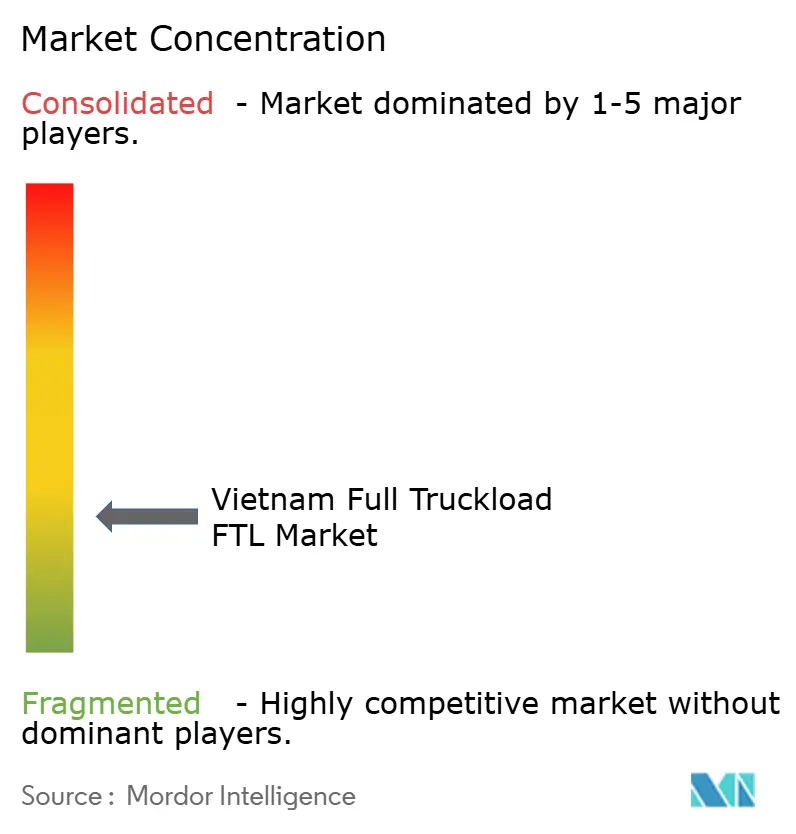
| Market Concentration | Low |
Major Players *Disclaimer: Major Players sorted in no particular order Image © Mordor Intelligence. Reuse requires attribution under CC BY 4.0. | |
Vietnam Full Truckload (FTL) Market Analysis by Mordor Intelligence
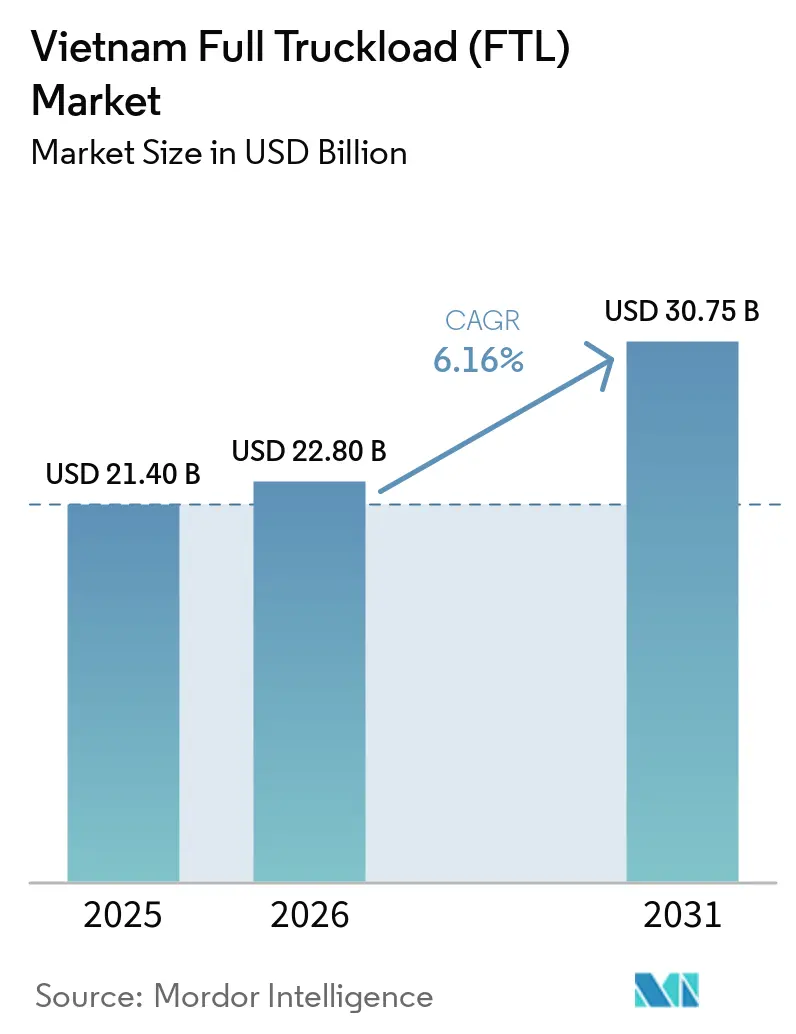
The Vietnam full truckload (FTL) market size was valued at USD 21.40 billion in 2025 and estimated to grow from USD 22.80 billion in 2026 to reach USD 30.75 billion by 2031, at a CAGR of 6.16% during the forecast period (2026-2031).
The Vietnam full truckload (FTL) market is supported by long-haul manufacturing corridors, export-oriented production, and large shipment volumes that suit dedicated truck capacity. Freight transported increased 16.7% year-over-year in the first 8 months of 2026. The Vietnam full truckload (FTL) market also faces a structural capacity constraint because qualified drivers are scarce and return loads remain uneven, which limits the use of existing tractor-trailers. Operators that combine compliant fleets, digital load matching, and specialized cold-chain capacity are better placed to compete as formal logistics requirements become more important.
Key Report Takeaways
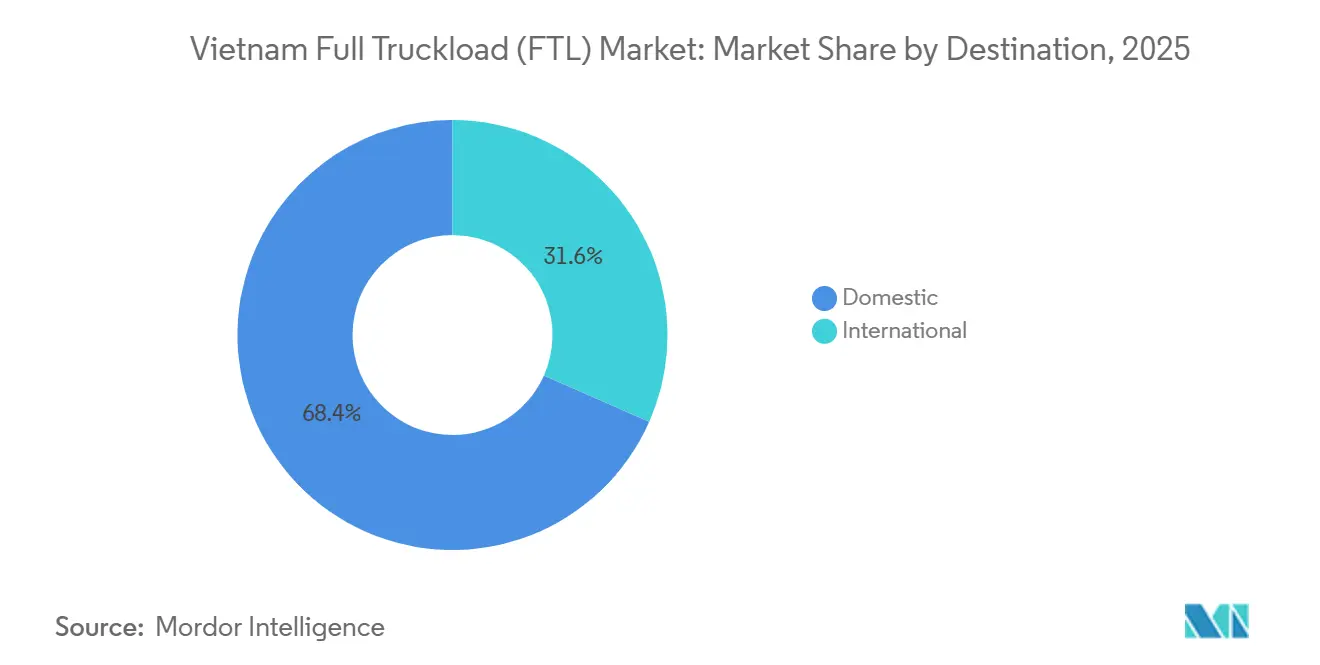
By destination, domestic FTL held 68.35% of the Vietnam full truckload (FTL) market share in 2025, while international lanes recorded the highest projected CAGR at 7.89% through 2031.
By temperature control, dry FTL held 91.31% of the Vietnam full truckload (FTL) market size in 2025, while reefer FTL recorded the highest projected CAGR at 10.45% through 2031.
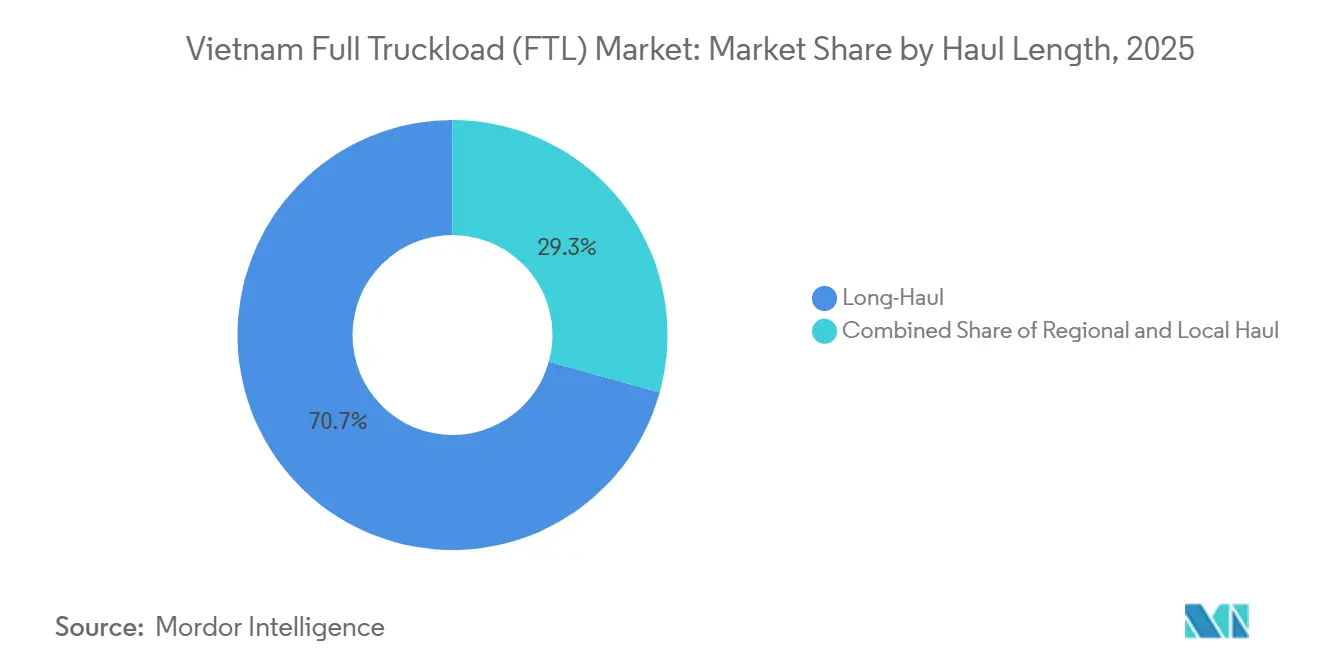
By haul length, long-haul FTL held 70.69% of the Vietnam full truckload (FTL) market share in 2025 and recorded the highest projected CAGR at 9.34% through 2031.
By end-user industry, manufacturing held 36.24% of the Vietnam full truckload (FTL) market size in 2025, while wholesale and retail trade recorded the highest projected CAGR at 10.32% through 2031.
By geography, Southern Vietnam held 46.32% of the Vietnam full truckload (FTL) market share in 2025, while Central Vietnam recorded the highest projected CAGR at 9.78% through 2031.
Note: Market size and forecast figures in this report are generated using Mordor Intelligence’s proprietary estimation framework, updated with the latest available data and insights as of January 2026.
Vietnam Full Truckload (FTL) Market Trends and Insights
Drivers Impact Analysis*
| Driver | (~) % Impact on CAGR Forecast | Geographic Relevance | Impact Timeline |
|---|---|---|---|
| Manufacturing Growth Increasing Full-Truckload Freight Volume Demand | +1.4% | Southern Vietnam, Northern Vietnam, with spillover to Central Vietnam | Medium term (2-4 years) |
| E-Commerce Outsourcing Expanding Dedicated Full-Load Transport Demand | +1.0% | National, concentrated in Ho Chi Minh City and Hanoi urban and peri-urban belts, expanding to the Central Vietnam gateway cities. | Short term (≤ 2 years) |
| Expressway Expansion Improving Long-Haul FTL Network Efficiency | +0.9% | National North-South corridor, with early gains in Quang Ngai, Binh Dinh, and Khanh Hoa | Medium term (2-4 years) |
| Cold-Chain Compliance Increasing Specialized FTL Transport Demand | +0.7% | Southern Vietnam, Central Vietnam, and ASEAN export lanes | Medium term (2-4 years) |
| Customs Digitalization Strengthening Cross-Border Trucking Connectivity | +0.6% | Northern Vietnam border gates and ASEAN trade corridors | Short term (≤ 2 years) |
| Fleet Modernization Improving Load Matching and Utilization | +0.5% | National, with early gains on the Ho Chi Minh City-Binh Duong and Hanoi-Bac Ninh corridors | Long term (≥ 4 years) |
| Source: Mordor Intelligence | |||
Manufacturing Growth Increasing Full-Truckload Freight Volume Demand
Manufacturing grew 10.5% in 2025 and remained the main generator of dedicated truck demand in the full truckload (FTL) market in Vietnam. Realized FDI in Vietnam reached USD 27.62 billion in 2025, the highest level in 5 years, with manufacturing and processing accounting for USD 22.88 billion, or 82.8% of total realized FDI. Electronics and machinery clusters in Bac Ninh and Thai Nguyen require regular palletized movements, making dedicated equipment more suitable than fragmented consignments. A deeper domestic sourcing chain also creates more movements between local suppliers and assembly plants, even when export volumes vary. Vietnam’s total import-export turnover reached USD 930.05 billion in 2025, which continued to support factory-to-port and supplier-to-factory transport flows.
E-Commerce Outsourcing Expanding Dedicated Full-Load Transport Demand
E-commerce is changing the upstream transport requirement for the Vietnam full truckload (FTL) market because fulfillment centers need frequent bulk replenishment from industrial zones. Parcel delivery remains more aligned with express and less-than-truckload networks, but inbound stock movements can fill a dedicated vehicle. Marketplace operators are diversifying fulfillment locations beyond the Ho Chi Minh City core, which creates additional links between suppliers, warehouses, and regional distribution sites. Organized logistics providers are taking a larger role in these flows as domestic brands and cross-border sellers outsource transport management. Freight transported increased 16.7% year-over-year in the first 8 months of 2026, while retail sales of goods and services increased 13.3%, supporting continued demand for domestic transport services. Carriers that pair inbound contracts with compliant return loads can improve the value of the corridor for platforms that require reliable replenishment.
Expressway Expansion Improving Long-Haul FTL Network Efficiency
Vietnam had 3,345 km of main expressway routes and 458 km of interchanges and connecting roads in operation by the end of 2025[1]. The Ministry of Construction targets 5,000 km of expressways by 2030. The North-South corridor improves the commercial case for long-haul FTL by shortening transit windows between Hanoi and Ho Chi Minh City. Faster transport reduces the time that shipments spend in transit and makes next-day service more practical on selected lanes. The approved expansion of the Ho Chi Minh City-Trung Luong-My Thuan expressway strengthens the connection between Ho Chi Minh City and the Mekong Delta, including agricultural and aquaculture production areas. The Vietnam full truckload (FTL) market benefits when carriers use telematics and route planning systems to convert these travel-time gains into better fleet scheduling.
Cold-Chain Compliance Increasing Specialized FTL Transport Demand
Temperature documentation is becoming an important condition for transporting perishable export cargo in the full truckload (FTL) market in Vietnam. Circular No. 80/2025/TT-BNNMT, issued in December 2025 and effective February 2026, established procedures for assessment and food-safety certification of exported fishery products, supporting greater formalization of export cold-chain requirements. These requirements favor carriers with certified reefer fleets over operators that cannot demonstrate temperature control. ITL Corporation held a dedicated cold-chain customer workshop in June 2026, showing that integrated providers were investing attention in the segment.
Restraints Impact Analysis*
| Restraint | (~) % Impact on CAGR Forecast | Geographic Relevance | Impact Timeline |
|---|---|---|---|
| Driver Shortages Increasing Fleet Availability and Cost Pressures | -1.2% | National, most acute in Ho Chi Minh City, Hanoi, Hai Phong, and Da Nang | Medium term (2-4 years) |
| Empty-Return Imbalances Reducing Long-Haul Fleet Utilization Efficiency | -0.8% | National, with a high effect on shorter industrial corridors | Long term (≥ 4 years) |
| Fragmented Fleets Limiting Financing and Modernization Capacity | -0.6% | National, particularly in Southern Vietnam, individual owner-operators | Long term (≥ 4 years) |
| Axle Limits and Congestion Restricting FTL Operations | -0.5% | National, especially major urban congestion zones and port access roads | Short term (≤ 2 years) |
| Source: Mordor Intelligence | |||
Driver Shortages Increasing Fleet Availability and Cost Pressures
The shortage of Category CE-licensed drivers is a structural constraint on the Vietnam full truckload (FTL) market. The Vietnam Automobile Transport Association reported in July 2026 that 25-30% of tractor-trailers in Ho Chi Minh City, Hanoi, Hai Phong, and Da Nang were idle because qualified drivers were unavailable[2]. The affected driver workforce is aging, while the number of new entrants has slowed as training capacity contracted. In Ho Chi Minh City, the number of authorized Category CE training centers reportedly declined from 7 to 1. Some long-haul trips that previously used 2-driver crews and took 36-48 hours now require 3-4 days, raising costs and reducing reliability. Decree 168/2024/ND-CP introduced a demerit-point system, and some transport vendors reported lower driver availability and higher wage requirements after enforcement.
Empty-Return Imbalances Reducing Long-Haul Fleet Utilization Efficiency
Return-trip imbalance remains a major operating restraint in the Vietnam full truckload (FTL) market. Outbound movements are dense and predictable, while return cargo can be sparse and dispersed across locations. This encourages competitive pricing on the outbound leg but weakens the economics of the return movement. The World Bank research on empty miles explains how geographic imbalance and search friction can perpetuate this problem. Fragmented fleets and limited financing make platform adoption slower, while axle limits and congestion add further pressure to payload planning and port access.
*Our forecasts treat driver/restraint impacts as directional, not additive. The impact forecasts reflect baseline growth, mix effects, and variable interactions.
Segment Analysis
By Destination: International Lanes Accelerate, Domestic Foundation Remains Intact
Domestic FTL commanded 68.35% of Vietnam's full truckload (FTL) market size in 2025. Its scale is rooted in industrial-zone-to-port flows and interregional replenishment on the Hanoi-Da Nang-Ho Chi Minh City corridor. Electronics assembly clusters in northern provinces send recurring full-truck loads to Cat Lai, Lach Huyen, and Cai Mep container terminals. Consumer-goods producers in the south also replenish modern retail networks across tier-2 and tier-3 cities through scheduled FTL movements. These flows offer carriers repeatable freight volumes and established operating patterns. Domestic demand, therefore, remains the central revenue base for the full truckload (FTL) market in Vietnam.
International lanes are smaller, but their projected 7.89% CAGR through 2031 makes them the fastest-growing destination segment. The June 2026 authorization for Chinese logistics companies and Type G-permitted vehicles to operate on designated inland routes lowers the need for transshipment. The Mong Cai-Dongxing smart border-gate pilot reduced truck processing time from 3-5 days to 15 seconds through QR code and AI-enabled clearance technology. The same pilot demonstrates how operational friction can decline when infrastructure and regulation are aligned. Cross-border connectivity is especially relevant to northern manufacturing and border-gate corridors. The Vietnam full truckload (FTL) market can shift gradually toward international lanes as compliant operators use these new arrangements.

By Temperature Control: Dry Cargo Anchors Volume While Reefer Climbs Fast
Dry FTL held 91.31% of the Vietnam full truckload (FTL) market size in 2025. Electronics, auto components, construction materials, and consumer goods make up much of the country’s outbound freight profile. These cargoes generally do not need temperature-controlled equipment at current volumes. Electronics producers in Bac Ninh and Thai Nguyen use contract FTL for just-in-time component deliveries. Their planning windows can extend across 5-6 days, which supports predictable vehicle scheduling. Dry freight consequently remains the core volume segment in the Vietnam full truckload (FTL) market.
Reefer FTL is the smaller temperature-control segment, but it is projected to register at a 10.45% CAGR through 2031. Certified temperature monitoring for agricultural export cargo raises the value of qualified reefer capacity. Fishery-product certification requirements introduced in 2025 add to formal cold-chain needs. Pharmaceutical cold-chain activity is a secondary source as domestic generics manufacturing and vaccine logistics expand. Carriers investing in GDP-certified reefer fleets can compete for contract work that dry-only fleets cannot serve.
By Haul Length: Long-Haul Dominates on Both Share and Growth
Long-haul trips, as journeys over 500 miles, captured 70.69% of the Vietnam full truckload (FTL) market share in 2025. They also recorded the highest projected CAGR at 9.34% through 2031. Vietnam’s linear geography connects the major economic poles of Hanoi, Da Nang, and Ho Chi Minh City. This pattern makes long-distance freight a central operating requirement rather than a limited premium service. The completed North-South expressway corridor shortens transit windows and improves the case for time-sensitive truck movements. Long-haul capacity is, therefore, central to the Vietnam full truckload (FTL) market.
Regional haul, covering 100-500 miles, supports industrial distribution and port-access corridors. Local haul, covering less than 100 miles, serves factory-to-consolidation-hub and final-distribution requirements. The shorter categories remain necessary because production, warehousing, and port operations depend on local connections. Long-haul carriers can gain from better fuel efficiency and highway performance when fleets comply with newer emissions standards. ITL Logistics received 40 Isuzu Euro 5 trucks in January 2026 to support its domestic road transportation network[3]. The Vietnam full truckload (FTL) market, therefore, combines a dominant long-haul core with essential regional and local movements.
By End-User Industry: Manufacturing Leads but Retail Trade Gains Ground Fastest
Manufacturing held 36.24% of the Vietnam full truckload (FTL) market size in 2025. Electronics, textiles, and auto-parts clusters require dedicated and sealed truck capacity to protect cargo and meet supply-chain schedules. Manufacturing customers commonly use contracts lasting 12-24 months, which gives carriers a more stable planning base. Their demand favors providers that can maintain consistent vehicle availability and provide shipment visibility. The sector’s factory, supplier, and port links create repeat freight demand across the country. Manufacturing remains the largest end-user base in the Vietnam full truckload (FTL) market.
Wholesale and retail trade is projected to register at a 10.32% CAGR through 2031, the highest rate among the listed end-user industries. E-commerce distribution centers require higher-frequency bulk inbound replenishment that can use dedicated truckloads. Construction also supports FTL demand through expressway and port projects. Oil and gas activity requires specialized transport for tubular goods and rig components, while mining and quarrying remain more cyclically exposed. Agriculture, fishing, and forestry are smaller, but important users, as cold-chain requirements formalize reefer transport. Decision No. 2229/QD-TTg seeks lower logistics costs across manufacturing and agricultural export supply chains, favoring efficient transport providers.
Geography Analysis
Southern Vietnam accounted for 46.32% of Vietnam's full truckload (FTL) market size in 2025. Ho Chi Minh City, Binh Duong, and Dong Nai generate the country’s densest freight flows. Electronics, consumer goods, and auto components move on contract truckloads to Cat Lai and Cai Mep-Thi Vai terminals. The region’s industrial concentration supports frequent movements between plants, warehouses, and ports. The Ho Chi Minh City-Trung Luong-My Thuan expressway expansion was approved in December 2025 and strengthened connectivity with the Mekong Delta[4]. This route opens a more formal agricultural-logistics corridor for carriers serving southern production and export areas.
Northern Vietnam has a large industrial base around Hanoi, Bac Ninh, and Thai Nguyen. Electronics production creates frequent FTL movements toward Lach Huyen port in Hai Phong. Lang Son, Mong Cai, and Lao Cai provide a second source of demand through cross-border trade with China. The Mong Cai-Dongxing pilot uses AI-enabled clearance and QR-code documentation to reduce processing time. Decision 453/QD-TTg approved smart border-gate construction at Kim Thanh and Ban Vuoc in March 2026. These projects support a more formal and efficient northern trade corridor.
Central Vietnam recorded the highest projected regional CAGR at 9.78% through 2031. Its growth reflects new expressway access and industrial decentralization from more established clusters. The national expressway network reached 3,345 km by the end of 2025, improving the links among Da Nang, Quy Nhon, Dung Quat Economic Zone, Hanoi, and Ho Chi Minh City. The national logistics strategy identifies Central Vietnam corridors as a development priority through 2035. This makes Central Vietnam an increasingly relevant growth area for the Vietnam full truckload (FTL) market.
Competitive Landscape
The market remains fragmented, with a large base of individual truck owners and small carriers. The organized tier includes ITL Corporation, Gemadept Corporation, and Transimex Corporation. These providers compete through fleet capability, digital visibility, and multimodal logistics connections. Global operators, including DHL Group, DSV A/S, Kuehne+Nagel, CEVA Logistics, and A.P. Moller-Maersk, compete for FDI manufacturer accounts and cross-border work. Their networks can combine road movements with bonded yards and wider regional services. The Vietnam full truckload (FTL) market, therefore, includes a large owner-operator base alongside a smaller group of integrated providers.
ITL Logistics received 40 Isuzu Euro 5 trucks in January 2026, expanding capacity for its domestic road transportation network. ITL Corporation and Seino Holdings launched Seino-ITL Logistics in September 2025 to provide LTL and FTL transportation services through Seino’s model and ITL’s Vietnamese network. This structure allows each party to focus on its own operating area. Gemadept has also identified cold-chain logistics as a growth area through its stake in Mekong Logistics. These moves show that leading providers are adding assets, refining partnerships, and pursuing specialized logistics capability.
Technology adoption is a differentiator for organized carriers. Transport-management-system links, telematics, track-and-trace tools, and electronic delivery orders support dedicated manufacturing contracts. These customers need rapid exception alerts and digital proof of delivery. The Logistics Service Development Strategy for 2025-2035 identifies digital transformation as a national priority. Temperature-monitoring integration and vehicle-emissions compliance are further areas where larger providers have practical advantages. Digital load matching also offers a route to improve utilization among individual operators, but dispersed ownership slows adoption across the Vietnam full truckload (FTL) market.
Vietnam Full Truckload (FTL) Industry Leaders
-
Indo Trans Logistics Corporation (ITL)
-
Linfox
-
Saigon Newport Corporation
-
DHL Group
-
Transimex Corporation
- *Disclaimer: Major Players sorted in no particular order
Recent Industry Developments
- August 2026: Circular 128/2026/TT-BTC issued by the Ministry of Finance established customs inspection and supervision requirements for smart border gate areas, effective October 15, 2026. The circular mandates AI-enabled camera systems, electronic barriers, electronic scales, and direct connection to the customs electronic data-processing system.
- June 2026: Gemadept Corporation and CJ Logistics Hong Kong Holdings Limited completed a capital-transfer transaction, restructuring their joint-venture arrangement. Gemadept now holds 49% equity in Mekong Logistics Joint Stock Company and directly manages shipping operations, while CJ Logistics fully manages 3PL services.
- January 2026: ITL Logistics received 40 Isuzu Euro 5 trucks from Green Ka Joint Stock Company in a formal handover ceremony in Ho Chi Minh City. The fleet expansion supports ITL's domestic road-transportation network.
- September 2025: ITL Corporation and Japan's Seino Holdings officially launched Seino-ITL Logistics, a joint venture headquartered in Ho Chi Minh City. The venture targets LTL and FTL transportation services, leveraging Seino's Japanese LTL model and ITL's nationwide Vietnamese network.
Vietnam Full Truckload (FTL) Market Report Scope
| Domestic |
| International |
| Dry |
| Reefer |
| Long-Haul (More than 500 miles) |
| Regional (100-500 miles) |
| Local (Less than 100 miles) |
| Agriculture |
| Fishing and Forestry |
| Construction |
| Manufacturing |
| Oil and Gas |
| Mining and Quarrying |
| Wholesale and Retail Trade |
| Others |
| Northern Vietnam |
| Central Vietnam |
| Southern Vietnam |
| By Destination | Domestic |
| International | |
| By Temperature Control | Dry |
| Reefer | |
| By Haul Length | Long-Haul (More than 500 miles) |
| Regional (100-500 miles) | |
| Local (Less than 100 miles) | |
| By End-User Industry | Agriculture |
| Fishing and Forestry | |
| Construction | |
| Manufacturing | |
| Oil and Gas | |
| Mining and Quarrying | |
| Wholesale and Retail Trade | |
| Others | |
| By Region | Northern Vietnam |
| Central Vietnam | |
| Southern Vietnam |
Key Questions Answered in the Report
What is the forecast for Vietnam's full truckload services?
The Vietnam full truckload (FTL) market is estimated to increase from USD 22.80 billion in 2026 to USD 30.75 billion by 2031, at a 6.16% CAGR.
Which destination type is growing fastest in Vietnam's full truckload services?
International lanes are projected to record a 7.89% CAGR through 2031, supported by digital customs processes and designated cross-border routes.
What is the leading temperature-control category for Vietnam FTL?
Dry FTL held 91.31% of demand in 2025, while reefer FTL is projected to register at a 10.45% CAGR through 2031.
Why is long-haul trucking important in Vietnam?
Long-haul FTL held 70.69% share in 2025 and is projected to register at a 9.34% CAGR as expressway links improve national connectivity.
Which customer sector uses the most dedicated truck capacity in Vietnam?
Manufacturing held 36.24% share in 2025 because electronics, textiles, and auto-parts producers need reliable factory, supplier, and port transport.
What constraint affects FTL capacity in Vietnam?
A shortage of Category CE-licensed drivers left 25-30% of tractor-trailers idle across major logistics hubs in July 2026.