
Vietnam Feed Additives Market Size and Share
Market Overview
| Study Period | 2018 - 2031 |
|---|---|
| Forecast Data Period | 2026 - 2031 |
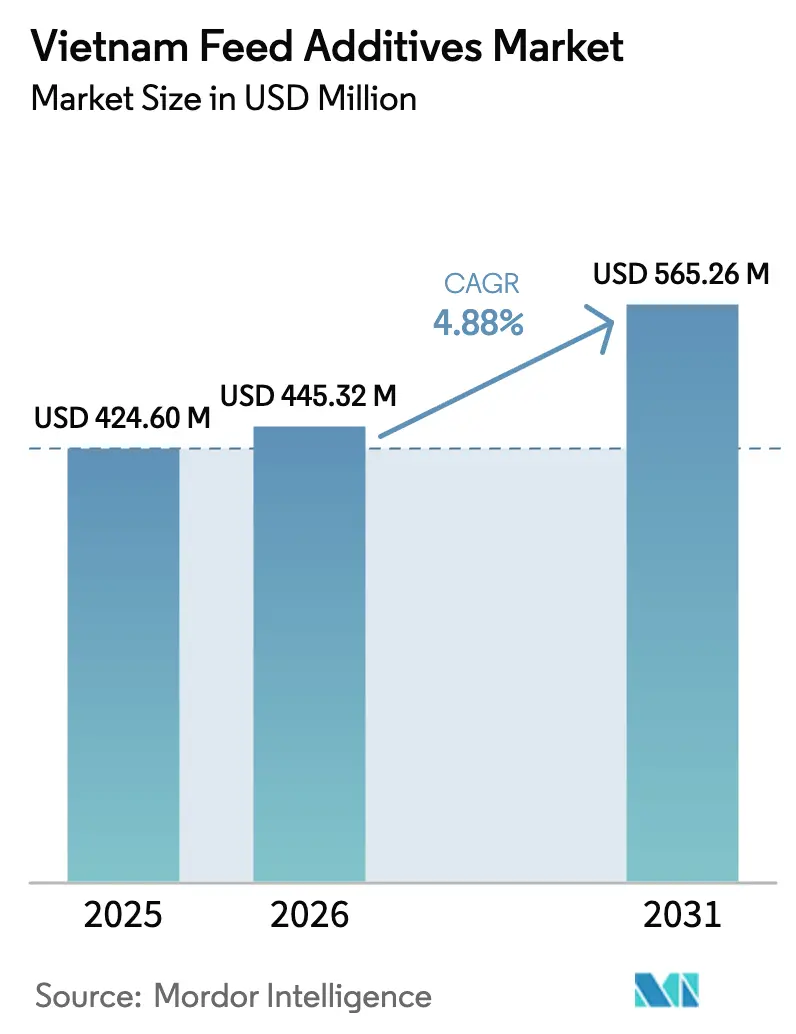
| Base Year Market Size (2025) | USD 424.6 Million |
| Market Size (2026) | USD 445.32 Million |
| Market Size (2031) | USD 565.26 Million |
| Growth Rate (2026 - 2031) | 4.88 % |
| Market Concentration | Medium |
Major Players *Disclaimer: Major Players sorted in no particular order Image © Mordor Intelligence. Reuse requires attribution under CC BY 4.0. | |
Vietnam Feed Additives Market Analysis by Mordor Intelligence
The Vietnam Feed Additives Market size is expected to grow from USD 424.6 million in 2025 to USD 445.32 million in 2026 and is forecast to reach USD 565.26 million by 2031 at 4.88% CAGR over 2026-2031.
The Vietnamese feed additives industry has evolved significantly, driven by an increasing focus on animal nutrition and feed efficiency. The industry structure is characterized by a strong presence of both international and domestic players, with major companies investing in local manufacturing capabilities to meet growing demand. A notable development in this direction was Alltech's establishment of a new organic trace minerals manufacturing facility in 2022, with an annual production capacity of 7,000 metric tons, demonstrating the industry's commitment to expanding local production capabilities. The market has also witnessed increased adoption of advanced feed ingredients technologies and formulations, particularly in the commercial farming sector.
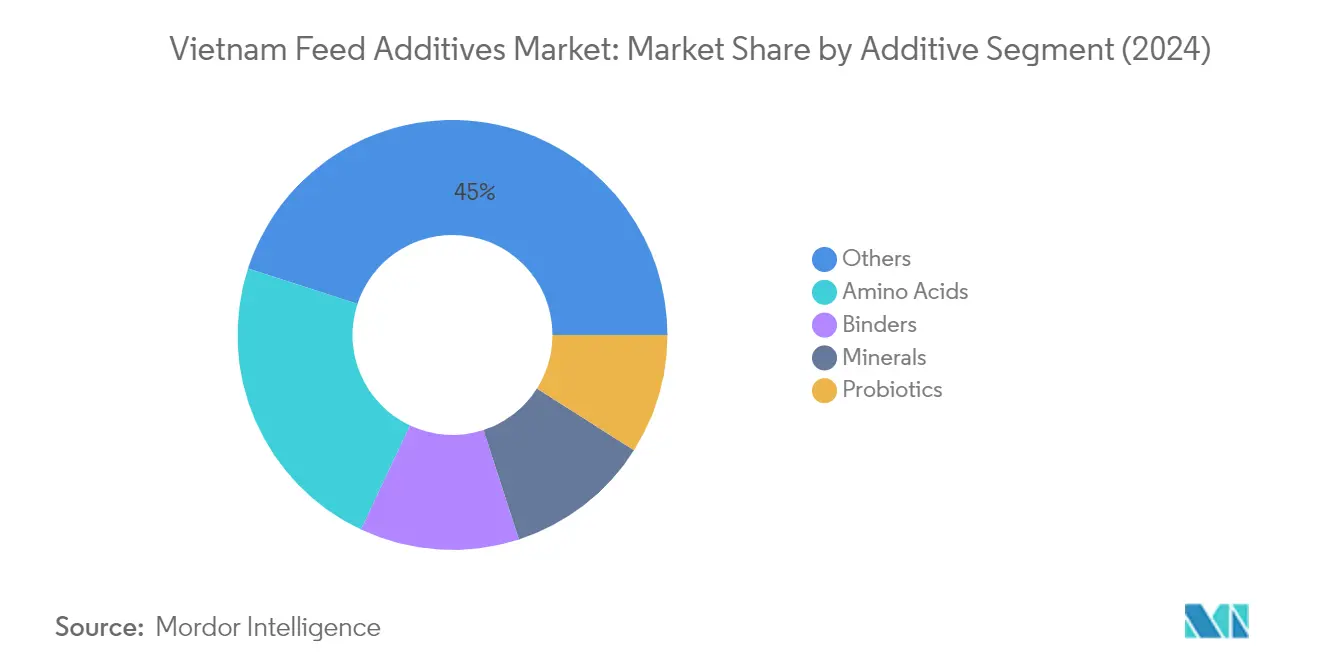
The industry has experienced a notable shift toward scientific feed formulation and quality enhancement, particularly in the feed amino acids segment. In 2022, the combination of key feed additives amino acids, binders, minerals, and probiotics accounted for 54.7% of the total market share, highlighting their crucial role in animal nutrition and growth performance. This trend is further evidenced by the significant utilization of specific amino acids, with lysine and methionine emerging as the dominant components, collectively representing over half of the amino acids segment. The industry has also seen increased emphasis on feed safety and quality standards, with manufacturers implementing stringent quality control measures.
The market is witnessing a transformation in feeding practices, particularly in the commercial livestock sector. Synthetic binders have gained substantial traction, commanding 64.4% of the binders segment in 2022, primarily due to their role in improving feed quality and digestibility. The industry has also seen increased adoption of advanced feed formulation technologies, with a growing focus on precision nutrition and customized feed solutions. This trend is particularly evident in the swine and poultry sectors, where feed efficiency and performance optimization are crucial.
The Vietnamese feed additives market is experiencing significant technological advancement and innovation in product development. Companies are increasingly investing in research and development to create more effective and sustainable nutritional feed additives solutions. The market has seen a notable shift toward natural and sustainable functional feed additives, with increasing emphasis on reducing environmental impact while maintaining performance benefits. This trend is particularly evident in the growing adoption of probiotics and organic feed minerals, as manufacturers respond to the increasing demand for more natural feed solutions. The industry has also witnessed increased collaboration between feed manufacturers and research institutions to develop innovative feed solutions.
Note: Market size and forecast figures in this report are generated using Mordor Intelligence’s proprietary estimation framework, updated with the latest available data and insights as of 2026.
Vietnam Feed Additives Market Trends and Insights
Poultry birds were 92.5% of country's animal population and has been increasing due to high demand for consumption and investment by companies to expand their farms
- Vietnam's poultry industry has grown in recent years, with poultry birds accounting for 92.5% of the total animal headcount in 2022. This trend can be attributed to the country's increasing demand for meat and eggs. Between 2017 and 2022, poultry production saw an impressive 67.5% growth due to the rising meat consumption and demand for animal protein.
- The spread of African swine fever in 2019 significantly impacted Vietnam's poultry industry. With consumers switching from pork to other meats such as chicken, poultry production increased by 26% from 2018, reaching 496 million heads in 2020. However, smallholder poultry production during the COVID-19 outbreak was negatively affected due to a shortage of feed caused by the closure of feed mills, leading to a 30% increase in feed prices. Nevertheless, poultry production bounced back in 2022, with a 1.9% increase from the previous year following the ease of COVID-19 restrictions and the reopening of restaurants, leading to a rise in poultry demand.
- Most of the poultry production in the country is attributed to smallholder farms, with flock sizes averaging 2,000-5,000 birds. However, major farms are investing in expanding their farms with a keeping size of 8,000-15,000 birds due to the increased profit margins and the growing demand for poultry meat and eggs. For instance, CP Vietnam invested USD 250 million in a poultry project to produce high-quality chicken products for local consumption and export to Japan, Europe, and the Middle East. Given the rising investments and consumer demand, Vietnam's poultry farming industry is expected to continue thriving during the forecast period.


Increasing awareness of nutritionally balanced feed and Vietnamese government plans for developing fishers industry is increasing the demand for aqua feed production
- In 2022, aquaculture compound feed production accounted for 28.5% of the total compound feed production in the country. The growing demand for aquaculture feed is being driven by the increasing awareness of nutritionally balanced feed to enhance the productivity and performance of aquaculture animals. This trend significantly increased aquaculture feed production by 55.2% in 2022 compared to 2017. The Vietnamese government is committed to developing the fisheries industry and meeting the growing consumer demand. The Ministry of Agriculture and Rural Development launched a national action plan in 2017 to develop Vietnam's shrimp industry until 2025 and expand the brackish water shrimp industry until 2030, leading to an increase in the production of compound feed for shrimp by 106.6% from 2017 to 365.4 thousand metric tons in 2022.
- The use of acidifiers is projected to increase in compound feed due to their ability to improve feed conversion, reduce pathogen pressure, and preserve feed. They are also considered a promising alternative to in-feed antibiotics in aquaculture. Therefore, the acidifiers segment of the feed additives market is projected to record a CAGR of 5.8% during the forecast period.
- Therefore, the growing awareness of the benefits of compound feed and the rising demand for aquaculture products are expected to boost the market's growth during the forecast period. The government initiatives to develop the fisheries industry and meet consumer demand may also drive the demand for compound feed, providing significant opportunities for businesses operating in this market.

OTHER KEY INDUSTRY TRENDS COVERED IN THE REPORT
- High number of dairy farms with high profit margins and increasing demand for milk production has been increasing the ruminants production in the country
- Increase in the egg production and higher investments in broiler farming is encouraging the feed producing companies to increase the feed production for poultry
- High demand for swine feed is in Vietnam's northern and southern regions but there is an increase in the demand for healthy pig which is expected to increase the demand for swine feed in the future
- Government initiatives such as paying compensation for culling pigs and piglets is leading to increasing swine production
- Dairy cattle feed is increasing in the country as there is increasing trend of organic milk which is leading to increase in the investments in the dairy sector
Segment Analysis: By Additive
Amino Acids Segment in Vietnam Feed Additives Market
Amino acids represent the dominant segment in Vietnam's feed additives market, accounting for approximately 23.82% of the total market share in 2025. This significant market position is primarily driven by their crucial role in promoting the growth and development of muscles and meat in animals. Feed amino acids such as lysine and methionine are the most widely used in Vietnam, together accounting for over 53% of the total amino acids consumption, particularly in aquaculture and poultry applications. The segment's prominence is further reinforced by the increasing awareness among farmers about the benefits of feed amino acids supplementation in improving feed efficiency and animal performance. The demand is particularly strong in the swine sector, which represents the largest consumer of amino acids in Vietnam, driven by the country's substantial pork production industry.

Acidifiers Segment in Vietnam Feed Additives Market
The acidifiers segment is emerging as the most dynamic category in Vietnam's feed additives market, projected to grow at approximately 5.67% CAGR from 2026 to 2031. This remarkable growth trajectory is primarily attributed to the increasing recognition of feed acidifiers' role in enhancing feed palatability and improving nutrient absorption in animals. Propionic acid and fumaric acid are leading the growth within this segment, as they effectively prevent digestive disorders and enhance feed conversion rates. The segment's expansion is further supported by the rising adoption of feed acidifiers as alternatives to antibiotics, particularly in the aquaculture and swine sectors. The growth is also driven by acidifiers' proven ability to improve intestinal immunity by enhancing gastrointestinal tract health and digestion in animals.
Remaining Segments in Feed Additives Market by Additive
The Vietnam feed additives market encompasses several other significant segments, including binders, minerals, probiotics, vitamins, enzymes, antioxidants, phytogenics, mycotoxin detoxifiers, and yeast derivatives. Binders play a crucial role in improving feed quality and reducing nutrient loss during processing, while feed minerals are essential for various physiological functions in animals. Feed probiotics and prebiotics are gaining importance due to their role in improving gut health and immunity. Feed vitamins are fundamental for maintaining animal health and productivity, while feed enzymes enhance nutrient utilization efficiency. Feed antioxidants help in preserving feed quality, and feed phytogenics are emerging as natural growth promoters. Mycotoxin detoxifiers are becoming increasingly important for feed safety, while yeast derivatives contribute to improved animal performance and health.
Segment Analysis: By Animal
Swine Segment in Vietnam Feed Additives Market
The swine segment dominates the Vietnam feed additives market, commanding approximately 42% market share in 2024. This significant market position is driven by Vietnam's substantial swine feed production, which reached 6.6 million metric tons in recent years. The segment's prominence is further reinforced by the country's high pork consumption patterns, where pork represents about 65-70% of total protein consumption. The strong market position is supported by increasing investments in swine farming infrastructure and the growing adoption of feed additives to improve meat quality and animal health. Amino acids constitute the most important feed additives used in swine rearing, with a notable focus on improving muscle growth, feed efficiency, and overall animal performance. The segment's growth is also supported by Vietnam's expanding export market for pork products and the increasing emphasis on high-quality meat production.
Poultry Segment in Vietnam Feed Additives Market
The poultry segment is emerging as the fastest-growing segment in the Vietnam feed additives market, projected to expand at a CAGR of approximately 6% during 2024-2029. This remarkable growth is driven by several factors, including the increasing demand for eggs and poultry meat for consumption and muscle development. The segment's growth is further supported by significant investments in the poultry sector, with major companies expanding their production facilities and implementing advanced feeding technologies. The rising adoption of feed additives in poultry diets is particularly notable in improving feed efficiency, enhancing immune function, and promoting better growth rates. The segment is witnessing increased usage of various feed additives, with acidifiers showing particularly strong growth potential due to their ability to improve nutrient absorption and reduce pathogenic microbes.
Remaining Segments in Vietnam Feed Additives Market
The remaining segments in the Vietnam feed additives market include aquaculture, ruminants, and other animals, each playing distinct roles in shaping the market landscape. The aquaculture segment has emerged as a significant contributor, particularly in fish and shrimp farming, with an increasing focus on feed quality and sustainability. The ruminants segment, though smaller, maintains steady growth through dairy cattle farming and increasing awareness about feed nutrition. The other animals segment, while representing a smaller portion of the market, serves specialized farming needs across various species. These segments collectively contribute to the market's diversity and demonstrate the expanding scope of feed additive applications across different livestock categories in Vietnam's agricultural sector.
Competitive Landscape
Top Companies in Vietnam Feed Additives Market
The Vietnam feed additives market is characterized by companies focusing on strategic initiatives to strengthen their market positions. Product innovation emerges as a key trend, with companies developing new feed enzymes products, phytogenic solutions, and specialized nutritional formulations to meet evolving customer needs. Operational agility is demonstrated through the establishment of local manufacturing facilities and distribution networks, enabling companies to better serve the Vietnamese market. Strategic partnerships and collaborations, particularly with regional players and research institutions, have become increasingly common to enhance product offerings and expand market reach. Companies are also pursuing geographical expansion through new manufacturing facilities and the acquisition of local players, while simultaneously investing in research and development capabilities to drive technological advancement in feed additives solutions.
Global Leaders Dominate Vietnamese Feed Market
The Vietnamese animal feed additives market exhibits a moderately consolidated structure, with global multinational corporations holding significant market share. These international players leverage their extensive research capabilities, technological expertise, and established brand reputation to maintain their market positions. The market is primarily dominated by diversified chemical and agricultural conglomerates that offer comprehensive product portfolios across multiple animal feed additives categories, while specialized feed additive manufacturers maintain their presence in specific market segments through focused product offerings and technical expertise.
The market has witnessed several strategic acquisitions and partnerships, indicating a trend toward consolidation. Global players are actively pursuing acquisitions of local companies to strengthen their regional presence and expand their product portfolios. These acquisitions are particularly focused on companies with strong distribution networks or specialized product offerings in high-growth segments such as amino acids, enzymes, and probiotics. The presence of both global and local players creates a competitive environment where companies must continuously innovate and adapt to maintain their market positions.
Innovation and Local Presence Drive Success
Success in the Vietnamese feed additives market increasingly depends on companies' ability to develop innovative products that address specific local needs while maintaining cost competitiveness. Incumbents can strengthen their market position by investing in local manufacturing facilities, developing strong distribution networks, and building close relationships with key customers in the livestock and aquaculture sectors. Companies must also focus on providing technical support services and customized solutions to differentiate themselves in an increasingly competitive market. The ability to offer integrated solutions that combine multiple feed ingredients categories while ensuring product quality and consistency will be crucial for maintaining market leadership.
For contenders looking to gain market share, establishing strong local partnerships and developing specialized product offerings for specific animal segments present significant opportunities. Success will depend on understanding local market dynamics, regulatory requirements, and customer preferences while maintaining competitive pricing strategies. Companies must also consider potential regulatory changes, particularly regarding antibiotic alternatives and sustainable production practices, which could create new market opportunities. The increasing focus on animal health and nutrition, combined with the growing demand for meat and aquaculture products, creates a favorable environment for companies that can effectively address these market needs while managing production costs and maintaining product quality.
Vietnam Feed Additives Industry Leaders
Alltech, Inc.
Archer Daniel Midland Co.
DSM Nutritional Products AG
Kemin Industries
SHV (Nutreco NV)
- *Disclaimer: Major Players sorted in no particular order


Recent Industry Developments
- January 2023: Novus International acquired the Biotech company Agrivida to develop new feed additives.
- November 2022: Kemin Industries introduced Toxfin Care, a solution that protects feed from mycotoxins. It strengthens the immune system, protects organs, and prevents loss of performance and productivity.
- November 2022: Alltech Inc. has established new manufacturing for organic trace minerals in Vietnam with a manufacturing facility with an annual capacity of about 7,000 metric tons.


Vietnam Feed Additives Market Report Scope
Acidifiers, Amino Acids, Antibiotics, Antioxidants, Binders, Enzymes, Flavors & Sweeteners, Minerals, Mycotoxin Detoxifiers, Phytogenics, Pigments, Prebiotics, Probiotics, Vitamins, Yeast are covered as segments by Additive. Aquaculture, Poultry, Ruminants, Swine are covered as segments by Animal.| Acidifiers | By Sub Additive | Fumaric Acid |
| Lactic Acid | ||
| Propionic Acid | ||
| Other Acidifiers | ||
| Amino Acids | By Sub Additive | Lysine |
| Methionine | ||
| Threonine | ||
| Tryptophan | ||
| Other Amino Acids | ||
| Antibiotics | By Sub Additive | Bacitracin |
| Penicillins | ||
| Tetracyclines | ||
| Tylosin | ||
| Other Antibiotics | ||
| Antioxidants | By Sub Additive | Butylated Hydroxyanisole (BHA) |
| Butylated Hydroxytoluene (BHT) | ||
| Citric Acid | ||
| Ethoxyquin | ||
| Propyl Gallate | ||
| Tocopherols | ||
| Other Antioxidants | ||
| Binders | By Sub Additive | Natural Binders |
| Synthetic Binders | ||
| Enzymes | By Sub Additive | Carbohydrases |
| Phytases | ||
| Other Enzymes | ||
| Flavors and Sweeteners | By Sub Additive | Flavors |
| Sweeteners | ||
| Minerals | By Sub Additive | Macrominerals |
| Microminerals | ||
| Mycotoxin Detoxifiers | By Sub Additive | Binders |
| Biotransformers | ||
| Other Mycotoxin Detoxifiers | ||
| Phytogenics | By Sub Additive | Essential Oil |
| Herbs and Spices | ||
| Other Phytogenics | ||
| Pigments | By Sub Additive | Carotenoids |
| Curcumin and Spirulina | ||
| Prebiotics | By Sub Additive | Fructo Oligosaccharides |
| Galacto Oligosaccharides | ||
| Inulin | ||
| Lactulose | ||
| Mannan Oligosaccharides | ||
| Xylo Oligosaccharides | ||
| Other Prebiotics | ||
| Probiotics | By Sub Additive | Bifidobacteria |
| Enterococcus | ||
| Lactobacilli | ||
| Pediococcus | ||
| Streptococcus | ||
| Other Probiotics | ||
| Vitamins | By Sub Additive | Vitamin A |
| Vitamin B | ||
| Vitamin C | ||
| Vitamin E | ||
| Other Vitamins | ||
| Yeast | By Sub Additive | Live Yeast |
| Selenium Yeast | ||
| Spent Yeast | ||
| Torula Dried Yeast | ||
| Whey Yeast | ||
| Yeast Derivatives |
| Aquaculture | By Sub Animal | Fish |
| Shrimp | ||
| Other Aquaculture Species | ||
| Poultry | By Sub Animal | Broiler |
| Layer | ||
| Other Poultry Birds | ||
| Ruminants | By Sub Animal | Beef Cattle |
| Dairy Cattle | ||
| Other Ruminants | ||
| Swine | ||
| Other Animals |
| Additive | Acidifiers | By Sub Additive | Fumaric Acid |
| Lactic Acid | |||
| Propionic Acid | |||
| Other Acidifiers | |||
| Amino Acids | By Sub Additive | Lysine | |
| Methionine | |||
| Threonine | |||
| Tryptophan | |||
| Other Amino Acids | |||
| Antibiotics | By Sub Additive | Bacitracin | |
| Penicillins | |||
| Tetracyclines | |||
| Tylosin | |||
| Other Antibiotics | |||
| Antioxidants | By Sub Additive | Butylated Hydroxyanisole (BHA) | |
| Butylated Hydroxytoluene (BHT) | |||
| Citric Acid | |||
| Ethoxyquin | |||
| Propyl Gallate | |||
| Tocopherols | |||
| Other Antioxidants | |||
| Binders | By Sub Additive | Natural Binders | |
| Synthetic Binders | |||
| Enzymes | By Sub Additive | Carbohydrases | |
| Phytases | |||
| Other Enzymes | |||
| Flavors and Sweeteners | By Sub Additive | Flavors | |
| Sweeteners | |||
| Minerals | By Sub Additive | Macrominerals | |
| Microminerals | |||
| Mycotoxin Detoxifiers | By Sub Additive | Binders | |
| Biotransformers | |||
| Other Mycotoxin Detoxifiers | |||
| Phytogenics | By Sub Additive | Essential Oil | |
| Herbs and Spices | |||
| Other Phytogenics | |||
| Pigments | By Sub Additive | Carotenoids | |
| Curcumin and Spirulina | |||
| Prebiotics | By Sub Additive | Fructo Oligosaccharides | |
| Galacto Oligosaccharides | |||
| Inulin | |||
| Lactulose | |||
| Mannan Oligosaccharides | |||
| Xylo Oligosaccharides | |||
| Other Prebiotics | |||
| Probiotics | By Sub Additive | Bifidobacteria | |
| Enterococcus | |||
| Lactobacilli | |||
| Pediococcus | |||
| Streptococcus | |||
| Other Probiotics | |||
| Vitamins | By Sub Additive | Vitamin A | |
| Vitamin B | |||
| Vitamin C | |||
| Vitamin E | |||
| Other Vitamins | |||
| Yeast | By Sub Additive | Live Yeast | |
| Selenium Yeast | |||
| Spent Yeast | |||
| Torula Dried Yeast | |||
| Whey Yeast | |||
| Yeast Derivatives | |||
| Animal | Aquaculture | By Sub Animal | Fish |
| Shrimp | |||
| Other Aquaculture Species | |||
| Poultry | By Sub Animal | Broiler | |
| Layer | |||
| Other Poultry Birds | |||
| Ruminants | By Sub Animal | Beef Cattle | |
| Dairy Cattle | |||
| Other Ruminants | |||
| Swine | |||
| Other Animals | |||


Market Definition
- FUNCTIONS - For the study, feed additives are considered to be commercially manufactured products that are used to enhance characteristics such as weight gain, feed conversion ratio, and feed intake when fed in appropriate proportions.
- RESELLERS - Companies engaged in reselling feed additives without value addition have been excluded from the market scope, to avoid double counting.
- END CONSUMERS - Compound feed manufacturers are considered to be end-consumers in the market studied. The scope excludes farmers buying feed additives to be used directly as supplements or premixes.
- INTERNAL COMPANY CONSUMPTION - Companies engaged in the production of compound feed as well as the manufacturing of feed additives are part of the study. However, while estimating the market sizes, the internal consumption of feed additives by such companies has been excluded.
| Keyword | Definition |
|---|---|
| Feed additives | Feed additives are products used in animal nutrition for purposes of improving the quality of feed and the quality of food from animal origin, or to improve the animals’ performance and health. |
| Probiotics | Probiotics are microorganisms introduced into the body for their beneficial qualities. (It maintains or restores beneficial bacteria to the gut). |
| Antibiotics | Antibiotic is a drug that is specifically used to inhibit the growth of bacteria. |
| Prebiotics | A non-digestible food ingredient that promotes the growth of beneficial microorganisms in the intestines. |
| Antioxidants | Antioxidants are compounds that inhibit oxidation, a chemical reaction that produces free radicals. |
| Phytogenics | Phytogenics are a group of natural and non-antibiotic growth promoters derived from herbs, spices, essential oils, and oleoresins. |
| Vitamins | Vitamins are organic compounds, which are required for normal growth and maintenance of the body. |
| Metabolism | A chemical process that occurs within a living organism in order to maintain life. |
| Amino acids | Amino acids are the building blocks of proteins and play an important role in metabolic pathways. |
| Enzymes | Enzyme is a substance that acts as a catalyst to bring about a specific biochemical reaction. |
| Anti-microbial resistance | The ability of a microorganism to resist the effects of an antimicrobial agent. |
| Anti-microbial | Destroying or inhibiting the growth of microorganisms. |
| Osmotic balance | It is a process of maintaining salt and water balance across membranes within the body's fluids. |
| Bacteriocin | Bacteriocins are the toxins produced by bacteria to inhibit the growth of similar or closely related bacterial strains. |
| Biohydrogenation | It is a process that occurs in the rumen of an animal in which bacteria convert unsaturated fatty acids (USFA) to saturated fatty acids (SFA). |
| Oxidative rancidity | It is a reaction of fatty acids with oxygen, which generally causes unpleasant odors in animals. To prevent these, antioxidants were added. |
| Mycotoxicosis | Any condition or disease caused by fungal toxins, mainly due to contamination of animal feed with mycotoxins. |
| Mycotoxins | Mycotoxins are toxin compounds that are naturally produced by certain types of molds (fungi). |
| Feed Probiotics | Microbial feed supplements positively affect gastrointestinal microbial balance. |
| Probiotic yeast | Feed yeast (single-cell fungi) and other fungi used as probiotics. |
| Feed enzymes | They are used to supplement digestive enzymes in an animal’s stomach to break down food. Enzymes also ensure that meat and egg production is improved. |
| Mycotoxin detoxifiers | They are used to prevent fungal growth and to stop any harmful mold from being absorbed in the gut and blood. |
| Feed antibiotics | They are used both for the prevention and treatment of diseases but also for rapid growth and development. |
| Feed antioxidants | They are used to protect the deterioration of other feed nutrients in the feed such as fats, vitamins, pigments, and flavoring agents, thus providing nutrient security to the animals. |
| Feed phytogenics | Phytogenics are natural substances, added to livestock feed to promote growth, aid in digestion, and act as anti-microbial agents. |
| Feed vitamins | They are used to maintain the normal physiological function and normal growth and development of animals. |
| Feed flavors and sweetners | These flavors and sweeteners help to mask tastes and odors during changes in additives or medications and make them ideal for animal diets undergoing transition. |
| Feed acidifiers | Animal feed acidifiers are organic acids incorporated into the feed for nutritional or preservative purposes. Acidifiers enhance congestion and microbiological balance in the alimentary and digestive tracts of livestock. |
| Feed minerals | Feed minerals play an important role in the regular dietary requirements of animal feed. |
| Feed binders | Feed binders are the binding agents used in the manufacture of safe animal feed products. It enhances the taste of food and prolongs the storage period of the feed. |
| Key Terms | Abbreviation |
| LSDV | Lumpy Skin Disease Virus |
| ASF | African Swine Fever |
| GPA | Growth Promoter Antibiotics |
| NSP | Non-Starch Polysaccharides |
| PUFA | Polyunsaturated Fatty Acid |
| Afs | Aflatoxins |
| AGP | Antibiotic Growth Promoters |
| FAO | The Food And Agriculture Organization of the United Nations |
| USDA | The United States Department of Agriculture |


Research Methodology
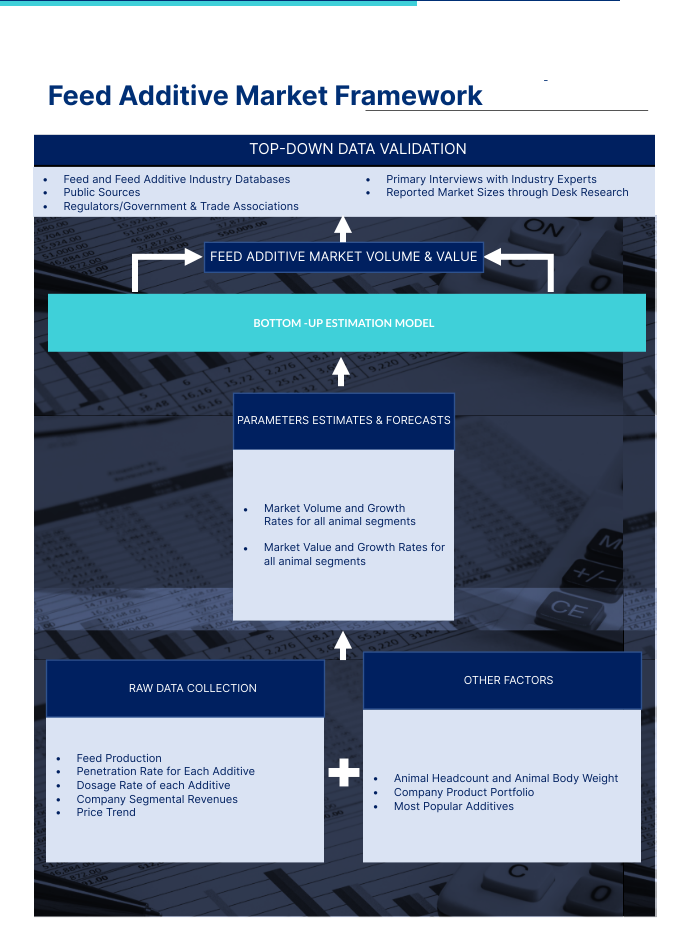
Mordor Intelligence follows a four-step methodology in all our reports.
- Step-1: IDENTIFY KEY VARIABLES: In order to build a robust forecasting methodology, the variables and factors identified in Step-1 are tested against available historical market numbers. Through an iterative process, the variables required for market forecast are set and the model is built on the basis of these variables.
- Step-2: Build a Market Model: Market-size estimations for the forecast years are in nominal terms. Inflation is not a part of the pricing, and the average selling price (ASP) is kept constant throughout the forecast period.
- Step-3: Validate and Finalize: In this important step, all market numbers, variables and analyst calls are validated through an extensive network of primary research experts from the market studied. The respondents are selected across levels and functions to generate a holistic picture of the market studied.
- Step-4: Research Outputs: Syndicated Reports, Custom Consulting Assignments, Databases & Subscription Platforms





 Your data is secure and never sold or shared.


