
Vietnam Data Center Storage Market Size and Share
Market Overview
| Study Period | 2020 - 2031 |
|---|---|
| Forecast Data Period | 2026 - 2031 |
| Base Year Market Size (2025) | USD 210 Billion |
| Market Size (2026) | USD 219.7 Billion |
| Market Size (2031) | USD 275.5 Billion |
| Growth Rate (2026 - 2031) | 4.62 % |
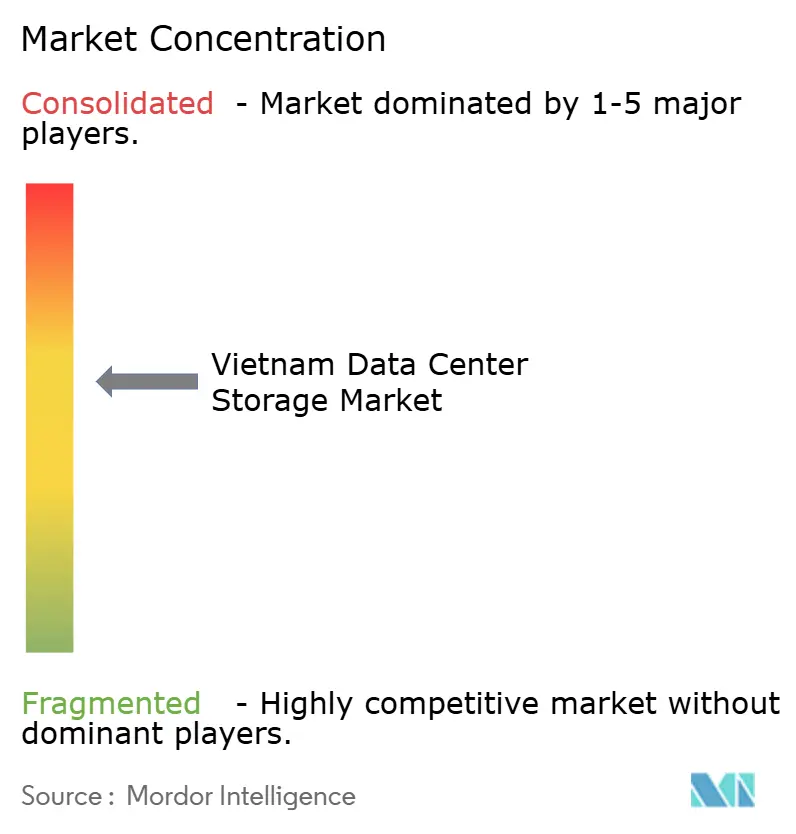
| Market Concentration | Medium |
Major Players *Disclaimer: Major Players sorted in no particular order Image © Mordor Intelligence. Reuse requires attribution under CC BY 4.0. | |
Vietnam Data Center Storage Market Analysis by Mordor Intelligence
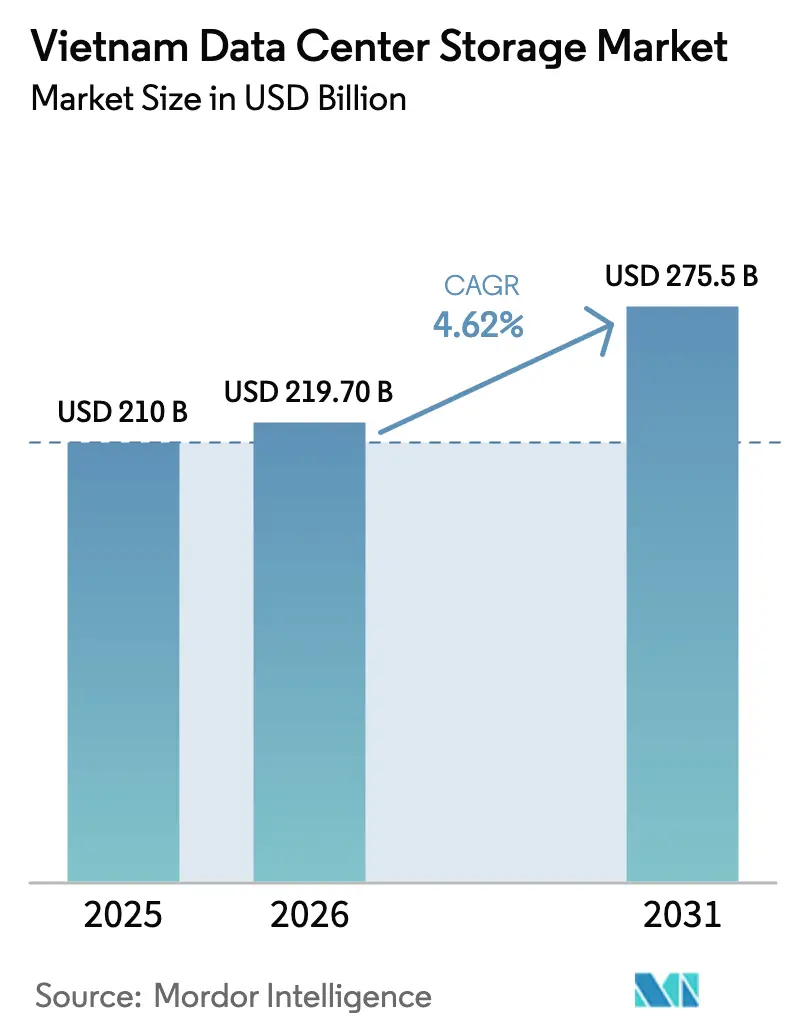
The Vietnam data center storage market size is expected to grow from USD 210 million in 2025 to USD 219.7 million in 2026 and is forecast to reach USD 275.5 million by 2031 at 4.62% CAGR over 2026-2031. Consistent policy support, 100% foreign‐ownership approval for data centers, and an influx of hyperscale projects position Vietnam as a rising regional hub for enterprise and cloud workloads. National digital‐economy targets, tighter data‐sovereignty rules, and rapid AI/ML adoption lead enterprises to modernize with flash and NVMe platforms. High-density builds such as Viettel’s 140 MW Tan Phu Trung facility illustrate how power-hungry AI clusters are reshaping rack design and storage interface preferences. Liberal regulation accelerates foreign capital inflows, yet grid constraints and a limited talent pool temper near-term capacity execution while opening niches for energy-efficient, managed‐service propositions
Key Report Takeaways
- By storage technology, SAN led with 33.92% revenue share in 2025, while NAS is projected to be the fastest-growing at a 6.58% CAGR to 2031.
- By storage type, HDD arrays accounted for 42.55% of the Vietnam data center storage market size in 2025; all-flash arrays are advancing at a 9.12% CAGR through 2031.
- By data-center type, colocation commanded 49.05% revenue in 2025, while hyperscalers are advancing at an 8.16% CAGR.
- By end user, IT and telecom captured 29.10% of Vietnam data center storage market share in 2025; BFSI is expanding fastest at a 7.21% CAGR.
- By form factor, rack-mounted systems held 62.70% share in 2025; composable infrastructure is growing at a 9.28% CAGR.
- By interface, SAS/SATA maintained 53.85% share in 2025; NVMe is increasing at an 8.01% CAGR.
Note: Market size and forecast figures in this report are generated using Mordor Intelligence’s proprietary estimation framework, updated with the latest available data and insights as of 2026.
Vietnam Data Center Storage Market Trends and Insights
Drivers Impact Analysis*
| Driver | (~) % Impact on CAGR Forecast | Geographic Relevance | Impact Timeline |
|---|---|---|---|
| Expansion of IT infrastructure and broadband | +1.2% | Ho Chi Minh City, Hanoi | Medium term (2-4 years) |
| Hyperscale data-center investments | +1.5% | Industrial zones nationwide | Long term (≥4 years) |
| Digital-transformation and data-sovereignty | +1.8% | National | Short term (≤2 years) |
| SME cloud adoption driving NAS | +0.9% | Urban clusters | Medium term (2-4 years) |
| AI/ML workload surge fueling all-flash | +1.1% | Technology hubs | Medium term (2-4 years) |
| 100% foreign-ownership liberalization | +0.7% | National | Short term (≤2 years) |
| Source: Mordor Intelligence | |||
Expansion of IT Infrastructure and Broadband
Vietnam’s target of 80% household broadband coverage by 2025 under the National Digital Transformation Program is stimulating demand for edge and core storage systems.[1]Ministry of Information & Communications, “Digital Transformation Program 2025,” vietnamnet.vn Ten additional submarine cables planned by 2030 will lift total capacity to 350 Tbps, generating sustained requirements for high-density edge appliances along landing points. Enterprises such as VTI report 70% cost savings after cloud migration, reinforcing hybrid storage uptake for analytics and backup operations vti. Manufacturing and logistics adopters are installing Industry 4.0 workflows that necessitate low-latency, compute-proximate storage for robotics and real-time quality control. Automotive OEMs and electronics exporters are notable early movers, using rack-scale flash to sustain inline analytics on production floors. This infrastructural momentum anchors long-run growth for the Vietnam data center storage market.
Rising Investments in Hyperscale Data Centers
Viettel’s 140 MW Tan Phu Trung build represents Vietnam’s inaugural 100 MW-plus data center, operating at 10 kW per rack—2.5× the national mean—thereby catalyzing demand for NVMe-accelerated, high-density arrays.[2]Anh Minh, “Viettel Starts Vietnam’s First 140 MW Data Center,” vietnamplus.vn Saigon Asset Management’s USD 1.5 billion, 150 MW SAM DigitalHub signals strong capital appetite for hyperscale footprints. Investors target PUE levels below 1.4 through warm-water and rear-door cooling, creating openings for software-defined storage that optimizes workload placement across distributed nodes. Vendors offering horizontally scalable platforms that minimize rack power draw gain a competitive edge as operators standardize on high-performance compute fabrics to serve regional AI demand.
Government Digital-Transformation and Data-Sovereignty Mandates
Vietnam’s Data Law effective July 2025 institutes a three-tier data-classification regime, compelling “core” and “important” datasets to reside domestically kpmg. The National Data Center launches August 2025 with two mirrored facilities housing around 1,000 racks each, establishing proof-of-concept for resilient sovereign architectures cafebiz. Alibaba’s shift from leasing to building its own site exemplifies how cross-border risk assessments trigger greenfield investment vnexpress. Procurement criteria now prioritize at-rest encryption, geo-fencing and audit logging that map directly to legal mandates, bolstering vendors with compliance-ready firmware and in-country service teams. The regulation accelerates near-term storage hardware refresh cycles across state agencies and regulated industries.
Surge in SME Cloud Adoption Driving NAS
The Ministry of Information and Communications’ SME Digital Transformation scheme subsidizes cloud services from 11 domestic providers, lowering entry costs by 20% and accelerating NAS adoption nhandan. Providers such as VNG Cloud tailor pay-as-you-grow models that angle directly at cost-sensitive SMEs. Growth is clear in e-commerce logistics: Ahamove orchestrates 200,000 daily deliveries on MongoDB Atlas, relying on NAS-backed clusters that flex with transaction peaks mongodb. Government workloads further validate NAS: SaoBacDau’s Red Hat OpenStack-based services deliver elastic object storage to ministries requiring domestic hosting redhat. The trend underpins sustained 6.8% CAGR for NAS within the Vietnam data center storage market.
Restraints Impact Analysis*
| Restraint | (~) % Impact on CAGR Forecast | Geographic Relevance | Impact Timeline |
|---|---|---|---|
| High upfront capex for Tier III/IV sites | -0.8% | Nationwide; acute for small operators | Medium term (2-4 years) |
| Shortage of skilled storage engineers | -1.1% | Urban centers | Long term (≥4 years) |
| Grid-energy constraints for dense racks | -0.6% | Industrial zones | Short term (≤2 years) |
| Rising cooling costs in tropical climate | -0.4% | National | Medium term (2-4 years) |
| Source: Mordor Intelligence | |||
High Upfront Capex for Tier III/IV Facilities
Tier III certification demands dual-path power, cooling and storage redundancy. Delta Electronics’ EPC contract in Hoa Lac illustrates capital intensity, with developers absorbing long ROI timelines delta. Domestic firms such as CMC Telecom must match global benchmarks to win multinational clients after becoming Vietnam’s first Level 4 Information Security-accredited site cmc. Financing constraints push operators toward vendor-financed, modular blocks and hyper-converged appliances that compress initial outlays. While the restraint suppresses greenfield pace, it stimulates demand for pre-integrated solutions that reduce on-site engineering effort.
Shortage of Skilled Storage Engineers
Vietnam counts roughly 6,000 hardware specialists against a projected need of 20,000 within five years.[3]Channel News Asia, “Vietnam Faces Tech Talent Crunch,” channelnewsasia.com Public programs such as Ho Chi Minh City’s USD 5 million initiative to train 40,000 microchip engineers by 2030 aim to narrow the gap vietnamnet. Meanwhile, vendors embed automation into management stacks, lowering skill thresholds required for day-to-day operations. Hyper-converged platforms and AI-driven telemetry become vital differentiators for operators facing recruitment bottlenecks in the Vietnam data center storage industry.
*Our forecasts treat driver/restraint impacts as directional, not additive. The impact forecasts reflect baseline growth, mix effects, and variable interactions.
Segment Analysis
By Storage Technology: SAN Dominance Amid NAS Acceleration
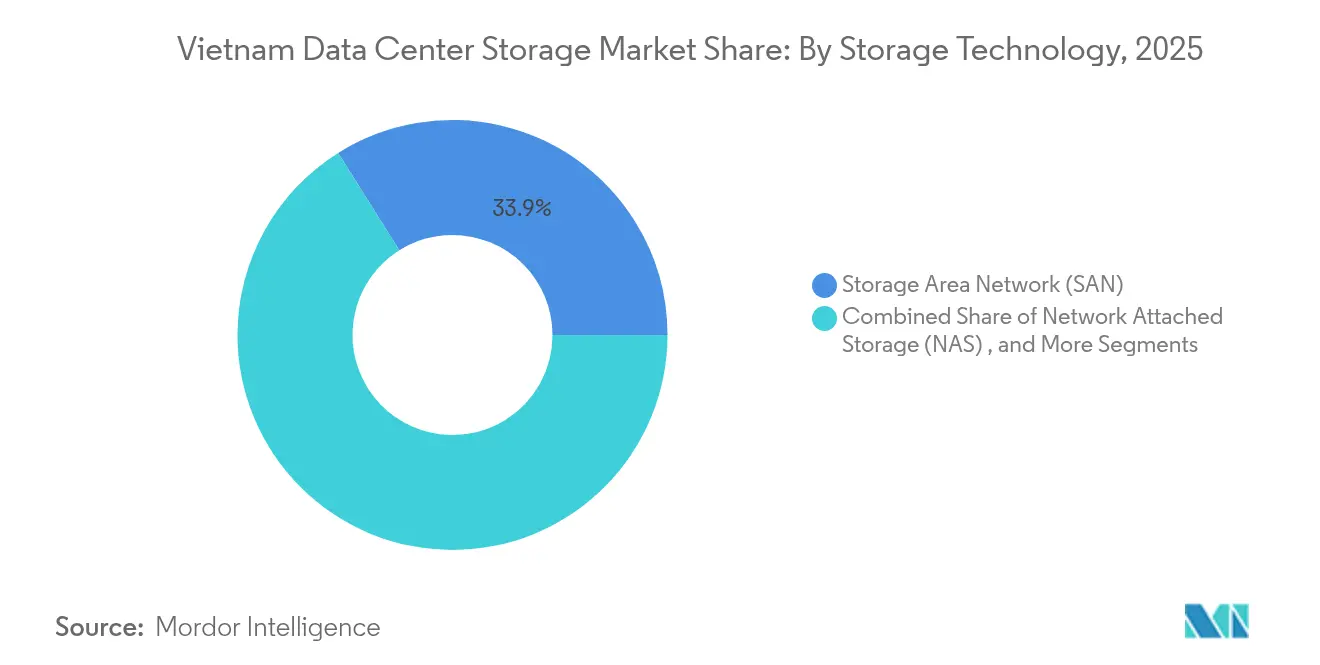
SAN solutions delivered 33.92% of 2025 revenues, reflecting enterprise demand for low-latency, block-level services in mission-critical cores. This share positions SAN as the performance backbone of the Vietnam data center storage market. NAS, climbing at 6.58% CAGR, benefits from SME cloud programs that reward cost-effective, Ethernet-based deployments. The Vietnam data center storage market size for NAS is projected to cross USD 0.1 billion by 2031, aided by government incentives. Direct-attached and object systems supplement specialized edge and archival workloads governed by emerging data-retention rules.
Hybrid adoption patterns intensify as Viettel IDC integrates Cloudian HyperStore to offer object and file services on a unified appliance, combining SAN-grade throughput for transactional workloads with NAS scalability for analytics datacenternews. Software-defined overlays blur protocol boundaries, enabling dynamic selection between block, file and object APIs. Enterprises thus future-proof investments while optimizing TCO, sustaining robust demand across all technology categories.



By Storage Type: HDD Arrays Lead Despite Flash Momentum
HDD arrays accounted for 42.55% of spending in 2025 due to favorable USD per-GB economics. All-flash, the fastest-growing at 9.12% CAGR, captures AI inference, real-time analytics and digital banking peaks. Vietnam data center storage market share for all-flash arrays is slated to climb beyond 31.2% by 2031. Hybrid tiers persist for mid-range workloads that fluctuate between capacity and performance needs.
Flash traction is underscored by Techcombank’s migration to IBM DS8886, quadrupling peak transaction throughput while shrinking rack footprint ibm. Kingston’s DC600M SSD line addresses mixed-use traffic and power efficiency, echoing policy emphasis on sustainable IT kingston. Energy incentives further tilt TCO calculus in favor of flash for operators seeking carbon neutrality certifications.
By Data Center Type: Colocation Leadership with Hyperscaler Growth
Colocation sites held 49.05% of 2025 revenues as enterprises opt for shared infrastructures that offload capital and operational complexity. The Vietnam data center storage market continues to rely on colo for interconnection access and quick deployment. Hyperscalers, bolstered by 8.16% CAGR, drive bulk capacity orders for high-density racks and petascale storage pools. The Vietnam data center storage market size for hyperscalers is estimated to climb from USD 0.07 billion in 2026 to more than USD 0.12 billion by 2031.
Viettel’s 10,000-rack flagship sets a reference design for AI and 5G workloads requiring enhanced power and cooling envelopes genk. Colocation incumbents counter with on-ramp services to AWS, Google Cloud and Azure, adding value-added storage tiers optimized for hybrid migrations. Enterprise and edge micro-data centers remain vital for latency-sensitive manufacturing and public-sector use cases under strict data-localization rules.
By End User: Telecommunications Strength with BFSI Acceleration
IT and telecom captured 29.10% of 2025 revenue, leveraging backbone networks and national backhaul to deliver ISP, CDN and 5G services. BFSI, expanding at 7.21% CAGR, demonstrates outsized appetite for encrypted, low-latency storage to support digital banking, e-payment platforms and regulatory audits. Vietnam data center storage market size for BFSI is forecast to nearly double by 2030.
VPBank’s OpenAPI platform processes 100 million monthly transactions on MongoDB clusters, highlighting new-age workloads that tax storage IO more than capacity mongodb. Government digital offices shift citizen services onto sovereign clouds, prompting expansions in archival and compliance repositories. Healthcare early adopters like Ho Chi Minh City’s eClinica leverage structured storage to consolidate 80,000 electronic patient records, spotlighting sectoral diversification
By Form Factor: Rack-Mounted Dominance with Composable Innovation
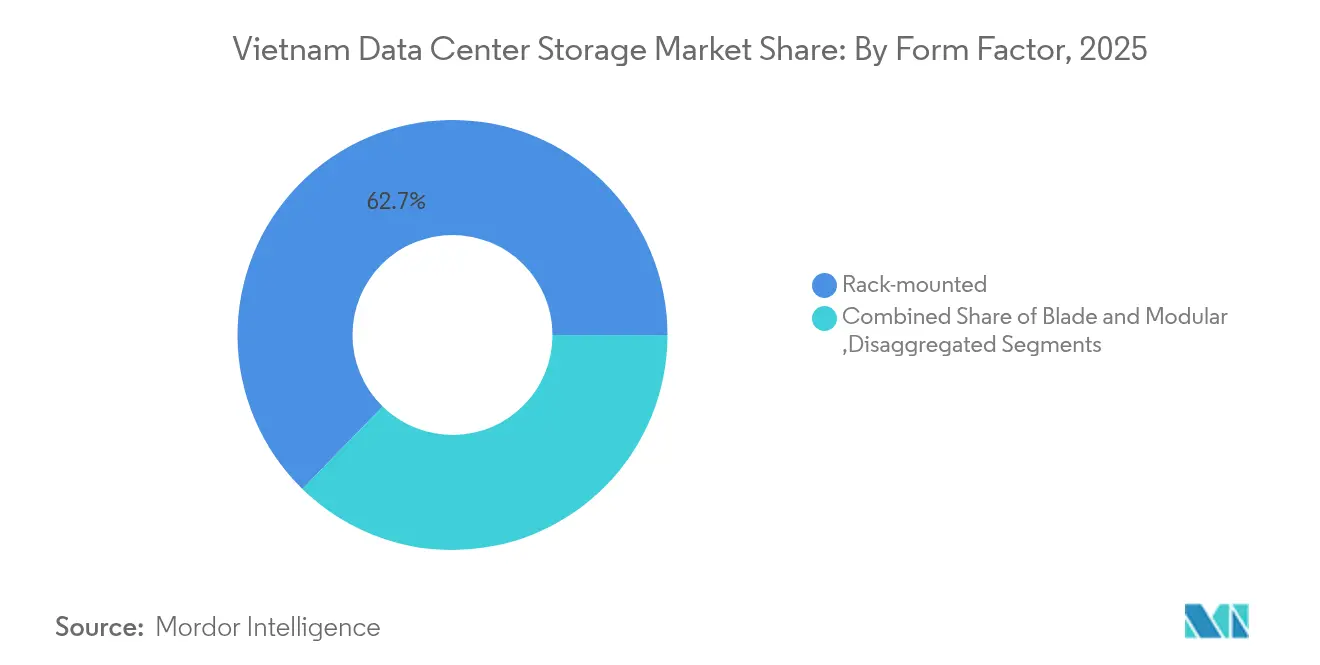
Rack-mounted chassis delivered 62.70% of revenue in 2025 thanks to broad ecosystem support and straightforward integration. Composable designs, rising at 9.28% CAGR, disaggregate compute, storage and network to enable dynamic pooling. Vietnam data center storage market size for composable solutions is projected to exceed USD 0.06 billion by 2031.
Dell’s Integrated Rack 7000 bundles liquid cooling and GPU-dense sleds for AI, demonstrating how form-factor innovation keeps pace with power and performance escalation dell. Blade and modular formats serve branch and disaster-recovery nodes, particularly in edge telco shelters requiring compact footprints. Software orchestration engines assign storage volumes on-demand, maximizing utilization and aligning with the skills shortage imperative.
By Interface: SAS/SATA Prevalence with NVMe Emergence
SAS/SATA maintained 53.85% share in 2025 due to mature toolchains and broad application compatibility. NVMe, advancing at 8.01% CAGR, underpins AI training sets and latency-sensitive fintech workloads. Vietnam data center storage market size for NVMe devices is projected to triple between 2025 and 2030.
Kingston’s FURY Renegade G5 PCIe 5.0 SSD posts up to 14,800 MB/s reads, delineating next-gen throughput curves for AI inference. TMBThanachart Bank’s deployment of Huawei end-to-end NVMe cut latency 60% and boosted compute 25%, validating interface migration economics. Fibre Channel persists for mission-critical SAN fabrics, whereas iSCSI and RoCE overlays enable cost-effective Ethernet convergence strategies.
Geography Analysis
Ho Chi Minh City and Hanoi anchor more than two-thirds of storage deployments, reflecting economic clout, fiber density and proximity to submarine cable landings. Viettel’s Tan Phu Trung complex and CMC’s Tan Thuan site position the southern cluster as the primary hyperscale corridor while feeding spillover demand for edge nodes in neighboring provinces soha. In the north, VNPT’s 23,000 sqm Hoa Lac campus with 2,000 racks supports government ministries and state banks, creating a gravitational pull for equipment vendors.
Central provinces increasingly court operators through renewable-power availability. Ninh Thuan hosts 1,500 MW solar and 1,442 MW wind capacity, offering green energy hooks for ESG-driven investors looking to cut Scope 2 emissions energysystemsresearch. Government strategy to designate regional digital hubs by 2050 accelerates fiber rollout and special-economic-zone tax relief, encouraging distributed storage topologies. Coastal locations gain thermodynamic efficiency for free-air and seawater cooling solutions; inland industrial parks offer affordable land to build multi-hectare campuses.
Connectivity remains the decisive factor for site selection across the Vietnam data center storage market. The upcoming submarine cable lines and continued investment in national backbones allow operators to place capacity closer to renewable sources without sacrificing latency to urban demand centers. As metro dark-fiber rates drop, tier-2 cities such as Thai Nguyen emerge as attractive cluster sites, supported by workforce development schemes for semiconductor and AI specializations.
Regulatory Landscape
Vietnam has moved to a clearer operating regime for data centers under the Telecommunications Law 2023 (effective July 2024), which defines data center services and sets operator obligations around registration and compliance rather than telecom-style licensing. In parallel, Decree No. 163/2024/ND-CP (effective December 2024) allows 100% foreign ownership of data centers, which supports international participation in local facilities that then feed enterprise and cloud storage procurement.
On technical compliance, Circular No. 42/2025/TT-BKHCN (effective February 1, 2026) updates construction and operation requirements and references national technical standards such as QCVN 32:2020/BTTTT and QCVN 06:2021/BXD. Operators register and report certain infrastructure changes to the Ministry of Information and Communications (MIC) and its Telecommunications Department, while storage buyers for regulated and public-sector workloads align procurement with domestic hosting and security controls shaped by Vietnam's data-sovereignty direction (including the Data Law effective July 2025).
Value Chain Analysis
Vietnam's data center storage value chain starts with international storage OEMs and component suppliers (HDD and SSD media, controllers, NICs/HBAs, and NVMe fabrics) selling through local distributors, system integrators, and telecom-led data center operators. Global vendors such as Dell Technologies, NetApp, Oracle, Kingston Technology, Huawei, Seagate, and Western Digital typically land platforms via channel partners for enterprise and colocation deployments, while hyperscale and AI projects also pull direct engagement for reference architectures and high-density design.
Midstream, local facility operators (including Viettel IDC, VNPT VinaData, CMC Telecom, and FPT Telecom) translate capacity builds into bulk storage orders, integration services, and managed offerings across block, file, and object storage. Downstream activities include deployment, migration, and ongoing operations (monitoring, backup, DR, and compliance), supported by specialist data center design and construction contractors such as Delta Group, Aurecon, Apave, and GreenViet. MIC registration and technical standards requirements also reinforce demand for in-country maintenance, spares, and compliance-ready firmware and security services, which affects vendor selection and lifecycle support models.
Competitive Landscape
Local telecom groups—Viettel IDC, VNPT VinaData, CMC Telecom and FPT Telecom—leverage long-haul networks, national POPs and government affinity to secure anchor colocation deals and manage 24/7 compliance audits. International hardware majors—Dell Technologies, NetApp, Oracle, Kingston Technology and Huawei—expand through reseller alliances and direct hyperscale engagements, supplying flash arrays, NVMe fabrics and software-defined storage stacks tuned for AI.
Strategic positioning revolves around scalability, energy efficiency and full-stack services. Dell’s AI Factory claims total cost reductions up to 62% versus public-cloud equivalents by integrating compute, cooling and PowerStore arrays under a single rack-scale SKU cafebiz. NetApp’s validation for NVIDIA DGX SuperPOD and Google Cloud partnership underscores hybrid-AI credentials appealing to financial institutions under latency and data-sovereignty pressure. Kingston differentiates with PCIe 5.0 offerings while bundling power-loss protection to ease adoption inside regions facing voltage fluctuation.
The race for talent generates collaborations with universities; Kioxia’s proposed joint program on NVMe curriculum typifies moves to seed long-term channel loyalty. Meanwhile, start-ups in hyper-converged, Kubernetes-native storage nibble at niche segments, banking on simplified ops that resonate with mid-market enterprises lacking deep IT benches. Moderate industry concentration persists as no single vendor surpasses 30% share, fostering healthy price–performance competition across project bids.
Vietnam Data Center Storage Industry Leaders
Viettel IDC Co. Ltd.
VNPT VinaData Co. Ltd.
FPT Telecom International
Dell Technologies Inc.
Seagate Technology Holdings plc
- *Disclaimer: Major Players sorted in no particular order

Market Opportunities and Future Outlook
Execution of data-sovereignty requirements is creating whitespace for compliance-aligned storage stacks inside domestic facilities, especially for government and regulated industries where encryption, auditing, and resilient architectures are procurement criteria. Vietnam's Data Law effective July 2025 and the August 2025 launch of the National Data Center (two mirrored sites with around 1,000 racks each) offer clear demand signals for sovereign hosting, backup, and archival tiers that remain within Vietnam, favoring vendors and operators with local service coverage and validated security configurations.
AI-ready infrastructure is also shifting storage requirements toward higher-throughput flash and NVMe, and this shows up in recent build-outs and partnerships. Viettel's Hoa Lac 2 AI Data Center integrating NVIDIA H200 systems with Uptime Tier III certification, along with the 140 MW Tan Phu Trung hyperscale campus, raises the baseline for rack density and performance per workload. This is expanding opportunities for all-flash arrays, NVMe-oF capable designs, and software-defined storage that optimizes power and footprint. On the investment side, the framework between FPT, Viet Thai Group, and G42, with commitments up to USD 1 billion for AI and cloud infrastructure, supports a pipeline of hyperscale-class facilities where storage vendors can attach through reference designs, managed services, and lifecycle supply programs tuned to local compliance and grid-constrained efficiency needs.
Recent Industry Developments
- June 2026: Viettel (IDC) integrated NVIDIA H200 GPU supercomputing systems at Hoa Lac 2 Data Center and received Uptime Institute TCCF Tier III certification. The AI-ready data center infrastructure supports GPU accelerated workloads and enhances local capacity for hyperscale AI deployments. This advances Vietnam’s hyperscale AI capable campus footprint and strengthens regional cloud sovereignty positioning.
- February 2026: FPT Corporation signed a framework agreement with G42 and Viet Thai Group to develop hyperscale data centers in Vietnam with investment commitments up to $1 billion. The framework accelerates hyperscale data center development and cross-border AI infrastructure. The deal signals large-scale international backed capacity expansion and aligns with national AI and cloud strategy.
- January 2026: Viettel IDC launched a new 400-rack server room (T6N6) at Hoang Hoa Tham Data Center, Ho Chi Minh City. This marks expansion of on-premises scale at a major Vietnamese data center. It demonstrates rapid capacity scale up to support growing enterprise and cloud workloads and AI ready storage demand.


Research Methodology Framework and Report Scope
Market Definition and Coverage
For this report, the market covers revenue earned from data storage systems deployed inside data centers in Vietnam, including the hardware platforms and related software that enable on-site storage for enterprise and cloud workloads.
Scope exclusions: We exclude end-user devices, pure public cloud storage services billed as subscriptions, and stand-alone networking gear that is not sold as part of a storage system.
Segmentation Overview
- By Storage Technology
- Network Attached Storage (NAS)
- Storage Area Network (SAN)
- Direct Attached Storage (DAS)
- Object and Tape Storage
- By Storage Type
- Traditional HDD Arrays
- All-Flash Arrays (AFA)
- Hybrid Storage
- By Data Center Type
- Colocation Facilities
- Hyperscalers/Cloud Service Providers
- Enterprise and Edge
- By End User
- IT and Telecommunication
- BFSI
- Government and Public Sector
- Media and Entertainment
- Healthcare and Life Sciences
- Manufacturing
- By Form Factor
- Rack-mounted
- Blade and Modular
- Disaggregated / Composable
- By Interface
- SAS / SATA
- NVMe
- Fibre Channel and iSCSI
Data Sources, Market Sizing, and Validation
Desk Research
Desk research was used to set the base demand context for storage inside Vietnamese data centers, and to frame what is happening with build-outs and data traffic growth. Public sources such as Vietnam's Ministry of Information and Communications releases, the General Statistics Office (GSO), International Telecommunication Union (ITU) indicators, World Bank data, and International Energy Agency (IEA) power series helped us sanity-check macro trends that influence data creation and facility expansion.
We also reviewed supplier annual reports, investor presentations, local operator announcements, and trusted technology press to understand refresh cycles and procurement timing. Where needed, a paid subscription for company financials and intelligence, plus a patent database, were used to standardize company-level snapshots and validate product direction without relying on one-off articles. The desk research sources mentioned here are illustrative only, and many other public and paid references were used during data collection, validation, and clarification.
Primary Interviews and Surveys
Primary work was used to pressure-test storage system pricing, typical deployment sizes, and how fast older arrays are being replaced in Vietnam. We spoke with a mix of data center operators, storage channel partners, system integrators, and enterprise IT buyers, and then used these views to confirm adoption drivers like virtualization, flash migration, and data sovereignty needs.
For Vietnam, coverage focused on the main demand pockets in Ho Chi Minh City and Hanoi, and it was extended to secondary industrial hubs where new capacity is being planned and procured.
Distribution of primary research fieldwork respondents
| Company type | Respondent position |
|---|---|
| Top tier: 34% | CXOs: 16% |
| Mid tier: 48% | Functional/Unit leaders: 32% |
| Smaller Players: 18% | Managers: 52% |
Market-Sizing & Forecasting
Sizing starts from a top-down build where Vietnam data center capacity additions, server base growth, and storage attach rates are used to reconstruct the storage spending pool by year. To keep the model tied to real buying behavior, we used inputs such as typical storage per rack or per server for key workloads, the share of flash and hybrid arrays in new deployments, replacement timing for legacy systems, and average selling price movements by platform type and capacity tier.
Those totals are then cross-checked with selective bottom-up approximations, such as sampling supplier and channel revenue splits for Vietnam, validating shipment direction through distributor checks, and testing ASP x volume for a small set of common configurations. When gaps appeared in smaller customer groups, assumptions were filled using nearby benchmarks (for example, comparable enterprise refresh cycles) and then re-tested in calls before finalizing.
Forecasting was done using scenario analysis supported by short trend fits, where the main drivers were data growth intensity, new data center commissioning cadence, and procurement lead times. The final forecast was adjusted after primary feedback on price erosion rates for flash, expected AI workload uptake, and the timing of large project rollouts.
Data Validation & Update Cycle
Validation is done by comparing the model outputs against independent signals, including announced data center expansions, implied storage intensity per IT load, and the direction of enterprise capex planning shared by interviewees. If a year shows a sharp jump or drop that cannot be explained by capacity additions or price movements, the inputs are re-checked and a follow-up call is triggered with the most relevant respondent type.
Before sign-off, the work goes through multi-step analyst reviews that focus on unit logic, currency conversions, and year-over-year reasonability checks. Reports are refreshed annually, and interim updates are made when material events shift commissioning schedules or procurement patterns. Right before delivery, a final pass is completed so clients receive the latest updated view.
Mordor Intelligence's Vietnam Data Center Storage Market Size Compared Against Other Published Estimates
Published market sizes for Vietnam data center storage can differ because each publisher chooses its own scope, currency timing, and what it treats as storage revenue versus adjacent IT spend. Differences also show up when one study relies more on vendor announcements, and another leans more on installation activity and replacement demand.
Some external figures expand the market by folding in cloud storage services and broader data center infrastructure budgets, which can inflate totals beyond hardware and enabling software sold into facilities. In Mordor Intelligence, only storage systems deployed in Vietnamese data centers are counted, and managed cloud storage subscriptions and unrelated network equipment are kept out so the value tracks procurement-led spending.
Benchmark comparison
| Source | Market Size | Gaps in Research Methodology |
|---|---|---|
| Mordor Intelligence | USD 210.00 M (2025) | |
| Industry Portal A | USD 565.97 M (2025) | Uses a wider scope that blends storage hardware with cloud storage revenue and related infrastructure spend, and it is less clear on how double counting is removed across on-prem and hosted environments. |
| Trade Media B | USD 0.75 B (2023) | Reported as a headline value with limited visibility on the conversion rate used, base-year refresh timing, and whether pricing is based on installed capacity or annual procurement. |
The table shows that the spread is mainly explained by what is included, and by how pricing and timing are handled. By keeping the demand pool tied to data center storage procurement and then checking it against capacity additions and real-world replacement cycles, our estimate stays easier to trace and repeat year to year.


Key Questions Answered in the Report
What is the current value of the Vietnam data center storage market?
It is valued at USD 219.7 million in 2026.
How fast is the Vietnam data center storage market expected to grow?
The market is projected to post a 4.62% CAGR and reach USD 275.5 million by 2031.
Which storage technology is growing fastest?
Network attached storage is forecast to expand at a 6.58% CAGR due to SME cloud adoption.
Why are hyperscale projects important for Vietnam?
Projects such as Viettel’s 140 MW campus demand high-density flash arrays and attract foreign capital, fueling long-term infrastructure growth.
What regulatory change influences storage procurement?
Vietnam’s Data Law mandates domestic hosting for “core” and “important” data, driving demand for compliant local facilities.
How severe is the skills shortage?
The country has around 6,000 storage engineers against an expected need of 20,000, increasing interest in managed and automated storage services.
Page last updated on:
- Data Center Server Market Servers worldwide, split by tier, facility size and facility type.
- Data Center Construction Market Global construction demand, split by tier, facility size and facility type.
- Artificial Intelligence (AI) Data Center Market Global AI facilities demand, split by facility type, component and tier.
- Vietnam Data Center Server Market Servers demand across Vietnam, covering data-center tier, form factor and application / workload.
- Vietnam Data Center Networking Market Vietnam's networking, split by component, end-user and data-center type.
- Southeast Asia Data Center GPU Market Southeast Asia's GPUs, split by deployment type, gpu type and interconnect.
- Vietnam Hyperscale Data Center Market Vietnam hyperscale sites, split by facility type, component and tier.
- South America Data Center Server Market South America's servers, split by facility size and tier.
- United Arab Emirates Hyperscale Data Center Market The UAE's hyperscale sites, split by facility type, component and tier.





