
Vietnam Data Center Server Market Size and Share
Market Overview
| Study Period | 2020 - 2031 |
|---|---|
| Forecast Data Period | 2026 - 2031 |
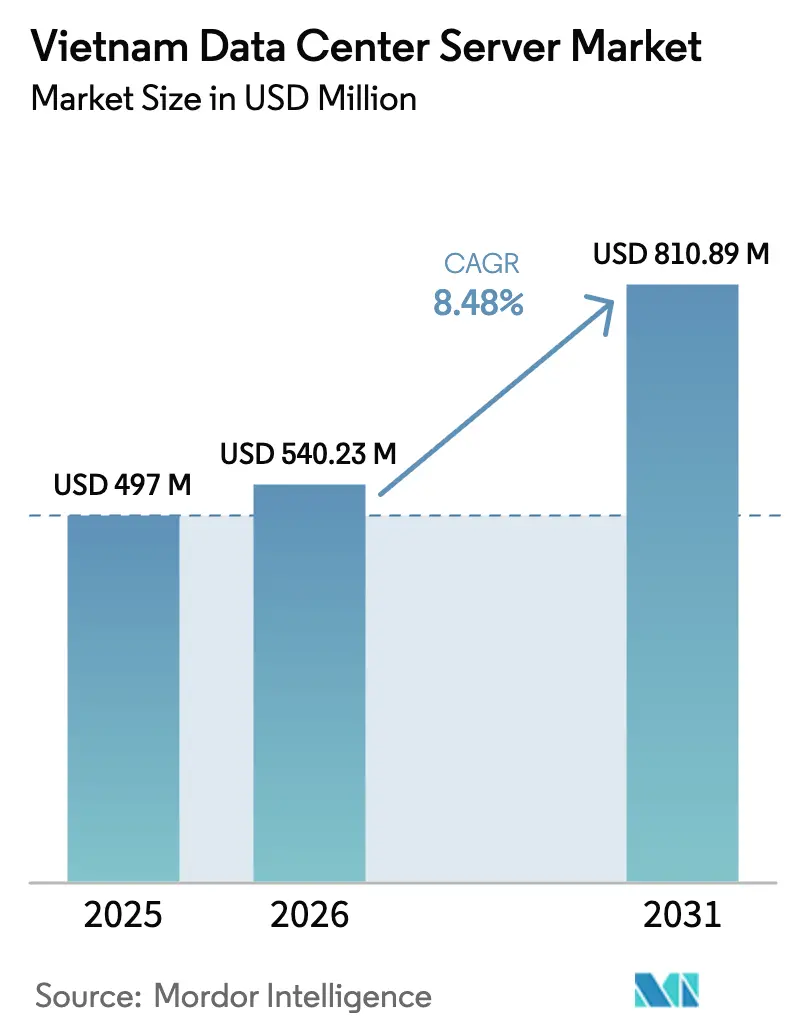
| Base Year Market Size (2025) | USD 497 Million |
| Market Size (2026) | USD 540.23 Million |
| Market Size (2031) | USD 810.89 Million |
| Growth Rate (2026 - 2031) | 8.48 % |
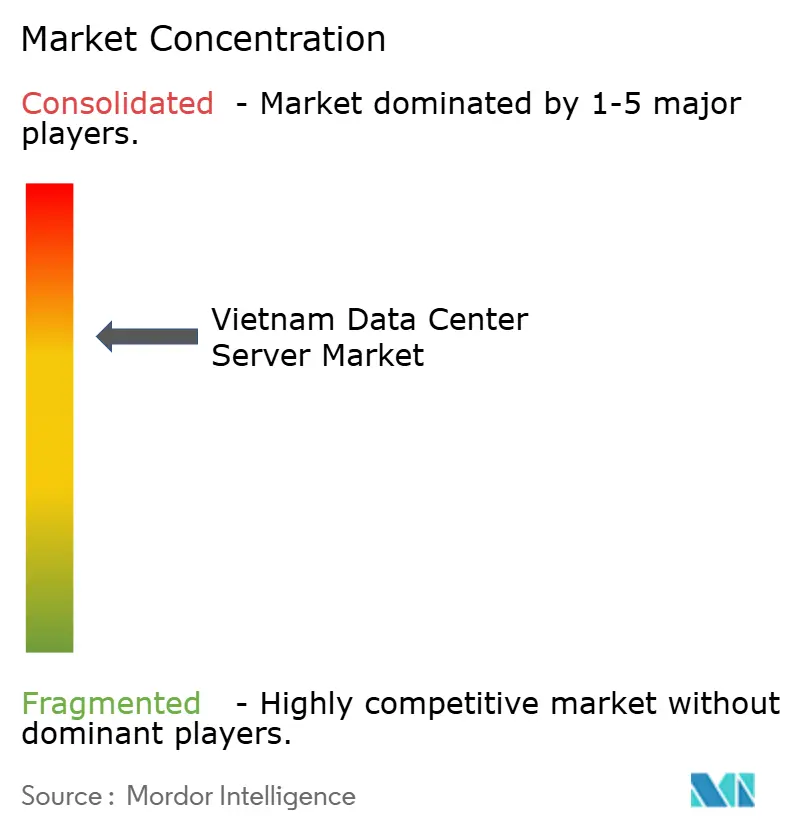
| Market Concentration | Medium |
Major Players *Disclaimer: Major Players sorted in no particular order Image © Mordor Intelligence. Reuse requires attribution under CC BY 4.0. | |
Vietnam Data Center Server Market Analysis by Mordor Intelligence
The Vietnam data center server market size is expected to grow from USD 497 million in 2025 to USD 540.23 million in 2026 and is forecast to reach USD 810.89 million by 2031 at 8.48% CAGR over 2026-2031. Robust fiscal incentives for digital infrastructure, ongoing power-sector upgrades and the removal of foreign ownership limits are accelerating capital inflows into new server capacity. Tier 3 facilities dominate deployments, yet Tier 4 builds are rising quickly as hyperscalers demand concurrent maintainability for AI clusters. Half-height blades remain the preferred form factor, though quarter-height and micro-blade systems are growing as operators pursue rack-level density gains. Edge nodes in second-tier cities, direct power-purchase agreements and the China + 1 manufacturing pivot continue to reinforce Vietnam’s status as a strategic Southeast Asian hub.
Key Report Takeaways
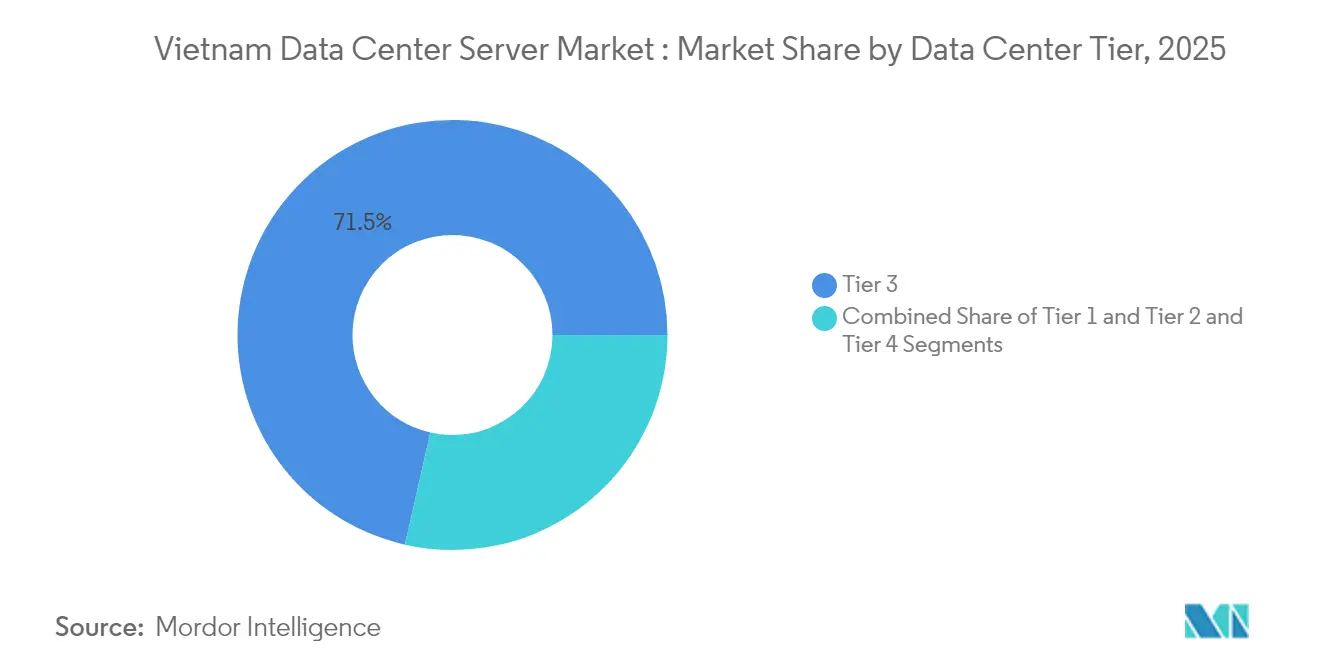
- By data-center tier, Tier 3 facilities led with 71.45% of Vietnam data center server market share in 2025; Tier 4 is forecast to expand at 16.08% CAGR through 2031.
- By form factor, half-height blade servers accounted for 47.98% of Vietnam data center server market size in 2025, while quarter-height and micro-blade systems record the highest projected CAGR at 14.87% between 2026-2031.
- By application, virtualization and private cloud held 38.74% share of the Vietnam data center server market size in 2025; AI / ML workloads are advancing at 17.05% CAGR through 2031.
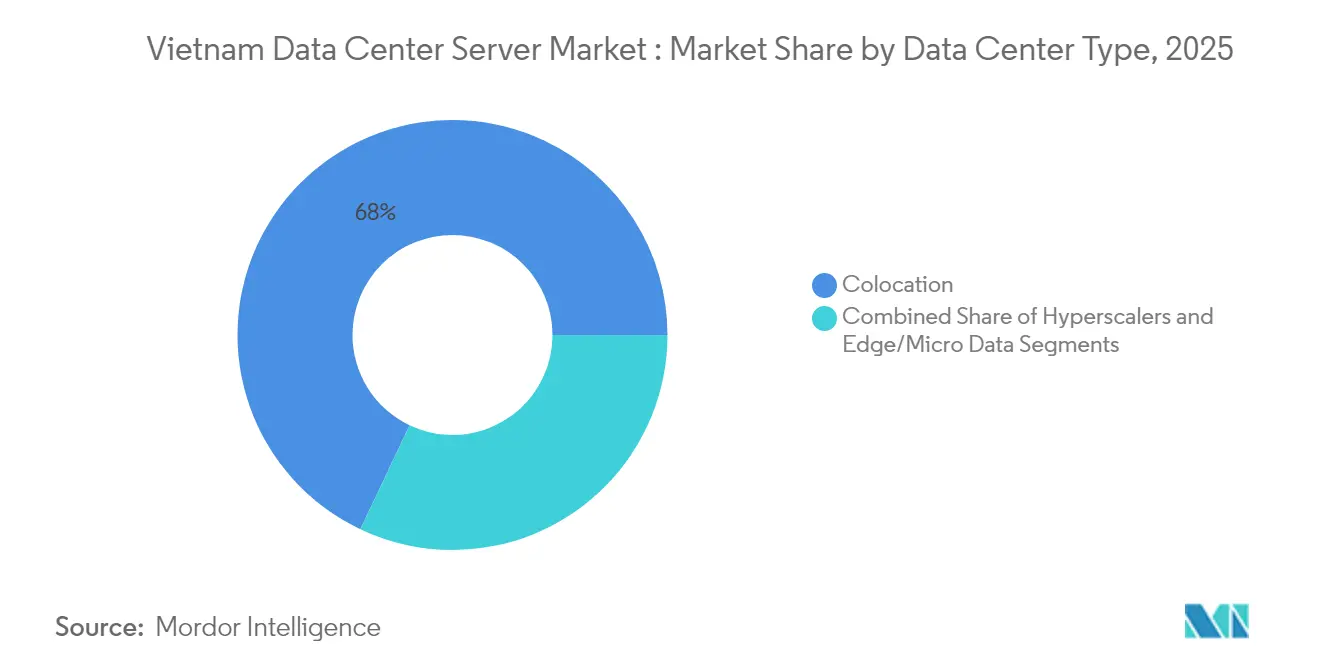
- By data-center type, colocation sites commanded 67.95% of Vietnam data center server market size in 2025; hyperscaler facilities are growing at 14.76% CAGR to 2031.
- By end-use industry, IT & telecommunications captured 25.93% of Vietnam data center server market share in 2025; government deployments are the fastest climber at 12.74% CAGR through 2031.
Note: Market size and forecast figures in this report are generated using Mordor Intelligence’s proprietary estimation framework, updated with the latest available data and insights as of 2026.
Vietnam Data Center Server Market Trends and Insights
Drivers Impact Analysis*
| Driver | (~) % Impact on CAGR Forecast | Geographic Relevance | Impact Timeline |
|---|---|---|---|
| Increase in construction of new data centers and internet infrastructure | +2.8% | National, concentrated in HCMC and Hanoi | Medium term (2-4 years) |
| Increasing adoption of cloud and IoT services | + 2.1% | National, with enterprise focus in major cities | Short term (≤ 2 years) |
| Government data-localization and digital-economy mandates | +1.9% | National, affecting all sectors | Long term (≥ 4 years) |
| China + 1 shift catalyzing server assembly in Vietnam | +1.2% | Northern provinces, Bac Giang and Binh Duong | Medium term (2-4 years) |
| Emergence of AI/GPU clusters for Vietnamese LLMs | +0.6% | HCMC and Hanoi tech corridors | Long term (≥ 4 years) |
| Tier-2 city tax abatements attracting second-wave data-center builds | +0.6% | National, with early gains Tier 2 areas | Medium term (2-4 years) |
| Source: Mordor Intelligence | |||
Increase in construction of new data centers and internet infrastructure
Vietnam’s construction boom is redefining server demand. Viettel’s 140 MW Ho Chi Minh City campus is the first domestic site to break the 100 MW threshold, prompting bespoke blade configurations optimized for tropical airflow and renewable-ready power systems.[1]Datacenter Dynamics, “Viettel breaks ground on Ho Chi Minh City’s first 140 MW data center,” datacenterdynamics.com Secondary-city edge sites are multiplying to support 5G backhaul and latency-sensitive workloads. Foreign investors such as Saigon Asset Management have committed USD 1.5 billion for a 150 MW campus in Binh Duong Province, intensifying requirements for local assembly partnerships that shorten delivery cycles.
Increasing adoption of cloud and IoT services
A USD 45 billion digital-economy target for 2025 stimulates enterprise cloud migration. Manufacturing zones in Tan Thuan deploy ruggedized edge servers for predictive-maintenance analytics, while Foxconn’s Lighthouse Factory in Bac Giang runs GPU-enabled digital-twin workloads that drive premium server demand. Healthcare digitization adds further momentum as Bach Mai Hospital scales electronic medical records across a nationwide care network.[2]Light Reading, “SAM plans USD 1.5B data-center campus in Binh Duong,” lightreading.com
Government data-localization and digital-economy mandates
The Law on Data, effective January 2025, obliges sensitive data to reside onshore, compelling global clouds to build domestic server farms rather than service Vietnam remotely. Banks such as An Binh deploy secure, Fortinet-hardened architectures to comply with sovereignty rules, while the National Data Center’s August 2025 launch will standardize procurement of certified, tamper-resistant servers.
China + 1 shift catalyzing server assembly in Vietnam
Quanta Computer’s USD 50 million factory and Taiwanese OEM expansions illustrate the pivot of server assembly to Vietnam’s northern corridor. Tariff advantages on U.S. exports and skilled labor pools enable local customization that addresses high-humidity conditions and local compliance.
Restraints Impact Analysis*
| Restraint | (~) % Impact on CAGR Forecast | Geographic Relevance | Impact Timeline |
|---|---|---|---|
| High initial capex for data-center construction | -1.4% | National, particularly affecting SME deployments | Short term (≤ 2 years) |
| Limited grid reliability and rising electricity tariffs | -1.1% | Ho Chi Minh City and industrial zones | Medium term (2-4 years) |
| Shortage of certified data-center engineers | -0.8% | National, acute in tier-2 cities | Long term (≥ 4 years) |
| Fragmented local supply chain for advanced components | -0.5% | Northern manufacturing corridors | Medium term (2-4 years) |
| Source: Mordor Intelligence | |||
High initial capex for data-center construction
Even at USD 6.9 million per MW, financing hurdles constrain small-to-mid-size firms. Electrical systems absorb a disproportionate share of budgets, steering buyers to standardized rack-mount servers that maximize watt-per-compute ratios. Asset-management funds are emerging to defray capex, yet procurement teams still favor lifecycle-cost optimization over raw performance.
Limited grid reliability and rising electricity tariffs
Vietnam needs USD 128.3 billion in grid investments through 2030, and periodic shortages in Ho Chi Minh City elevate operational risk.[3]International Trade Administration, “Vietnam Power Development Plan VIII overview,” trade.gov Operators lock in renewable supply via direct power-purchase agreements, compelling server OEMs to certify low-power silicon and liquid cooling for racks exceeding 30 kW BCLP.
*Our forecasts treat driver/restraint impacts as directional, not additive. The impact forecasts reflect baseline growth, mix effects, and variable interactions.
Segment Analysis
By Data-Center Tier: Enterprise-Grade Infrastructure Dominates
Tier 3 facilities held 71.45% share of the Vietnam data center server market in 2025, mirroring enterprise tolerance for cost-balanced redundancy. This tier underpins banking, telecom and public-sector workloads that stipulate 99.982% availability. Operators specify dual-power blades, hot-swappable drives and battery-assisted modules to control Mean-Time-To-Repair. Tier 4 sites, growing 16.08% CAGR, are propelled by hyperscalers building AI clusters that require concurrent maintainability.
Vietnam data center server market size within Tier 4 is projected to expand sharply as GPU-dense racks demand fault-tolerant cooling. Tier 1 and Tier 2 venues remain viable for distributed edge nodes, housing cost-optimized 1U and 2U servers. NTT’s 6 MW Ho Chi Minh City 1 facility exemplifies how foreign entrants target Tier 3 specifications for regional cloud tenancy. AI-ready blueprinting accelerates Tier 4 adoption, with facilities provisioning 100 kW per rack for Blackwell-class GPUs.



By Form Factor: Density Optimization Drives Micro-Blade Adoption
Half-height blades retained 47.98% share in 2025, delivering a sweet spot of density versus thermal headroom. Enterprises leverage integrated chassis management to streamline firmware updates and power budgeting. Quarter-height and micro-blade platforms rise at 14.87% CAGR, reflecting edge-site constraints where floor space and power feeds are limited.
Vietnam data center server market size for micro-blade deployments benefits from telecom 5G rollouts that embed compute at radio access points. Full-height blades serve HPC clusters in research institutes funded under the Vietnam National University program. Telecommunications players, notably Viettel, standardize micro-blades to minimize heat per RU, aiding operations in 35 °C ambient climates.
By Application/Workload: AI Transformation Accelerates Beyond Virtualization
Virtualization and private cloud workloads delivered 38.74% of revenue in 2025. Enterprises continue to collapse legacy x86 footprints onto VMware- and KVM-based clusters. AI / ML server shipments, however, surge 17.05% CAGR. Telecommunications firms employ GPU farms for natural-language chatbots and anti-fraud analytics under Korea Telecom’s USD 94.6 million pact with Viettel.
Vietnam data center server market size tied to AI applications will eclipse virtualization in large sites by 2028. HPC workloads remain niche, servicing seismic modeling and pharmaceutical research. Storage-centric builds fulfill regulatory backup mandates, while IoT gateway servers proliferate in Industry 4.0 plants such as Samsung’s smart-factory program.
By Data-Center Type: Hyperscaler Expansion Challenges Colocation Dominance
Colocation facilities accounted for 67.95% of capacity in 2025 as enterprises prefer OPEX models over building proprietary halls. Viettel IDC alone manages 49% of domestic colocation racks, bundling connectivity with managed services. Hyperscaler investment, now climbing at 14.76% CAGR, is reshaping the Vietnam data center server market as foreign clouds deploy dedicated campuses.
Vietnam data center server market share for hyperscalers is fueled by policy liberalization removing equity caps on foreign investors in July 2024 VietnamBriefing. Google’s site-selection studies and Amazon’s regional roadmaps signal further divergence toward 200 MW-plus campuses. Edge and enterprise micro-centers persist for low-latency workloads where data sovereignty or process-control loops preclude public cloud.
By End-Use Industry: Government Digitization Outpaces Traditional Leaders
IT & telecommunications absorbed 25.93% of server shipments in 2025, sustaining network-core modernization and 5G RAN upgrades with Qualcomm-enabled massive-MIMO servers, LightReading. Yet government programs log the steepest growth at 12.74% CAGR, energised by the National Data Center and mandatory digital-process initiatives.
Vietnam data center server industry participants serve BFSI clients evolving digital-banking stacks, such as Cake Digital Bank’s AI-driven risk engines hosted on GPU servers, Google Cloud. Healthcare adoption rises with electronic health-record rollouts, while energy utilities deploy hardened servers for smart-grid telemetry along transmission corridors.
Geography Analysis
Ho Chi Minh City and Hanoi concentrate nearly 80% of installed server racks because they couple submarine-cable gateways with dense enterprise clusters. Ho Chi Minh City’s Saigon Hi-Tech Park supports hyperscale builds such as Viettel’s 140 MW campus, benefitting from proximity to AAE-1 and APG cable landings. Hanoi’s political role secures federal workloads and disaster-recovery preferring geographic dispersion from the south.
Secondary nodes such as Da Nang emerge as edge aggregation points; its IDC facility offers latency under 20 milliseconds to both major hubs DevelopingTelecoms. Northern provinces, led by Bac Giang, evolve into server-assembly hotbeds under the China + 1 strategy, leveraging road links to Shenzhen suppliers. Foxconn’s Lighthouse Factory illustrates deep-tier integration supporting custom tropical server SKUs SloveniaTimes.
Vietnam data center server market size grows in Binh Duong and Long An as power projects under PDP VIII unlock loads above 100 MW backed by solar farms. Grid-reliability upgrades and direct PPAs entice investors like Saigon Asset Management to place USD 1.5 billion campuses close to major industrial parks LightReading. Coastal fiber-landing expansions widen resilience for east-west traffic, enhancing appeal for multi-region replicas.
Regulatory Landscape
Vietnam’s policy framework increasingly treats data centers as regulated digital infrastructure, tightening data governance while opening market entry. The Law on Telecommunications No. 24/2023/QH15, effective 1 July 2024, classifies data center services as value-added telecommunications services and removes foreign ownership limits, supporting greater participation by international operators and investors.
On data governance, the Law on Data and its associated Decree took effect on 1 July 2025, establishing requirements around important data, localization, and positioning within national infrastructure priorities. The Personal Data Protection Law, effective 1 January 2026, adds cross-border transfer assessment and breach notification obligations, shaping how server capacity is deployed for regulated workloads. On the technical side, the Ministry of Information and Communications governs compliance through Circular 23/2022/TT-BTTTT, including TCVN 9250:2021 for data-center technical infrastructure (aligned with ANSI/TIA-942-B:2017), alongside building fire safety requirements such as QCVN 06:2021/BXD. Decree No. 96/2026/ND-CP, effective 31 March 2026, further streamlines investment procedures and expands incentives for high-tech, AI, and cloud data center projects, reinforcing an approvals and compliance environment that influences server procurement specifications and certification requirements.
Value Chain Analysis
The Vietnam data center server value chain runs from global silicon, motherboard, and GPU ecosystems into OEM/ODM system integration, then into in-country distribution, systems integration, and deployment within colocation, hyperscaler, and enterprise facilities. International server OEMs (including Dell Technologies, HPE, Cisco, Huawei, and Inspur) typically reach end users through local partners and distributors that provide import handling, configuration, warranty, and onshore services. Localization requirements tied to the Law on Data (effective 1 July 2025) and the Personal Data Protection Law (effective 1 January 2026) also increase the role of Vietnamese integrators that can deliver compliant designs, security hardening, and documentation for regulated industries.
Downstream, data center developers and operators convert demand signals into server orders, with industrial-park ecosystems playing an outsized role in site selection and time-to-power. Projects in hubs such as Saigon Hi-Tech Park and Vietnam Singapore Industrial Park show how land, licensing, and grid connection pathways are bundled with facility development, driving concentrated buying cycles for high-density blade and AI server configurations. Power and cooling constraints are key gating factors, pushing operators toward efficiency-led architectures and procurement packages that include liquid cooling readiness, rack-level power management, and service-level support for 24x7 operations. Emerging direct power purchase agreement (DPPA) frameworks also affect hardware choices as operators align server refresh cycles with renewable sourcing and energy-cost management.
Competitive Landscape
Domestic telecom heavyweights retain significant sway. Viettel Group, integrating fiber, mobile and IDC footprints, operates 230,000 servers across 14 sites and captures almost half of national colocation revenue TheInvestor. VNPT and FPT follow with nationwide fiber rings and government contract pipelines. International OEMs compete through alliance models; Dell Technologies partners with FPT Information System to bundle PowerEdge platforms with local compliance services, while HPE collaborates with FPT for AI factory offerings FPTSoftware.
Competition pivots on AI-optimized designs and energy efficiency. NVIDIA’s forthcoming R&D center will seed ecosystem demand for Blackwell GPU blades and liquid-cool racks NVIDIA. White-space opportunities persist in Tier 2-city edge deployments where local SI integrators such as CMC Telecom deliver ruggedized, environmental-grade servers.
Foreign ownership liberalization heightens rivalry. Google and Microsoft scout sites for first-party campuses, raising supply-chain award stakes for ODMs assembling in Bac Ninh. Market entrants must differentiate via renewable integration, advanced cooling and sovereign-cloud certifications to win public-sector and regulated-industry bids.
Vietnam Data Center Server Industry Leaders
Dell Inc.
Hewlett Packard Enterprise
Cisco Systems Inc.
Huawei Technologies Co. Ltd.
Inspur Group
- *Disclaimer: Major Players sorted in no particular order

Market Opportunities and Future Outlook
Policy and project announcements are creating whitespace for server vendors and integrators that can supply compliant, high-density compute for onshore processing. The Telecommunications Law effective 1 July 2024 removed foreign ownership limits for data center services, while the Law on Data (effective 1 July 2025) and the Personal Data Protection Law (effective 1 January 2026) increase the need for domestic hosting and controlled cross-border data handling, particularly for BFSI, government, and healthcare workloads. These shifts favor suppliers that can provide sovereignty-ready reference architectures, audit-ready configurations, and lifecycle services aligned to Circular 23/2022/TT-BTTTT and TCVN 9250:2021.
Near-term opportunity is visible in campus-scale builds and AI-led infrastructure programs that expand the addressable install base for servers. Saigon Asset Management has advanced plans for a large campus in Binh Duong Province (positioned as Vietnam’s largest), and Sembcorp secured Vietnamese government investment approval for a 90 MW data center at Saigon Hi-Tech Park in Ho Chi Minh City through the StarMason joint venture with BB Holdings, both pointing to new halls that need standardized procurement and rapid delivery of rack-ready systems. Separately, a framework cooperation agreement involving G42, FPT Corporation, and Viet Thai Group to develop sovereign AI and cloud infrastructure across three data center locations (USD 1 billion commitment) indicates demand for GPU-capable platforms, networking, and supporting server management stacks. A February 2026 government decision to classify data centers under commercial electricity tariffs, raising operating costs materially, also supports demand for efficient compute designs, power-aware scheduling, and liquid-cooling-ready server configurations that reduce watts per unit of performance within constrained grid environments.
Recent Industry Developments
- July 2026: The project secures regulatory approval for a 90MW data center in Ho Chi Minh Citys Saigon Hi-Tech Park through the StarMason joint venture with BB Holdings. The capacity expansion strengthens Ho Chi Minh Citys data center footprint and signals growing government support for large scale hyperscale infrastructure.
- March 2026: Saigon Asset Management announces plans for Vietnams largest data center campus in Binh Duong Province. The campus plan could shift supply demand dynamics in southern Vietnam by adding substantial capacity.
- February 2026: A framework cooperation agreement to develop sovereign AI capabilities and cloud infrastructure across three data center locations commits 1 billion. The agreement strengthens sovereign AI and cloud capacity in Vietnam and signals large scale data center deployment.


Research Methodology Framework and Report Scope
Market Definition and Coverage
For this report, the Vietnam data center server market means the revenue earned from servers that are deployed inside data centers in Vietnam, covering new server shipments and replacements that support compute and storage needs across workloads.
Scope exclusions: We exclude data center construction, power and cooling infrastructure, networking-only equipment, and standalone PCs or enterprise servers that are not deployed in data center environments.
Segmentation Overview
- By Data-Center Tier
- Tier 1 and 2
- Tier 3
- Tier 4
- By Form Factor
- Half-height Blades
- Full-height Blades
- Quarter-height / Micro-blades
- By Application / Workload
- Virtualisation and Private Cloud
- High-Performance Computing (HPC)
- Artificial Intelligence/Machine Learning and Data Analytics
- Storage-centric
- Edge / IoT Gateways
- By Data Center Type
- Hyperscalers/Cloud Service Provider
- Colocation Facilities
- Enterprise and Edge
- By End-use Industry
- BFSI
- IT and Telecom
- Healthcare and Life-Sciences
- Manufacturing and Industry 4.0
- Energy and Utilities
- Government and Defence
Data Sources, Market Sizing, and Validation
Desk Research
Desk work was used to set the market boundary and to build realistic input ranges before we spoke to industry participants. We referenced public statistics and policy signals that shape data center buildouts in Vietnam, such as releases from the General Statistics Office of Vietnam, the Ministry of Information and Communications, and the World Bank for macro and digital economy indicators.
To keep the server demand logic grounded, we also reviewed open publications and data from sources such as the International Telecommunication Union, the International Energy Agency (power availability context), and relevant IEEE and other peer-reviewed papers covering server efficiency and data center hardware trends. On the commercial side, we reviewed company filings, investor presentations, credible press articles, and public tender notices where server procurement is visible. For cross-checks on company financials, news flow, patent activity, and shipment and trade movements, selected paid database subscriptions were used where it improved consistency across years. The desk sources listed here are illustrative, and many other public and internal references were also used for data collection, validation, and clarification.
Primary Interviews and Surveys
Primary interviews and short surveys were run with data center operators, server channel partners, system integrators, and enterprise IT teams that buy and deploy servers in Vietnam. The discussions helped confirm buying cycles, typical configuration mixes, and how pricing moves when new CPU platforms launch, or when supply constraints ease, which then tightened our assumptions.
To avoid single-city bias, viewpoints were gathered across key demand pockets and from both local and foreign-invested operators, followed by follow-up questions when desk signals and field feedback did not line up.
Distribution of primary research fieldwork respondents
| Company type | Respondent position |
|---|---|
| Top tier: 37% | CXOs: 17% |
| Mid tier: 44% | Functional/Unit leaders: 28% |
| Smaller Players: 19% | Managers: 55% |
Market-Sizing & Forecasting
Market sizing starts with a top-down reconstruction of server demand from Vietnam data center expansion and refresh needs, where facility build activity and installed capacity growth are translated into addressable server deployments. Once the demand pool is built, it is converted into value using sampled average selling prices (ASP) that are aligned to typical rack density, CPU platform cycles, and configuration shifts over time.
A bottom-up check is then used to corroborate totals through selective roll-ups from the supply side, such as channel checks on shipments, mix, and typical deal sizes across enterprise and colocation buyers, which are then adjusted when gaps appear. The model is shaped by practical inputs like data center commissioning timelines, average server refresh periods, workload mix (virtualization, cloud, and AI-ready clusters), import intensity for hardware, and observed ASP erosion or step-ups after major platform releases.
For forecasting, scenario analysis is applied around data center capacity additions and procurement timing, followed by ARIMA-based smoothing on historical value trends so one-off spikes do not overstate the steady run rate. When data is missing for a sub group, we use bounded assumptions from interviews and then retest them against independent demand signals before finalizing the series.
Data Validation & Update Cycle
Outputs are checked through triangulation, where the value series is compared against independent signals such as data center capacity announcements, procurement timelines, and observed pricing movement for common server configurations. If the model produces an abrupt jump or an unusual slowdown, the assumptions are reviewed again and follow-up questions are sent to primary contacts until the variance is explained.
A second analyst review is completed before sign-off so calculation logic, units, and year mapping are consistent. The report is refreshed annually, and interim updates are made when material events occur such as policy changes, large data center project shifts, or sharp currency and component price movements. Before delivery, a final refresh pass is performed so clients receive the latest updated view.
Mordor Intelligence's Vietnam Data Center Server Market Size Versus Other Published Estimates
Different published market values for Vietnam data center servers can look far apart because the timing of currency conversion, the way ASP is stepped down (or up) across platform cycles, and the refresh cadence used for new build announcements do not always match.
In this study, quarterly checks on server pricing signals and a consistent USD conversion timing are used to avoid overstating value in years with volatile exchange rates, and those refresh checks are one reason the 2025 number lands where it does for Mordor Intelligence.
Benchmark comparison
| Source | Market Size | Gaps in Research Methodology |
|---|---|---|
| Mordor Intelligence | USD 497 M (2025) | |
| Regional Consultancy A | USD 403 M (2023) | Uses an earlier base year and often captures a different procurement window, which can undercount replacement cycles that start when new data center capacity comes online. |
| Trade Journal B | USD 693 M (2029) | Forecast year value can be inflated if ASP declines are applied too slowly and if announced capacity is treated as fully operational without delays and phased server ramp ups. |
Across the three figures, the spread is mainly explained by year selection and how quickly pricing and deployments are updated in the model. By keeping the demand pool tied to commissioning timing and by rechecking ASP movement during updates, the final number stays traceable to repeatable steps rather than one-time assumptions.


Key Questions Answered in the Report
What is the current size of the Vietnam data center server market?
The Vietnam data center server market generates USD 540.23 million in 2026 revenue and is forecast to reach USD 810.89 million by 2031.
Which data-center tier holds the largest share?
Tier 3 facilities command 71.45% of deployments, offering enterprises a balance of high availability and manageable costs.
How fast is the AI server segment expanding?
AI / machine-learning workloads are increasing at a 17.05% CAGR, outpacing all other application segments through 2031.
Why are hyperscalers investing in Vietnam?
Liberalized foreign-ownership rules, low construction costs of USD 6.9 million per MW and data-localization laws make Vietnam an attractive location for hyperscale campuses.
Page last updated on:
- Data Center Construction Market Construction across all regions, split by tier, facility size and facility type.
- Artificial Intelligence (AI) Data Center Market AI facilities across all regions, split by facility type, component and tier.
- Vietnam Data Center Storage Market Storage in Vietnam, split by storage technology, storage type and facility type.
- Mexico Data Center Storage Market Mexico storage, split by storage technology, storage type and end user.
- Vietnam Data Center Rack Market Vietnam's racks, split by facility size and tier.
- Brazil Data Center Storage Market Brazil's storage, split by storage technology, storage type and end user.
- Middle East Data Center Storage Market Storage demand across the Middle East, covering storage technology, storage type and end user.
- Mexico Data Center Networking Market Networking demand across Mexico, covering component.
- Southeast Asia Data Center GPU Market Southeast Asia GPUs, split by deployment type, gpu type and interconnect.





