
Vietnam Cross-border Road Freight Transport Market Size and Share
Market Overview
| Study Period | 2020 - 2031 |
|---|---|
| Forecast Data Period | 2026 - 2031 |
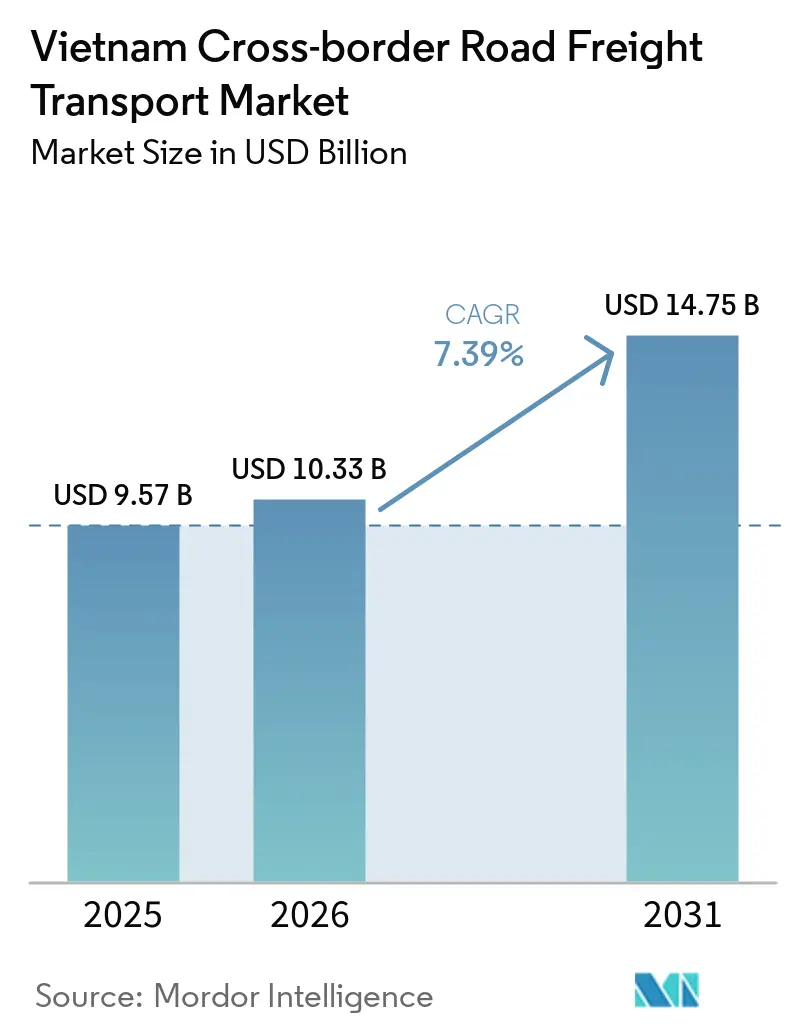
| Base Year Market Size (2025) | USD 9.57 Billion |
| Market Size (2026) | USD 10.33 Billion |
| Market Size (2031) | USD 14.75 Billion |
| Growth Rate (2026 - 2031) | 7.39 % |
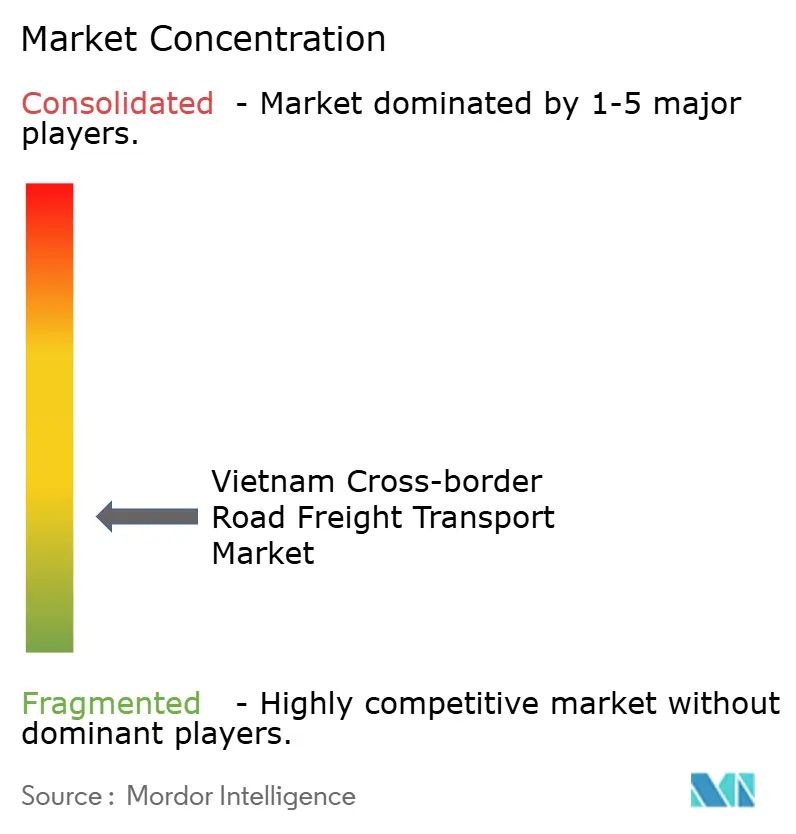
| Market Concentration | Low |
Major Players *Disclaimer: Major Players sorted in no particular order Image © Mordor Intelligence. Reuse requires attribution under CC BY 4.0. | |
Vietnam Cross-border Road Freight Transport Market Analysis by Mordor Intelligence
The Vietnam cross-border road freight transport market size was valued at USD 9.57 billion in 2025 and is estimated to grow from USD 10.33 billion in 2026 to reach USD 14.75 billion by 2031, at a CAGR of 7.39% during the forecast period from 2026 to 2031.
Manufacturing relocation, regional trade integration, and new expressway links support demand for cross-border trucking. Vietnam’s assembly sites need regular deliveries of components from China and the timely outward movement of finished products. China and Vietnam recorded USD 256.5 billion in bilateral trade during 2025, which reinforced the importance of northern freight corridors. Border digitization and bonded logistics capacity have become more important as shippers seek predictable clearance. The Vietnam cross-border road freight transport market also faces uneven backhaul demand, border queues, and a large base of small carriers that still rely on manual booking.
Key Report Takeaways
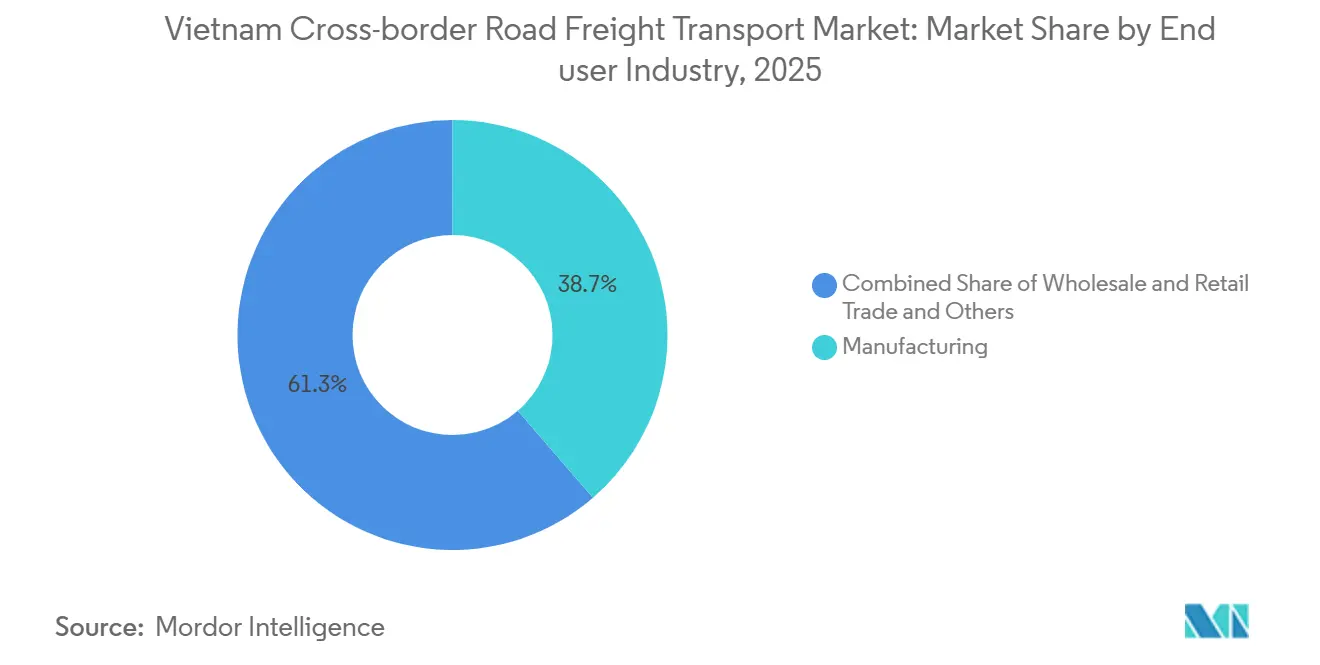
- By end user industry, manufacturing held 38.65% of the Vietnam cross-border road freight transport market share in 2025, while wholesale and retail trade is forecast to register at 8.46% CAGR through 2031.
- By truckload specification, full truckload held 82.39% of the Vietnam cross-border road freight transport market size in 2025, while less-than-truckload is forecast to register at a 9.34% CAGR through 2031.
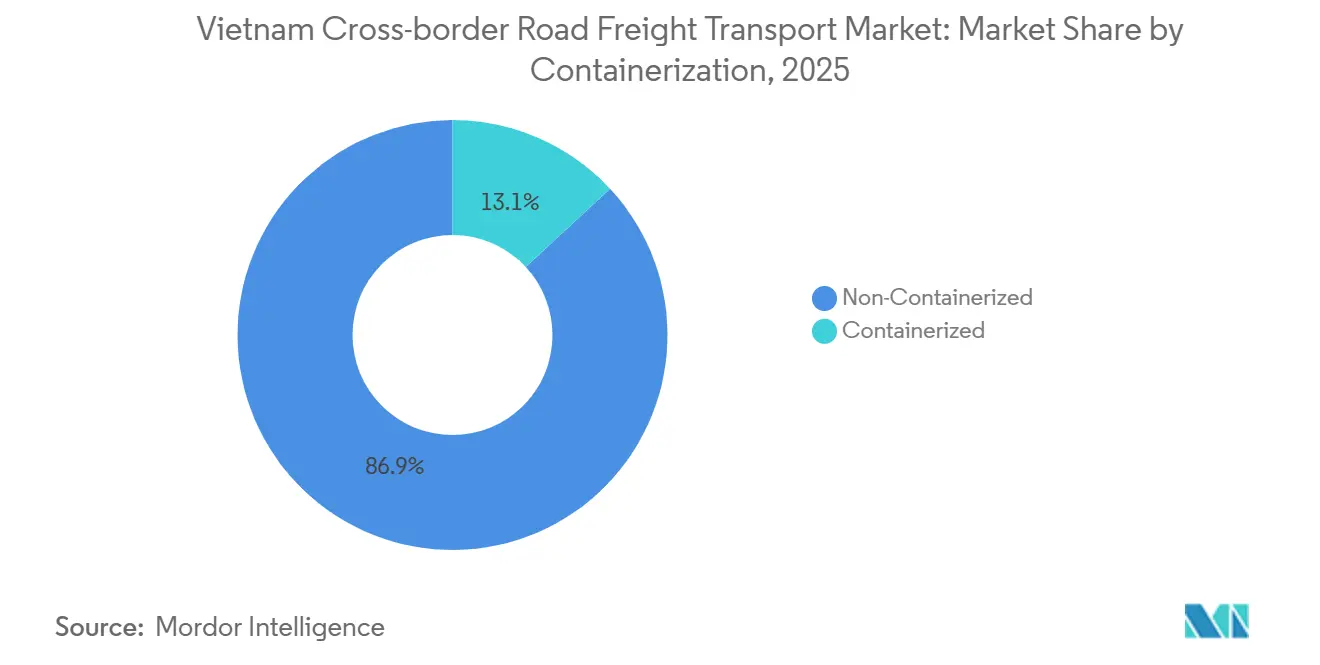
- By containerization, non-containerized freight accounted for 86.91% of the Vietnam cross-border road freight transport market share in 2025, while containerized cargo is forecast to register at a 10.24% CAGR through 2031.
- By distance, long-haul routes accounted for 73.16% of the Vietnam cross-border road freight transport market size in 2025, while short-haul routes are forecast to register at an 8.29% CAGR through 2031.
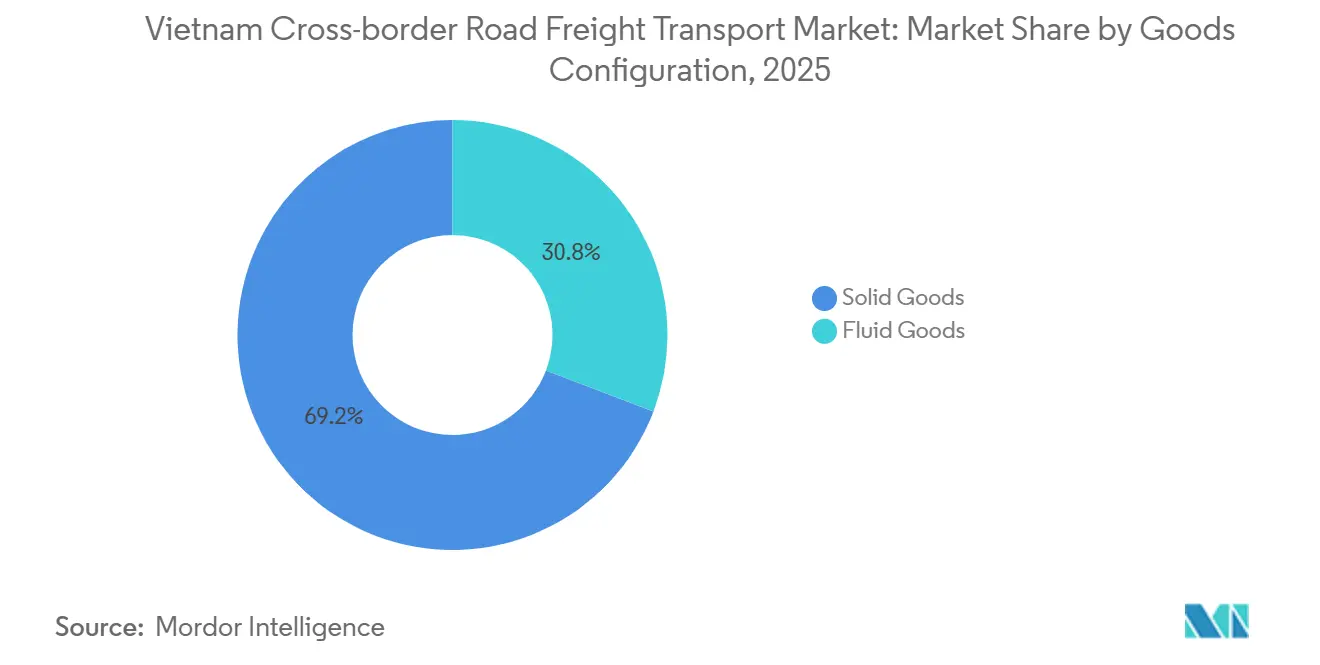
- By goods configuration, solid goods held 69.22% of the Vietnam cross-border road freight transport market size in 2025, while fluid goods are forecast to register at an 8.36% CAGR through 2031.
- By temperature control, non-temperature-controlled freight held 92.42% of the Vietnam cross-border road freight transport market share in 2025, while temperature-controlled freight is forecast to register at a 10.39% CAGR through 2031.
- By cross-border lane, Vietnam-China held 47.39% of the Vietnam cross-border road freight transport market size in 2025, while the Vietnam-Thailand lane is forecast to register at a 9.82% CAGR through 2031.
Note: Market size and forecast figures in this report are generated using Mordor Intelligence’s proprietary estimation framework, updated with the latest available data and insights as of January 2026.
Vietnam Cross-border Road Freight Transport Market Trends and Insights
Drivers Impact Analysis*
| Driver | (~) % Impact on CAGR Forecast | Geographic Relevance | Impact Timeline |
|---|---|---|---|
| Manufacturing Nearshoring Increasing Cross-Border Freight Demand | +1.8% | National, concentrated in northern and southern industrial zones near China and Thailand borders. | Medium term (2-4 years) |
| RCEP Integration Strengthening Regional Road Trade Corridors | +1.3% | Vietnam-China and Vietnam-ASEAN lanes, extending across the bilateral border corridors | Medium term (2-4 years) |
| Expressway Expansion Improving Border-Gate Freight Connectivity | +1.1% | National, with relevance for Lang Son, Cao Bang, Lao Cai, and Tay Ninh corridors | Long term (≥ 4 years) |
| E-Commerce Growth Expanding SME Cross-Border Consolidation Demand | +0.9% | National, with the highest impact on Ho Chi Minh City-Cambodia and Ho Chi Minh City-Thailand lanes | Short term (≤ 2 years) |
| Cold-Chain Expansion Increasing Specialized Road Freight Demand | +0.7% | National, particularly the Vietnam-China agricultural export lanes and the southern corridors | Medium term (2-4 years) |
| Digital Seals Improving Cross-Border Shipment Traceability | +0.5% | Vietnam-China lane, with spillover to Vietnam-Laos and Vietnam-Thailand | Short term (≤ 2 years) |
| Source: Mordor Intelligence | |||
Manufacturing Nearshoring Increasing Cross-Border Freight Demand
Electronics, textiles, and furniture production continue to support regular cross-border truck movements in Vietnam in 2026. Vietnam has become a more permanent production location for manufacturers diversifying their supply chains beyond China. In August 2025, BW Industrial and Acclime reported that supply-chain diversification was becoming an increasingly important consideration for manufacturers in Vietnam. This shift creates inbound demand for components and materials as well as outbound demand for completed goods. The Vietnam cross-border road freight transport market benefits when carriers can match those two flows on the same route. Documentation has become a larger part of the service because exporters need to demonstrate the origin of goods moving to overseas markets. Vietnam-based manufacturers are also adjusting to tighter scrutiny of transshipped goods. A 40% United States tariff on goods transshipped through Vietnam from third countries, compared with a 20% rate on Vietnam-origin goods. This difference encourages exporters to invest in origin records and formal transport documentation. Carriers that can connect shipment data with customs systems can offer a more complete service to electronics exporters. Northern routes are especially important because they link assembly clusters with Chinese component suppliers. Southern routes also gain from production sites that serve Cambodia, Thailand, and regional distribution networks.
RCEP Integration Strengthening Regional Road Trade Corridors
The Regional Comprehensive Economic Partnership supports trade movement among Vietnam, China, Laos, and Cambodia. Its tariff schedules and rules of origin encourage suppliers to use regional production networks. The Vietnam cross-border road freight transport market gains when more inputs move repeatedly across land borders rather than through occasional spot shipments. China-Vietnam trade reached USD 66.7 billion in the first 2 months of 2026. These flows require predictable clearance and consistent vehicle access at border gates. RCEP's tariff schedules and rules of origin continue to support regional production networks involving Vietnam and its major Asian trading partners. These schedules favor carriers with enterprise resource planning connections to customs platforms. It reduces the relative advantage of manual documentation and broker-led processing. Digital integration can lower waiting time and reduce the risk of demurrage on high-frequency lanes. Smaller operators may find the required systems expensive to establish. This creates a more divided service environment between integrated providers and operators that offer only transport capacity.
Expressway Expansion Improving Border-Gate Freight Connectivity
Vietnam is coordinating 2,000 km of new expressway construction between 2026 and 2030, which would raise the national expressway network to 5,000 km[1]. The investment supports the Vietnam cross-border road freight transport market by improving access to border gates and industrial areas. Faster road connections matter most where trucks compete with rail or coastal routes for cargo that needs quick replenishment. The Huu Nghi-Chi Lang project connects Lang Son border gates with the Bac Giang-Lang Son expressway. The Huu Nghi-Chi Lang project opened 50 km to traffic in December 2025[2]. As of September 2026, remaining construction and site-clearance work continued, with the contractual completion date extending to December 2026. The Ho Chi Minh City-Moc Bai expressway entered construction in July 2026. It will link Ho Chi Minh City more directly with the Cambodian border. The Vinh-Thanh Thuy expressway started construction in May 2026 and would form part of the Hanoi-Vientiane corridor. Such projects can reduce the cost of using trucks for shorter regional moves. They can also make more frequent deliveries practical for retail and manufacturing customers. The gains will depend on border processing, road safety, and the availability of compliant drivers and vehicles.
E-Commerce Growth Expanding SME Cross-Border Consolidation Demand
Cross-border e-commerce is increasing the demand for smaller and more frequent freight shipments. Small and medium-sized enterprises are moving away from some air express use as shipment volumes become suitable for road-based consolidation. The Vietnam cross-border road freight transport market can serve these flows through less-than-truckload networks. In November 2025, Amazon Global Logistics launched its Vietnam-United States service, making Vietnam the second FBA export origin for the program after China. This arrangement provides smaller exporters with more structured pallet movements and predictable consolidation needs. Decision No. 2229/QD-TTg set targets for logistics costs to fall to 12-15% of GDP and called for at least 5 international-scale logistics centers by 2035. The policy direction supports larger consolidation facilities and more formal documentation processes. The Law on E-Commerce No. 122/2025/QH15 became effective in July 2026. It raises compliance requirements for logistics providers connected with online platforms. Operators with electronic customs records and reliable load planning are better placed to serve these customers. The result is a gradual shift away from informal parcel arrangements toward scheduled, documented freight services.
Restraints Impact Analysis*
| Restraint | (~) % Impact on CAGR Forecast | Geographic Relevance | Impact Timeline |
|---|---|---|---|
| Border Dwell-Time Variability Increasing Transit Uncertainty | -1.2% | National, with the highest variability at Vietnam-China crossings, including Huu Nghi, Mong Cai, and Lao Cai | Short term (≤ 2 years) |
| Fragmented Carriers Slowing Digital Freight Adoption | -0.9% | National, particularly short-haul and less-than-truckload operations on all lanes | Long term (≥ 4 years) |
| Backhaul Imbalances Reducing Cross-Border Fleet Utilization | -0.7% | Vietnam-China lane, Vietnam-Cambodia lane, and Vietnam-Laos lane | Medium term (2-4 years) |
| Permit and Vehicle Interoperability Gaps Limiting Efficiency | -0.5% | Vietnam-Cambodia and Vietnam-Laos corridors, especially non-Greater Mekong Subregion routes | Medium term (2-4 years) |
| Source: Mordor Intelligence | |||
Border Dwell-Time Variability Increasing Transit Uncertainty
Border waiting times remain a direct constraint on time-sensitive road freight. Trucks can experience multi-day delays at northern border gates during periods of high agricultural export volumes and additional inspection requirements. This delay can reduce quality and raise the risk faced by shippers of refrigerated goods. The volumes show why gate capacity and operating conditions remain important to the Vietnam cross-border road freight transport market. Uncertain transit times make road freight less attractive for pharmaceutical and high-value perishables. Reefer operators may add risk premiums when the timing of clearance is unclear. Those costs can narrow the price difference between trucking and air freight. Digital border systems can improve the documentation process, but they do not fully address seasonal surges, inspections, or physical yard capacity. The restraint is most pronounced at the Vietnam-China crossings because they carry the highest traffic. Better scheduling, gate coordination, and parking capacity would improve the reliability of the service.
Fragmented Carriers Slowing Digital Freight Adoption
Vietnam had more than 34,000 logistics enterprises as of November 2025, while the trucking sector remained highly fragmented, with a large base of small fleet operators. This structure limits the ability of smaller carriers to finance digital booking, tracking, and customs integration systems. Phone-based booking remains common for many short-haul and partial-load services. The Vietnam cross-border road freight transport market needs denser carrier networks before digital matching can consistently reduce empty miles. Low fleet density also makes it harder to assemble reliable return loads. Formal co-loading centers can help, but their success depends on trusted data, standard operating rules, and a steady flow of participating carriers. International integrators are building such facilities because they can combine freight forwarding, warehousing, and road transport. Smaller firms often rely on local broker relationships that are difficult to integrate with standardized digital platforms. The fragmented structure is likely to slow the adoption of standardized digital systems, particularly among smaller carriers with limited capital for technology investment. The long adjustment period leaves room for both consolidation and specialist partnerships.
*Our forecasts treat driver/restraint impacts as directional, not additive. The impact forecasts reflect baseline growth, mix effects, and variable interactions.
Segment Analysis
By End User Industry: Manufacturing Leads Current Demand While Retail Trade Grows Faster
Manufacturing accounted for 38.65% of the Vietnam cross-border road freight transport market share in 2025, supported by electronics assembly sites near Hanoi and textile factories in southern Vietnam. The Vietnam cross-border road freight transport industry serves inbound components from China and the outward movement of finished goods. Agriculture, fishing, and forestry use northern gates for durian, seafood, and lychee exports. Construction moves equipment through Cambodia and Laos, while oil, gas, mining, and quarrying require more specialized permits and bulk transport arrangements.
Wholesale and retail trade is forecast to record the highest CAGR of 8.46% through 2031, as retail chains and e-commerce fulfillment providers require regular replenishment between Vietnam and nearby markets. Manufacturing transport has become more documentation-intensive as exporters seek clear origin records. BW Industrial and Acclime stated that supply-chain diversification away from China was becoming an operating necessity for multinational companies. This supports containerized and scheduled freight that can meet production timetables. Carriers that handle components in one direction and finished goods in the other can improve asset utilization. Agricultural shipments remain important but are more exposed to seasonal demand and border delays. Retail freight gives providers a reason to invest in shared-load systems. The end-user mix, therefore, favors a combination of high-volume manufacturing contracts and flexible consolidation services.

By Truckload Specification: Full Truckload Retains Scale While Less-Than-Truckload Services Expand
Full truckload configurations accounted for 82.39% of the Vietnam cross-border road freight transport market size in 2025. Machinery, textiles, and electronic components can fill a vehicle on major Vietnam-China and Vietnam-Cambodia routes. The Vietnam cross-border road freight transport market relies on consolidation centers to make partial loads economical. Full truckload freight remains the preferred service for large and predictable manufacturing flows.
Less-than-truckload freight is forecast to register at a 9.34% CAGR through 2031, supported by smaller shipments from e-commerce sellers and regional distributors. Amazon Global Logistics’ selection of Vietnam as a strategic FBA origin supports more standardized pallet movements from small and medium-sized exporters. The Greater Mekong Subregion Cross-Border Transport Agreement also supports direct vehicle movement to the destination. A Chongqing-Hai Duong route, launched in August 2025, completed a 1,500 km journey without intermediate transloading. The model can reduce handling costs that previously favored full truckload shipments. Providers with co-loading facilities near border gates can build denser partial-load networks. Pure full truckload operators may face more pricing pressure where return-load utilization is weak.
By Containerization: Non-Containerized Cargo Leads While Containers Gain Ground
Non-containerized freight accounted for 86.91% of the Vietnam cross-border road freight transport market share in 2025. Raw materials, agricultural goods, and oversized industrial cargo often move without ISO container standardization. Electronics original equipment manufacturers and Tier-1 suppliers increasingly use 20-foot and 40-foot ISO containers. Containers can lower handling damage and simplify processes at bonded terminals. The Vietnam cross-border road freight transport market has room for further container use, where shippers need better cargo control.
Containerized freight is forecast to register at a 10.24% CAGR through 2031, supported by increasing adoption among electronics original equipment manufacturers and Tier-1 suppliers. Bonded container terminals require capital, licensed operations, and appropriate handling equipment. DHL Global Forwarding expanded its Ho Chi Minh City Container Freight Station from 4,600 m² to 6,800 m² and increased its Hai Phong facility to 4,000 m² in November 2025. The company's action indicates that export customers need more consolidation capacity. International providers can use these facilities to combine warehousing, customs support, and road transport. Domestic carriers may participate through subcontracting or local route expertise. Container growth can, therefore, increase competition for higher-value freight while conventional break-bulk cargo continues to dominate volume.
By Distance: Long-Haul Routes Carry Most Freight While Short-Haul Demand Broadens
Long-haul routes accounted for 73.16% of distance-based demand in Vietnam's cross-border road freight transport market in 2025. Major corridors between Ho Chi Minh City and northern Chinese border gates can extend 1,200-1,500 km. Retail replenishment and just-in-time manufacturing create demand for quicker movements across nearby borders. The Ho Chi Minh City-Moc Bai corridor is important because the border is close to the city. Road improvements can shift customer views of what can be served in a same-day or next-day cycle.
Short-haul routes are forecast to register at an 8.29% CAGR through 2031, supported by retail replenishment and just-in-time manufacturing requirements across nearby borders. The Ho Chi Minh City-Moc Bai expressway is expected to reduce travel time to the Cambodian border from around 3 hours to under 2 hours at design speed. The Yen Bai-Lao Cai expansion also began in October 2025, which would cover 121 km. Improved speeds can support overnight freight cycles between Hanoi and Yunnan Province. Long-haul services will continue to carry the bulk of industrial traffic. Short-haul services are likely to gain relevance where e-commerce and retail networks require frequent border crossings.
By Goods Configuration: Solid Goods Lead, While Fluid Cargo Supports Specialist Services
Solid goods represented 69.22% of Vietnam's cross-border road freight transport market share in 2025. Electronics, machinery, textiles, packaged consumer products, and agricultural products make up this large base of freight. The Vietnam cross-border road freight transport market has a broad conventional cargo base but a smaller specialist segment with stricter operating requirements. The latter can support higher service rates where qualified capacity is limited.
Fluid goods are forecast to register at an 8.36% CAGR through 2031, supported by demand for petrochemicals, edible oils, and specialty chemicals that require tank containers, tanker trailers, and dedicated equipment. Fluid cargo needs vehicle certification, specific insurance, and hazardous-material documentation. Vietnam-Laos and Vietnam-Cambodia routes are important for chemical and fuel movements. These requirements limit direct price competition with standard solid-goods services. Foreign investment in plastics, agrochemicals, and lubricant blending around the southern border areas supports a growing customer base. Certified tanker operators can develop relationships with shippers that value compliance and reliable equipment. The opportunity is narrower than in conventional freight, but it offers a clearer basis for specialized pricing. Providers must still manage safety, route permissions, and insurance exposure.
By Temperature Control: Ambient Freight Dominates While Cold Chain Services Grow Fastest
Non-temperature-controlled freight accounted for 92.42% of Vietnam's cross-border road freight transport market size in 2025. Electronics, textiles, and industrial materials do not need active temperature management during road transport. This segment remains the dominant freight base in the Vietnam cross-border road freight transport market, while temperature-controlled services address more specialized cargo requirements.
Temperature-controlled freight is forecast to register at a 10.39% CAGR through 2031, supported by demand for fresh produce, seafood, dairy, and pharmaceutical products that require verified cold-chain continuity. Growth depends on equipment availability as well as the ability to clear border gates without long delays. Refrigerated capacity can command a premium because shippers face spoilage and compliance risks. In August 2026, Viettel Logistics announced an investment in 160 new refrigerated containers to expand its cross-border cold-chain capacity. This deployment shows a domestic provider expanding into specialized equipment. Cold-chain networks need storage, maintenance, trained teams, and real-time visibility. A carrier that can protect product quality throughout the route can reduce exposure to the margin pressure common in ambient freight.
Geography Analysis
The Vietnam-China lane held 47.39% of Vietnam's cross-border road freight transport market size in 2025. The corridor links Vietnam’s assembly plants with China’s component supply base. Bilateral trade reached USD 256.5 billion in 2025 and USD 66.7 billion during the first 2 months of 2026. Trucks move components and machinery into Vietnam, then carry finished products and agricultural goods northbound. The route has high traffic density, but that density also creates queues and backhaul challenges. China and Vietnam agreed in April 2026 to use automated inspection robots at 9 land border crossings. The project is intended to reduce processing time at pilot locations from 10 minutes to 2-3 minutes, with wider deployment planned for 2027-2028. The Huu Nghi-Chi Lang expressway further improves access from Lang Son gates to the national road network. These changes support road freight for consignments moving less than 1,000 km. They do not remove the need for seasonal queue management or customs coordination.
The Vietnam-Thailand lane is forecast to register at a 9.82% CAGR through 2031, the fastest among the identified cross-border corridors. The East-West Economic Corridor connects Da Nang with Thailand through Laos and supports regional manufacturing and distribution. Kuehne+Nagel invested in around 40 prime movers and 100 containers in Thailand during October 2025 to expand Southeast Asian cross-border services, including Vietnam[3]. The Vietnam-Laos route is gaining importance through the Vinh-Thanh Thuy expressway, which began construction in May 2026 and targeted for completion by the end of 2028.
The Vietnam-Cambodia lane supports retail, fast-moving consumer goods, and e-commerce fulfillment between Ho Chi Minh City and Phnom Penh. Its shorter distance suits frequent replenishment, although vehicle quotas remain a constraint. Vietnam’s customs authority proposed a review of Cambodia’s vehicle quota rules to reflect trade volumes. Other routes, including triangular movements through Laos to Thailand, are smaller today. They offer future options as Greater Mekong Subregion infrastructure becomes more complete. Carrier networks that can combine lanes may improve equipment utilization. The geographic mix, therefore, favors strong Vietnam-China operations while offering faster growth in Thailand and selected southern routes.
Competitive Landscape
The Vietnam cross-border road freight transport market is fragmented among domestic carriers but more concentrated in premium logistics services. Indo Trans Logistics, Bee Logistics, VINATRANS, and Transimex compete through route knowledge and pricing in conventional freight. DHL Group, Kuehne+Nagel, DSV, GEODIS, and Nippon Express Holdings have stronger positions in certified facilities, cold chain, and technology-enabled services. These capabilities are relevant to electronics and pharmaceutical customers who need documented handling. The gap between basic trucking and integrated logistics creates different forms of competition. Domestic firms can retain local relationships while global providers use facilities and systems to serve complex contracts.
CJ Logistics acquired the remaining 49.1% interest in CJ Gemadept Logistics Holding in April 2026. Gemadept and CJ Logistics completed the related shipping and logistics restructuring in June 2026. CJ Logistics further stated that it would accelerate investment in Vietnamese logistics infrastructure, distribution centers, and technology. This move gives each party a clearer focus on its core operations. It also signals continued interest in scale and vertical integration within logistics services.
DHL Supply Chain broke ground on its North Logistics Campus in Hung Yen Province in July 2026. The facility represents a VND 1.9 trillion (USD 76 million) investment and covers 82,500 m², making it DHL’s largest Grade A complex in Southeast Asia[4]. Kuehne+Nagel’s equipment investment for Southeast Asian cross-border transport is another example of providers building regional capacity. White-space opportunities include temperature-controlled partial loads, digital load matching, and Vietnam-Thailand premium-lane services.
Vietnam Cross-border Road Freight Transport Industry Leaders
-
Indo Trans Logistics Corporation (ITL)
-
Bee Logistics Corporation
-
THACO
-
GEODIS
-
DSV
- *Disclaimer: Major Players sorted in no particular order
Recent Industry Developments
- July 2026: DHL Supply Chain broke ground on the DHL North Logistics Campus in Hung Yen Province on July 24, 2026, investing USD 76 million. The 82,500 m² Grade A complex, DHL’s largest in Southeast Asia, serves electronics, automotive, and pharmaceutical shippers, with Phase 1 targeted for the first half of 2027.
- June 2026: Gemadept Corporation completed its restructuring with CJ Logistics on June 30, 2026. Gemadept took 100% ownership of the shipping joint venture. In comparison, CJ Logistics assumed 100% control of CJ Gemadept Logistics Holding, enabling each company to accelerate capital deployment in its core Vietnam business independently.
- May 2026: Construction commenced on the 60 km Vinh-Thanh Thuy expressway, with a value of USD 1.37 billion. The project connects Nghe An to the Laotian border and is targeted for completion by the end of 2028.
- April 2026: CJ Logistics acquired the remaining 49.1% stake in CJ Gemadept Logistics Holding on April 1, 2026, assuming 100% ownership. CJ Logistics plans to accelerate logistics infrastructure investment in Vietnam, including new distribution centers and technology from its TES Logistics Research Institute.
Vietnam Cross-border Road Freight Transport Market Report Scope
| Agriculture, Fishing, and Forestry |
| Construction |
| Manufacturing |
| Oil and Gas, Mining and Quarrying |
| Wholesale and Retail Trade |
| Others |
| Full-Truck-Load (FTL) |
| Less than-Truck-Load (LTL) |
| Containerized |
| Non-Containerized |
| Long Haul |
| Short Haul |
| Fluid Goods |
| Solid Goods |
| Non-Temperature Controlled |
| Temperature Controlled |
| Vietnam-China |
| Vietnam-Laos |
| Vietnam-Cambodia |
| Vietnam-Thailand |
| Other Cross-Border Road Freight Lanes |
| By End User Industry | Agriculture, Fishing, and Forestry |
| Construction | |
| Manufacturing | |
| Oil and Gas, Mining and Quarrying | |
| Wholesale and Retail Trade | |
| Others | |
| By Truckload Specification | Full-Truck-Load (FTL) |
| Less than-Truck-Load (LTL) | |
| By Containerization | Containerized |
| Non-Containerized | |
| By Distance | Long Haul |
| Short Haul | |
| By Goods Configuration | Fluid Goods |
| Solid Goods | |
| By Temperature Control | Non-Temperature Controlled |
| Temperature Controlled | |
| By Cross-Border Lane | Vietnam-China |
| Vietnam-Laos | |
| Vietnam-Cambodia | |
| Vietnam-Thailand | |
| Other Cross-Border Road Freight Lanes |
Key Questions Answered in the Report
What is the projected value of Vietnam's cross-border road freight transport by 2031?
It is projected to reach USD 14.75 billion by 2031, rising from USD 10.33 billion in 2026 at a 7.39% CAGR.
Which end-user group has the greatest demand for cross-border road freight in Vietnam?
Manufacturing led demand with a 38.65% share in 2025, supported by component flows and finished-goods exports.
Which freight service is expected to grow fastest through 2031?
Temperature-controlled freight is forecast to register at a 10.39% CAGR through 2031, driven by food, seafood, and pharmaceutical shipments.
Why is the Vietnam-China corridor important for road carriers?
The lane held 47.39% of the total value in 2025 and connects Vietnam’s factories with China’s component supply base.
What is limiting cross-border trucking performance in Vietnam?
Border dwell-time variability, fragmented carrier networks, backhaul imbalance, and permit gaps can increase cost and transit uncertainty.
Which infrastructure projects can improve regional trucking routes?
The Huu Nghi-Chi Lang, Ho Chi Minh City-Moc Bai, and Vinh-Thanh Thuy expressway projects can improve access to China, Cambodia, and Laos.