
Video-Assisted Identity Verification Market Size and Share
Market Overview
| Study Period | 2021 - 2032 |
|---|---|
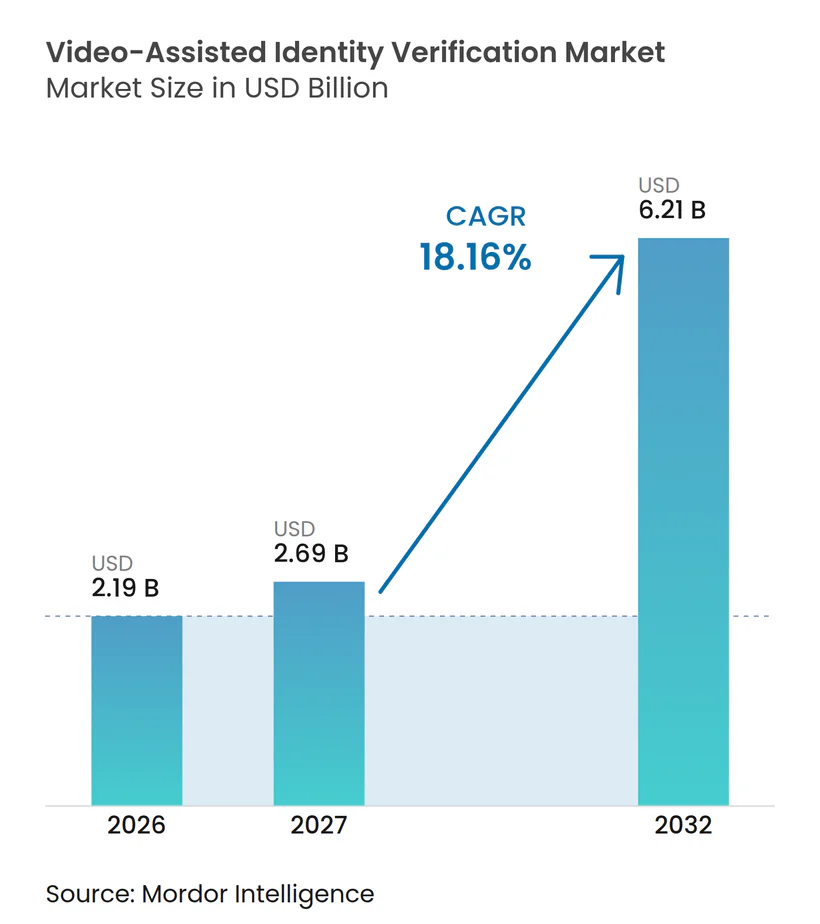
| Market Size (2027) | USD 2.69 Billion |
| Market Size (2032) | USD 6.21 Billion |
| Growth Rate (2027 - 2032) | 18.16 % |
| Fastest Growing Market | Asia-Pacific |
| Largest Market | North America |
| Market Concentration | Medium |
Major Players *Disclaimer: Major Players sorted in no particular order Image © Mordor Intelligence. Reuse requires attribution under CC BY 4.0. | |
Video-Assisted Identity Verification Market Analysis by Mordor Intelligence
The Video-Assisted Identity Verification Market size is projected to expand from USD 2.19 billion in 2026 and USD 2.69 billion in 2027 to USD 6.21 billion by 2032, registering a CAGR of 18.16% between 2027 and 2032. Remote identity proofing is becoming standard in financial services, government, and digital commerce. Regulations are widening the use of remote verification, while AI-enabled fraud is raising demand for liveness-aware video checks. Providers are combining biometric matching, document validation, risk signals, and workflow tools into a single service. This positions the Video-Assisted Identity Verification Market as part of the digital infrastructure rather than a limited compliance tool. Demand is extending to mobile-first economies where branch-based verification had limited reach, although local privacy rules, infrastructure, and data residency requirements remain important.
Key Report Takeaways
- By component, software held 73.85% of the Video-Assisted Identity Verification Market in 2026 and is projected to expand at an 18.56% CAGR through 2032.
- By verification modality, Face Video Verification held 65.13% share in 2026, while Multimodal Video Verification is projected to expand at an 18.94% CAGR through 2032.
- By deployment mode, cloud held 38.34% share in 2026 and is projected to expand at an 18.53% CAGR through 2032.
- By organization size, Large Enterprises held 24.44% share in 2026, while SMEs are projected to expand at an 18.91% CAGR through 2032.
- By end user, BFSI held 34.81% share in 2026, while the Government and Public Sector are projected to expand at a 19.34% CAGR through 2032.
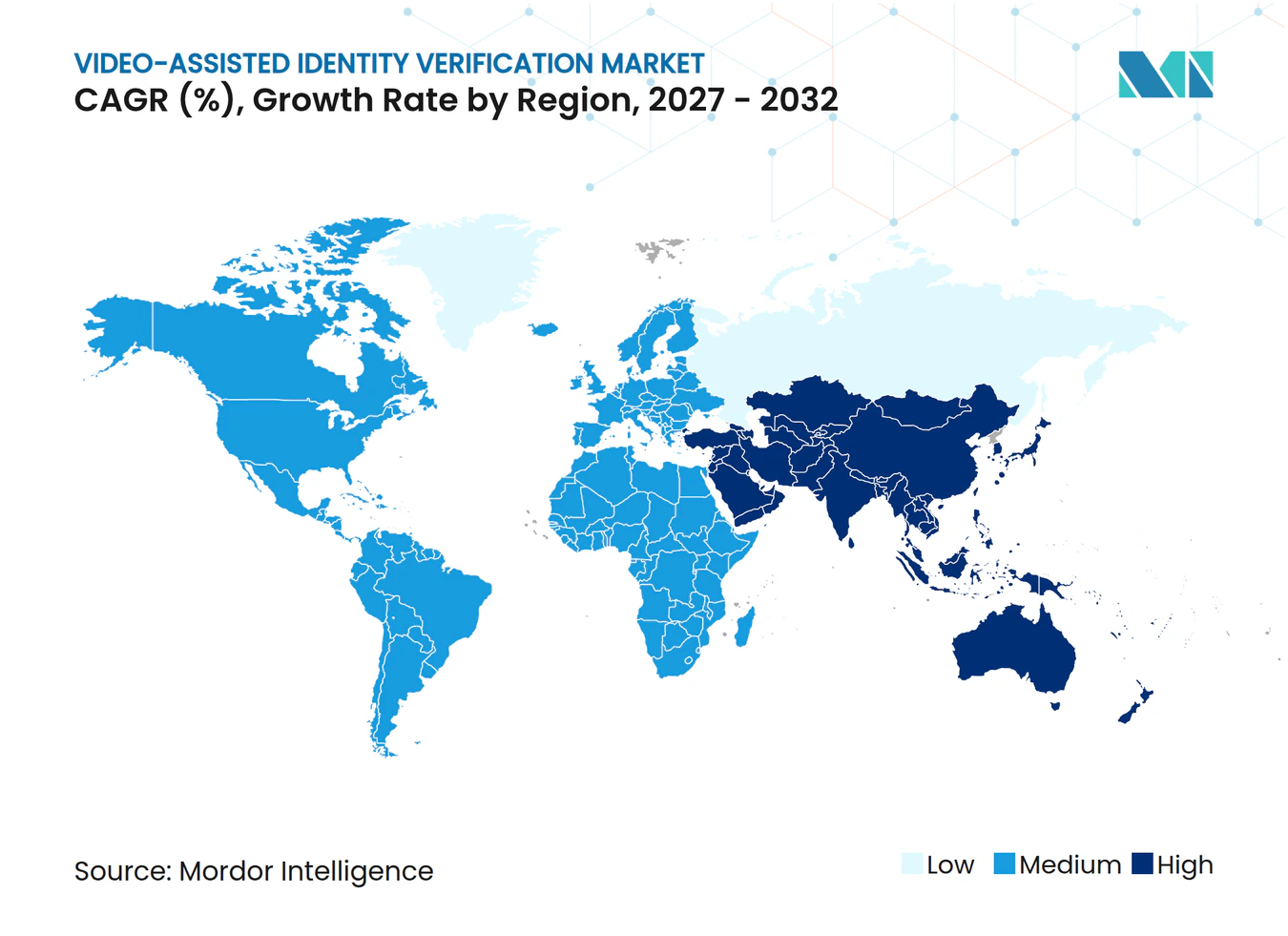
- By geography, North America was the largest regional segment in 2026 with a share of 34.42%, while Asia-Pacific is projected to expand at a 19.12% CAGR through 2032.
Note: Market numbers in this report are based on Mordor Intelligence's proprietary estimation framework, which combines nine months of actuals with Q4 projections for base year 2026.
Market Trends and Insights
Drivers Impact Analysis of Video-Assisted Identity Verification Market*
| Driver | (~) % Impact on CAGR Forecast | Geographic Relevance | Impact Timeline |
|---|---|---|---|
| Regulatory Expansion of Remote Identity Proofing | +3.5% | Global, concentrated in EU-27, North America, and India | Short term (≤ 2 years) |
| Escalating Deepfake and Synthetic Identity Fraud | +3.0% | Global | Short term (≤ 2 years) |
| Digital Onboarding and Real-Time Payment Growth | +2.8% | Global, strongest in Asia-Pacific and North America | Medium term (2-4 years) |
| Reusable Digital Identity and Wallet Adoption | +2.5% | EU-27 core, with emerging adoption in North America and Asia-Pacific | Medium term (2-4 years) |
| AI-Enabled Multimodal Liveness Improvement | +2.0% | Global | Medium term (2-4 years) |
| Expansion of Video-Assisted Verification in Emerging Markets | +1.8% | Africa, South and Southeast Asia, South America | Long term (≥ 4 years) |
| Source: Mordor Intelligence | |||
Regulatory Expansion of Remote Identity Proofing
Regulatory requirements are a central driver of demand for the Video-Assisted Identity Verification Market, as compliant processes enable new digital services, broader customer access, and remote delivery without a branch visit. NIST finalized Digital Identity Guidelines SP 800-63 Revision 4 in July 2025, which recognizes video-based proofing as a route to Identity Assurance Level 2 and provides a benchmark for agencies evaluating stronger remote processes. NIST also launched an implementation resource hub in October 2026 to support adoption by federal agencies and provide procurement teams with clearer materials for deployment planning. The guidelines provide public agencies and vendors with a common reference point for selecting methods, documenting evidence, and assessing how remote proofing can meet assurance expectations. ETSI TS 119 461, ISO/IEC 30107-3 presentation attack detection testing, and eIDAS 2.0 requirements are shaping vendor product plans, certification priorities, and enterprise procurement criteria. These requirements make evidence quality, records, liveness testing, accessibility, privacy controls, and explicit consent more important when selecting providers.
Escalating Deepfake and Synthetic Identity Fraud
Deepfake and synthetic identity fraud are driving demand for active liveness checks and video review within the Video-Assisted Identity Verification Market, particularly when a fraudulent account can be used for payments, credit, or account recovery. The World Economic Forum reviewed 25 deepfake and camera-injection tools and found that some could enable real-time, high-fidelity impersonation against live verification processes. This threat means that document images alone may not provide sufficient evidence for higher-risk onboarding, since a convincing document image does not confirm that a live, authorized person is present. iProov reported that native virtual-camera attacks increased 2,665% in 2024, with peak detection reaching 785 incidents per week in the second quarter of that year. Vendors are therefore pairing session-integrity controls with biometric matching, challenge-response prompts, document analysis, and rules that identify unusual behavior before a case is approved. The result is a verification flow that must verify whether the session, person, document, and technical capture path are genuine, rather than merely confirming that a face appears on screen.
Digital Onboarding and Real-Time Payment Growth
Digital onboarding and faster payment services increase the cost of admitting a fraudulent user into an account or transaction network, since digital accounts can be opened and used with little delay. Visa reported that identity systems integrated with payment infrastructure can extend the value of identity credentials beyond payment use cases.[1] Financial institutions are consequently linking onboarding controls more closely to payment risk, account recovery, dispute handling, and the verification of people making higher-risk transactions. This connection supports the demand for remote verification that can be completed without unnecessarily interrupting the customer journey or moving a valid applicant into a manual queue. In the Video-Assisted Identity Verification Market, providers can compete on successful completion, clear user guidance, and fraud reduction instead of treating compliance as the only buyer objective. Better integration with payment and onboarding systems can also move purchasing discussions from a narrow compliance function toward product operations, customer retention, and the cost of resolving fraud.
Reusable Digital Identity and Wallet Adoption
Reusable digital identity wallets can concentrate identity proofing at the initial enrollment stage rather than eliminate the need for proofing, because a reusable credential must be linked to a trustworthy identity before it can be accepted elsewhere. The FIDO Alliance launched its Digital Credentials Initiative in December 2025 to establish wallet certification criteria for interoperability and privacy. High-assurance enrollment remains necessary before a credential can be issued, shared, and reused by different services. That requirement supports video-assisted processes that can establish a defensible initial identity record while preserving appropriate information for later review. The Video-Assisted Identity Verification Market may therefore benefit as wallet programs make verified credentials useful across payments, public services, and private digital channels. Providers that support verifiable credentials, selective disclosure, interoperable wallet connections, and reliable enrollment records can position their verification systems within a wider identity ecosystem.
Restraints Impact Analysis of Video-Assisted Identity Verification Market*
| Restraint | (~) % Impact on CAGR Forecast | Geographic Relevance | Impact Timeline |
|---|---|---|---|
| Privacy, Data Residency, and Biometric Consent Requirements | -1.5% | Global, most acute in EU-27, India, and Asia-Pacific | Short term (≤ 2 years) |
| Virtual Camera and Injection Attack Evasion | -1.2% | Global | Short term (≤ 2 years) |
| Camera, Lighting, Connectivity, and Accessibility Variability | -1.0% | Africa, South Asia, rural Asia-Pacific | Long term (≥ 4 years) |
| Legacy System Integration and Total Cost of Ownership | -0.8% | North America and Europe | Medium term (2-4 years) |
| Source: Mordor Intelligence | |||
Privacy, Data Residency, and Biometric Consent Requirements
Privacy, data residency, and biometric consent rules complicate cross-border delivery in the Video-Assisted Identity Verification Market because providers must design for different requirements on collection, processing, retention, and transfer. The European Data Protection Supervisor notes that biometric data used to uniquely identify a person is subject to special protections under European data rules.[2] The EU AI Act adds obligations for remote biometric identification systems, increasing the need for documented controls, clear accountability, and careful assessment of the purpose for which biometric data is used. Data localization requirements can also require providers to use local processing, storage, support arrangements, and infrastructure rather than a single global operating model. These conditions increase implementation work for multinational customers, introduce additional legal review, and can lengthen approval cycles before a service goes live. Providers that use privacy-by-design methods, local data processing, selective disclosure, clear consent journeys, and controlled retention policies can reduce this burden for buyers.
Virtual Camera and Injection Attack Evasion
Virtual camera and injection attacks challenge the assumption that a video stream always represents a live user, even when the interface appears to use an ordinary device camera. The World Economic Forum noted that available tools can support camera injection and high-fidelity impersonation in real time. iProov described the expansion of native virtual-camera attacks that can bypass a device's camera feed without modifying the device. ISO/IEC 25456 development began in early 2025 to address injection attack detection, building on CEN/TS 18099:2024 and highlighting the integrity of the capture path. Until testing and implementation become more consistent, buyers must assess how a provider protects the camera feed, detects tampering, and maintains records of the checks performed. This requirement increases the technical, testing, and assurance burden for vendors, even as it reinforces the need for stronger verification services.
*Our forecasts treat driver/restraint impacts as directional, not additive. The impact forecasts reflect baseline growth, mix effects, and variable interactions.
Video-Assisted Identity Verification Market Segment Analysis
By Component:
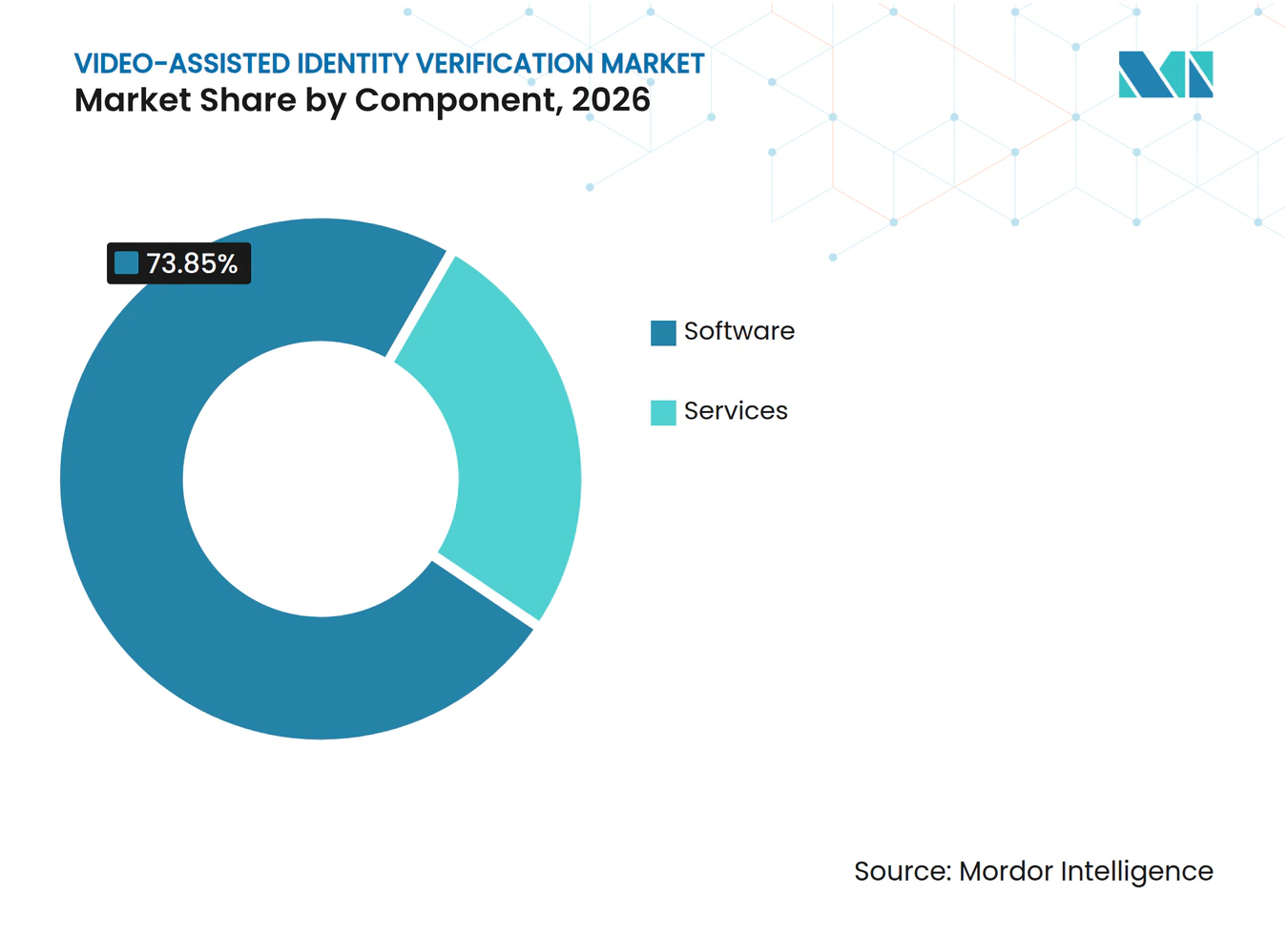
Software Anchors The Revenue BaseSoftware held 73.85% of the Video-Assisted Identity Verification Market in 2026 and is projected to expand at an 18.56% CAGR through 2032. This position reflects the importance of systems that turn a video session into a documented identity decision. The software layer includes AI inference pipelines, workflow orchestration, risk scoring, and records that support compliance review. It also connects biometric evidence to the identity document, customer record, and risk policy used by the client. Providers use these functions to identify presentation artifacts, inconsistent facial behavior, and document mismatches. Deep integration into onboarding and recovery workflows can make a platform difficult to replace.
Services constitute the remaining revenue stream in the video-assisted identity verification industry. They include implementation support, managed review, integration work, and help with compliance procedures. Large regulated customers often require these services because their processes span multiple jurisdictions and rely on established identity systems. A video workflow may need to connect with legacy KYC tools, case management systems, fraud controls, and customer databases. Services help buyers configure these connections and manage unusual cases that do not fit automated rules. Software remains the main source of scalable recurring revenue because the same platform can serve rising verification volumes. Managed review retains a role where a case needs additional evidence or human judgment. As autonomous decision tools improve, routine verification work can move from review teams to automated processes. This enables providers to increase capacity without adding staff at the same pace.


By Verification Modality:
Multimodal Methods Close In On Face-Only ChecksFace Video Verification commanded 65.13% of the Video-Assisted Identity Verification Market share in 2026. Its leading position reflects its established use in consumer-facing financial onboarding and other regulated digital services. A face-based flow can compare the person on camera with a photograph on an identity document. It can also observe liveness cues that are not available from a static upload. This approach remains familiar to customers and can be deployed through common smartphone cameras. Synthetic media attacks, however, have made a face-only approach less reliable for higher-risk cases. Institutions are therefore placing greater weight on flows that collect multiple biometric or behavioral signals.
Multimodal Video Verification is projected to expand at an 18.94% CAGR through 2032. A 2025 IEEE study found that adaptive systems combining facial and vocal evidence with dynamic challenge-response liveness can improve spoof resistance compared with single-mode methods. Multimodal processes can collect different forms of evidence when the risk of a transaction or account requires it. They can also reduce reliance on any single biometric signal that may be vulnerable to a new attack. Document Video Verification remains important where regulators require forensic examination of a document alongside biometric matching. Voice and Video Verification is relevant to financial advisory and healthcare settings where voice can serve as an additional identity signal. The Video-Assisted Identity Verification Market is likely to favor methods that adjust evidence collection to the risk of each case. Providers must make these checks clear for users with different devices, network conditions, and physical abilities. Stronger methods will still need to avoid unnecessary delays that lead users to abandon the process.
By Deployment Mode:
Cloud Leads, But Hybrid Models Are Gaining GroundCloud held 38.34% of the Video-Assisted Identity Verification Market in 2026 and is projected to expand at an 18.53% CAGR through 2032. Cloud delivery gives institutions flexibility when demand for verification rises during product launches, promotions, and regulatory deadlines. It enables providers to update liveness models, fraud rules, and workflow settings without requiring a full local software release. A centralized service can also support consistent configuration across a client’s regional operations. Where data rules allow it, anonymized signals from verification activity can help identify new attack patterns. These capabilities can help providers respond faster than systems operating in isolated environments.
On-premises deployment remains relevant for institutions with strict data residency, security, or internal control requirements. This includes financial institutions subject to local processing restrictions and large European banking groups with established technology policies. These deployments allow a customer to keep selected biometric data and controls inside its own environment. Hybrid models are gaining traction because they divide workloads between local systems and cloud services. A customer may keep biometric matching local while using cloud services for analytics, orchestration, or model updates. This structure can balance operational flexibility with control over sensitive information. Digital identity wallet infrastructure also supports cloud connections where credentials must work across several services. Buyers assess deployment options against privacy obligations, integration requirements, operating cost, and the resilience of existing systems. The Video-Assisted Identity Verification Market must support these different choices instead of assuming one architecture will suit every institution.
By Organization Size:
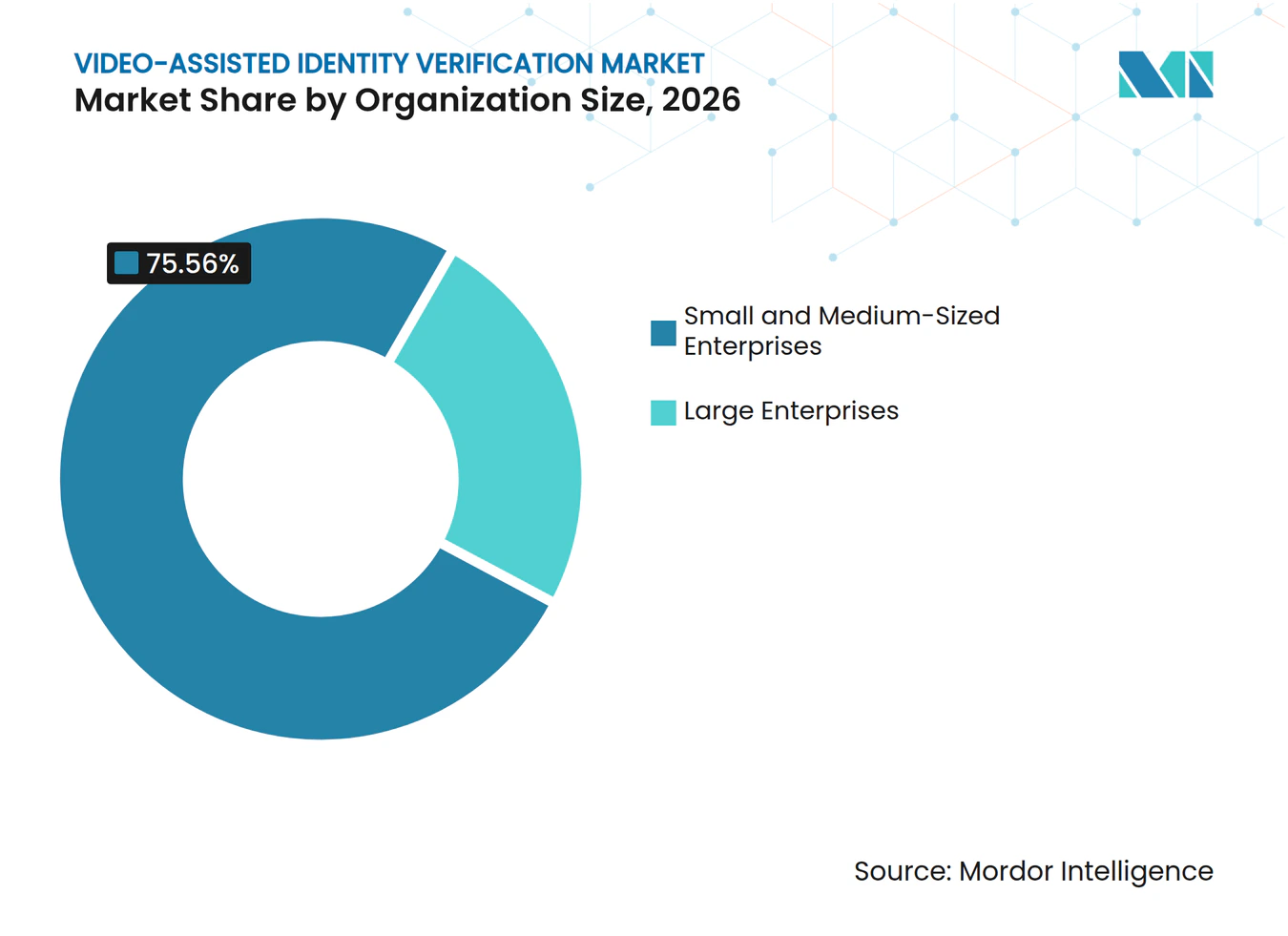
SMEs Emerge As The Fastest-Growing Adopter CohortLarge Enterprises held 24.44% of the Video-Assisted Identity Verification Market in 2026. Their early adoption reflects regulatory obligations in BFSI and the requirements associated with government contracts. Enterprise programs frequently involve several identity vendors, connections to established KYC systems, and formal case review processes. These customers need records, permissions, service levels, and evidence trails that can withstand an internal audit. They may also require products to work across several countries, business units, and customer channels. Complex procurement can favor providers with implementation experience and a broad network of integrations.
SMEs are projected to expand at an 18.91% CAGR through 2032. API-first offerings are reducing the effort required to add a basic video verification process to a digital service. This gives smaller fintechs and online businesses access to functions that previously required larger compliance and technology teams. A smaller customer may use verification to support sign-up completion, account activation, and regulatory compliance simultaneously. Simple integration and transparent pricing are important where buyers have limited internal capacity. The Video-Assisted Identity Verification Market can reach more SMEs when providers offer settings that fit different risk levels and verification volumes. Providers also need practical support for exceptions that automated systems cannot resolve. The ability to launch quickly can reduce the operational barrier to adoption. It can also allow a smaller business to introduce a stronger identity process before its exposure to fraud becomes material.

By End User:
BFSI Leads As Government Adoption AcceleratesBFSI accounted for 34.81% of the Video-Assisted Identity Verification Market share in 2026. Banks, payment firms, insurers, and securities businesses use identity proofing during onboarding, customer reviews, high-value transactions, and account recovery. Each process can require a different evidence threshold and audit trail. This creates repeated demand for risk-based identity decisions rather than a single onboarding check. Financial institutions also need verification outcomes to connect with AML controls, fraud systems, and customer lifecycle records. These requirements make the sector an important source of recurring demand for providers.
The government and public sector are projected to expand at a 19.34% CAGR through 2032. National digital identity programs and online public services are increasing the need for strong proofing without an in-person visit. Government buyers place particular emphasis on certification, accessibility, recordkeeping, and service delivery to diverse populations. They often need processes that serve users with different devices, languages, and connectivity conditions. Retail and e-commerce use video-assisted processes for merchant and customer onboarding. Telecommunications providers use them for SIM registration, while healthcare organizations use them for patient identity and telehealth access. Each use case has a different balance of fraud risk, convenience, and regulatory requirements. The Video-Assisted Identity Verification Market must accommodate those differences without treating any single verification method as suitable for every case. This creates space for configurable workflows that can adjust the evidence required for a particular service.
Geography Analysis
North America Video-Assisted Identity Verification Market
North America was the largest regional segment of the Video-Assisted Identity Verification Market in 2026, accounting for 34.42%. The region combines demand from BFSI and federal contracting with a dense set of identity and financial crime requirements. US federal digital-service programs support demand for proofing that can be used in online public services. Canada’s open banking discussions link identity standards to payment rail modernization. Mexico’s fintech activity provides demand from digital lenders and payment businesses. NIST’s SP 800-63-4 implementation resource hub provides agencies with material for planning digital identity programs.[3]
APAC Video-Assisted Identity Verification Market
Asia-Pacific is projected to expand at a 19.12% CAGR through 2032. India’s V-CIP framework, digital financial services in Malaysia, and mobile-first onboarding across Southeast Asia are supporting adoption. Singapore and Australia provide regional reference points for multilingual and low-bandwidth verification designs. Data localization requirements in India, Indonesia, and Vietnam can require providers to maintain in-country capacity. This can limit global platforms without local infrastructure while supporting suppliers that meet domestic processing and service requirements.
EMEA and South America Video-Assisted Identity Verification Market
Europe is shaped by EUDI Wallet preparations and the need for consistent identity proofing across member states. Updated ETSI specifications can reduce the cost of meeting diverse national requirements when suppliers operate across Europe. Germany and France have significant institutional demand, while Spain provides an example of AML-compliant remote video identification. South America is seeing demand driven by Brazil’s fintech activity, with adoption extending to Colombia and Argentina. Gulf central bank policies that allow Arabic-language video flows and dual-ID capture are supporting use in the United Arab Emirates and Saudi Arabia. Nigeria’s March 2026 AML circular points to the potential for first-time adoption in Africa, where remote verification can broaden access to formal digital services.
Competitive Landscape
Market Concentration
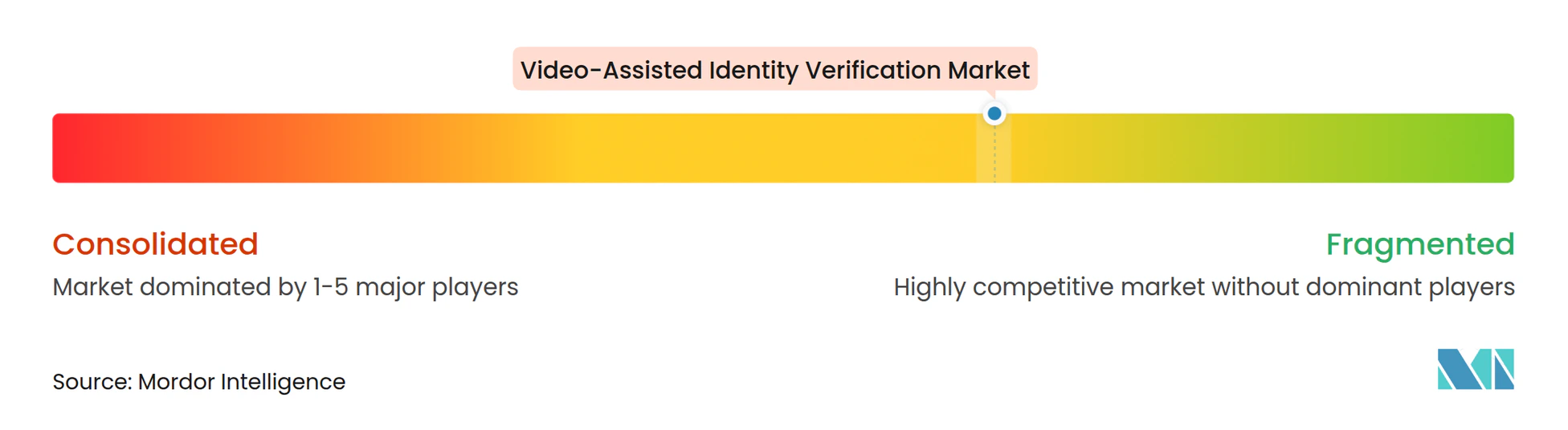
The Video-Assisted Identity Verification Market is moderately fragmented. Jumio, Veriff, iProov, Sumsub, Socure, AU10TIX, HyperVerge, Incode Technologies, IDnow, FacePhi, and Innovatrics compete across enterprise and regional opportunities. Competition centers on the services provided around a verification event and the strength of biometric liveness controls. Providers are adding KYB, AML screening, fraud analysis, and reusable identity tools alongside core video verification. Certifications such as iBeta Level 2, FIDO IAD, and eIDAS High Level of Assurance can influence procurement because buyers want independent evidence of performance.
Veriff acquired Vespia in February 2026 to add business verification to its identity platform. AU10TIX joined Microsoft’s Security Store in December 2025, bringing identity and biometric technology into the Microsoft Entra environment. These moves show how providers are adding services and placing products inside enterprise ecosystems. Incode Technologies acquired AuthenticID in August 2025 to combine digital identity and fraud prevention capabilities. The transaction reflects the need to address generative AI fraud and identity authentication through broader platforms rather than isolated tools.
Socure acquired Fravity in August 2026 after raising USD 156 million in a Series E extension at a USD 5.2 billion valuation. The acquisition linked identity verification with downstream fraud, risk, and compliance workflows. Signzy’s RBI selection for unassisted video KYC piloting and HyperVerge’s Southeast Asia expansion show how firms that adapted to local rules and low-bandwidth settings can compete in high-growth regions. Daon’s August 2026 filing of 5 Quantum Identity patents also shows vendor attention to cryptographic resilience in biometric systems. These strategies are keeping the Video-Assisted Identity Verification Market competitive because providers must improve the verification event and the systems that follow it.
Video-Assisted Identity Verification Industry Leaders
-
Jumio Corporation
-
Veriff OÜ
-
iProov Limited
-
Daon, Inc.
-
Incode Technologies, Inc.
- *Disclaimer: Major Players sorted in no particular order
Video-Assisted Identity Verification Market Companies Covered in this Report
- 1Kosmos, Inc.
- APLYiD Limited
- AU10TIX Ltd.
- Daon, Inc.
- FacePhi Biometria, S.A.
- HyperVerge Technologies, Inc.
- iDenfy UAB
- iProov Limited
- Incode Technologies, Inc.
- Innovatrics, s.r.o.
- Jumio Corporation
- Ondato UAB
- Persona Identities, Inc.
- Prove Identity, Inc.
- Regula Forensics Inc.
- Shufti Pro Ltd.
- Smile Identity, Inc.
- Socure, Inc.
- Sumsub Inc.
- Veriff OÜ
- IDnow GmbH
- Identomat Ltd.
Recent Industry Developments in Video-Assisted Identity Verification Market
- October 2026: FacePhi partnered with Crif to deliver document verification and facial biometric technology within Crif's remote customer onboarding services across Europe and South America, integrating passive liveness detection and OCR-based document extraction. The partnership extends FacePhi's reach into a business-information provider present in more than 50 countries, broadening video-assisted identity verification into commercial credit use cases.
- September 2026: Jumio launched selfie.DONE, its selfie-based reusable identity product, across Europe, the Middle East, and Africa, enabling businesses to recognize previously verified users without requiring a new document check. The launch followed the product's Asia-Pacific rollout earlier that same month, establishing coordinated global deployment aligned with EUDI Wallet-era demand.
- August 2026: Socure raised USD 156 million in a Series E extension at a USD 5.2 billion valuation, led by Summit Partners with participation from Goldman Sachs Alternatives, Wells Fargo, and Docusign, and simultaneously acquired Fravity, an agentic AI operations platform, to automate fraud, risk, and compliance workflows downstream of identity verification events.
- July 2026: Xcelerate Solutions and Socure secured a USD 163 million 5-year call order from the U.S. federal government to supply the next generation of remote identity proofing for Login.gov, the largest publicly reported public-sector video-assisted identity verification contract of 2026.
Global Video-Assisted Identity Verification Market Report Scope
The Video-Assisted Identity Verification Market comprises software solutions and associated services that use video-based technologies to verify individuals’ identities remotely through visual, audio, and document-based authentication processes. These solutions leverage technologies such as facial recognition, liveness detection, voice analysis, document authentication, and artificial intelligence (AI) to validate user identities, detect impersonation and identity fraud, and support secure digital interactions. Video-assisted identity verification platforms enable organizations to streamline customer and user verification, strengthen fraud prevention, enhance security, and meet regulatory and compliance requirements across digital onboarding and authentication processes.
The Video-Assisted Identity Verification Market Report is Segmented by Component (Software, and Services), Verification Modality (Face Video Verification, Voice and Video Verification, Document Video Verification, and Multimodal Video Verification), Deployment (Cloud, On-Premises, and Hybrid), Size (Large Enterprises, and Small and Medium-Sized Enterprises), End User (BFSI, Retail and E-Commerce, Government and Public Sector, Telecommunications, Healthcare and Life Sciences, and Other End Users), and Geography (North America, South America, Europe, Asia-Pacific, Middle East, and Africa). The Market Forecasts are Provided in Terms of Value (USD).
Segmentation Overview
| Software |
| Services |
| Face Video Verification |
| Voice and Video Verification |
| Document Video Verification |
| Multimodal Video Verification |
| Cloud |
| On-Premises |
| Hybrid |
| Large Enterprises |
| Small and Medium-Sized Enterprises |
| BFSI |
| Retail and E-Commerce |
| Government and Public Sector |
| Telecommunications |
| Healthcare and Life Sciences |
| Other End Users |
| North America | United States |
| Canada | |
| Mexico | |
| South America | Brazil |
| Argentina | |
| Colombia | |
| Rest of South America | |
| Europe | United Kingdom |
| Germany | |
| France | |
| Italy | |
| Spain | |
| Rest of Europe | |
| Asia-Pacific | China |
| India | |
| Japan | |
| Singapore | |
| Australia | |
| Rest of Asia-Pacific | |
| Middle East | United Arab Emirates |
| Saudi Arabia | |
| Turkey | |
| Rest of Middle East | |
| Africa | South Africa |
| Nigeria | |
| Kenya | |
| Egypt | |
| Rest of Africa |
| By Component | Software | |
| Services | ||
| By Verification Modality | Face Video Verification | |
| Voice and Video Verification | ||
| Document Video Verification | ||
| Multimodal Video Verification | ||
| By Deployment Mode | Cloud | |
| On-Premises | ||
| Hybrid | ||
| By Organization Size | Large Enterprises | |
| Small and Medium-Sized Enterprises | ||
| By End User | BFSI | |
| Retail and E-Commerce | ||
| Government and Public Sector | ||
| Telecommunications | ||
| Healthcare and Life Sciences | ||
| Other End Users | ||
| By Geography | North America | United States |
| Canada | ||
| Mexico | ||
| South America | Brazil | |
| Argentina | ||
| Colombia | ||
| Rest of South America | ||
| Europe | United Kingdom | |
| Germany | ||
| France | ||
| Italy | ||
| Spain | ||
| Rest of Europe | ||
| Asia-Pacific | China | |
| India | ||
| Japan | ||
| Singapore | ||
| Australia | ||
| Rest of Asia-Pacific | ||
| Middle East | United Arab Emirates | |
| Saudi Arabia | ||
| Turkey | ||
| Rest of Middle East | ||
| Africa | South Africa | |
| Nigeria | ||
| Kenya | ||
| Egypt | ||
| Rest of Africa | ||
Key Questions Answered in the Report
What is the 2027 size of the Video-Assisted Identity Verification Market?
The market is projected to be USD 2.69 billion in 2027 and is forecast to reach USD 6.21 billion by 2032 at an 18.16% CAGR.
What is driving demand for video-assisted identity verification?
Remote proofing rules, deepfake threats, digital onboarding, faster payments, and digital identity wallets are supporting demand.
Which component leads this sector?
Software led with 73.85% share in 2026 and is projected to expand at an 18.56% CAGR through 2032.
Which verification method is expanding fastest?
Multimodal Video Verification is projected to expand at an 18.94% CAGR through 2032.
Which end-user group has the largest demand?
BFSI held 34.81% share in 2026 because it uses identity checks for onboarding, reviews, account recovery, and higher-risk transactions.
Which region is expected to expand fastest?
Asia-Pacific is projected to expand at a 19.12% CAGR through 2032, supported by digital financial services and mobile-first onboarding.