
Vendor and Supplier Digital Onboarding Platform Market Size and Share
Market Overview
| Study Period | 2021 - 2032 |
|---|---|
| Market Size (2027) | USD 1.62 Billion |
| Market Size (2032) | USD 3.27 Billion |
| Growth Rate (2027 - 2032) | 15.04 % |
| Fastest Growing Market | Asia-Pacific |
| Largest Market | North America |
| Market Concentration | Medium |
Major Players *Disclaimer: Major Players sorted in no particular order Image © Mordor Intelligence. Reuse requires attribution under CC BY 4.0. | |
Vendor and Supplier Digital Onboarding Platform Market Analysis by Mordor Intelligence
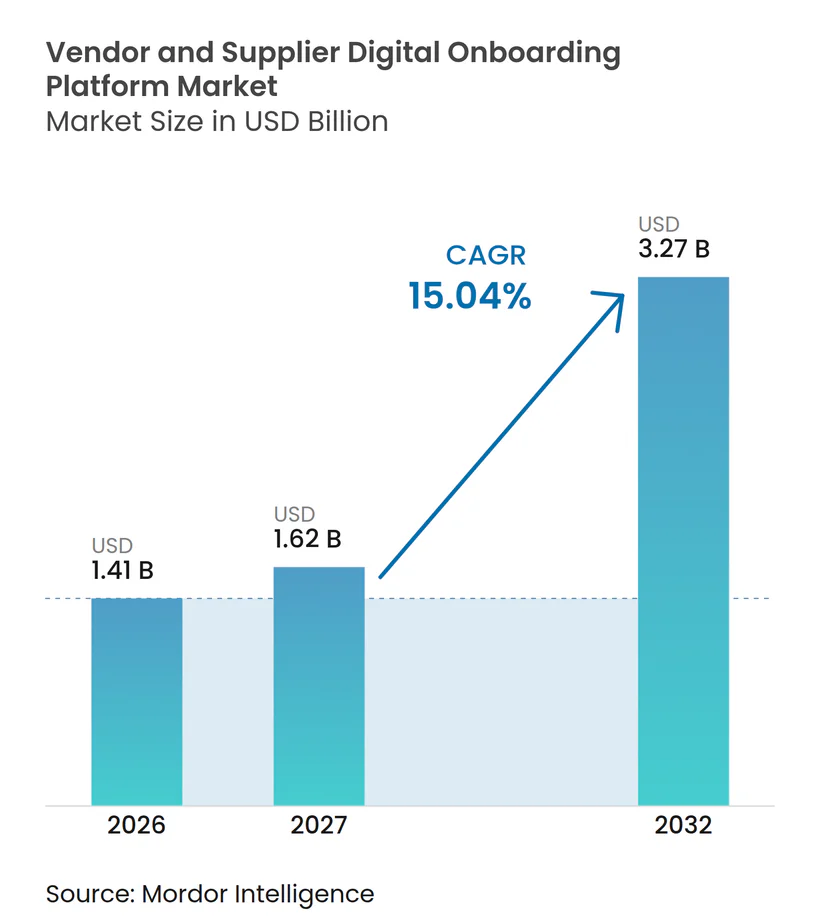
The vendor and supplier digital onboarding platform market size was valued at USD 1.41 billion in 2026 and is estimated to expand from USD 1.62 billion in 2027 to reach USD 3.27 billion by 2032, at a CAGR of 15.04% during the forecast period 2027-2032. Regulatory controls are moving supplier onboarding from a procurement task into a documented risk-management process. Global sourcing models are adding suppliers, service providers, and lower-tier relationships that require more consistent validation. Cloud platforms are becoming more suitable for organizations that need current supplier records across locations and systems. The vendor and supplier digital onboarding platform market also benefits when companies replace email-based forms and disconnected approvals with governed workflows. Competition is centered on integration quality, data validation, and the ability to support regulated buyers without creating separate manual processes.
Key Report Takeaways
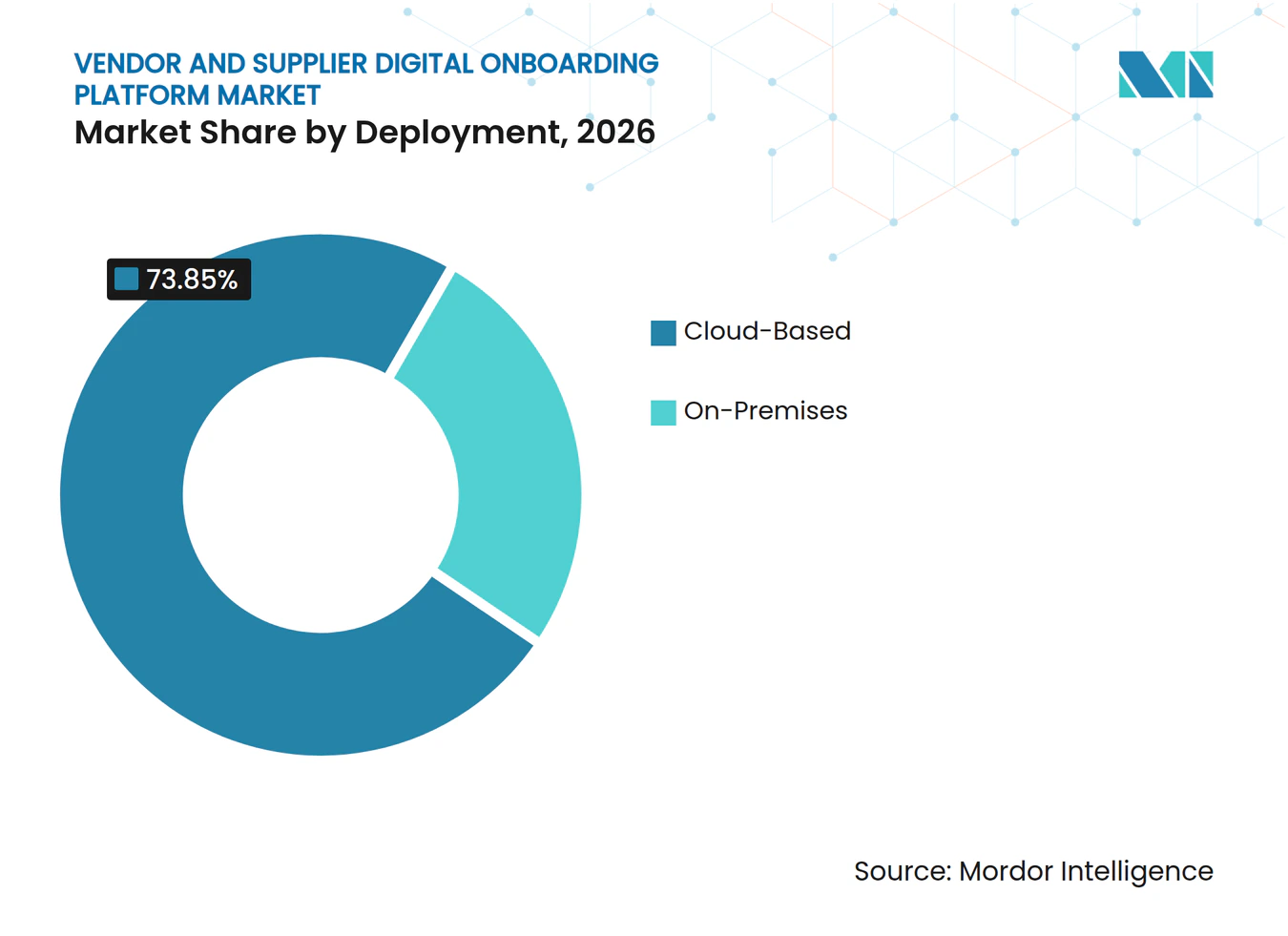
- By deployment, cloud-based platforms held 73.85% of the vendor and supplier digital onboarding platform market share in 2026, while hybrid deployment is projected to expand at a 15.44% CAGR through 2032.
- By organization size, large enterprises held 65.13% share in 2026, while small and medium-sized enterprises are projected to expand at a 15.41% CAGR through 2032.
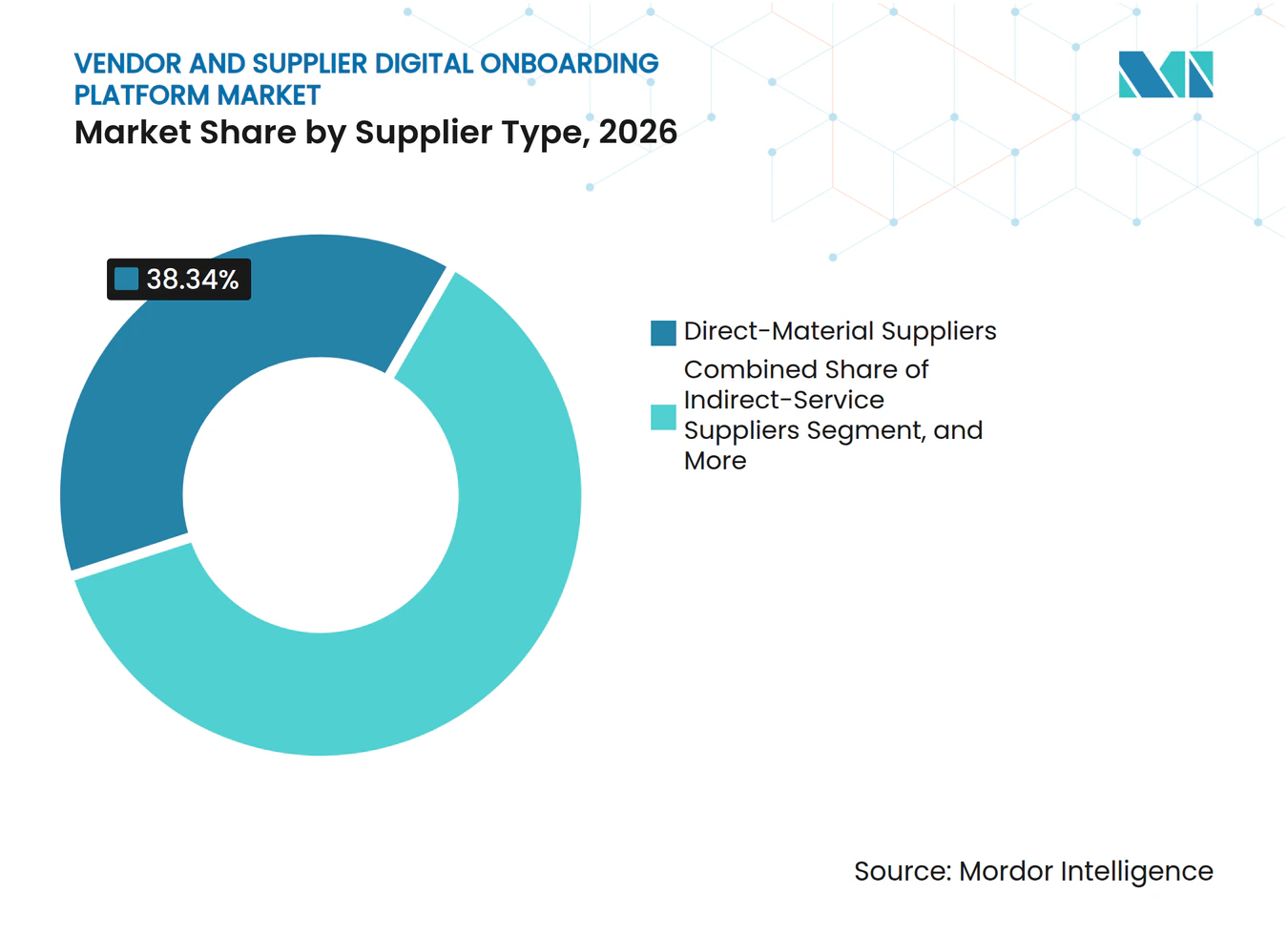
- By supplier type, direct-material suppliers held 38.34% share in 2026, while professional-service providers are projected to expand at a 15.86% CAGR through 2032.
- By end-user industry, BFSI held 24.44% share in 2026, while healthcare and life sciences are projected to expand at a 16.42% CAGR through 2032.
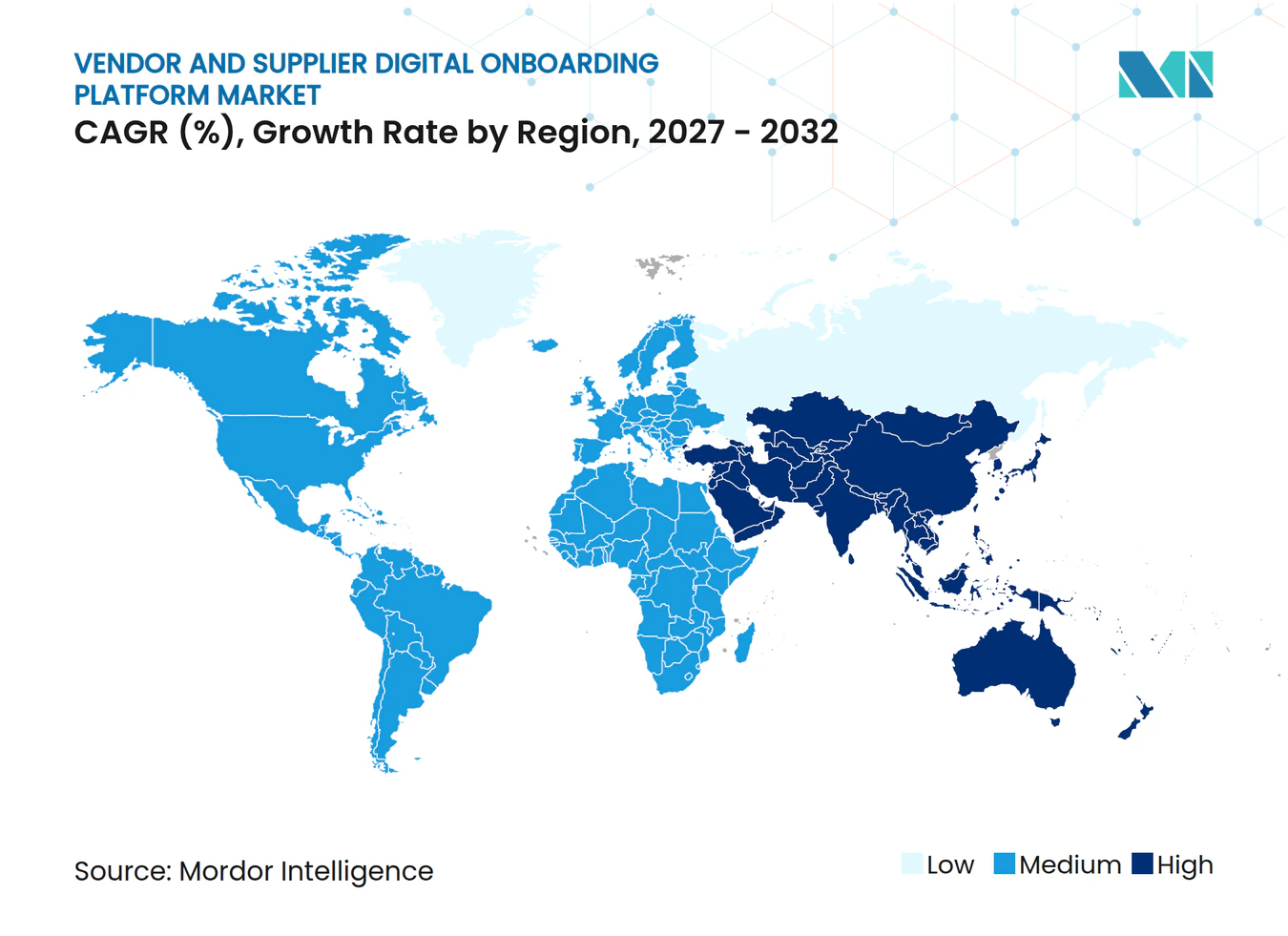
- By geography, North America held 34.81% share in 2026, while Asia-Pacific is projected to expand at a 16.06% CAGR through 2032.
Note: Market numbers in this report are based on Mordor Intelligence's proprietary estimation framework, which combines nine months of actuals with Q4 projections for base year 2026.
Market Trends and Insights
Drivers Impact Analysis of Vendor and Supplier Digital Onboarding Platform Market*
| Driver | (~) % Impact on CAGR Forecast | Geographic Relevance | Impact Timeline |
|---|---|---|---|
| Increasing Third-Party Risk and Compliance Requirements | +2.8% | Global, with highest intensity in North America and Europe | Short term (≤ 2 years) |
| Expansion of Multi-Tier and Global Supplier Networks | +2.3% | Global, with Asia-Pacific core and spillover to the Middle East | Medium term (2-4 years) |
| Demand for Faster Supplier Activation and Lower Administrative Costs | +2.0% | Global, with early adoption gains in North America and the Nordics | Short term (≤ 2 years) |
| Rising Adoption of Cloud-Based Procurement Technology | +1.7% | Global, with strongest momentum in Asia-Pacific and South America | Medium term (2-4 years) |
| Growth of E-Invoicing and Continuous Transaction Controls | +1.5% | Europe, South America, Asia-Pacific, and the Middle East and Africa | Medium term (2-4 years) |
| AI-Based Supplier Data Validation and Risk Monitoring | +1.2% | North America and Europe, expanding to developed Asia-Pacific markets | Long term (≥ 4 years) |
| Source: Mordor Intelligence | |||
Increasing Third-Party Risk and Compliance Requirements
The vendor and supplier digital onboarding platform market is supported by rules requiring auditable supplier due diligence and clear evidence for each decision. The European Banking Authority issued final third-party risk guidelines on September 18, 2026. The guidance covers assessment, due diligence, contracting, monitoring, and exit arrangements for critical functions, and thus extends well beyond a simple supplier registration exercise.[1] New York guidance issued in October 2025 also calls for structured evaluation of service providers before engagement and emphasizes oversight of the relationship afterward. It identifies cybersecurity, data residency, and fourth-party exposure as relevant considerations. These requirements make documented onboarding more important for financial institutions and other regulated buyers that need to demonstrate how a supplier was evaluated.
Expansion of Multi-Tier and Global Supplier Networks
The vendor and supplier digital onboarding platform market gains relevance as companies use broader and more dispersed supply bases. Buyers increasingly need consistent records for direct suppliers, service providers, and lower-tier relationships, rather than relying on scattered records owned by individual purchasing teams. The Basel Committee’s 2025 principles require banks to manage risks arising from material third-party arrangements and related subcontracting. This expectation makes visibility beyond the first supplier tier more important, especially when a supplier relies on other providers to deliver a critical service. Platforms can support this need through supplier registration, relationship mapping, workflow controls, and records that remain available when a supplier is reviewed again. The vendor and supplier digital onboarding platform market, therefore, has a stronger role where organizations connect onboarding information with continuing supplier oversight.
Demand for Faster Supplier Activation and Lower Administrative Costs
Procurement teams need faster activation when a supplier must be replaced or added quickly after a disruption, sourcing event, or business expansion. Manual processes can delay supplier approvals when data collection, reviews, and system setup are handled by separate teams and must be repeated across departments. Digital workflows can route required documents and approvals to the right reviewers without relying on untracked email exchanges. Faster activation can help buyers respond to sourcing changes without weakening control requirements or losing evidence of due diligence. The vendor and supplier digital onboarding platform market, therefore, serves both procurement capacity and compliance administration in organizations with complex supplier bases. Providers that reduce rework between procurement, finance, and risk teams can improve the practical value of automation and make supplier activation more predictable.
Rising Adoption of Cloud-Based Procurement Technology
Cloud delivery supports supplier onboarding across several jurisdictions and business units that need access to the same approved information. It can provide current connections to tax, sanctions, and supplier reference data without local infrastructure at every site or separate manual uploads from regional teams. Apexanalytix states that its platform connects to more than 1,200 trusted data sources for supplier validation. Automatic rule and data updates are useful when e-invoicing or reporting requirements vary across countries and suppliers must meet different local requirements. The vendor and supplier digital onboarding platform market can use cloud delivery to support standardized workflows for a large supplier population. Data-localization requirements still necessitate hybrid or regionally controlled deployments, particularly for organizations that handle sensitive payee and ownership records.
Restraints Impact Analysis of Vendor and Supplier Digital Onboarding Platform Market*
| Restraint | (~) % Impact on CAGR Forecast | Geographic Relevance | Impact Timeline |
|---|---|---|---|
| Integration Complexity Across ERP and Procurement Environments | -1.9% | Global, most acute in North America and Europe with multi-ERP enterprises | Medium term (2-4 years) |
| Data Privacy, Cybersecurity, and Cross-Border Data-Transfer Concerns | -1.6% | Europe, Asia-Pacific, and the Middle East, with global relevance for multinationals | Long term (≥ 4 years) |
| High Implementation Costs and Limited Internal Technical Capacity | -1.3% | South America, Africa, parts of Asia-Pacific, and mid-market organizations globally | Medium term (2-4 years) |
| Supplier Resistance to Repeated Data Submission and Complex Workflows | -1.0% | Global, with greater exposure in markets with large SME supplier bases | Short term (≤ 2 years) |
| Source: Mordor Intelligence | |||
Integration Complexity Across ERP and Procurement Environments
Integration complexity can slow adoption across the vendor and supplier digital onboarding platform market. Acquired businesses often retain distinct ERP systems, supplier data models, approval routes, and custom fields that do not align without detailed mapping. A centralized onboarding layer must reconcile these differences before it can create reliable supplier records and pass consistent data into downstream systems. Integration work can also involve procurement, finance, inventory, and accounts payable systems, each of which may have separate ownership and change controls. A faulty interface can result in blocked purchase orders, delayed supplier activation, or failed payments after a supplier appears to be approved. Prebuilt connectors can reduce this burden, but coverage, version compatibility, and the quality of local configuration remain important considerations for buyers.
Data Privacy, Cybersecurity, and Cross-Border Data-Transfer Concerns
Supplier onboarding records can contain bank details, tax identifiers, beneficial ownership information, and other sensitive data that must be handled consistently throughout the supplier lifecycle. The New York State Department of Financial Services requires covered entities to manage third-party cybersecurity risk under 23 NYCRR Part 500.[2] Cross-border transfer rules can limit where suppliers’ data is stored and processed, particularly when an organization uses a common global onboarding process. International buyers may need regional data stores or platforms that separate data by jurisdiction while preserving the controls needed for central oversight. Both approaches add implementation, governance, and audit work, because teams must establish which data can move and which records must remain local. These considerations favor providers with clearly documented data-residency and security controls, as well as workflows that can adapt to different country requirements.
*Our forecasts treat driver/restraint impacts as directional, not additive. The impact forecasts reflect baseline growth, mix effects, and variable interactions.
Vendor and Supplier Digital Onboarding Platform Market Segment Analysis
By Deployment:
Cloud Platforms Lead While Hybrid Models Address Data RequirementsCloud-based platforms accounted for 73.85% of the vendor and supplier digital onboarding platform market in 2026. This position reflects the need to extend consistent onboarding workflows across locations without maintaining separate local infrastructure or creating different approval practices for each business unit. Cloud environments can update connections to tax databases, sanctions lists, and beneficial-ownership registries, enabling checks to use more up-to-date external reference data. They can also give procurement, finance, and risk teams access to the same current supplier record, reducing the chance that separate systems hold conflicting information. This design is particularly useful when companies operate several buying units across countries and need common controls without local infrastructure at each site.
On-premises systems remain relevant in defense and critical-infrastructure settings with strict sovereignty requirements and limited tolerance for externally hosted data. Their role is also preserved where buyers need tightly controlled internal environments or have legacy systems that are not ready for cloud integration. Hybrid deployment is projected to expand at a 15.44% CAGR through 2032. This part of the vendor and supplier digital onboarding platform market reflects demand for cloud flexibility combined with local control for specific data sets. Vendors that support data routing, compartmentalization, and consistent workflow rules can address this requirement without forcing a single deployment approach.


By Organization Size:
Large Enterprises Anchor Spending While SMEs Adopt Flexible ToolsLarge enterprises accounted for 65.13% of the vendor and supplier digital onboarding platform market in 2026. These organizations manage higher supplier volumes across more jurisdictions and business units, often with different operating companies using separate procurement systems. They also face formal third-party risk requirements that make complete supplier records, evidence of approval, and recurring reviews essential to daily operations. Automated workflows can coordinate procurement, compliance, and finance checks before supplier activation, rather than leaving departments to collect the same information separately. This helps maintain complete vendor master data, even when suppliers, legal entities, and payment arrangements change frequently.
Small and medium-sized enterprises are projected to expand at a 15.41% CAGR through 2032. Their adoption is supported by cloud tools with lower entry costs, usage-based pricing, and less need for internal technology resources than traditional enterprise platforms. SupplierGateway introduced its Global Enhanced Digital Certification in 188 countries to provide standardized supplier verification. Smaller suppliers also face more customer requests for consistent compliance information before they can work with large enterprises. The vendor and supplier digital onboarding platform market can support this group by enabling platforms to avoid repeated data entry and provide reusable, verified supplier information.
By Supplier Type:
Direct-Material Suppliers Lead While Professional Services Expand FasterDirect-material suppliers held 38.34% of the vendor and supplier digital onboarding platform market share in 2026. Production-linked suppliers often require evidence of qualification, quality documentation, material compliance records, and traceable approval records before purchasing can begin. The FDA’s Quality Management System Regulation became effective on February 2, 2026. It incorporates the requirements of ISO 13485:2016 into the device quality system regulation.[3] This rule reinforces the need for documented supplier evaluation and reevaluation in affected life sciences settings, where a supplier’s status can affect product quality processes.
Indirect-service suppliers are another important part of supplier management programs, especially as organizations extend oversight beyond historically controlled production categories. Logistics firms, staffing businesses, and utilities each require different documents, risk checks, and approval logic because the nature of their services differs. Professional-service providers are projected to expand at a 15.86% CAGR through 2032. These engagements can require background screening, insurance verification, and conflict-of-interest reviews, particularly in BFSI and healthcare procurement. The vendor and supplier digital onboarding platform market supports configurable workflows that apply controls according to the type and risk level of each relationship.


By End-User Industry:
BFSI Has the Largest Position While Healthcare Gains MomentumBFSI accounted for 24.44% of the market value in 2026. Financial firms must manage suppliers within operational resilience and third-party risk programs, with records that support oversight throughout the relationship, not only during initial approval. DORA became applicable to EU financial entities on January 17, 2025. The framework requires information registers and structured oversight of ICT third-party providers. The EBA’s 2026 guidelines extend lifecycle governance principles to important non-ICT relationships.
Healthcare and life sciences are projected to expand at a 16.42% CAGR through 2032. The segment benefits from stronger supplier qualification requirements in medical-device and pharmaceutical supply chains, where purchasing controls are closely linked to quality management. Retail, consumer goods, IT and telecom, and energy and utilities also use onboarding platforms during procurement and ERP modernization programs that seek cleaner vendor master data. Government adoption is supported by digital public procurement systems and standardized supplier registration, which can create more consistent expectations for suppliers. The vendor and supplier digital onboarding platform market is shaped by sector rules on quality, information security, and privacy, which influence which platform buyers prioritize.
Geography Analysis
The Americas Vendor and Supplier Digital Onboarding Platform Market
North America accounted for 34.81% of the market value in 2026. The United States combines large procurement programs with detailed financial services, life sciences, and defense requirements, making supplier controls a routine business requirement across many large enterprises. New York’s October 2025 third-party guidance places supplier risk controls within cybersecurity examination expectations. Canada contributes through financial-sector third-party risk programs, while Mexico adds demand through digital tax and invoicing infrastructure that requires current supplier information. The vendor and supplier digital onboarding platform market is also developing in South America, where e-invoicing systems increase the value of verified supplier tax records and consistent onboarding data.
Europe Vendor and Supplier Digital Onboarding Platform Market
Europe was the second-largest region by value in 2026. DORA and EBA guidance highlight the importance of lifecycle controls for financial entities across the region. Germany, the United Kingdom, France, the Benelux countries, and the Nordic countries form a concentrated demand base because they combine mature enterprise procurement with demanding regulatory environments. Germany’s phased e-invoicing transition is increasing the practical need for verified supplier credentials before a supplier begins transacting or submits invoices. The vendor and supplier digital onboarding platform market benefits when tax and supplier data require ongoing validation, while Spain, Italy, and other European markets drive demand through ERP modernization and public procurement digitization.
APAC and MEA Vendor and Supplier Digital Onboarding Platform Market
Asia-Pacific is projected to expand at a 16.06% CAGR through 2032. India’s GeM procurement platform had exceeded 37.8 million cumulative orders by August 2026, supporting digital supplier registration and data exchange across a large public-procurement network. China, Japan, South Korea, and Australia are established enterprise procurement settings, while Singapore, Indonesia, and Vietnam are moving through government-supported digitization programs. The vendor and supplier digital onboarding platform market also has opportunities in Saudi Arabia and the UAE, driven by digital transformation and e-invoicing requirements, while Africa remains at an earlier stage, with activity concentrated in large-enterprise and public-sector programs in South Africa, Nigeria, and Egypt.
Competitive Landscape
Market Concentration
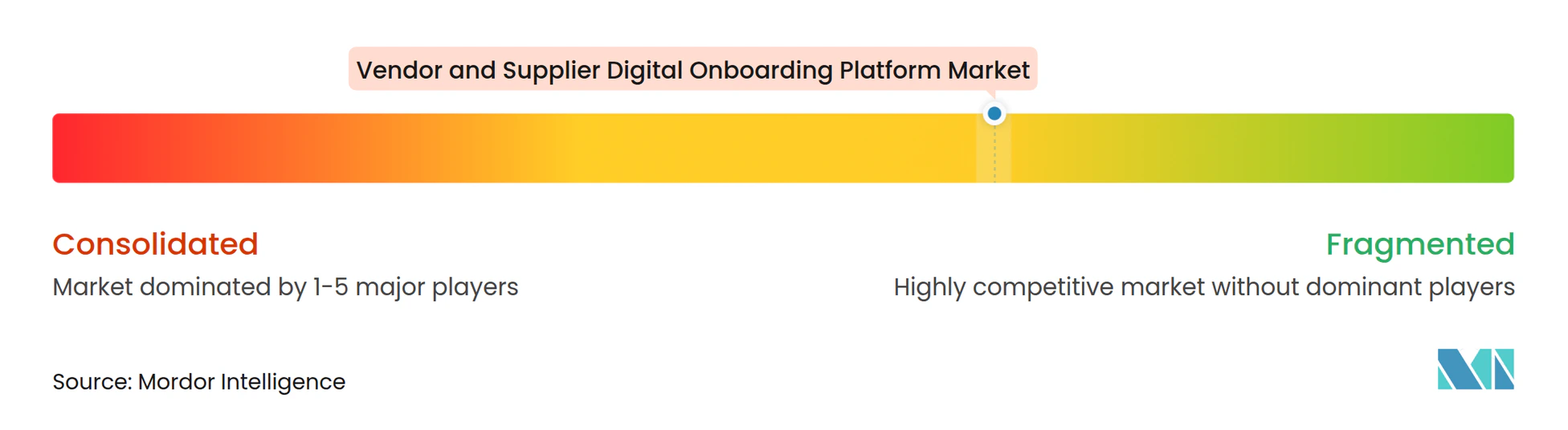
The vendor and supplier digital onboarding platform market is moderately fragmented, and no provider dominates every use case. Specialized supplier information platforms compete with third-party risk suites and source-to-pay providers that extend supplier activation functions into broader procurement environments. Buyers compare integration depth, validation data coverage, workflow flexibility, and risk scoring because shortcomings in any of these areas can lead to manual work, repeated reviews, and inconsistent supplier records. HICX Solutions and Aravo Solutions represent dedicated supplier information management approaches, while other vendors attach onboarding capabilities to risk or purchasing systems. The vendor and supplier digital onboarding platform market favors providers that work with established ERP environments and maintain a reliable supplier data foundation across procurement, finance, and compliance teams.
HICX Solutions focuses on governed supplier data and supplier information management within complex procurement environments. Apexanalytix emphasizes real-time supplier validation through connections to more than 1,200 trusted data sources. These positions show that data quality, validation breadth, and the ability to bring current external information into workflows are central competitive considerations in the vendor and supplier digital onboarding platform market. Providers also need integration approaches that avoid creating additional manual work for procurement, compliance, and finance teams and do not require buyers to prematurely replace core systems.
Vanta launched Agent for Risk in June 2026 to consolidate internal and third-party risk activities into a single, continuously updated program. This approach positions vendor onboarding as part of a broader trust and risk management framework, especially for buyers who assess supplier controls alongside internal governance. Regional specialists can compete by connecting directly with local records and compliance systems, as AuthBridge Research Services does in India through UIDAI, NSDL, and MCA databases for vendor authentication. Opportunities remain in SME onboarding, multi-tier supplier mapping, energy and utilities, and government procurement, where adoption is less mature than in BFSI and healthcare. The vendor and supplier digital onboarding platform industry continues to reward providers that make supplier controls easier to operate at scale and usable across many supplier categories.
Vendor and Supplier Digital Onboarding Platform Industry Leaders
-
HICX Solutions Limited
-
Aravo Solutions, Inc.
-
PaymentWorks, Inc.
-
SupplierGateway, Inc.
-
apexanalytix, Inc.
- *Disclaimer: Major Players sorted in no particular order
Vendor and Supplier Digital Onboarding Platform Market Companies Covered in this Report
- HICX Solutions Limited
- Aravo Solutions, Inc.
- PaymentWorks, Inc.
- SupplierGateway, Inc.
- apexanalytix, Inc.
- Certa, Inc.
- Gatekeeper Systems, Inc.
- Prevalent, Inc.
- Venminder, Inc.
- ProcessUnity Corporation
- Whistic, Inc.
- SecurityScorecard, Inc.
- LogicGate, Inc.
- Hyperproof, Inc.
- Vanta Inc.
- SafeBase, Inc.
- Evident ID, Inc.
- Vendorful, Inc.
- Kodiak Hub AB
- Supplier.io, Inc.
- Aavenir Technologies Private Limited
- Procol Technologies Private Limited
- AuthBridge Research Services Private Limited
- HighRadius Corporation
Recent Industry Developments in Vendor and Supplier Digital Onboarding Platform Market
- October 2026: Vanta named Leader in Forrester Wave: Governance, Risk, and Compliance Platforms Q2 2026 on its first inclusion in that evaluation. The recognition reflects Vanta’s expansion from compliance automation into a full third-party risk management platform, with its Trust Graph spanning 400-plus integrations and 1,400-plus continuous tests, repositioning vendor onboarding assessment as part of a continuously monitored risk program rather than a periodic review cycle.
- September 2026: European Banking Authority published final Guidelines on the Management of Third-Party Risk, applicable across banking, payments, and investment-service providers. The guidelines establish a full lifecycle framework, from onboarding due diligence through exit, for all arrangements supporting critical or important functions, with a 2-year transitional period for implementation. This regulation directly expands platform demand among EU-regulated financial entities.
- July 2026: HICX Solutions secured a GBP 15 million (USD 19.76 million) growth funding and refinancing package from HSBC Innovation Banking and existing investor Wavecrest Growth Partners. The capital is allocated to product innovation, commercial expansion, and selective acquisitions, as enterprises increasingly treat governed supplier data as essential infrastructure for AI-driven procurement and risk decisions.
- February 2026: US FDA’s Quality Management System Regulation, which incorporates ISO 13485:2016 purchasing-control requirements into 21 CFR Part 820, came into effect. This regulatory shift created structured supplier qualification and reevaluation obligations for medical-device manufacturers, directly expanding the addressable base for digital onboarding platforms in life sciences procurement.
Global Vendor and Supplier Digital Onboarding Platform Market Report Scope
The Vendor and Supplier Digital Onboarding Platform Market comprises software solutions and associated technologies that enable organizations to digitize, automate, and manage vendor and supplier onboarding across the procurement and supply chain lifecycle. These platforms facilitate supplier registration, data collection, document submission and verification, compliance screening, risk assessment, qualification, approval workflows, and integration with procurement, enterprise resource planning (ERP), and supplier relationship management systems.
The Vendor and Supplier Digital Onboarding Platform Market Report is Segmented by Deployment (Cloud-Based, and On-Premises), Organization Size (Large Enterprises, and Small and Medium-Sized Enterprises), Supplier Type (Direct-Material Suppliers, Indirect-Service Suppliers, Professional-Service Providers, and Other Supplier Types), End-User Industry (BFSI, Healthcare and Life Sciences, Retail and Consumer Goods, IT and Telecom, Energy and Utilities, Government and Public Sector, and Other End-User Industries), and Geography (North America, South America, Europe, Asia-Pacific, Middle East, Africa). The Market Forecasts are Provided in Terms of Value (USD).
Segmentation Overview
| Cloud-Based |
| On-Premises |
| Large Enterprises |
| Small and Medium-Sized Enterprises |
| Direct-Material Suppliers |
| Indirect-Service Suppliers |
| Professional-Service Providers |
| Other Supplier Types |
| BFSI |
| Healthcare and Life Sciences |
| Retail and Consumer Goods |
| IT and Telecom |
| Energy and Utilities |
| Government and Public Sector |
| Other End-User Industries |
| North America | United States |
| Canada | |
| Mexico | |
| South America | Brazil |
| Argentina | |
| Rest of South America | |
| Europe | Germany |
| United Kingdom | |
| France | |
| Italy | |
| Spain | |
| Benelux | |
| Nordics | |
| Rest of Europe | |
| Asia-Pacific | China |
| Japan | |
| India | |
| South Korea | |
| Australia | |
| Southeast Asia | |
| Rest of Asia-Pacific | |
| Middle East | Saudi Arabia |
| United Arab Emirates | |
| Turkey | |
| Rest of Middle East | |
| Africa | South Africa |
| Nigeria | |
| Egypt | |
| Rest of Africa |
| By Deployment | Cloud-Based | |
| On-Premises | ||
| By Organization Size | Large Enterprises | |
| Small and Medium-Sized Enterprises | ||
| By Supplier Type | Direct-Material Suppliers | |
| Indirect-Service Suppliers | ||
| Professional-Service Providers | ||
| Other Supplier Types | ||
| By End-User Industry | BFSI | |
| Healthcare and Life Sciences | ||
| Retail and Consumer Goods | ||
| IT and Telecom | ||
| Energy and Utilities | ||
| Government and Public Sector | ||
| Other End-User Industries | ||
| By Geography | North America | United States |
| Canada | ||
| Mexico | ||
| South America | Brazil | |
| Argentina | ||
| Rest of South America | ||
| Europe | Germany | |
| United Kingdom | ||
| France | ||
| Italy | ||
| Spain | ||
| Benelux | ||
| Nordics | ||
| Rest of Europe | ||
| Asia-Pacific | China | |
| Japan | ||
| India | ||
| South Korea | ||
| Australia | ||
| Southeast Asia | ||
| Rest of Asia-Pacific | ||
| Middle East | Saudi Arabia | |
| United Arab Emirates | ||
| Turkey | ||
| Rest of Middle East | ||
| Africa | South Africa | |
| Nigeria | ||
| Egypt | ||
| Rest of Africa | ||
Key Questions Answered in the Report
What is the vendor and supplier digital onboarding platform market size?
The vendor and supplier digital onboarding platform market was valued at USD 1.41 billion in 2026 and is projected to reach USD 3.27 billion by 2032.
What is driving adoption of digital supplier onboarding platforms?
Third-party risk requirements, broader supplier networks, cloud procurement adoption, and the need for faster supplier activation are supporting demand.
Which deployment model leads vendor and supplier onboarding platform adoption?
Cloud-based deployment led with 73.85% share in 2026, while hybrid deployment is projected to expand at a 15.44% CAGR through 2032.
Which end-user sector is growing fastest for onboarding platforms?
Healthcare and life sciences are projected to expand at a 16.42% CAGR through 2032, supported by supplier qualification requirements.
Which region is expanding fastest for digital supplier onboarding solutions?
Asia-Pacific is projected to expand at a 16.06% CAGR through 2032, supported by procurement digitization and digital supplier registration.
What makes supplier onboarding platform implementation difficult?
Multi-ERP integration, data-residency requirements, implementation costs, and supplier resistance to repeated data submission can delay deployment.