
US Meat Slicer Market Size and Share
Market Overview
| Study Period | 2021 - 2031 |
|---|---|
| Forecast Data Period | 2026 - 2031 |
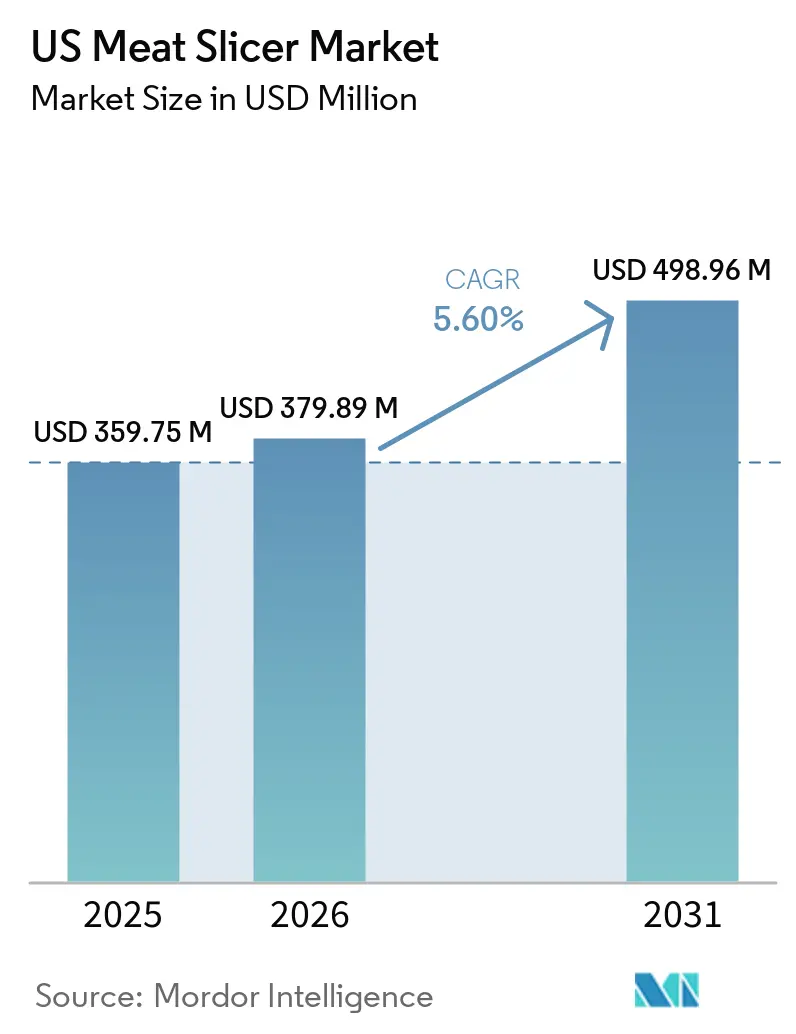
| Base Year Market Size (2025) | USD 359.75 Million |
| Market Size (2026) | USD 379.89 Million |
| Market Size (2031) | USD 498.96 Million |
| Growth Rate (2026 - 2031) | 5.60 % |
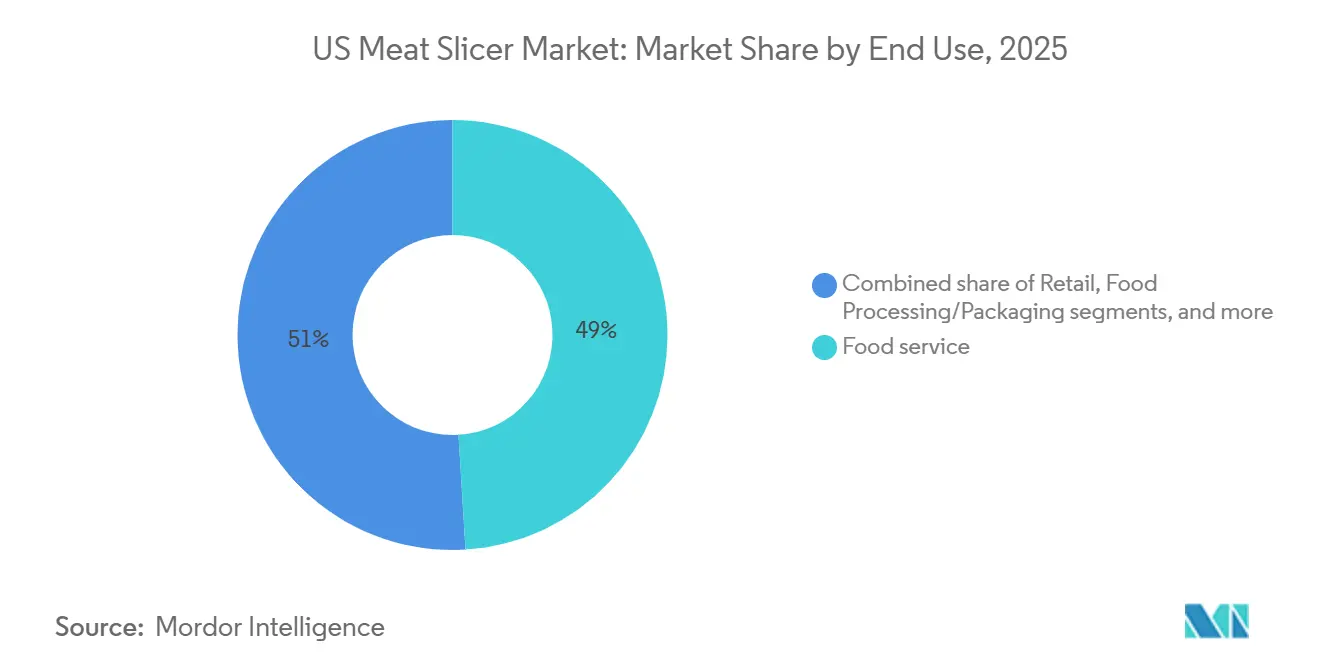
| Market Concentration | Low |
Major Players *Disclaimer: Major Players sorted in no particular order Image © Mordor Intelligence. Reuse requires attribution under CC BY 4.0. | |
US Meat Slicer Market Analysis by Mordor Intelligence
The United States meat slicer market size is expected to grow from USD 359.75 million in 2025 to USD 379.89 million in 2026 and is forecast to reach USD 498.96 million by 2031 at a 5.60% CAGR over 2026-2031. The market is driven by the continued demand for efficient, consistent, and hygienic meat preparation across foodservice, retail, institutional kitchens, and food processing operations. Increasing labor constraints and the need to improve operational efficiency are encouraging businesses to adopt more automated slicing solutions and replace aging equipment. Demand is also supported by the modernization of commercial kitchens and processing facilities, with buyers increasingly seeking equipment that delivers consistent slice quality, throughput, ease of cleaning, and compatibility with broader food production workflows. Overall, the market reflects a gradual shift toward more efficient, reliable, and integrated meat-slicing solutions.
Key Report Takeaways
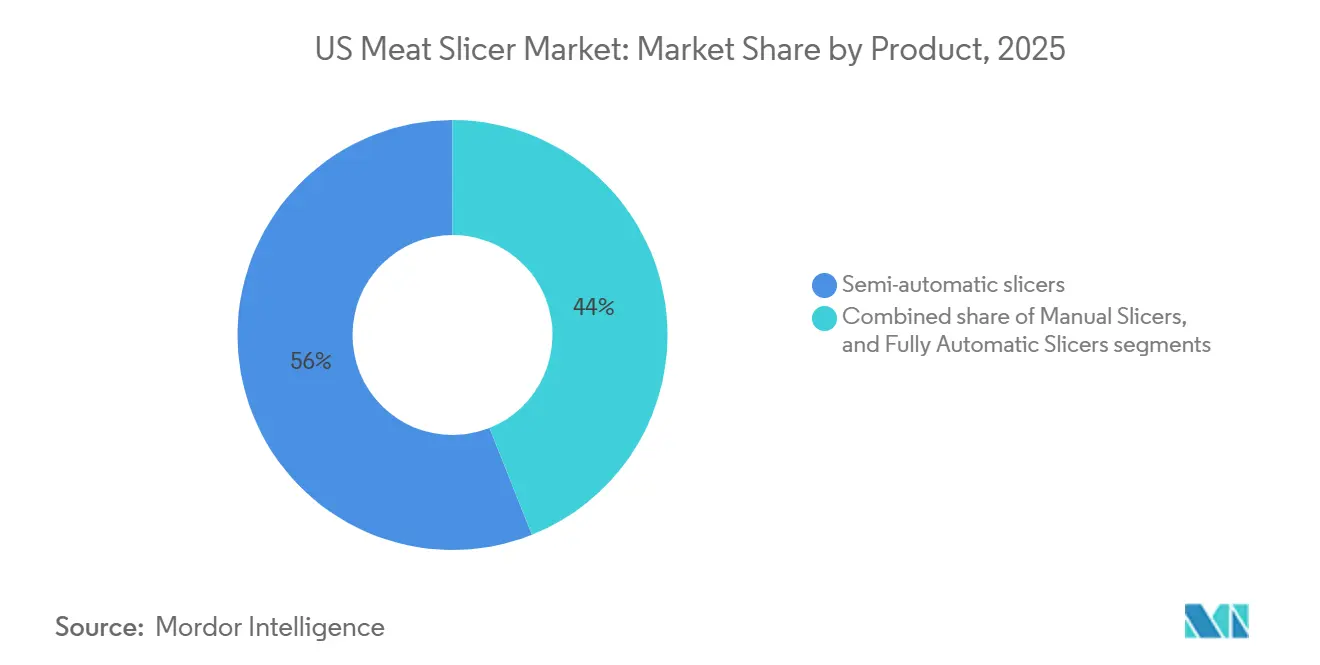
- By product, semi-automatic slicers held 56.03% of the United States meat slicer market share in 2025, while fully automatic slicers are forecast to grow at an 8.09% CAGR from 2026 to 2031.
- By blade size, 10-12-inch slicers accounted for 47.02% of the United States meat slicer market share in 2025, while above-12-inch models are projected to expand at a 6.81% CAGR from 2026 to 2031.
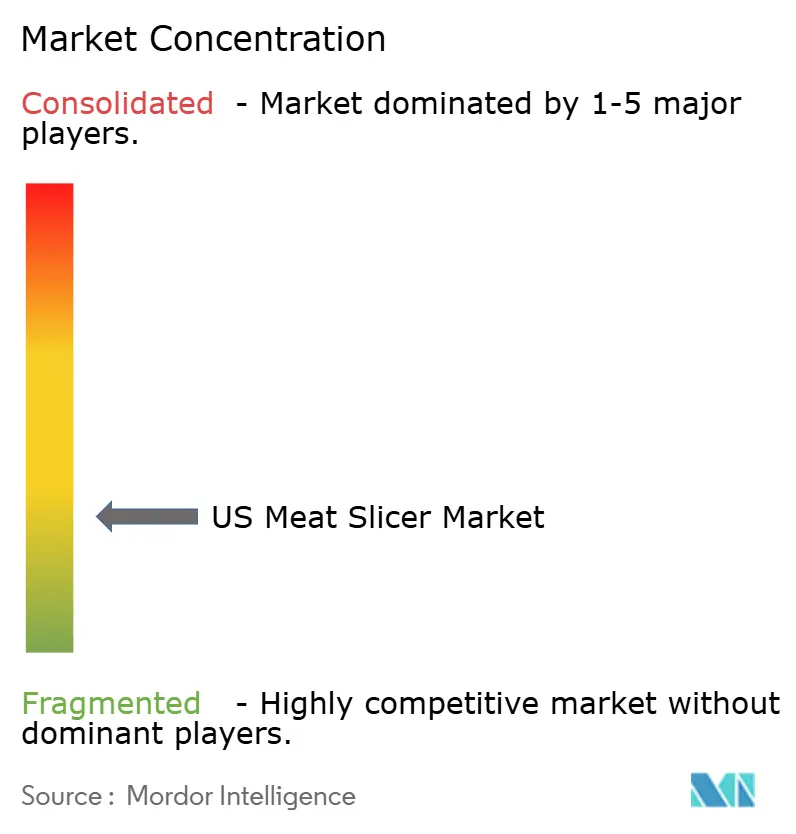
- By end use, food service held 49.04% of the United States meat slicer market share in 2025, while food processing and packaging is forecast to advance at a 7.89% CAGR from 2026 to 2031.
Note: Market size and forecast figures in this report are generated using Mordor Intelligence’s proprietary estimation framework, updated with the latest available data and insights as of January 2026.
US Meat Slicer Market Trends and Insights
Drivers Impact Analysis*
| Driver | (~) % Impact on CAGR Forecast | Geographic Relevance | Impact Timeline |
|---|---|---|---|
| Demand for processed and ready-to-eat meat products | +1.5% | National; intensified in high-density urban and suburban markets (New York Metro, Chicago, Los Angeles, Houston) | Medium term (2–4 years) |
| Labor shortages driving meat slicer automation | +1.2% | National; most acute in Midwest processing hubs and Southeast foodservice corridors | Long term (≥ 4 years) |
| Growth of foodservice and commercial meat preparation | +0.9% | National; early gains in hospitality-dense markets: Nevada, Florida, New York | Short term (≤ 2 years) |
| Expansion of retail deli and prepared-food operations | +0.8% | National; concentrated in suburban grocery markets across the Sun Belt and Northeast | Medium term (2–4 years) |
| Demand for consistent portioning and yield optimization | +0.6% | National; concentrated in large-scale central kitchen operations in the Midwest and Southeast | Medium term (2–4 years) |
| Increasing focus on food safety, hygiene, and equipment cleanability | +0.5% | National; compliance pressure highest among federally inspected meat processing facilities | Long term (≥ 4 years) |
| Source: Mordor Intelligence | |||
Demand for Processed and Ready-to-Eat Meat Products
Rising consumption of meat and poultry products is supporting demand for efficient slicing equipment across foodservice, retail, and food processing operations. According to the United States Department of Agriculture (USDA) Economic Research Service (ERS), 228.8 pounds of beef, pork, broilers, and turkey were available per United States consumer in 2026, with availability projected to increase to 229.4 pounds in 2027; this measure includes fresh and processed meat sold through grocery stores and used in restaurants[1]. In addition, the Food Industry Association (FMI) and the Meat Institute reported that 98% of American households purchased meat in 2025, highlighting the broad penetration of meat products among United States consumers[2]. This sustained demand encourages commercial operators to invest in slicing equipment that provides consistent portions, product presentation, and processing efficiency.
Labor Shortages Driving Meat Slicer Automation
Labor shortages within United States meat and poultry processing are encouraging processors to adopt technologies that reduce reliance on labor-intensive tasks. The United States Department of Agriculture (USDA) has identified securing sufficient numbers of meat and poultry processing workers as a persistent challenge, with the industry also experiencing elevated absenteeism. USDA research further highlights automation and robotics as potential solutions to labor and working-condition challenges in meat processing. In addition, the Meat Institute reported that the United States meat and poultry processing industry directly employed nearly 584,000 workers in 2025, underscoring the substantial workforce involved in processing operations[3]. These labor pressures support the adoption of automated slicing and other processing equipment that can improve throughput and reduce dependence on manual operations.
Expansion of Retail Deli and Prepared-Food Operations
The expansion of retail deli and prepared-food operations is driving additional demand for commercial meat-slicing equipment, as grocery retailers broaden their fresh and ready-to-eat offerings. According to the Food Industry Association (FMI), 87% of United States retailers operated fresh-prepared foodservice programs in 2024, with foodservice emerging as a key area for operational and workforce investment[4]. FMI also reported that 28% of consumers chose deli-prepared foods as an alternative to restaurant meals in 2025, more than double the share recorded in 2017. The growing role of deli departments in providing convenient meal solutions is encouraging retailers to invest in equipment that supports consistent slicing, preparation efficiency, and higher-volume foodservice operations.
Growth of Foodservice and Commercial Meat Preparation
The continued expansion of foodservice and commercial food preparation is supporting demand for reliable meat-slicing equipment across restaurants, delis, catering operations, institutional kitchens, and other commercial establishments. As these operators handle greater volumes of prepared meals and made-to-order food, efficient slicing becomes important for maintaining consistent portions, product presentation, and preparation speed. The increasing focus on streamlined kitchen workflows is also encouraging businesses to replace manual preparation methods with equipment that can improve productivity and reduce preparation time. This supports ongoing demand for meat slicers across a broad range of commercial food preparation environments.
Restraints Impact Analysis*
| Restraint | (~) % Impact on CAGR Forecast | Geographic Relevance | Impact Timeline |
|---|---|---|---|
| High equipment, installation, and training costs | −0.6% | National; disproportionate impact on small independent operators in rural and secondary markets | Medium term (2–4 years) |
| Recurring blade, seal, and gasket replacement requirements | −0.4% | National; stronger impact in high-throughput food processing and packaging facilities | Long term (≥ 4 years) |
| Limited availability of specialized service technicians | −0.3% | National; acute in markets distant from major OEM service networks | Long term (≥ 4 years) |
| Downtime and production disruptions during equipment maintenance | −0.3% | National; concentrated in high-volume food processing and quick-service operators | Short term (≤ 2 years) |
| Source: Mordor Intelligence | |||
High Equipment, Installation, and Training Costs
High upfront investment requirements can limit the adoption of advanced meat slicers, particularly among smaller foodservice operators and independent processing businesses. Beyond the equipment purchase, businesses may need to account for installation, facility modifications, maintenance, operator training, and food safety procedures when introducing new slicing systems. The United States Department of Agriculture (USDA) guidelines for meat and poultry processing equipment specify sanitary design and fabrication requirements, while USDA-supported meat processing programs also incorporate equipment installation and hands-on operator training. These additional implementation requirements can increase the overall cost and complexity of equipment upgrades, potentially extending replacement cycles and encouraging businesses to retain existing equipment.
Recurring Blade, Seal, and Gasket Replacement Requirements
Regular replacement of wear-prone components adds to the ongoing maintenance requirements of commercial meat slicers. Blades may require sharpening or replacement to maintain cutting performance, while seals and gaskets can deteriorate through repeated use and frequent cleaning. The United States Food and Drug Administration (FDA) notes that slicer seals and gaskets can become worn or degraded, and recommends routine inspection and replacement when their integrity is compromised. These recurring maintenance needs can increase operating costs and contribute to downtime, particularly for equipment used frequently in commercial food preparation and processing environments.
*Our forecasts treat driver/restraint impacts as directional, not additive. The impact forecasts reflect baseline growth, mix effects, and variable interactions.
Segment Analysis
By Product: Automation Momentum Reshapes the Semi-Automatic Core
Semi-automatic slicers accounted for the largest share of the United States meat slicer market, at 56.03% in 2025, supported by their balance of automation, operator control, and capital requirements. These slicers are widely used across grocery delis, restaurants, institutional kitchens, and other commercial food preparation settings where operators require greater efficiency than manual equipment while keeping capital costs manageable. Their versatility and relatively straightforward operation make them suitable for businesses with varied slicing volumes and product requirements. The segment therefore continues to represent the primary product category across commercial meat-slicing applications.
Fully automatic slicers are projected to be the fastest-growing product segment, expanding at a CAGR of 8.09% from 2026 to 2031, as food processing facilities, central kitchens, and larger commercial operators increasingly prioritize throughput and labor efficiency. These systems minimize manual intervention while supporting consistent slice thickness, portioning, and continuous operation. Growing adoption of programmable controls, automated feeding, and integrated portioning capabilities is further improving their suitability for high-volume applications. The shift toward greater automation is therefore expected to drive demand for fully automatic slicers over the forecast period.

By Blade Size: Industrial Demand Tilts Toward Larger Formats
The 10–12-inch blade segment accounted for the largest share of the United States meat slicer market, at 47.02% in 2025. This reflects its suitability across commercial foodservice, retail deli, and mid-volume food preparation operations. This blade size balances cutting capacity, equipment footprint, operational flexibility, and cost, making it appropriate for a broad range of commercial users. Below-10-inch blades remain relevant for household and light-duty applications where compact equipment and ease of handling are prioritized. The versatility of the 10–12-inch category supports its leading position across the market.
The above-12-inch blade segment is projected to be the fastest-growing category, expanding at a CAGR of 6.81% from 2026 to 2031. This growth is supported by demand from high-volume meat processing, commercial preparation, and retail-ready packaging operations. Larger blades provide greater cutting capacity and are better suited to processing dense, larger, or whole-muscle meat formats at higher throughput. Their adoption is also supported by improvements in slicing precision, automation, and equipment design that enhance operational consistency. As processors increasingly seek equipment capable of handling diverse product formats efficiently, demand for larger blade configurations is expected to strengthen.
By End Use: Food Service Dominates, Processing Accelerates
The food service segment accounted for the largest share of the United States meat slicer market at 49.04% in 2025, supported by the widespread use of commercial slicers across restaurants, institutional kitchens, deli counters, and catering operations. These businesses rely on slicing equipment to improve preparation efficiency, maintain consistent portions, and support product presentation. Retail applications, including grocery deli and specialty food retailers, also represent an important demand base due to the continued role of fresh-cut meat in deli operations. Household applications remain comparatively limited and are primarily associated with lighter-duty manual and semi-automatic equipment.
Food processing and packaging is projected to be the fastest-growing end-use segment, registering a CAGR of 7.89% from 2026 to 2031, driven by increasing demand for high-volume and consistent meat preparation. The expansion of centralized production facilities and greater emphasis on standardized portioning are encouraging processors to adopt slicing systems capable of continuous operation. Integration with downstream weighing, packaging, and handling equipment is also improving the efficiency of production workflows. These developments are expected to strengthen the adoption of commercial and industrial meat slicers within food processing and packaging applications.
Competitive Landscape
The United States meat slicer market is fragmented, with competition spread across established food equipment manufacturers and specialized meat-slicing equipment suppliers. Major players include Hobart Corporation, Globe Food Equipment Co., Bizerba SE & Co. KG, Van Berkel International S.r.l., and Univex Corporation, which serve commercial foodservice, retail deli, and meat-processing applications through differentiated product portfolios. The fragmented structure allows multiple manufacturers to compete across different equipment configurations, customer requirements, and operating scales, rather than being dominated by a single supplier.
Leading companies are strengthening their positions through product development, automation capabilities, and improvements in slicing precision and operational efficiency. Hobart continues to expand its commercial food-preparation equipment portfolio, while Bizerba is developing slicing solutions incorporating automation and digital controls. Globe Food Equipment, Van Berkel International, and Univex maintain established positions in commercial slicing equipment, with product offerings focused on reliability, operator convenience, and suitability for foodservice and retail applications. Competition is increasingly influenced by equipment performance, hygiene features, ease of operation, and after-sales support.
Emerging and specialized players are competing by targeting specific customer requirements and application niches rather than attempting to match the full product breadth of larger manufacturers. These companies differentiate through compact equipment designs, specialized slicing configurations, customization, and solutions suited to smaller commercial operators. Opportunities also exist for newer suppliers to introduce connected equipment, improved automation, and maintenance-focused technologies at accessible price points. This creates scope for niche manufacturers to strengthen their presence as customers increasingly seek equipment that combines productivity, operational simplicity, and lower maintenance requirements.
US Meat Slicer Industry Leaders
-
Hobart Corporation
-
Globe Food Equipment Co.
-
Bizerba SE & Co. KG
-
Van Berkel International S.r.l.
-
Univex Corporation
- *Disclaimer: Major Players sorted in no particular order
Recent Industry Developments
- June 2026: JBT Marel expanded its portfolio to offer end-to-end meat portioning lines covering processes from crust freezing through final packing. The integrated solutions combine portioning, automation, weighing, and packaging equipment to reduce manual handling and improve production efficiency.
- February 2026: JBT Marel launched the new Proseal XT2 tray sealing machine, featuring increased automation, enhanced diagnostics, and improved energy efficiency. The machine is designed for integration into food production lines and supports hygienic, high-efficiency packaging operations.
- June 2025: Bizerba, FANUC, KILIVATIONS, and Schmalz formed a strategic partnership to advance automation solutions for the food sector. The collaboration combines Bizerba’s slicing and inspection technologies with robotics, vacuum handling, and automation capabilities.
- February 2024: MULTIVAC expanded its slicing portfolio with new Professional, Performance, and Advanced series slicers for small- to high-output applications. The new equipment supports automatic slicing of processed meat and integration into automated production lines.
US Meat Slicer Market Report Scope
The United States meat slicer market comprises equipment designed to cut and portion meat products into consistent slices for commercial, retail, food processing, and household applications. The market includes manual, semi-automatic, and fully automatic slicing solutions across different blade sizes and end-use settings. The market is segmented by product into manual slicers, semi-automatic slicers, and fully automatic slicers; by blade size into below 10 inches, 10–12 inches, and above 12 inches; and by end use into food service, retail, food processing/packaging, and household. For each segment, the market sizing and forecasting have been done in value terms (USD million).
| Manual Slicers |
| Semi-Automatic Slicers |
| Fully Automatic Slicers |
| Below 10 Inches |
| 10-12 Inches |
| Above 12 Inches |
| Food Service |
| Retail |
| Food Processing/Packaging |
| Household |
| By Product | Manual Slicers |
| Semi-Automatic Slicers | |
| Fully Automatic Slicers | |
| By Blade Size | Below 10 Inches |
| 10-12 Inches | |
| Above 12 Inches | |
| By End Use | Food Service |
| Retail | |
| Food Processing/Packaging | |
| Household |
Key Questions Answered in the Report
What is the projected value of the United States meat slicer market by 2031?
The United States meat slicer market is forecast to reach USD 498.96 million by 2031, growing at a 5.60% CAGR from 2026 to 2031.
Which product category led United States meat slicer sales in 2025?
Semi-automatic slicers led with 56.03% share in 2025 because they balance throughput, cost, and operating flexibility for commercial food preparation.
Which meat slicer product is forecast to grow fastest through 2031?
Fully automatic slicers are forecast to grow at an 8.09% CAGR as central kitchens and processors increase automation across multi-shift production operations.
Which end-use category has the largest demand for commercial slicers?
Food service held 49.04% share in 2025, supported by restaurants, delis, catering operations, institutional kitchens, and their need for daily food preparation.