
United States Suture Wire Market Size and Share
Market Overview
| Study Period | 2020 - 2031 |
|---|---|
| Forecast Data Period | 2026 - 2031 |
| Base Year Market Size (2025) | USD 1.26 Billion |
| Market Size (2026) | USD 1.30 Billion |
| Market Size (2031) | USD 1.57 Billion |
| Growth Rate (2026 - 2031) | 3.79 % |
| Market Concentration | Medium |
Major Players *Disclaimer: Major Players sorted in no particular order Image © Mordor Intelligence. Reuse requires attribution under CC BY 4.0. | |
United States Suture Wire Market Analysis by Mordor Intelligence
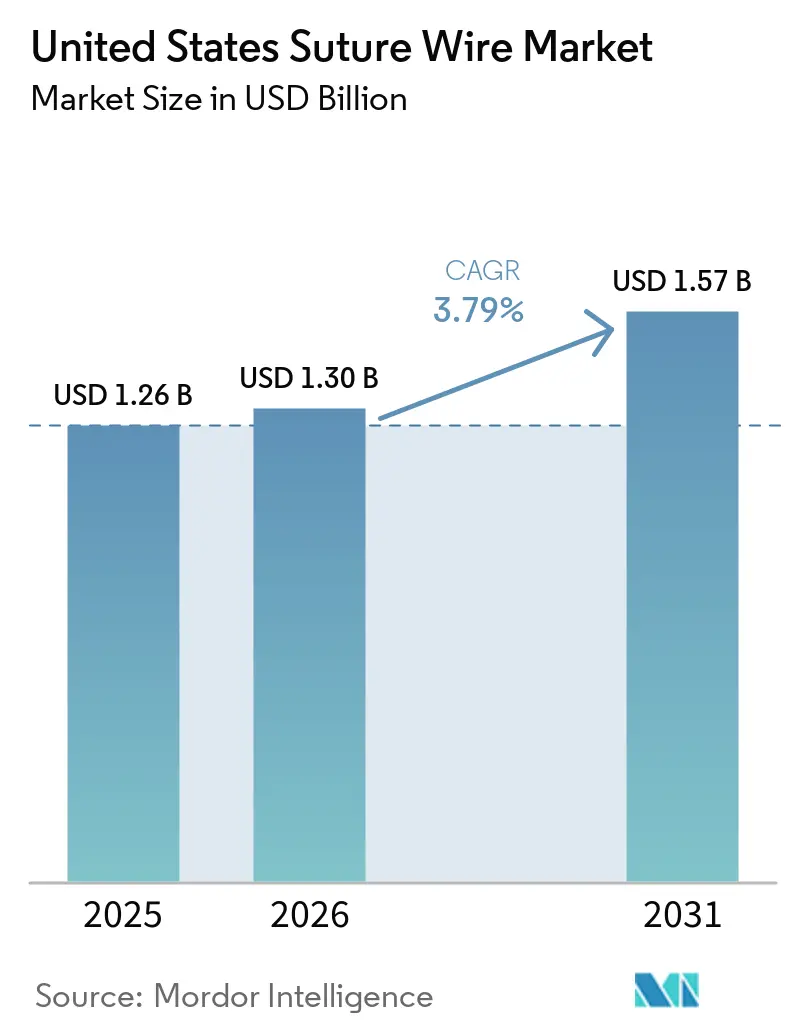
The United States Suture Wire Market size is projected to expand from USD 1.26 billion in 2025 and USD 1.30 billion in 2026 to USD 1.57 billion by 2031, registering a CAGR of 3.79% between 2026 to 2031.
The United States suture wire market remains closely tied to high-acuity surgical care, especially sternotomy closure and orthopedic cerclage, because the Society of Thoracic Surgeons database covers more than 8.3 million procedures across over 1,000 institutions and more than 97% of U.S. cardiac surgery programs. Demand is also supported by aging demographics, with the U.S. population aged 65 and older projected to reach 82 million by 2050, sustaining long-term need for cardiovascular, orthopedic, and ophthalmic procedures. Hospitals continue to hold the core volume because most wire-intensive surgeries remain inpatient, while the shift into ambulatory and specialty settings is creating room for sterile kits, precision formats, and other higher-value offerings. Competition is moderate, as large diversified suppliers defend established accounts through portfolio breadth and procurement access, while specialty manufacturers pursue focused applications where surgeon preference carries more weight. The main upside for the United States suture wire market lies in advanced alloys, coated configurations, and specialty channel expansion, even as substitution from staplers, tissue adhesives, absorbable sutures, and ongoing pricing pressure keeps overall growth measured through 2031.
Key Report Takeaways
- By type, stainless steel held 61.42% of United States suture wire market share in 2025, while other suture wire types are projected to grow at 4.89% CAGR through 2031.
- By material, stainless steel accounted for 73.88% of the United States suture wire market size in 2025, while other metals and alloys are projected to expand at 5.89% CAGR through 2031.
- By end use, hospitals held 88.42% share in 2025, while specialty clinics are forecast to record the fastest growth at 5.29% CAGR through 2031.
- By application, cardiovascular surgery led with 35.62% share in 2025, while ophthalmic surgery is projected to grow at 5.47% CAGR through 2031.
Note: Market size and forecast figures in this report are generated using Mordor Intelligence’s proprietary estimation framework, updated with the latest available data and insights as of January 2026.
United States Suture Wire Market Trends and Insights
Drivers Impact Analysis*
| Driver | (~) % Impact on CAGR Forecast | Geographic Relevance | Impact Timeline |
|---|---|---|---|
| Rising US Surgical Volumes and Procedure Intensity | +1.1% | National, with highest intensity in Southeast, Mid-Atlantic, and Midwest surgical hubs | Short term (≤ 2 years) |
| Orthopedic and Cardiovascular Wire-Intensive Procedure Growth | +0.9% | National, with outsized contribution from states with high cardiac surgery volumes like Texas, Ohio, New York, and Florida | Medium term (2-4 years) |
| Shift Toward Ambulatory and Outpatient Surgery Settings | +0.7% | National, concentrated in metropolitan ASC clusters and Sun Belt states | Medium term (2-4 years) |
| Demand for Lower-Infection-Profile Closure Materials | +0.4% | National, with compliance influence especially visible in Joint Commission-accredited facilities | Medium term (2-4 years) |
| Sterile Packaging and Kit Integration for High-Throughput Operating Rooms | +0.3% | National, with early adoption in high-volume teaching hospitals and IDN-affiliated ASCs | Long term (≥ 4 years) |
| Dual-Source Procurement Requirements From Health Systems | +0.2% | National, driven by GPO contract structures and supply-chain resilience mandates | Long term (≥ 4 years) |
| Source: Mordor Intelligence | |||
Rising US Surgical Volumes and Procedure Intensity
The United States suture wire market draws support from a national surgical base that exceeds 52 million procedures each year, giving suppliers a broad and recurring demand foundation across care settings. Volume alone is not the only factor, because case mix is also shifting toward more complex interventions where closure security matters more and metal wire remains clinically familiar. Open-heart surgery still creates one of the most dependable consumption pools, with more than 300,000 annual procedures and continued reliance on stainless steel wire for standard sternotomy closure in routine-risk patients.[1] The Society of Thoracic Surgeons database reinforces that base, covering more than 8.3 million cumulative procedures across over 1,000 institutions and more than 97% of U.S. cardiac surgery programs. Higher-acuity case flow also keeps hospitals focused on dependable wire supply, because closure failure, readmission, and reintervention carry material clinical and financial consequences. At the same time, the United States suture wire market must monitor a selective shift in high-risk patients toward rigid fixation systems, which may narrow wire use in a small subset of complex cardiac cases over time.
Orthopedic and Cardiovascular Wire-Intensive Procedure Growth
The United States suture wire market remains anchored in orthopedic and cardiovascular surgery because these two specialties account for most stainless steel wire consumption. Cardiac care continues to rely on metal wire after median sternotomy, which preserves a stable volume base even when hospitals push harder on pricing. Orthopedic demand is also broad, covering periprosthetic fracture fixation, patellar repair, revision arthroplasty, and other cerclage-driven reconstruction procedures that still require strong non-absorbable fixation. Joint replacement volumes already exceed 1.5 million procedures per year in the country, which keeps fixation-related demand elevated as revision and trauma workloads expand with age. A 2024 analysis presented to the World Society of Cardiovascular and Thoracic Surgeons found that all 37 sternal readmissions in the compared cohorts occurred in the wire cerclage group and averaged USD 42,326 per admission, which is pushing providers toward more selective patient risk stratification.[2] This does not remove wire from practice, but it does mean the United States suture wire market is becoming more segmented between routine cases that stay with standard steel formats and higher-risk cases that may justify alternative fixation systems.
Shift Toward Ambulatory and Outpatient Surgery Settings
The United States suture wire market is also being reshaped by the steady movement of surgical volume into ambulatory and outpatient settings. CMS added 21 new approved procedures for ambulatory surgery center settings in 2025, which widened the pathway for additional procedural migration outside the hospital. This matters because orthopedic, ophthalmic, and selected cardiovascular procedures are increasingly handled in faster-turn care environments where product simplicity and room efficiency influence purchasing decisions. Outpatient materials teams usually work with tighter per-case cost targets, so standardized wire formats, pre-configured packs, and sterile kits often become more attractive than bulk inventory models. The effect is strongest in Sun Belt metros, where rapid ASC formation intersects with high concentrations of older patients and strong procedural throughput. As a result, manufacturers that can pair clinical reliability with packaging convenience are likely to improve repeat demand as the United States suture wire market becomes more distributed across sites of care.
Demand for Lower-Infection-Profile Closure Materials
Infection prevention has become a direct buying issue for the United States suture wire market because surgical site infections add cost, length of stay, and follow-up burden for already pressured health systems. The CDC’s National Healthcare Safety Network keeps this issue visible by requiring surveillance and monitoring of surgical site infections at enrolled facilities, which supports closer scrutiny of closure material choice.[3] That environment is increasing interest in modified surfaces and lower-infection-profile closure options, including coated configurations and other specialty formats where clinical need is clear. Research published in Scientific Reports in 2025 showed that nanoparticle and nanocomposite coating materials can improve antimicrobial performance on surgical sutures, which supports ongoing development work around more differentiated closure products. The commercial point is not that every facility will adopt premium wire immediately, but that documented infection-control advantages are becoming more meaningful in procurement reviews. For suppliers, the strongest path to differentiation in the United States suture wire market is tied to evidence, sterilization compatibility, and measurable clinical value rather than simple commodity discounting.
Restraints Impact Analysis*
| Restraint | (~) % Impact on CAGR Forecast | Geographic Relevance | Impact Timeline |
|---|---|---|---|
| Competition From Staplers, Adhesives, and Absorbable Polymer Sutures | -0.7% | National, with pressure most acute in general surgery and laparoscopic procedures | Short term (≤ 2 years) |
| Pricing Pressure From GPOs and IDNs | -0.5% | National, concentrated in large health systems and IDN-affiliated procurement structures | Short term (≤ 2 years) |
| Regulatory Validation Burden for Material, Process, and Sterilization Changes | -0.3% | National, with disproportionate impact on manufacturers pursuing novel alloy or sterilization innovations | Long term (≥ 4 years) |
| Limited Clinical Differentiation in Commodity Wire Formats | -0.3% | National, with commodity pressure strongest in non-specialized hospital segments | Medium term (2-4 years) |
| Source: Mordor Intelligence | |||
Competition From Staplers, Adhesives, and Absorbable Polymer Sutures
The United States suture wire market faces its clearest substitution risk outside cardiac and orthopedic surgery, where alternative closure methods already have stronger clinical acceptance. Staplers continue to improve in soft-tissue closure, and Johnson & Johnson launched the ETHICON 4000 Stapler in the United States in June 2025 before securing CE Mark approval for the platform in April 2026. Tissue adhesives and high-performance absorbable sutures have also reduced wire use in superficial, laparoscopic, and minimally invasive procedures. Even in sternotomy closure, a 2025 Journal of Clinical Medicine study reported greater biomechanical load tolerance for UHMWPE suture tapes than standard steel wires, showing that alternative formats are becoming more credible in selected cardiac cases. Adoption remains limited in routine practice because steel wire is familiar, cost-effective, and well embedded in standard protocols. Even so, this keeps the United States suture wire market the strongest in entrenched procedures while capping upside in applications where wire is not the default closure option.
Pricing Pressure From Group Purchasing Organizations and IDNs
Pricing pressure remains one of the most persistent restraints on the United States suture wire market, especially in large hospital systems where purchasing is centralized. Group purchasing organizations cover 47% of hospital supply contracts and commonly push discounts of 20% to 40% from list price, which reduces realized pricing across much of the category. Integrated delivery networks add another layer of pressure through multi-year volume commitments and system-wide standardization demands. Dual-source procurement rules are especially important because they prevent a single supplier from locking in full-category exclusivity across many large health systems. This structure rewards companies with broad product lines, dependable fulfillment, and the ability to offer value across adjacent closure categories rather than one narrow wire format. Vendors that rely mainly on commodity stainless steel offerings have less room to protect margin, which keeps the United States suture wire market commercially disciplined even where clinical substitution is limited.
*Our forecasts treat driver/restraint impacts as directional, not additive. The impact forecasts reflect baseline growth, mix effects, and variable interactions.
Segment Analysis
By Type: Stainless Steel's Durability Edge Sustains Market Leadership
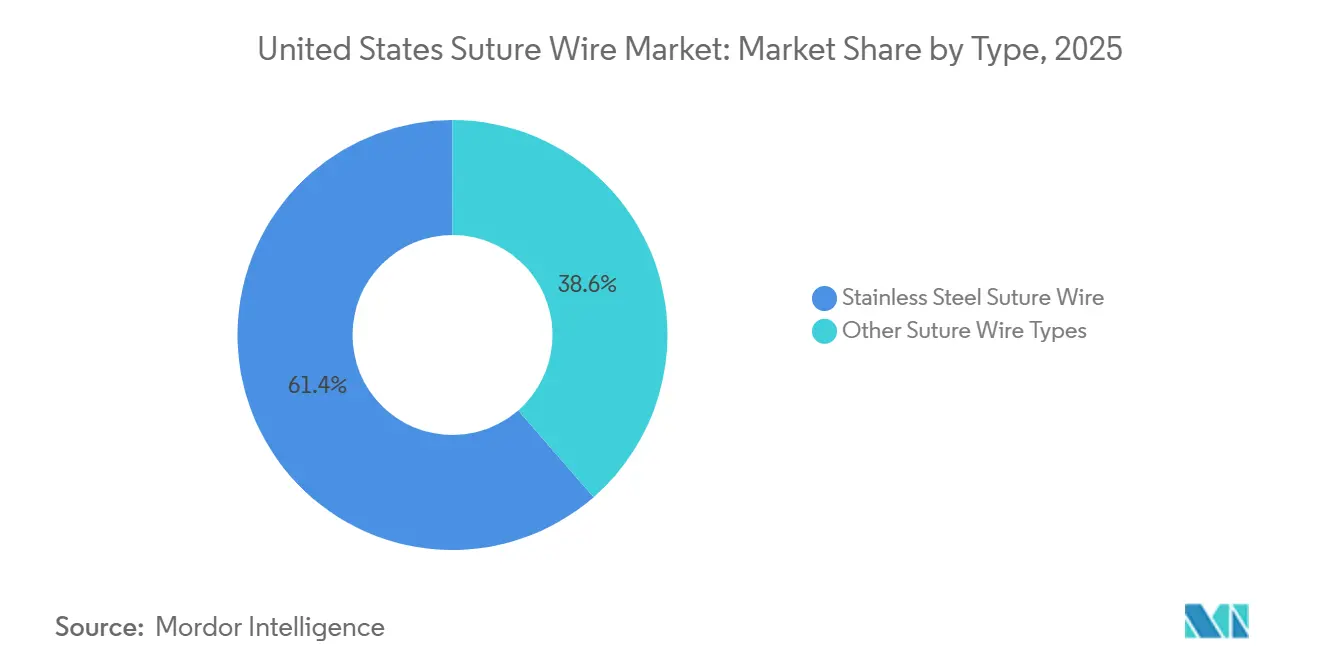
Stainless steel suture wire held 61.42% of United States suture wire market share in 2025, which kept it clearly ahead of specialty formats across the category. Its leadership came from broad use in sternal closure, orthopedic cerclage, hernia reinforcement, and abdominal wound closure, where surgeons continue to value dependable tensile performance and familiar handling. That installed base gives the United States suture wire market a stable demand core that is less exposed to short-term changes in procedural preference. Other suture wire types, including titanium cable systems, nitinol-based configurations, UHMWPE fiber wire, and coated specialty formats, are projected to grow at 4.89% CAGR from 2026 to 2031, showing where the next layer of expansion is forming.
Premium growth within this segment is being shaped more by engineering quality than by raw material identity alone. Research published in Archives of Orthopaedic and Trauma Surgery in April 2025 showed that double-looped cerclage constructs produced stronger and more consistent compression than single-looped alternatives, which supports higher-value design improvements in wire configuration. That kind of evidence helps suppliers justify performance-led positioning without claiming a full replacement of stainless steel in standard care. Regulatory demands also favor established suppliers, because novel alloys and surface modifications must pass the same biocompatibility, sterilization, and device control checks that larger players are already equipped to manage. The result is a segment where incumbent steel products retain the volume base, while specialty formats expand first in carefully selected clinical niches rather than replacing the category standard.
By Material: Alloy Diversification Reshapes Material Procurement
Stainless steel retained 73.88% of the United States suture wire market size in 2025, reflecting its long use across cardiac and orthopedic protocols and its continued position as the default material in many facilities. Its tensile-to-cost balance, sterilization familiarity, and broad inclusion in standardized surgical trays keep it central to routine procurement decisions. This stability matters because hospital buyers still place heavy weight on materials that already fit existing workflow, training, and approval systems. Other metals and alloys are projected to grow at 5.89% CAGR from 2026 to 2031, making this the fastest-growing material tier in the United States suture wire market.
That growth is concentrated in cases where surgeons want MRI compatibility, lower cutting risk, or a different performance profile in fragile bone and high-risk sternal closure. Titanium sits at the center of this shift because it is seen as a practical option for patients with obesity, osteoporosis, or other factors that complicate closure stability. The clinical trial activity around iso-elastic sternal closure systems shows that alternative material systems are moving from discussion into formal evaluation, even if broad adoption will take time. Procurement behavior is also being affected by 2025 tariff-related input cost pressure, which has increased attention on dual sourcing and regional manufacturing strategies for specialty products. The practical outcome is a split inside the United States suture wire market between cost-led stainless steel standardization and targeted use of advanced materials in cases where performance differences are considered worth the premium.
By End User: Hospitals Anchor Demand But Specialty Clinics Narrow the Gap
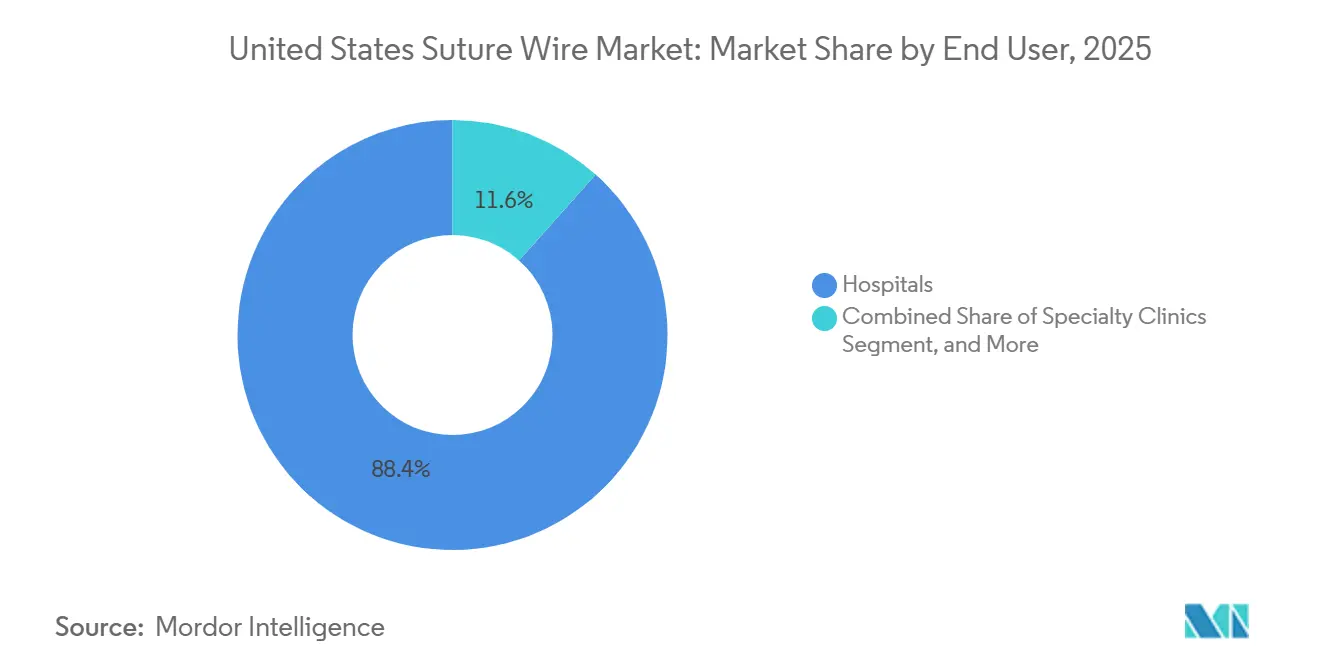
Hospitals commanded 88.42% share in 2025, confirming that the United States suture wire market still depends heavily on inpatient and high-acuity surgical care. Cardiac, thoracic, and complex orthopedic procedures remain the main reason, because these are the applications where wire use stays most concentrated and clinically routine. Large teaching hospitals also shape product selection well beyond their own operating rooms by setting closure protocols that often extend into affiliated outpatient networks. This keeps hospital procurement at the center of the United States suture wire market even as care delivery continues to spread across more channels.
Ambulatory surgical centers remain the second-largest end-use channel, supported by procedure list expansion and broader outpatient use in orthopedic and ophthalmic care. Specialty clinics are projected to grow at 5.29% CAGR from 2026 to 2031, which makes them the fastest-growing end-use setting in the United States suture wire market. Cataract surgery volumes already exceed 3 million procedures each year in the country, and more of that activity is being handled in freestanding ophthalmic environments where precision closure products are routinely stocked. This shift changes the buying landscape because smaller specialty operators often move faster than hospital committees and can give greater weight to physician preference. Suppliers that can build direct relationships with ophthalmology, sports medicine, and focused cardiovascular clinics should be best placed to capture the incremental growth moving away from the traditional hospital channel.

By Application: Cardiovascular Procedures Drive Core Demand
Cardiovascular surgery captured 35.62% of United States suture wire market share in 2025, which made it the largest application segment by a clear margin. The reason remains simple, because median sternotomy closure still relies on stainless steel wire as the standard approach after open cardiac procedures. Bioengineering research published in 2025 reaffirmed that stainless steel wires remain the primary post-cardiac closure method because of low cost and limited training burden, with figure-of-eight, trans-sternal, and parasternal techniques still widely used in practice. Orthopedic surgery remained the second-largest application base, supported by revision arthroplasty, patellar repair, and periprosthetic fracture fixation where cerclage wire continues to play a practical role.
General surgery adds a steady layer of demand in cases where high-tensile non-absorbable closure is still preferred for selected abdominal wall and hernia repairs. Ophthalmic surgery is projected to grow at 5.47% CAGR from 2026 to 2031, making it the fastest-growing application in the United States suture wire market. Corza Medical’s July 2025 expansion of the Onatec ophthalmic suture portfolio to nearly 130 products shows how actively manufacturers are targeting this high-growth area. Cataract surgery volumes already exceed 3 million procedures annually in the United States, which gives ophthalmic care a large procedural base even before further outpatient migration is considered. As specialist eye care networks continue to expand, this application should keep pulling product development toward finer needles, more precise handling, and procedure-specific packaging formats.
Geography Analysis
The Southeast, led by Florida, Georgia, North Carolina, and South Carolina, of the U.S. ophthalmic suture submarket in 2025, supports its position as one of the strongest regional demand pockets in the United States suture wire market. The broader Sun Belt is also the fastest-growing demand zone because it combines high ASC formation with large and rising concentrations of people aged 65 and older. Florida stands out for ophthalmic surgery center density, where cataract-related demand continues to support the use of ultra-fine closure products in outpatient care. Texas and Arizona add to this momentum through large orthopedic and cardiovascular case flow, which keeps both routine and specialty wire formats relevant. This combination makes the South a key growth corridor for the United States suture wire market, especially where aging demographics and site-of-care migration reinforce each other.
The Northeast and Mid-Atlantic provide the most stable volume base, anchored by major academic medical centers and high-acuity cardiac surgery programs. The Society of Thoracic Surgeons database, with more than 8.3 million cumulative cardiac procedures across member institutions, illustrates the procedural depth that supports demand in these regions. Cleveland Clinic alone performed more than 2,000 CABG and valve procedures in 2024, showing how concentrated cardiac volumes translate into steady stainless steel wire use at flagship centers. State-level restrictions on competing ASC formation in parts of the Northeast keep purchasing concentrated in larger institutions, which supports volume stability but also strengthens GPO-led price pressure.
The Midwest and West generate lower per-capita surgical volumes than the most concentrated coastal hubs, but they continue to add demand through aging populations and health system expansion into suburban and exurban communities. Orthopedics and cardiology remain important demand anchors in these regions because both specialties continue to use wire in core procedures that have been slower to move away from metal fixation. California is especially relevant in the West, where large orthopedic ASC networks and advanced surgical platforms support interest in finer and more specialized closure products. That direction became more visible in April 2026, when MMI launched the first microsurgical suture built for robotics in the United States, pointing to a more specialized product mix in high-skill western centers.
Competitive Landscape
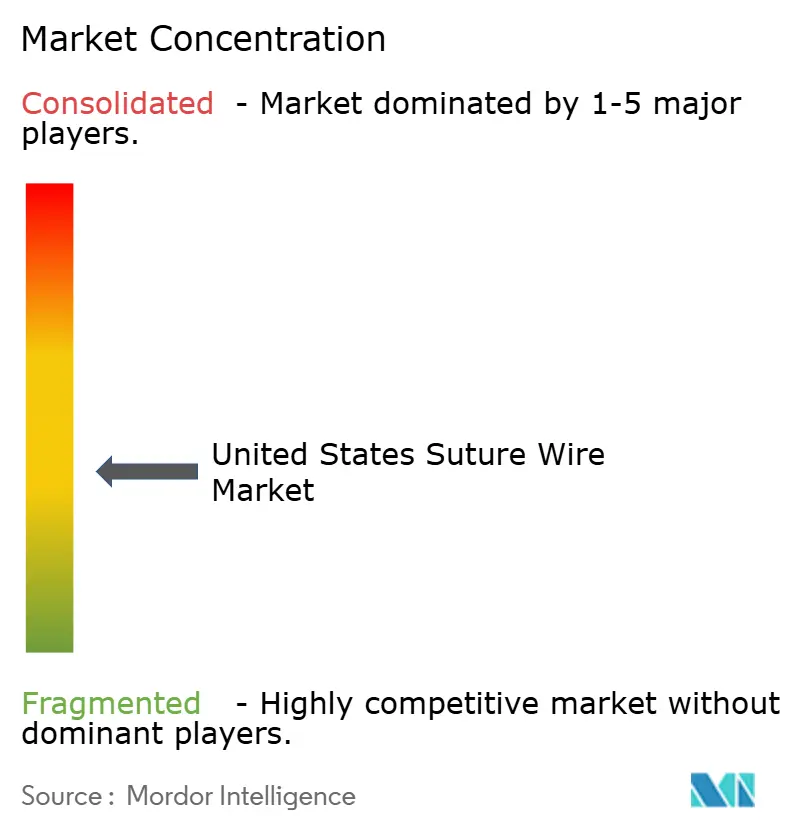
The United States suture wire market has a moderately fragmented structure, with diversified surgical companies holding meaningful positions and a wider field of specialty suppliers competing around them. Johnson & Johnson, through Ethicon, benefits from broad closure portfolios and deep reach into institutional procurement frameworks, which helps it defend volume across hospitals and outpatient settings. B. Braun brings manufacturing depth and sterilization capability, while Corza Medical and DemeTECH use focused portfolios and pricing flexibility to remain relevant in specialty and value-driven accounts. This keeps the United States suture wire market competitive on both contract access and clinical fit, rather than on scale alone.
Several recent moves show how suppliers are targeting higher-growth niches instead of relying only on commodity wire. Corza Medical expanded its Onatec ophthalmic suture portfolio to nearly 130 products in July 2025, strengthening its push into ophthalmology and oculoplastic surgery. Advanced Medical Solutions widened its cardiovascular and ophthalmic exposure through the July 2024 acquisition of Peters Surgical, adding specialist products to its wound-closure portfolio. Johnson & Johnson also launched the ETHICON 4000 Stapler in June 2025 and later secured CE Mark approval in April 2026, which matters because advanced stapling systems compete with sutures in several closure settings. These actions show that product adjacency, specialty depth, and channel focus are shaping strategy across the United States suture wire market.
White space remains most visible in antimicrobial coatings, patient-risk-stratified sternal closure systems, and ultra-fine products for robotic or microsurgical use. Mid-tier entrants can still win in specialty clinics and ASCs, where surgeon preference may matter more than broad GPO coverage and where focused selling can offset scale disadvantages. Smaller companies face a harder path when they try to compete only on commodity stainless steel products, because established suppliers already pair compliance readiness with contract reach and dependable fulfillment. As a result, success in the United States suture wire market depends on combining application-specific differentiation with pricing discipline, clean regulatory execution, and access to the right clinical channels.
United States Suture Wire Industry Leaders
-
B. Braun SE
-
Becton, Dickinson and Company
-
Stryker Corporation
-
Teleflex Incorporated
-
W. L. Gore and Associates, Inc.
- *Disclaimer: Major Players sorted in no particular order
Recent Industry Developments
- April 2026: Corza Medical, a leading global medical technology company, announced that it is reaffirming its commitment to the gut suture category. The company emphasized its focus on ensuring surgeons continue to have reliable access to essential suture materials, particularly in light of recent changes affecting the gut suture market.
- July 2025: OSSIO announced the U.S. launch and first commercial use of its OSSIOfiber Suture Anchors, marking a significant expansion of patient access to its growing portfolio of bio-integrative orthopedic fixation technology. This milestone highlights OSSIO’s commitment to advancing innovative fixation solutions that integrate naturally with the body, offering surgeons new options for improved outcomes in orthopedic procedures.
- July 2025: Corza Medical launched its expanded Onatec Ophthalmic Suture Portfolio, growing the range to nearly 130 absorbable and non-absorbable suture products purpose-built for ophthalmic and oculoplastic surgery. Needles are manufactured from highly tempered stainless steel with precision-ground geometries. The expansion positions Corza as the only company offering a dedicated end-to-end ophthalmic suture portfolio, directly competing with Ethicon in high-growth ophthalmology ASC channels.
United States Suture Wire Market Report Scope
Suture wire refers to specialized, non-absorbable surgical wire (typically made of stainless steel or titanium) used to hold body tissues together, repair bone fractures, or provide heavy-duty closure during orthopedic, sternal (cardiac), and plastic surgeries.
The United States Suture Wire market is segmented across several categories. By Type, it includes Stainless Steel Suture Wire and Other Suture Wire Types. By Material, the market is divided into Stainless Steel and Other Metals and Alloys. By End Use, segmentation covers Hospitals, Ambulatory Surgical Centers, and Specialty Clinics. By Application, the market is categorized into Cardiovascular Surgery, Orthopedic Surgery, General Surgery, Ophthalmic Surgery, and Other Surgical Applications.
| Stainless Steel Suture Wire |
| Other Suture Wire Types |
| Stainless Steel |
| Other Metals and Alloys |
| Hospitals |
| Ambulatory Surgical Centers |
| Specialty Clinics |
| Cardiovascular Surgery |
| Orthopedic Surgery |
| General Surgery |
| Ophthalmic Surgery |
| Other Surgical Applications |
| By Type | Stainless Steel Suture Wire |
| Other Suture Wire Types | |
| By Material | Stainless Steel |
| Other Metals and Alloys | |
| By End User | Hospitals |
| Ambulatory Surgical Centers | |
| Specialty Clinics | |
| By Application | Cardiovascular Surgery |
| Orthopedic Surgery | |
| General Surgery | |
| Ophthalmic Surgery | |
| Other Surgical Applications |
Key Questions Answered in the Report
How large is the United States suture wire market in 2026?
The United States suture wire market stands at USD 1.30 billion in 2026 and is forecast to reach USD 1.57 billion by 2031 at a 3.79% CAGR.
Which application generates the highest demand for suture wire in the United States?
Cardiovascular surgery leads demand, holding 35.62% share in 2025 because median sternotomy closure still relies heavily on stainless steel wire.
Why do hospitals remain the main end users of suture wire products?
Hospitals held 88.42% share in 2025 because wire-intensive cardiac, thoracic, and complex orthopedic procedures are still concentrated in inpatient settings.
Which segment is growing fastest in this category?
Other metals and alloys are growing fastest at 5.89% CAGR, showing rising interest in advanced material options for more complex and higher-risk cases.
What is driving growth in ophthalmic use of suture wire?
Ophthalmic surgery is projected to grow at 5.47% CAGR through 2031, supported by cataract procedure volumes above 3 million annually and continued expansion of specialty eye care settings.