
United States Pharmaceutical Cold Chain Air Logistics Market Size and Share
Market Overview
| Study Period | 2020 - 2031 |
|---|---|
| Forecast Data Period | 2026 - 2031 |
| Base Year Market Size (2025) | USD 10.69 Billion |
| Market Size (2026) | USD 11.54 Billion |
| Market Size (2031) | USD 16.63 Billion |
| Growth Rate (2026 - 2031) | 7.57 % |
| Market Concentration | Medium |
Major Players *Disclaimer: Major Players sorted in no particular order Image © Mordor Intelligence. Reuse requires attribution under CC BY 4.0. | |
United States Pharmaceutical Cold Chain Air Logistics Market Analysis by Mordor Intelligence
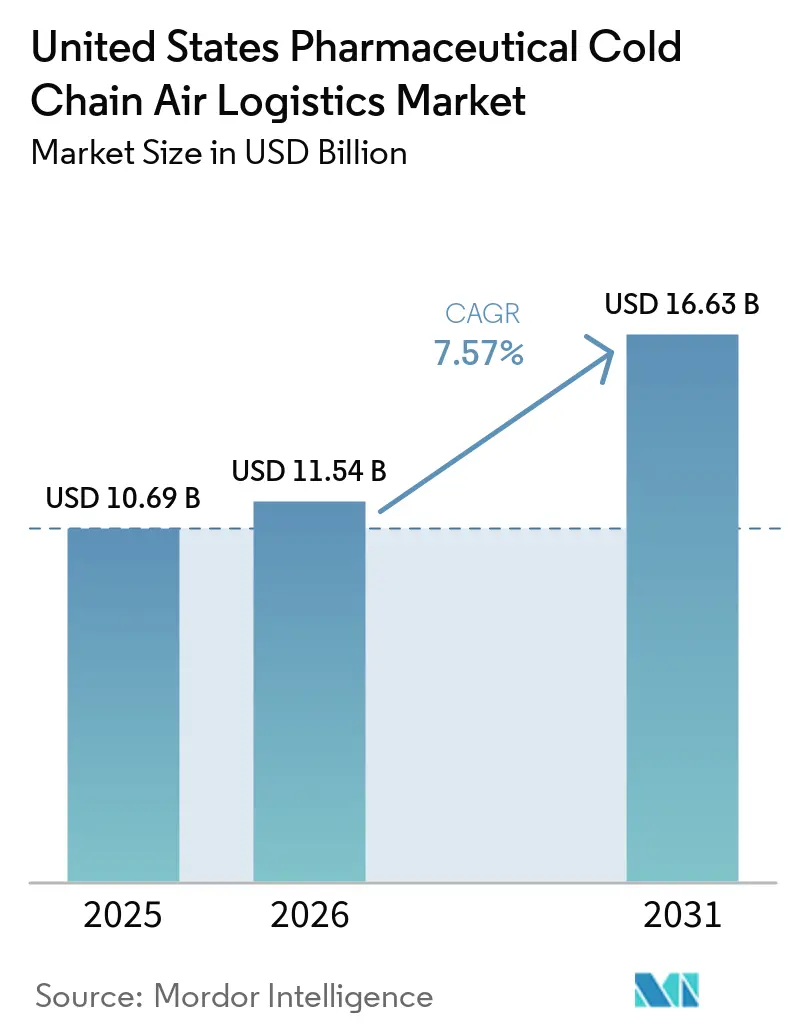
The United States pharmaceutical cold chain air logistics market size was valued at USD 10.69 billion in 2025 and estimated to grow from USD 11.54 billion in 2026 to reach USD 16.63 billion by 2031, at a CAGR of 7.57% during the forecast period (2026-2031).
The expansion reflects a larger pipeline of temperature-sensitive medicines and a distribution model that is moving closer to patients. FDA drug approvals added new products that require validated transport, including biologics and advanced therapies. The United States pharmaceutical cold chain air logistics market also benefits when higher-volume medicines use the same qualified airport and handling network as specialized shipments. Direct-to-patient distribution is increasing the number of small, time-sensitive shipments and raising the value of reliable temperature control.[1]United States Food and Drug Administration, “Advancing Health Through Innovation New Drug Therapy Approvals 2025,” FDA, fda.gov Providers with certified facilities, documented handoffs, and suitable handling capacity are better placed to meet pharmaceutical procurement requirements.
Key Report Takeaways
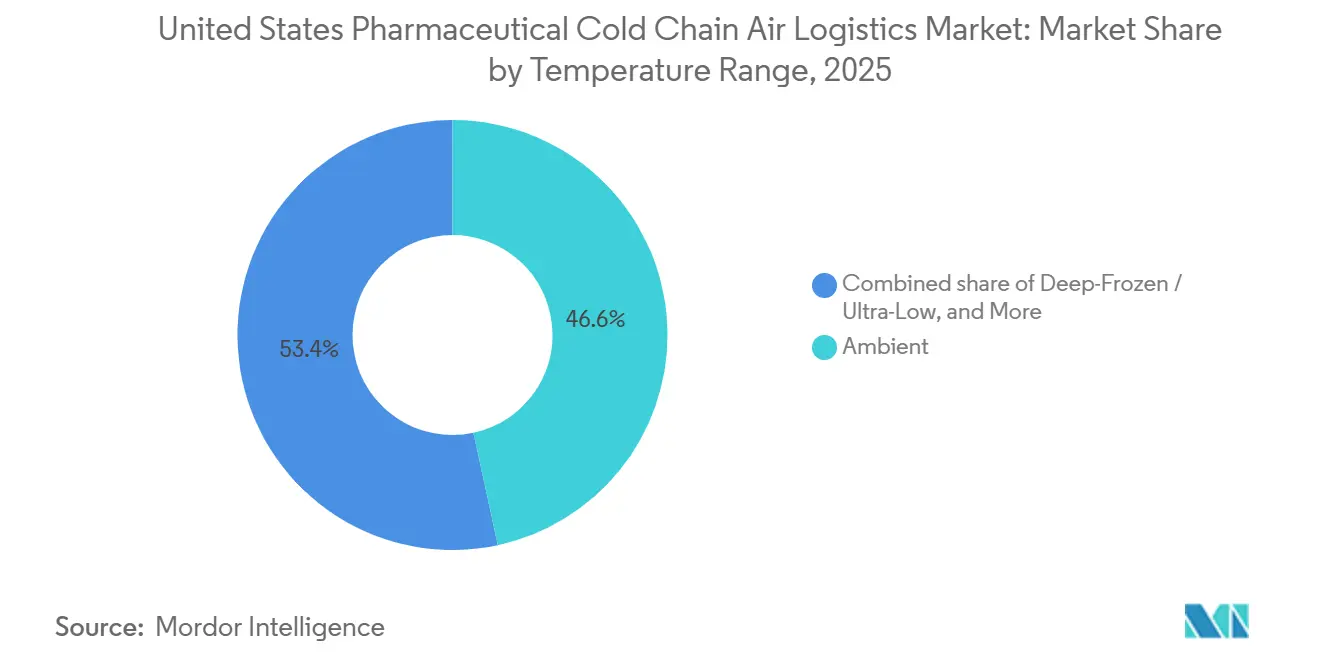
- By temperature range, ambient shipments held 46.62% of the United States pharmaceutical cold chain air logistics market share in 2025, while deep-frozen and ultra-low products are forecast to grow at an 11.55% CAGR through 2031.
- By pharmaceutical product type, biological pharmaceuticals accounted for 44.20% of the United States pharmaceutical cold chain air logistics market size in 2025, while cell and gene therapies are forecast to grow at a 13.69% CAGR through 2031.
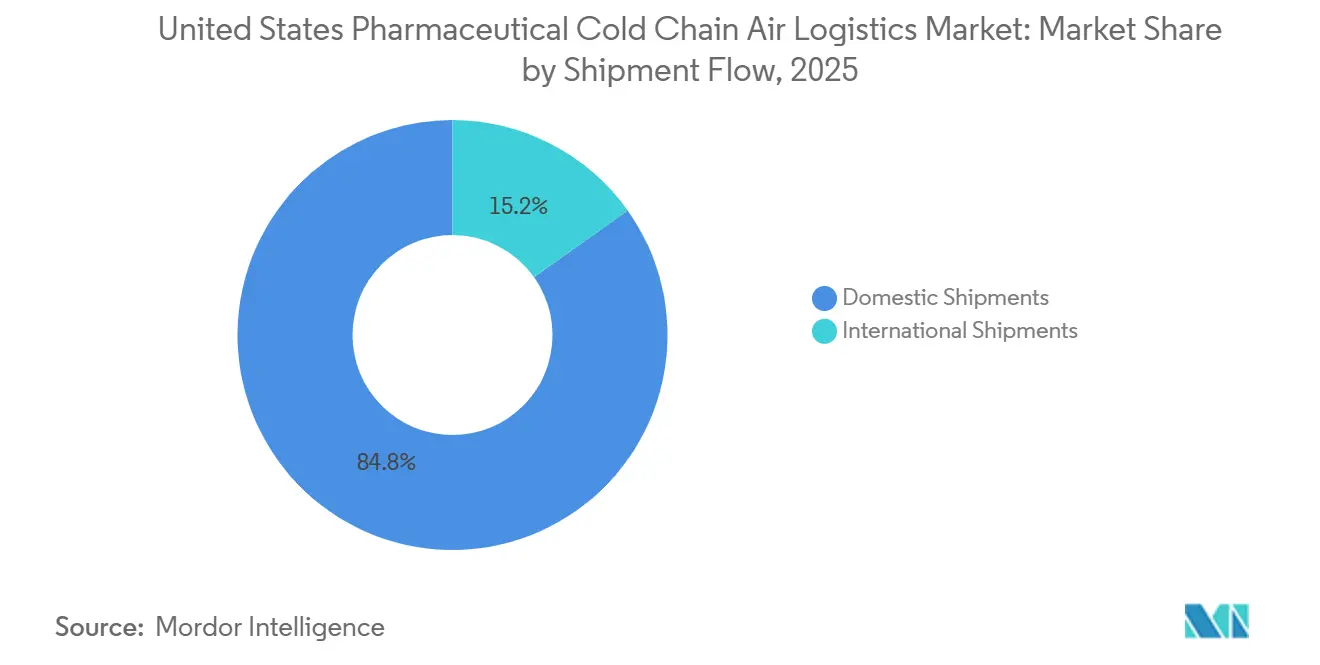
- By shipment flow, domestic shipments accounted for 84.84% of the United States pharmaceutical cold chain air logistics market share in 2025, while international shipments are forecast to grow at an 8.53% CAGR through 2031.
- By region, the Northeast held 26.84% of the United States pharmaceutical cold chain air logistics market size in 2025, while the Southwest is forecast to grow at an 8.93% CAGR through 2031.
Note: Market size and forecast figures in this report are generated using Mordor Intelligence’s proprietary estimation framework, updated with the latest available data and insights as of January 2026.
United States Pharmaceutical Cold Chain Air Logistics Market Trends and Insights
Drivers Impact Analysis*
| Driver | (~) % Impact on CAGR Forecast | Geographic Relevance | Impact Timeline |
|---|---|---|---|
| Biologics and Specialty-Pharmaceutical Shipment Growth | +2.4% | National, with the highest freight density in the Northeast and Southeast | Long term (≥ 4 years) |
| Cell and Gene Therapy Commercialization | +1.8% | National, concentrated in Northeast manufacturing clusters and certified hub airports | Long term (≥ 4 years) |
| Direct-to-Patient and Specialty-Pharmacy Fulfillment | +1.2% | National, with the highest adoption in dense metro areas in the Northeast and the West | Medium term (2-4 years) |
| Clinical-Trial Decentralization and Patient-Specific Shipments | +0.8% | National, with early gains in Southeast and Midwest secondary locations | Medium term (2-4 years) |
| Airport-Level Cold-Chain Resilience and Qualified Cross-Dock Expansion | +0.6% | Concentrated at DFW, JFK, PHL, MIA, LAX, and selected secondary gateways | Short term (≤ 2 years) |
| Digital Chain-of-Custody and Predictive Exception Management | +0.4% | National, with adoption across certified station networks | Short term (≤ 2 years) |
| Source: Mordor Intelligence | |||
Biologics and Specialty-Pharmaceutical Shipment Growth
Biologics are reshaping the cost structure of the United States pharmaceutical cold chain air logistics market because they need controlled transport and documented release procedures. CDER approved 46 novel drugs during 2025, including 12 biologics, while the combined number of novel approvals across CDER and CBER reached 58.[2]United States Food and Drug Administration, “Decentralized Clinical Trials for Drugs, Biological Products, and Devices Guidance,” FDA, fda.gov Each launch creates transport qualification work because the product must move through a validated lane before commercial distribution begins. The United States pharmaceutical cold chain air logistics market, therefore, gains demand from both shipment movement and the qualification work that accompanies a new product. FDA approvals included 18 biosimilars for 10 reference products in 2025. Separate biosimilar manufacturers need their own qualified packaging and carrier arrangements, which increases the number of active freight relationships rather than combining freight under one originator program.
Cell and Gene Therapy Commercialization
Cell and gene therapies are moving from clinical activity into commercial distribution and have become the most demanding cargo category in the United States pharmaceutical cold chain air logistics market. Cryoport reported support for 21 commercially approved cell and gene therapies and 766 global clinical trials as of March 31, 2026. FDA approvals of GENGLYCOS in August 2026 and TREGZI in July 2026 added therapies that need specialized distribution to certified treatment centers. Autologous therapies require patient cells to travel from a hospital to a manufacturing site and then return to the same care location. That two-way movement makes identity control, timing, and temperature performance central to the shipment process. Liquid nitrogen vapor shippers operating below -150 °C are subject to IATA dangerous goods requirements for UN 1977, which limit carrier options and increase handling requirements.
Direct-to-Patient and Specialty-Pharmacy Fulfillment
Direct-to-patient distribution is changing the shipment profile of the United States pharmaceutical cold chain air logistics market from bulk movements toward smaller and more frequent deliveries. PhRMA supported White House direct-to-patient programs in September 2025, and manufacturer platforms have moved specialty drug activity beyond traditional wholesale channels. Specialty medicines represented more than 50% of the United States drug expenditures, while the top 2% of patients by use accounted for that same share of spending. This patient base is dispersed across locations and depends on dependable temperature-controlled home delivery. The United States pharmaceutical cold chain air logistics market must therefore support tighter delivery windows and clear custody records at the last mile. Operators designed only for palletized air freight face a weaker fit than providers that can maintain temperature assurance through parcel handoffs.
Clinical-Trial Decentralization and Patient-Specific Shipments
Decentralized clinical trials are creating patient-specific shipments that must reach homes without the support of an institutional pharmacy. FDA final guidance issued in September 2024 clarified decentralized clinical trial operations and reduced barriers to direct shipment of investigational products to participants. A proof-of-concept study in Clinical Pharmacology & Therapeutics reported 68 direct-to-participant investigational medicinal product shipments with a 94% successful delivery rate.[3]Duvall, MN, et al., “The Supply of Investigational Medicinal Product and Management of Study Materials for Decentralized Participants,” Clinical Pharmacology & Therapeutics, doi.org Each participant location requires packaging that can preserve the required temperature and provide a clear chain of custody. This requirement makes packaging selection and exception management more important than in an institutional delivery model. The United States pharmaceutical cold chain air logistics market can serve this demand through qualified direct-to-patient services with reliable documentation and delivery controls.
Restraints Impact Analysis*
| Restraint | (~) % Impact on CAGR Forecast | Geographic Relevance | Impact Timeline |
|---|---|---|---|
| High Validation, Packaging, and Temperature-Control Costs | -1.4% | National, with a larger burden in the Northeast and Southeast because of freight density and lane complexity | Long term (≥ 4 years) |
| Temperature Excursion, Delay, and Product-Disposal Risk | -0.9% | National, with higher exposure at secondary airports without qualified cross-dock infrastructure | Medium term (2-4 years) |
| Dry-Ice and Cryogenic Supply Volatility at Air Hubs | -0.6% | West Coast hubs, including LAX and SFO, with national spillover risk | Medium term (2-4 years) |
| Limited GxP-Trained Labor and Site-of-Care Cryogenic Readiness | -0.4% | National, with an acute gap in secondary locations and emerging Southwest hubs | Long term (≥ 4 years) |
| Source: Mordor Intelligence | |||
High Validation, Packaging, and Temperature-Control Costs
Validation requirements establish a cost floor for pharmaceutical cold-chain air lanes, regardless of shipment volume. Under 21 CFR Part 211.142 and 211.150, manufacturers and distributors must maintain written procedures that protect a drug product’s identity, strength, quality, and purity during storage and distribution. The United States pharmaceutical cold chain air logistics market must account for seasonal lane qualification, packaging performance, and documented transport procedures. USP General Chapter 1079 provides good storage and distribution practices for drug products and supports formal temperature-control processes.[4]United States Pharmacopeia, “USP General Chapter 1079 Good Storage and Distribution Practices for Drug Products,” U.S. Pharmacopeia, usp.org Active containers and qualified equipment add recurring certification and operating costs. These requirements are harder to absorb for smaller providers and sponsors managing low-volume, high-value therapy shipments.
Temperature Excursion, Delay, and Product-Disposal Risk
Temperature excursions create risks that extend beyond product loss because an affected shipment may delay treatment and trigger a formal quality review. FDA good manufacturing practice rules require a review of products that do not meet established requirements before they are released or rejected. USP guidance requires an appropriate assessment of temperature exposure during storage and transportation. IATA temperature-control requirements call for consistent labeling, acceptance checks, and documented handling procedures for pharmaceutical cargo. A delay at an airport without qualified cross-dock facilities can therefore put a high-value therapy at risk. This exposure keeps investment focused on capable gateways and makes station-level procedures important in the United States pharmaceutical cold chain air logistics market.
*Our forecasts treat driver/restraint impacts as directional, not additive. The impact forecasts reflect baseline growth, mix effects, and variable interactions.
Segment Analysis
By Temperature Range: Deep-Frozen Demand Accelerating as CGT Volumes Mature
Ambient shipments held 46.62% of the market share in 2025, the largest position within the United States pharmaceutical cold chain air logistics market. This category includes GLP-1 injectables with controlled room-temperature requirements and oral specialty medicines with extended room-temperature profiles. Their high volume supports investment in airport cargo facilities and handling processes. That investment can also support specialized cargo moving along the same corridors. Chilled products require close handling control for many biologics and vaccines. FDA materials describe the importance of proper distribution conditions for approved drug products. Frozen products also remain important where product stability calls for lower temperature exposure.
The United States pharmaceutical cold chain air logistics market size for deep-frozen and ultra-low products is forecast to increase at an 11.55% CAGR between 2026 and 2031. This pace exceeds that of the other temperature categories. Cell and gene therapies are the main source of this demand because many require liquid nitrogen vapor shipment at temperatures below -150 °C. IATA treats UN 1977 liquid nitrogen shipments under dangerous goods rules that include specific handling controls. Growth is likely to concentrate at certified gateways with active container areas and the ability to manage cold equipment during ground dwell. Airports without these capabilities have a limited role in advanced therapy lanes. This channeling of traffic makes infrastructure quality a material factor in the United States pharmaceutical cold chain air logistics market.



By Pharmaceutical Product Type: Biologics Lead While CGT Redefines Logistics Standards
Biological pharmaceuticals held 44.2% of the United States pharmaceutical cold chain air logistics market share in 2025. This position reflects both higher product values and the handling requirements of monoclonal antibodies, vaccines, biosimilars, and blood-derived products. FDA approvals of 18 biosimilars for 10 reference products in 2025 created additional needs for independent validated logistics arrangements. Each manufacturer must establish appropriate packaging and carrier qualification for its own program. Small-molecule medicines continue to provide baseline air freight volume. Their more frequent ambient profile generally limits the premium spent on temperature-controlled handling. Specialty and veterinary medicines serve narrower uses that still require tailored fulfillment and transport processes.
Cell and gene therapies are the fastest-growing product group, with a projected 13.69% CAGR from 2026 to 2031. The United States pharmaceutical cold chain air logistics market depends on specialized handling for this group because therapies may need cryogenic movement to specific infusion centers. FDA approved GENGLYCOS in August 2026 and TREGZI in July 2026, adding to the advanced therapy portfolio. These products require a logistics design that matches their product-specific transport conditions. Shipping validation information is part of the product approval and distribution framework under FDA requirements. The resulting requirements favor providers that can prove performance across the full shipment path. They also limit the ability of general freight providers to handle every advanced therapy movement.
By Shipment Flow: Domestic Networks Dominate but International Corridors Are Gaining Speed
Domestic flows accounted for 84.84% of the market size in 2025 and formed the operating base of the United States pharmaceutical cold chain air logistics market. Specialty pharmacy networks use hub-and-spoke models to move high-value medicines to homes and infusion locations. These movements require predictable overnight delivery and dependable custody controls. Direct-to-patient distribution has added further domestic movements as manufacturers seek control over the patient delivery experience. The cost of a delayed or compromised therapy can exceed the freight charge, which supports continued use of qualified air services. Domestic scale also enables providers to build repeatable processes around established airport and pharmacy networks.
International shipments are forecast to grow at an 8.53% CAGR from 2026 to 2031, the fastest rate within shipment flow. The United States pharmaceutical cold chain air logistics market is supported by export movements of biologics and advanced therapies, as well as imports of active ingredients and finished products. PhRMA reported that United States biopharmaceutical companies continued to expand advanced manufacturing activity during 2025. Kuehne+Nagel expanded its Cool Corridor network in July 2026, including routes between Frankfurt and Atlanta and between Chicago and Sao Paulo. The routes show continued investment in dedicated temperature-controlled air connections. International growth increases the importance of consistent practices across origin, transit, and destination stations.
Geography Analysis
The Northeast held 26.84% of the United States pharmaceutical cold chain air logistics market share in 2025 and remained the main center for pharmaceutical air freight activity. New Jersey, Massachusetts, and Pennsylvania have a high density of drug manufacturing and biologics activity. These states generate commercial, clinical, and advanced-therapy shipments that need controlled transport. Philadelphia supports life sciences cargo with temperature-controlled handling across relevant ranges. Boston serves transatlantic movements of clinical materials and commercial biologics. The concentration of specialty pharmacies, contract manufacturers, and clinical research organizations creates inbound, outbound, and return logistics needs. This breadth of activity supports year-round demand for qualified air services.
The Southwest is the fastest-growing geography, with an 8.93% CAGR projected for 2026 to 2031. Texas is attracting biomanufacturing investment that can generate outbound cold-chain shipments from Dallas-Fort Worth, Austin, and Houston. Dallas-Fort Worth’s CEIV Pharma community certification provides documented practices among participating logistics providers. The United States pharmaceutical cold chain air logistics market can use this coordinated model to improve handoffs across air and ground operations. The West is also strengthening its airport logistics base. DHL Global Forwarding invested USD 1.5 million in cold storage at Los Angeles International Airport in December 2025. This investment connects a major West Coast gateway with DHL’s temperature-controlled healthcare network.
Chicago O’Hare serves as a Midwest transit location for temperature-sensitive imports from India and Asia. Its role is more import-oriented than that of the Northeast manufacturing corridor. Secondary Midwest locations are adding direct-to-patient fulfillment capacity as pharmacy networks seek shorter transit times outside the Northeast. Miami remains a gateway for pharmaceutical trade with Latin America. Puerto Rico supports a pharmaceutical manufacturing base and adds regional cold-chain capacity. The geographic structure of the United States pharmaceutical cold chain air logistics market depends on large, certified hubs, but it also requires qualified connections to secondary cities and care locations.
Competitive Landscape
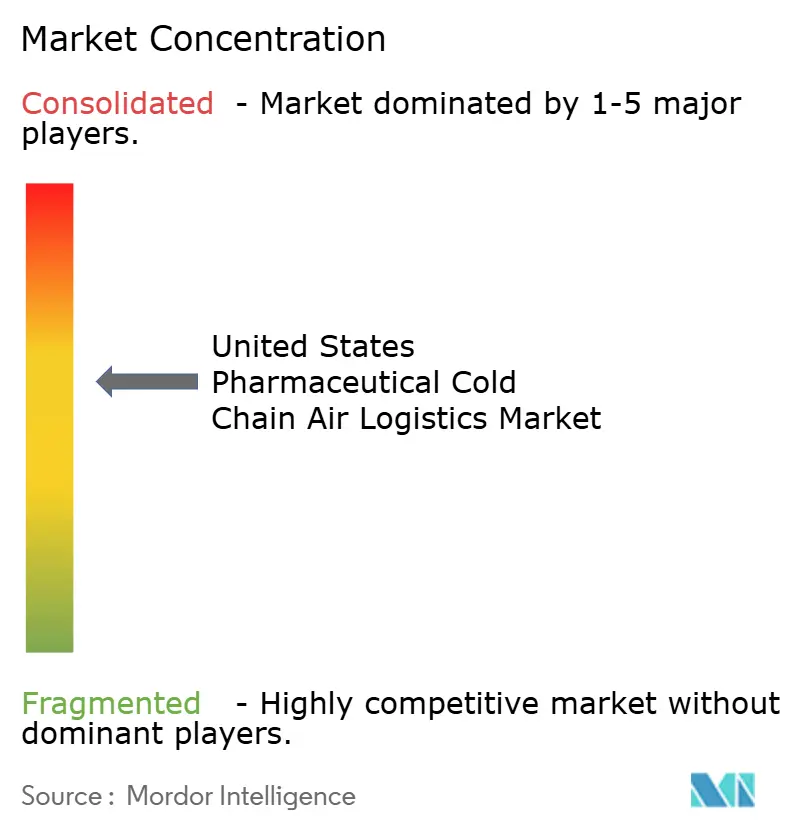
The United States pharmaceutical cold chain air logistics market is moderately consolidated among global integrated providers with certified facilities and wide transport networks. UPS Healthcare, FedEx, and DHL have scale advantages in infrastructure, network coverage, and temperature monitoring. UPS Healthcare generated more than USD 11 billion in healthcare revenue during 2025. The company completed its acquisition of Andlauer Healthcare Group for USD 1.6 billion, adding 1.7 million square feet of GDP-certified North American storage and more -80 °C freezer capacity. Cryoport, World Courier, and Biocair compete through specialized service models, clinical expertise, and therapy-specific handling. Their roles are especially relevant where shipment identity and cryogenic capability matter as much as route coverage.
Leading providers are increasing specialized capacity through acquisitions and network investment. DHL acquired CRYOPDP from Cryoport in 2025 for USD 200 million to strengthen white-glove advanced-therapy courier capability. UPS announced a USD 48 million investment in 27 temperature-controlled freight cross-dock facilities in June 2026. Kuehne+Nagel expanded its Cool Corridor network in July 2026 to add dedicated temperature-controlled air routes. These moves add capacity near key gateways and improve control across air and ground handoffs. They also raise the infrastructure threshold for smaller providers that seek to compete on broad network coverage.
Specialists continue to have room where advanced therapies require precise procedures and direct communication between treatment sites and logistics teams. Secondary airport locations without certified cold-chain ecosystems remain a service gap for some advanced-therapy routes. Digital monitoring can also distinguish providers when customers need clear temperature and custody records. An IEEE study published in February 2026 reported that an Internet of Things and blockchain approach reduced therapeutic spoilage by up to 28% and achieved 100% tamper evidence in test records. The United States pharmaceutical cold chain air logistics market, therefore, rewards both large providers with certified networks and specialists with deep therapy knowledge.
United States Pharmaceutical Cold Chain Air Logistics Industry Leaders
DHL Group
United Parcel Service, Inc. (UPS Healthcare, including Marken)
FedEx Corporation
Kuehne+Nagel International AG
DSV A/S
- *Disclaimer: Major Players sorted in no particular order

Recent Industry Developments
- August 2026: The FDA approved GENGLYCOS by Ultragenyx Pharmaceutical under accelerated approval, adding a gene therapy product with ultra-cold distribution requirements to the growing portfolio of approved CGTs that depend on qualified pharmaceutical cold-chain air logistics networks.
- July 2026: Kuehne+Nagel expanded its Cool Corridor network by adding 4 new GDP-compliant dedicated temperature-controlled air freight routes, including Frankfurt-to-Atlanta and 2 Chicago-to-Sao Paulo connections, increasing coverage of key United States international pharmaceutical trade lanes.
- June 2026: UPS announced a USD 48 million investment in 27 temperature-controlled freight cross-dock facilities across the Americas, Europe, and Asia, all IATA CEIV Pharma-certified and equipped with a 24/7/365 control tower, targeting enhanced speed and chain-of-custody integrity between air and ground movements for biologics and GLP-1 medications.
- June 2025: Cryoport completed the divestiture of its specialty courier subsidiary CRYOPDP to DHL Group in a transaction that included USD 200 million in cash payments, while simultaneously establishing a strategic partnership with DHL to co-develop integrated cold-chain solutions for the global life sciences sector.


United States Pharmaceutical Cold Chain Air Logistics Market Report Scope
| Chilled (0–5 °C) |
| Frozen (-18–0 °C) |
| Ambient |
| Deep-Frozen / Ultra-Low (More than -20 °C) |
| Small-Molecule Pharmaceuticals | Branded Pharmaceuticals |
| Over-the-Counter (OTC) Pharmaceuticals | |
| Generic Pharmaceuticals | |
| Biological Pharmaceuticals (Biologics, Biosimilars, Vaccines, and Blood-Derived Medicinal Products) | |
| Specialty Pharmaceuticals | |
| Cell and Gene Therapies | |
| Veterinary Pharmaceuticals | |
| Other Pharmaceutical Products |
| Domestic Shipments |
| International Shipments |
| Northeast |
| Southeast |
| Midwest |
| Southwest |
| West |
| By Temperature Range | Chilled (0–5 °C) | |
| Frozen (-18–0 °C) | ||
| Ambient | ||
| Deep-Frozen / Ultra-Low (More than -20 °C) | ||
| By Pharmaceutical Product Type | Small-Molecule Pharmaceuticals | Branded Pharmaceuticals |
| Over-the-Counter (OTC) Pharmaceuticals | ||
| Generic Pharmaceuticals | ||
| Biological Pharmaceuticals (Biologics, Biosimilars, Vaccines, and Blood-Derived Medicinal Products) | ||
| Specialty Pharmaceuticals | ||
| Cell and Gene Therapies | ||
| Veterinary Pharmaceuticals | ||
| Other Pharmaceutical Products | ||
| By Shipment Flow | Domestic Shipments | |
| International Shipments | ||
| By Region | Northeast | |
| Southeast | ||
| Midwest | ||
| Southwest | ||
| West | ||


Key Questions Answered in the Report
What is driving demand for pharmaceutical cold-chain air logistics in the United States?
Biologics, cell and gene therapies, direct-to-patient delivery, and decentralized trials increase the need for validated temperature-controlled shipment services. New launches also require qualified lanes, packaging, records, and carefully managed handoffs. Airlines, forwarders, and specialist providers must coordinate these processes from origin collection through final delivery.
How large is the United States pharmaceutical cold-chain air logistics in 2026?
The value is estimated at USD 11.54 billion in 2026 and is forecast to reach USD 16.63 billion by 2031 at a 7.57% CAGR. The forecast reflects continuing demand for controlled handling of high-value, time-sensitive therapies across domestic and international service lanes.
Which temperature range has the fastest projected growth?
Deep-frozen and ultra-low products are forecast to grow at an 11.55% CAGR from 2026 to 2031, supported by cell and gene therapy requirements. These shipments need equipment and airport processes that can maintain very low temperatures during transfer, ground dwell, and final delivery.
Which pharmaceutical products need the most specialized air freight handling?
Cell and gene therapies need specialized, often cryogenic, distribution because they may move in liquid nitrogen vapor shippers below -150 °C. Many also require delivery to certified treatment centers within narrow timing windows and with complete identity documentation.
Which United States region has the largest pharmaceutical cold-chain air freight base?
The Northeast held 26.84% of revenue in 2025 because it has a dense concentration of drug manufacturing, specialty pharmacies, and life sciences services. Its airport and service network support domestic and transatlantic pharmaceutical lanes.
Why does CEIV Pharma certification matter for air logistics providers?
Certification provides a structured standard for handling temperature-sensitive pharmaceutical cargo and supports documented controls across the shipment process. It helps shippers assess whether participating facilities can manage pharmaceutical cargo consistently.
Page last updated on:





