
United States Metal Forming Equipment Market Size and Share
Market Overview
| Study Period | 2020 - 2031 |
|---|---|
| Forecast Data Period | 2026 - 2031 |
| Base Year Market Size (2025) | USD 2.83 Billion |
| Market Size (2026) | USD 2.94 Billion |
| Market Size (2031) | USD 3.45 Billion |
| Growth Rate (2026 - 2031) | 3.25 % |
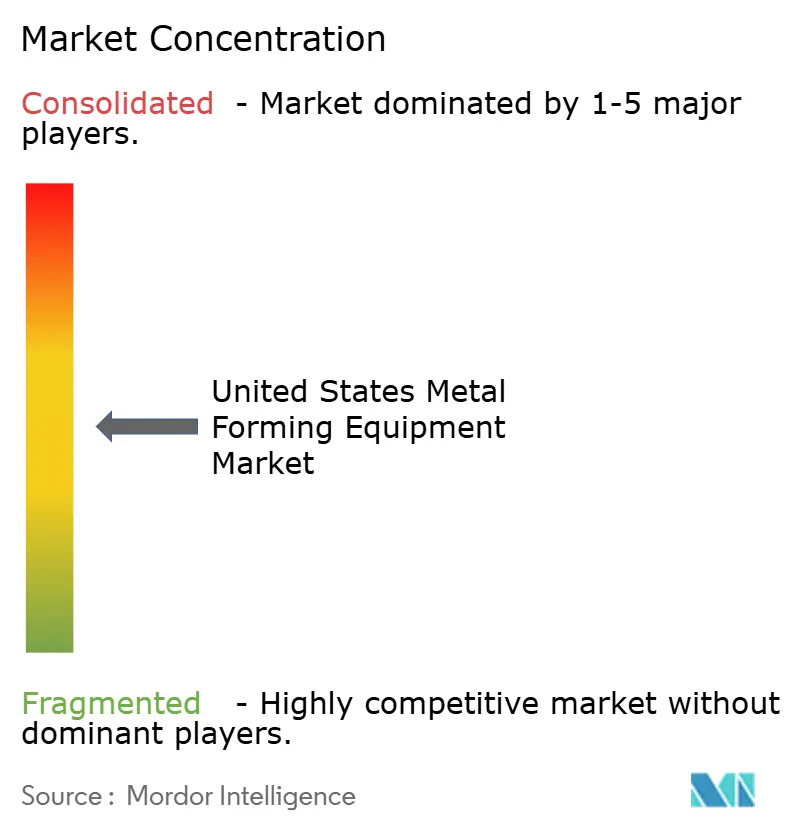
| Market Concentration | Medium |
Major Players *Disclaimer: Major Players sorted in no particular order Image © Mordor Intelligence. Reuse requires attribution under CC BY 4.0. | |
United States Metal Forming Equipment Market Analysis by Mordor Intelligence
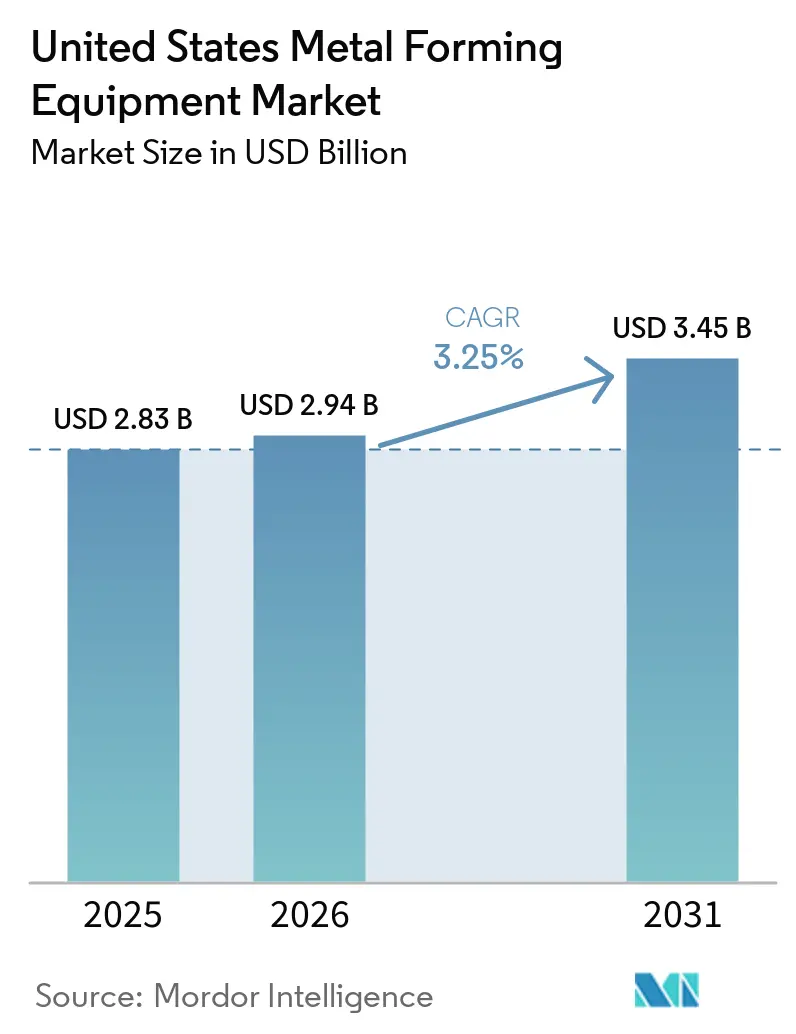
The United States Metal Forming Equipment Market size is projected to be USD 2.83 billion in 2025, USD 2.94 billion in 2026, and reach USD 3.45 billion by 2031, growing at a CAGR of 3.25% from 2026 to 2031.
The United States metal forming equipment market is supported by replacement demand, reshoring, aerospace and defense capacity expansion, infrastructure manufacturing, and redesigned components for electric vehicles. Manufacturing technology orders reached USD 3.44 billion in the first half of 2026, 36.0% higher than the first half of 2025 and the strongest first half on record, indicating sustained capital investment across the United States manufacturing. Aerospace manufacturers recorded their highest first-half machinery order value and unit volume on record in 2026, while automotive manufacturing technology orders increased 22.2% in 2025 from 2024, supporting demand for presses, forming systems, bending equipment, and automated production lines. Federal infrastructure procurement requirements also strengthen domestic manufacturing demand, while high equipment acquisition costs, skilled-worker shortages, tariff uncertainty, and reliance on imported components remain constraints. The market is therefore increasingly shaped by higher-value, automated, and application-specific equipment investment rather than machine-volume growth alone.
Key Report Takeaways
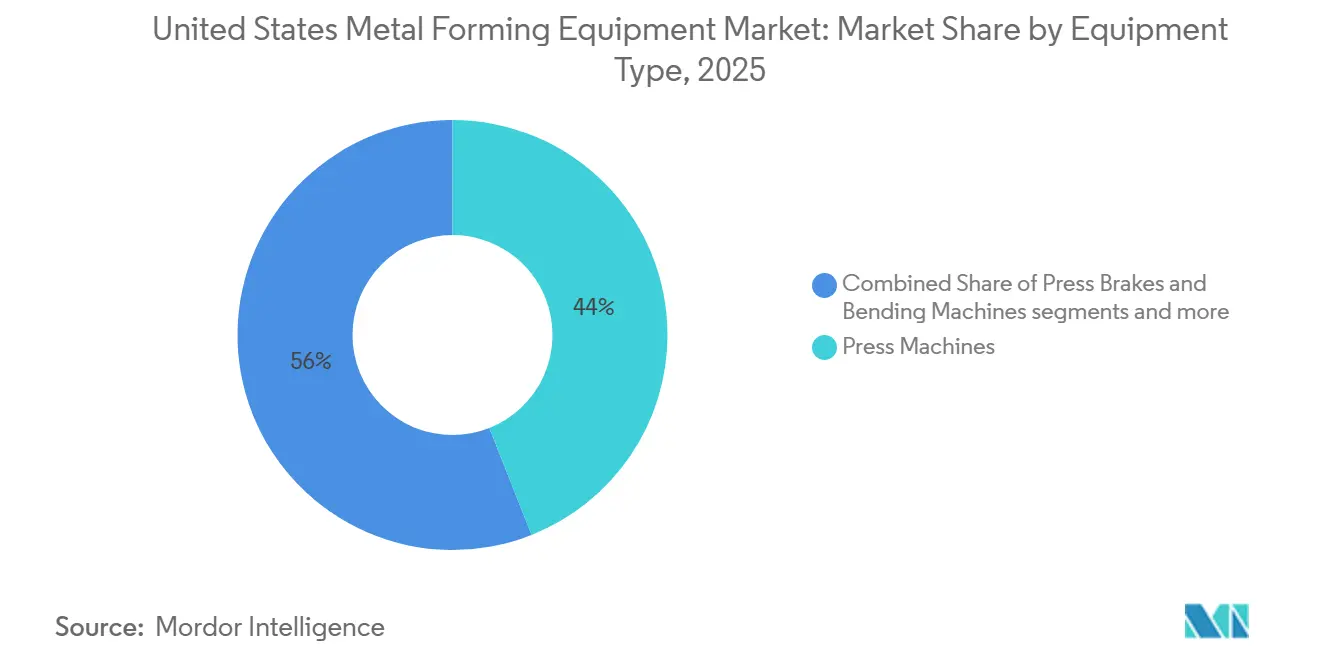
- By equipment type, press machines held 44% of the United States metal forming equipment market share in 2025, while servo presses are forecast to grow at a 5.3% CAGR through 2031.
- By forming process, stamping and punching held 32.5% of the United States metal forming equipment market size in 2025, while hydroforming is forecast to grow at a 4.9% CAGR through 2031.
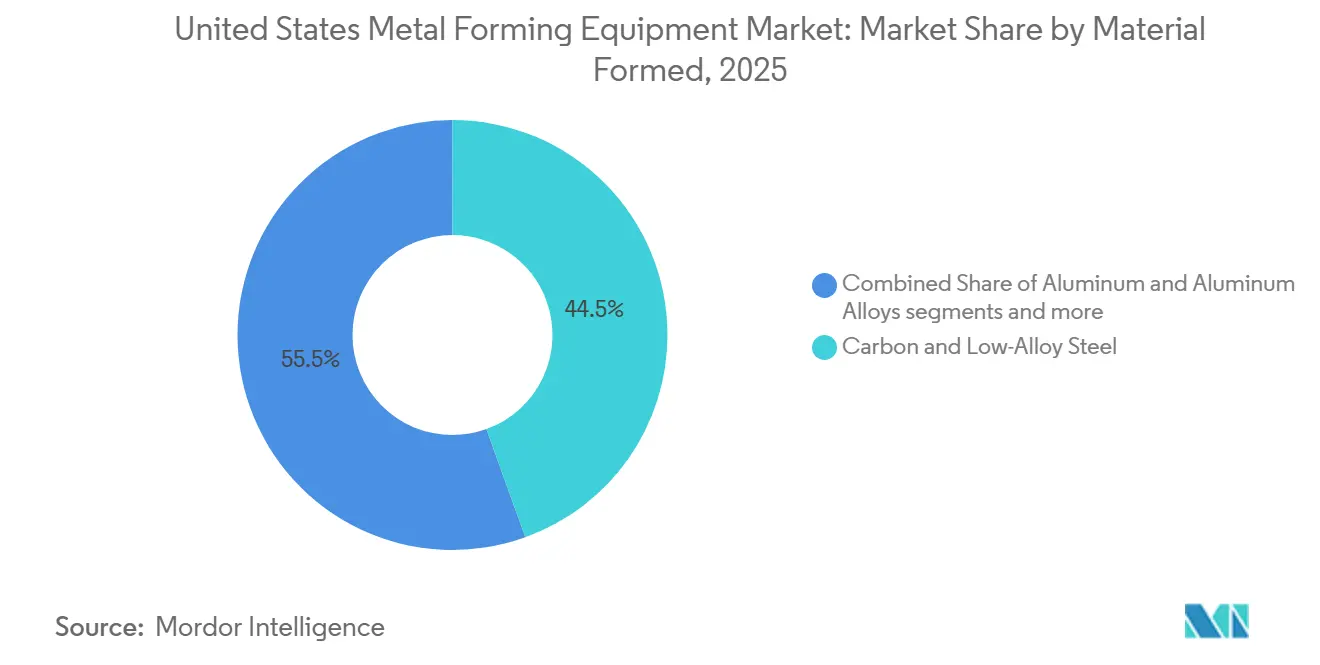
- By material formed, carbon and low-alloy steel held 44.5% of the United States metal forming equipment market share in 2025, while aluminum and aluminum alloys are forecast to grow at a 4.7% CAGR through 2031.
- By end-use industry, automotive and transportation held 36% of the United States metal forming equipment market share in 2025, while aerospace and defense are forecast to grow at a 5.1% CAGR through 2031.
Note: Market size and forecast figures in this report are generated using Mordor Intelligence’s proprietary estimation framework, updated with the latest available data and insights as of January 2026.
United States Metal Forming Equipment Market Trends and Insights
Drivers Impact Analysis*
| Driver | (~) % Impact on CAGR Forecast | Geographic Relevance | Impact Timeline |
|---|---|---|---|
| Reshoring and Federal Manufacturing Investment | +1.5% | National, with early concentration in the Midwest, Southeast, and Southwest industrial corridors | Long term (≥ 4 years) |
| EV, Battery, and Lightweight-Component Manufacturing | +1.2% | National, concentrated in the Midwest automotive states and the Southeast battery-corridor states. | Medium term (2-4 years) |
| Industry 4.0 Automation and Labor-Productivity Imperatives | +0.9% | National, accelerating across the automotive Tier-1 supplier belt | Medium term (2-4 years) |
| Aerospace, Defense, and Shipbuilding Capacity Expansion | +0.7% | National, concentrated in Ohio, Texas, New England, the Southeast, and the Pacific West. | Long term (≥ 4 years) |
| Distributed Production Requiring Fast-Changeover Forming Cells | +0.4% | National, with early gains in high-mix Midwest and Northeast fabrication clusters | Short term (≤ 2 years) |
| Digital Serviceability of Legacy Presses and Controls | +0.2% | National | Short term (≤ 2 years) |
| Source: Mordor Intelligence | |||
Reshoring and Federal Manufacturing Investment
Build America, Buy America provisions require every iron and steel manufacturing process used for federally assisted infrastructure projects to occur within the United States, tying federally funded construction demand to qualified domestic fabrication facilities.[1]Federal Highway Administration, “Infrastructure Investment And Jobs Act,” U.S. Department Of Transportation, highways.dot.gov This requirement supports purchases of presses, roll formers, bending machines, and related systems used by fabricators making compliant components. The Reshoring Initiative reported that fabricated metals reshoring grew 19% in 2025, indicating that more production activity was returning to United States manufacturing locations.[2]Reshoring Initiative, “2024 Annual Report Including 1Q2025 Insights,” Reshoring Initiative, reshorenow.org It also recorded a 12-fold year-over-year rise in tariff-driven reshoring rationales, showing the growing role of trade conditions in location decisions. These conditions favor committed spending on stamping lines, forging presses, and roll-forming systems instead of short-term changes in where production is performed. Announced semiconductor investments exceeding USD 630 billion across 140 projects add fabrication work for structural steel and aluminum used in facility buildings, data centers, and power substations.[3]Congressional Research Service, “Semiconductor Manufacturing Incentives,” Congress.gov, congress.gov
EV, Battery, and Lightweight-Component Manufacturing
Electric vehicles require purpose-designed stamped components for battery integration, structural support, and related powertrain changes, increasing the range of metal parts that suppliers must form. Aluminum battery enclosures increase demand for equipment that can process lightweight sheet materials while meeting production and quality requirements. Novelis states that aluminum solutions can reduce battery enclosure mass by up to 50% compared with equivalent steel solutions, which gives material weight a central role in equipment selection. This requirement favors aluminum-capable servo presses, hydroforming equipment, and CNC press brakes with suitable controls, tooling, and forming capability. Domestic-content requirements for battery components direct a greater share of this work toward United States plants rather than offshore supply arrangements. Tariffs on aluminum derivatives also reinforce the cost case for local sourcing of formed aluminum parts and related component systems.
Industry 4.0 Automation and Labor-Productivity Imperatives
Servo presses support programmable force and velocity profiles during the forming cycle, giving manufacturers more control over how materials are shaped during complex production operations. These capabilities allow direct integration with in-die sensing, machine vision, and predictive maintenance tools that can monitor forming conditions during production. Machine units ordered fell 2.6% in the first half of 2026 compared with the prior 6 months, while total order value rose 36%, indicating a shift toward more costly automation-integrated equipment. The change indicates that purchasers are giving greater weight to automation content, controls, service capability, and higher-value system features. Research on digital-twin systems for hydraulic press networks describes virtual testing, fault analysis, and online monitoring as functions used alongside continuous forming operations. This direction supports equipment investments that improve uptime, provide earlier visibility into equipment problems, and reduce reliance on manual adjustments.
Aerospace, Defense, and Shipbuilding Capacity Expansion
GE Aerospace is investing USD 1 billion in the United States manufacturing during 2026 across more than 30 communities in 17 states, creating demand throughout its own facilities and domestic supplier network. More than USD 275 million is allocated specifically to defense engine and component production, which requires precision forming capability for critical aerospace parts. The company is adding 5,000 manufacturing and engineering workers in 2026 after adding the same number during 2025, increasing the operational base supporting its production ramp. Cincinnati Incorporated secured contracts for press brakes that form steel plates above 2,000 tons for military shipyards, demonstrating demand for large domestic machines in naval production. The United States metal forming equipment market benefits from these requirements for high-tonnage, precise, and application-specific forming equipment.
Restraints Impact Analysis*
| Restraint | (~) % Impact on CAGR Forecast | Geographic Relevance | Impact Timeline |
|---|---|---|---|
| High Capital Cost and Financing Sensitivity | -0.9% | National, with disproportionate effects on small and midsized fabricators | Long term (≥ 4 years) |
| Skilled Technician and Controls-Engineer Shortages | -0.7% | National, most acute in rural manufacturing corridors with limited technical-college access | Long term (≥ 4 years) |
| Tariff Exposure and Imported Component Volatility | -0.5% | National, with the highest sensitivity among import-dependent equipment distributors | Medium term (2-4 years) |
| Integration Risk Across Mixed-Vintage Factory Systems | -0.4% | National | Medium term (2-4 years) |
| Source: Mordor Intelligence | |||
High Capital Cost and Financing Sensitivity
New forming equipment requires substantial capital, particularly for smaller fabricators that lack long-term original equipment manufacturer supply agreements to support financing applications or secure predictable equipment use. The contrast between lower unit orders and higher order value in 2026 shows how automation content and advanced controls can raise the cost of a new equipment purchase. The Small Business Administration 504 program offers fixed-asset financing for eligible small businesses, including equipment investments that meet program requirements. Its approval process can slow purchases tied to time-sensitive contract awards, creating a practical challenge for fabricators seeking to respond quickly to new production opportunities. The 2023-2025 period of elevated interest rates delayed equipment replacement decisions and showed that the United States metal forming equipment market is sensitive to financing conditions. Tax expensing can ease acquisition costs, but larger press-line investments can exceed the range where those provisions provide the strongest support.
Skilled Technician and Controls-Engineer Shortages
The Bureau of Labor Statistics projects tool-and-die-maker employment to decline 11% between 2024 and 2034, reflecting a continuing structural workforce challenge for equipment users and manufacturers. It expects 34,200 annual openings for machinists and tool-and-die makers, with these openings driven by retirement and career transfers rather than net employment growth. These occupations require long-term on-the-job training and apprenticeship-based skills, so the available workforce cannot rapidly expand in response to short-term demand. Fabricated metal product manufacturing employed 56,060 cutting, punching, and press machine setters, operators, and tenders in 2025, representing a workforce pool subject to retirement-driven losses. Servo presses and CNC press brakes require programming and controls knowledge that extends beyond traditional manual operating roles and routine machine adjustments. Newly installed systems may therefore run at intended throughput below until qualified workers are recruited, trained, and retained.
*Our forecasts treat driver/restraint impacts as directional, not additive. The impact forecasts reflect baseline growth, mix effects, and variable interactions.
Segment Analysis
By Equipment Type: Press Machines Lead Demand While Servo Systems Add Value
Press machines held 44% of the United States metal forming equipment market size in 2025, supported by mechanical and hydraulic systems used in high-volume automotive stamping, industrial component fabrication, and general metal-products operations. Servo presses are the fastest-growing subsegment, with a projected 5.3% CAGR from 2026 to 2031, because programmable slide motion supports electric vehicle components, aerospace parts, and precision medical forming applications. A 2026 study of a 25,000 kN heavy-duty servo press found that dynamics parameter calibration reduced peak torque error by 72.7%. The same study reduced effective motor torque prediction error from 7.6% to 1.4%, which supports the use of servo technology where precision and repeatable operation are required. Hydraulic presses remain important for deep drawing, rubber-pad forming, and hydroforming, where controlled force is needed over long stroke lengths.
Mechanical presses retain a role in commodity stamping because high production speed remains central to their economics. Press brakes and bending machines are the second-largest equipment category, while electric and servo variants gain interest as purchasers consider energy use and lifetime operating costs. Roll-forming equipment serves construction and infrastructure work, whereas forging equipment supports aerospace and defense applications requiring specialized parts. Hydroforming equipment and extrusion presses address adjacent precision requirements for automotive structures, aerospace ducts, and aluminum battery enclosure frames. Schuler Inc. and Feintool launched a new HFA fineblanking press generation during January 2026, with servo-controlled hydraulic pump drives, higher stroke rates, and double-digit energy-efficiency gains.



By Forming Process: Stamping Supports Revenue While Hydroforming Expands
Stamping and punching held 32.5% of the United States metal forming equipment market size in 2025, reflecting their broad use across automotive body panels, electrical enclosures, appliance components, and industrial hardware. Progressive-die and transfer-press lines suit these applications because they can produce repeatable parts at high volumes. Hydroforming is the fastest-growing process segment, forecast to expand at a 4.9% CAGR from 2026 to 2031. Electric vehicle platforms and aerospace duct systems require seamless tubular or sheet-formed shapes that conventional die stamping cannot consistently provide. Bending, including press-brake and roll-bending work, also benefits from aerospace and defense investment in high-tonnage systems for naval vessels and space-launch structures.
Cincinnati Incorporated delivered large press brakes to rocket programs during May 2026, illustrating demand for precision fabrication of large structural components. Deep drawing remains important for consumer appliances, medical devices, and aerospace fuel systems, where draw depth, wall thickness, and surface finish matter. Forging benefits from the defense procurement of high-integrity titanium and nickel-superalloy parts used in aerospace and missile programs. Rolling and roll-forming processes provide structural steel and aluminum profiles for highway, bridge, and construction projects. Other processes, including electromagnetic forming, rubber-pad forming, and incremental sheet forming, have uses in low-volume, complex aerospace and defense prototypes, while digital-twin systems are becoming relevant in hot-stamping qualification.
By Material Formed: Steel Retains the Largest Base While Aluminum Gains Use
Carbon and low-alloy steel held 44.5% of the United States metal forming equipment market share in 2025, underpinned by its cost advantage, established forming parameters, and use in automotive stampings, machinery housings, and infrastructure sections. Aluminum and aluminum alloys are forecast to grow at a 4.7% CAGR between 2026 and 2031. Electric vehicle lightweighting, aerospace weight limits, and wider construction use of aluminum structural profiles support this growth. Aluminum forming creates distinct requirements because springback, forming speed, temperature, and die-surface selection require greater process control. These needs favor servo presses and CNC press brakes with adaptive tooling rather than older mechanical equipment for some applications.
Stainless steel retains a specialized role in food processing, medical devices, chemical processing, and marine applications where corrosion resistance is essential. Copper and copper alloys serve electrical connectors, busbars, and heat exchangers used in electric vehicle charging systems, data centers, and power-conversion equipment. Titanium, nickel, and other non-ferrous metals represent the highest-value material group, concentrated in aerospace turbine components, medical implants, and defense parts. This work requires isothermal forging presses, controlled-atmosphere environments, specialized dies, and complete material traceability. SeAH commissioned a facility in Temple, Texas, in 2026 with 6,000 tons of annual capacity for nickel superalloy and additive-manufacturing powder, reinforcing upstream material investment relevant to precision forming.
By End-Use Industry: Automotive Holds the Largest Position, While Aerospace and Defense Grow Fastest
Automotive and transportation held 36% of the United States metal forming equipment market size in 2025, based on its high volumes of structural stampings, transmission parts, body panels, battery trays, and crash members. Aerospace and defense is forecast to grow at a 5.1% CAGR from 2026 to 2031. Commercial aviation recovery and expanding defense programs support purchases of precision forging, hydroforming, and multi-axis press-brake capacity. These applications require accuracy, material traceability, and mechanical certification that general-purpose equipment may not provide. Industrial machinery and capital equipment use forming capacity for fluid-power components, agricultural equipment stampings, and construction-machinery housings.
Metal products and fabrication shops extend demand across heating, ventilation, air conditioning, commercial refrigeration, electrical enclosures, and structural steel customers that do not maintain their own press capacity. Electrical and electronics demand is supported by grid modernization, transformer upgrades, data-center construction, and renewable-energy integration that require copper and aluminum parts and structural enclosures. Construction and infrastructure programs sustain roll-forming demand for framing, cladding panels, and guardrail profiles, while energy and power work requires pressure vessels, heat exchangers, and turbine housings. Consumer appliances support steady deep-drawing and progressive-die demand, whereas medical and precision manufacturing require close tolerances and documented processes. GE Aerospace's plan to add 5,000 United States workers in 2026, following 5,000 additions in 2025, supports equipment spending through aerospace supplier tiers.
Geography Analysis
The United States metal forming equipment market is national in scope, but the largest customer clusters are concentrated in established manufacturing regions. Midwest automotive states support substantial demand for automotive stamping, component forming, press automation, and supplier production lines. Southeast battery-corridor states support demand for battery enclosures and lightweight vehicle components. Southwest industrial corridors benefit from manufacturing investment and semiconductor-related construction. Federal domestic-content requirements apply to qualifying infrastructure projects across the country. These requirements encourage local fabrication capacity and create demand for equipment at qualified facilities.
The Midwest remains a critical location because it combines automotive original equipment manufacturers, Tier-1 suppliers, tool-and-die capability, and established metal-fabrication clusters. Automotive production supports mechanical presses, servo presses, transfer systems, bending equipment, and connected forming automation in this region. Fabricated metals reshoring grew 19% in 2025, supporting local capacity near industrial customers and established supply chains. The Northeast has high-mix fabrication activity and early demand for fast-changeover forming cells. Connecticut also hosts TRUMPF manufacturing and its Smart Factory investment, linking the region with equipment production and advanced fabrication activity.
Ohio, Texas, New England, the Southeast, and the Pacific West are key locations for aerospace, defense, shipbuilding, and related equipment purchases. GE Aerospace's 2026 investment spans 17 states and more than 30 communities, supporting its domestic manufacturing network and supplier base. Texas adds upstream alloy capacity through SeAH's Temple facility. Rural manufacturing corridors face more limited access to technical colleges and trained personnel. This shortage can delay commissioning and reduce equipment utilization outside major industrial centers. The United States metal forming equipment market, therefore, relies on regional buyer bases, local service coverage, and trained operators.
Competitive Landscape
The United States metal forming equipment market exhibits a medium level of market concentration in high-tonnage and technically complex systems, where global original equipment manufacturer subsidiaries influence automotive and aerospace specifications. Standard press brakes and hydraulic presses below USD 1 million per unit are more fragmented. Domestic builders and distributors compete in these categories through lead times, service proximity, application support, and financing flexibility. TRUMPF identifies the United States as its largest single national market. The company invested USD 40 million in a Smart Factory addition at Farmington, Connecticut.
TRUMPF and Mate Precision Technologies signed an agreement in July 2026 under which TRUMPF will acquire Mate's global tooling portfolio. The agreement expands the company's punching and bending tool offer for machines from multiple manufacturers. Bystronic completed the acquisition of Coherent's Tools for Materials Processing business in January 2026. This move broadened Bystronic's reach into medical devices, semiconductors, and precision material processing. Cincinnati Incorporated also secured aerospace, space-launch, and military shipbuilding work in 2026, supported by its domestic application engineering capability.
Beckwood Press and Greenerd Press serve custom hydraulic press needs in composites, medical, and aerospace molding applications. Domestic builders can address the lengthy lead times associated with some European and Asian suppliers. Retrofit-first automation is relevant for small and mid-sized fabricators that need sensing and process monitoring but cannot support full replacement costs. Local service and spare parts networks are also important where imported components face changing cost conditions. Schuler Inc. uses servo-controlled hydraulic pump architecture in its latest HFA fineblanking presses, helping defend its premium positioning through energy efficiency and precision controls. The United States metal forming equipment market combines global suppliers with specialized domestic builders serving specific equipment and customer requirements.
United States Metal Forming Equipment Industry Leaders
TRUMPF Inc.
AMADA AMERICA, INC.
Bystronic Inc.
Komatsu America Industries LLC
Schuler Inc.
- *Disclaimer: Major Players sorted in no particular order

Recent Industry Developments
- July 2026: TRUMPF and Mate Precision Technologies signed an agreement under which TRUMPF will acquire Mate, a global leader in punch press and press brake tooling. The partnership expands TRUMPF's punching and bending tool portfolio to support machines from all manufacturers and extends Mate's reach through TRUMPF's global footprint.
- May 2026: Cincinnati Incorporated delivered multiple high-capacity press brake systems to aerospace and space-launch programs. The systems enable precision fabrication of large structural components for next-generation rockets.
- April 2026: Cincinnati Incorporated secured multiple multi-million-dollar contracts for large press brakes and integrated automation systems at United States military shipyards. The equipment can form steel plates above 2,000 tons and supports the naval shipbuilding capacity expansion.
- March 2026: GE Aerospace announced a USD 1 billion United States manufacturing investment for 2026. The investment covers more than 30 communities, allocates USD 275 million to defense-engine sites, and adds 5,000 manufacturing and engineering workers.


United States Metal Forming Equipment Market Report Scope
The United States Metal Forming Equipment Market is Segmented by Equipment Type (Press Machines, Press Brakes and Bending Machines, and More), by Forming Process (Stamping and Punching, Forging and More), by Material Formed (Carbon and Low-Alloy Steel, Stainless Steel, and More), by End-Use Industry (Automotive and Transportation, Aerospace and Defense, and More). The Market Forecasts are Provided in Terms of Value (USD).
| Press Machines | Mechanical Presses |
| Hydraulic Presses | |
| Servo Presses | |
| Other General-Purpose Presses | |
| Press Brakes and Bending Machines | Hydraulic Press Brakes |
| Servo / Electric Press Brakes | |
| Mechanical Press Brakes | |
| Other Bending Machines | |
| Forging Equipment | Forging Presses |
| Forging Hammers | |
| Upsetting and Heading Machines | |
| Other Forging Equipment | |
| Roll Forming and Plate/Profile Rolling Equipment | Roll Forming Machines |
| Plate Rolling Machines | |
| Section and Profile Rolling Machines | |
| Other Secondary Rolling/Forming Equipment | |
| Wire, Tube and Profile Forming Equipment | Wire and Bar Drawing/Forming Equipment |
| Tube Forming and Bending Equipment | |
| Profile Forming Equipment | |
| Extrusion Presses | |
| Hydroforming Equipment | |
| Other Metal Forming Equipment |
| Stamping and Punching |
| Deep Drawing |
| Bending |
| Forging |
| Rolling and Roll Forming |
| Extrusion |
| Hydroforming |
| Other Forming Processes |
| Carbon and Low-Alloy Steel |
| Stainless Steel |
| Aluminum and Aluminum Alloys |
| Copper and Copper Alloys |
| Titanium, Nickel and Other Non-Ferrous Metals |
| Other Materials |
| Automotive and Transportation |
| Aerospace and Defense |
| Industrial Machinery and Capital Equipment |
| Metal Products and Fabrication |
| Electrical and Electronics |
| Construction and Infrastructure |
| Energy and Power |
| Consumer Appliances and Durable Goods |
| Medical and Precision Manufacturing |
| Other End-Use Industries |
| By Equipment Type | Press Machines | Mechanical Presses |
| Hydraulic Presses | ||
| Servo Presses | ||
| Other General-Purpose Presses | ||
| Press Brakes and Bending Machines | Hydraulic Press Brakes | |
| Servo / Electric Press Brakes | ||
| Mechanical Press Brakes | ||
| Other Bending Machines | ||
| Forging Equipment | Forging Presses | |
| Forging Hammers | ||
| Upsetting and Heading Machines | ||
| Other Forging Equipment | ||
| Roll Forming and Plate/Profile Rolling Equipment | Roll Forming Machines | |
| Plate Rolling Machines | ||
| Section and Profile Rolling Machines | ||
| Other Secondary Rolling/Forming Equipment | ||
| Wire, Tube and Profile Forming Equipment | Wire and Bar Drawing/Forming Equipment | |
| Tube Forming and Bending Equipment | ||
| Profile Forming Equipment | ||
| Extrusion Presses | ||
| Hydroforming Equipment | ||
| Other Metal Forming Equipment | ||
| By Forming Process | Stamping and Punching | |
| Deep Drawing | ||
| Bending | ||
| Forging | ||
| Rolling and Roll Forming | ||
| Extrusion | ||
| Hydroforming | ||
| Other Forming Processes | ||
| By Material Formed | Carbon and Low-Alloy Steel | |
| Stainless Steel | ||
| Aluminum and Aluminum Alloys | ||
| Copper and Copper Alloys | ||
| Titanium, Nickel and Other Non-Ferrous Metals | ||
| Other Materials | ||
| By End-Use Industry | Automotive and Transportation | |
| Aerospace and Defense | ||
| Industrial Machinery and Capital Equipment | ||
| Metal Products and Fabrication | ||
| Electrical and Electronics | ||
| Construction and Infrastructure | ||
| Energy and Power | ||
| Consumer Appliances and Durable Goods | ||
| Medical and Precision Manufacturing | ||
| Other End-Use Industries | ||


Key Questions Answered in the Report
What is the projected value of the United States metal forming equipment market by 2031?
The United States metal forming equipment market is forecast to reach USD 3.45 billion by 2031, expanding at a 3.2% CAGR from 2026 to 2031. This outlook reflects replacement purchases, domestic manufacturing investment, and demand from advanced fabrication customers.
Which equipment type leads United States demand?
Press machines held 44% of demand in 2025. Mechanical, hydraulic, and servo presses support automotive, industrial, and general metal-products production, with each type serving different force, speed, and precision requirements.
Which forming process is expected to grow fastest through 2031?
Hydroforming is forecast to expand at a 4.9% CAGR, supported by electric vehicle platforms and aerospace systems requiring complex formed shapes. It is used where seamless tubular or sheet-formed geometries are needed.
Why are servo presses becoming more important?
Servo presses provide programmable motion and can connect with sensors, machine vision, and predictive maintenance tools used in precision production environments. These functions help users manage forming conditions and reduce reliance on manual adjustments.
Which end-use sector has the strongest growth outlook?
Aerospace and defense is forecast to grow at a 5.1% CAGR through 2031 as aviation recovery and defense programs require specialized forming capacity. Precision forging, hydroforming, and multi-axis bending systems are relevant in this segment.
What factors may delay new equipment purchases?
High initial costs, financing constraints, tariff exposure, and shortages of technicians and controls engineers can delay purchases or reduce equipment utilization. Smaller fabricators are more exposed when equipment purchases depend on time-sensitive contract awards.
Page last updated on:





