
United Kingdom Bottled Water Market Size and Share
Market Overview
| Study Period | 2021 - 2031 |
|---|---|
| Forecast Data Period | 2026 - 2031 |
| Base Year Market Size (2025) | USD 9.62 Billion |
| Market Size (2026) | USD 10.14 Billion |
| Market Size (2031) | USD 14.13 Billion |
| Growth Rate (2026 - 2031) | 6.87 % |
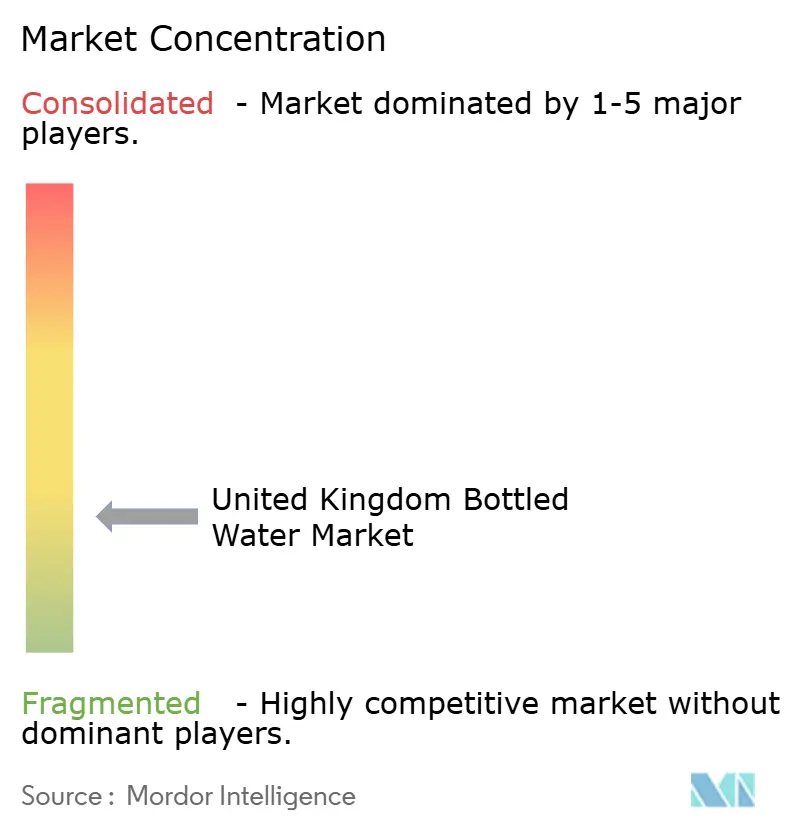
| Market Concentration | Low |
Major Players
*Disclaimer: Major Players sorted in no particular order Image © Mordor Intelligence. Reuse requires attribution under CC BY 4.0. |
|
United Kingdom Bottled Water Market Analysis by Mordor Intelligence
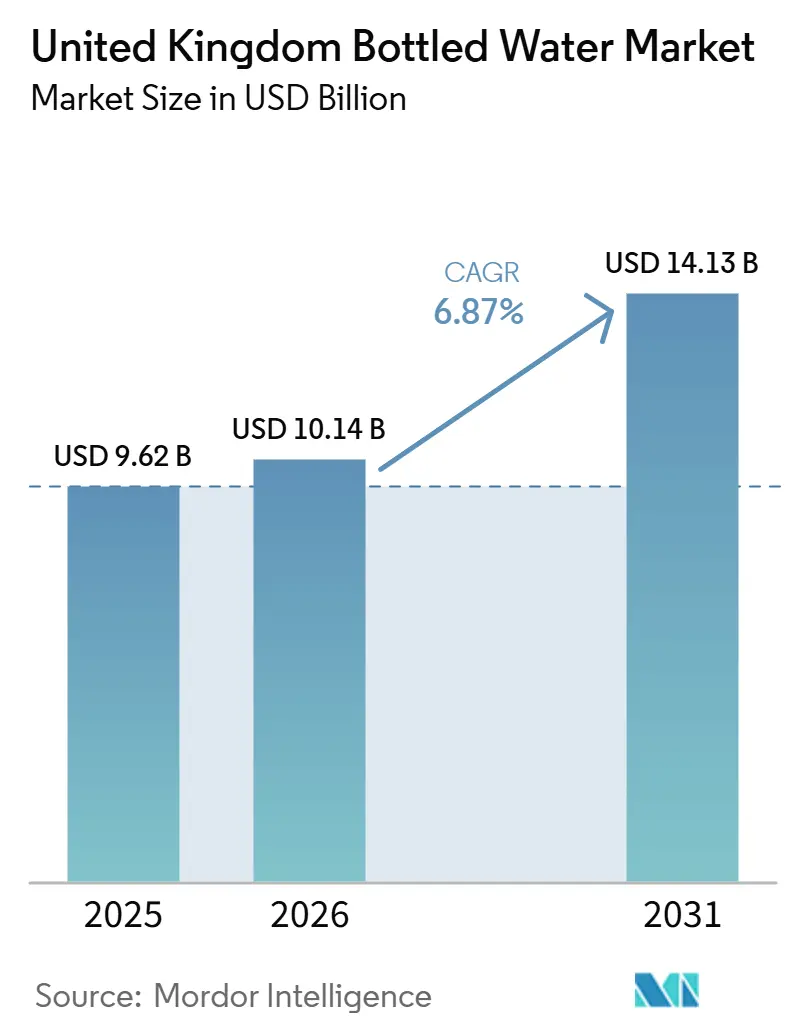
The United Kingdom bottled water market size is expected to grow from USD 9.62 billion in 2025 to USD 10.14 billion in 2026, and is forecast to reach USD 14.13 billion by 2031 at a 6.87% CAGR over 2026-2031. The United Kingdom bottled water market is a mature and steadily developing industry, supported by increasing consumer demand for healthier hydration options compared to sugary beverages. Rising still water consumption continues to drive market demand, while sparkling and functional/flavored water products are gaining traction among health-conscious consumers seeking premium and value-added offerings. Sustainability remains a key competitive priority, leading manufacturers to invest in 100% recycled, lightweight packaging, and aluminum cans to align with consumer expectations and environmental regulations. Strong retail penetration, combined with growth in foodservice and online distribution channels, continues to support market expansion across the country.
Key Report Takeaways
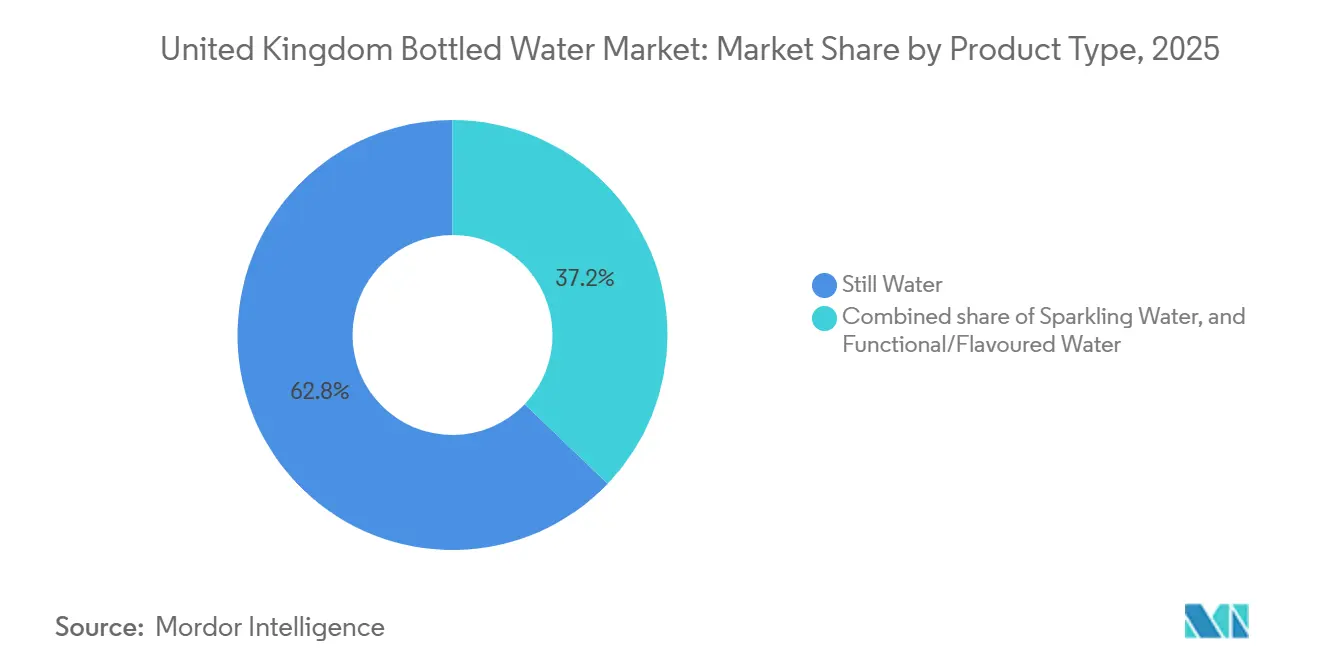
- By product type, still water led the United Kingdom bottled water market with a share of 62.83% in 2025, while functional/flavoured water is anticipated to register the fastest CAGR of 8.68% during 2026-2031.
- By packaging material, PET bottles retained 73.21% share in 2025, whereas glass bottles is forecast to expand at a 8.45% CAGR through 2031.
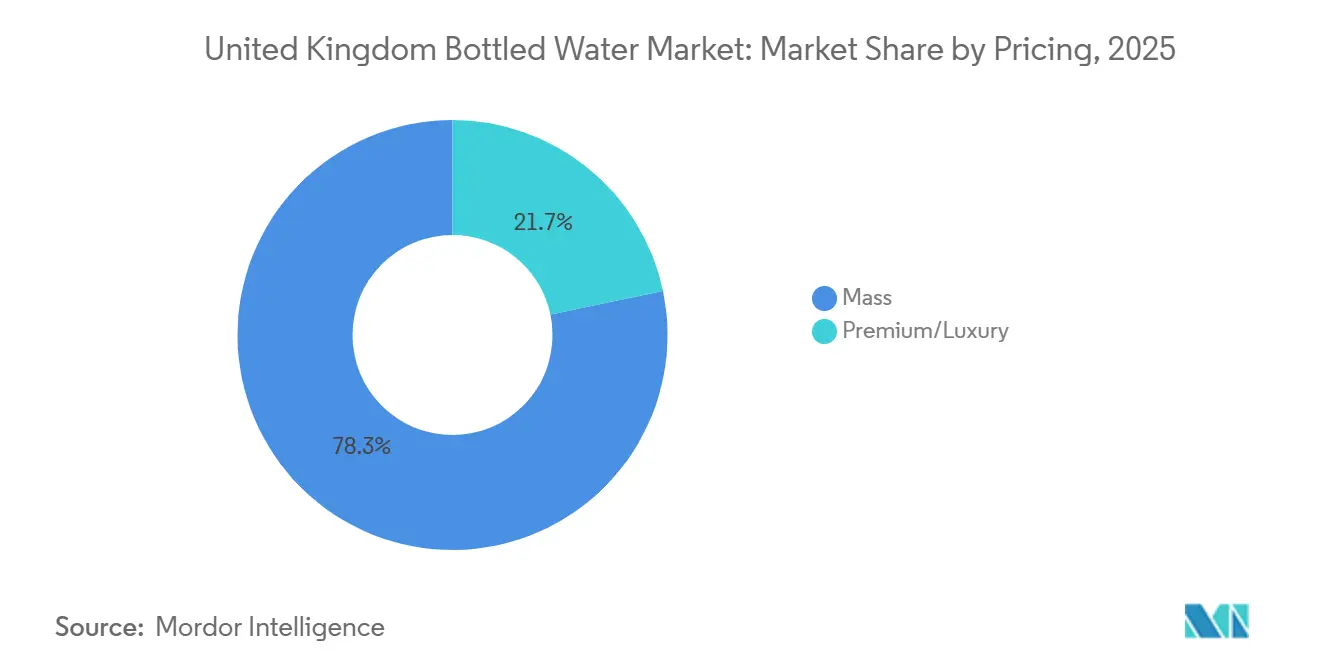
- By pricing, mass led the market with a 78.28% share in 2025, while premium/luxury is anticipated to register the fastest CAGR of 7.89% during 2026-2031.
- By distribution channel, off-trade led the market with a share of 87.22% in 2025, while on-trade is anticipated to register the fastest CAGR of 7.01% during 2026-2031.
Note: Market size and forecast figures in this report are generated using Mordor Intelligence’s proprietary estimation framework, updated with the latest available data and insights as of January 2026.
United Kingdom Bottled Water Market Trends and Insights
Drivers Impact Analysis*
| Driver | % Impact on CAGR Forecast | Geographic Relevance | Impact Timeline |
|---|---|---|---|
| Rising consumer preference for healthy hydration | +1.8% | Global, concentrated in England’s urban commuter and younger demographic groups | Long term (≥ 4 years) |
| Expansion of on-the-go consumption | +1.2% | Greater London and major urban centers across England, with spillover to Scotland | Medium term (2-4 years) |
| Expanding foodservice and premium hospitality recovery | +1.0% | England, especially London and the South East, and Scotland, especially Edinburgh and Glasgow | Medium term (2-4 years) |
| Sustainability driving packaging innovation | +0.8% | United Kingdom-wide, with early adoption in premium on-trade and direct-to-consumer channels | Medium term (2-4 years) |
| Premiumization of mineral, spring, and functional water | +0.7% | England and imports from France, Fiji, and other source markets | Long term (≥ 4 years) |
| Focus on purity, source transparency, and certified quality | +0.5% | United Kingdom-wide, with greater relevance where tap-water quality concerns are documented | Long term (≥ 4 years) |
| Source: Mordor Intelligence | |||
Rising consumer preference for healthy hydration
Growing health consciousness and initiatives to reduce sugar intake are encouraging consumers in the United Kingdom to replace carbonated soft drinks with bottled water. Increasing awareness of lifestyle-related health issues and growing demand for clean-label, low-calorie beverages are further supporting category growth. Manufacturers are also expanding their product portfolios with functional and flavored water to address evolving consumer preferences and premium hydration trends. Reflecting this shift, Danone Waters Europe is expected to report 9% value growth in the United Kingdom in 2025, driven by consumers substituting bottled water for sugary soft drinks. In addition, the United Kingdom Soft Drinks Industry Levy (Sugar Tax) continues to encourage consumers to choose low- and no-sugar beverages, further supporting bottled water consumption as a healthier hydration option.
Expansion of on-the-go consumption
Commuting, travel, leisure activities, and convenience shopping create frequent single-serve purchase occasions in the bottled water market in the United Kingdom. Transit corridors and high-footfall locations favor smaller packs that consumers can carry easily and consume immediately. In January 2026, Boost launched Boost Water+, a three-variant, zero-sugar electrolyte range priced at GBP 1 per 500 ml in convenience stores. The product is launched in three varieties: Citrus, Strawberry and Peach, and Cherry. This shift toward electrolyte and value-added products can improve revenue per purchase, but brands without convenience distribution may lose visibility in high-frequency locations.
Expanding foodservice and premium hospitality recovery
Restaurants, hotels, and bars increasingly use water selection, glass service, and local sourcing to enhance the customer experience. In July 2025, South Downs Natural Mineral Water signed a nationwide supply agreement with The Ivy Collection restaurants across the United Kingdom, citing its local supply chain, glass bottles, and source credentials. In the same year, a Michelin-starred Cheshire restaurant introduced a water menu, with bottles priced from GBP 5 to GBP 19. Hospitality demand can be more resilient than promotional retail demand because water forms part of the broader dining or accommodation experience. Belu Water received a GBP 110,085 contract to supply the United Kingdom Parliament in 2025, indicating that institutional buyers also prioritize sustainability and product quality. Hospitality demand may remain more resilient than promotional retail demand, as water forms part of the broader dining or accommodation experience.
Sustainability driving packaging innovation
Packaging sustainability has become both a brand requirement and a cost consideration in the United Kingdom bottled water market. The extended producer responsibility framework is set to come fully into force in January 2026 in the United Kingdom, introducing a plastic disposal fee of GBP 423 per tonne, compared with GBP 192 per tonne for glass. The framework also sets a 57% plastic recycling obligation for 2026[3]Source: Government of the United Kingdom, "Extended Producer Responsibility for Packaging," gov.uk. These regulations are expected to support investment in glass, aluminum, recycled polyethylene terephthalate (PET), and recyclable packaging designs, although glass remains heavier to transport. Manufacturers are taking initiatives to introduce bottled water in sustainable packaging. For instance, Belu uses United Kingdom-made glass bottles with at least 40% recycled content. Such actions remain important in premium hospitality and institutional tenders, where source protection and packaging credentials can influence supplier selection.
Restraints Impact Analysis*
| Restraint | (~) % Impact on CAGR Forecast | Geographic Relevance | Impact Timeline |
|---|---|---|---|
| Stringent plastic packaging regulations increase compliance costs | -1.2% | United Kingdom-wide, with a larger effect on high-volume PET producers in England | Short term (≤ 2 years) |
| High consumer confidence in tap water | -0.9% | United Kingdom-wide, with a stronger effect outside major urban areas | Long term (≥ 4 years) |
| Environmental concerns about plastic waste | -0.7% | United Kingdom-wide, particularly in coastal and environmentally conscious regional areas | Medium term (2-4 years) |
| Competition from refillable bottles and hydration systems | -0.6% | England and Scotland, especially among younger urban consumers | Medium term (2-4 years) |
| Source: Mordor Intelligence | |||
Stringent plastic packaging regulations increase compliance costs
Extended producer responsibility rules create a direct cost challenge for polyethylene terephthalate (PET)-intensive businesses in the United Kingdom bottled water market. Large producers face a plastic disposal fee of GBP 423 per tonne, while the plastic recycling obligation will rise from 57% in 2026 to 59% in 2027, according to the government of the United Kingdom. In addition, the Deposit Scheme for Drinks Containers, scheduled to begin in October 2027, will apply to PET bottles [2]Source: Department for Environment, Food & Rural Affairs, "Deposit Return Scheme" gov.uk, aluminum containers, and steel containers ranging from 150 ml to 3 liters. The scheme will introduce requirements for registration, labeling, deposits, and producer fees. Mid-sized producers may find these investments harder to absorb than larger companies with established recycling partnerships and recycled-material supply chains. In May 2025, Anglian Water will face a record GBP 1.42 million fine at Northampton Crown Court following a prosecution by the Drinking Water Inspectorate (DWI) over drinking water failures that affected around 1.3 million people [4]Source: Drinking Water Inspectorate, "Press Releases," dwi.gov.uk.
High consumer confidence in tap water
The widespread availability of safe, regulated, and affordable tap water continues to constrain the growth potential of the bottled water market in the United Kingdom. Many consumers depend on municipal drinking water for daily hydration, reducing the need for packaged water, particularly across households and workplaces. Increasing environmental awareness further supports this preference, as consumers adopt reusable water bottles filled with tap water to reduce single-use plastic waste. In addition, government initiatives that promote tap water consumption, along with the availability of free refill stations in public spaces, further limit reliance on bottled water. The Consumer Council for Water reported 90% overall satisfaction with water supply in 2025[1]Source: Consumer Council for Water, "Water Matters 2025," ccw.org.uk, indicating strong consumer confidence in the United Kingdom's public water infrastructure and its moderating impact on bottled water demand.
*Our forecasts treat driver/restraint impacts as directional, not additive. The impact forecasts reflect baseline growth, mix effects, and variable interactions.
Segment Analysis
By Product Type: Functional Water Outpaces a Mature Still Water Base
Still water accounted for 62.83% of the category value in 2025, maintaining its position as the largest product category. Its broad presence reflects private-label ranges, entry-price packs, supermarket distribution, and convenience formats. Sparkling water occupies a position between mass-market still water and higher-value imported mineral products. Premium imported waters in glass bottles and domestic branded sparkling products support this category across restaurants and retail channels. Functional and flavored water is forecast to grow at a CAGR of 8.68% from 2026 to 2031, making it the fastest-growing product type. This growth provides the United Kingdom bottled water market with an opportunity to serve hydration occasions that extend beyond basic thirst.
The functional and flavored category is gaining shelf space through fruit-infused, botanical, vitamin-enhanced, and electrolyte products. Brands position these formats for morning routines, gym visits, commutes, and post-exercise consumption. In July 2026, Highland Spring expanded its flavored still water portfolio by introducing Orange and Passion Fruit and Summer Berries flavors in the United Kingdom market, supported with a GBP 3.6 million campaign. As a result, established spring water brands in the United Kingdom bottled water industry are treating flavor as a central portfolio priority.



By Packaging Material: EPR Compliance Accelerates the Shift to Glass
PET bottles accounted for 73.21% of category value in 2025, as they remain affordable, lightweight, and convenient. The format is well suited for supermarket, convenience, travel, and immediate-consumption purchases. However, disposal fees, recycling obligations, and rising demand for more visible sustainability credentials are affecting its position. Glass bottles are forecast to grow at a CAGR of 8.45% through 2031. Premium table service and the lower GBP 192-per-tonne disposal fee compared to plastic support the United Kingdom bottled water market size for glass.
Glass fits well in applications where product presentation, local provenance, and perceptions of returnable quality matter. Belu’s Parliament contract and Hildon’s presence in luxury hotels highlight its relevance in high-service settings. Aluminum cans and bottles are also gaining traction in functional and flavored formats, as these packs align naturally with energy drinks and soft drinks. The recyclability assessment approach could reduce fees for green-rated glass formats from the second year of the system. However, the higher weight of glass remains a transport and handling challenge. Producers must therefore balance fee exposure, material recovery, retail use, and the cost of supplying each format.
By Pricing: Mass Dominates but Premium Products Capture Value Growth
Mass-priced products accounted for 78.28% of the United Kingdom bottled water market size in 2025. High retail turnover, private-label competition, promotional pricing, and low unit margins define the segment. It serves the category’s basic hydration needs across supermarkets and convenience outlets. Its large customer base provides scale. Premium and luxury bottled water are forecast to register a 7.89% CAGR through 2031. This growth is linked to demand from the hospitality industry, certified sources, imported mineral water brands, and functional products sold at higher price points.
Premium water relies more on brand positioning, source credentials, and packaging than on the cost of extracted water. In April 2026, Danone committed EUR 20 million to upgrade the Evian bottling facility and EUR 8 million to preserve sites for Volvic, Badoit, and La Salvetat. The supplied material stated that Coca-Cola paid GBP 6,070 per year for rights to extract up to 674 million liters from a Northumberland aquifer. These differences make packaging, source assurance, and customer perception central to premium value creation. The United Kingdom bottled water market can support trade-up when producers build a distinct product proposition rather than compete only on shelf price.
By Distribution Channel: Off-Trade Scale and On-Trade Value Migration
Off-trade channels represented 87.22% of the category value in 2025. Supermarkets and hypermarkets account for the largest volumes, supported by private-label ranges, promotions, and broad pack availability. Convenience stores contribute immediate-consumption sales, particularly for small bottles and functional formats. Online retail remains the fastest-growing off-trade subchannel, as health-focused households increasingly use delivery and repeat ordering. Home and office delivery may also benefit from hybrid work and employer interest in workplace hydration.
On-trade channels are forecast to grow at a 7.01% CAGR through 2031. Restaurants, hotels, and bars can sell premium glass bottles with less direct price comparison than retail shelves. South Downs Water’s 2025 agreement with The Ivy Collection and Belu’s Parliament supply contract in 2025 highlight this opportunity. In July 2026, Highland Spring used a summer campaign to reach 23 million on-the-go shoppers. This activity increases the cost of capturing consumer attention at convenience and impulse locations. Smaller brands can still compete in hospitality, where a clear local source and suitable service format matter more than nationwide retail scale.
Geography Analysis
England accounts for the largest share of bottled water consumption in the United Kingdom, supported by its large population base, major transit networks, and concentrated hospitality sector. London and the South East drive a high volume of premium purchases across restaurants, hotels, and travel channels. Hard-water areas in London can affect taste perception, supporting demand for spring water and filtered alternatives. Greater London also serves as a launch market for water menus, glass-bottle service, and artisanal brands before these formats expand more widely. Brighton, Bristol, Manchester, and Leeds show demand for glass and aluminum packaging that aligns with local sustainability preferences.
Scotland plays a central role in the United Kingdom bottled water market as a source region for recognized spring-water brands. The Ochil Hills, Cairngorms, and other Highland aquifers support a strong domestic production base. Scotland’s protected natural environments support a source-quality proposition that producers in more industrial water-sourcing locations find difficult to replicate.
Wales and Northern Ireland account for a smaller share of consumption but contribute brands with strong positioning in hospitality and institutional channels. Belu is sourced from mid-Wales, is expected to become fully owned by the Belu Foundation in 2025, and donateed GBP 371,204 to WaterAid during in 2025. Its Parliament contract highlights the role of purpose-led purchasing in the United Kingdom bottled water market. Antrim Hills and Crag Spring Water demonstrate the appeal of location-specific products at higher hospitality price points. Sources in Wales, Northern Ireland, and the Scottish Highlands give domestic producers a credible response to increased scrutiny of origin and water stewardship.
Competitive Landscape
The United Kingdom bottled water market remains fragmented across multinational groups, domestic spring-water companies, social enterprises, and smaller artisanal producers. Nestlé Waters United Kingdom sells Buxton and Pure Life in July 2026, while Danone’s portfolio includes Volvic, Harrogate, and Evian. No player controls the category to the extent seen in some adjacent beverage categories. This structure gives retailers and hospitality buyers multiple sourcing options across price points. It also makes brand identity, source provenance, packaging, and route-to-market access important competitive tools.
Boost launched Boost Water+, a range of zero-sugar water with electrolytes, exclusively in convenience stores in January 2026. Available in Citrus, Strawberry and Peach, and Cherry varieties, the range aims to bridge the “gap between flavored and functional water". Nestlé’s Buxton site has Alliance for Water Stewardship platinum certification, giving the brand a relevant credential for sustainability-led procurement. In April 2026, Highland Spring expanded its flavored still water portfolio with the launch of Orange and Passionfruit and Summer Berries variants. These actions show how established producers are pursuing growth through formats and branding, rather than relying only on core still water.
Belu differentiates itself through charity ownership, certified provenance, glass packaging, and direct support for WaterAid. This model has helped the company address institutional opportunities that require measurable sustainability standards. Hildon, Crag Spring Water, and South Downs Water are strengthening their positions in premium hospitality, where margins are higher and national supermarket scale is less critical. The United Kingdom bottled water market remains open to specialist brands, but their success depends on a clear source story, appropriate packaging choices, and sustained distribution execution.
United Kingdom Bottled Water Industry Leaders
-
The Coca‑Cola Company
-
Danone
-
Highland Spring Limited
-
Harrogate Water Brands
-
Nestlé S.A.
- *Disclaimer: Major Players sorted in no particular order

Recent Industry Developments
- July 2026: Nestle spun out its Buxton and Perrier water business to create a joint venture valued at around EUR 4.9 billion. The Swiss company agreed to a deal with private equity firm Platinum Equity to establish a new company, Peranel, in which each party will hold a 50% stake. The joint venture will include more than 30 brands, including Nestlé’s water brands, such as S.Pellegrino, Perrier, Buxton, and Acqua Panna, as well as its hydration drinks and the global Nestlé Pure Life brand.
- April 2026: Danone announced a new EUR 20 million investment to modernize the evian bottling facility, improving production efficiency, sustainability, and innovation capabilities.
- February 2026: Highland Spring Group partnered with the Woodland Trust to fund woodland creation and restoration across 1,200 hectares of conservation land at Glen Devon Woodlands in the Ochil Hills, Perthshire. The partnership reinforces the brand's nature-positive supply chain commitments and supports the protection of the source environment surrounding its spring.
- January 2025: The Carlsberg Group announced that its wholly owned subsidiary, Carlsberg United Kingdom Holdings Limited, completed the acquisition of Britvic plc, a leading international soft drinks business, to create a single integrated beverage company in the United Kingdom. The combined business, including the Aqua Libra brand, will operate as Carlsberg Britvic.


United Kingdom Bottled Water Market Report Scope
Bottled water comprises potable water packaged in sealed containers for human consumption. The category includes still, sparkling, and functional/flavored water sourced from natural springs, mineral sources, groundwater, or purified water, and distributed through on-trade and off-trade channels.
The United Kingdom bottled water market is segmented by product type, packaging material, pricing, and distribution channel. By product type, the market is segmented into still water, sparkling water, and functional/flavoured water (vitamin-enhanced, electrolyte/sports, botanical/fruit-infused). By packaging material, the market is segmented into PET bottles, glass bottles, aluminium cans and bottles, and others. By pricing, the market is segmented into mass and premium/luxury. By distribution channel, the market is segmented into on-trade and off-trade. The market forecasts are provided in terms of value (USD) and volume (Liters).
| Still Water | |
| Sparkling Water | |
| Functional/Flavoured Water | Vitamin-Enhanced |
| Electrolyte/Sports | |
| Botanical/Fruit-Infused |
| PET Bottles |
| Glass Bottles |
| Aluminium Cans and Bottles |
| Others |
| Mass |
| Premium/Luxury |
| On-Trade | |
| Off-Trade | Supermarkets/Hypermarkets |
| Convenience/Grocery Stores | |
| Home and Office Space | |
| Online Retail | |
| Other Off-Trade Channels |
| By Product Type | Still Water | |
| Sparkling Water | ||
| Functional/Flavoured Water | Vitamin-Enhanced | |
| Electrolyte/Sports | ||
| Botanical/Fruit-Infused | ||
| By Packaging Material | PET Bottles | |
| Glass Bottles | ||
| Aluminium Cans and Bottles | ||
| Others | ||
| By Pricing | Mass | |
| Premium/Luxury | ||
| By Distribution Channel | On-Trade | |
| Off-Trade | Supermarkets/Hypermarkets | |
| Convenience/Grocery Stores | ||
| Home and Office Space | ||
| Online Retail | ||
| Other Off-Trade Channels | ||


Key Questions Answered in the Report
What is the projected size of the United Kingdom bottled water market by 2031?
The United Kingdom bottled water market is projected to reach USD 14.13 billion by 2031, growing from USD 9.62 billion in 2025.
What is the expected CAGR of the United Kingdom bottled water market during 2026–2031?
The market is forecast to grow at a CAGR of 6.87% between 2026 and 2031.
Which product type held the largest share of the United Kingdom bottled water market in 2025?
Still water was the leading product type segment in 2025, accounting for 62.83% of the market share.
Which packaging material dominated the United Kingdom bottled water market in 2025?
PET bottles dominated the market in 2025, holding a 73.21% share.
Which pricing category accounted for the largest share of the United Kingdom bottled water market in 2025?
The mass pricing segment led the market in 2025, representing 78.28% of total sales.
Which distribution channel held the largest market share in 2025?
The off-trade channel dominated the market in 2025, accounting for 87.22% of total market revenue.
Page last updated on:





