
Market Overview
| Study Period | 2021 - 2031 |
|---|---|
| Forecast Data Period | 2026 - 2031 |
| Base Year Market Size (2025) | USD 5.44 Billion |
| Market Size (2026) | USD 5.80 Billion |
| Market Size (2031) | USD 7.96 Billion |
| Growth Rate (2026 - 2031) | 6.54 % |
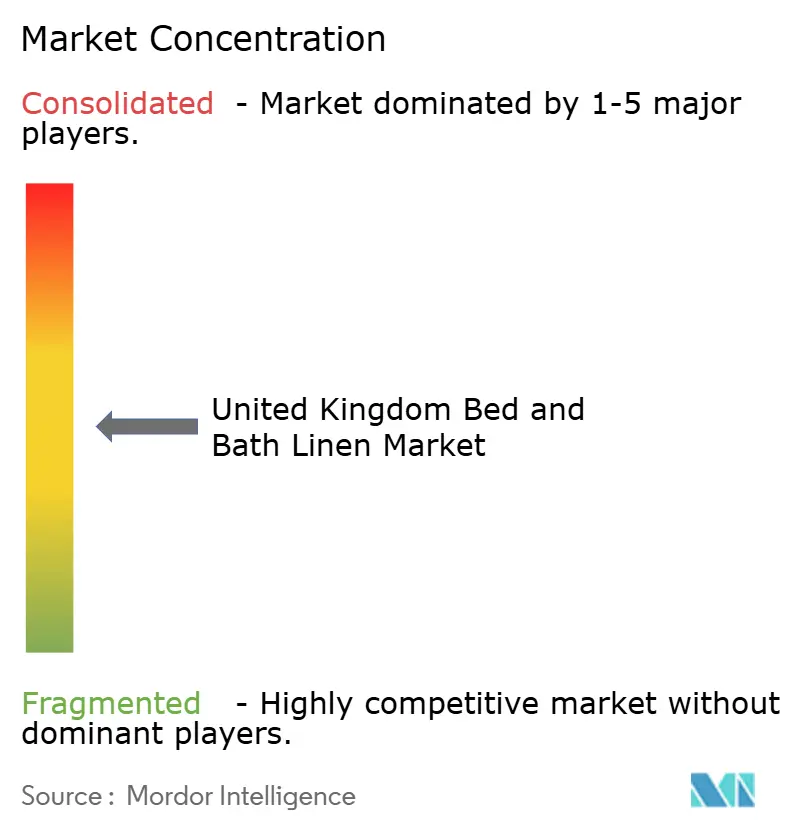
| Market Concentration | Medium |
Major Players *Disclaimer: Major Players sorted in no particular order Image © Mordor Intelligence. Reuse requires attribution under CC BY 4.0. | |
United Kingdom Bed and Bath Linen Market Analysis by Mordor Intelligence
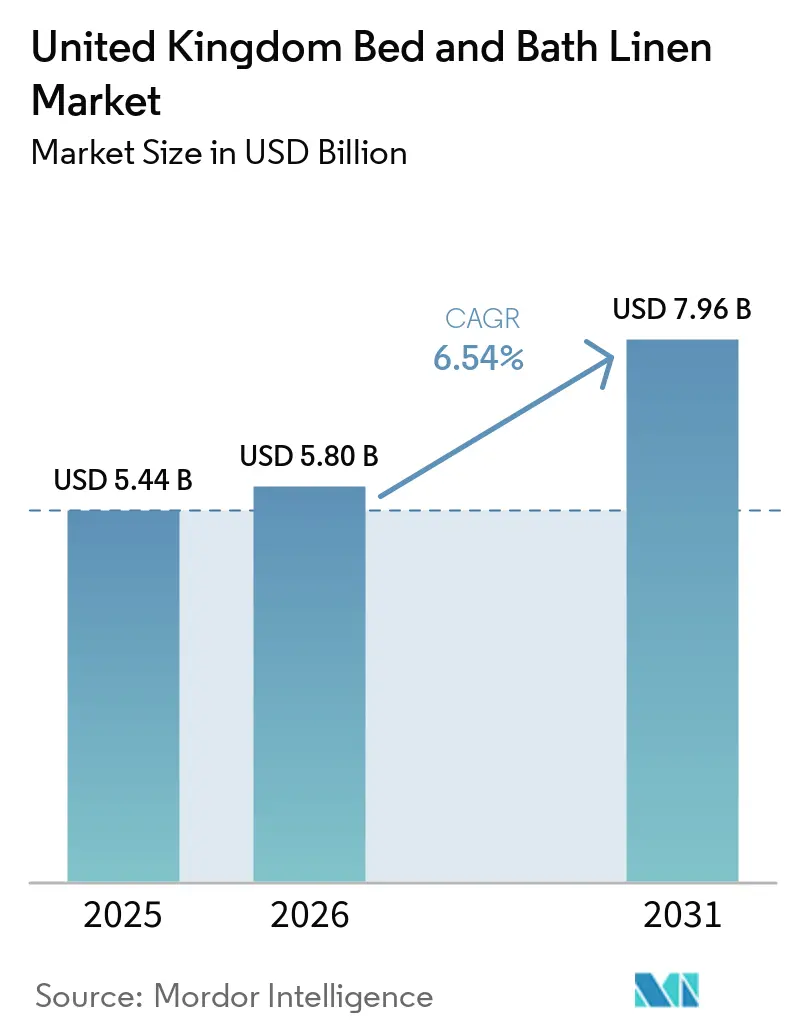
United Kingdom bed and bath linen market size in 2026 is estimated at USD 5.8 billion, growing from a 2025 value of USD 5.44 billion, with 2031 projections showing USD 7.96 billion, growing at a 6.54% CAGR over 2026-2031. The United Kingdom bed and bath linen market is supported by sustained home-improvement activity, increasing hospitality investments, and a growing preference for sustainable and premium fabrics. Consumers are increasingly upgrading bedding and towels as part of home renovation and décor improvements, creating replacement demand across value and premium product categories. The expansion of the luxury hotel pipeline further strengthens commercial demand, as hospitality operators prioritize durable, high-quality, and sustainably sourced linens. E-commerce is also reshaping purchasing behavior by providing wider product assortments, convenient delivery, personalized recommendations, and enhanced product visualization. Meanwhile, growing consumer awareness of environmental issues is encouraging adoption of organic cotton, recycled fibers, and circular take-back programs. On the commercial side, stricter hygiene requirements from healthcare facilities and hospitality operators are supporting demand for performance-oriented linens with antimicrobial, durable, and easy-care properties. These trends collectively encourage product innovation, premiumization, omnichannel distribution, and sustainable sourcing across the market.
Key Report Takeaways
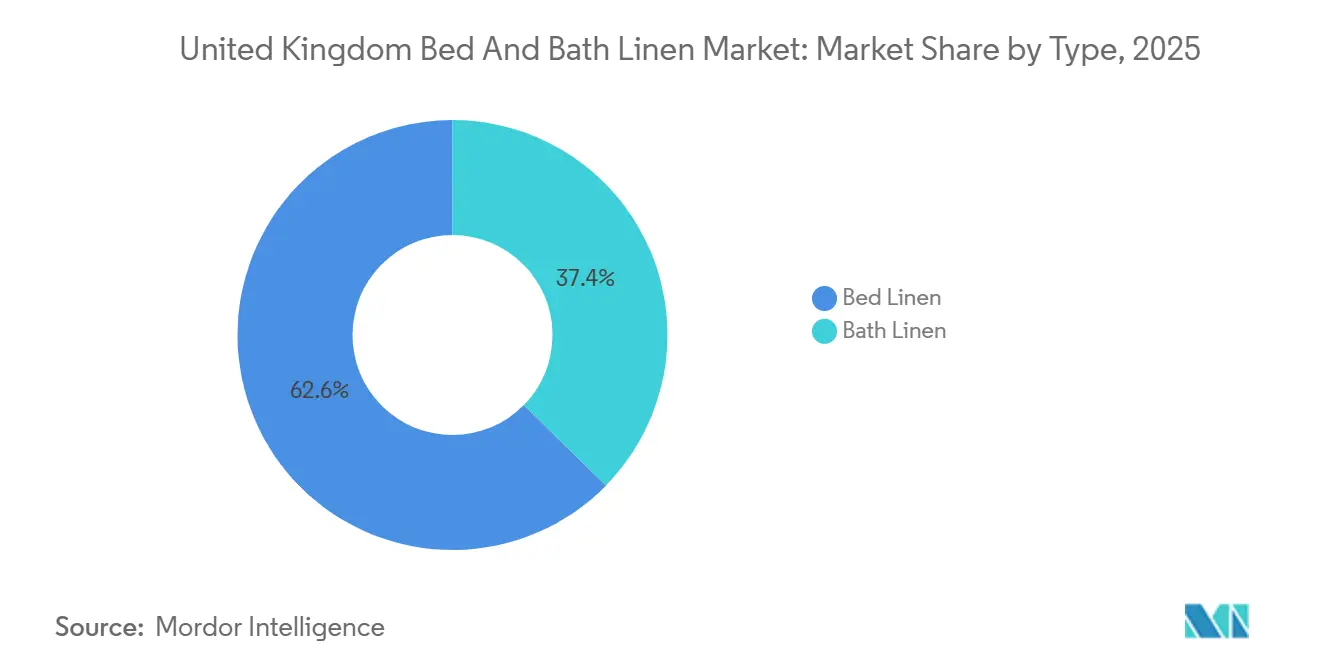
- By product type, bed linen led with 62.65% of the United Kingdom Bed and Bath Linen Market share in 2025; bath linen is forecast to expand at a 7.18% CAGR through 2031.
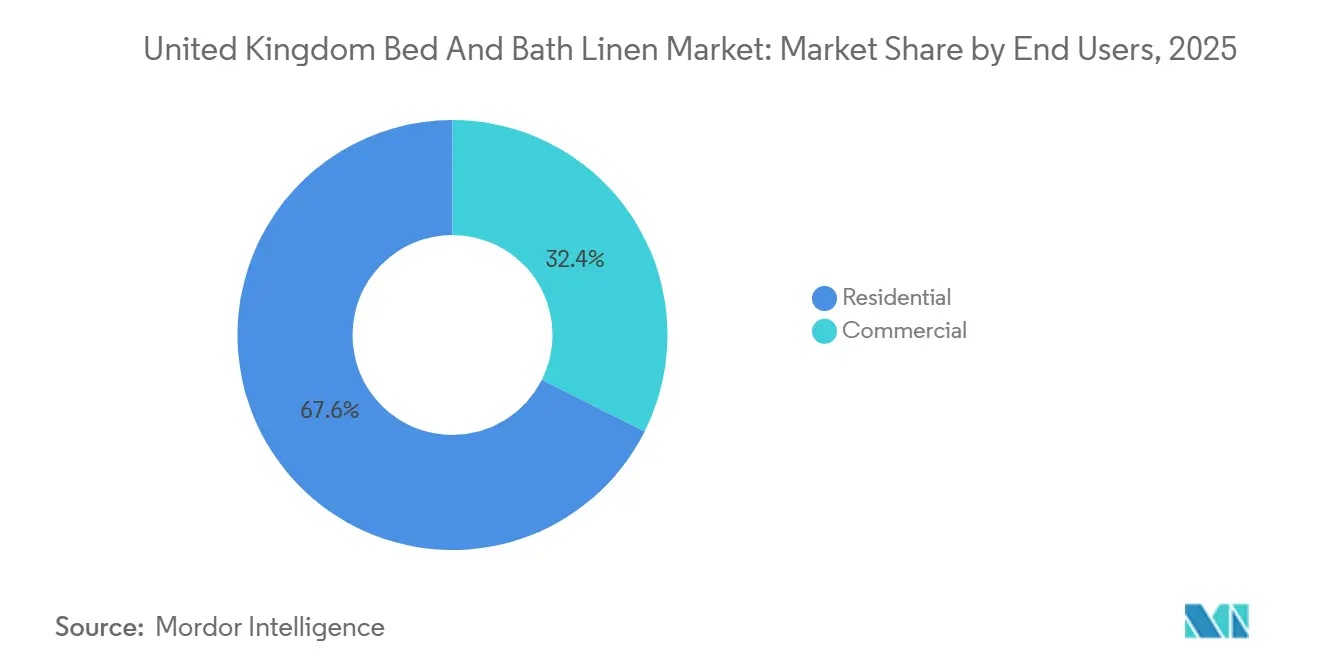
- By end-users, the residential segment captured 67.60% of the United Kingdom Bed and Bath Linen Market share in 2025; the commercial segment is projected to advance at a 7.10% CAGR between 2026 and 2031.
- By distribution channel, hypermarkets and supermarkets contributed 37.75% of the United Kingdom Bed and Bath Linen Market share in 2025, and sales from e-commerce are expected to accelerate at a 10.15% CAGR in the same period.
- By geography, England accounted for 78.90% of the United Kingdom's Bed and Bath Linen Market share in 2025, and Scotland is set to grow fastest with a 7.35% CAGR to 2031.
Note: Market size and forecast figures in this report are generated using Mordor Intelligence’s proprietary estimation framework, updated with the latest available data and insights as of 2026.
Market Trends and Insights
Drivers Impact Analysis of United Kingdom Bed and Bath Linen Market*
| Driver | (~) % Impact on CAGR Forecast | Geographic Relevance | Impact Timeline |
|---|---|---|---|
| Post-pandemic home renovation boom | 1.0% | National, with higher impact in England and Wales | Medium term (2-4 years) |
| Expansion ofUnited Kingdomluxury hotel pipeline | 0.8% | National, concentrated in England and Scotland | Medium term (2-4 years) |
| E-commerce share gains in home textiles | 1.2% | National, with stronger adoption in urban areas | Long term (≥ 4 years) |
| Consumer shift to sustainable & organic fabrics | 0.7% | National, led by England and Scotland | Long term (≥ 4 years) |
| NHS infection-control protocols for healthcare linens | 0.5% | National, concentrated in England | Short term (≤ 2 years) |
| Early adoption of smart bedding technology | 0.4% | England and Scotland, limited Wales/Northern Ireland | Long term (≥ 4 years) |
| Source: Mordor Intelligence | |||
Post-pandemic Home Renovation Boom
Households continue to funnel discretionary income into home upgrades that include higher-quality sheets, duvets, and towels as lifestyles remain more home-centric. Retail footfall data show that linen categories sustained mid-single-digit volume growth in 2024 even after lockdowns ended[2]. Consumers who initially purchased budget bedding during supply constraints are now trading up to organic cotton and premium thread counts, driving average selling prices. Big-box chains leverage bundled bedroom sets to capture this upgrade cycle, while specialty e-tailers rely on customizable design tools to convert browsers into repeat buyers. The trend is most pronounced among owners of recently renovated properties, where coordinated linens become finishing touches that elevate interior aesthetics. Ongoing DIY activity, therefore, acts as a reliable spur to replacement demand across both value and premium segments.
Expansion of United Kingdom Luxury Hotel Pipeline
Hospitality operators have announced or opened thousands of high-end rooms that require premium linen specifications, supporting a stable base of institutional demand. IHG alone added more than 900 United Kingdom and Ireland rooms in 2024 and specified higher thread counts to boost guest satisfaction metrics[3]. Hoteliers now see linens as a cost-effective differentiator for revenue per available room, prompting supply contracts with strict durability and sustainability clauses. Forward bookings for heritage properties under renovation signal continued appetite for upscale accommodation, especially in London and Edinburgh. As each luxury bed set typically includes multiple sheets, duvet covers, and pillow protectors, procurement volumes compound quickly, benefiting suppliers able to meet stringent delivery windows. The pipeline expansion therefore provides a predictable offtake that helps manufacturers smooth volatility in consumer channels.
E-commerce Share Gains in Home Textiles
Digital migration reshapes purchasing habits as improved imagery, same-day delivery in major cities, and no-quibble return policies overcome the traditional need to feel fabrics in-store. Online linen sales rose to 37% of Dunelm’s revenue in fiscal 2024, doubling their share from 2020. Artificial-intelligence search tools and augmented-reality visualization help customers match colors to bedroom décor, lifting conversion rates. Marketplaces and direct-to-consumer brands exploit lower overhead to undercut brick-and-mortar pricing without sacrificing margins. For rural consumers, e-commerce extends the range of styles beyond what local retailers carry, further accelerating digital uptake. Logistics partners expand capacity ahead of bank-holiday promotions, ensuring that delivery speed remains a differentiator as channels converge.
Consumer Shift to Sustainable & Organic Fabrics
Eco-conscious shoppers scrutinize origin certificates and water usage, pushing organic cotton and recycled blends into mainstream assortments. Royal College of Art research shows circular design could halve textile sector emissions by 2030 if widely adopted[4]. Retailers respond with in-aisle QR codes that trace farm-to-shelf supply chains, boosting transparency. Pricing premiums for organic bedding remained resilient despite cost-of-living headwinds, indicating strong value attribution to environmental attributes. Brands launching linen take-back schemes find improved customer loyalty and incremental sales upon voucher redemption for returned goods. This green pivot pressures conventional manufacturers to invest in water-saving dyeing and renewable energy usage to keep pace with evolving buyer expectations.
Restraints Impact Analysis of United Kingdom Bed and Bath Linen Market*
| Restraint | (~) % Impact on CAGR Forecast | Geographic Relevance | Impact Timeline |
|---|---|---|---|
| Volatility in global cotton and flax prices | -0.8% | National, affecting all regions | Short term (≤ 2 years) |
| Influx of low-cost Asian imports driving price wars | -0.5% | National, concentrated in England | Medium term (2-4 years) |
| Post-Brexit customs documentation delays | -0.3% | National, with higher impact on importers | Short term (≤ 2 years) |
| Skilled-labour shortages United Kingdom textile mills | -0.3% | England and Wales, limited Scotland/Northern Ireland | Medium term (2-4 years) |
| Source: Mordor Intelligence | |||
Volatility in Global Cotton and Flax Prices
Cotton futures swung between USD 0.70 and USD 0.80 per pound in 2024 because of weather shocks and trade disruptions, compressing margins for import-reliant United Kingdom mills. Spot price uncertainty deters long production runs, forcing retailers to hold higher safety stock or hedge with synthetic substitutes. Currency fluctuations since Brexit amplify raw-material cost swings when converting invoices denominated in USD or EUR. Some suppliers pivot to recycled fibers to mitigate exposure, yet supply volumes remain insufficient for wide-scale substitution. Retailers, therefore, use dynamic pricing engines, passing part of the spike to consumers but risking demand elasticity in value tiers. Abrupt input cost reversals also create inventory valuation risks, complicating promotional planning.
Influx of Low-Cost Asian Imports Driving Price Wars
Asian manufacturers leverage scale and wage advantages to supply entry-level linens at price points domestic producers cannot match. Value-tier retailers intensify promotional frequency, eroding margins across the chain. Quality-conscious consumers sometimes report premature wear and dye bleed on imported items, handing opportunities to local brands that highlight British craftsmanship. Yet tariffs remain low, so import penetration holds above 65% in volume terms. Domestic mills focus on quick-turn and bespoke production to avoid direct price competition, but capacity limitations restrict market share recapture. Sustained pressure from imports thus restrains average selling price growth even as premium sub-segments expand.
*Our forecasts treat driver/restraint impacts as directional, not additive. The impact forecasts reflect baseline growth, mix effects, and variable interactions.
United Kingdom Bed and Bath Linen Market Segment Analysis
By Type:
Bed Linen Dominance Faces Bath Linen AccelerationBed linen accounts for 62.65% of 2025 revenue, underlining the category’s entrenched role in household refresh cycles that align with seasonal promotions and gifting peaks. The United Kingdom bed and bath linen market share concentration in bed sheets is reinforced by robust private-label programs at grocery chains, which entice shoppers seeking one-stop convenience. However, the United Kingdom bed and bath linen market is witnessing faster unit growth for bath towels and robes as hospitality buyers replace stock more frequently to meet infection-control standards. Commercial purchase orders often stipulate higher GSM weights and antimicrobial finishes, raising value per unit and supporting supplier margins. At the premium end, spa-like towel sets marketed through social media influencers stimulate cross-selling opportunities for coordinated floor mats and shower curtains. Conversely, bed linen innovation focuses on thermoregulation and moisture wicking, as seen in temperature-controlled mattress covers that command triple the average price of conventional bedding.
The United Kingdom bed and bath linen market size for bath linen is projected to swell at a 7.18% CAGR, exceeding the 6.03% pace forecast for bed linen, evidence that product diversification is reshaping strategic portfolios. Hospitality refurbishment cycles amplify bath linen volumes because each guest room requires multiple towel sizes, hand towels, and bathmats. Manufacturers able to pre-treat towels for chlorine resistance gain a competitive edge among institutional laundries that cycle items hundreds of times. Meanwhile, retailers harness color-story merchandising to upsell complete bathroom makeovers, bundling towels with matching shower curtains and accessories to lift basket value. Supply chain investments in low-liquor-ratio dyeing reduce water use, aligning with sustainability messaging and lowering operational costs. Overall, the dual-speed trajectory between bed and bath segments demands agile inventory management and tailored marketing to avoid overstocks in slower-moving SKUs.

By End Users:
Residential Leadership Amid Commercial AccelerationResidential customers captured 67.60% of 2025 turnover thanks to lingering home-centric lifestyles and a millennial cohort entering peak household-formation years. The United Kingdom bed and bath linen market benefits from consumers viewing bedding as both a functional necessity and a décor statement, raising willingness to pay for organic cotton and higher thread counts. Yet commercial institutions from luxury hotels to NHS facilities are set to outpace households with a 7.10% CAGR by 2031 as hospitality occupancy climbs toward pre-pandemic norms. Institutional contracts often include multi-year replenishment clauses, offering predictable volumes that help mills optimize capacity. However, price concessions demanded by public procurement frameworks pressure margins unless suppliers differentiate on performance features. Residential channels, by contrast, allow richer storytelling around wellness and sustainability, cushioning against discounting cycles.
The United Kingdom bed and bath linen market size allocated to commercial buyers rests on repeat purchase frequency rather than initial order magnitude, so supplier responsiveness and compliance credentials often trump brand recognition. Healthcare providers demand detailed laundering instructions and product-life certifications, tightening the tendering gate. Hotel groups, meanwhile, embed linen quality into brand standards, making supplier switches less common once approved. For residential shoppers, impulse buys in grocery aisles and online flash sales create volatile demand spikes that test fulfillment agility. Consequently, companies with dual-channel strategies hedge cyclical swings, cross-leveraging production runs to serve both consumer and institutional specifications with minimal changeovers. This balanced exposure supports stable EBITDA despite sectoral shocks.
By Distribution Channel:
Traditional Retail Resilience Amid Digital DisruptionHypermarkets and supermarkets preserved a 37.75% share in 2025 due to high shopper frequency and attractive price points, confirming brick-and-mortar relevance in linens. The United Kingdom bed and bath linen market nonetheless tilts increasingly toward clicks as e-commerce records a 10.15% CAGR, winning younger demographics who rely on reviews and next-day delivery. Grocery chains respond by integrating QR-based virtual shelves that extend assortments beyond on-site space constraints, thereby defending share. Specialty stores differentiate through curated ranges and tactile experiences, but footfall recovery remains uneven, especially outside prime high-street locations. At the same time, marketplace operators weaponize data analytics to personalize offers and compress search costs, raising conversion and average order value. Return-rate management for texture-sensitive items improves through easy-wash product descriptors and 360-degree imagery.
The United Kingdom bed and bath linen market share captured by brick-and-mortar retailers could erode if digital payment adoption accelerates further among older cohorts, yet physical outlets still play a pivotal role in omnichannel fulfillment. Click-and-collect services accounted for one-third of online linen orders in 2024 at leading homeware chains. This hybrid model lowers last-mile costs and drives incremental in-store purchases. Hypermarkets invest in in-aisle digital kiosks that let shoppers browse extended catalogs without leaving the store, blending convenience with instant gratification. E-tailers experiment with subscription models supplying fresh towels every quarter, smoothing revenue and reinforcing customer loyalty. Overall, channel boundaries blur as retailers chase seamless customer journeys while mitigating logistical spend.
Geography Analysis
England contributed 78.90% of the 2025 value owing to dense population centers, higher disposable incomes, and a concentration of luxury hotels that demand premium linens. The United Kingdom bed and bath linen market size in England benefits from integrated supply networks centered around the Midlands logistics corridor, enabling next-day delivery across most postcodes. London’s design-savvy consumers drive premiumization trends that ripple out to regional cities via social media influence. Scotland, though smaller, delivers the fastest growth at a 6.05% CAGR on tourism revival and public-sector infrastructure projects that boost hospitality linen demand. Wales and Northern Ireland experience steadier but modest advances tied to demographic changes and value positioning among retailers.
Regional disparities in household income shape SKU mix: Southeast England leans toward organic Egyptian cotton, while parts of Wales favor polyester-cotton blends that meet price thresholds. Transport costs increase toward peripheral regions, encouraging retailers to site micro-fulfillment hubs to maintain service levels. Scottish textile mills tap governmental innovation grants to modernize looms, enabling faster turnaround and bespoke tartan designs that resonate with local heritage initiatives. Northern Ireland leverages unfettered intra-UK trade routes to mitigate Brexit customs friction, steadying import flows of raw fabrics. The United Kingdom bed and bath linen market share for England is expected to settle slightly lower by 2031 as faster-growing regions nibble at its dominance, yet absolute gains remain largest there because of scale.
Regulatory Landscape
The UK bed and bath linen market operates under product-safety and labeling rules that govern consumer-facing claims and retailer due diligence. The General Product Safety Regulations 2005 set the baseline requirement that only safe products are placed on the Great Britain market, while the Textile Products (Labelling and Fibre Composition) Regulations 2012 govern fibre composition declarations used across bedding and towel assortments in stores and online.
For furnishings used in certain applications, fire-safety requirements influence material and finishing choices and increase the value of test evidence and traceability across supply partners. A compliance change took effect on 30 October 2025 when The Furniture and Furnishings (Fire) (Safety) (Amendment) Regulations 2025 came into force, removing the requirement for display (swing) labels on domestic upholstered furniture and extending the window for enforcement authorities to bring proceedings from 6 to 12 months under the Consumer Protection Act framework. This lengthens the period of compliance exposure for suppliers and retailers that maintain product records.
Value Chain Analysis
The value chain runs from fibre and yarn sourcing (cotton, linen/flax, and blends) through fabric formation and finishing (dyeing, printing, and anti-microbial or performance finishes for commercial towels), cut-and-sew assembly, and packaging and labeling. Distribution then moves through hypermarkets and supermarkets, specialty home retailers, and e-commerce. Because the market is import-reliant for both raw materials and finished goods, international suppliers and freight forwarders play a larger role, and customs compliance and product documentation become critical for UK retail listings.
Technical compliance and sustainability programs are supported by UK-based testing, certification, and industry bodies that retailers and commercial buyers refer to in tendering. Organizations such as the Furniture Industry Research Association (FIRA) provide technical guidance for the wider furnishings ecosystem, while the Furniture Industry Sustainability Programme (FISP, established in 2006) is used as a sustainability benchmark across furnishings supply chains. Upstream engagement is also supported by trade associations including the British Furniture Confederation and the British Furniture Association. Downstream, logistics increasingly combines home delivery with click-and-collect and reverse logistics to manage returns and circular takeback pilots for end-of-life textiles.
Competitive Landscape
The United Kingdom bed and bath linen market is moderately fragmented, with the top five companies collectively holding a significant portion of the market. This creates opportunities for both large-scale growth and specialized niche strategies. Dunelm stands out as the market leader, demonstrating the strength of its omnichannel approach and focus on value. At the higher end of the market, The White Company has established a strong presence by emphasizing luxury and direct-to-consumer sales. Together, these players illustrate the diverse ways brands can succeed in a competitive landscape. Competitive dynamics are increasingly shaped by supply chain resilience and sustainable sourcing, as consumers demand ethical manufacturing and environmentally responsible practices.
Post-Brexit customs complexities are providing an edge to domestic players and seasoned importers with robust logistics and compliance infrastructure. These changes create barriers for smaller international entrants who lack documentation proficiency and customs experience. Strategic efforts across the industry focus on vertical integration, with Dunelm moving into made-to-measure window treatment manufacturing. This shift aims to capture higher-margin custom orders and reduce reliance on external suppliers. As a result, businesses are better positioned to control quality, costs, and customer experience.
Technology is rapidly transforming the sector through innovations such as AI-powered search, augmented reality tools, and smart inventory systems. These solutions enhance the customer journey and improve operational efficiency by boosting conversion rates and lowering working capital needs. Circular economy initiatives are gaining traction, with Dunelm and The Salvation Army piloting textile takeback schemes. These programs not only promote sustainable end-of-life solutions but also enhance customer loyalty through environmental responsibility. Upcoming Extended Producer Responsibility (EPR) legislation is expected to benefit larger companies with mature reverse logistics, while increasing compliance costs could challenge smaller, less-resourced competitors.
United Kingdom Bed and Bath Linen Industry Leaders
-
Dunelm Group plc
-
John Lewis Partnership plc
-
Marks & Spencer Group plc
-
IKEA Ltd (UK)
-
The White Company
- *Disclaimer: Major Players sorted in no particular order
United Kingdom Bed and Bath Linen Market Companies Covered in this Report
- Dunelm Group plc
- John Lewis Partnership plc
- Marks & Spencer Group plc
- IKEA Ltd (UK)
- The White Company
- Next plc
- Bedeck Ltd
- Christy (Welspun UK)
- Soak & Sleep Ltd
- Belledorm (Fine Bedding Co.)
- Dreams Ltd
- Sheridan (Hanover Acceptances)
- Sanderson Design Group
- Brabantia UK
- House of Fraser Ltd
- Habitat Retail Ltd
- Laura Ashley Ltd
- Slumberdown (Comfy Quilts)
- Brook + Wilde
- Dunroven House UK
Read Analysis of United Kingdom Bed and Bath Linen Companies
Market Opportunities and Future Outlook
Circularity and reverse-logistics capability is emerging as an area where retailers are still building practical execution, as takeback and recycling routes are tested while textiles face tighter scrutiny on waste management. UK pilots such as Dunelm and The Salvation Army's home textile takeback via ACT UK (launched July 2024) and the operational start of the Project Reclaim facility in Kettering, Northamptonshire (May 2024) give manufacturers and retailers workable pathways for vouchers, sorting, and recycling outcomes tied to bedding and towel purchases. This supports differentiated propositions beyond price-led promotions.
Hospitality additions and healthcare procurement anchor demand for higher-durability towels and contract-ready bedding, with IHG adding more than 900 UK and Ireland rooms in 2024. On the supply side, companies with stronger balance sheets can pursue assortment rationalization, improve forecasting, and build more resilient sourcing and fulfilment to manage ongoing overhead and inventory pressures.
Recent Industry Developments in United Kingdom Bed and Bath Linen Market
- July 2026: John Lewis Partnership announced a GBP 50 million investment program across five UK store locations, including a GBP 20 million redevelopment for its Glasgow department store. Store reinvestment supports higher-throughput home ranges and stronger omnichannel fulfillment, influencing how bed and bath linen brands are ranged, merchandised, and replenished through a major national retailer.
- July 2025: Trident Group announced entry into the UK home textile market, launching its Trident Threads brand for bed and bath linens. The entrant adds direct market presence in the mid-to-value tiers and increases sourcing scale, potentially pressuring incumbents on price and promotional cadence.
- July 2024: Dunelm and The Salvation Army launched a trial home textile takeback scheme through ACT UK. The pilot operationalizes collection and reverse logistics for used home textiles, reinforcing circular-economy propositions and aligning retail processes with rising end-of-life management expectations.
United Kingdom Bed and Bath Linen Market Report Scope and Research Methodology
Market Definition and Coverage
For this report, the market covers the value of bed linen and bath linen sold for use in the United Kingdom across residential and commercial buyers, counted at the point of sale through offline and online retail channels.
Scope exclusions: Decorative home textiles such as curtains, upholstery fabrics, and carpets are excluded from this market.
Segments Covered in This Report
- By Type
- Bed Linen
- Bath Linen
- By End Users
- Residential
- Commercial
- By Distribution Channel
- Hypermarkets & Supermarkets
- Specialty Stores
- E-Commerce
- Other Distribution Channels
- By Geography
- England
- Scotland
- Wales
- Northern Ireland
Data Sources, Market Sizing, and Validation
Desk Research
We start by building a clear fact base on UK textile consumption and trade, because bed and bath linen moves through both domestic supply and import-heavy channels. Common references include official UK trade and customs statistics, Office for National Statistics household spending tables, and HMRC publications where relevant to the value flows by category. To understand commercial demand, we review hospitality and accommodation indicators from sources such as VisitBritain and industry occupancy releases, since linen replacement is linked to room nights and hotel openings.
On the supply and pricing side, we cross-check company filings and investor materials for large retailers and brands, along with reputable press coverage on assortment changes and promotions. Peer-reviewed textile and sustainability publications are used to sanity-check fabric mix changes that can move average selling prices over time. We also use paid databases for company financials and news tracking, and for patent databases when innovation signals matter for materials and finishes. The desk sources mentioned above are illustrative and not exhaustive, and additional public and paid references were used for data collection, validation, and research clarification.
Primary Interviews and Surveys
Primary interviews were used to pressure-test assumptions that are hard to read from public data, such as mix shifts between sheets, pillow cases, towels, and bath robes, and how promotions affect realized pricing. We spoke with a mix of retailers, distributors, and commercial laundry or hospitality-linked participants across the United Kingdom, and then used follow-up questions to reconcile differences between what supply-side and buyer-side respondents reported.
Distribution of primary research fieldwork respondents
| Company type | Respondent position |
|---|---|
| Top tier: 25% | CXOs: 15% |
| Mid tier: 58% | Functional/Unit leaders: 28% |
| Smaller Players: 17% | Managers: 57% |
Market-Sizing & Forecasting
Sizing starts from a top-down build where household consumption indicators and retail sales signals are used to reconstruct the spend pool for bed and bath linen in the United Kingdom, which is then split across product groups and buyer types. We corroborate that total with selective bottom-up approximations, such as sampled price points across channels multiplied by expected unit throughput, followed by checks against retailer category exposure seen in public filings and interviews.
A few practical inputs that matter in this market include average selling price progression by item type (for example towels versus sheet sets), promotion intensity by channel, the share of e-commerce in home textiles, hospitality activity that influences commercial replacement cycles, and import value trends that can show up in pricing and availability. Where bottom-up signals are patchy for smaller channels, we fill gaps using interview-led ranges and then re-check the result against the overall spend pool so the final number stays realistic.
For forecasting, scenario analysis is used around the variables that respondents most consistently flagged, namely inflation-led price resets, channel mix changes, and hotel and short-stay demand trends. The base case is then stress-tested with a simpler time-series check so the trajectory does not drift away from what historical growth and near-term retail signals would support.
Data Validation & Update Cycle
We validate outputs through multiple cross-checks, where model totals are compared with independent indicators like trade value movement, large-retailer disclosures, and directional changes in household spending. Outliers are reviewed at the assumption level, and when a variance cannot be explained by seasonality, channel shifts, or one-off price moves, we re-contact respondents to confirm what changed and when it took place.
Before sign-off, the work goes through a step-by-step analyst review so arithmetic, unit consistency, and currency treatment are aligned. The report is refreshed annually, and interim updates are made when material events occur that can change pricing, demand, or supply. Right before delivery, we run a final update pass so the market view reflects the latest available public releases and interview learnings.
Mordor Intelligence's United Kingdom Bed and Bath Linen Market Size Measured Against Other Published Estimates
Published market values for UK bed and bath linen can vary even when the topic appears the same, because the product basket, channel coverage, and the year used for pricing can be handled differently. Differences also show up when one estimate leans more on trade or production signals, while another leans more on retail spend patterns and promotion-adjusted pricing.
Curtains and broader home textile items are kept outside Mordor Intelligence's scope, which is one reason the market total can look different from estimates that roll multiple textile categories into one number. Another gap driver is pricing, since some publishers use list prices or a single inflation uplift, whereas our model uses interview-checked realized pricing by item type and channel before annualizing. Currency conversion timing and refresh cadence also matter, because newer updates tend to reflect the latest retail discounting and hospitality demand shifts sooner.
Benchmark comparison
| Source | Market Size | Gaps in Research Methodology |
|---|---|---|
| Mordor Intelligence | USD 5.80 B (2026) | |
| Trade Journal A | USD 6.50 B (2026) | Often groups bed and bath linen with adjacent home textile categories and applies broad retail price inflation, which can overstate spend when promotions and product-mix shifts are not adjusted. |
| Global Consultancy B | USD 5.10 B (2025) | Uses an earlier base year and may rely more heavily on import-led value signals, which can undercount domestically sourced sales and some commercial procurement routed through local distributors. |
Taken together, the spread mainly comes from what gets included in the product basket, how prices are normalized to actual transaction levels, and whether the base year reflects current buying conditions. By keeping the scope tight to bed and bath linen and by tying the build to a repeatable set of demand and pricing checks, the estimate stays easier to audit and update year after year.
Key Questions Answered in the Report
How large is the United Kingdom bed and bath linen market in 2026?
It totals USD 5.8 billion and is expected to reach USD 7.96 billion by 2031, growing at a 6.54% CAGR.
Which product category leads sales?
Bed linen accounts for 62.65% of 2025 revenue, dominating due to frequent replacement cycles and premiumization.
What channel is expanding fastest?
E-commerce is advancing at a 10.15% CAGR as consumers embrace digital convenience and broader assortments.
Why is Scotland viewed as a growth hotspot?
Tourism recovery and new hotel projects push regional demand, lifting Scotland’s forecast CAGR to 6.05%.